
Druid — Wild Shape, Primal Magic and Sacred Traditions
At a Glance
| Primary ability | Wisdom in 5.5e, 5e, Pathfinder 1e and 3.5e |
|---|---|
| Core fantasy | Prepared nature magic, transformation, healing, battlefield control and communion with living powers |
| Strongest strengths | Versatility, exploration, control spells, scouting, healing, utility and shape-changing |
| Common roles | Controller, support caster, scout, healer, summoner, shapeshifter or frontline combatant |
| Sacred authority | Not automatic from class level; social standing comes from recognised office, learning and reputation |
| Key resources | Druid Spells, Druidic Hierarchy, Ogham |
Wisdom caster · Wild Shape · Healing · Control · Sacred places · Spirits · Beasts
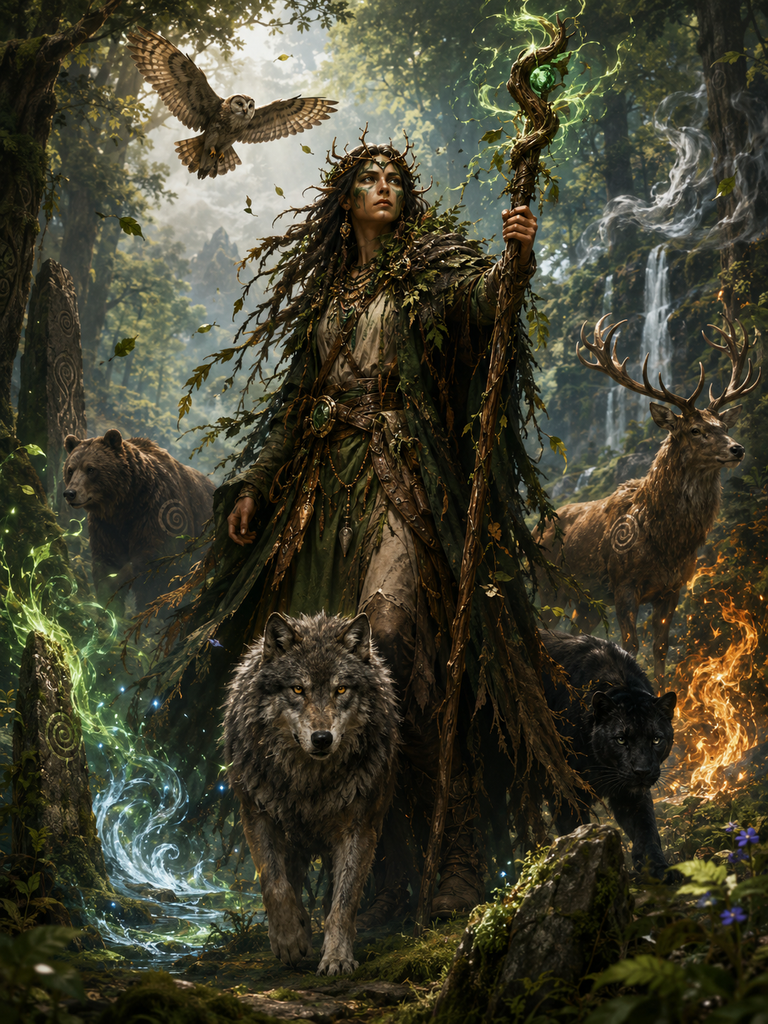
A druid is a full spellcaster who works through the powers of the living world. Some transform into beasts, some command weather and plants, some heal, divine, negotiate with spirits or defend sacred places. The class does not require one religion, one culture or one universal druidic organisation.
Druid Rules by Edition
5.5e / 2024 Druid
Primary Ability: Wisdom
Hit Die: d8
Saving Throws: Intelligence, Wisdom
Skills: Choose two from Arcana, Animal Handling, Insight, Medicine, Nature, Perception, Religion and Survival
Weapons: Simple weapons
Tools: Herbalism Kit
Armor: Light armor and Shields
The released 5.5e Druid is a prepared full spellcaster whose Wild Shape is a flexible class resource rather than a replacement hit-point pool. The subclass begins at level 3; Primal Order is a level-1 class choice, not the subclass.
| Lvl | PB | Features | WS | Cantrips | Prepared | 1 | 2 | 3 | 4 | 5 | 6 | 7 | 8 | 9 |
|---|---|---|---|---|---|---|---|---|---|---|---|---|---|---|
| 1 | +2 | Spellcasting, Druidic, Primal Order | — | 2 | 4 | 2 | — | — | — | — | — | — | — | — |
| 2 | +2 | Wild Shape, Wild Companion | 2 | 2 | 5 | 3 | — | — | — | — | — | — | — | — |
| 3 | +2 | Druid Subclass | 2 | 2 | 6 | 4 | 2 | — | — | — | — | — | — | — |
| 4 | +2 | Ability Score Improvement | 2 | 3 | 7 | 4 | 3 | — | — | — | — | — | — | — |
| 5 | +3 | Wild Resurgence | 2 | 3 | 9 | 4 | 3 | 2 | — | — | — | — | — | — |
| 6 | +3 | Subclass Feature | 3 | 3 | 10 | 4 | 3 | 3 | — | — | — | — | — | — |
| 7 | +3 | Elemental Fury | 3 | 3 | 11 | 4 | 3 | 3 | 1 | — | — | — | — | — |
| 8 | +3 | Ability Score Improvement | 3 | 3 | 12 | 4 | 3 | 3 | 2 | — | — | — | — | — |
| 9 | +4 | — | 3 | 3 | 14 | 4 | 3 | 3 | 3 | 1 | — | — | — | — |
| 10 | +4 | Subclass Feature | 3 | 4 | 15 | 4 | 3 | 3 | 3 | 2 | — | — | — | — |
| 11 | +4 | — | 3 | 4 | 16 | 4 | 3 | 3 | 3 | 2 | 1 | — | — | — |
| 12 | +4 | Ability Score Improvement | 3 | 4 | 16 | 4 | 3 | 3 | 3 | 2 | 1 | — | — | — |
| 13 | +5 | — | 3 | 4 | 17 | 4 | 3 | 3 | 3 | 2 | 1 | 1 | — | — |
| 14 | +5 | Subclass Feature | 3 | 4 | 17 | 4 | 3 | 3 | 3 | 2 | 1 | 1 | — | — |
| 15 | +5 | Improved Elemental Fury | 3 | 4 | 18 | 4 | 3 | 3 | 3 | 2 | 1 | 1 | 1 | — |
| 16 | +5 | Ability Score Improvement | 3 | 4 | 18 | 4 | 3 | 3 | 3 | 2 | 1 | 1 | 1 | — |
| 17 | +6 | — | 4 | 4 | 19 | 4 | 3 | 3 | 3 | 2 | 1 | 1 | 1 | 1 |
| 18 | +6 | Beast Spells | 4 | 4 | 20 | 4 | 3 | 3 | 3 | 3 | 1 | 1 | 1 | 1 |
| 19 | +6 | Epic Boon | 4 | 4 | 21 | 4 | 3 | 3 | 3 | 3 | 2 | 1 | 1 | 1 |
| 20 | +6 | Archdruid | 4 | 4 | 22 | 4 | 3 | 3 | 3 | 3 | 2 | 2 | 1 | 1 |
Spellcasting
You prepare Druid spells after a Long Rest and use Wisdom as the spellcasting ability. The number of prepared spells is fixed by the class table rather than being calculated as Druid level plus Wisdom modifier. You can use a Druidic Focus for your spells. Cantrips increase at levels 4 and 10.
Druidic
You know Druidic and can use it for hidden messages. The 2024 class also keeps Speak with Animals permanently prepared through this feature.
Primal Order
At level 1 choose Magician or Warden. Magician grants another Druid cantrip and adds Wisdom to selected Arcana or Nature checks; Warden grants martial-weapon proficiency and Medium armor training.
Wild Shape
At level 2 you can transform as a Bonus Action into one of your learned Beast forms. You begin with four forms of CR 1/4 or lower that lack a Fly Speed. At level 4 you know six forms up to CR 1/2; at level 8 you know eight forms up to CR 1 and flying forms become available.
| Druid Level | Known Forms | Maximum CR | Fly Speed? |
|---|---|---|---|
| 2 | 4 | 1/4 | No |
| 4 | 6 | 1/2 | No |
| 8 | 8 | 1 | Yes |
The form lasts for half your Druid level in hours unless ended earlier. You retain personality, memories, languages, mental ability scores, class features, feats, Hit Points and Hit Dice. The Beast replaces most other game statistics. You gain temporary hit points equal to Druid level when transforming. You cannot cast spells while transformed until Beast Spells arrives, but concentration on an already-active spell can continue.
Wild Companion
At level 2 you can spend either a spell slot or a Wild Shape use to cast Find Familiar without material components. The familiar is Fey and disappears when you finish a Long Rest.
Druid Subclass
Your subclass begins at level 3 and grants further features at levels 6, 10 and 14. The freely available 2024 rules present Circle of the Land; other published circles can be used if the table permits them.
Wild Resurgence
At level 5 the spellcasting and Wild Shape resource pools begin to interact. If you have no Wild Shape uses left, you can spend a spell slot to regain one use. You can also spend one Wild Shape use to recover a 1st-level spell slot once per Long Rest.
Elemental Fury
At level 7 choose Potent Spellcasting or Primal Strike. Potent Spellcasting adds Wisdom to Druid-cantrip damage. Primal Strike adds 1d8 Cold, Fire, Lightning or Thunder damage once on each of your turns when you hit with a weapon or Beast-form attack. At level 15, the chosen option improves: Potent Spellcasting greatly extends qualifying cantrip range, while Primal Strike rises to 2d8.
Beast Spells
At level 18 you can cast spells while using Wild Shape except spells with costly or consumed material components.
Archdruid
At level 20, if initiative is rolled while you have no Wild Shape uses, you regain one. You can also convert unspent Wild Shape uses into a spell slot, with each use contributing two spell levels, once per Long Rest. The feature also slows physical aging.
Setting note: the mechanical capstone called Archdruid does not automatically grant the social office described on Druidic Hierarchy. Recognition by circles, colleges and communities is still required.
5e / 2014 Druid
Primary Ability: Wisdom
Hit Die: d8
Saving Throws: Intelligence, Wisdom
Armor: Light armor, medium armor and Shields, with the edition’s metal restriction
Weapons: Club, dagger, dart, javelin, mace, quarterstaff, scimitar, sickle, sling and spear
Tools: Herbalism Kit
The 2014 Druid is a prepared full caster with a two-use Wild Shape resource that returns on a Short or Long Rest. Unlike 5.5e, transforming normally replaces your physical statistics and gives you the Beast’s hit-point pool for the duration.
| Lvl | PB | Features | Cantrips | 1 | 2 | 3 | 4 | 5 | 6 | 7 | 8 | 9 |
|---|---|---|---|---|---|---|---|---|---|---|---|---|
| 1 | +2 | Druidic, Spellcasting | 2 | 2 | — | — | — | — | — | — | — | — |
| 2 | +2 | Wild Shape, Druid Circle | 2 | 3 | — | — | — | — | — | — | — | — |
| 3 | +2 | — | 2 | 4 | 2 | — | — | — | — | — | — | — |
| 4 | +2 | Wild Shape Improvement, ASI | 3 | 4 | 3 | — | — | — | — | — | — | — |
| 5 | +3 | — | 3 | 4 | 3 | 2 | — | — | — | — | — | — |
| 6 | +3 | Druid Circle Feature | 3 | 4 | 3 | 3 | — | — | — | — | — | — |
| 7 | +3 | — | 3 | 4 | 3 | 3 | 1 | — | — | — | — | — |
| 8 | +3 | Wild Shape Improvement, ASI | 3 | 4 | 3 | 3 | 2 | — | — | — | — | — |
| 9 | +4 | — | 3 | 4 | 3 | 3 | 3 | 1 | — | — | — | — |
| 10 | +4 | Druid Circle Feature | 4 | 4 | 3 | 3 | 3 | 2 | — | — | — | — |
| 11 | +4 | — | 4 | 4 | 3 | 3 | 3 | 2 | 1 | — | — | — |
| 12 | +4 | ASI | 4 | 4 | 3 | 3 | 3 | 2 | 1 | — | — | — |
| 13 | +5 | — | 4 | 4 | 3 | 3 | 3 | 2 | 1 | 1 | — | — |
| 14 | +5 | Druid Circle Feature | 4 | 4 | 3 | 3 | 3 | 2 | 1 | 1 | — | — |
| 15 | +5 | — | 4 | 4 | 3 | 3 | 3 | 2 | 1 | 1 | 1 | — |
| 16 | +5 | ASI | 4 | 4 | 3 | 3 | 3 | 2 | 1 | 1 | 1 | — |
| 17 | +6 | — | 4 | 4 | 3 | 3 | 3 | 2 | 1 | 1 | 1 | 1 |
| 18 | +6 | Timeless Body, Beast Spells | 4 | 4 | 3 | 3 | 3 | 3 | 1 | 1 | 1 | 1 |
| 19 | +6 | ASI | 4 | 4 | 3 | 3 | 3 | 3 | 2 | 1 | 1 | 1 |
| 20 | +6 | Archdruid | 4 | 4 | 3 | 3 | 3 | 3 | 2 | 2 | 1 | 1 |
Spellcasting
You prepare Druid spells using Wisdom. Your prepared-spell count equals Druid level + Wisdom modifier, with a minimum of one spell, and you regain all expended spell slots after a Long Rest. Ritual casting works for prepared Druid spells that carry the Ritual tag, and a Druidic Focus can serve as the spellcasting focus.
Druidic
You know the class’s secret Druidic language and can leave hidden messages in it. This is an edition rule; regional written traditions such as Ogham are setting material rather than a replacement for the 2014 class feature.
Wild Shape
At level 2 you can transform into a Beast you have seen. You have two uses and regain them on a Short or Long Rest. The basic progression is:
| Druid Level | Maximum CR | Movement Limit |
|---|---|---|
| 2 | 1/4 | No flying or swimming speed |
| 4 | 1/2 | No flying speed |
| 8 | 1 | No movement restriction |
You can remain transformed for a number of hours equal to half your Druid level. In Beast form, your game statistics are largely replaced by the creature’s statistics, including its hit points, while your alignment, personality and mental ability scores remain yours. When the Beast form is reduced to 0 hit points, excess damage carries over to your normal form.
Druid Circle
Your subclass begins at level 2 and grants further features at levels 6, 10 and 14. The Basic Rules present Circle of the Land and Circle of the Moon. Land emphasises spellcasting and terrain-linked magic; Moon pushes Wild Shape toward combat and stronger forms.
Ability Score Improvements
You gain an Ability Score Improvement at levels 4, 8, 12, 16 and 19. If your table uses feats, the normal feat substitution rule applies.
Timeless Body
At level 18, primal magic slows aging dramatically: ten years of elapsed time age the Druid’s body by only one year.
Beast Spells
Also at level 18, you can perform verbal and somatic components while using Wild Shape. Material components remain unavailable while transformed unless another rule solves that limitation.
Archdruid
At level 20, Wild Shape uses become unlimited. You can also ignore verbal and somatic components of Druid spells and ignore non-costly, non-consumed material components. As with the 2024 capstone, this mechanical feature does not automatically grant social authority in the setting.
Pathfinder 1e Druid
Alignment: Any Neutral
Hit Die: d8
Skill Ranks: 4 + Intelligence modifier per level
Strong Saves: Fortitude and Will
Primary Casting Ability: Wisdom
The PF1e Druid is a prepared divine full caster with Nature Bond, Wild Shape, strong wilderness skills and a choice between animal-companion play and domain-focused magic.
| Lvl | BAB | Fort | Ref | Will | Special |
|---|---|---|---|---|---|
| 1 | +0 | +2 | +0 | +2 | Nature Bond, Nature Sense, Orisons, Wild Empathy |
| 2 | +1 | +3 | +0 | +3 | Woodland Stride |
| 3 | +2 | +3 | +1 | +3 | Trackless Step |
| 4 | +3 | +4 | +1 | +4 | Resist Nature’s Lure, Wild Shape 1/day |
| 5 | +3 | +4 | +1 | +4 | — |
| 6 | +4 | +5 | +2 | +5 | Wild Shape 2/day |
| 7 | +5 | +5 | +2 | +5 | — |
| 8 | +6/+1 | +6 | +2 | +6 | Wild Shape 3/day |
| 9 | +6/+1 | +6 | +3 | +6 | Venom Immunity |
| 10 | +7/+2 | +7 | +3 | +7 | Wild Shape 4/day |
| 11 | +8/+3 | +7 | +3 | +7 | — |
| 12 | +9/+4 | +8 | +4 | +8 | Wild Shape 5/day |
| 13 | +9/+4 | +8 | +4 | +8 | A Thousand Faces |
| 14 | +10/+5 | +9 | +4 | +9 | Wild Shape 6/day |
| 15 | +11/+6/+1 | +9 | +5 | +9 | Timeless Body |
| 16 | +12/+7/+2 | +10 | +5 | +10 | Wild Shape 7/day |
| 17 | +12/+7/+2 | +10 | +5 | +10 | — |
| 18 | +13/+8/+3 | +11 | +6 | +11 | Wild Shape 8/day |
| 19 | +14/+9/+4 | +11 | +6 | +11 | — |
| 20 | +15/+10/+5 | +12 | +6 | +12 | Wild Shape at will |
Class Skills
Climb, Craft, Fly, Handle Animal, Heal, Knowledge (geography), Knowledge (nature), Perception, Profession, Ride, Spellcraft, Survival and Swim. This makes a PF1e Druid naturally effective as a tracker, animal handler, wilderness guide and magical scholar.
Weapon and Armor Proficiency
The PF1e class is proficient with its traditional Druid weapon group and natural attacks used in Wild Shape. It gains light and medium armor plus shields other than tower shields, but the edition keeps the prohibition on metal armor and metal shields.
Spellcasting
PF1e Druids prepare divine spells using Wisdom. They know the whole class list and choose prepared spells each day. A prepared spell can be converted spontaneously into summon nature’s ally of the same level or lower. Orisons are prepared 0-level spells and can be cast repeatedly without being expended.
Nature Bond
At 1st level choose between an animal companion and a nature-focused domain. Domain options in the core rules include Air, Animal, Earth, Fire, Plant, Water and Weather. A domain grants its powers and bonus spell slots using Druid level as effective Cleric level. The companion option instead gives a persistent animal ally that advances with the Druid.
Nature Sense
You gain a +2 bonus on Knowledge (nature) and Survival checks.
Wild Empathy
You can improve an animal’s attitude with 1d20 + Druid level + Charisma modifier, functioning similarly to Diplomacy. Magical beasts of Intelligence 1 or 2 can also be influenced at a penalty.
Woodland Stride and Trackless Step
At level 2 you move through ordinary natural undergrowth without the usual penalties. At level 3 you stop leaving a trail in natural surroundings unless you choose to do so.
Resist Nature’s Lure
At level 4 you gain a +4 bonus on saving throws against Fey spell-like abilities.
Wild Shape
PF1e Wild Shape begins at level 4 and lasts one hour per Druid level. It uses the beast shape, elemental body and plant shape spell families rather than copying a creature’s entire stat block.
- Level 4: Small or Medium animal; functions as beast shape I.
- Level 6: Tiny or Large animal, or Small elemental; beast shape II / elemental body I.
- Level 8: Diminutive or Huge animal, Medium elemental, or Small/Medium plant; beast shape III, elemental body II, plant shape I.
- Level 10: Large elemental or Large plant; elemental body III / plant shape II.
- Level 12: Huge elemental or Huge plant; elemental body IV / plant shape III.
- Level 20: Wild Shape becomes at will.
Venom Immunity, A Thousand Faces and Timeless Body
At level 9 you become immune to poison. At level 13 you can alter your appearance at will while in normal form using the edition’s alter self-style effect. At level 15 you stop taking further age penalties and cannot be magically aged, though normal lifespan still ends naturally.
Animal Companion Route
PF1e companions use their own base-statistics progression rather than the 3.5e bonus-HD table. Their Hit Dice, base attack, saves, skill ranks, feats, natural armor, ability bonuses and tricks improve with effective Druid level. Many companions also gain size increases at specified levels. Use the PF1e companion entry for the exact creature rather than importing the 3.5e alternative-companion adjustments below.
Common PF1e Builds
- Companion Master: invests in the animal companion and support magic.
- Wild Shape Combatant: builds around natural attacks, physical form changes and form access.
- Summoner: exploits spontaneous summon nature’s ally conversion and summoning feats.
- Terrain Controller: prepares entangling, wall, fog and battlefield-shaping spells.
- Domain Druid: uses Nature Bond to deepen one elemental or natural theme.
- Healer / Utility Caster: leans into restoration, divination, travel and problem-solving magic.
Ex-Druids
The PF1e class retains the edition’s alignment and conduct restrictions. A Druid who ceases to revere nature, moves to a prohibited alignment or violates the class’s Druidic-language restriction can lose class abilities until the appropriate atonement is completed. Keep this as PF1e mechanics, not a universal campaign law.
D&D 3.5e Druid
Alignment: Neutral Good, Lawful Neutral, Neutral, Chaotic Neutral or Neutral Evil
Hit Die: d8
Skill Points: (4 + Intelligence modifier) ×4 at 1st level; 4 + Intelligence modifier thereafter
Strong Saves: Fortitude and Will
Primary Casting Ability: Wisdom
The 3.5e Druid is a prepared divine caster with an animal companion from level 1, Wild Shape from level 5, broad wilderness skills and one of the edition’s most expansive transformation progressions.
| Lvl | BAB | Fort | Ref | Will | Special | 0 | 1 | 2 | 3 | 4 | 5 | 6 | 7 | 8 | 9 |
|---|---|---|---|---|---|---|---|---|---|---|---|---|---|---|---|
| 1 | +0 | +2 | +0 | +2 | Animal Companion, Nature Sense, Wild Empathy | 3 | 1 | — | — | — | — | — | — | — | — |
| 2 | +1 | +3 | +0 | +3 | Woodland Stride | 4 | 2 | — | — | — | — | — | — | — | — |
| 3 | +2 | +3 | +1 | +3 | Trackless Step | 4 | 2 | 1 | — | — | — | — | — | — | — |
| 4 | +3 | +4 | +1 | +4 | Resist Nature’s Lure | 5 | 3 | 2 | — | — | — | — | — | — | — |
| 5 | +3 | +4 | +1 | +4 | Wild Shape 1/day | 5 | 3 | 2 | 1 | — | — | — | — | — | — |
| 6 | +4 | +5 | +2 | +5 | Wild Shape 2/day | 5 | 3 | 3 | 2 | — | — | — | — | — | — |
| 7 | +5 | +5 | +2 | +5 | Wild Shape 3/day | 6 | 4 | 3 | 2 | 1 | — | — | — | — | — |
| 8 | +6/+1 | +6 | +2 | +6 | Wild Shape: Large | 6 | 4 | 3 | 3 | 2 | — | — | — | — | — |
| 9 | +6/+1 | +6 | +3 | +6 | Venom Immunity | 6 | 4 | 4 | 3 | 2 | 1 | — | — | — | — |
| 10 | +7/+2 | +7 | +3 | +7 | Wild Shape 4/day | 6 | 4 | 4 | 3 | 3 | 2 | — | — | — | — |
| 11 | +8/+3 | +7 | +3 | +7 | Wild Shape: Tiny | 6 | 5 | 4 | 4 | 3 | 2 | 1 | — | — | — |
| 12 | +9/+4 | +8 | +4 | +8 | Wild Shape: Plant | 6 | 5 | 4 | 4 | 3 | 3 | 2 | — | — | — |
| 13 | +9/+4 | +8 | +4 | +8 | A Thousand Faces | 6 | 5 | 5 | 4 | 4 | 3 | 2 | 1 | — | — |
| 14 | +10/+5 | +9 | +4 | +9 | Wild Shape 5/day | 6 | 5 | 5 | 4 | 4 | 3 | 3 | 2 | — | — |
| 15 | +11/+6/+1 | +9 | +5 | +9 | Timeless Body, Wild Shape: Huge | 6 | 5 | 5 | 5 | 4 | 4 | 3 | 2 | 1 | — |
| 16 | +12/+7/+2 | +10 | +5 | +10 | Elemental Wild Shape 1/day | 6 | 5 | 5 | 5 | 4 | 4 | 3 | 3 | 2 | — |
| 17 | +12/+7/+2 | +10 | +5 | +10 | — | 6 | 5 | 5 | 5 | 5 | 4 | 4 | 3 | 2 | 1 |
| 18 | +13/+8/+3 | +11 | +6 | +11 | Wild Shape 6/day, Elemental 2/day | 6 | 5 | 5 | 5 | 5 | 4 | 4 | 3 | 3 | 2 |
| 19 | +14/+9/+4 | +11 | +6 | +11 | — | 6 | 5 | 5 | 5 | 5 | 5 | 4 | 4 | 3 | 3 |
| 20 | +15/+10/+5 | +12 | +6 | +12 | Elemental 3/day, Huge Elemental | 6 | 5 | 5 | 5 | 5 | 5 | 4 | 4 | 4 | 4 |
Class Skills
Concentration, Craft, Diplomacy, Handle Animal, Heal, Knowledge (nature), Listen, Profession, Ride, Spellcraft, Spot, Survival and Swim. The skill list makes the Druid a natural wilderness guide, healer, animal handler and observer even when no spell is being cast.
Weapon and Armor Proficiency
The 3.5e list includes club, dagger, dart, quarterstaff, scimitar, sickle, shortspear, sling and spear, plus natural attacks of Wild Shape forms. Druids are proficient with light and medium armor and shields other than tower shields, but the edition prohibits metal armor and metal shields. Breaking that restriction suppresses Druid spells and supernatural or spell-like class abilities for 24 hours.
Spellcasting and Spontaneous Summoning
Spellcasting is prepared, divine and Wisdom-based. To prepare or cast a spell, Wisdom must be at least 10 + spell level; the save DC is 10 + spell level + Wisdom modifier. Bonus spells come from high Wisdom. A prepared spell can be converted spontaneously into a summon nature’s ally spell of the same level or lower.
Alignment descriptors matter in 3.5e: a Druid cannot cast a spell whose alignment is opposed to the Druid’s own alignment or that of a chosen deity. Keep that rule inside this edition rather than applying it to the setting as a whole.
Bonus Languages and Druidic
Sylvan is available as a bonus-language option. Druidic is gained as a free secret language with its own alphabet under the 3.5e class rules. Teaching it to a non-Druid has mechanical consequences described under Ex-Druids below.
Animal Companion
A 1st-level Druid begins with a loyal animal companion. Base choices include badger, camel, dire rat, dog, riding dog, eagle, hawk, horse, owl, pony, Small or Medium viper and wolf, with porpoise, Medium shark and squid available in aquatic campaigns. The companion improves with effective Druid level through bonus Hit Dice, natural armor, Strength and Dexterity increases, bonus tricks and special abilities.
| Druid level | Bonus HD | Natural Armor | Str/Dex | Bonus Tricks | Special |
|---|---|---|---|---|---|
| 1–2 | +0 | +0 | +0 | 1 | Link, Share Spells |
| 3–5 | +2 | +2 | +1 | 2 | Evasion |
| 6–8 | +4 | +4 | +2 | 3 | Devotion |
| 9–11 | +6 | +6 | +3 | 4 | Multiattack |
| 12–14 | +8 | +8 | +4 | 5 | — |
| 15–17 | +10 | +10 | +5 | 6 | Improved Evasion |
| 18–20 | +12 | +12 | +6 | 7 | — |
Nature Sense
At 1st level you gain a +2 bonus on Knowledge (nature) and Survival checks.
Wild Empathy
You can influence an animal’s attitude with a check equal to 1d20 + Druid level + Charisma modifier. Using the ability normally requires the Druid and animal to study one another within about 30 feet and usually takes a minute. Magical beasts with Intelligence 1 or 2 can also be influenced, but at a penalty.
Woodland Stride
At level 2, natural undergrowth no longer slows or harms you. Magically manipulated thorns, briars and similar terrain still work normally.
Trackless Step
At level 3, you leave no trail in natural surroundings and cannot normally be tracked unless you deliberately choose to leave tracks.
Resist Nature’s Lure
At level 4 you gain a +4 bonus on saving throws against the spell-like abilities of Fey.
Wild Shape
At level 5 you can assume a Small or Medium animal form once per day for up to one hour per Druid level. Changing form is a standard action and does not provoke an attack of opportunity. The form must be an animal with which the Druid is familiar, and its Hit Dice cannot exceed Druid level.
Uses increase at levels 6, 7, 10, 14 and 18. Large forms arrive at level 8, Tiny at 11 and Huge at 15. Plant-creature forms become available at level 12. Elemental Wild Shape begins at 16, improves to twice per day at 18 and three times per day at 20; the level-20 version can become a Huge elemental.
Venom Immunity
At level 9 you become immune to poison.
A Thousand Faces
At level 13 you can alter your physical appearance at will while in normal form, within the limits of disguise self; this is a physical alteration rather than an illusion and does not change possessions.
Timeless Body
At level 15 you stop taking ability-score penalties from further aging and cannot be magically aged. Existing penalties remain and normal age bonuses still accrue; the Druid can still die of old age.
Ex-Druids
Under the 3.5e class rules, ceasing to revere nature, moving to a prohibited alignment or teaching Druidic to a non-Druid causes loss of Druid spells and class abilities until the character atones. Treat this as a 3.5e mechanical rule, not as a universal statement about every druidic tradition in the setting.
The larger companion progression, alternative-companion lists and campaign-specific Lost World options are restored below under Wild Shape and Animal Allies.
What a Druid Is
A druid stands where living systems, sacred places and supernatural powers meet. That can mean an oak grove, but it can also mean a river crossing, a high pasture, a plague garden, a volcanic slope, a city well, a marsh, an orchard, a migration route or a coast where storms regularly erase the boundary between land and sea.
Druids do not simply “serve nature” in the abstract. They work with particular places and powers. One may protect a valley because the river spirit there is dangerous when ignored. Another may advise farmers on when to burn old growth. Another might hunt unnatural predators, negotiate with fey, preserve the breeding ground of a sacred animal or deliberately destroy an invasive magical species before it overwhelms a region.
Wild Shape expresses this closeness through the body. Spellcasting expresses it through weather, plants, animals, healing, divination and elemental force. Socially, a druid can be a healer, judge, teacher, envoy, hermit, royal adviser, keeper of taboo, keeper of roads, protector of common grazing or custodian of a place no ruler truly owns.
The class works best when the character has obligations as well as powers. Decide what place recognises them, what beings they refuse to offend, what ecological or sacred knowledge only they possess, and what would make them abandon an otherwise profitable adventure. Those answers make the Druid more than “the nature caster.”
Why Play a Druid?
The Druid is one of the broadest problem-solving classes in fantasy roleplaying. A single character can scout as an animal, control a battlefield with roots and weather, heal an ally, speak with beasts, survive hostile terrain, negotiate with spirits and still contribute directly in combat. The class rewards players who enjoy preparing for the environment and changing tactics rather than repeating one attack routine.
The strongest Druid characters also have a clear relationship with the world around them. Decide what your character protects, what they consider sacred, which natural powers they trust, and which kinds of change they believe are necessary. A druid of orchards and irrigation can be just as authentic as a druid of primeval forest; a volcanic seer, plague-garden healer, coastal tide-reader or city-root keeper can all belong to the class.
Real-World and Mythic Inspirations
The fantasy Druid combines several different traditions. These inspirations should be used as starting points rather than treated as a claim that every culture had an identical “druid” institution.
Celtic Druids
Historical accounts of druids in Gaul and Britain describe learned specialists associated with law, teaching, ritual and judgement. Medieval Irish material preserves a complex learned world of druids, filid, bards and brehons. In play, that supports characters who are scholars, mediators, diviners and keepers of sacred places as well as spellcasters.
Animist and Spirit-Mediating Traditions
Many cultures understand landscapes, animals, rivers, mountains, weather or ancestors as active participants in human life. Fantasy druids can draw on that wider idea without simply copying a living tradition. A druid may bargain with a river, ask permission before entering a spirit-haunted wood, read the behaviour of migratory animals, or treat a storm as a power with intentions rather than as scenery.
Healers, Herbalists and Ecological Knowledge
Practical knowledge matters as much as mystical power. Druids can know soils, grazing cycles, dangerous fungi, medicinal plants, animal behaviour, seasonal floods, weather signs and the relationships between predators and prey. This makes the class useful in settlements as well as wilderness.
Nature Mysticism and Fantasy Literature
Modern fantasy adds the wandering sage, beast-friend, shapeshifter and elemental guardian. These are not historical claims; they are fantasy developments that help explain Wild Shape, plant magic, weather control and the class’s strong association with ancient forests and hidden places.
Ecology Without a Single “Balance” Doctrine
Nature is not static. Fire clears old growth, rivers change course, predators kill, forests spread and retreat, species migrate and people cultivate land. Druids therefore disagree about what should be preserved and what should be allowed to change. That disagreement creates better characters than a universal instruction to “protect balance.”
What Changed in 5.5e?
- Primal Order is a level-1 choice, not the subclass.
- The subclass moves to level 3.
- Wild Shape uses actual Beast stat blocks and grants temporary hit points instead of replacing the Druid’s hit-point pool.
- Known Beast forms are limited and can be changed after Long Rests.
- Wild Companion is part of the core class.
- Wild Resurgence links spell slots and Wild Shape uses.
- Elemental Fury creates a clear choice between cantrip-focused and attack-focused druids.
- The old universal metal-armor restriction is no longer part of the 5.5e core traits.
- The level-20 Archdruid feature is a mechanical capstone, not automatic social authority in the setting.
How to Play a Druid
Druids are strongest when you decide what kind of problem-solver you want to be before choosing spells and forms. The class can do almost everything, but trying to do everything at once makes turns slower and character identity weaker.
| Style | What you do | What to prioritise |
|---|---|---|
| Wild Shaper | Scout, infiltrate and fight in Beast form | Knowledge of useful Beast forms, mobility, concentration spells cast before changing |
| Battlefield Controller | Reshape movement and sight lines | Entangling plants, fog, walls, difficult terrain and forced movement |
| Storm Druid | Damage and area control | Lightning, wind, fire, cold and terrain that channels enemies into bad positions |
| Healer and Warden | Keep the party functioning and protect vulnerable allies | Healing, restoration, defensive summons, scouting and protective terrain |
| Spirit Speaker | Gather information and negotiate with non-human powers | Divination, animal speech, fey knowledge, local taboos and social standing |
| Companion Druid | Fight and explore through allied creatures | Edition-appropriate companion, familiar or summon mechanics |
Druids Are More Than Wilderness Hermits
A druid can protect a city orchard, manage floodwaters, keep a plague garden, advise a ruler, tend a sacred cemetery, negotiate with river spirits, study volcanic omens, maintain a mountain pass or defend grazing land. “Nature” includes cultivated fields, animals living beside people, weather, rivers, disease, fire, death, decomposition and the supernatural powers attached to place.
This is why a City Dweller can be as recognisably druidic as a Wandering Druid. The class is defined by its relationship with living systems and primal powers, not by refusing civilisation.
Sacred Colleges, Groves and Authority
Druids do not form one global central institution. Local traditions create colleges, circles, grove communities, royal offices, itinerant teachers and solitary guardians. A character’s Druid level measures adventuring power; it does not automatically measure authority over other druids.
The detailed social model is on Druidic Hierarchy. In Ireland, the formal grades Fochloc through Ollam properly belong to the filid, not to a universal Druid class ladder. Druids gain recognition through learning, office, judgement, service and the willingness of communities or colleges to accept their authority.
For Insular traditions, Ogham can function as writing, encoded learning and sacred notation without becoming a universal language known by every nature caster in the world.
Druidic Traditions in the World
Ireland
Druids work beside filid, bards and brehons, serving rulers, sacred hills, river valleys and local gods. Ireland preserves strong learned institutions without turning them into one central hierarchy.
Wales and Britain
Prophecy, bardic memory, sacred landscapes and royal legitimacy often overlap with druidic practice. Local traditions are shaped by hills, islands, forests and Otherworld crossings rather than by a uniform curriculum.
Gaul and Continental Traditions
Regional assemblies and stronger council leadership fit continental traditions, but local groves and tribal communities still matter. A presiding druid can wield real authority without ruling every druid everywhere.
Other Cultures
The Druid class can represent nature-bound mystics far beyond Celtic lands. Use local names, gods, spirits, sacred plants and institutions. Do not force Irish titles such as Ollam onto desert, steppe, forest, island or non-human traditions unless that culture has adopted them.
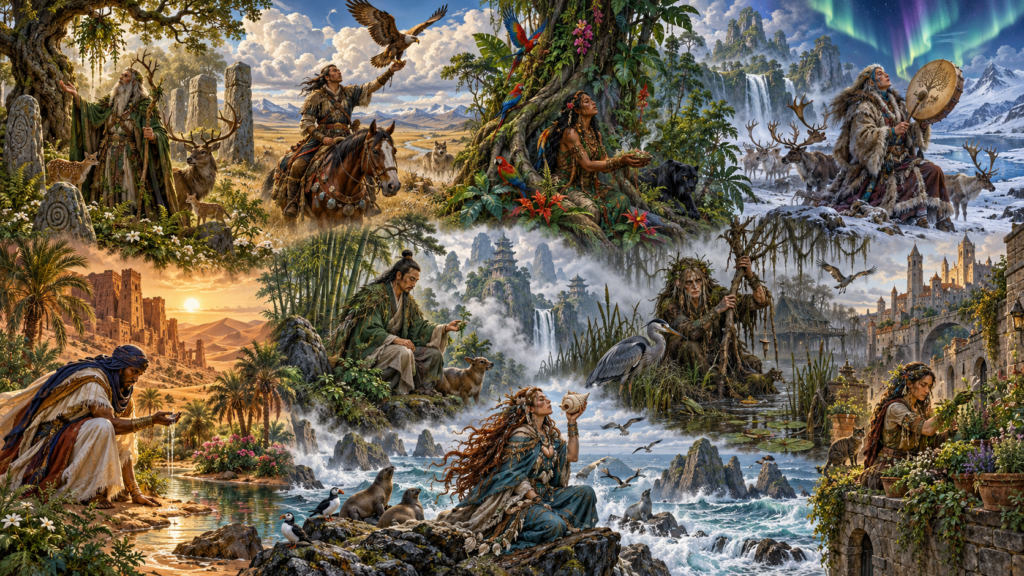
Twelve Global Druidic Archetypes
These are fantasy Druid interpretations inspired by different landscapes and historical traditions. They are not claims that the named cultures used Druid class mechanics. Each entry restores the practical armor, weapons, gear and role material from the older page.
1. Grovekeeper of the Old Ways
Inspiration: Celtic druids of Britain and Gaul.
Armor: hide armor or bark-reinforced padded armor.
Weapons: sickle, sling, staff.
Gear: Herbalism Kit, oak Druidic Focus, mistletoe and ritual herbs, carved wooden mask.
Role: guardian of sacred groves, law, lore and prophecy; often advises rulers and rural communities.
2. Cloud-Walker of the Steppes
Inspiration: Inner Asian sky, horse and ancestral traditions.
Armor: layered robes reinforced with horsehide.
Weapons: feathered staff, hunting knife, bow where locally appropriate.
Gear: drum, charm bundle, felt shelter kit, preserved travel rations and horse tack.
Role: reads wind, storm, herd movement and ancestral signs across immense grasslands.
3. Rainforest Dreamspeaker
Inspiration: Amazonian forest knowledge and spirit traditions, adapted into fantasy rather than copied directly.
Armor: little or none; protective plant fibres and body paint where culturally appropriate.
Weapons: spear, blowpipe or short bow by region.
Gear: medicinal plants, fibres, seed pouches, antidotes and river-travel equipment.
Role: plant specialist, healer, tracker and guide through spirit-haunted forest paths.
4. Sámi Spirit-Caller
Inspiration: northern Scandinavian Sámi landscape and spirit traditions.
Armor: layered reindeer hide and wool.
Weapons: staff, knife, bow.
Gear: snowshoes, fire kit, drum, carved tokens and cold-weather shelter gear.
Role: reindeer friend, healer, weather-reader and traveller through blizzard country.
5. Desert Binder
Inspiration: Amazigh, Tuareg and wider North African desert traditions.
Armor: layered robes over leather protection.
Weapons: curved blade, shortbow, spear.
Gear: waterskins, oasis herbs, navigation markers, sun charms and stone talismans.
Role: interpreter of dunes, drought, mirage, wells and spirits gathered around isolated water.
6. Forest Monk of the Celestial Bamboo
Inspiration: Chinese mountain hermits, Daoist natural philosophy and local spirit traditions.
Armor: padded robe.
Weapons: quarterstaff, bronze sickle.
Gear: herbal scrolls, incense, medicinal tea, paper charms and weather records.
Role: studies medicine, inner discipline, changing seasons and omens in birds and wind.
7. Swamp Oracle
Inspiration: wetland healers, rootworkers and spirit-medium traditions of Atlantic and Caribbean cultures, adapted into fantasy.
Armor: treated hide and waterproofed cloth.
Weapons: machete, knife, spear.
Gear: preserved herbs, chalk, bones, snake vertebrae, medicines and wax figures.
Role: works with rot, disease, fermentation, carrion, spirits of the dead and the healing potential of difficult wetlands.
8. Thunder-Watcher of the Plains
Inspiration: Plains Indigenous sky, storm and herd traditions, adapted respectfully into fantasy.
Armor: painted hide.
Weapons: spear, bow or war club.
Gear: medicine bundle, feather tokens, fire kit and weather stones.
Role: follows storms and migrating herds, reads distant sky signs and guards seasonal routes.
9. Stone-Speaker of the Andes
Inspiration: Andean mountain, terrace and earth traditions.
Armor: quilted cloth with metal or woven reinforcement.
Weapons: sling, staff and stone-edged tools.
Gear: coca leaves, obsidian focus, woven sun medallion, seed corn and climbing equipment.
Role: guardian of terraces, irrigation, mountain passes and dangerous rock or frost conditions.
10. Ash-Walker of the Burning Earth
Inspiration: Aboriginal Australian fire-management and songline traditions, adapted into a fantasy analogue rather than portrayed directly.
Armor: light hide.
Weapons: fire-hardened spear and throwing weapon.
Gear: fire kit, ochre, route markers, woven carrying net and ash samples.
Role: uses controlled burning, seasonal movement and remembered routes to manage living country.
11. Ocean Whisperer
Inspiration: Polynesian navigation, island ecology and sea-spirit traditions.
Armor: light woven or hide protection.
Weapons: wooden club, spear, harpoon.
Gear: shell focus, navigation cordage, fishing tools, oil lamp and carved sea tokens.
Role: reads stars, currents, reefs and seabirds and negotiates with sea beasts, storms and ancestral waters.
12. Urban Root-Witch
Inspiration: medieval herbalists, garden keepers, folk healers and household nature traditions.
Armor: practical light armor or work clothes.
Weapons: sickle, staff, ironwood cane.
Gear: pocket garden, alchemical bottles, seed packets, scavenged spell components and herb press.
Role: protects wells, orchards, livestock, cemeteries, drains, market animals and the stubborn life growing through walls and paving.
Non-Human Druidic Archetypes
Non-human cultures develop druidic traditions from their own landscapes, gods, ancestors and magical history. These are not copies of human Celtic colleges.
Elf — Sylvan High Druid
Region: Black Forest, Carpathians and deep Faerie-linked woodland.
Origin: Elven forest traditions shaped by Celtic, Slavic and Germanic woodland myth.
Primal Tradition: Wild / Flora / Fey.
Armor: Leaf-woven padded armor with moonsteel or living-wood reinforcement.
Weapons: Longbow, silver sickle.
Gear: Elvenstar pendant, ancient rune-scrolls, starlight dew, enchanted seed pouches.
Patron Powers: Artio, Flidais, Leshy, Diana and local forest spirits.
Role: Keeper of ancient trees, fey treaties, hidden roads and ecological memory stretching across centuries.
Dwarf — Stoneheart Druid
Region: Central Alps and other deep mountain chains.
Origin: Dwarven mountain lore, mine spirits and old earth powers.
Primal Tradition: Stone / Earth / Deep Water.
Armor: Stone-etched scale or reinforced hide.
Weapons: Hammerstaff, iron-shod pick or mattock.
Gear: Flint totems, mineral seed crystals, chisel focus, lichen medicines and cave-mapping tools.
Patron Powers: Geb, Ogma, Ilmarinen and ancestral mountain spirits.
Role: Reads faults, springs, ore veins, fungi, alpine weather and the slow life of stone.
Halfling — Hearthgrove Herbalist
Region: South Downs, Cotswolds, Upper Rhine, Alsace, Provence, Languedoc, Po Valley and halfling garden settlements elsewhere.
Origin: Household, orchard and smallholding traditions shaped by long agricultural memory.
Primal Tradition: Hearth / Life / Earth.
Armor: Patchwork leather or padded garden coat.
Weapons: Sling, pruning sickle, staff.
Gear: Seed pouches, iron cooking pot, spice packets, grafting knife, medicinal tinctures and bee-smoke tools.
Patron Powers: Rhiannon, Demeter, Bastet, Bes, Hathor and local household powers.
Role: Protects gardens, orchards, vineyards, seed beds, medicinal plots, bees and household fertility.
Orc — Bloodroot Warden
Region: frontier highlands, steppe margins and hard grazing country.
Origin: Orc traditions of herd survival, wildfire, ancestral territory and dangerous weather.
Primal Tradition: Flame / Strength / Herd.
Armor: Bone-plated hide or hardened leather.
Weapons: Fire-tempered spear, obsidian or iron blade.
Gear: Ash charms, volcanic dust, warpaint, herd markers and weather stones.
Patron Powers: fiery, predatory and ancestral powers appropriate to the local orc culture rather than one universal pantheon.
Role: Uses controlled burning, herd movement and hard seasonal knowledge to keep frontier land alive.
Gnome — Rootwisp Druid
Region: Carpathians, hidden woodland enclaves and deep garden settlements.
Origin: Gnomish root, fungus and hidden-life traditions.
Primal Tradition: Whisper / Fungus / Secret Life.
Armor: Moss-padded armor.
Weapons: Mushroom-headed club, thorn darts, pruning blade.
Gear: Spore satchel, lichen scrolls, mushroom teas, luminescent powder and tiny specimen jars.
Patron Powers: Nantosuelta, Veles, Chang’e and local root or moon spirits.
Role: Works with fungi, insects, roots and the miniature ecosystems overlooked by larger peoples.
Dragonborn — Emberdrake Druid
Region: volcanic plateaus, high deserts and dragon-haunted mountain belts.
Origin: draconic landscape traditions shaped by storm, fire, ash and great reptiles.
Primal Tradition: Storm / Flame / Scale.
Armor: bronze or scaled medium armor where the edition permits it.
Weapons: flame spear, dragonbone sickle.
Gear: smoked crystal lens, fire-glyph tokens, scale poultice and solar mirror.
Patron Powers: Xiuhtecuhtli, Fūjin, Shenlong or local draconic powers according to region.
Role: Reads eruptions, storm fronts, geothermal springs and the territories of great reptiles.
Tiefling — Ashthorn Druid
Region: scorched badlands, poisoned valleys and infernal borderlands.
Origin: communities that learned to survive magically damaged ecologies rather than flee them.
Primal Tradition: Blight / Decay / Recovery.
Armor: charred bark armor laced with bone or thorn.
Weapons: bramble whip, blackened sickle.
Gear: tainted-water testing kit, dried thistle heart, bone tokens and antidote tinctures.
Patron Powers: Kali, Hecate, Coatlicue and chthonic or boundary powers suited to the character’s homeland.
Role: Studies what survives poison, curse, fire and magical contamination, turning blight knowledge toward survival or vengeance.
Firbolg — Hillwarden Druid
Region: Scottish Highlands, Kerry and other giant-touched uplands.
Origin: Fir Bolg, giant and hill-spirit traditions adapted into living firbolg culture.
Primal Tradition: Skyroot / Hill / Storm.
Armor: stonefelt robes over hide.
Weapons: giantwood club, heavy staff.
Gear: stormstone focus, cloudroot poultice, sky-mapped staff, thunder pebbles and antler tokens.
Patron Powers: Lugh, Taranis, Cernunnos and local hill or storm powers.
Role: Keeps peatlands, hill paths, standing stones, giant roads and dangerous upland weather.
Character Concepts
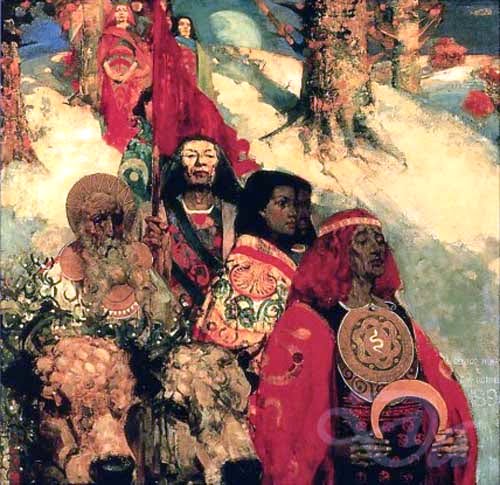
Character concepts are optional roleplaying packages. They give a druid a specific past, responsibility or way of approaching the class. The older concept pages remain useful as idea banks, but their mechanics should be checked against the edition being played.
Child of the Wild
Raised beyond ordinary settlements and more comfortable reading tracks, weather and animal behaviour than court etiquette.
City Dweller
A druid of wells, gardens, livestock, drains, firebreaks, markets and urban ecology.
Oak Brother
A grove-bound guardian whose duties are tied to ancient trees and one specific sacred landscape.
Ollam
An Irish learned character whose poetic and scholarly standing overlaps with druidic practice. Ollam is a recognised learned grade, not a universal Druid level.
Rescued Soul
An exile or condemned outsider who survived through druidic teaching and built a new identity in the wild.
Nature’s Philosopher
A scholar of elements, living systems and cosmological relationships who approaches primal magic as disciplined study.
Unrebuked
A druid whose authority comes from refusing an unjust judgement, surviving censure and proving their relationship with the living world on their own terms.
Wandering Druid
An itinerant mediator who crosses political boundaries and carries news, cures, warnings and sacred obligations between distant communities.
More Druid material:
Tricks of the Trade ·
Druidic Ethos ·
Living Magic ·
Ogham ·
Druidic Hierarchy ·
Evil Druids & Dark Druids.
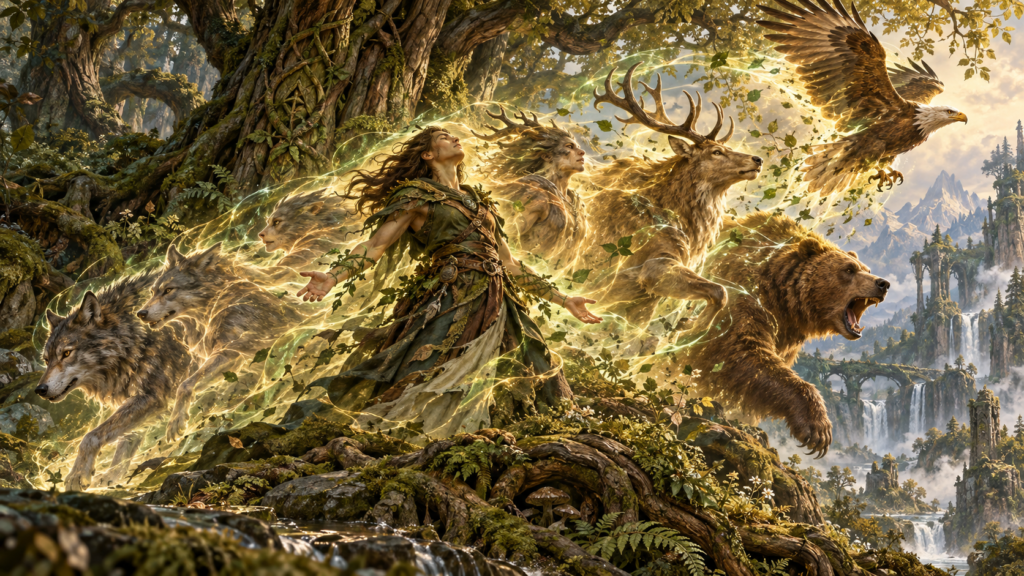
Wild Shape and Animal Allies
Wild Shape and animal companions were a major part of the older page, so they remain a major part of this one. The exact mechanics differ sharply by edition, but the practical lesson is the same: choose creatures because they solve problems, not because they merely look impressive.
| Need | Useful form qualities |
|---|---|
| Scouting | Small size, stealth, climbing and strong senses |
| Travel | High speed, climbing, swimming or flight when the edition permits it |
| Escape | Burrowing, climbing, squeezing or unusual movement |
| Combat | Reliable attacks, useful rider effects, mobility and enough resilience for that edition’s Wild Shape rules |
| Tracking | Scent, keen hearing, speed and strong Survival-style traits |
| Water | Swimming, holding breath, blindsight or aquatic senses |
| Carrying | Large size, high Strength and appropriate anatomy |
Useful creature pages include Dire Wolf, Brown Bear, Eagle, Crocodile, Tiger, Boar, Bison and Rhinoceros. Always use statistics appropriate to the edition being played.
Animal Companion Basics — 3.5e
In 3.5e the animal companion is a persistent class feature rather than a temporary summon. Use the base creature, then apply the advancement granted by effective Druid level.
- Bonus Hit Dice: increase the companion’s durability, attack progression, saves, skills and feats.
- Natural Armor: improves as the Druid advances.
- Strength and Dexterity: rise at the listed progression.
- Bonus Tricks: are learned without training time and do not count against the normal trick limit.
- Link: improves handling and wild-empathy interaction with the companion.
- Share Spells: lets self-targeted magic work with the companion under the edition’s distance rules.
- Evasion / Improved Evasion: make the companion much more durable against Reflex-based area effects.
- Devotion: strengthens resistance to enchantment.
- Multiattack: improves companions built around several natural attacks.
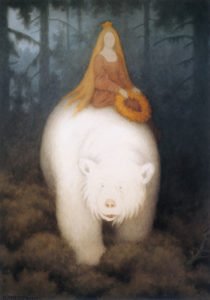
Starting Companion Types
Traditional starting choices include badger, camel, dire rat, dog, riding dog, eagle, hawk, horse, owl, pony, Small or Medium viper and wolf. Aquatic campaigns can add crocodile, porpoise, Medium shark and squid. In a Lost World campaign, Acanthostega is also available as the original page specified; other prehistoric animals can be opened by the GM where their effective-level adjustment fits the rules.
Alternative Animal Companions
Higher-level choices reduce effective Druid level for companion progression. These restored lists preserve the broad range that made the old page useful.
4th Level or Higher — Effective Druid Level −3
- Adar Llwch Gwin
- Aepycamelus — Lost World
- Altamaha-Ha — where treated as an animal in the campaign
- Ape
- Black Bear
- Bison
- Boar
- Cheetah
- Crocodile — aquatic environment
- Dire Badger
- Dire Bat
- Dire Weasel
- Leopard
- Monitor Lizard
- Large Shark — aquatic environment
- Constrictor Snake
- Large Viper
- Wolverine
5th Level or Higher — Effective Druid Level −4
- Alligator Snapping Turtle — aquatic or wetland environment
7th Level or Higher — Effective Druid Level −6
- Brown Bear
- Dire Wolverine
- Giant Crocodile
- Dire Ape
- Dire Boar
- Dire Wolf
- Lion
- Rhinoceros
- Huge Viper
- Tiger
10th Level or Higher — Effective Druid Level −9
- Polar Bear
- Dire Lion
- Huge Shark — aquatic environment
- Giant Constrictor Snake
- Orca — aquatic environment
13th Level or Higher — Effective Druid Level −12
16th Level or Higher — Effective Druid Level −15
- Agriotherium
- Dire Shark — aquatic environment
- Dire Tiger
- Giant Squid — aquatic environment
Edition boundary: these companion-level adjustments belong to the older 3.5e-style companion system. Do not apply them to 5.5e Wild Companion or 5e Wild Shape.
Druid Spells
The full class list is maintained on Druid Spells. A strong prepared list normally mixes four functions:
- Control: change terrain, restrain enemies, obscure sight or alter movement.
- Support: healing, restoration, movement and defensive magic.
- Information: communicate with animals, read environments, divine danger and locate creatures or places.
- Pressure: elemental damage, summons, persistent hazards and spells that punish enemies for staying in one place.
Build around the adventure you expect that day. Prepared casting is one of the Druid’s greatest strengths.
Run a Druid Tonight
The Grove Is Wrong
A sacred grove begins producing fruit out of season. The harvest heals disease, but every animal within a mile is abandoning its young. The local keeper refuses to destroy the trees until the cause is understood.
The River Demands a Name
A flooded river will not fall. Divination reveals that the river spirit is not angry; it has forgotten the name by which the local people once addressed it. The oldest surviving record is held by a rival community upstream.
The Beast Form Remembers
After using Wild Shape, a druid remembers a place the chosen animal has seen even though the character never has. The memory points toward a ruined sanctuary that should have vanished generations ago.
Druidic Ethos
“Balance” is guidance, not a commandment that every druid interprets identically. Some defend wilderness, some defend settled communities from flood and famine, some preserve predators, some manage forests, and some serve specific gods or spirits whose demands are anything but neutral.
Use Celtic Druidic Ethos for the Insular tradition and Dark Druids for characters who weaponise sacred knowledge, predation, blight or coercive ritual.
Rules Sources and Licensing
- D&D System Reference Document v5.2.1 — current 5.5e-compatible SRD.
- D&D Beyond Basic Rules (2024), Druid — released Druid progression and Wild Shape rules.
- D&D Basic Rules (2014), Druid — 2014 class progression and Wild Shape.
- Archives of Nethys — Pathfinder 1e Druid.
- d20 SRD — 3.5e Druid.
Rules on this page are presented as edition-separated summaries and compatibility guidance. Use the linked rules sources for complete legal text and exact edge-case wording.
Keep this reference growing
If this page helped with your reading or game, you can support its upkeep or explore the curated books.
Explore the Bookshop — epics, classics and stories behind imagined worlds.