
Faerie Witch Tradition — Fey Allies and Wild Magic
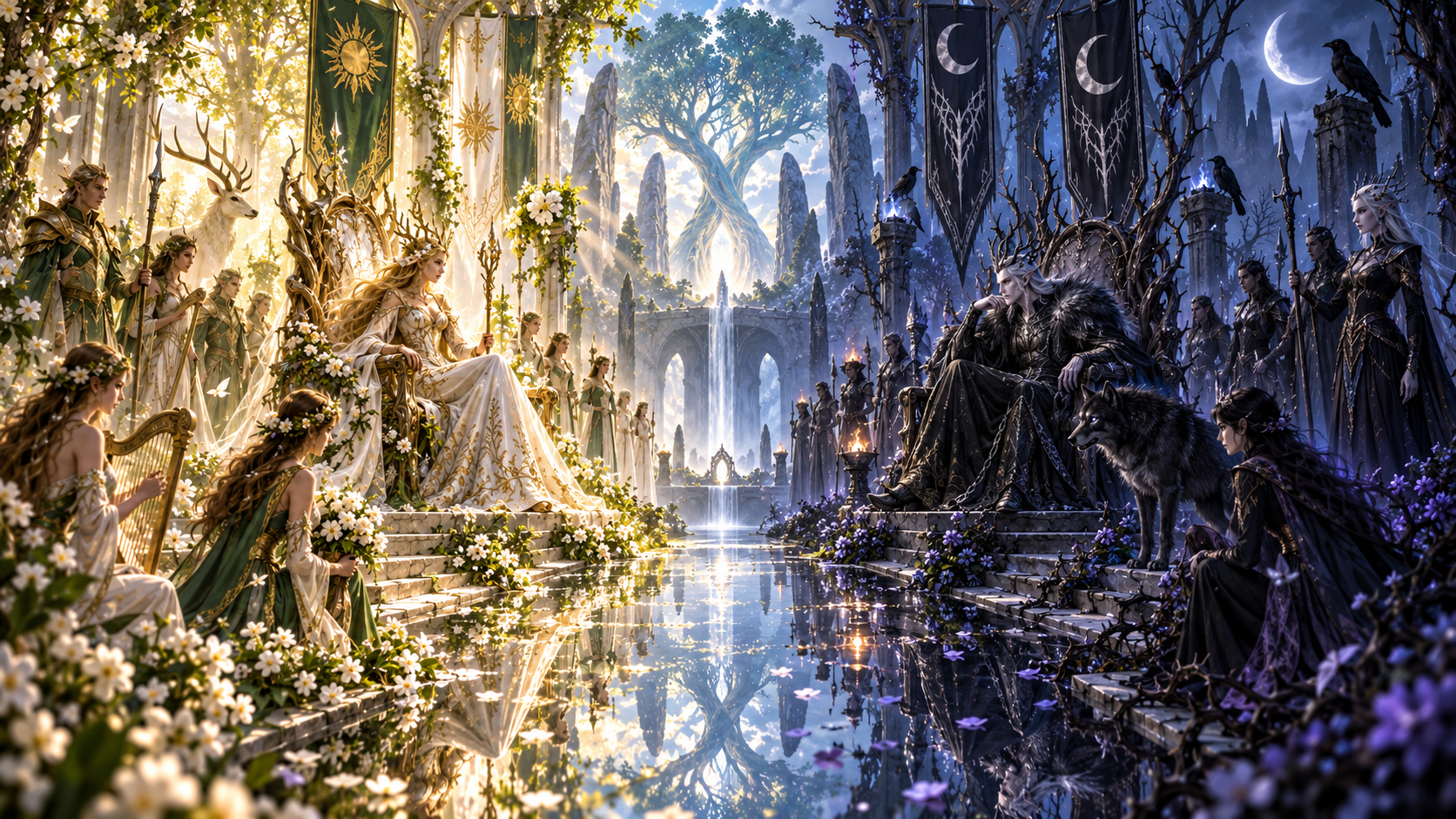
Faerie Witches live at the boundary between mortal settlements and fey places, acting as guides, negotiators, diviners and protectors where the two worlds overlap.
Choose the Faerie Tradition If…
- You want your Witch tied directly to fey courts, enchanted wilderness and otherworldly bargains.
- You like divination, nature magic, strange allies and crossing between mortal and fey concerns.
- You want your patron or coven to create obligations that are beautiful, dangerous and not always human.
- You enjoy transformation and the possibility of taking on fey forms in the legacy rules.
At a Glance
| Play style | Guide, diviner, negotiator and nature-linked spellcaster. |
|---|---|
| Signature identity | Fey allies, enchanted places and otherworldly patronage. |
| Strongest stories | Broken bargains, disappearing roads, rival courts, threatened groves and mortal-fey diplomacy. |
| Legacy rules | Fey transformation and Occult Powers preserved below. |
What it feels like to play: a Faerie Witch should make the world feel stranger. You are the character who knows which hill must not be entered after sunset, which gift cannot be accepted twice and why the smiling stranger at the ford is probably not human.
5.5e / 2024 Tradition
Level 3: Fey-Touched Craft
You gain proficiency in Nature or Persuasion; if already proficient, gain Expertise instead. You also learn Sylvan if that language exists in the campaign.
Faerie spells: Faerie Fire and Speak with Animals are always prepared. At Witch level 5 add Misty Step; at level 7 add Plant Growth; at level 9 add Polymorph.
Level 6: Fey Step
As a Bonus Action, expend one Hexcraft use to teleport up to 30 feet to an unoccupied space you can see. After you teleport, one creature you can see within 10 feet of your destination either gains Temporary Hit Points equal to your Hex Die + your Intelligence modifier or must succeed on a Wisdom saving throw against your Witch spell save DC or have the Charmed condition until the start of your next turn.
Level 10: Glamour Ward
You have Advantage on saving throws against the Charmed condition, and magic cannot put you to sleep. When you succeed on a saving throw against an Enchantment or Illusion spell, you can move up to 10 feet without provoking Opportunity Attacks.
Level 14: Otherworldly Form
As a Bonus Action, take on a fey aspect for 1 minute. You gain a Fly Speed equal to your Speed, can move through the space of other creatures as Difficult Terrain, and once on each of your turns after you teleport or use a Hex, you can become Invisible until the start of your next turn or until you make an attack roll or cast a spell. Once used, this feature returns after a Long Rest.
Legacy rules source
Liber Mysterium: The Netbook of Witches and Warlocks, Timothy S. Brannan and the Netbook of Witches and Warlocks team.
Description: Faerie witches appear to be living in solitude, usually in a sylvan setting. In reality, they often live in large communities of fey, serving as an ambassador to travelers moving through the area.
Faerie Witches often carry something of the uncanny places they inhabit: unusual eyes, fey mannerisms, strange clothing, a scent of rain or flowers, or simply the sense that the forest is listening when they speak. Others look entirely ordinary. Their homes range from hidden cottages and garden houses to caves, towers or dwellings shared with local fey.
Any people with access to a fey realm, enchanted wilderness or established fey community can produce Faerie Witches. Elves, humans, gnomes, halflings, dwarves, orcs and mixed-heritage characters may all enter the tradition where their history and local relationships support it.
Role: Faerie witches spend much of their time conversing with the local fey. They take good care of the plants and animals near their home, building large gardens of flowers and vines in the surrounding area. As a witch their chief concerns are brewing helpful potions, studying the ways of nature, and using their divination magic to watch the forest area they protect.
Faerie witches easily form alliances with rangers and druids living in the same area. They will often inform these allies of local happenings and sometimes offer their magical services to them.
Joining this Tradition: Faerie Witches join their coven through various means. One common way is when a small child becomes lost in the wilderness, and an existing Faerie Witch finds the child. The Faerie Witch may then receive a vision from her patron to teach the Faerie Witch the traditions. Other times, a person may become divinely inspired, and attempt to seek out an existing Faerie Witch to train under.
On the Vernal Equinox, Faerie witch covens gather to celebrate the beginning of Spring. These celebrations vary by coven, but usually are extremely joyous gatherings. On the Autumnal Equinox, the Faerie witch covens are much more serious and gather to prepare for the oncoming winter.
Leaving this Tradition: A Faerie Witch who ceases to revere and respect their homeland, or betray the trust of the local fey will lose their powers, until an Atonement spell is cast.
Skills & Feats: Faerie Witches receive Knowledge (Nature) and Survival as Class Skills. Animal Empathy is a Cross Class skill, instead of restricted (Core Rulebook I, version 3.0 only).
Occult Powers: At 7th level, choose a type of fey from the table below. The Faerie Witch can assume another form once per day that lasts one minute per witch level. In that form, they receive the lesser power associated. At 13th level, they get a new fey form which they receive the lesser power,
and their previous one grants both the lesser and medial power. At 19th, their first fey form allows the Faerie witch to polymorph into the fey and receive all powers that the type of fey normally would have. Their second form grants lesser and medial power, and they receive one new form that grants the lesser power.
The Witch chooses a fey form that fits beliefs, surroundings, patronage or personal history. Choice of form is not restricted by sex. Under the legacy Greater Occult Power, a complete transformation grants the chosen fey creature’s listed special abilities and physical adjustments as described by these d20 rules.

- Minor: 7th Level: The witch glows slightly, shrinks one size category, and sprouts vestigial gossamer wings. The witch does gain a +4 bonus to Handle Animal checks, and can use the wings to negate falling damage.
- Medial: 13th Level: The witch shrinks two size categories, and can use the gossamer wings to fly at her base movement rate with Good Maneuverability.
- Greater: 19th Level: The greater power of the Butterfae is not a transformation, but instead, the witch is accompanied by 2d3 adult butterfae at all times. These butterfae do their best to protect the witch. If all butterfae are killed, no more can be regained for 1 year. A witch can also choose to absorb the damage a butterfae receives as per the spell shield other.

- Minor: 7th Level: The witch’s hair turns to an autumn color. In this form she can speak with plants at will.
- Medial: 13th Level: The witch’s skin turns to a light green color. She can dimensional door once while in this form.
- Greater: 19th Level: The witch can completely turn into a Dryad (which includes changing sex, if the witch is male). In this form, the witch is not bound to a tree as a dryad normally would be.
- Minor: 7th Level: The witch sprouts antennae. In this form she is granted a +6 to Listen skill checks.
- Medial: 13th Level: The witch decreases one size category, and gains a +6 to her reflex save (along with the +1 bonus to armor class and to hit for being smaller)
- Greater: 19th Level: The witch can completely turn into a grig, and gains all special abilities a grig would normally have.
Leprechaun (any subtype)
- Minor: 7th Level: The witch shrinks a little bit (but does not become size small). In this form, she gains a +6 bonus to Listen Checks.
- Medial: 13th Level: The witch shrinks a whole size category. She receives a bonus to her Pick Pockets skill equal to her Faerie Witch level, and can use the skill even if she has no ranks.
- Greater: 19th Level: The witch can completely turn into a Leprechaun, and gains all special abilities a Leprechaun would normally have.
- Minor: 7th Level: The witch develops gills just under her chin. With these, she is able to breathe under water.
- Medial: 13th Level: The witch’s eyes and ears become wider and sharper. With these, she gains a +6 bonus to Listen and spot checks.
- Greater: 19th Level: The witch can completely turn into a Nixie, and gains all special abilities a nixie would
normally have.
Nymph (any subtype)


- Minor: 7th Level: The physical appearance of the witch is improved: hair is brushed, skin is smoothed over, etc. In this form the witch gains a +4 bonus to Charisma based skill checks.
- Medial: 13th Level: The witch generally appears fit. A single time in this form, the witch can use the Nymphs Blinding Beauty ability.
- Greater: 19th Level: The witch can completely turn into a Nymphs (which includes changing sex, if the witch is male), and gains all special abilities a Nymph would normally have.
- Minor: 7th Level: The witch’s hair radiates a slight hue of an odd color (blue, purple, etc.) and her ears become pointed. Once while in this form, the witch can become Invisible as per the spell.
- Medial: 13th Level: In this form, the witch sprouts gossamer wings. These do not allow the witch to fly, but she can turn Invisible at will in this form.
- Greater: 19th Level: The witch can completely turn into a Pixie, and gains all special abilities a Pixie would normally have.

- Minor: 7th Level: In this form, the witch grows a set of goat horns, which can be used as an extra melee attack, dealing 1d6 bludgeoning damage. This does not count as an off hand attack.
- Medial: 13th Level: The witch’s legs bend backwards, like a goat’s. In this form, the witch adds +15 to her base speed.
- Greater: 19th Level: The witch can completely turn into a satyr (which includes changing sex, if the witch is female), and gains all special abilities a satyr would normally have.
Other Fey Races
Other Fey races maybe chosen if the GM sees fit to include them. Stories and mythology are full of various Fey races such as Brownies (and Bwbachods and Fenoderee), Dame Vertes (Wind Nymphs) Hamadryads (dryads of Rowan and Willow trees), Naiads, Nereids, Rusalkas, and Sirens (all Water Nymphs). Use the closest type above for these other types.
Special Benefits: Faerie witches often have many allies in Sylvan settings. Her ability to speak with the other fey races is often very helpful.
Legacy Restriction: The original d20 tradition bars evil alignment and leans toward neutral good. Treat this as the expected ethic of many Faerie covens rather than proof that ancestry or fey magic determines alignment; a campaign can tie access to conduct, patron or coven law instead.
Equipment: The traditional tool of this tradition is the wand. The wand is often made from branch from the oldest tree in the Faerie witch’s forest.
Coven Domains: Animal, Chaos, Good, Plant, Sun
Preferred/Barred Covens: Many Faerie covens are local and protective of secrets because they negotiate directly with nearby fey. Some therefore recruit cautiously, while others form mixed covens with druids, rangers or Witches from allied traditions.
Relationship to the Patron: A Faerie Witch’s patron may be a fey sovereign, local spirit, nature power, deity or other being tied to the region. Protecting nearby plants, animals and fey places can be part of that relationship without requiring one universal theology.
Source/Views of Magic: Many Faerie Witches understand magic as flowing through the fey realm, enchanted wilderness and the patron who taught them to work with it. This often gives them common ground with druids, though the two classes keep distinct traditions and rules.
White/Black Magic: As with most witches, Faerie witches do not make this distinction. In addition they tend to ignore or dismiss those that do.
Wealth: Faerie Witches tend not to hoard much wealth. However, their homes are well kept, and some are ornamented with works of art. The yards of the Faerie witches homes are usually filled with lavish gardens, which may give the appearance of wealth, but more often than not Faerie Witches will have little to no money in their homes.
Other: Faerie Witches multi-class best with the ranger. The rogue is also a good choice for her ability to Move Silently through the forest and hide among its greenery. The extremely rare Witch/druid combination is most likely to be found among faerie witches.
Typically Faerie witches do not take a prestige class, they devote their time and energies to be witches, first and foremost.
Keep this reference growing
If this page helped with your reading or game, you can support its upkeep or explore the curated books.
Explore the Bookshop — epics, classics and stories behind imagined worlds.