
Cernunnos, Horned God of the Wild Hunt
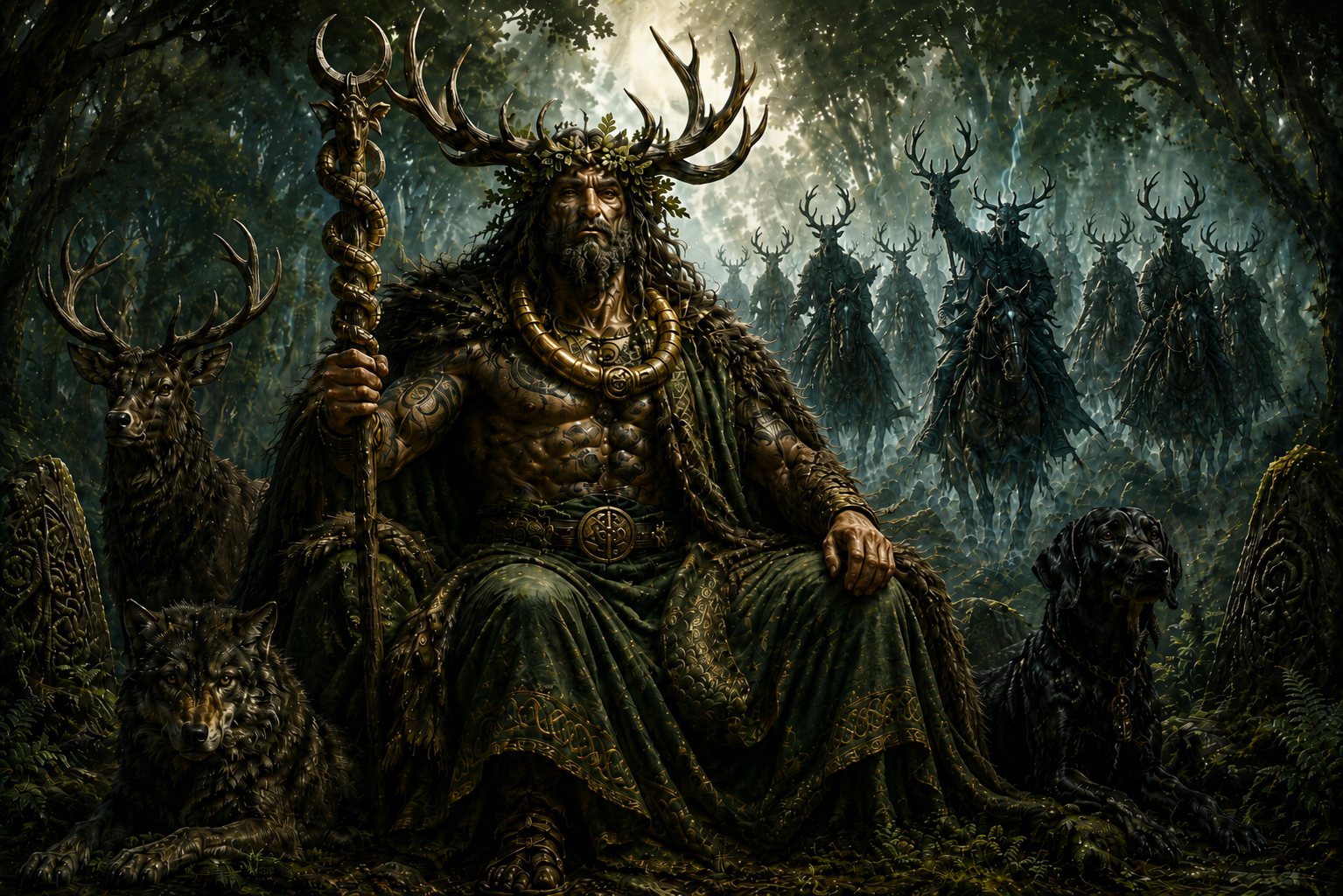
Cernunnos is the antlered Gaulish god of animals, abundance, fertility and the sacred hunt. In SpiralWorlds he is also the terrible sovereign of the Wild Hunt, master of the Hunting Wilds in Ladinion and one of the greatest powers dwelling in Faerie.
Divine Profile
Historical Cernunnos — What Survives
Cernunnos is one of the most recognisable gods associated with ancient Gaul, but the surviving evidence is far thinner than modern mythology sometimes suggests. Archaeology preserves his name and a distinctive body of imagery; it does not preserve an ancient literary cycle explaining his birth, adventures, family or theology.
The Boatmen’s Pillar
The strongest identification is the Roman-period Pillar of the Boatmen from Lutetia, ancient Paris. A surviving panel joins the divine name Cernunnos to an antlered male figure from whose antlers torcs hang.
This makes the Paris monument the essential starting point for identifying the god rather than relying on later folklore.
The Reims Cernunnos
A Gallo-Roman relief from Reims depicts an antlered, torc-wearing Cernunnos seated between Apollo and Mercury. A stag and bull stand below him while seeds or coins pour from a bag.
The image gives particularly strong support to interpretations connecting Cernunnos with abundance, prosperity, fertility and renewal.
The Gundestrup Figure
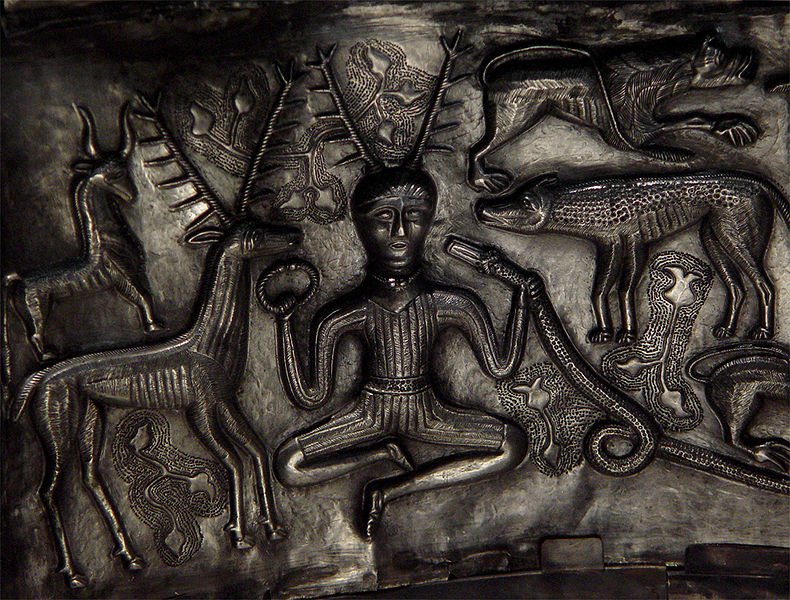
The Gundestrup Cauldron contains the famous cross-legged antlered figure surrounded by animals and holding both a torc and a serpent. The iconography resembles other images conventionally grouped with Cernunnos.
The vessel itself does not name the figure. SpiralWorlds therefore treats it as evidence of the wider antlered-god iconographic tradition rather than presenting the identification as certain.
What the Evidence Supports
Antlers, torcs and associations with animals are unusually strong. The Reims relief strengthens interpretations involving abundance, fecundity and regeneration. Wider claims about an exact underworld office, universal priesthood or fixed mythology remain more speculative.
Name Forms, Comparisons and Conflations
Cernunnos is the standard form used throughout SpiralWorlds. Related ancient forms and proposed cognates include Cernenus, Cernunincos and Carnonos, although the relationship between every attestation is not equally secure.
Herne the Hunter is not an alias of Cernunnos. Herne belongs to a much later English tradition centred upon Windsor. Later writers have compared or conflated the two horned hunters, but SpiralWorlds treats them as distinct beings.
Belatucadros is likewise distinct. The northern British god has his own epigraphic identity and is not simply another name for Cernunnos.
Cernunnos in SpiralWorlds
Cernunnos is older than the convenient distinctions mortals draw between gods and the mightiest powers of Faerie. He is a Greater Deity, but he is also a sovereign Faerie power. The old title Faerie Lord describes his nature and authority; it does not reduce him to something beneath divinity.
He is an exception to the ancient estrangement between the Fey World and the creator gods. Cernunnos is not one of the remote divine architects who fashioned Faerie and abandoned it. His authority grew from within the living Otherworld itself, and the deeper wilds accept his presence in a manner they would resist from an invading foreign pantheon.
Cernunnos is among the greatest hunters in existence. To him the hunt is not merely blood sport. It is the purest exercise of attention, adaptation and consequence. A true hunter must understand terrain, weather, quarry, competing predators and the exact instant when patience must become action.
His neutrality is not indifference. Predator and prey both have a place. He can favour a careful hunter and punish a sentimental fool who destroys a predator population out of misplaced compassion. He can protect a village’s livestock and still preserve the wolves beyond its fields.
What he despises is sterile destruction: slaughter without need, waste without renewal and the deliberate breaking of natural systems merely to demonstrate power or wealth.
When idle, Cernunnos enjoys stories of difficult pursuits. He cares little for flattery. A mortal who tells an extraordinary hunting story without exaggerating their own part in it is far more likely to earn his attention.
The Hunting Wilds of Ladinion
Cernunnos rules the Hunting Wilds, a vast divine realm within Ladinion, the deeper and more primal reaches of Faerie. Mountain forests descend into misty valleys, moors roll beneath enormous skies and old tracks cross country capable of changing whenever the hunt demands a different challenge.
The Endless Chase
The Wilds contain quarry powerful enough to challenge immortal hunters. Rivers alter course, mountain passes close, scent can carry against the wind and trails may open only when pursued.
The Hidden Glade
At the heart of the realm lies a glade almost impossible to find deliberately. Cernunnos receives hunters here and keeps trophies from legendary pursuits. Their stories matter more to him than their monetary value.
Thin Roads
The Hunting Wilds contain ancient paths to Terra, other regions of Faerie and occasionally the Beastlands. When the Wild Hunt rides, such roads may open where no portal existed moments before.
Law of the Quarry
A visitor does not automatically become prey. Breaking an offered truce, wasting a kill, betraying a hunting companion or stealing from the Hidden Glade is far more dangerous.
Leader of the Wild Hunt
The Wild Hunt is an independent power of Faerie, older than many political arrangements that now divide the plane’s courts. Its members understand hunting as part of the greater rhythm by which living things survive, reproduce and die.
Cernunnos is its acknowledged leader. He rarely wastes time upon court politics, but the great powers of Faerie respect what gathers when his carnyx sounds.
The Hunt can defend Faerie against invasion, pursue a marked enemy across planar boundaries or ride simply because Cernunnos has discovered quarry worthy of legend.
Servitors of the Hunt
Appearance, Symbols and Manifestations
Cernunnos most often manifests as a powerfully built antlered man roughly 10 to 12 feet tall before the crown of his antlers. He is enormous beside a mortal, but he is not normally a giant or colossus. His apparent age changes with the season: at one meeting his beard may be silver and his face marked by centuries; at another he appears in the full strength of early adulthood.
His antlers remain constant. A heavy golden torc usually encircles his neck, while serpents—sometimes horned or ram-headed—may accompany him.
Animals near Cernunnos do not become tame. They simply cease behaving as though a supernatural intruder has entered their world.
He also assumes the shape of a great stag. When he wishes to embody the hunt at its most primal, this transformed manifestation may become Huge, but supernatural scale is a chosen form rather than his ordinary stature. No branch catches his antlers, no undergrowth impedes him and no track remains unless he wishes one to remain.
Signs of Favour
Clean tracks appearing after a trail seems lost, healthy game, an animal leading a traveller from danger or a shed antler lying across a path.
Signs of Anger
Game vanishing from a district, snares repeatedly breaking, hunters becoming lost upon familiar ground or a distant horn growing closer each night.
Divine Symbol
An antlered head, or stag antlers framing a torc and coiling serpent.
Worship and Sacred Practice
No universal priesthood speaks for Cernunnos. His surviving traditions are local, practical and strongest among communities that depend directly upon forest, pasture, animals and seasonal abundance.
Worshippers
Hunters, foresters, shepherds, herders, farmers, trackers, rangers, druids, midwives, animal keepers and those responsible for maintaining productive wild land.
Priestly Duties
Preserve breeding populations, prevent wasteful killing, mediate conflicts over game and grazing, protect important wilderness, heal injured creatures and teach hunting and survival.
Sacred Places
Old groves, woodland springs, caves beneath forested hills, ancient game trails and places where Terra lies unusually close to Faerie.
Observances
Local rites commonly accompany seasonal transitions, major hunts, the movement of herds, the end of difficult winters and the first return of abundant game.
Cernunnos in 1454
In 1454 Cernunnos ranges across Europe’s surviving great forests and the hidden ways connecting them to Faerie. His concern is not that civilisation exists. Villages, fields, pasture, managed woodland and hunting preserves can all exist within the living cycles he protects.
The danger lies in scale and appetite. Timber demand, charcoal burning, mining, agricultural expansion and the ambitions of rulers steadily press into old woodland. Hunting rights turn animals and forests into political property. Poachers may face brutal punishment while princes maintain vast preserves. Predators are driven from settled districts, and old roads, mills and clearances disturb boundaries with Faerie that have remained thin for centuries.
Cernunnos does not answer this with a simple war upon humanity. He chooses particular contests.
A mine that destroys a watershed may discover that every road through the surrounding forest now returns travellers to its entrance. A lord who slaughters animals merely to display wealth may hear the carnyx at dusk. A community that carefully manages grazing, hunting and timber may find its animals unusually healthy through a difficult year.
Learned natural philosophers investigate such events through observation, medicine, alchemy, astrology, magic and the hidden properties of living things. Cernunnos has no inherent objection to knowledge. What matters is whether knowledge deepens participation in the living world or merely makes exploitation more efficient.
One of his best-known mortal champions is Robin the Hooded Man , whose struggle within the forests of England repeatedly intersects with the larger question of who may claim the hunt, the land and the wealth produced by both.
Relations with Other Powers
Continental Kindred
Cernunnos has natural affinities with Epona, whose concerns include horses, fertility and abundance, and with Esus, another ancient Continental power.
Other Celtic Powers
He maintains generally favourable relations with Brigid, Danu, Lugh and the Morrígan, although none commands him.
Other Hunters
Flidais shares important concerns with him while remaining an independent Irish divine power rather than another form of Cernunnos.
Enemies and Boundaries
Crom Cruach and Balor represent powers Cernunnos has repeatedly opposed. Arawn is not an automatic foe: the lord of Annwn represents another Otherworld sovereignty with which Cernunnos maintains wary boundaries.
Divine Relics
The Torc of Cernunnos
The Torc of Cernunnos is a massive neck-ring of ancient gold whose surface seems alternately plain and covered with minute patterns of antlers, leaves and coiling serpents. It embodies living abundance rather than simple attraction or seduction.
D&D 5.5e
Artifact, requires attunement. Constitution increases by 2 to a maximum of 24. The bearer is immune to disease, has Resistance to Poison damage and has Advantage on saving throws against Exhaustion.
The bearer can communicate with Beasts and Plants, may cast commune with nature once per Long Rest and regenerate once every seven days.
Pathfinder 1e
Major artifact. Grants +6 enhancement to Constitution, immunity to disease and poison, woodland stride and wild empathy as a 20th-level druid.
Once per day the bearer may use commune with nature, heal or animal shapes.
D&D 3.5e
Major artifact. Grants +6 enhancement to Constitution, immunity to disease and poison, wild empathy and continuous speak with animals.
Once per day the bearer may use commune with nature or heal; once per week it may invoke animal shapes.
Cernunnos’s Carnyx
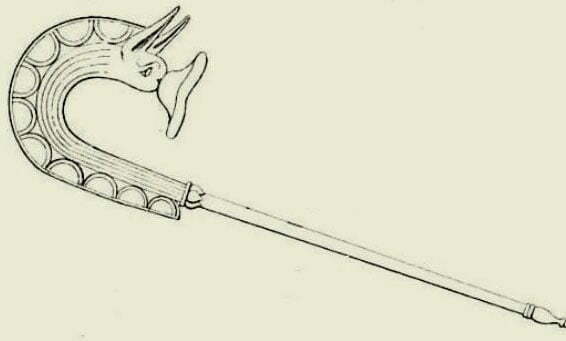
Cernunnos sounds his immense carnyx when the Wild Hunt must gather in force. The instrument is dark green-black and its animal-headed bell seems to breathe before the first note.
The first call can be heard for miles without seeming painfully loud. The second silences animals. By the third, old roads between worlds begin to open.
Twilight Harvester
Twilight Harvester is the ceremonial weapon of the leader of the Wild Hunt: a long silver-headed spear with a dark wooden shaft engraved with serpents and old Faerie signs.
It returns when thrown and can bind defeated prey rather than kill them. Its supernatural radiance changes at Cernunnos’s will, becoming green-white fire, winter frost, lightning or corrosive mist.
Game Statistics
Cernunnos is a Greater Deity rather than a conventional monster. His normal combat manifestation is Large, not giant-sized. He may assume larger animal or primal forms through his divine transformations. Destroying a manifestation away from the Hunting Wilds does not permanently kill him.
D&D 5.5e / 2024
Divine Rank 18 • Epic Challenge 45 • Proficiency Bonus +13
Armor Class 38 (divine natural armor)
Hit Points 1,980 (88d10 + 1,496)
Speed 80 ft., climb 80 ft.
Saving Throws Str +31, Dex +26, Con +30, Wis +31, Cha +27
Skills Athletics +31, Nature +36, Perception +44, Stealth +39, Survival +44
Damage Resistances acid, cold, fire, lightning, necrotic, radiant
Damage Immunities poison; bludgeoning, piercing and slashing damage from nonmagical attacks
Condition Immunities Charmed, Exhaustion, Frightened, Paralyzed, Poisoned
Senses blindsight 120 ft., truesight 300 ft., passive Perception 54
Languages all; telepathy 1 mile; communicates with Beasts and Plants
Divine Traits
Divine Spellcasting
Cernunnos’s spellcasting ability is Wisdom (spell save DC 39, +31 to hit with spell attacks). He requires no material components.
At will: animal friendship, druidcraft, faerie fire, hunter’s mark, pass without trace, speak with animals, speak with plants
3/day each: commune with nature, freedom of movement, greater restoration, locate creature, plant growth, tree stride
2/day each: control weather, plane shift, regenerate, transport via plants
1/day each: animal shapes, foresight, shapechange, storm of vengeance
Actions
On a failure, green-white faerie fire outlines it for 1 hour. Cernunnos always knows its direction and distance while it remains on the same plane. It gains no benefit from Invisible against Cernunnos or the Wild Hunt.
The first time each turn Cernunnos or one of his Wild Hunt allies damages the marked creature, the attack deals an additional 22 (4d10) Force damage.
Wild Hunt allies that hear the horn gain 30 temporary Hit Points and may immediately move up to half their Speed without provoking Opportunity Attacks.
He chooses up to three 120-foot-long, 20-foot-wide lines originating from points he can see within 300 feet. Each hostile creature in a line makes a DC 39 Dexterity saving throw, taking 66 (12d10) Force damage and falling Prone on a failure, or half damage on a success.
Each willing Wild Hunt ally on the same plane may immediately teleport to an unoccupied space within 120 feet of Cernunnos.
Bonus Action
Reaction
Legendary Actions
Cernunnos has 5 Legendary Actions, regained at the start of his turn.
Mythic Trait — The Hunt Unbound
Each hostile creature within 120 feet makes a DC 39 Wisdom saving throw or becomes Frightened until the end of its next turn.
For the remainder of the encounter Cernunnos’s Speed becomes 120 feet, he is immune to Charmed, Frightened, Restrained and Stunned, and Twilight Harvester deals an additional 18 (4d8) damage on a hit.
Lair Actions — The Hunting Wilds
5.5e Domains and Domain Spells
Domains: Life, War and the SpiralWorlds Hunt Domain. Where legacy-compatible 5e domains are used, Cernunnos may also grant Nature.
| Spell Level | Hunt Domain Spells |
|---|---|
| 1st | animal friendship, hunter’s mark |
| 2nd | beast sense, pass without trace |
| 3rd | plant growth, speak with plants |
| 4th | freedom of movement, locate creature |
| 5th | commune with nature, tree stride |
Pathfinder 1e
Male horned hunter ranger 40
Divine Rank 18 • Total HD 62
Init +38; Senses blindsight 300 ft., darkvision 120 ft., low-light vision, true seeing; Perception +113
Aura wild majesty 180 ft. (DC 56)
AC 95, touch 74, flat-footed 78 (–1 size, +16 Dex, +21 natural, +18 divine, +15 deflection, +15 insight, +1 dodge)
hp 1,648 (22d6 + 40d10 + 1,116; maximum hit points)
Fort +67, Ref +71, Will +66
DR 40/cold iron and epic; SR 75
Speed 80 ft., climb 80 ft.; woodland stride
Melee +10 Twilight Harvester +99/+99/+94/+89/+84 (4d8+58/19–20×3 plus 6d6 energy and binding), gore +86 (4d6+28)
Ranged Twilight Harvester +95 (4d8+48/19–20×3 plus 6d6 energy)
Space 10 ft.; Reach 10 ft. (Twilight Harvester 15 ft.)
Base Atk +51; CMB +90; CMD 129
Special Abilities
A marked creature is outlined as faerie fire. Cernunnos knows its direction and distance while it remains upon the same plane and gains +18 additional divine damage against it.
Spell-Like Abilities
CL 48th; concentration +68. Saving throw DC is 43 + spell level where a listed spell-like ability permits a save.
Constant: freedom of movement, speak with animals, speak with plants, true seeing
At will: animal friendship, awaken, commune with nature, detect animals or plants, greater dispel magic, greater magic fang, greater teleport, plant growth, tree stride, faerie fire
3/day: animal shapes, control weather, earthquake, heal, plane shift, regenerate, shapechange
1/day: foresight, storm of vengeance
Feats
Alertness, Blind-Fight, Combat Expertise, Combat Reflexes, Dodge, Great Fortitude, Greater Bull Rush, Greater Trip, Greater Vital Strike, Improved Bull Rush, Improved Critical (spear), Improved Initiative, Improved Iron Will, Improved Lightning Reflexes, Improved Trip, Improved Vital Strike, Iron Will, Lightning Reflexes, Lunge, Mobility, Multiattack, Power Attack, Quick Draw, Run, Skill Focus (Perception), Skill Focus (Survival), Spring Attack, Step Up, Strike Back, Toughness, Vital Strike.
Ranger bonus feats: Track, Endurance and appropriate combat-style feats from the Ranger.
Pathfinder Domains and Domain Spells
Domains: Animal, Earth, Plant, Strength, Travel.
| Domain | 1st–9th Domain Spells |
|---|---|
| Animal | calm animals; hold animal; dominate animal; summon nature’s ally IV; beast shape III; antilife shell; animal shapes; summon nature’s ally VIII; shapechange |
| Earth | magic stone; soften earth and stone; stone shape; spike stones; wall of stone; stoneskin; elemental body IV; earthquake; elemental swarm |
| Plant | entangle; barkskin; plant growth; command plants; wall of thorns; repel wood; animate plants; control plants; shambler |
| Strength | enlarge person; bull’s strength; magic vestment; spell immunity; righteous might; stoneskin; grasping hand; clenched fist; crushing hand |
| Travel | longstrider; locate object; fly; dimension door; teleport; find the path; greater teleport; phase door; astral projection |
D&D 3.5e
Male horned hunter ranger 52
Racial Hit Dice 22d6 • Class Hit Dice 52d8 • Total HD 74 • Divine Rank 18
Initiative +38; Supreme Hunter
Senses blindsense 300 ft., darkvision 90 ft., low-light vision, see invisibility, true seeing; Listen +126, Spot +126
Aura Faerie Glamour 144 ft. (DC 80)
AC 100, touch 79, flat-footed 84 (–1 size, +16 Dex, +21 natural, +18 divine, +15 deflection, +21 insight)
hp 1,954 maximum (22d6 + 52d8 + 1,406)
Fort +74, Ref +77, Will +71
Fast Healing 57; DR 60/cold iron and epic; SR 67
Speed 80 ft., fly 160 ft. (perfect)
Melee Twilight Harvester +124/+124/+119/+114/+109 (2d8+65 plus 3d6 energy/19–20×3 plus binding), gore +111 (4d6+30/18–20×3)
Ranged Twilight Harvester +115 (2d8+53 plus 3d6 energy/19–20×3)
Space 10 ft.; Reach 10 ft. (Twilight Harvester 15 ft.)
Base Attack +63; Grapple +92
Skills Concentration +114, Diplomacy +116, Hide +107, Knowledge (geography) +103, Knowledge (nature) +103, Listen +126, Move Silently +111, Search +111, Sense Motive +116, Spot +126, Survival +124, Tumble +111
Feats
Alertness, Blind-Fight, Combat Expertise, Combat Reflexes, Dodge, Great Fortitude, Improved Critical (spear), Improved Initiative, Iron Will, Lightning Reflexes, Mobility, Multiattack, Power Attack, Quick Draw, Run, Spring Attack, Weapon Focus (spear), Whirlwind Attack, Bane of Enemies, Death of Enemies, Dire Charge, Epic Prowess ×8, Legendary Tracker, Improved Whirlwind Attack, Spellcasting Harrier.
Salient Divine Abilities
Leader of the Wild Hunt, Mark the Prey, Nature Incarnate, Primal Frenzy, Primal Sovereignty and Supreme Hunter.
Marked prey is outlined by faerie fire. Cernunnos knows its location as though using discern location, may plane shift to within 1d10 miles of it once per day, and Cernunnos and members of the Wild Hunt gain +18 divine on weapon attack and damage rolls against it.
He can reproduce the effect of any druid spell as a divine effect by spending a full-round action in addition to the spell’s normal casting time.
Spellcasting
Cernunnos possesses the spellcasting progression of a 52nd-level ranger. His effective ranger caster level is 55th through divine mastery.
His domain spell-like abilities function at caster level 74th. Their saving throw DC is normally 43 + spell level.
Commonly active: deathwatch, freedom of movement, see invisibility, true seeing
Common spell-like abilities: awaken, commune with nature, detect animals or plants, greater dispel magic, greater magic fang, greater teleport, heal, plant growth, reincarnate, tree stride, faerie fire, shapechange
D&D 3.5e Domains and Domain Spells
Domains: Animal, Earth, Plant, Strength, Travel.
Twilight Harvester — D&D 3.5e
Twilight Harvester functions as a +10 keen returning silver spear of speed. It deals an additional 3d6 points of energy damage. As a swift action Cernunnos may change this energy to acid, cold, electricity or fire.
In Cernunnos’s hands the spear also gains Spear of Binding without losing its other properties.
Using Cernunnos in a Campaign
The Quarry
The characters discover that someone they have sworn to protect has already been marked by Cernunnos. Survival depends upon discovering why.
The Stolen Trophy
An artifact taken from the Hidden Glade appears in a mortal collection. Cernunnos cares less about the object than about discovering whether its thief is worthy quarry.
A Hunt Worth Joining
A planar predator has escaped into Terra. Cernunnos offers the characters a place in the Wild Hunt for one night—if they can keep pace.
The Forest Boundary
A conflict over mining, charcoal, grazing or timber awakens an ancient crossing into the Hunting Wilds.
The Horn Sounds Three Times
Every night the carnyx sounds closer to a fortified town. Cernunnos is not hunting the inhabitants but something hidden among them.
The Impossible Track
Someone has discovered a way to erase a trail even Cernunnos cannot follow. The Supreme Hunter wants to know how.
Watch & Explore
These two videos approach Cernunnos from different directions. The first concentrates upon the surviving archaeological and epigraphic evidence; the second provides a broader popular-history exploration of the Horned God and the traditions that accumulated around him.
Who was Cernunnos, the Deer God of the Celts? — Evropantiqva. An evidence-focused examination of inscriptions, Celtic and Gallo-Roman iconography and the limits of what can confidently be reconstructed about the historical god.
Celtic Gods — Cernunnos — Count Dankula. A longer popular-history treatment of Cernunnos, his surviving imagery, proposed attributes and later traditions associated with the Horned God.
Historical Sources and Provenance
The historical material above is deliberately separated from SpiralWorlds campaign canon. The principal archaeological reference points are the Pillar of the Boatmen from ancient Lutetia, the Cernunnos relief from Reims and the antlered figure on the Gundestrup Cauldron.
- Pillar of the Boatmen, Lutetia: the crucial surviving image associated directly with the name Cernunnos.
- Cernunnos relief from Reims: a Gallo-Roman relief showing an antlered, torc-wearing god with animals and imagery of material abundance.
- Gundestrup Cauldron: the famous unnamed antlered figure used here as comparative iconographic evidence rather than incontrovertible identification.
Explore SpiralWorlds
Keep this reference growing
If this page helped with your reading or game, you can support its upkeep or explore the curated books.
Explore the Bookshop — epics, classics and stories behind imagined worlds.