
Bard Magic • Spell Reference
Plant Growth Spell
Verdant Dominion • Overgrowth, Enrichment, and Living Terrain
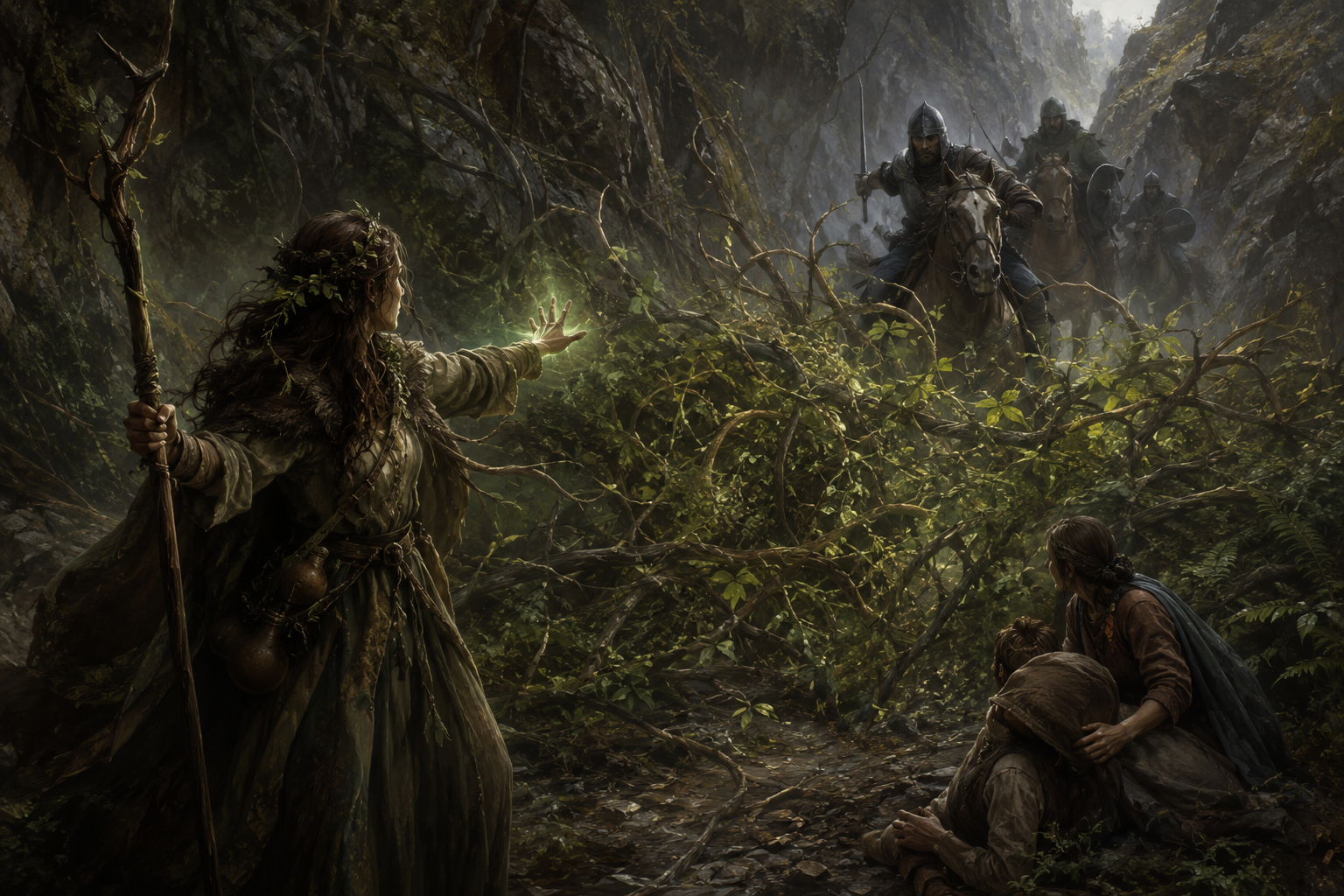
Plant Growth is nature magic acting on the world rather than merely on creatures. In one form, it makes existing vegetation grow thick, tangled, and obstructive, turning roads, clearings, hedges, orchards, and woodland edges into dangerous ground. In the other, it enriches crops and useful plants over a wide area, changing a year’s harvest and the fortunes of everyone who lives from the land.
This is not a spell for commanding plant monsters or conjuring a forest from bare stone. It works through ordinary living vegetation: grasses, briars, bushes, reeds, vines, creepers, thistles, crops, trees, orchard growth, and similar plants. A druid can cast it to halt pursuers, shield a retreat, deny a road to soldiers, protect a sacred grove, strengthen a border village, or turn a poor estate into a rich one.
In play, Plant Growth works best as a spell of terrain, food, and local power. It changes who can move, who can pursue, who can eat, and who can claim the land’s favour.
Plant Growth at a Glance
| School | Transmutation |
|---|---|
| Bard level | 2024 / 2014: 3; legacy: absent from standard Bard lists |
| Purpose | Overgrowth or enrichment of existing plants |
| Duration | Instantaneous |
| Concentration | None |
Spell Rules by Edition
Plant Growth — 5.5e / 2024
Rules source: System Reference Document 5.2.1.
| Spell | Level 3 Transmutation |
|---|---|
| Classes | Bard, Druid, Ranger |
| Casting Time | Action (Overgrowth) or 8 hours (Enrichment) |
| Range | 150 feet |
| Components | V, S |
| Duration | Instantaneous |
This spell channels vitality into plants. The casting time you use determines whether the spell has the Overgrowth or the Enrichment effect below.
Overgrowth. Choose a point within range. All normal plants in a 100-foot-radius Sphere centered on that point become thick and overgrown. A creature moving through that area must spend 4 feet of movement for every 1 foot it moves. You can exclude one or more areas of any size within the spell’s area from being affected.
Enrichment. All plants in a half-mile radius centered on a point within range become enriched for 365 days. The plants yield twice the normal amount of food when harvested. They can benefit from only one Plant Growth per year.
Plant Growth — 5e / 2014
Rules source: System Reference Document 5.1.
| Spell | Level 3 Transmutation |
|---|---|
| Classes | Bard, Druid, Ranger |
| Casting Time | 1 action or 8 hours |
| Range | 150 feet |
| Components | V, S |
| Duration | Instantaneous |
This spell channels vitality into plants within a specific area. There are two possible uses for the spell, granting either immediate or long-term benefits.
If you cast this spell using 1 action, choose a point within range. All normal plants in a 100-foot radius centered on that point become thick and overgrown. A creature moving through the area must spend 4 feet of movement for every 1 foot it moves.
You can exclude one or more areas of any size within the spell’s area from being affected.
If you cast this spell over 8 hours, you enrich the land. All plants in a half-mile radius centered on a point within range become enriched for 1 year. The plants yield twice the normal amount of food when harvested.
Plant Growth — Pathfinder 1e
Rules source: Edition reference.
| School | Transmutation |
|---|---|
| Level | Druid 3, Hunter 3, Ranger 3 |
| Casting Time | 1 standard action |
| Components | V, S, DF |
| Range | See text |
| Target or Area | See text |
| Duration | Instantaneous |
| Saving Throw | None |
| Spell Resistance | No |
Plant Growth has different effects depending on the version chosen.
Overgrowth. This effect causes normal vegetation, including grasses, briars, bushes, creepers, thistles, trees, vines, and similar plants, within long range (400 feet + 40 feet per caster level) to become thick and overgrown. The plants entwine to form a thicket or jungle that creatures must hack or force a way through. Speed through the area drops to 5 feet, or 10 feet for Large or larger creatures.
If this spell is cast on an area that is already affected by any spell or effect that enhances plants, such as Entangle or Wall of Thorns, any DC involved with those spells is increased by 4. This bonus is granted for 1 day after the casting of Plant Growth.
The area must have brush and trees in it for this effect to work. At the caster’s option, the area may be a 100-foot-radius circle, a 150-foot-radius semicircle, or a 200-foot-radius quarter circle. The caster may designate places within the area that are not affected.
Enrichment. This effect targets plants within a range of one-half mile, raising their potential productivity over the course of the next year to one-third above normal.
Counterspell Interaction. Plant Growth counters Diminish Plants.
Plant Creatures. This spell has no effect on plant creatures.
Plant Growth — D&D 3.5e
Rules source: Edition reference.
| School | Transmutation |
|---|---|
| Level | Druid 3, Plant domain 3, Ranger 3 |
| Casting Time | 1 standard action |
| Components | V, S, DF |
| Range | See text |
| Target or Area | See text |
| Duration | Instantaneous |
| Saving Throw | None |
| Spell Resistance | No |
Plant growth has different effects depending on the version chosen.
Overgrowth This effect causes normal vegetation (grasses, briars, bushes, creepers, thistles, trees, vines) within long range (400 feet + 40 feet per caster level) to become thick and overgrown. The plants entwine to form a thicket or jungle that creatures must hack or force a way through. Speed drops to 5 feet, or 10 feet for Large or larger creatures. The area must have brush and trees in it for this spell to take effect.
At your option, the area can be a 100-foot-radius circle, a 150-foot-radius semicircle, or a 200-foot-radius quarter circle.
You may designate places within the area that are not affected.
Enrichment This effect targets plants within a range of one-half mile, raising their potential productivity over the course of the next year to one-third above normal.
Plant growth counters diminish plants.
This spell has no effect on plant creatures.
Edition Differences
| Bard access | Bard 3 in 2024 and 2014. No standard Bard access in Pathfinder 1e or core 3.5. |
|---|---|
| Overgrowth movement | Modern: spend 4 feet for each 1 foot moved. Legacy: speed drops to 5 feet, or 10 feet for Large or larger creatures. |
| Enrichment | Modern: twice the normal food yield. Legacy: one-third above normal productivity for the next year. 2024 expressly limits a plant to one Plant Growth benefit per year. |
| Casting time | Modern enrichment takes 8 hours. Both legacy effects use 1 standard action. |
| Pathfinder interaction | For 1 day, Plant Growth adds +4 to DCs of existing plant-enhancing effects such as Entangle or Wall of Thorns. This is absent from the 3.5 text. |
Practical Notes
Notes. The spell causes a physical change rather than creating an ongoing magical field. Once the growth occurs, it remains until cut back, harvested, burned, cleared, trampled down over time, or otherwise altered. The overgrowth form requires ordinary living plants in the area and does not create dense vegetation on bare stone, open water, worked metal, or lifeless ground.
Notes. The spell changes the terrain rather than creating a temporary magical zone. Once the vegetation has thickened, it remains until cut, burned, cleared, or otherwise dealt with. Flight, teleportation, climbing, and similar methods may bypass it where appropriate.
These notes explain the spell’s instantaneous change to existing vegetation; they do not add a new restraint or grapple condition. The movement rules in the chosen edition control travel through the affected ground.
Quick Rules Reference
- Spell type: 3rd-level transmutation.
- Main use: Makes existing normal vegetation thick and overgrown.
- Secondary use: Improves plant productivity over a much larger area.
- Saving Throw: None.
- Spell Resistance: No in Pathfinder 1e / 3.5e-compatible rules.
- Important limit: The spell requires ordinary living plants already present.
- Does not affect: Plant creatures.
- Practical role: Terrain control, road denial, ambush shaping, harvest blessing, and land magic.
Effect
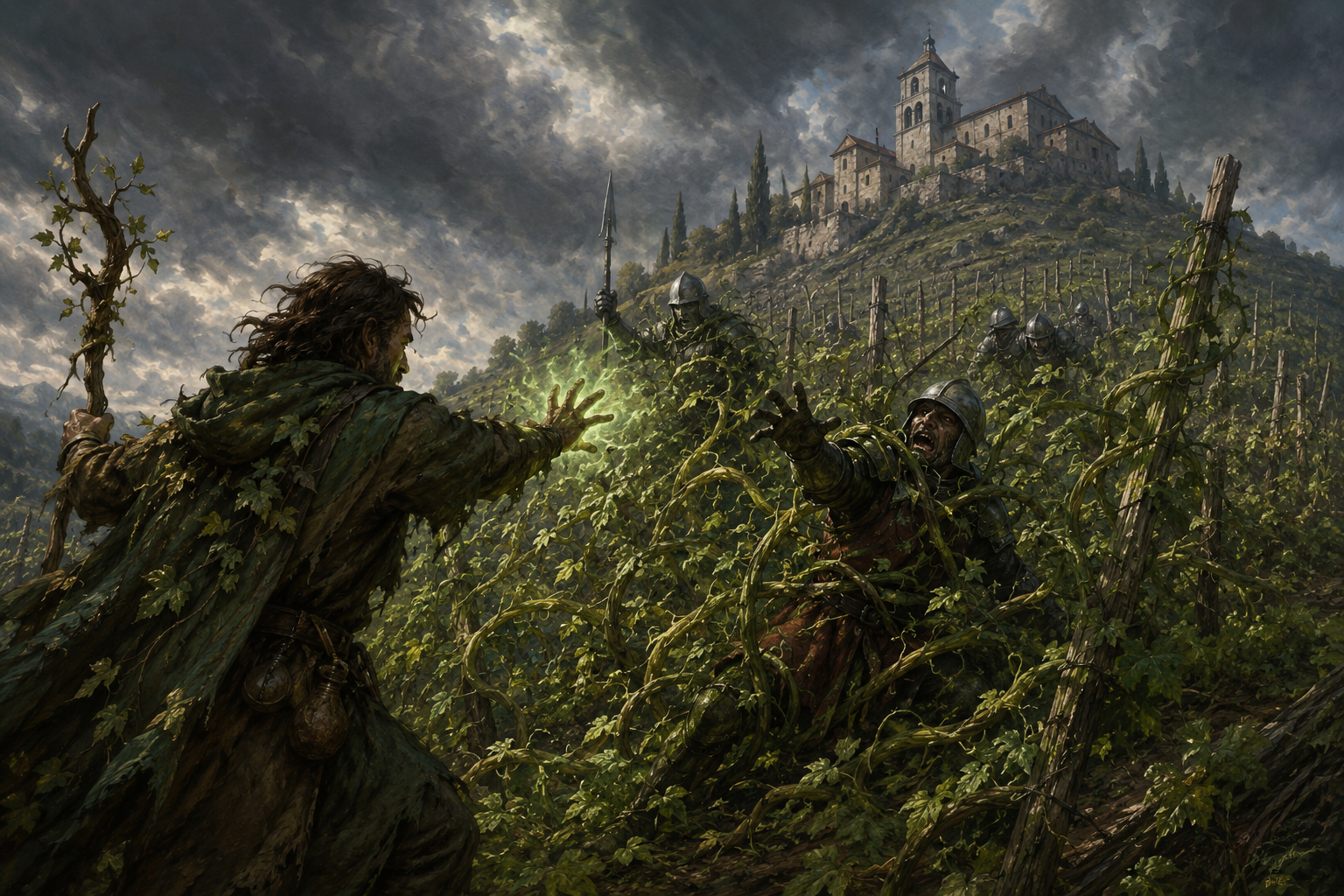
Plant Growth has two broad uses. The first is immediate overgrowth: vegetation thickens into a tangled mass that is hard to cross and difficult to clear quickly. The second is enrichment: fields, orchards, gardens, vineyards, and similar planted or naturally productive land become more fruitful over the coming year.
The overgrowth form is strongest where plant life is already established: forest roads, riverbanks, marsh edges, hedge-lines, overgrown ruins, pastures, orchards, graveyards, abandoned fields, and woodland approaches. The enrichment form is quieter but often more consequential. A single casting can affect food supply, rents, tithes, local loyalty, and the political value of land.
Why This Spell Is Dangerous in the World
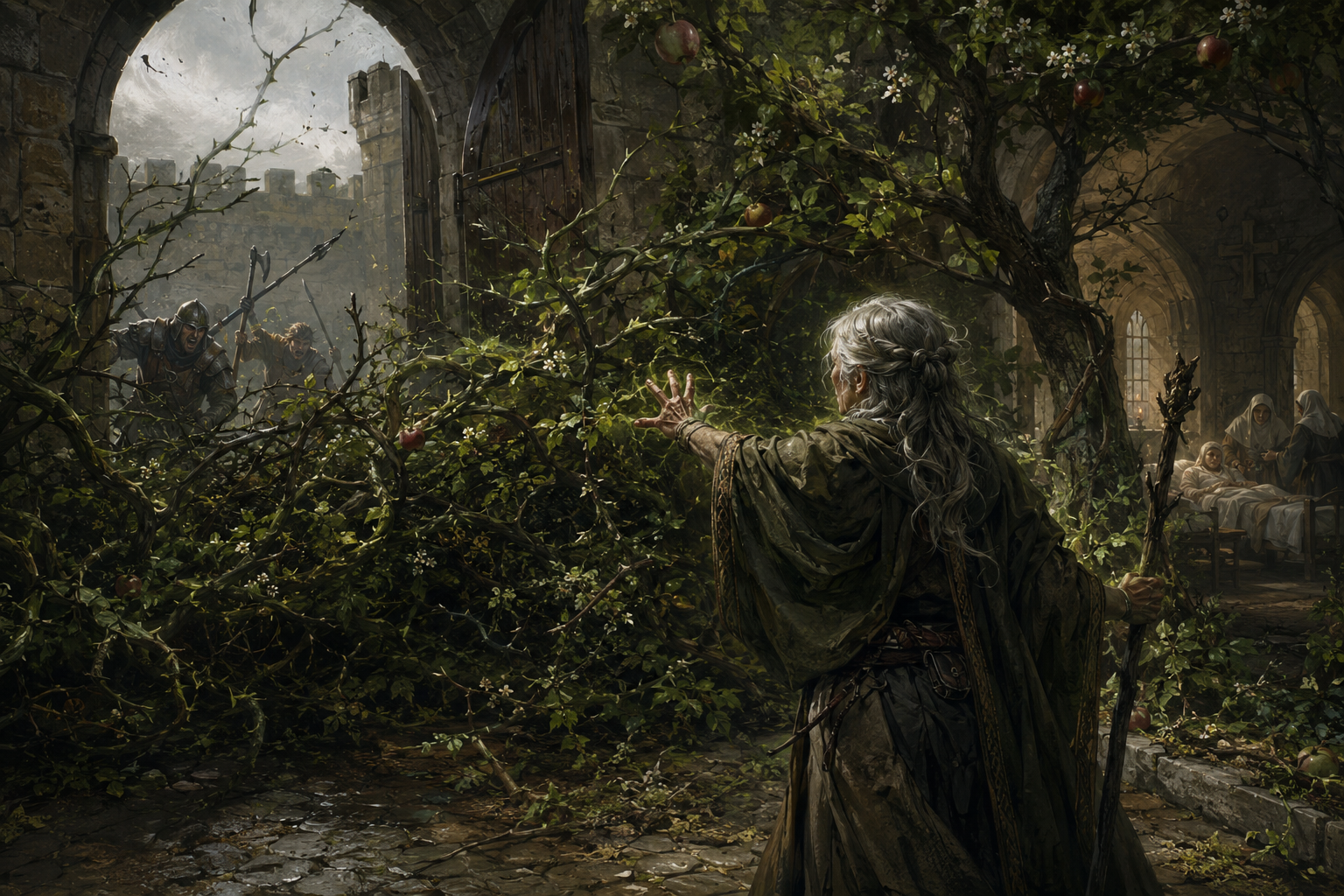
Plant Growth is dangerous because it changes how land can be used. Its overgrowth form closes roads, ruins cavalry momentum, slows infantry, hinders wagons, disrupts pursuit, and reshapes a battlefield without a single attack roll. Its enrichment form changes food supply, rents, tithes, labour expectations, and the value of estates over the next year.
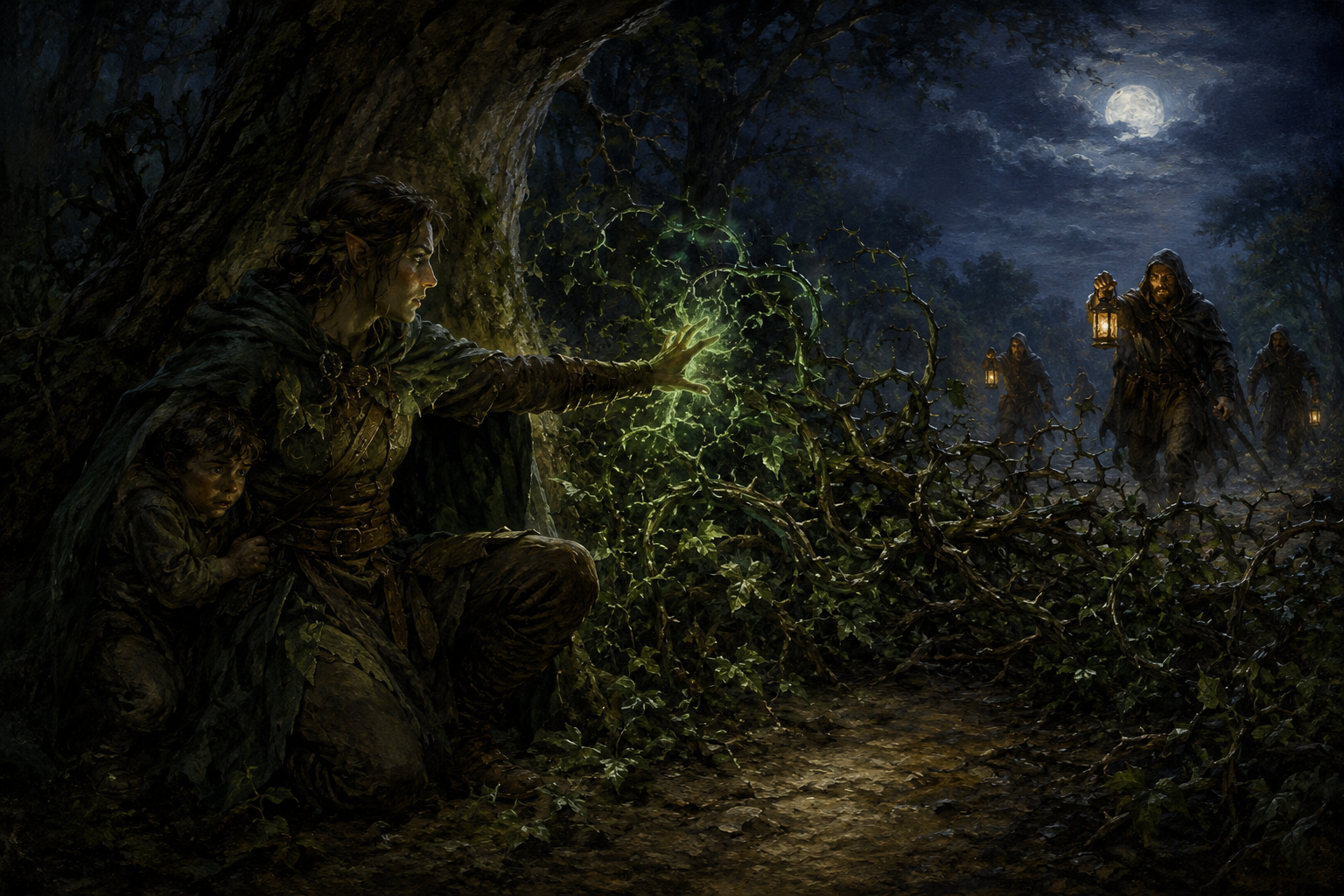
That makes it more than a nature spell. It is a road spell, a siege spell, a border spell, and a famine spell. A rebel druid can deny soldiers and tax collectors the roads they rely on. A village priest or hedge-witch can prevent hunger and make a struggling settlement viable. A lord who controls a caster with this magic can enrich loyal tenants and make enemy land harder to reach.
In a late medieval world, food is power and movement is power. A spell that interferes with either can have consequences far beyond the scene in which it is cast. People remember the mage who made the wheat heavy with grain. They also remember the one who turned the king’s road into a wall of briars before the riders came.
Rules Clarifications and Edge Cases
- Plant Growth requires living vegetation. Forest undergrowth, hedges, bramble patches, marsh plants, vines, weeds, pasture growth, orchards, and similar plant life can be affected. Bare courtyards, clean flagstones, deep cavern stone, and open sea normally cannot.
- The spell does not create plants from nothing. It intensifies what is already there rather than summoning a new forest.
- It is not Entangle. Plant Growth slows movement drastically, but it does not automatically restrain, grapple, or pin creatures unless another effect says so.
- Plant creatures are unaffected. Treants, shambling mounds, awakened shrubs, assassin vines, and similar beings are not strengthened or controlled by the spell.
- Excluded lanes are tactically important. A caster can leave narrow paths for allies, hidden escape routes, ambush channels, or safe ritual spaces inside the affected ground.
- Instantaneous means lasting. This is not a concentration effect waiting to end. The ground is physically changed.
- Fire is not a clean answer. Burning a way through may solve the movement problem, but it can also destroy crops, start a wider blaze, foul the air with smoke, and create serious legal or social consequences.
Good Combinations
- Entangle: Plant Growth creates the slow ground; Entangle can then trap creatures within it.
- Spike Growth: Plant Growth makes movement through the area expensive, while Spike Growth punishes every step of that movement.
- Fog Cloud: Fog Cloud hides the true shape of the overgrown area and makes safe lanes harder to identify.
- Wall of Thorns: Wall of Thorns provides the hard barrier, while Plant Growth turns the surrounding approach into a punishing crawl.
- Speak with Plants: Speak with Plants lets the caster learn from local vegetation; Plant Growth lets the caster make that same landscape act.
Adventure Hooks
The Closed King’s Road. A royal road through old woodland becomes nearly impassable overnight. The court calls it rebellion. The villagers call it protection. The truth lies in an older land dispute, and something sacred in the forest has begun to take notice.
The Blessed Orchard. A poor manor becomes unexpectedly prosperous after its orchards produce impossible abundance for a full year. Neighbouring lords want the caster found. The local temple wants the miracle claimed. The peasants only know that for the first time in years, their children are not hungry.
The Briar Siege. Defenders keep a small fortress alive by using Plant Growth on every orchard, copse, and hedgerow around it. Attackers can burn a path through, but doing so may destroy the region’s food supply and turn local opinion against them.
Historical and Mythic Context
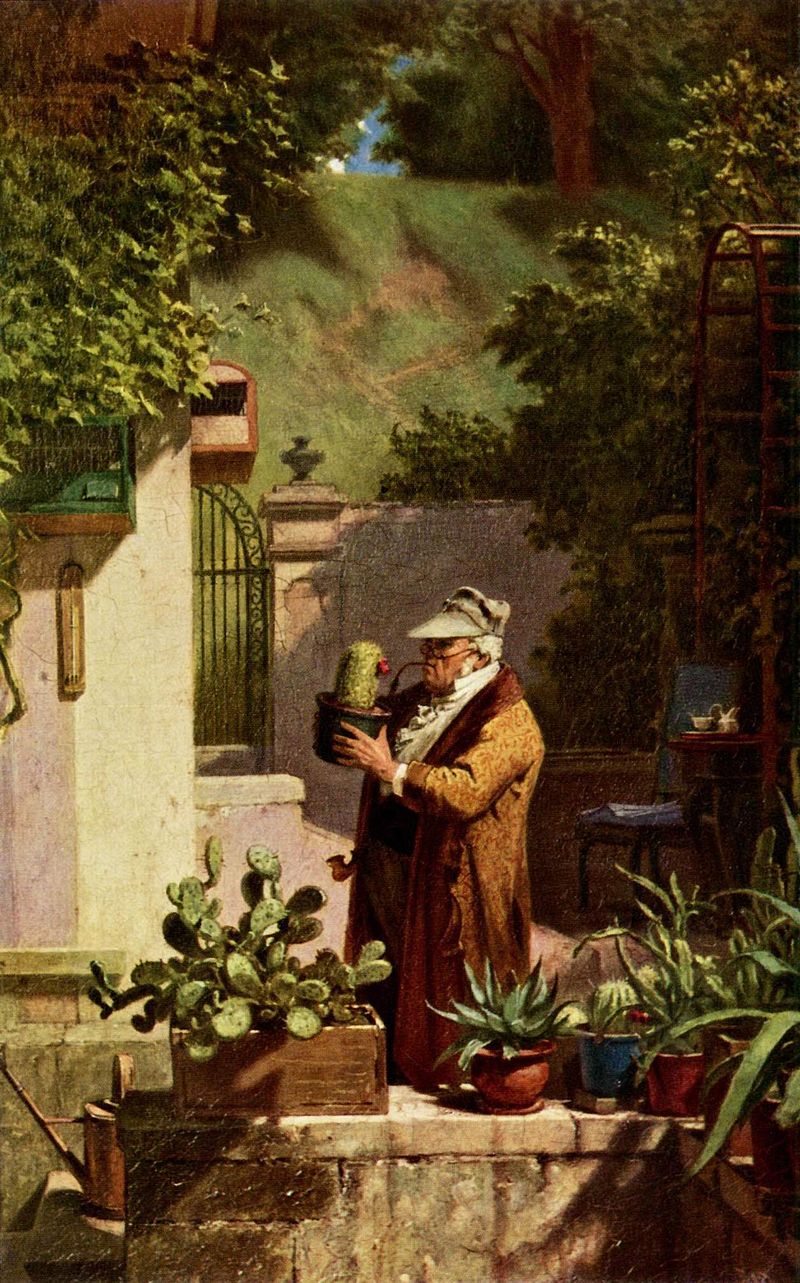
Plant Growth belongs to an old and powerful idea: that the health of the land reflects the relationship between people, power, and the unseen world. Fruitful fields, heavy orchards, and passable roads are not merely agricultural facts. They are signs of order, blessing, peace, and proper stewardship. Thorn-choked borders, devouring woodland, and failed harvests suggest neglect, wrath, trespass, or broken obligation.
Its overgrowth aspect echoes stories of roads swallowed by forest, sacred groves closing against the unworthy, and wilderness reclaiming land that violence or arrogance has misused. Its enrichment aspect belongs to the opposite current: miracle harvests, blessed valleys, restored orchards, and fields that prosper because the right guardian, offering, or oath has been honoured.
For background reading, see sacred groves, agriculture and its wider social importance, and traditions of woodland regulation and contested access under forest law. In play, Plant Growth becomes much stronger when treated as a spell of roads, harvests, hedge-boundaries, and rural memory rather than a simple patch of difficult terrain.
The Living Barrier
Earlier D&D 3.0e-labelled archive
The previous page carried the following text under a D&D 3.0e label. It is retained as the original archive; the separately sourced 3.5 panel above is the rules reference for that edition.
This material is Open Game Content, and is licensed for public use under the terms of the Open Game License v1.0a.
Transmutation
Level Druid 3, Plant 3, Ranger 3
Components V, S, DF
Casting Time 1 standard action
Range See text
Target or Area See text
Duration Instantaneous
Saving Throw None
Spell Resistance No
Plant growth has different effects depending on the version chosen.
Overgrowth This effect causes normal vegetation (grasses, briars, bushes, creepers, thistles, trees, vines) within long range (400 feet + 40 feet per caster level) to become thick and overgrown. The plants entwine to form a thicket or jungle that creatures must hack or force a way through. Speed drops to 5 feet, or 10 feet for Large or larger creatures. The area must have brush and trees in it for this spell to take effect.
At your option, the area can be a 100-foot-radius circle, a 150-foot-radius semicircle, or a 200-foot-radius quarter circle.
You may designate places within the area that are not affected.
Enrichment This effect targets plants within a range of one-half mile, raising their potential productivity over the course of the next year to one-third above normal.
Plant growth counters diminish plants.
This spell has no effect on plant creatures.
Rules Sources and Licensing
This work includes material taken from the System Reference Document 5.1 (“SRD 5.1”) by Wizards of the Coast LLC and available at https://dnd.wizards.com/resources/systems-reference-document. The SRD 5.1 is licensed under the Creative Commons Attribution 4.0 International License available at https://creativecommons.org/licenses/by/4.0/legalcode.
This work includes material from the System Reference Document 5.2.1 (“SRD 5.2.1”) by Wizards of the Coast LLC, available at https://www.dndbeyond.com/srd. The SRD 5.2.1 is licensed under the Creative Commons Attribution 4.0 International License, available at https://creativecommons.org/licenses/by/4.0/legalcode.
The Pathfinder and 3.5 spell mechanics and their tables are Open Game Content under the Open Game License v1.0a. Artwork and original setting prose are excluded from that designation.
Open Game License v1.0a and copyright notices
Permission to copy, modify and distribute the files collectively known as the System Reference Document (“SRD”) is granted solely through the use of the Open Gaming License, Version 1.0a.
This material is being released using the Open Gaming License Version 1.0a and you should read and understand the terms of that license before using this material.
The text of the Open Gaming License itself is not Open Game Content. Instructions on using the License are provided within the License itself.
The following items are designated Product Identity, as defined in Section 1(e) of the Open Game License Version 1.0a, and are subject to the conditions set forth in Section 7 of the OGL, and are not Open Content: Dungeons & Dragons, D&D, Player’s Handbook, Dungeon Master, Monster Manual, d20 System, Wizards of the Coast, d20 (when used as a trademark), Forgotten Realms, Faerûn, proper names (including those used in the names of spells or items), places, Red Wizard of Thay, the City of Union, Heroic Domains of Ysgard, Ever-Changing Chaos of Limbo, Windswept Depths of Pandemonium, Infinite Layers of the Abyss, Tarterian Depths of Carceri, Gray Waste of Hades, Bleak Eternity of Gehenna, Nine Hells of Baator, Infernal Battlefield of Acheron, Clockwork Nirvana of Mechanus, Peaceable Kingdoms of Arcadia, Seven Mounting Heavens of Celestia, Twin Paradises of Bytopia, Blessed Fields of Elysium, Wilderness of the Beastlands, Olympian Glades of Arborea, Concordant Domain of the Outlands, Sigil, Lady of Pain, Book of Exalted Deeds, Book of Vile Darkness, beholder, gauth, carrion crawler, tanar’ri, baatezu, displacer beast, githyanki, githzerai, mind flayer, illithid, umber hulk, yuan-ti.
All of the rest of the SRD is Open Game Content as described in Section 1(d) of the License.
More information on the Open Game License can be found at www.wizards.com/d20.
The terms of the Open Gaming License Version 1.0a are as follows:
OPEN GAME LICENSE Version 1.0a
The following text is the property of Wizards of the Coast, Inc. and is Copyright 2000 Wizards of the Coast, Inc (“Wizards”). All Rights Reserved.
1. Definitions: (a)”Contributors” means the copyright and/or trademark owners who have contributed Open Game Content; (b)”Derivative Material” means copyrighted material including derivative works and translations (including into other computer languages), potation, modification, correction, addition, extension, upgrade, improvement, compilation, abridgment or other form in which an existing work may be recast, transformed or adapted; (c) “Distribute” means to reproduce, license, rent, lease, sell, broadcast, publicly display, transmit or otherwise distribute; (d)”Open Game Content” means the game mechanic and includes the methods, procedures, processes and routines to the extent such content does not embody the Product Identity and is an enhancement over the prior art and any additional content clearly identified as Open Game Content by the Contributor, and means any work covered by this License, including translations and derivative works under copyright law, but specifically excludes Product Identity. (e) “Product Identity” means product and product line names, logos and identifying marks including trade dress; artifacts; creatures characters; stories, storylines, plots, thematic elements, dialogue, incidents, language, artwork, symbols, designs, depictions, likenesses, formats, poses, concepts, themes and graphic, photographic and other visual or audio representations; names and descriptions of characters, spells, enchantments, personalities, teams, personas, likenesses and special abilities; places, locations, environments, creatures, equipment, magical or supernatural abilities or effects, logos, symbols, or graphic designs; and any other trademark or registered trademark clearly identified as Product identity by the owner of the Product Identity, and which specifically excludes the Open Game Content; (f) “Trademark” means the logos, names, mark, sign, motto, designs that are used by a Contributor to identify itself or its products or the associated products contributed to the Open Game License by the Contributor (g) “Use”, “Used” or “Using” means to use, Distribute, copy, edit, format, modify, translate and otherwise create Derivative Material of Open Game Content. (h) “You” or “Your” means the licensee in terms of this agreement.
2. The License: This License applies to any Open Game Content that contains a notice indicating that the Open Game Content may only be Used under and in terms of this License. You must affix such a notice to any Open Game Content that you Use. No terms may be added to or subtracted from this License except as described by the License itself. No other terms or conditions may be applied to any Open Game Content distributed using this License.
3.Offer and Acceptance: By Using the Open Game Content You indicate Your acceptance of the terms of this License.
4. Grant and Consideration: In consideration for agreeing to use this License, the Contributors grant You a perpetual, worldwide, royalty-free, non-exclusive license with the exact terms of this License to Use, the Open Game Content.
5.Representation of Authority to Contribute: If You are contributing original material as Open Game Content, You represent that Your Contributions are Your original creation and/or You have sufficient rights to grant the rights conveyed by this License.
6.Notice of License Copyright: You must update the COPYRIGHT NOTICE portion of this License to include the exact text of the COPYRIGHT NOTICE of any Open Game Content You are copying, modifying or distributing, and You must add the title, the copyright date, and the copyright holder’s name to the COPYRIGHT NOTICE of any original Open Game Content you Distribute.
7. Use of Product Identity: You agree not to Use any Product Identity, including as an indication as to compatibility, except as expressly licensed in another, independent Agreement with the owner of each element of that Product Identity. You agree not to indicate compatibility or co-adaptability with any Trademark or Registered Trademark in conjunction with a work containing Open Game Content except as expressly licensed in another, independent Agreement with the owner of such Trademark or Registered Trademark. The use of any Product Identity in Open Game Content does not constitute a challenge to the ownership of that Product Identity. The owner of any Product Identity used in Open Game Content shall retain all rights, title and interest in and to that Product Identity.
8. Identification: If you distribute Open Game Content You must clearly indicate which portions of the work that you are distributing are Open Game Content.
9. Updating the License: Wizards or its designated Agents may publish updated versions of this License. You may use any authorized version of this License to copy, modify and distribute any Open Game Content originally distributed under any version of this License.
10. Copy of this License: You MUST include a copy of this License with every copy of the Open Game Content You Distribute.
11. Use of Contributor Credits: You may not market or advertise the Open Game Content using the name of any Contributor unless You have written permission from the Contributor to do so.
12. Inability to Comply: If it is impossible for You to comply with any of the terms of this License with respect to some or all of the Open Game Content due to statute, judicial order, or governmental regulation then You may not Use any Open Game Material so affected.
13. Termination: This License will terminate automatically if You fail to comply with all terms herein and fail to cure such breach within 30 days of becoming aware of the breach. All sublicenses shall survive the termination of this License.
14. Reformation: If any provision of this License is held to be unenforceable, such provision shall be reformed only to the extent necessary to make it enforceable.
15. COPYRIGHT NOTICE
Open Game License v 1.0a Copyright 2000, Wizards of the Coast, Inc.
System Reference Document Copyright 2000-2003, Wizards of the Coast, Inc.; Authors Jonathan Tweet, Monte Cook, Skip Williams, Rich Baker, Andy Collins, David Noonan, Rich Redman, Bruce R. Cordell, John D. Rateliff, Thomas Reid, James Wyatt, based on original material by E. Gary Gygax and Dave Arneson.
Pathfinder Roleplaying Game Core Rulebook. © 2009, Paizo Publishing, LLC; Author: Jason Bulmahn, based on material by Jonathan Tweet, Monte Cook, and Skip Williams. END OF LICENSE
Keep this reference growing
If this page helped with your reading or game, you can support its upkeep or explore the curated books.
Explore the Bookshop — epics, classics and stories behind imagined worlds.