
Plant Domain
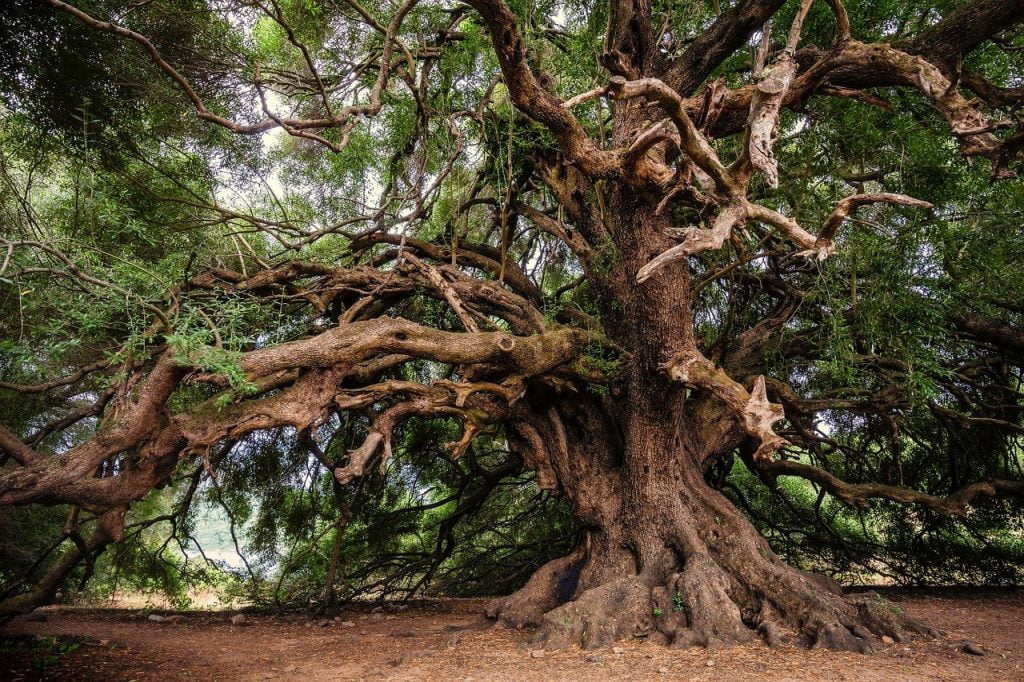
The Plant Domain is divine power expressed through roots, thorns, living wood and the slow force of growth. Its clerics protect sacred groves, bless crops, command supernatural vegetation and turn the battlefield itself into living terrain.
At a Glance
| Divine Sphere | Plants, growth, forests, crops, living wood, thorns and sacred vegetation |
|---|---|
| Typical Role | Battlefield controller, wilderness priest and protector of cultivated or wild growth |
| Core Strengths | Entangling movement, shaping vegetation, resisting elemental harm and dealing with plant creatures |
| Primary Ability | Wisdom |
| Sacred Imagery | Leaf, branching tree, seed, thorned staff or sheaf of grain |
| Typical Patrons | Demeter, Artemis, Dionysus and Freyr where their established cults emphasise vegetation, fertility or wild growth |
| Best For | Players who want terrain control and a strong wilderness identity rather than a purely healing or martial cleric |
Plant Domain Mechanics
The Plant Domain is published in Pathfinder 1e and D&D 3.5e, but those editions give it different granted powers. D&D 5e/2014 uses the official Nature Domain rather than Plant, so the 2014 panel is a deliberate Plant-focused adaptation. The 2024 panel is a compatible conversion for the current Cleric progression, not an official published Plant subclass.
Plant Domain — D&D 5.5e / 2024-Compatible
Rules status: compatible adaptation. No official Plant Domain is published for the 2024 Cleric. This version keeps close to the 2014 Nature Domain while narrowing its creature control toward plants.
| Cleric Level | Feature |
|---|---|
| 3rd | Plant Domain Spells, Acolyte of Growth, Channel Divinity: Charm Plants |
| 6th | Dampen Elements |
| 17th | Master of the Green |
Acolyte of Growth
You gain proficiency in Nature. If you already have it, choose another Intelligence- or Wisdom-based skill in which you are not proficient. You also learn Druidcraft; it counts as a Cleric cantrip for you and uses Wisdom.
Channel Divinity: Charm Plants
As a Magic action, present your Holy Symbol. Each Plant creature of your choice within 30 feet that can perceive you must make a Wisdom saving throw against your spell save DC. On a failure, it is Charmed by you for 1 minute or until it takes damage. Ordinary vegetation is not automatically a creature and cannot be commanded by this feature.
Dampen Elements
At 6th level, when you or a creature you can see within 30 feet takes Acid, Cold, Fire, Lightning or Thunder damage, you can use your Reaction to grant that creature Resistance to that instance of damage.
Master of the Green
At 17th level, Plant creatures Charmed by your Plant Domain features follow your verbal directions while the charm lasts. You and allies of your choice within 30 feet also ignore nonmagical difficult terrain caused by plants, roots and undergrowth.
5.5e / 2024-Compatible Domain Spells
| Cleric Level | Always-Prepared Spells |
|---|---|
| 3rd | Entangle, Goodberry, Barkskin, Spike Growth |
| 5th | Plant Growth, Speak with Plants |
| 7th | Grasping Vine, Hallucinatory Terrain |
| 9th | Insect Plague, Tree Stride |
Plant Domain — D&D 5e / 2014-Compatible
Rules status: compatible adaptation. The 2014 Player’s Handbook uses Nature rather than Plant; this version narrows that subclass toward vegetation while retaining the normal 2014 domain progression.
| Cleric Level | Feature |
|---|---|
| 1st | Domain Spells, Acolyte of Growth |
| 2nd | Channel Divinity: Charm Plants |
| 6th | Dampen Elements |
| 8th | Potent Spellcasting |
| 17th | Master of the Green |
Acolyte of Growth
You learn one Druid cantrip of your choice; it counts as a Cleric cantrip for you. You also gain proficiency in Nature.
Channel Divinity: Charm Plants
Starting at 2nd level, as an Action, present your holy symbol. Plant creatures of your choice within 30 feet must make a Wisdom saving throw. A creature that fails is Charmed by you for 1 minute or until it takes damage.
Dampen Elements
At 6th level, when you or a creature within 30 feet takes Acid, Cold, Fire, Lightning or Thunder damage, you can use your Reaction to grant Resistance against that instance of damage.
Potent Spellcasting
At 8th level, add your Wisdom modifier to the damage you deal with a Cleric cantrip.
Master of the Green
At 17th level, Plant creatures Charmed by your Channel Divinity follow your verbal directions while the charm lasts. You and allies of your choice within 30 feet also ignore nonmagical difficult terrain caused by plants and undergrowth.
5e / 2014-Compatible Domain Spells
| Cleric Level | Domain Spells |
|---|---|
| 1st | Entangle, Goodberry |
| 3rd | Barkskin, Spike Growth |
| 5th | Plant Growth, Speak with Plants |
| 7th | Grasping Vine, Hallucinatory Terrain |
| 9th | Insect Plague, Tree Stride |
Plant Domain — Pathfinder 1e
Rules status: published Pathfinder 1e domain. Pathfinder does not use the old 3.5e rebuke-and-command power here.
Wooden Fist
As a free action, you harden your hands into living-wood weapons for a total number of rounds per day equal to 3 + your Wisdom modifier. Your unarmed strikes do not provoke attacks of opportunity, deal lethal damage and gain a damage bonus equal to half your Cleric level, minimum +1. The rounds need not be consecutive.
Bramble Armor
At 6th level, you can cover yourself in supernatural thorns as a free action for a total number of rounds per day equal to your Cleric level. A creature that hits you with a melee weapon without reach or with an unarmed or natural attack takes 1d6 piercing damage + 1 per two Cleric levels. The rounds need not be consecutive.
Pathfinder 1e Plant Domain Spells
| 1st | Entangle |
|---|---|
| 2nd | Barkskin |
| 3rd | Plant Growth |
| 4th | Command Plants |
| 5th | Wall of Thorns |
| 6th | Repel Wood |
| 7th | Animate Plants |
| 8th | Control Plants |
| 9th | Shambler |
Plant Domain — D&D 3.5e
Rules status: published 3.5e SRD domain. This is the source of the rebuke-or-command-plant mechanic that previously appeared on this page without an edition label.
Granted Power
You can rebuke or command Plant creatures using the same turning framework an evil Cleric uses for undead. You may use this supernatural power a total number of times per day equal to 3 + your Charisma modifier. Knowledge (nature) is also a Cleric class skill for you.
D&D 3.5e Plant Domain Spells
| 1st | Entangle |
|---|---|
| 2nd | Barkskin |
| 3rd | Plant Growth |
| 4th | Command Plants |
| 5th | Wall of Thorns |
| 6th | Repel Wood |
| 7th | Animate Plants |
| 8th | Control Plants |
| 9th | Shambler |
How the Plant Domain Plays
A Plant cleric is strongest when the battlefield contains space to shape. Entangling magic, walls, thorns and animated vegetation make routes matter: allies can hold a narrow opening while enemies are forced through bad ground, or a retreat can become much safer once the terrain itself fights for the party.
In Combat
- Control before damage. Slowing or rerouting several enemies can matter more than one direct attack.
- Exploit choke points. Doorways, woodland paths, bridges and confined ruins become more defensible when growth closes easy approaches.
- Know the edition. Pathfinder’s Wooden Fist and Bramble Armor make the cleric personally dangerous at close range; 3.5e instead emphasises authority over Plant creatures.
- Do not assume every forest is an ally. Ordinary vegetation is terrain, not automatically a creature that can be commanded.
Outside Combat
Plant priests bless fields, judge disputes over sacred groves, identify blights, supervise orchards and woodland boundaries, preserve seed stock, and decide when useful harvesting becomes desecration.
Who Grants the Plant Domain?
The domain belongs where a deity’s established portfolio genuinely includes vegetation, cultivation, wilderness growth or closely related fertility. Existing site connections include Demeter, Freyr, Artemis and Dionysus in aspects of worship concerned with living growth.
Priests, Temples and Rites
Plant clergy tend sacred orchards, field shrines, forest clearings, seed houses and temple gardens. Their rites follow practical cycles: sowing, pruning, first fruit, harvest, controlled burning, winter dormancy and the protection of old trees that outlive human communities.
What Are Plant Priests Doing Now?
Plant priests are useful wherever food security and supernatural wilderness meet. Some protect harvests after war or disease has reduced labour; others investigate fields that grow too quickly, forests that refuse axes, blights spreading from cursed ground, or plant creatures disturbed by settlement and road building.
Historical and Mythological Context
Vegetation cults are rarely just generic “nature worship.” Grain, vines, orchards, woodland boundaries and uncultivated growth can belong to different divine relationships. A Plant Domain cleric should therefore inherit the customs of the particular deity and culture granting the domain.
Related Domains and Character Options
Rules Sources and Licensing
- D&D 5.5e / 2024-compatible: Plant is a compatibility conversion, not an official 2024 subclass.
- D&D 5e / 2014-compatible: deliberate adaptation benchmarked against the official Nature Domain.
- Pathfinder 1e: powers and spell list follow the Pathfinder Core Rulebook reference.
- D&D 3.5e: granted power and spell list follow the 3.5 SRD.
Keep this reference growing
If this page helped with your reading or game, you can support its upkeep or explore the curated books.
Explore the Bookshop — epics, classics and stories behind imagined worlds.