
Conjuration · Long-Range Magical Travel
Teleport
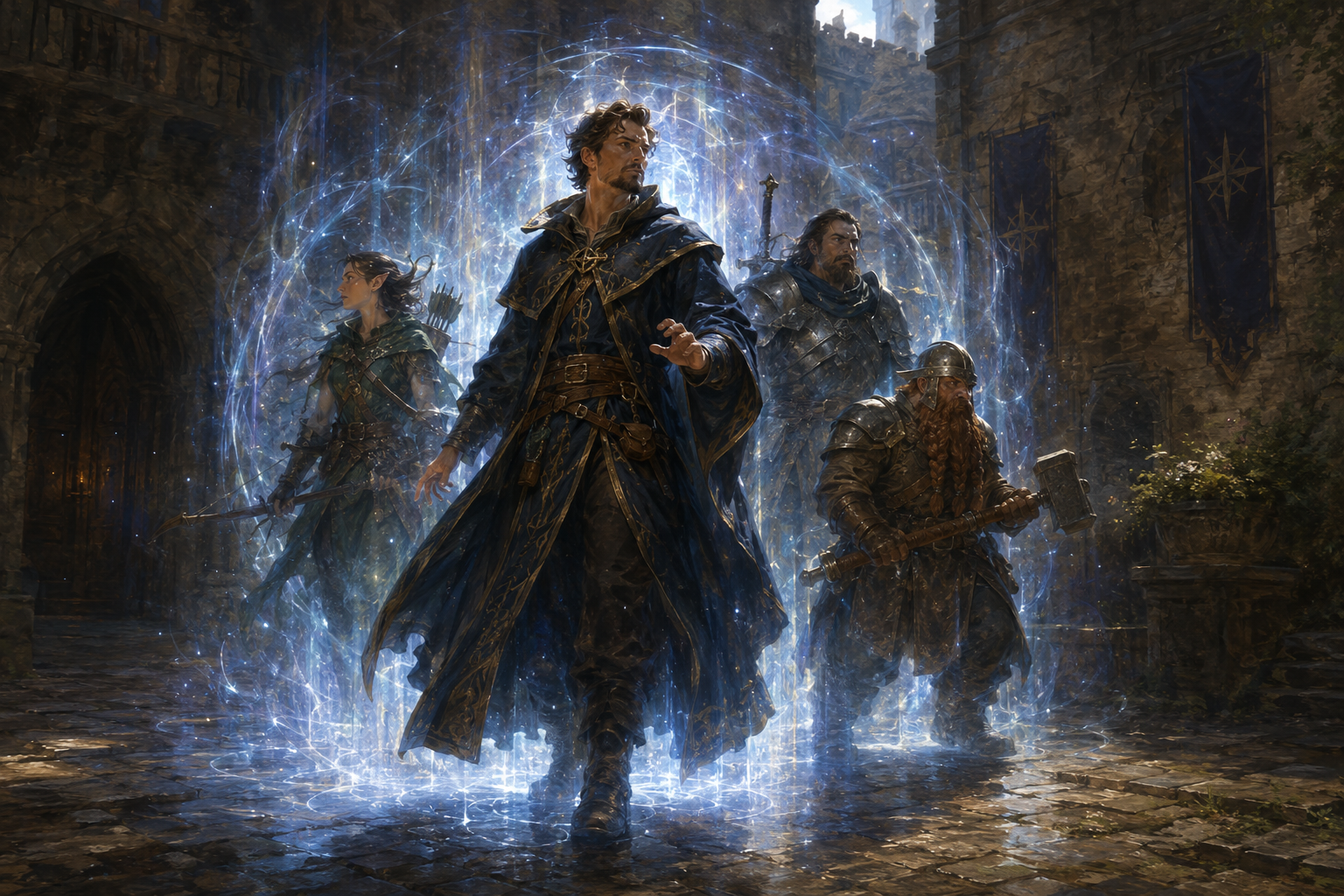
Teleport is one of the decisive spells of high-level play. It can extract a company from disaster, move agents across kingdoms, deliver vital objects and turn knowledge of a place into strategic power.
Teleport is not a standing portal. Travellers vanish from one place and arrive at another in the same instant. What happens when the caster knows the destination imperfectly depends on the edition in play, and the modern and legacy outcome systems must not be mixed.
At a Glance
Teleport at a Glance
| 5.5e / 2024 | Bard, Sorcerer, Wizard 7 · 10 feet · same plane · 2d12-mile Off Target result |
|---|---|
| 5e / 2014 | Bard, Sorcerer, Wizard 7 · 10 feet · same plane · percentage-distance Off Target result |
| Pathfinder 1e | Usually 5th level · 100 miles/level · d% of journey for Off Target distance |
| D&D 3.5e | Sorcerer/Wizard 5, Travel 5 · 100 miles/level · 1d10 × 1d10% Off Target distance |
Rules
Teleport by Edition
Teleport — 5.5e / 2024
| Level | 7th-level Conjuration |
|---|---|
| Classes | Bard, Sorcerer, Wizard |
| Casting Time | Action |
| Range | 10 feet |
| Components | V |
| Duration | Instantaneous |
| Destination | A place known to you on the same plane |
You teleport yourself and up to eight willing creatures you can see within range. Instead, you can teleport one visible Large-or-smaller object in range, provided an unwilling creature is not holding or carrying it.
| Familiarity | Mishap | Similar Area | Off Target | On Target |
|---|---|---|---|---|
| Permanent circle | — | — | — | 01–100 |
| Linked object | — | — | — | 01–100 |
| Very familiar | 01–05 | 06–13 | 14–24 | 25–100 |
| Seen casually | 01–33 | 34–43 | 44–53 | 54–100 |
| Viewed once or described | 01–43 | 44–53 | 54–73 | 74–100 |
| False destination | 01–50 | 51–100 | — | — |
Mishap: each transported creature or object takes 3d10 Force damage, then the DM rerolls. Similar Area: the travellers arrive at the closest place that resembles the intended destination. Off Target: they arrive 2d12 miles away in a random direction determined by a d8.
Teleport — 5e / 2014
| Level | 7th-level Conjuration |
|---|---|
| Classes | Bard, Sorcerer, Wizard |
| Casting Time | 1 action |
| Range | 10 feet |
| Components | V |
| Duration | Instantaneous |
| Destination | A place known to you on the same plane |
You teleport yourself and up to eight willing creatures you can see within range. Instead, you can teleport one visible object in range if it fits entirely inside a 10-foot cube and is not held or carried by an unwilling creature.
| Familiarity | Mishap | Similar Area | Off Target | On Target |
|---|---|---|---|---|
| Permanent circle | — | — | — | 01–100 |
| Associated object | — | — | — | 01–100 |
| Very familiar | 01–05 | 06–13 | 14–24 | 25–100 |
| Seen casually | 01–33 | 34–43 | 44–53 | 54–100 |
| Viewed once | 01–43 | 44–53 | 54–73 | 74–100 |
| Description | 01–43 | 44–53 | 54–73 | 74–100 |
| False destination | 01–50 | 51–100 | — | — |
Mishap: each traveller or object takes 3d10 Force damage and the DM rerolls. Off Target: the distance missed is 1d10 × 1d10 percent of the intended travel distance, in a random d8 direction. Similar Area: the spell sends the group to a different place that resembles the intended destination.
Teleport — Pathfinder 1e
| School | Conjuration (teleportation) |
|---|---|
| Levels | Arcanist 5, Magus 5, Medium 4, Occultist 5, Psychic 5, Sorcerer 5, Spiritualist 5, Summoner 4, Unchained Summoner 5, Witch 5, Wizard 5; Travel 5 |
| Casting Time | 1 standard action |
| Components | V |
| Range | Personal and touch; destination up to 100 miles/level |
| Target | You and touched willing creatures or attended objects |
| Duration | Instantaneous |
You may bring one additional willing Medium-or-smaller creature, or the equivalent in larger creatures, per three caster levels. All travellers must remain in physical contact, and the spell cannot cross planar boundaries.
| Familiarity | On Target | Off Target | Similar Area | Mishap |
|---|---|---|---|---|
| Very familiar | 01–97 | 98–99 | 100 | — |
| Studied carefully | 01–94 | 95–97 | 98–99 | 100 |
| Seen casually | 01–88 | 89–94 | 95–98 | 99–100 |
| Viewed once | 01–76 | 77–88 | 89–96 | 97–100 |
| False destination (1d20 + 80) | — | — | 81–92 | 93–100 |
Off Target: the miss distance is a d% of the intended journey. Mishap: each traveller takes 1d10 damage, then roll 1d20 + 80 again. A completed teleport is instantaneous and is not an ongoing effect to dispel.
Teleport — D&D 3.5e
| School | Conjuration (Teleportation) |
|---|---|
| Level | Sorcerer/Wizard 5, Travel 5 |
| Casting Time | 1 standard action |
| Components | V |
| Range | Personal and touch; destination up to 100 miles/level |
| Target | You and touched willing creatures or attended objects |
| Duration | Instantaneous |
You may bring one additional willing Medium-or-smaller creature, or the equivalent in larger creatures, per three caster levels. Every traveller must be in contact with another member of the group, and the spell cannot cross planar boundaries.
| Familiarity | On Target | Off Target | Similar Area | Mishap |
|---|---|---|---|---|
| Very familiar | 01–97 | 98–99 | 100 | — |
| Studied carefully | 01–94 | 95–97 | 98–99 | 100 |
| Seen casually | 01–88 | 89–94 | 95–98 | 99–100 |
| Viewed once | 01–76 | 77–88 | 89–96 | 97–100 |
| False destination (1d20 + 80) | — | — | 81–92 | 93–100 |
Off Target: the miss distance is 1d10 × 1d10 percent of the intended journey, in a random direction. Mishap: each traveller takes 1d10 damage and the result is rerolled with 1d20 + 80.
Edition Changes
What Changed?
- 2024 vs 2014 objects: 2024 uses a visible Large-or-smaller object; 2014 instead requires the object to fit entirely inside a 10-foot cube.
- 2024 Off Target: always 2d12 miles away in a random direction.
- 2014 Off Target: 1d10 × 1d10 percent of the intended travel distance.
- Pathfinder 1e Off Target: d% of the intended journey.
- D&D 3.5e Off Target: 1d10 × 1d10 percent of the intended journey.
- Legacy distance: PF1e and 3.5e limit Teleport to 100 miles per caster level; modern D&D states no maximum travel distance beyond remaining on the same plane.
The Nature of Worldstep
Teleport is best understood as the removal of an interval. It does not make the caster run faster, pass invisibly through the intervening country or open a doorway that others can follow. The point of departure becomes empty; the destination becomes occupied.
That distinction gives the spell its particular severity. A bridge can be guarded, a road watched and a ship intercepted. Teleportation answers none of those obstacles because it does not contest them. It makes them irrelevant for the duration of a single magical act.
The spell is nevertheless bound to place. Names, descriptions, memories, maps, circles and objects taken from a destination are not decoration: they are the means by which the caster fixes intent upon a real location. The more uncertain the relationship, the more room the magic has to obey imperfectly.
Visions of Teleportation
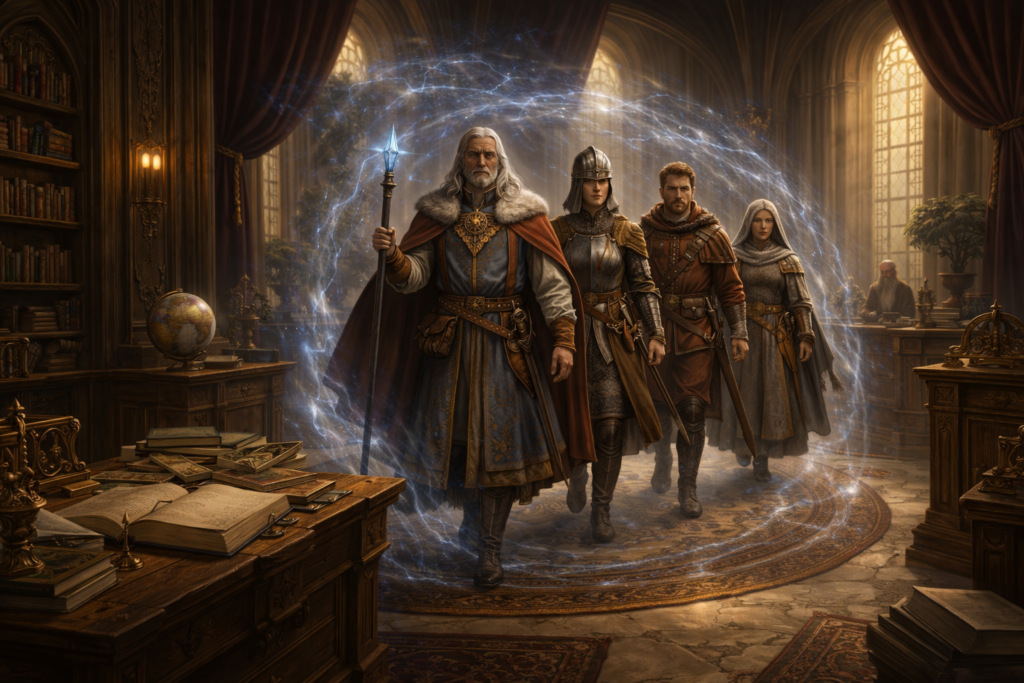
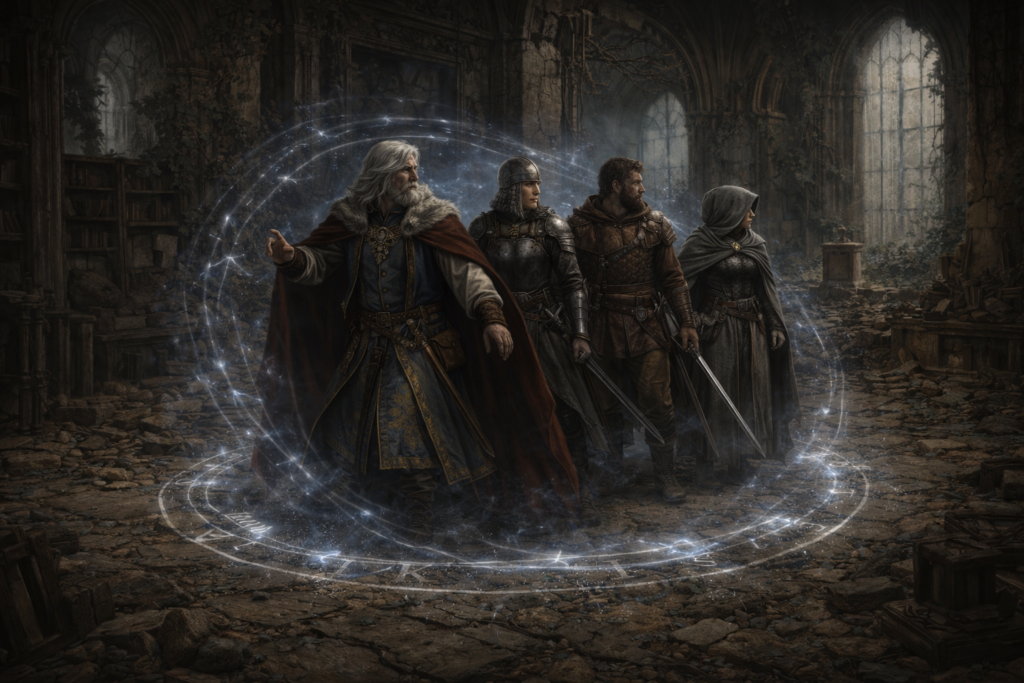
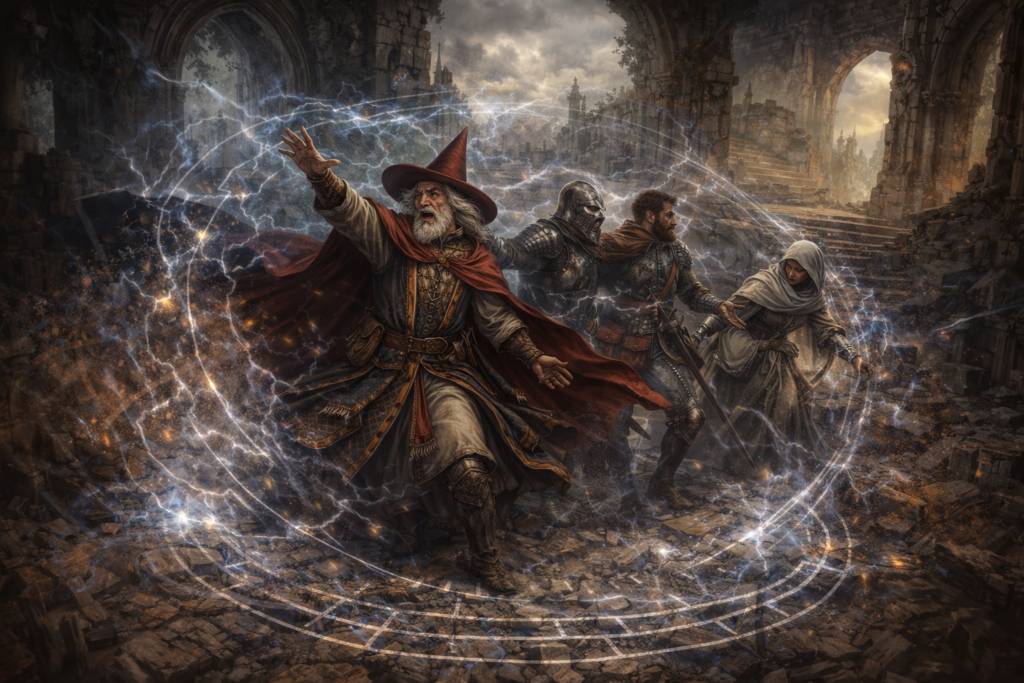
These paintings present three distinct interpretations of the spell in action. Their luminous circles and arcs represent the split-second distortion of departure or arrival, not a stable doorway that remains open after the spell resolves.
Tactical and Strategic Use
Teleport rewards preparation more than improvisation. The strongest castings begin before the crisis, when the party establishes safe destinations, studies arrival points and protects the knowledge that makes accurate travel possible.
Emergency Extraction
Remove a company from a collapsing fortress, an overwhelming enemy or an expedition that can no longer retreat by ordinary means. The caster still needs the freedom and opportunity to complete the spell.
Strategic Insertion
Move past distance, weather and conventional patrols to reach an allied stronghold, hidden base or previously studied approach. Arrival does not guarantee secrecy; observers at the destination can still see and hear the travellers appear.
Rescue and Relief
Bring healers, commanders or essential equipment to a distant crisis, then evacuate survivors whose continued presence would otherwise be impossible.
Secure Destinations
Maintain more than one prepared refuge. A single compromised arrival point turns a reliable escape plan into an ambush route.
Reconnaissance First
Scouting, scrying, maps and trustworthy witnesses can improve the caster’s understanding of a destination. They can also be manipulated, so information security matters as much as spellcasting power.
Objects as Leverage
Where the active edition allows objects to be transported, the spell can move documents, relics, supplies or dangerous cargo without exposing a full travelling party.
Risks, Wards and Countermeasures
Teleport is powerful because ordinary distance is not a defence. Secure powers therefore protect destinations rather than roads. They conceal layouts, rotate sensitive chambers, isolate arrival courts, maintain anti-teleportation wards and treat accurate descriptions as restricted information.
A false map, staged scrying image or altered room can be more useful than a wall. The objective is not always to stop the spell outright; it may be enough to lower the caster’s familiarity, redirect arrival or ensure that a seemingly safe location is no longer what the caster remembers.
Counterspelling works only while the spell is being cast. Dispelling is relevant to a continuing ward or magical obstruction, not to undoing an instantaneous journey that has already ended.
Campaign-World Consequences
Teleportation changes elite movement without making ordinary travel obsolete. The spell belongs to powerful casters, consumes major magical resources and remains dependent upon destinations, knowledge and security. Most people, armies and goods still move by road, river and sea. What changes is the speed at which exceptional people can intervene.
Courts and Diplomacy
Rulers can summon distant specialists, send envoys home within moments and coordinate crises across enormous territories. Audiences with powerful teleporters become matters of state security.
War and Intelligence
Small companies can redeploy faster than armies, extract commanders, deliver messages and strike prepared locations. Fortifications respond with layered wards, concealed layouts and controlled arrival zones.
Trade and Custody
Teleport favours objects of extreme value relative to their size: treaties, gemstones, medicines, arcane components and evidence. Bulk commerce remains tied to transport networks.
Crime and Law
Investigators must consider impossible entries and exits. Prisons designed for powerful spellcasters rely on more than locks, while possession of plans or destination-linked objects can become a serious offence.
Guilds and Infrastructure
Permanent circles create a privileged network of known destinations. Institutions record sigils, certify safe arrivals and control who may learn the sequences.
Culture and Reputation
A famous teleporter is not merely a traveller. They are an emergency route, diplomatic channel, military asset and potential security threat.
Running Teleport at the Table
- Name the destination precisely. Establish the actual place the caster intends to reach before discussing familiarity.
- Choose the familiarity category before rolling. Ask what the caster has seen, studied, received or carried from the site. Do not revise the category after seeing the result.
- Use only the active edition’s table. The modern and legacy outcomes produce materially different journeys.
- Make Similar Area meaningful. Select the closest location that genuinely resembles the intended destination. It should follow the spell’s logic rather than serve as arbitrary punishment.
- Respect established security. If a destination has wards, false layouts or controlled arrival chambers, establish those facts before the casting whenever the characters could reasonably have discovered them.
- Let preparation matter. Maps, reconnaissance, recovered objects, known circles and repeated visits should feel valuable because the spell is built around knowledge of place.
Historical and Occult Development
Stories of impossible movement are ancient, but the modern word teleportation belongs to the twentieth century. Charles Fort used it in his 1931 book Lo!—also preserved in the Internet Archive edition of Fort’s collected books—for a hypothetical force that might explain reported disappearances, appearances and displaced objects. Fort presented collections of anomalies and speculation rather than an experimentally demonstrated mechanism.
The idea entered a culture already fascinated by spiritualism, psychical research and claims of materialisation or apports—objects said to appear during séances or other paranormal events. The Society for Psychical Research, founded in 1882, sought to investigate such claims in a scientific spirit. These reports are historically important to occult and paranormal thought, but they do not establish literal physical teleportation.
Science fiction transformed the concept into a technological dream: matter disappears here and reappears elsewhere. Modern physics uses the same word in a much narrower sense. Quantum teleportation transfers quantum information between systems; it does not transport a person or object from one place to another. The fantasy spell remains closer to Fort’s imagined transportory force and to literary matter transmission than to the laboratory process.
Mythological and Folkloric Parallels
Folklore rarely describes teleportation with the precise logic of a roleplaying spell, but it repeatedly imagines enchanted objects that defeat ordinary distance.
Fortunatus’s Wishing Hat
In the Fortunatus tradition, a plain-looking hat carries its wearer to any place they desire. The device is a close literary parallel to destination-by-intent: possession of the object and a correctly formed wish replace the road entirely.
Seven-League Boots
European fairy tales give their wearer strides of impossible length. In Charles Perrault’s stories, preserved in Project Gutenberg’s collection, seven-league boots compress vast journeys into a handful of steps. They do not erase space completely, but they express the same fantasy of making geography yield to magic.
The Folded Road
Across later folklore and fantasy, impossible travel is often described as shortening, folding or stepping outside the road. These images treat distance as something that can be manipulated rather than merely endured—the central imaginative principle behind Teleport.
Further Viewing
These existing videos are retained as optional popular-science and speculative context. They are not rules sources and do not define how the fantasy spell functions.
Why Teleportation Is the Worst Science Idea Ever?
Ridddle examines the physical and philosophical problems behind matter-transmission models, including reconstruction and continuity of identity.
Why You Don’t Want Teleportation
Because Science considers momentum, moving planets and unsafe arrival coordinates—the practical dangers that speculative teleportation often ignores.
Sources & Licensing
Rules Sources and Licensing
D&D 5.5e / 2024
Rules checked against the official D&D Beyond Teleport entry, including the current familiarity table and 2d12-mile Off Target result.
D&D 5e / 2014
The 2014 panel follows the 2014 Teleport rules, including the 10-foot-cube object limit and 1d10 × 1d10 percent Off Target distance. It is kept separate from 2024 because those mechanics are not interchangeable.
Pathfinder 1e
Rules checked against the Archives of Nethys Teleport entry and its teleportation-subschool rules. Pathfinder Roleplaying Game material is used under the Open Game License v1.0a.
D&D 3.5e
Rules checked against the d20 System Reference Document Teleport entry. Relevant Open Game Content is used under the Open Game License v1.0a.
The Pathfinder 1e and D&D 3.5e mechanics summaries and outcome tables on this page are designated Open Game Content where their source licenses require it. Original explanatory prose, page presentation and illustrations are excluded from that designation.
Open Game License v1.0a and copyright notice
OPEN GAME LICENSE Version 1.0a
The following text is the property of Wizards of the Coast, Inc. and is Copyright 2000 Wizards of the Coast, Inc (“Wizards”). All Rights Reserved.
- Definitions: (a)”Contributors” means the copyright and/or trademark owners who have contributed Open Game Content; (b)”Derivative Material” means copyrighted material including derivative works and translations (including into other computer languages), potation, modification, correction, addition, extension, upgrade, improvement, compilation, abridgment or other form in which an existing work may be recast, transformed or adapted; (c)”Distribute” means to reproduce, license, rent, lease, sell, broadcast, publicly display, transmit or otherwise distribute; (d)”Open Game Content” means the game mechanic and includes the methods, procedures, processes and routines to the extent such content does not embody the Product Identity and is an enhancement over the prior art and any additional content clearly identified as Open Game Content by the Contributor, and means any work covered by this License, including translations and derivative works under copyright law, but specifically excludes Product Identity. (e)”Product Identity” means product and product line names, logos and identifying marks including trade dress; artifacts; creatures characters; stories, storylines, plots, thematic elements, dialogue, incidents, language, artwork, symbols, designs, depictions, likenesses, formats, poses, concepts, themes and graphic, photographic and other visual or audio representations; names and descriptions of characters, spells, enchantments, personalities, teams, personas, likenesses and special abilities; places, locations, environments, creatures, equipment, magical or supernatural abilities or effects, logos, symbols, or graphic designs; and any other trademark or registered trademark clearly identified as Product identity by the owner of the Product Identity, and which specifically excludes the Open Game Content; (f)”Trademark” means the logos, names, mark, sign, motto, designs that are used by a Contributor to identify itself or its products or the associated products contributed to the Open Game License (g)”Use”, “Used” or “Using” means to use, Distribute, copy, edit, format, modify, translate and otherwise create Derivative Material of Open Game Content. (h)”You” or “Your” means the licensee in terms of this agreement.
- The License: This License applies to any Open Game Content that contains a notice indicating that the Open Game Content may only be Used under and in terms of this License. You must affix such a notice to any Open Game Content that you Use. No terms may be added to or subtracted from this License except as described by the License itself. No other terms or conditions may be applied to any Open Game Content distributed using this License.
- Offer and Acceptance: By Using the Open Game Content You indicate Your acceptance of the terms of this License.
- Grant and Consideration: In consideration for agreeing to use this License, the Contributors grant You a perpetual, worldwide, royalty-free, non-exclusive license with the exact terms of this License to Use, the Open Game Content.
- Representation of Authority to Contribute: If You are contributing original material as Open Game Content, You represent that Your Contributions are Your original creation and/or You have sufficient rights to grant the rights conveyed by this License.
- Notice of License Copyright: You must update the COPYRIGHT NOTICE portion of this License to include the exact text of the COPYRIGHT NOTICE of any Open Game Content You are copying, modifying or distributing, and You must add the title, the copyright date, and the copyright holder’s name to the COPYRIGHT NOTICE of any original Open Game Content you Distribute.
- Use of Product Identity: You agree not to Use any Product Identity, including as an indication as to compatibility, except as expressly licensed in another, independent Agreement with the owner of each element of that Product Identity. You agree not to indicate compatibility or co-adaptability with any Trademark or Registered Trademark in conjunction with a work containing Open Game Content except as expressly licensed in another, independent Agreement with the owner of such Trademark or Registered Trademark. The use of any Product Identity in Open Game Content does not constitute a challenge to the ownership of that Product Identity. The owner of any Product Identity used in Open Game Content shall retain all rights, title and interest in and to that Product Identity.
- Identification: If you distribute Open Game Content You must clearly indicate which portions of the work that you are distributing are Open Game Content.
- Updating the License: Wizards or its designated Agents may publish updated versions of this License. You may use any authorized version of this License to copy, modify and distribute any Open Game Content originally distributed under any version of this License.
- Copy of this License: You MUST include a copy of this License with every copy of the Open Game Content You Distribute.
- Use of Contributor Credits: You may not market or advertise the Open Game Content using the name of any Contributor unless You have written permission from the Contributor to do so.
- Inability to Comply: If it is impossible for You to comply with any of the terms of this License with respect to some or all of the Open Game Content due to statute, judicial order, or governmental regulation then You may not Use any Open Game Material so affected.
- Termination: This License will terminate automatically if You fail to comply with all terms herein and fail to cure such breach within 30 days of becoming aware of the breach. All sublicenses shall survive the termination of this License.
- Reformation: If any provision of this License is held to be unenforceable, such provision shall be reformed only to the extent necessary to make it enforceable.
- COPYRIGHT NOTICE
Open Game License v 1.0 Copyright 2000, Wizards of the Coast, Inc.
System Reference Document Copyright 2000-2003, Wizards of the Coast, Inc.; Authors Jonathan Tweet, Monte Cook, Skip Williams, Rich Baker, Andy Collins, David Noonan, Rich Redman, Bruce R. Cordell, John D. Rateliff, Thomas Reid, James Wyatt, based on original material by E. Gary Gygax and Dave Arneson.
Pathfinder Roleplaying Game Core Rulebook © 2009, Paizo Publishing, LLC; Author: Jason Bulmahn, based on material by Jonathan Tweet, Monte Cook, and Skip Williams.
The Archives of Nethys. Copyright 2010, Blake Davis.
Original Teleport page material © 2026.
Keep this reference growing
If this page helped with your reading or game, you can support its upkeep or explore the curated books.
Explore the Bookshop — epics, classics and stories behind imagined worlds.