
Shambler Spell
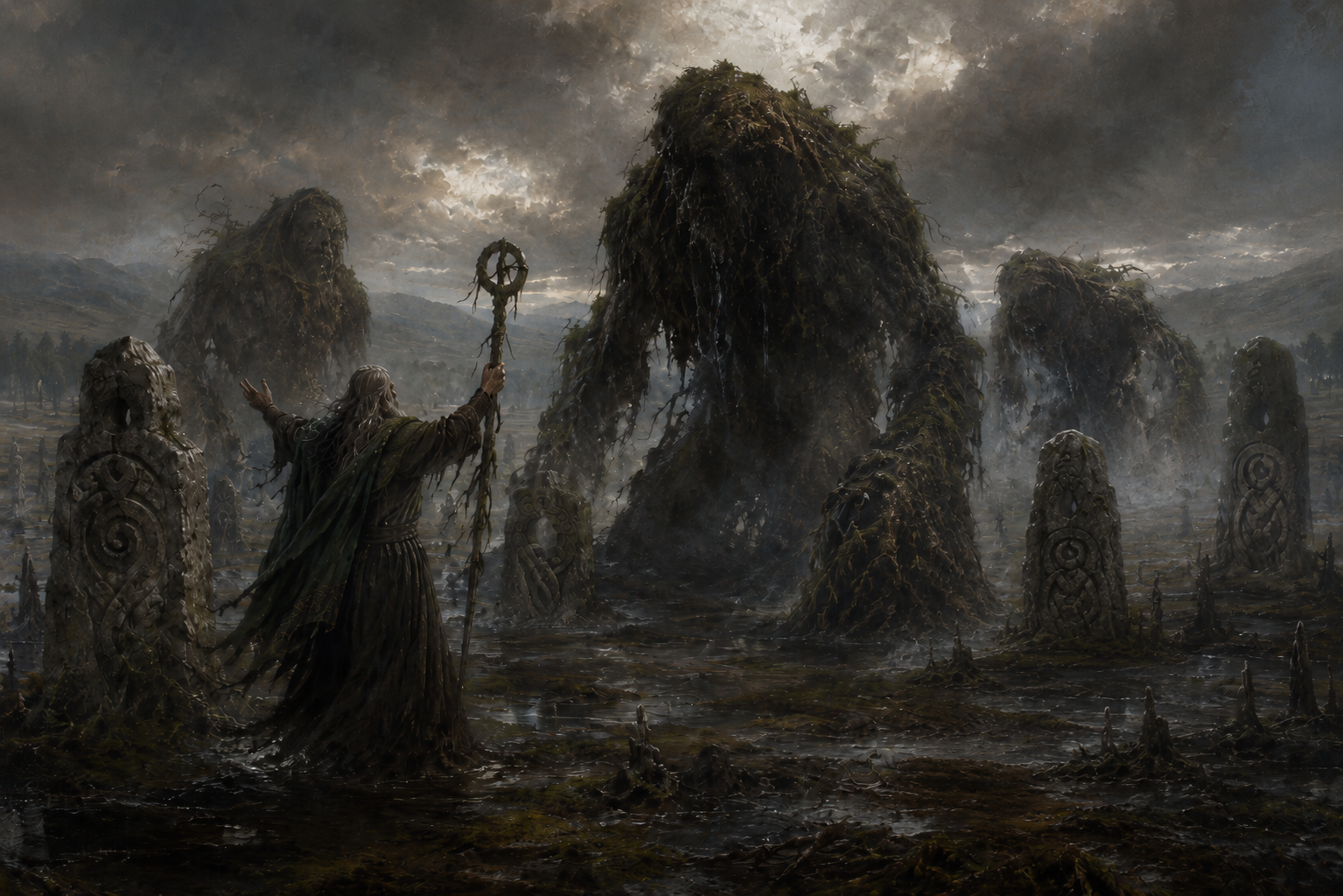
A great druid gives wet ground bodies of its own: shambling mound guardians for days, or territorial wardens for months.
Shambler is a 9th-level creation spell in Pathfinder 1e and D&D 3.5e. There is no direct official D&D 5e / 2014 or D&D 5.5e / 2024 version, so the previous modern conversion on this page has been removed.
The two legacy editions share the same long-duration identity but differ in the creatures created. D&D 3.5e creates 1d4+2 shambling mounds with 11 Hit Dice each. Pathfinder 1e instead creates 1d4+2 shambling mounds with the advanced template, and adds a one-casting-at-a-time limit.
Quick Rules Reference
- 5.5e / 2024: no direct official Shambler spell.
- 5e / 2014: no direct official Shambler spell.
- Pathfinder 1e: Druid 9, Shaman 9; creates 1d4+2 advanced shambling mounds.
- D&D 3.5e: Druid 9, Plant 9; creates 1d4+2 shambling mounds with 11 HD each.
- Normal duty: seven days.
- Guard duty: seven months, but the creatures must guard a specific site and remain within the spell’s range measured from where they appeared.
- Fire resistance: retained only in rainy, marshy or damp terrain.
Rules
Shambler by Edition
5.5e / 2024 — No Direct Official Shambler
The 2024 spell list does not contain Shambler. The former 9th-level modern conversion on this page was not published 2024 rules and has been removed.
5e / 2014 — No Direct Official Shambler
The 2014 rules do not contain a direct Shambler spell. If a campaign wants this exact months-long guardian effect, it is a legacy import or house rule rather than a 5e spell.
Shambler — Pathfinder 1e
| School | Conjuration (Creation) |
|---|---|
| Level | Druid 9, Shaman 9 |
| Casting Time | 1 standard action |
| Components | V, S |
| Range | Medium (100 ft. + 10 ft./level) |
| Effect | 1d4+2 shambling mounds with the advanced template |
| Duration | 7 days or 7 months (D) |
| Saving Throw | None |
| Spell Resistance | No |
The shambling mounds willingly aid you in battle, perform a specific mission, or serve as bodyguards for seven days.
If created only for guard duty, they remain for seven months, must guard a specific site, and cannot move outside the spell’s range measured from the point where each first appeared.
You can have only one Shambler spell active at a time. Casting it again dispels the previous casting.
The shamblers retain their normal fire resistance only if the terrain is rainy, marshy or damp.
Shambler — D&D 3.5e
| School | Conjuration (Creation) |
|---|---|
| Level | Druid 9, Plant 9 |
| Casting Time | 1 standard action |
| Components | V, S |
| Range | Medium (100 ft. + 10 ft./level) |
| Effect | 1d4+2 shambling mounds, 11 HD each |
| Duration | 7 days or 7 months (D) |
| Saving Throw | None |
| Spell Resistance | No |
The created shambling mounds willingly aid you in combat, carry out a specific mission, or serve as bodyguards for seven days.
If created only for guard duty, they remain seven months and cannot move outside the spell’s range measured from where each first appeared.
They have their normal fire resistance only in rainy, marshy or damp terrain.
What Changed?
- The invented 5.5e/2024 conversion has been removed.
- Pathfinder 1e and D&D 3.5e are now separate.
- Pathfinder creates advanced-template shambling mounds and limits the caster to one active Shambler spell.
- D&D 3.5e creates fixed 11-HD shambling mounds.
- The seven-day / seven-month duty split is preserved in both legacy editions.
Legacy 3.0 Shambler
Conjuration (Creation)
Level: Druid 9, Plant 9
Components: V, S
Casting Time: 1 standard action
Range: Medium (100 ft. + 10 ft./level)
Effect: 1d4+2 shambling mounds, 11 HD each
Duration: 7 days or 7 months (D)
Saving Throw: None
Spell Resistance: No
The older spell uses the same mission/bodyguard versus long-term guard-duty structure later seen in 3.5e.
Why This Spell Is Dangerous in the World
Shambler is dangerous because it lets one caster impose military force on a place for months.
A druid can close a road without soldiers. A grove can defend itself after its priesthood has gone into hiding. A plague pit can be guarded through an entire season. A sacred spring can become inaccessible to tax collectors, tomb robbers, rival cults, or royal surveyors. A bridge, ferry, burial mound, ruined monastery, fey gate, or old battlefield can be made lethal without building a wall.
That makes the spell a matter of law and politics as much as magic. A circle that casts Shambler has made a territorial claim. Anyone who crosses that boundary may be treated as an intruder by creatures that do not negotiate unless commanded to do so.
The spell is especially feared in wet country. In marsh, rain, riverland, bog, fen, drowned woodland, or floodplain, the shambling mounds are harder to burn away and easier to mistake for part of the terrain. A heap of reeds by the causeway may be a monster. A compost bank beside a shrine may be a guard. A mass of drowned roots under a bridge may be waiting for a command spoken months ago.
Best Uses in Play
Guard a sacred location. Shambler is strongest when attached to a place that matters: a grove, shrine, burial mound, oracle spring, plague boundary, witch-tree, fey crossing, or forbidden road.
Hold wet terrain. Rain, marsh, riverbank, flooded ruin, and damp woodland all help the spell feel properly dangerous.
Protect a vulnerable ritual. Seven days is long enough for funerals, seasonal rites, exorcisms, coronations, plague burnings, curse-breakings, and long druidic workings.
Create a living bodyguard screen. The shambling mounds can protect an archdruid, oracle, sacred beast, wounded ruler, or ritual caster.
Deny movement. The seven-month guard form can close a road, bridge, ford, mine entrance, cave mouth, harbour path, or forest track.
Failure, Risk, and Misuse
The spell is powerful, but not subtle once discovered.
Its guard-duty form cannot be turned into a travelling army. If the caster wants the shambling mounds to move, fight abroad, escort a company, or complete a mission, the duration is seven days, not seven months.
The terrain can also betray the spell. Dryness, drainage, drought magic, alchemical fire, controlled burning, firebreaks, and siege preparation all weaken its strongest defensive advantage.
The gravest risk is command. A badly worded order can make the shambling mounds too passive, too aggressive, or dangerously literal. “Guard this place against trespassers” may sound sensible until pilgrims, messengers, lost children, wounded soldiers, envoys, or villagers fleeing floodwater enter the protected ground.
A wise caster defines the boundary, the protected object, the permitted people, and the conditions under which force should be used.
Investigation and Counterplay
Shambler should be foreshadowed before it attacks.
Useful signs include reed beds leaning against the wind, heaps of leaves that return after being cleared, animal trails ending at a wet boundary, bootprints swallowed by root growth, old mud rising in rounded shapes, or a shrine approach where no bird will land.
Counterplay should depend on terrain and preparation. Characters may drain the ground, lure a shambler beyond its allowed range, fly over the guarded area, negotiate with the caster’s circle, identify the boundary of the spell, burn the vegetation in dry conditions, or use divination to learn the original command.
In wet terrain, direct assault should feel costly. Shambler is a 9th-level spell. If the party charges into a guarded fen without scouting, the land should punish them for it.
When This Spell Appears
Shambler works best when the spell reveals that someone powerful prepared the ground long before the characters arrived.
The guardians are not just monsters. They are evidence. They prove that a place was claimed, feared, protected, cursed, or sealed. Their presence should raise questions: who cast the spell, what were they protecting, who were they trying to keep out, and why has no one dismissed the guardians yet?
Used well, Shambler turns scenery into history. The road, shrine, marsh, or ruin becomes part of the encounter instead of a backdrop for it.
Rules Clarifications and Edge Cases
Can the shambling mounds leave the area?
Yes, if the spell is being used for its normal seven-day duration. No, if it was cast only for seven-month guard duty.
Can the caster change the spell into the seven-month version later?
No. The long duration applies only if the shambling mounds are created for guard duty from the start.
Does the spell require concentration?
No. The duration is fixed.
Do the shambling mounds have fire resistance everywhere?
No. They have their normal fire resistance only in rainy, marshy, wet, swampy, or damp terrain.
Are the shambling mounds natural creatures?
They use shambling mound statistics, but they are created by the spell and collapse when the spell ends.
Can they be dismissed?
Yes. The caster can dismiss the spell, ending the created shamblers.
Adventure and Worldbuilding Hooks
The Seven-Month Gate
A mountain pass should have opened after winter, but the druid who set its guardians has died. Merchants want the road cleared. The nearby villages insist the shamblers are still keeping something worse from coming through.
The Marsh That Joined the War
A baron sends soldiers through a wetland to flank an enemy army. None return. The enemy has not occupied the marsh; the marsh has been given orders.
The Shrine That Refuses the Crown
Royal surveyors arrive to claim an old sacred grove for timber and road-building. The shambling mounds surrounding the shrine do not attack villagers, pilgrims, or children, but they crush anyone carrying the king’s measuring rods.
Related Spells
- Animate Plants: Turns existing vegetation into active force, but lacks Shambler’s long-duration created guardians.
- Liveoak: Another long-lasting druidic guardian spell, especially useful for comparing tree-bound protection with mobile plant wardens.
- Wall of Thorns: Controls movement through plant magic but does not create independent defenders.
- Transport via Plants: Pairs well with Shambler when druids need to move between defended groves, tree-roads, and hidden circles.
- Control Weather: Strengthens Shambler’s battlefield identity by bringing rain, mud, and damp conditions that make the shambling mounds harder to burn away.
Historical, Botanical, and Mythic Context
Shambler draws on one of the oldest fears in landscape myth: the belief that land may have will. Woods, marshes, bogs, groves, riverbanks, and burial grounds often carry a dangerous presence in legend. They mislead travellers, hide the dead, preserve old crimes, shelter spirits, and punish those who cross forbidden boundaries without permission.
The spell’s shambling mounds are best understood as guardians made from place-memory. They are not elegant tree-knights or decorative plant servants. They are wetland bodies assembled from peat, reed, moss, drowned root, fallen leaves, and black earth. Their horror comes from weight and patience. They feel as if the land has remembered every body, branch, oath, and trespass buried inside it.
This makes Shambler especially close to traditions of sacred groves, haunted bogs, guardian trees, and boundary spirits. A grove may protect a god. A marsh may hide a corpse. A boundary tree may mark an oath. A bog may preserve what should have rotted away. The spell turns those ideas into visible force: the landscape rises and enforces the rule laid upon it.
The botanical imagery behind the spell is equally important. Wetlands are places of preservation and transformation, where water, low oxygen, peat, decay, and dense root systems create terrain that seems half-alive. Useful real-world starting points include wetlands, peat, and bog bodies. These links are not the spell’s source, but they help ground the image of a creature made from waterlogged earth and preserved organic matter.
In play, Shambler should feel like an oath given mass. It is the spell a druid casts when a ford must stay closed, a shrine must not be touched, a plague pit must not be opened, or a sacred grove must outlast the mortal hands that defend it.
Keep this reference growing
If this page helped with your reading or game, you can support its upkeep or explore the curated books.
Explore the Bookshop — epics, classics and stories behind imagined worlds.