
Bard Magic • Spell Reference
Speak with Plants Spell
Green Tongue • Plant Communication and Living Terrain
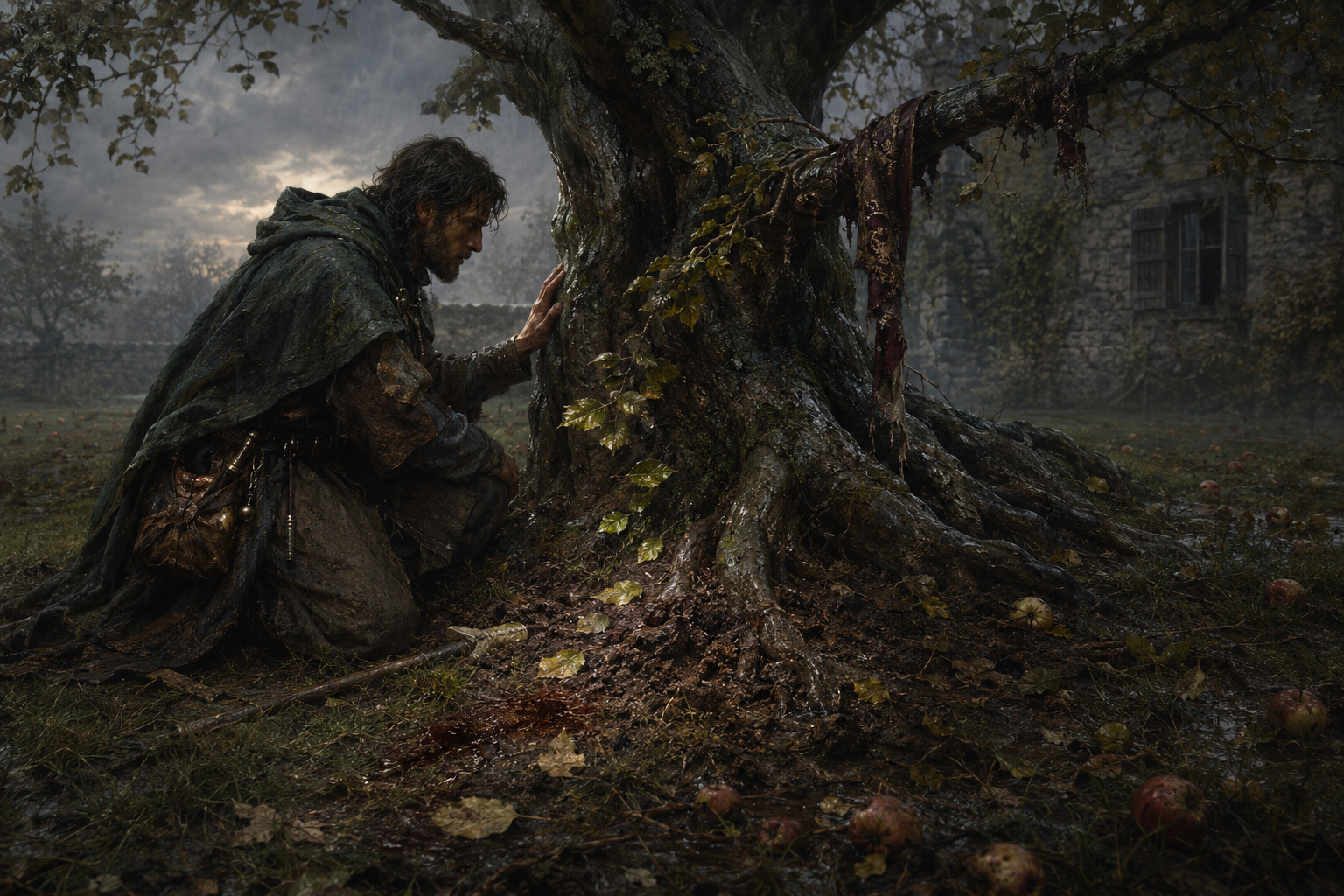
Speak With Plants gives voice to the living green world. In current 5.5e play it can question plants about the previous day, animate vegetation enough to follow simple commands, and reshape plant-covered terrain. In Pathfinder 1e and D&D 3.5e it is primarily a conversation with normal plants and plant creatures whose awareness, intelligence and attitude still matter.
Grass, trees, moss, vines, hedgerows, orchard rows, thorn brakes, ancient yews, graveyard ivy, sacred groves and plant creatures can all become sources of information, warning, negotiation and strange testimony.
The useful image is that of a rooted witness: a living thing whose relationship with a place is deeper and stranger than a human observer’s. That idea should give the spell character without taking away information that the rules actually grant.
Speak with Plants at a Glance
| Spell role | Environmental investigation, wilderness communication, negotiation and living-terrain control. |
|---|---|
| Current edition | Level 3 Transmutation for Bard, Druid and Ranger. |
| 5e / 2014 | 3rd-level Transmutation for Bard, Druid and Ranger; see its separate rules panel. |
| Legacy editions | Divination; Bard 4, Druid 3, Ranger 2 in Pathfinder 1e and D&D 3.5e. |
| Best environments | Forests, gardens, orchards, hedges, graveyards, ruins, roadsides, marshes, fields and plant-creature territories. |
| Best questions | Ask what passed, what changed, what harmed the plants, what happened recently and where disturbances occurred. |
| Central principle | Communication does not automatically make an intelligent plant friendly, truthful or loyal. |
Spell Rules by Edition
Speak with Plants — 5.5e / 2024
Rules source: System Reference Document 5.2.1.
System Reference Document 5.2.1 spell
| Level & School | Level 3 Transmutation |
|---|---|
| Casting Time | Action |
| Range | Self |
| Area | Immobile 30-foot Emanation |
| Components | V, S |
| Duration | 10 minutes |
Alternative SpiralWorlds name: Green Tongue
Rules Effect
Plants in the spell’s immobile 30-foot Emanation gain limited sentience and animation. They can communicate with you and follow simple commands.
You can question the plants about events that occurred in the spell’s area during the previous day. The information can include creatures that passed through, weather and other circumstances.
The spell can also alter plant-covered terrain for its duration. Difficult Terrain created by plant growth, such as thickets or undergrowth, can become ordinary terrain. Ordinary terrain where plants are present can instead become Difficult Terrain.
Plants cannot uproot themselves and walk away, but they can move branches, tendrils and stalks for you.
If a Plant creature is inside the area, you can communicate with it as though you shared a common language. Communication alone does not grant magical control over that creature.
The past-day information is an explicit part of the modern spell. A GM can give the information in an unusual botanical voice, but should not replace it with “the plants know nothing” merely because an ordinary plant would lack human senses without the spell.
Practical Rulings
Optional adjudication — not additional spell rules
- No check is required to make the spell work. If the plants possess information that the spell says they can provide, give that information.
- Use strange perspective as presentation. A hedge might describe heavy creatures forcing through its branches, the smell of smoke, repeated passage or fresh blood rather than using a guard’s vocabulary.
- Do not impose an automatic action cost for every question. Conversation follows the normal rules for speech and whatever action is actually being taken. The spell itself does not create a special “one question per Action” rule.
- Simple commands are real. Plants may move branches, stalks and tendrils in response. Do not silently turn this into a separate attack, damage effect or condition unless another rule supports that result.
- Use the terrain rule when the goal is obstruction. If the caster wants vegetation to hinder movement, the spell already provides a defined way to create Difficult Terrain.
- The Emanation is immobile. It is fixed rather than travelling with the caster.
- Plant creatures keep their own motives. The spell permits communication but does not Charm them, compel honesty or make them allies.
- Optional checks belong after the information. A Nature, Survival, Investigation, Insight or other appropriate check may help a character interpret clues, combine several observations or draw an additional conclusion. It should not be required merely to receive information granted by the spell.
Speak with Plants — 5e / 2014
Rules source: System Reference Document 5.1.
| Level & school | 3rd-level Transmutation |
|---|---|
| Classes | Bard, Druid, Ranger |
| Casting time | 1 action |
| Range | Self (30-foot radius) |
| Components | V, S |
| Duration | 10 minutes |
Rules Effect
Plants within 30 feet gain limited sentience and animation for the duration, enabling conversation with you and simple commands. You can ask about events in the spell’s area during the past day, including passing creatures, weather and other circumstances.
You may turn difficult terrain caused by plant growth, including thickets and undergrowth, into ordinary terrain for the duration. You may instead make ordinary terrain where plants are present into difficult terrain for the duration, with vines and branches hindering movement.
The Games Master may allow plants to perform additional tasks. They cannot uproot themselves and travel, but they can freely move their branches, tendrils and stalks.
You can communicate with a plant creature in the area as if you shared a language. This grants no magical ability to influence that creature.
This edition explicitly allows plants created by Entangle to release a restrained creature.
Edition distinction: the 2014 text says plants within 30 feet of you; it does not specify the revised spell’s immobile Emanation. Use the 2014 wording and agree any disputed movement interpretation with the Games Master. The 2024 spell is explicitly stationary and omits the 2014 Entangle-release clause.
Speak with Plants — Pathfinder 1e
Pathfinder Roleplaying Game Core Rulebook spell
| School | Divination |
|---|---|
| Core spell lists | Bard 4, Druid 3, Ranger 2 |
| Casting Time | 1 standard action |
| Components | V, S |
| Range / Target | Personal / You |
| Duration | 1 minute/level |
Rules Effect
You can communicate with normal plants and plant creatures, asking questions and receiving answers.
A normal plant has a limited sense of its surroundings. It cannot give or recognise detailed descriptions of creatures and cannot answer questions about events outside its immediate vicinity.
The spell does not make plant creatures friendlier or more cooperative. Wary or cunning plant creatures can be terse or evasive, while less intelligent creatures may give very simple or irrelevant responses. A plant creature that is already friendly may choose to provide a favour or service.
Practical Rulings
Optional adjudication — not additional spell rules
- Phrase questions around things the plant could reasonably have experienced: damage, passage, weather, shade, fire, trampling, digging, blood, poison, water or repeated disturbance.
- No skill check is required simply to communicate.
- A Knowledge (nature) or Survival check can be useful when a character is interpreting several fragmentary clues rather than merely asking the spell to function.
- Use Sense Motive when the issue is whether an intelligent plant creature is evasive or deceptive.
- Use Diplomacy when a character is trying to persuade an intelligent plant creature to provide voluntary help.
- Communication is not control. A friendly plant creature may help because it chooses to, not because the spell has compelled it.
Rules source: Pathfinder Core Rulebook.
The listed Pathfinder levels are the Core Rulebook Bard, Druid and Ranger lists. Supplemental classes and individual character options can provide other access.
Speak with Plants — D&D 3.5e
Revised System Reference Document spell
| School | Divination |
|---|---|
| Level | Bard 4, Druid 3, Ranger 2 |
| Casting Time | 1 standard action |
| Components | V, S |
| Range / Target | Personal / You |
| Duration | 1 minute/level |
Rules Effect
You can comprehend and communicate with plants, including normal plants and plant creatures, and may ask questions and receive answers.
A normal plant’s awareness of its surroundings is limited. It cannot provide or recognise detailed descriptions of creatures and cannot answer questions about events outside its immediate vicinity.
Plant creatures do not become friendlier or more cooperative. Wary and cunning plant creatures may be terse or evasive; less intelligent ones may offer simple or irrelevant comments. A plant creature that is already friendly may choose to perform a favour or service.
Practical Rulings
Optional adjudication — not additional spell rules
- Ask about physical experience rather than assuming a normal plant possesses humanoid concepts.
- Do not import the 5.5e past-day information guarantee, terrain manipulation or simple-command mechanics into the 3.5e spell.
- Knowledge (nature) and Survival are useful for interpreting environmental clues.
- Sense Motive can apply when an intelligent plant creature is concealing its intentions.
- Diplomacy can apply when requesting additional voluntary assistance.
- The Plant Control feat directly builds on this spell: it requires the ability to cast Speak With Plants and Plant Defiance. Plant Control has its own command mechanics; those abilities are not part of Speak With Plants itself.
Rules source: Revised System Reference Document.
The Rooted-Witness Principle
The strongest way to portray Speak With Plants is to let vegetation answer from a perspective shaped by place, growth and disturbance without arbitrarily making its answers useless.
A roadside tree might speak of the iron-rimmed wheel that scarred one root, the body that swung from a branch, the wolf that returned every night or the rider who crashed through its lower limbs. Grass might remember a mass of heavy feet. Reeds might remember blood, hot metal and the direction from which something entered the marsh.
In the legacy editions this perspective reflects the normal plant’s explicitly limited awareness. In 5.5e it is primarily a way to make the magically granted information feel like information from plants rather than a police report.
Why This Spell Is Dangerous in the World
Speak With Plants is dangerous because it gives voice to places people assume are silent.
A murderer may avoid human witnesses but forget the hedge forced aside during the escape. A poacher may hide from the lord’s foresters but not from the wounded oak. A grave robber may sweep away footprints but still tear roots while digging. A locked house may seem private while ivy covers the wall beneath an upper window.
The spell also changes power in rural and sacred places. Druids, rangers, woodland courts, fey-touched families, grove guardians and other practitioners may learn things that ordinary investigators cannot. Fields can become witnesses. Orchards can remember disturbance. Graveyard yews can speak of midnight visitors. Ancient groves can make secrecy far more difficult than rulers expect.
Its danger is not that every leaf becomes an all-knowing spy. Its danger is that the living world may possess information about what happened where no humanoid witness was watching.
Best Uses
Investigating a Trail
Use Speak With Plants where ordinary tracking becomes uncertain: crossroads, trampled grass, muddy banks, hedgerows, broken reeds, graveyards, ruined courtyards, forest paths, battlefields or gardens.
In current play the spell can directly gather information about creatures that passed through its area during the previous day. In legacy play, question vegetation whose immediate surroundings were physically disturbed.
Finding Hidden Things
Plants are particularly useful around disturbed soil and locations visited repeatedly. Roots, grass, vines and hedges may provide clues leading toward buried weapons, concealed corpses, hidden shrines, smuggler caches, covered wells, trapped paths or places where someone returned again and again.
Negotiating with Plant Creatures
The spell lets the caster speak directly with awakened trees, treants, assassin vines, shambling mounds, blights, sentient fungi, sacred orchard spirits and other plant creatures.
Conversation may be more useful than combat, but language does not remove hunger, territorial instinct, ancient loyalties, resentment or hostility.
Reading the Health of a Place
Plants can become excellent witnesses to drought, poison, ash, salt, disease, unnatural growth, blood-fed soil, cursed rain, necromantic rot, supernatural corruption, fey influence or alchemical runoff.
This makes Speak With Plants useful for wilderness mysteries, plague stories, ruined gardens, sacred groves, polluted waterways and poisoned estates.
Controlling Living Terrain in 5.5e
Current Speak With Plants is not only an information spell. In vegetation it can turn ordinary ground into Difficult Terrain or remove Difficult Terrain caused by plant growth for the duration.
That gives the spell real tactical value during pursuit, withdrawal, defence of a position, movement through dense undergrowth or an attempt to slow creatures crossing a planted area.
Tactics
Ask Useful Questions
Questions about what happened usually work better than questions loaded with assumptions.
Strong questions include:
- “What happened here yesterday?”
- “What creatures passed through?”
- “What damaged this place?”
- “Where was the ground disturbed?”
- “What came here repeatedly?”
- “What changed after the rain?”
- “Which direction did the disturbance continue?”
- “What has been harming the plants here?”
Legacy casters benefit particularly from sensory and physical phrasing because normal plants are explicitly limited in their awareness.
Question the Whole Area
Do not assume the adventure depends on finding the single perfect tree. Grass, moss, hedges, reeds, orchard rows, undergrowth and nearby trees can together form a much clearer picture of a scene.
In 5.5e the spell affects plants throughout its Emanation. Use that area rather than unnecessarily reducing the effect to a conversation with only one specimen.
Use the Terrain Effect Deliberately
In 5.5e, changing terrain can be as important as questioning the plants. Use Difficult Terrain to delay pursuers or protect a position, or clear plant-created Difficult Terrain when speed matters.
Remember the Area Is Stationary
The current spell uses an immobile 30-foot Emanation. Choose the casting point carefully when the party wants to question a scene or manipulate its vegetation.
Do Not Treat Intelligent Plant Creatures as Tools
An intelligent plant creature may be older than the road, angrier than the village and far less impressed by humanoid urgency than the party expects. Approach it as a witness, neighbour, guardian, predator or local power.
GM Notes
The spell works best when the answer moves the adventure forward while still feeling as though it came from the living environment.
Do not make every answer useless. A player has chosen and cast a spell specifically intended to communicate with plants. Reward sensible use of that resource.
At the same time, the answer does not need to sound like a human investigator speaking through a tree.
Plant testimony might sound like:
- “Heavy feet came after moon-cold. Many. Iron pressed the mud.”
- “The thin one came often. Always with salt hands. Always to the buried place.”
- “Blood warmed my roots. Then the soil was opened. Then closed.”
- “The horse broke my lower branch. The rider smelled of smoke.”
- “The dead water came from the black ditch. It burned the reeds.”
- “The thorn remembers the cloak because a piece of it remained.”
Those answers can still convey concrete information. Mystery comes from interpretation and context, not from refusing to let the spell do what it says.
Optional Interpretation Checks
A check should normally answer a question beyond the spell itself: what a clue means, how several clues fit together, whether an intelligent plant creature is deceiving the party, or which mundane conclusion follows from the testimony.
Do not require a successful check merely to receive information that the spell already grants.
Related Spells, Skills, Feats and Character Options
Best Spell Combinations
- Speak With Animals — compare the testimony of rooted plants with creatures that can move through the surrounding area. Animals and plants may have noticed completely different parts of the same event.
- Locate Object — plant testimony can narrow the search area or establish where an object was carried before the caster tries to locate it.
- Detect Poison and Detect Disease — useful when vegetation describes tainted water, diseased growth, poison, dying roots or a sudden change in the health of a place.
- Pass Without Trace — an important investigative interaction. Concealing tracks does not automatically erase every disturbance or piece of information available through plant communication; apply the actual rules of the relevant editions.
- Entangle — manipulates surrounding vegetation to restrain or impede creatures, making it a natural companion to a spell concerned with communicating with that same living environment.
- Spike Growth — weaponises ground-covering vegetation and roots. Particularly useful when plant testimony has already revealed where enemies are approaching from.
- Plant Growth — changes vegetation on a much larger scale. In current play, Speak With Plants can then interact with living terrain directly and temporarily change movement through plant-covered ground.
- Commune With Nature — supplies broad knowledge of the surrounding natural region, while Speak With Plants deals with the much more immediate testimony and behaviour of vegetation.
The Wider Plant-Magic Family
Speak With Plants sits inside a much larger body of plant magic. These spells do different jobs and should not be treated as interchangeable, but together they show the progression from detecting and communicating with vegetation to shaping, awakening, commanding and travelling through it.
- Detect Animals or Plants — locates particular kinds of animals or plants rather than communicating with them.
- Diminish Plants — prunes or stunts normal vegetation and directly opposes some uses of Plant Growth.
- Command Plants — moves beyond communication into magical influence over plant creatures.
- Awaken — grants a tree lasting sentience rather than the temporary limited sentience created by the current Speak With Plants spell.
- Tree Shape — transforms the caster into the form of a tree rather than allowing communication with vegetation.
- Tree Stride — turns living trees into a means of supernatural movement.
- Transport via Plants — uses living plants as gateways for much longer-distance travel.
- Liveoak — turns a suitable oak into a supernatural guardian.
- Animate Plants — gives ordinary plants mobility and combat utility rather than merely allowing conversation.
- Control Plants — directly controls plant creatures and therefore represents a much stronger form of magical authority than Speak With Plants.
- Repel Wood — manipulates wooden material and creatures caught in its advancing effect rather than communicating with living vegetation.
- Wall of Thorns — creates a formidable barrier of magically produced vegetation.
- Shambler — creates shambling mound guardians, extending plant magic into the creation of powerful protectors.
Relevant Skills
These skills do not make Speak With Plants work and should not be required merely to receive information granted by the spell. They become useful when the character interprets evidence, follows a trail or negotiates with an intelligent plant creature.
- Knowledge (nature) — the most directly relevant legacy knowledge skill for plants, natural environments, seasons, weather and related creatures.
- Survival — combines naturally with plant testimony when following tracks, identifying routes or interpreting signs left in the wilderness.
- Diplomacy — relevant when an intelligent plant creature can communicate but still needs to be persuaded to cooperate.
- Sense Motive — useful when an intelligent plant creature may be evasive, hostile or deceptive.
Relevant Feats
- Plant Control — the most important direct feat connection. Its prerequisite includes the ability to cast Speak With Plants and Plant Defiance, and commanding a plant requires the ability to communicate with it through a Speak With Plants effect.
- Plant Defiance — part of the same legacy plant-focused feat chain and a prerequisite for Plant Control.
- Naturalist — improves Knowledge (nature) and Survival, making it particularly useful when interpreting botanical testimony and wilderness evidence.
- Sylvan Empathy — provides a useful contrast with Speak With Plants. It can reveal basic impressions about the local ecosystem but explicitly does not grant the ability to communicate as the spell does.
- Track — combines Survival-based tracking with the additional environmental evidence that Speak With Plants can reveal.
- Negotiator — improves Diplomacy and Sense Motive, both useful when dealing with intelligent plant creatures rather than ordinary vegetation.
- Self-Sufficient — improves Survival and therefore supports the wilderness-investigation side of the spell.
Related Character Option
The Voice of the Forest prestige class has a particularly close relationship with this magic. Its Voice of the Trees ability explicitly allows communication with plants and plant creatures as Speak With Plants and develops into stronger forms of plant manipulation.
Speak With Plants in 1454
In 1454, vegetation surrounds much of everyday life. Roads are bordered by hedges and verges. Towns contain gardens, orchards, vines and courtyards. Villages are surrounded by fields, woods and pasture boundaries. Noble estates depend upon managed forests, vineyards, kitchen gardens and orchards. Graveyards, ruins and old defensive works are often overgrown.
Speak With Plants therefore has uses far beyond an isolated wilderness.
A forester can question vegetation around an illegal felling. An orchard keeper can discover what disturbed the trees during the night. A ranger can question reeds along a river crossing. A druid can ask what poisoned a field. A court magician can question the ivy beneath a supposedly inaccessible window. A gardener may know that a hedge has been opened and closed at the same place night after night.
In rural communities, people capable of doing this may be respected, feared or both. A field can become evidence. An orchard can complicate a murder. A boundary hedge can remember repeated trespass. A graveyard yew may have information about whoever opened a tomb after dark.
Druids may treat the spell as an act of listening before intervention. Rangers can combine it with fieldcraft and knowledge of trails. Bards may preserve garden songs, orchard charms and old formulas for addressing cultivated plants.
Learned natural philosophers can treat the resulting testimony as another form of observation: powerful, unusual and valuable, but something whose context must still be understood.
Noble Estates and Political Danger
Gardens can be politically dangerous when they can answer back. A vineyard may know where one row was deliberately contaminated. A maze hedge may know where a missing heir went. Ivy might know that someone climbed a supposedly secure wall. An orchard may know that a grave beneath its trees was opened twice.
This does not make every garden an infallible court witness. It does make vegetation another source of information that conspirators must remember exists.
Fey-Haunted Places
In places strongly touched by the fey, speaking to plants may become stranger still. Vegetation may gossip, judge, accuse, bargain or repeat old griefs. Intelligent or supernatural plant beings may have loyalties and memories extending far beyond those of ordinary vegetation.
Adventure and Worldbuilding Hooks
1. The Orchard That Accuses
A noble family asks the party to investigate a murder in an orchard. The trees insist that the victim was buried twice: once in haste and once with ceremony. Someone returned after the first burial and moved the corpse.
2. The Hedge Refuses the Road
A living hedge blocks an old trade route and refuses to open for wagons. When questioned, it says that the road “ate children” during the last winter fog. The nearby village insists that no children are missing.
3. The Reeds Remember Fire
A body is found in a river marsh, but the reeds speak of smoke, hot iron and a horse that refused to enter the water. The murder happened somewhere else and the corpse was moved.
FAQ
What does Speak With Plants do in 5.5e / 2024?
It gives plants in an immobile 30-foot Emanation limited sentience and animation, lets them communicate with the caster and follow simple commands, provides information about events in the area during the previous day, allows plant-covered terrain to be changed to or from Difficult Terrain for the duration, and permits branches, tendrils and stalks to move without allowing plants to uproot themselves and walk away.
What changes between the 2024 and 2014 spells?
Both modern spells are level 3 Transmutation with plant conversation, simple commands, past-day information and temporary terrain changes. The 2024 area is an immobile 30-foot Emanation. The 2014 version expressly includes release from Entangle and GM-approved additional tasks; those clauses are absent from the 2024 spell.
Is Speak With Plants Divination or Transmutation?
It depends on the edition. In 5.5e / 2024 it is a Level 3 Transmutation spell. It is also 3rd-level Transmutation in 5e / 2014. In Pathfinder 1e and D&D 3.5e it is Divination.
Can ordinary plants identify a specific person?
Do not apply one answer to every edition.
In 5.5e, the spell explicitly provides information about creatures that passed through the area during the previous day. Do not impose a blanket rule that ordinary plants are incapable of giving useful identifying information. The answer may still be expressed through distinctive circumstances, behaviour, objects, damage or other features rather than a formal human identity.
Pathfinder 1e and D&D 3.5e explicitly state that a normal plant has limited awareness and cannot give or recognise detailed descriptions of creatures.
Can Speak With Plants solve a murder mystery?
It can reveal extremely important evidence, especially when vegetation was present at the scene. That does not necessarily establish motive, legal responsibility or the meaning of every clue. Let the spell provide the information it is entitled to provide, then allow investigation to determine what that information means.
Does Speak With Plants make plant creatures friendly?
No. Communication is not friendship or magical influence. Intelligent plant creatures keep their existing goals, loyalties, grudges and attitudes.
Can plants lie?
The spell is not a truth-compulsion effect. Intelligent plant creatures can certainly deceive, evade or bargain. With ordinary plants, avoid using uncertainty or unusual phrasing simply as a device for withholding information that the edition’s spell says should be available.
Can plants report conversations?
Edition matters here too. The modern spell does not state a universal rule that magically awakened plants are incapable of conveying anything connected with speech; it grants information about events and circumstances during the previous day. The GM decides how the plant’s limited sentience expresses that information.
In the legacy versions, a normal plant’s limited sense of its surroundings is a much stronger restriction, so exact humanoid dialogue will often be beyond what that plant can meaningfully report.
Can plants attack creatures when given simple commands?
Not automatically. The 5.5e spell says plants can follow simple commands and move branches, tendrils and stalks, but it does not itself give ordinary vegetation an attack roll, damage value or automatic condition. Use the spell’s explicit Difficult Terrain rule when the intended effect is to impede movement.
Does the 5.5e Emanation move with the caster?
No. Speak With Plants specifically creates an immobile 30-foot Emanation.
Historical, Botanical and Mythic Context
Plants do not speak in a human sense, but modern botany gives Speak With Plants useful imagery to build from. Plants respond to touch, damage, drought, light, pests, disease and other organisms through physical and chemical processes.
Plant communication research often discusses volatile organic compounds: airborne chemical signals involved in interactions among plants, herbivores, pollinators, microorganisms and neighbouring vegetation.
For accessible real-world starting points, see Royal Botanic Gardens, Kew on plant odours and chemical information and the Max Planck Society on chemical communication in plant communities.
This real-world background does not turn Speak With Plants into scientific translation. The spell is magical. The natural science simply gives the fantasy richer texture: plants are living organisms continuously affected by their surroundings rather than inert scenery.
Mythically, speaking with trees and plants belongs to an older idea that groves, orchards, sacred trees, boundary hedges and graveyard growth participate in the moral and supernatural landscape.
A sacred tree may remember an oath. A thorn hedge may guard a border. A graveyard yew may hold the memory of repeated visitors. An old grove may possess obligations that began before the nearby road existed.
Speak With Plants is at its most distinctive when the land is not merely background but a living participant in history.
Sources, Attribution and Licensing
Rules References
System Reference Document 5.1 supplies the 2014 panel.
- D&D Beyond — Speak With Plants, current rules reference .
- System Reference Document 5.2.1 .
- Pathfinder Reference Document — Speak With Plants .
- Revised System Reference Document — Speak With Plants .
- Revised System Reference Document — Plant Control and Plant Defiance .
Botanical References
- Royal Botanic Gardens, Kew — Deceptive plant smells: Camouflaging with odour.
- Max-Planck-Gesellschaft — Plant diversity shapes chemical communication in ecosystems.
Artwork
Speak With Plants / Green Tongue hero illustration, SpiralWorlds, 2026.
SRD 5.1 Attribution
This work includes material taken from the System Reference Document 5.1 (“SRD 5.1”) by Wizards of the Coast LLC and available at https://dnd.wizards.com/resources/systems-reference-document. The SRD 5.1 is licensed under the Creative Commons Attribution 4.0 International License available at https://creativecommons.org/licenses/by/4.0/legalcode.
SRD 5.2.1 Attribution
This work includes material from the System Reference Document 5.2.1 (“SRD 5.2.1”) by Wizards of the Coast LLC, available at D&D Beyond. The SRD 5.2.1 is licensed under the Creative Commons Attribution 4.0 International License.
Legacy Open Game Content
The mechanical rules text inside the Pathfinder 1e and D&D 3.5e mechanics panels is designated as Open Game Content only to the extent that it derives from material already released as Open Game Content under the Open Game License v1.0a.
No other portion of this page is designated as Open Game Content. SpiralWorlds-original commentary, 1454 setting material, examples, rulings discussion, adventure hooks, historical and botanical discussion, page architecture, CSS, presentation and artwork are excluded from that designation.
Material derived from SRD 5.2.1 is used separately under Creative Commons Attribution 4.0 International.
Open Game License v1.0a & Section 15 Copyright Notices
OPEN GAME LICENSE Version 1.0a
The following text is the property of Wizards of the Coast, Inc. and is Copyright 2000 Wizards of the Coast, Inc (“Wizards”). All Rights Reserved.
1. Definitions: (a)”Contributors” means the copyright and/or trademark owners who have contributed Open Game Content; (b)”Derivative Material” means copyrighted material including derivative works and translations (including into other computer languages), potation, modification, correction, addition, extension, upgrade, improvement, compilation, abridgment or other form in which an existing work may be recast, transformed or adapted; (c) “Distribute” means to reproduce, license, rent, lease, sell, broadcast, publicly display, transmit or otherwise distribute; (d)”Open Game Content” means the game mechanic and includes the methods, procedures, processes and routines to the extent such content does not embody the Product Identity and is an enhancement over the prior art and any additional content clearly identified as Open Game Content by the Contributor, and means any work covered by this License, including translations and derivative works under copyright law, but specifically excludes Product Identity. (e) “Product Identity” means product and product line names, logos and identifying marks including trade dress; artifacts; creatures characters; stories, storylines, plots, thematic elements, dialogue, incidents, language, artwork, symbols, designs, depictions, likenesses, formats, poses, concepts, themes and graphic, photographic and other visual or audio representations; names and descriptions of characters, spells, enchantments, personalities, teams, personas, likenesses and special abilities; places, locations, environments, creatures, equipment, magical or supernatural abilities or effects, logos, symbols, or graphic designs; and any other trademark or registered trademark clearly identified as Product identity by the owner of the Product Identity, and which specifically excludes the Open Game Content; (f) “Trademark” means the logos, names, mark, sign, motto, designs that are used by a Contributor to identify itself or its products or the associated products contributed to the Open Game License by the Contributor (g) “Use”, “Used” or “Using” means to use, Distribute, copy, edit, format, modify, translate and otherwise create Derivative Material of Open Game Content. (h) “You” or “Your” means the licensee in terms of this agreement.
2. The License: This License applies to any Open Game Content that contains a notice indicating that the Open Game Content may only be Used under and in terms of this License. You must affix such a notice to any Open Game Content that you Use. No terms may be added to or subtracted from this License except as described by the License itself. No other terms or conditions may be applied to any Open Game Content distributed using this License.
3.Offer and Acceptance: By Using the Open Game Content You indicate Your acceptance of the terms of this License.
4. Grant and Consideration: In consideration for agreeing to use this License, the Contributors grant You a perpetual, worldwide, royalty-free, non-exclusive license with the exact terms of this License to Use, the Open Game Content.
5.Representation of Authority to Contribute: If You are contributing original material as Open Game Content, You represent that Your Contributions are Your original creation and/or You have sufficient rights to grant the rights conveyed by this License.
6.Notice of License Copyright: You must update the COPYRIGHT NOTICE portion of this License to include the exact text of the COPYRIGHT NOTICE of any Open Game Content You are copying, modifying or distributing, and You must add the title, the copyright date, and the copyright holder’s name to the COPYRIGHT NOTICE of any original Open Game Content you Distribute.
7. Use of Product Identity: You agree not to Use any Product Identity, including as an indication as to compatibility, except as expressly licensed in another, independent Agreement with the owner of each element of that Product Identity. You agree not to indicate compatibility or co-adaptability with any Trademark or Registered Trademark in conjunction with a work containing Open Game Content except as expressly licensed in another, independent Agreement with the owner of such Trademark or Registered Trademark. The use of any Product Identity in Open Game Content does not constitute a challenge to the ownership of that Product Identity. The owner of any Product Identity used in Open Game Content shall retain all rights, title and interest in and to that Product Identity.
8. Identification: If you distribute Open Game Content You must clearly indicate which portions of the work that you are distributing are Open Game Content.
9. Updating the License: Wizards or its designated Agents may publish updated versions of this License. You may use any authorized version of this License to copy, modify and distribute any Open Game Content originally distributed under any version of this License.
10. Copy of this License: You MUST include a copy of this License with every copy of the Open Game Content You Distribute.
11. Use of Contributor Credits: You may not market or advertise the Open Game Content using the name of any Contributor unless You have written permission from the Contributor to do so.
12. Inability to Comply: If it is impossible for You to comply with any of the terms of this License with respect to some or all of the Open Game Content due to statute, judicial order, or governmental regulation then You may not Use any Open Game Material so affected.
13. Termination: This License will terminate automatically if You fail to comply with all terms herein and fail to cure such breach within 30 days of becoming aware of the breach. All sublicenses shall survive the termination of this License.
14. Reformation: If any provision of this License is held to be unenforceable, such provision shall be reformed only to the extent necessary to make it enforceable.
15. COPYRIGHT NOTICE
Open Game License v 1.0a Copyright 2000, Wizards of the Coast, Inc.
System Reference Document Copyright 2000–2003, Wizards of the Coast, Inc.; Authors Jonathan Tweet, Monte Cook, Skip Williams, Rich Baker, Andy Collins, David Noonan, Rich Redman, Bruce R. Cordell, John D. Rateliff, Thomas Reid, James Wyatt, based on original material by E. Gary Gygax and Dave Arneson.
Pathfinder Roleplaying Game Core Rulebook © 2009, Paizo Publishing, LLC; Author: Jason Bulmahn, based on material by Jonathan Tweet, Monte Cook and Skip Williams.
Pathfinder Roleplaying Game Reference Document © 2011, Paizo Publishing, LLC.
Original Speak With Plants / Green Tongue setting material, 1454 campaign material, examples, adventure material, historical and botanical framing and editorial content Copyright © 2026 SpiralWorlds. All rights reserved except material separately identified as Open Game Content or licensed under Creative Commons Attribution 4.0 International.
Keep this reference growing
If this page helped with your reading or game, you can support its upkeep or explore the curated books.
Explore the Bookshop — epics, classics and stories behind imagined worlds.