
Longstrider
At a Glance
| 5.5e / 2024 | Level 1 · Action · Touch · +10 feet Speed · 1 hour · additional targets with higher slots |
|---|---|
| 5e / 2014 | Level 1 · action · Touch · +10 feet speed · 1 hour · additional targets with higher slots |
| Pathfinder 1e | Druid/Hunter/Ranger 1 · personal · +10-foot enhancement bonus to base speed · 1 hour/level (D) |
| D&D 3.5e | Druid/Ranger/Travel 1 · personal · +10-foot enhancement bonus to land speed · 1 hour/level (D) |
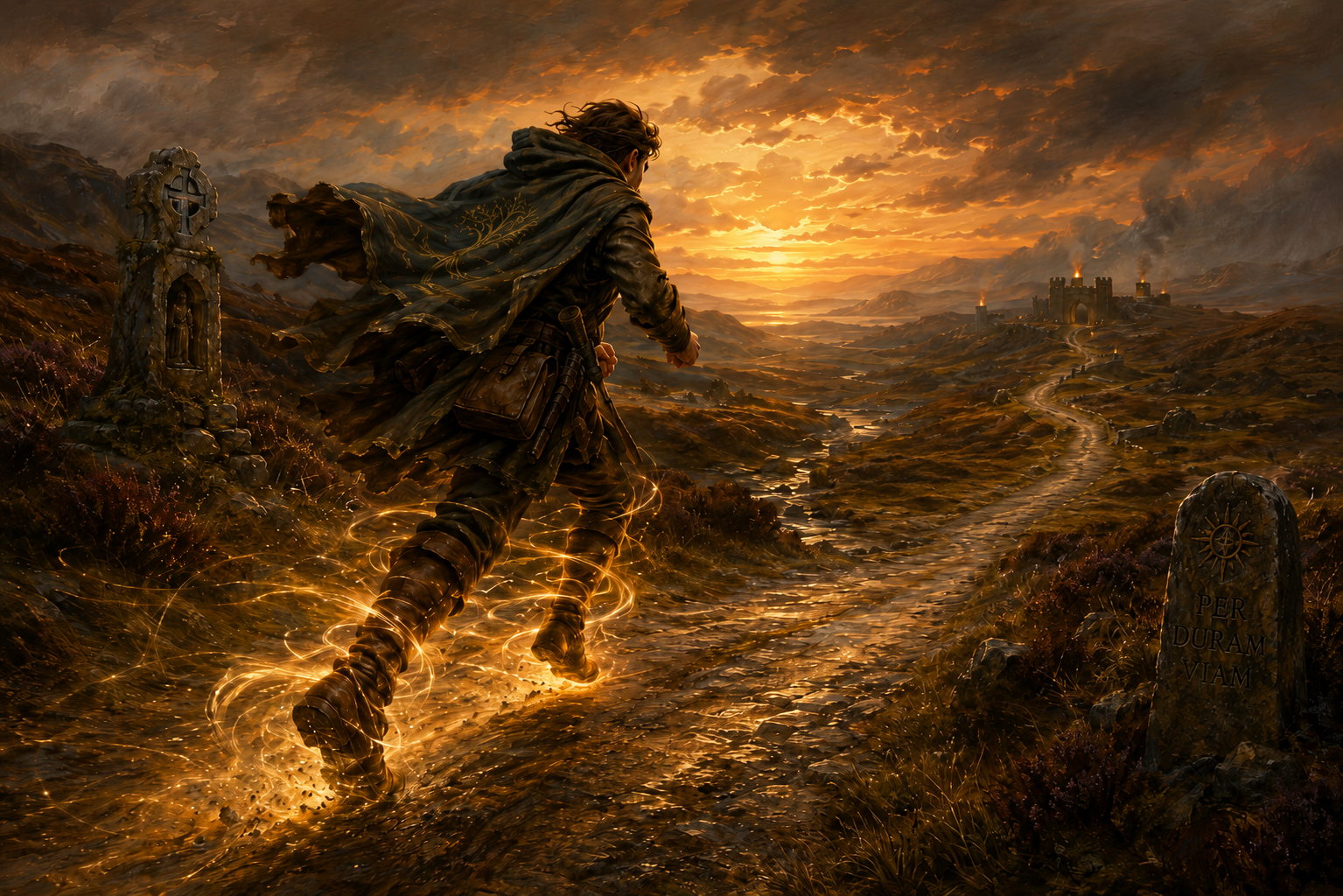
Cross the road before the gate closes, outrun pursuit, and make distance serve the one who knows the path.
Longstrider is a practical transmutation spell that turns ordinary movement into reliable advantage. It does not make the caster vanish, fly, teleport, or blur through time. It does something simpler and often more useful: it lets a creature cover more ground.
That small change matters. A scout reaches the ridge before the enemy column vanishes. A courier reaches the bridge before the soldiers cut it. A ranger keeps moving through rain, mud, and fear after ordinary legs would have slowed. In a dangerous world, speed is not only a combat statistic. It is warning, rescue, escape, pursuit, and survival.
In a late medieval world, Longstrider belongs to rangers, druids, outriders, foresters, hill guides, pilgrim escorts, military runners, guild couriers, border wardens, hunters, and anyone who knows that the road itself can decide who lives.
Further Uses
- Spell Theme: Movement enhancement and travel endurance
- Typical Level: Low-level transmutation
- Core Effect: Increases Speed in modern editions; base land speed in legacy editions
- Best For: Scouting, pursuit, retreat, overland urgency, battlefield positioning, and dangerous travel
- Limitations: Does not remove terrain, weather, exhaustion, blocked routes, or bad decisions
- Material Image: A pinch of dirt, road dust, or earth from the path ahead
Spell Rules
Longstrider — 5.5e / 2024
1st-Level Transmutation
| Casting Time | Action |
|---|---|
| Range | Touch |
| Components | Verbal, Somatic, Material |
| Material Component | A pinch of dirt |
| Duration | 1 hour |
| Available To | Bard, Druid, Ranger, Wizard |
Alternative Spell Name: Road-Blessing
Effect
A creature you touch gains 10 feet of Speed for the duration. The spell does not require a willing target.
At Higher Levels
When you cast this spell using a spell slot of level 2 or higher, you can target one additional creature for each slot level above 1.
Notes
This version treats Longstrider as a clean, long-duration movement spell. It is best cast before a journey, before a chase, before entering a hostile site, or before a fight where spacing and withdrawal matter.
The spell increases Speed. It does not grant a new movement mode; apply the edition’s movement rules to the target’s existing movement. The exclusive land-speed restriction used in PF1e and 3.5e is not part of this spell text.
The spell does not ignore difficult terrain, exhaustion, weather, closed doors, legal boundaries, roadblocks, pursuit tactics, or the need to know where one is going. It makes the target faster on foot. It does not make the road safe.
Longstrider — 5e / 2014
| Spell | 1st-level Transmutation · Bard, Druid, Ranger, Wizard |
|---|---|
| Casting Time | 1 action |
| Range / Target | Touch · one creature |
| Components | V, S, M (a pinch of dirt) |
| Duration | 1 hour · no concentration |
| Saving Throw | None |
Touch a creature to increase its speed by 10 feet for one hour. Willingness is not a condition of the spell. This version does not use the legacy personal-only target or enhancement-bonus restriction.
Higher slots: add one creature for every slot level above 1. It grants no new movement mode; use the 2014 movement rules for speeds and movement costs.
Longstrider — Pathfinder 1e
Transmutation
| Level | Druid 1, Hunter 1, Ranger 1 |
|---|---|
| Components | Verbal, Somatic, Material |
| Casting Time | 1 standard action |
| Range | Personal |
| Target | You |
| Duration | 1 hour per level (dismissible) |
Effect
Your base land speed increases by 10 feet. This is an enhancement bonus.
The spell has no effect on other movement modes, such as burrow, climb, fly, or swim.
Material Component
A pinch of dirt.
Notes
This version is personal-only. It is especially useful for rangers, druids, scouts, hunters, and lightly armoured travellers who need steady speed rather than sudden magical spectacle.
Because the speed increase is an enhancement bonus, it does not stack with other enhancement bonuses to land speed unless a specific rule says otherwise.
This spell improves only base land movement. It does not improve burrowing, climbing, flight or swimming, and casting it on yourself does not make your mount faster.
Longstrider — D&D 3.5e
This material is Open Game Content, and is licensed for public use under the terms of the Open Game License v1.0a.
| Spell | Transmutation |
|---|---|
| Level | Druid 1, Ranger 1, Travel 1 |
| Components | V, S, M |
| Casting Time | 1 standard action |
| Range | Personal |
| Target | You |
| Duration | 1 hour/level (D) |
This spell increases your base land speed by 10 feet. (This adjustment counts as an enhancement bonus.) It has no effect on other modes of movement, such as burrow, Climb, fly, or Swim.
Material Component A pinch of dirt.
What Changed
- 2024 and 2014 affect a touched creature for one hour and can add targets with higher slots.
- Neither modern spell requires a willing creature or uses the legacy land-speed-only wording.
- PF1e and 3.5e are personal, scale duration by caster level and grant an enhancement bonus. PF1e includes Hunter; 3.5e includes the Travel domain.
Why This Spell Is Dangerous in the World
Longstrider is dangerous because law, war, trade, pursuit, and rescue all depend on timing.
A border patrol assumes a fugitive can only reach one ford before nightfall. A lord assumes a messenger cannot warn the next town before the raid begins. A plague village assumes no runner can reach the healers’ college before the fever breaks through the doors. A war captain assumes the enemy cannot cross the pass before the bridge is burned. Longstrider breaks those assumptions.
The spell does not overthrow kingdoms by itself, but it quietly changes the shape of power. Roads, tolls, ambushes, watch rotations, border stones, hunting grounds, market routes, military signals, and sacred pilgrim paths all depend on ordinary bodies moving at ordinary speed. A single blessed runner can make those arrangements fail.
That is why the spell is valued by wardens, scouts, smugglers, couriers, druids, armies, rebels, and priests of road and boundary. It is not spectacular magic. It is the kind of magic that decides whether help arrives before the screaming starts.
Best Uses in Play
Scout without losing the party: A character under Longstrider can range ahead, examine a route, and return more safely before the rest of the group falls too far behind.
Win pursuit and retreat scenes: The spell is excellent when characters must chase a thief, escape guards, outrun beasts, cross a courtyard under fire, or reach a gate before it closes.
Improve battlefield positioning: Extra speed helps a melee character reach archers, casters, cover, flanking routes, weak back-line enemies, or a threatened ally.
Support urgent overland travel: When the question is not “can we travel?” but “can we arrive before it is too late?”, Longstrider turns time into a playable pressure.
Keep the vital person moving: A guide, healer, messenger, ritual specialist, wounded noble, or key witness may survive because the spell keeps them from falling behind.
Risks and Misuse
Longstrider can tempt players into splitting the party. A fast scout is useful. A fast scout who vanishes beyond help becomes a hostage, corpse, false witness, or bargaining chip.
The spell also encourages overconfidence. It does not create a safe road. It does not reveal ambushes. It does not stop hounds from following a scent, guards from closing a gate, or enemies from guessing the obvious route.
In social play, Longstrider can cause suspicion. A courier who arrives impossibly early may be accused of espionage, forbidden druidry, road-witchcraft, oath-breaking, or carrying news from powers that should not have known the event had happened.
How the Spell Changes a Scene
When Longstrider is active, distance should become visible.
A horn sounds from the tower. A drawbridge begins to rise. A child is being dragged into the trees. A ferry is pushing away from the bank. A funeral cart is leaving the plague quarter. A ritual chant is entering its final verse. The question becomes simple: can the spell’s extra pace change the result?
The spell is strongest when time, terrain, and consequence are all present at the table. It should not just add a number. It should make the road feel shorter, the danger closer, and the decision sharper.
Rules Clarifications and Edge Cases
Does Longstrider stack with other speed bonuses?
In modern play, follow the relevant edition’s normal stacking rules. In Pathfinder 1e / D&D 3.5e-style play, the bonus is an enhancement bonus and does not stack with another enhancement bonus to land speed unless a specific rule says otherwise.
Does it help climbing, swimming, flying, or burrowing?
No for the Pathfinder 1e / D&D 3.5e-compatible version. The 2024 and 2014 spell texts increase Speed/speed without the legacy land-speed restriction; apply the selected edition’s movement rules.
Can it be cast before combat?
Yes. Its long duration makes it ideal before entering a ruin, crossing exposed ground, beginning a hunt, launching a pursuit, or preparing for a retreat.
Does it make overland travel automatically safe?
No. The spell improves speed. It does not remove weather, terrain, hunger, fatigue, pursuit, navigation problems, tolls, legal barriers, broken bridges, or hostile patrols.
Is it worth a spell slot?
Yes, when movement matters. Longstrider does not deal damage, but it can decide who reaches the objective, who escapes, who gets isolated, and who arrives in time.
Good Combinations
- Pass without Trace: Helps a scouting group move quickly and quietly through dangerous country.
- Expeditious Retreat: Adds sudden burst movement when a character must flee, chase, or cross open ground immediately.
- Haste: Turns a mobile ally into a major battlefield threat when speed, reach, and action pressure all matter.
- Freedom of Movement: Keeps a traveller moving when restraint, terrain, or magic would otherwise ruin the advantage.
- Jump: Helps characters cross broken roads, ravines, rooftops, battlefield debris, ruined bridges, and rough ground.
Adventure and Worldbuilding Hooks
The Quarantine Runner
A runner under Longstrider has crossed a sealed plague road to bring warning from a Red Death village. The authorities want him hanged for breaking quarantine; the dead behind him may prove he was right.
The Border That Failed
Smugglers are crossing a guarded frontier between patrol bells. The lord blames bribery, but the truth is a druidic road-blessing and a forgotten cattle track through the marsh.
The Army That Arrived Too Soon
A warband reaches a ford before any scout believed it possible. Either the maps are wrong, the guides know a hidden route, or the enemy’s priests have blessed the feet of the marching column.
Historical and Mythic Context
Longstrider belongs to one of the oldest powers in myth and war: the ability to cross distance before ordinary people can respond. Before fast ships, reliable postal routes, and paved highways, a runner, scout, pilgrim, or mounted courier could change the fate of a settlement by arriving before the gate closed, before the fire spread, before the army crossed the ford, or before the lord’s enemies heard the news.
Ancient and medieval societies depended on roads, tracks, bridges, passes, ferries, and messenger routes. The Roman road system is one famous example of how movement could become power, binding forts, towns, military stations, and provincial centres into a working network. A spell that lengthens a traveller’s stride fits naturally into that same logic: whoever controls speed controls warning, trade, pursuit, escape, and command.
In a late medieval campaign, road magic matters because travel is never neutral. Toll roads, pilgrim roads, courier routes, military roads, drove roads, forest tracks, marsh causeways, and unsafe border paths all carry different laws, risks, and powers. A spell like Longstrider does not merely help someone move. It helps them cross between jurisdictions, outrun local authority, beat a warning bell, reach a shrine before nightfall, or escape a quarantine line before anyone agrees what the law requires.
The spell also echoes the heroic image of the long-distance runner. The marathon tradition preserves the idea that a single exhausted messenger can alter history by reaching a city in time. Whether treated as history, legend, or heroic memory, the image remains potent: one body becomes the final link between disaster and warning.
In mythic play, Longstrider is not merely a convenience spell. It is road-dust magic, hunter’s endurance, pilgrim’s stubbornness, border-runner’s urgency, and the old blessing of earth underfoot. Its material component, a pinch of dirt, is exactly right. The spell does not free the caster from the world. It binds the caster more closely to the road, the field, the forest path, and the ground that must be crossed before it is too late.
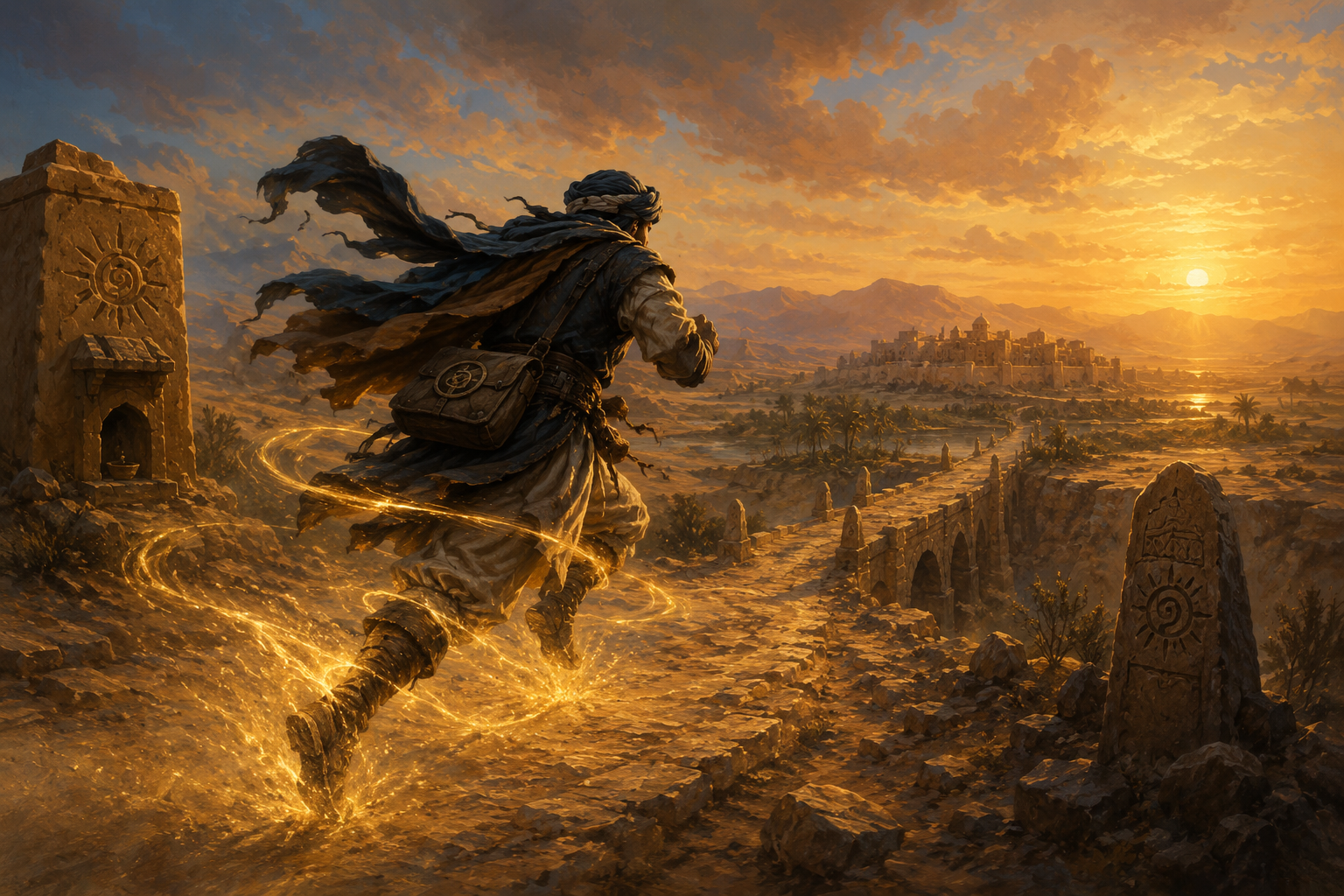
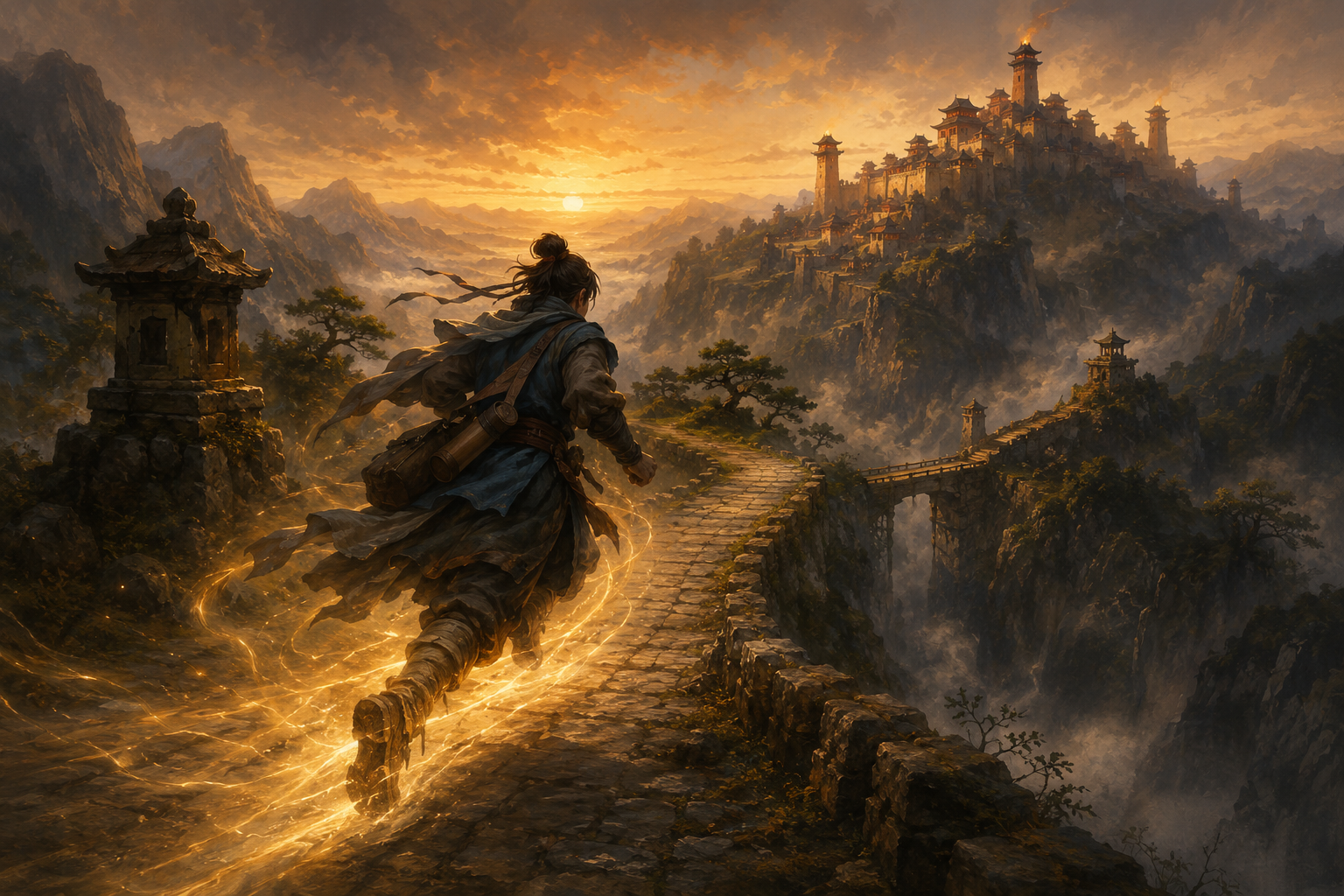
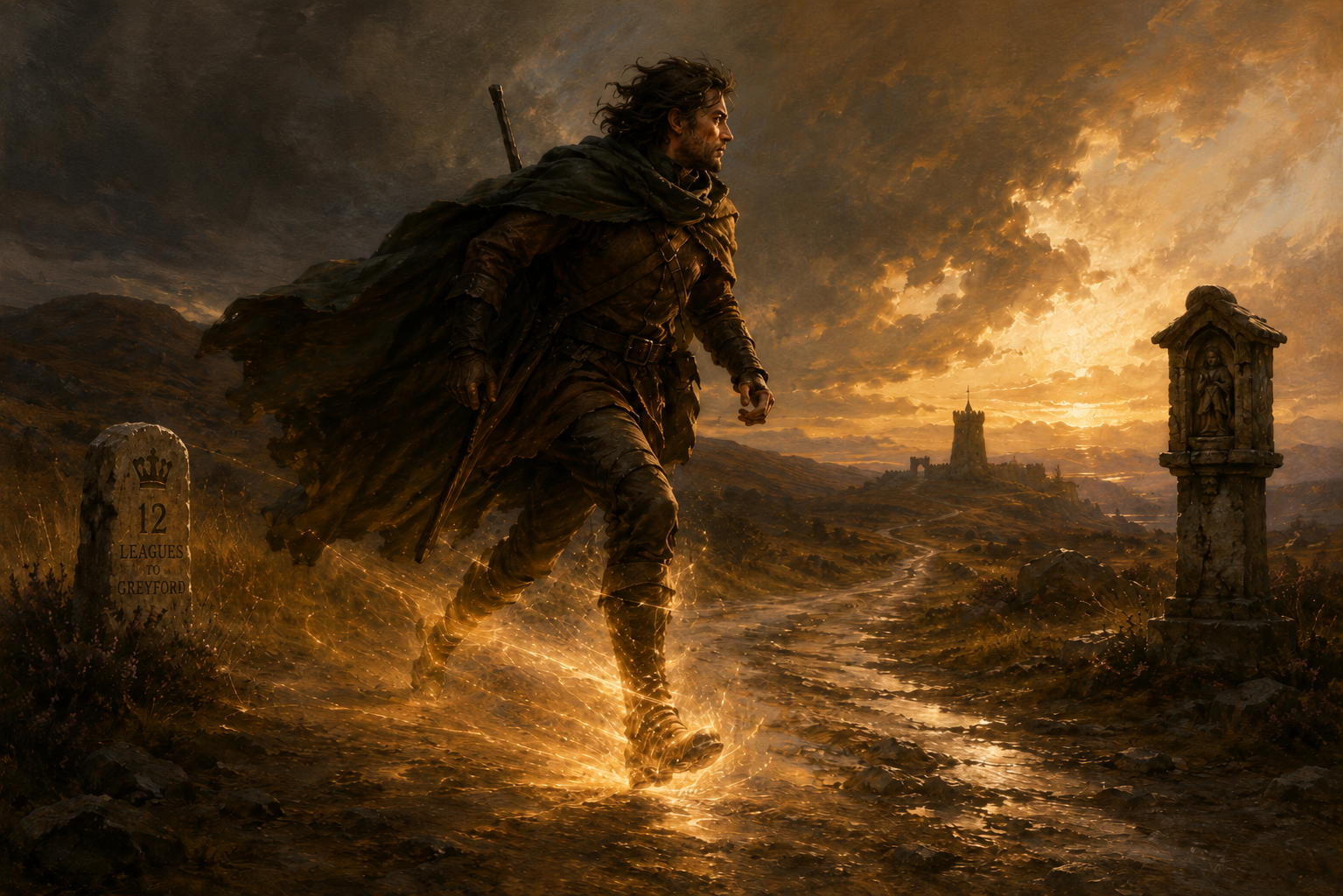
Further Illustrations
Sources and Licensing
This work includes material from the System Reference Document 5.2.1 and System Reference Document 5.1 by Wizards of the Coast LLC, available through the D&D SRD page. Both are licensed under Creative Commons Attribution 4.0 International. Rules summaries are adapted; tactical and setting commentary is separate.
Open Game License v1.0a & Copyright Notices
The Pathfinder 1e and D&D 3.5e rules material on this page is derived from Open Game Content and is used under the Open Game License Version 1.0a. Presentation, navigation, original commentary and setting material are not designated Open Game Content by this notice.
OPEN GAME LICENSE Version 1.0a
The following text is the property of Wizards of the Coast, Inc. and is Copyright 2000 Wizards of the Coast, Inc (“Wizards”). All Rights Reserved.
- Definitions: (a)”Contributors” means the copyright and/or trademark owners who have contributed Open Game Content; (b)”Derivative Material” means copyrighted material including derivative works and translations (including into other computer languages), potation, modification, correction, addition, extension, upgrade, improvement, compilation, abridgment or other form in which an existing work may be recast, transformed or adapted; (c)”Distribute” means to reproduce, license, rent, lease, sell, broadcast, publicly display, transmit or otherwise distribute; (d)”Open Game Content” means the game mechanic and includes the methods, procedures, processes and routines to the extent such content does not embody the Product Identity and is an enhancement over the prior art and any additional content clearly identified as Open Game Content by the Contributor, and means any work covered by this License, including translations and derivative works under copyright law, but specifically excludes Product Identity. (e)”Product Identity” means product and product line names, logos and identifying marks including trade dress; artifacts; creatures characters; stories, storylines, plots, thematic elements, dialogue, incidents, language, artwork, symbols, designs, depictions, likenesses, formats, poses, concepts, themes and graphic, photographic and other visual or audio representations; names and descriptions of characters, spells, enchantments, personalities, teams, personas, likenesses and special abilities; places, locations, environments, creatures, equipment, magical or supernatural abilities or effects, logos, symbols, or graphic designs; and any other trademark or registered trademark clearly identified as Product identity by the owner of the Product Identity, and which specifically excludes the Open Game Content; (f)”Trademark” means the logos, names, mark, sign, motto, designs that are used by a Contributor to identify itself or its products or the associated products contributed to the Open Game License (g)”Use”, “Used” or “Using” means to use, Distribute, copy, edit, format, modify, translate and otherwise create Derivative Material of Open Game Content. (h)”You” or “Your” means the licensee in terms of this agreement.
- The License: This License applies to any Open Game Content that contains a notice indicating that the Open Game Content may only be Used under and in terms of this License. You must affix such a notice to any Open Game Content that you Use. No terms may be added to or subtracted from this License except as described by the License itself. No other terms or conditions may be applied to any Open Game Content distributed using this License.
- Offer and Acceptance: By Using the Open Game Content You indicate Your acceptance of the terms of this License.
- Grant and Consideration: In consideration for agreeing to use this License, the Contributors grant You a perpetual, worldwide, royalty-free, non-exclusive license with the exact terms of this License to Use, the Open Game Content.
- Representation of Authority to Contribute: If You are contributing original material as Open Game Content, You represent that Your Contributions are Your original creation and/or You have sufficient rights to grant the rights conveyed by this License.
- Notice of License Copyright: You must update the COPYRIGHT NOTICE portion of this License to include the exact text of the COPYRIGHT NOTICE of any Open Game Content You are copying, modifying or distributing, and You must add the title, the copyright date, and the copyright holder’s name to the COPYRIGHT NOTICE of any original Open Game Content you Distribute.
- Use of Product Identity: You agree not to Use any Product Identity, including as an indication as to compatibility, except as expressly licensed in another, independent Agreement with the owner of each element of that Product Identity. You agree not to indicate compatibility or co-adaptability with any Trademark or Registered Trademark in conjunction with a work containing Open Game Content except as expressly licensed in another, independent Agreement with the owner of such Trademark or Registered Trademark. The use of any Product Identity in Open Game Content does not constitute a challenge to the ownership of that Product Identity. The owner of any Product Identity used in Open Game Content shall retain all rights, title and interest in and to that Product Identity.
- Identification: If you distribute Open Game Content You must clearly indicate which portions of the work that you are distributing are Open Game Content.
- Updating the License: Wizards or its designated Agents may publish updated versions of this License. You may use any authorized version of this License to copy, modify and distribute any Open Game Content originally distributed under any version of this License.
- Copy of this License: You MUST include a copy of this License with every copy of the Open Game Content You Distribute.
- Use of Contributor Credits: You may not market or advertise the Open Game Content using the name of any Contributor unless You have written permission from the Contributor to do so.
- Inability to Comply: If it is impossible for You to comply with any of the terms of this License with respect to some or all of the Open Game Content due to statute, judicial order, or governmental regulation then You may not Use any Open Game Material so affected.
- Termination: This License will terminate automatically if You fail to comply with all terms herein and fail to cure such breach within 30 days of becoming aware of the breach. All sublicenses shall survive the termination of this License.
- Reformation: If any provision of this License is held to be unenforceable, such provision shall be reformed only to the extent necessary to make it enforceable.
- COPYRIGHT NOTICE
Open Game License v 1.0a Copyright 2000, Wizards of the Coast, Inc.
System Reference Document Copyright 2000-2003, Wizards of the Coast, Inc.; Authors Jonathan Tweet, Monte Cook, Skip Williams, Rich Baker, Andy Collins, David Noonan, Rich Redman, Bruce R. Cordell, John D. Rateliff, Thomas Reid, James Wyatt, based on original material by E. Gary Gygax and Dave Arneson.
Pathfinder Roleplaying Game Core Rulebook © 2009, Paizo Publishing, LLC; Author: Jason Bulmahn, based on material by Jonathan Tweet, Monte Cook, and Skip Williams.
END OF LICENSE
Keep this reference growing
If this page helped with your reading or game, you can support its upkeep or explore the curated books.
Explore the Bookshop — epics, classics and stories behind imagined worlds.