
Speak With Animals Spell
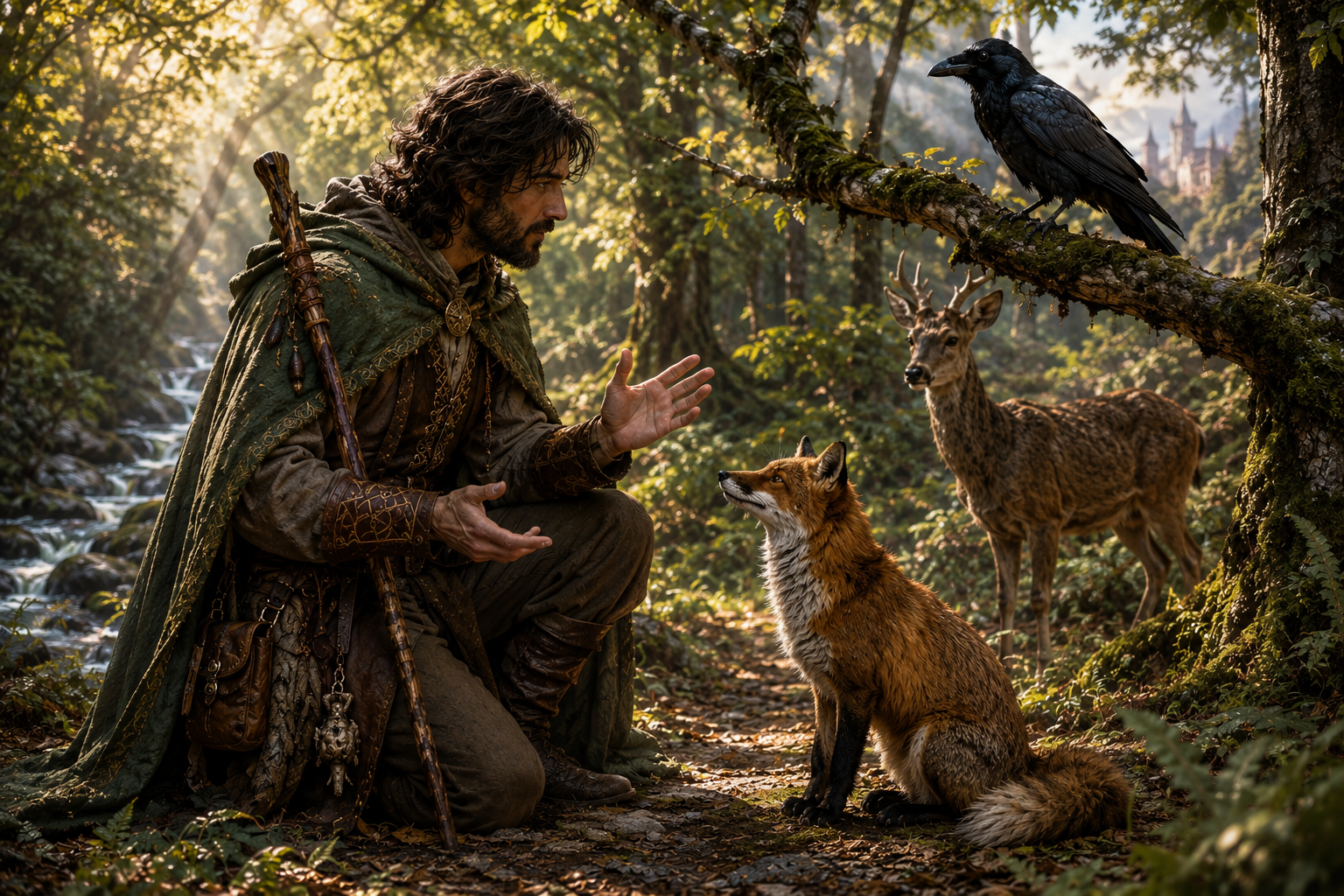
At a Glance
| 5.5e / 2024 | Level 1 Divination; Action or Ritual; Self; V, S; 10 minutes; verbal communication with Beasts and Influence skill options. |
|---|---|
| 5e / 2014 | Level 1 Divination; 1 action (ritual); Self; V, S; 10 minutes; communication with beasts; a small favour at the GM’s discretion. |
| Pathfinder 1e | Bard 3, Druid 1, Ranger 1; Divination; standard action; Personal; V, S; 1 minute/level; attitude remains unchanged. |
| D&D 3.5e | Bard 3, Druid 1, Ranger 1; Divination; standard action; Personal; V, S; 1 minute/level; a friendly animal may help voluntarily. |
Speak With Animals turns nearby beasts into possible witnesses, guides and negotiating partners. It removes the barrier to conversation; it does not make an animal wiser, more loyal, more truthful or more obedient than it already is.
Speak With Animals Mechanics
Speak With Animals — 5.5e / 2024
System Reference Document 5.2.1 spell
| Level | 1st-level Divination |
|---|---|
| Casting Time | Action or Ritual |
| Range | Self |
| Components | V, S |
| Duration | 10 minutes |
| Classes | Bard, Druid, Ranger, Warlock |
Effect
For the duration, you can understand and verbally communicate with Beasts. You can also use the skill options of the Influence action when dealing with them.
Most Beasts think primarily in terms of immediate life: survival, food, danger, territory, shelter, companions and familiar routines. Even so, the spell guarantees a useful minimum. A Beast can provide information about nearby places and monsters, including things it perceived during the previous day.
Practical rulings
- Beast is a rules term. Looking like an animal is not enough. A creature must qualify as a Beast for this spell unless another rule specifically says otherwise.
- The spell creates communication, not obedience. It does not Charm a Beast, alter its attitude or require it to follow an order.
- Use Influence for requests. A willing Beast may simply cooperate. A hesitant Beast can require an appropriate Influence check. A request the Beast is genuinely unwilling to perform cannot be forced merely by rolling well.
- Animal Handling is not the only possible social approach. The Influence rules also permit other appropriate skill options when the interaction supports them.
- The spell does not compel honesty. A Beast can be mistaken, frightened, evasive or deceptive to the extent its nature and Intelligence allow.
- Communication is not telepathy. The spell establishes verbal communication rather than mind reading. It does not expose private thoughts or memories the Beast does not communicate.
- The past-day information floor matters. Nearby locations, monsters and relevant things perceived during the previous day are specifically within the spell’s intended information range.
- An animal’s perspective still matters. A hound may remember a distinctive scent, a horse may remember fear or a difficult road, and a raven may remember a corpse or armed strangers without understanding heraldry, titles or political allegiance.
Druidic: A 2024 Druid always has Speak With Animals prepared through the Druidic class feature. It does not count against the normal number of spells the Druid prepares.
Speak With Animals — 5e / 2014
| Level / classes | 1st-level Divination; Bard, Druid, Ranger |
|---|---|
| Casting time | 1 action; ritual if your casting feature permits |
| Range | Self |
| Components | V, S |
| Duration | 10 minutes; no Concentration |
For the duration, you understand beasts and can speak with them. Their intelligence limits what they know and understand, but they can report nearby places and monsters, including things they perceive now or perceived during the preceding day.
You may persuade a beast to provide a small favour at the GM’s discretion. The spell neither commands obedience nor changes its attitude, intelligence or willingness to tell the truth.
Practical use
Ask about scents, familiar creatures, paths, danger and recent disturbances. A fox may describe a stranger’s smell without recognising a title or coat of arms. This edition uses its ordinary interaction rules for requests.
Speak With Animals — Pathfinder 1e
Pathfinder RPG Core Rulebook spell
| School | Divination |
|---|---|
| Level | Bard 3, Druid 1, Ranger 1 |
| Casting Time | 1 standard action |
| Components | V, S |
| Range | Personal |
| Target | You |
| Duration | 1 minute/level |
Effect
You can ask questions of animals and understand their answers. The spell does not improve an animal’s normal attitude toward you. A cautious or cunning animal may answer briefly or evasively, while a less intelligent animal may offer confused, irrelevant or very simple observations. An animal that is already friendly may choose to provide a reasonable favour or service.
Practical rulings
- Communication is not attitude control. Hostile, unfriendly or wary animals remain so unless something else changes their attitude.
- Animal means the appropriate creature type. A magical beast or another creature that merely resembles an ordinary animal is not automatically a legal target for this effect.
- The spell does not increase Intelligence. An animal answers from the understanding, senses and memory it actually possesses.
- Questions still need to make sense to the animal. Asking which rider smelled of blood is often more useful than asking which rider was a member of a particular noble house.
- A friendly animal may help, but the favour is voluntary. Communication alone does not grant control comparable to Dominate Animal.
- The spell does not compel truth. An animal can refuse, evade, misunderstand or communicate an incorrect conclusion.
- Use the normal social and animal-interaction rules where needed. The spell opens the conversation; it does not replace every other check or class ability relevant to influencing animals.
Animal Domain: A Pathfinder Cleric with the Animal Domain can speak with animals as the spell for a number of rounds per day equal to 3 + the cleric’s level. These rounds do not need to be consecutive.
Speak With Animals — D&D 3.5e
Revised System Reference Document spell
| School | Divination |
|---|---|
| Level | Bard 3, Druid 1, Ranger 1 |
| Components | V, S |
| Casting Time | 1 standard action |
| Range | Personal |
| Target | You |
| Duration | 1 minute/level |
Effect
You can understand and communicate with animals. You may ask questions and receive answers, but the spell does not make the animals friendlier or more cooperative. Wary or cunning animals can be terse or evasive, while less intelligent animals may give simple or unhelpful responses. A friendly animal may choose to perform an appropriate favour or service.
Practical rulings
- The spell supplies communication rather than control. It does not make an animal your ally or override its normal instincts.
- The animal keeps its existing Intelligence. Communication does not supply human concepts the creature has never learned.
- Ask sensory questions. Animals are often strongest on scent, sound, movement, food, predators, pain, familiar people, familiar places and disturbances in their territory.
- Friendliness matters. The possibility of a favour applies to an animal that is already friendly; the spell itself does not create that friendliness.
- There is no truth-compulsion effect. Treat the conversation according to the animal’s actual disposition and understanding.
- Do not silently import later-edition guarantees. The explicit modern rule concerning information perceived during the previous day belongs to the modern mechanics and is not part of this spell’s 3.5e text.
Animal Domain: In the 3.5e rules, a cleric with the Animal domain has a separate domain-granted ability allowing Speak With Animals once per day as a spell-like ability. That feature does not change the Bard, Druid or Ranger spell levels above.
What Can an Animal Actually Tell You?
The best animal witnesses describe the world in terms that matter to them. They notice predators, prey, food, water, shelter, pain, territory, familiar creatures, strange smells, sudden noises, blood, smoke, fire, repeated visitors and routes they use regularly.
The spell should not turn an ordinary fox, horse or pigeon into a human investigator. An animal may have witnessed the entire event while understanding only a few of its important details.
Strong questions
“What frightened you?” “Which way did they go?” “What smelled strange?” “Where is the water?” “What creature hunts here?” “Did anyone come through after dark?” “Which horse returned without its rider?”
Weak questions
“Was he a Burgundian agent?” “Which coat of arms did the rider wear?” “Was the document genuine?” “How many florins were stolen?” “Was the stranger legally entitled to cross the boundary?”
Example: A raven may remember six armed travellers moving east, one limping badly, another carrying something that smelled of fresh blood, and wolves following their trail after sunset. It need not understand which traveller was a knight, which lord employed them, or why they were being pursued.
Best Uses in Play
Scouting
Local birds and mammals may know where predators hunt, where travellers have recently passed, which path carries unusual traffic or where a dangerous creature has established territory.
Investigation
Stable animals, watchdogs, ravens, rats and livestock can become witnesses to events that happened when no humanoid observer was present.
Travel
Animals can identify nearby water, shelter, danger, feeding grounds, broken routes and places avoided by the local wildlife.
Negotiation
Communication can prevent unnecessary fights, reveal what an animal wants and make practical bargains possible without magically controlling the creature.
GM principle: reward the spell with information the animal could genuinely possess. Preserve uncertainty through the animal’s limited viewpoint, incomplete memory, attitude and priorities rather than by making every creature mysteriously useless as soon as the spell is cast.
Related Spells
Speak With Animals in Town and Wilderness
In a world moved by horses, oxen, pack animals, hunting dogs, falcons, pigeons and livestock, communication with animals has uses far beyond the wilderness. Foresters can question creatures disturbed by poachers. Drovers can learn what frightened a herd. A courier’s horse may remember the road on which its rider fell. A castle hound may know which stranger entered after midnight.
Towns provide witnesses of their own. Rats know which cellars remain occupied. Ravens notice corpses, carrion and repeated movement. Stable horses recognise familiar handlers and frightening smells. Dogs know voices, scents and habitual visitors even when they know nothing of a person’s rank or legal identity.
Hunters, falconers, shepherds, scouts, rangers and druids value the spell because they already understand how to ask useful questions. Learned natural philosophers can treat animal testimony in much the same way: not as perfect human evidence, but as a new source of observation whose limitations must be understood.
This can reshape an investigation without solving it outright. A murderer may silence every human witness and still overlook the victim’s dog. Smugglers may watch the road but forget the ravens above it. A patrol can disguise its banners and armour while leaving a trail of unfamiliar horses, blood, smoke and frightened wildlife behind.
Animals in the Medieval Imagination
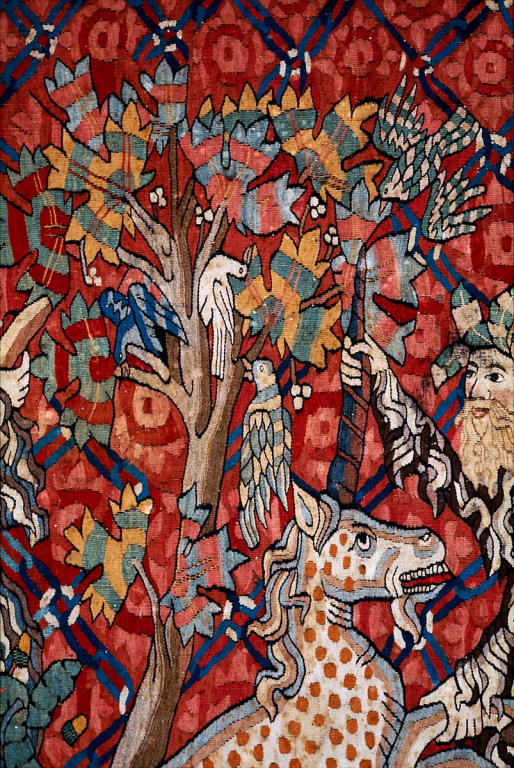
Medieval art repeatedly placed animals beside human figures as creatures of wilderness, danger, companionship, symbolism and story. The surviving tapestry below is especially close to the campaign present: it was woven around 1400 in the German-speaking world, probably in Alsace and possibly Strasbourg.
Sources, Attribution and Licensing
Rules references
- System Reference Document 5.1 — D&D 2014
- Speak With Animals — current rules reference
- D&D 2024 Rules Glossary — Influence action.
- D&D 2024 Character Classes — Druidic and the Druid’s always-prepared Speak With Animals.
- Pathfinder Reference Document: Speak With Animals
- Pathfinder Reference Document: Cleric — Animal Domain
- Revised System Reference Document: Speak With Animals
Artwork
Wild Men and Moors, detail 6 of 12, unknown artist, c. 1400, wool and linen tapestry; Museum of Fine Arts, Boston, Charles Potter Kling Fund, accession 54.1431. Public-domain reproduction via Wikimedia Commons .
SRD 5.2.1 attribution
This work includes material from the System Reference Document 5.2.1 (“SRD 5.2.1”) by Wizards of the Coast LLC, available at https://www.dndbeyond.com/srd. The SRD 5.2.1 is licensed under the Creative Commons Attribution 4.0 International License, available at https://creativecommons.org/licenses/by/4.0/legalcode.
This work includes material taken from the System Reference Document 5.1 (“SRD 5.1”) by Wizards of the Coast LLC and available at https://dnd.wizards.com/resources/systems-reference-document. The SRD 5.1 is licensed under the Creative Commons Attribution 4.0 International License available at https://creativecommons.org/licenses/by/4.0/legalcode.
Legacy Open Game Content
The mechanical rules text inside the Pathfinder 1e and D&D 3.5e mechanics panels is designated as Open Game Content and may be Used only under and in terms of the Open Game License version 1.0a.
No other portion of this page is designated as Open Game Content. The artwork, design, CSS, presentation, examples, comparative commentary, rulings analysis, historical discussion, setting material and original prose remain excluded from that designation.
Open Game License v1.0a & Copyright Notices
The Pathfinder 1e and D&D 3.5e rules material is Open Game Content used under this licence. Artwork, navigation, original commentary and setting material are excluded.
OPEN GAME LICENSE Version 1.0a
The following text is the property of Wizards of the Coast, Inc. and is Copyright 2000 Wizards of the Coast, Inc (“Wizards”). All Rights Reserved.
- Definitions: (a)”Contributors” means the copyright and/or trademark owners who have contributed Open Game Content; (b)”Derivative Material” means copyrighted material including derivative works and translations (including into other computer languages), potation, modification, correction, addition, extension, upgrade, improvement, compilation, abridgment or other form in which an existing work may be recast, transformed or adapted; (c)”Distribute” means to reproduce, license, rent, lease, sell, broadcast, publicly display, transmit or otherwise distribute; (d)”Open Game Content” means the game mechanic and includes the methods, procedures, processes and routines to the extent such content does not embody the Product Identity and is an enhancement over the prior art and any additional content clearly identified as Open Game Content by the Contributor, and means any work covered by this License, including translations and derivative works under copyright law, but specifically excludes Product Identity. (e)”Product Identity” means product and product line names, logos and identifying marks including trade dress; artifacts; creatures characters; stories, storylines, plots, thematic elements, dialogue, incidents, language, artwork, symbols, designs, depictions, likenesses, formats, poses, concepts, themes and graphic, photographic and other visual or audio representations; names and descriptions of characters, spells, enchantments, personalities, teams, personas, likenesses and special abilities; places, locations, environments, creatures, equipment, magical or supernatural abilities or effects, logos, symbols, or graphic designs; and any other trademark or registered trademark clearly identified as Product identity by the owner of the Product Identity, and which specifically excludes the Open Game Content; (f)”Trademark” means the logos, names, mark, sign, motto, designs that are used by a Contributor to identify itself or its products or the associated products contributed to the Open Game License (g)”Use”, “Used” or “Using” means to use, Distribute, copy, edit, format, modify, translate and otherwise create Derivative Material of Open Game Content. (h)”You” or “Your” means the licensee in terms of this agreement.
- The License: This License applies to any Open Game Content that contains a notice indicating that the Open Game Content may only be Used under and in terms of this License. You must affix such a notice to any Open Game Content that you Use. No terms may be added to or subtracted from this License except as described by the License itself. No other terms or conditions may be applied to any Open Game Content distributed using this License.
- Offer and Acceptance: By Using the Open Game Content You indicate Your acceptance of the terms of this License.
- Grant and Consideration: In consideration for agreeing to use this License, the Contributors grant You a perpetual, worldwide, royalty-free, non-exclusive license with the exact terms of this License to Use, the Open Game Content.
- Representation of Authority to Contribute: If You are contributing original material as Open Game Content, You represent that Your Contributions are Your original creation and/or You have sufficient rights to grant the rights conveyed by this License.
- Notice of License Copyright: You must update the COPYRIGHT NOTICE portion of this License to include the exact text of the COPYRIGHT NOTICE of any Open Game Content You are copying, modifying or distributing, and You must add the title, the copyright date, and the copyright holder’s name to the COPYRIGHT NOTICE of any original Open Game Content you Distribute.
- Use of Product Identity: You agree not to Use any Product Identity, including as an indication as to compatibility, except as expressly licensed in another, independent Agreement with the owner of each element of that Product Identity. You agree not to indicate compatibility or co-adaptability with any Trademark or Registered Trademark in conjunction with a work containing Open Game Content except as expressly licensed in another, independent Agreement with the owner of such Trademark or Registered Trademark. The use of any Product Identity in Open Game Content does not constitute a challenge to the ownership of that Product Identity. The owner of any Product Identity used in Open Game Content shall retain all rights, title and interest in and to that Product Identity.
- Identification: If you distribute Open Game Content You must clearly indicate which portions of the work that you are distributing are Open Game Content.
- Updating the License: Wizards or its designated Agents may publish updated versions of this License. You may use any authorized version of this License to copy, modify and distribute any Open Game Content originally distributed under any version of this License.
- Copy of this License: You MUST include a copy of this License with every copy of the Open Game Content You Distribute.
- Use of Contributor Credits: You may not market or advertise the Open Game Content using the name of any Contributor unless You have written permission from the Contributor to do so.
- Inability to Comply: If it is impossible for You to comply with any of the terms of this License with respect to some or all of the Open Game Content due to statute, judicial order, or governmental regulation then You may not Use any Open Game Material so affected.
- Termination: This License will terminate automatically if You fail to comply with all terms herein and fail to cure such breach within 30 days of becoming aware of the breach. All sublicenses shall survive the termination of this License.
- Reformation: If any provision of this License is held to be unenforceable, such provision shall be reformed only to the extent necessary to make it enforceable.
- COPYRIGHT NOTICE
Open Game License v 1.0a Copyright 2000, Wizards of the Coast, Inc.
System Reference Document Copyright 2000-2003, Wizards of the Coast, Inc.; Authors Jonathan Tweet, Monte Cook, Skip Williams, Rich Baker, Andy Collins, David Noonan, Rich Redman, Bruce R. Cordell, John D. Rateliff, Thomas Reid, James Wyatt, based on original material by E. Gary Gygax and Dave Arneson.
Pathfinder Roleplaying Game Core Rulebook © 2009, Paizo Publishing, LLC; Author: Jason Bulmahn, based on material by Jonathan Tweet, Monte Cook, and Skip Williams.
END OF LICENSE
Keep this reference growing
If this page helped with your reading or game, you can support its upkeep or explore the curated books.
Explore the Bookshop — epics, classics and stories behind imagined worlds.