
Eblis — Lord of the Divs, the Sundered Flame
Eblis — Lord of the Divs, the Sundered Flame
Related entries: Divs, Abaddon, History of Hell and Toward Earth and Beyond.
Eblis, the Sundered Flame: an ancient sovereign of destruction and the burning worlds.
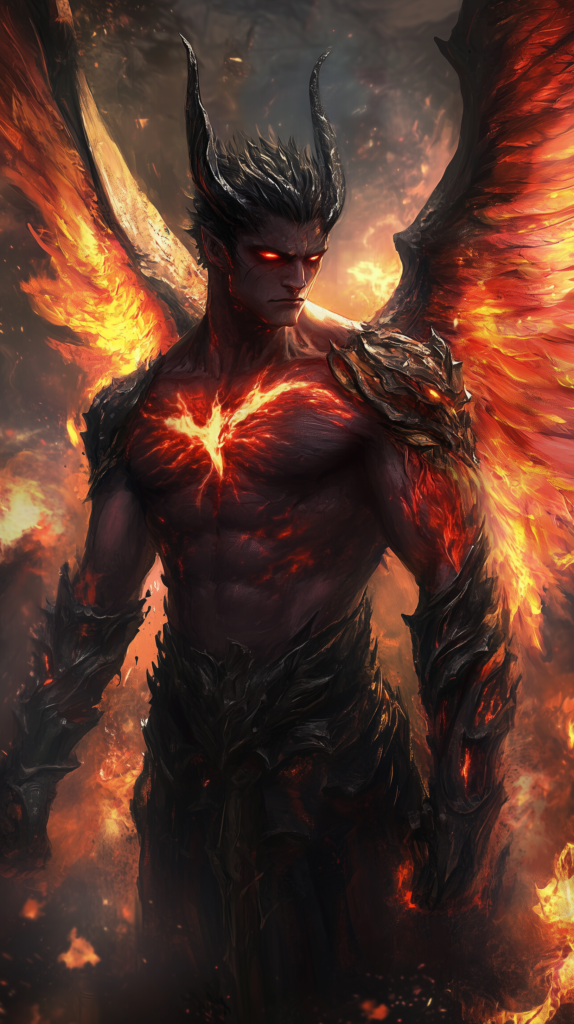
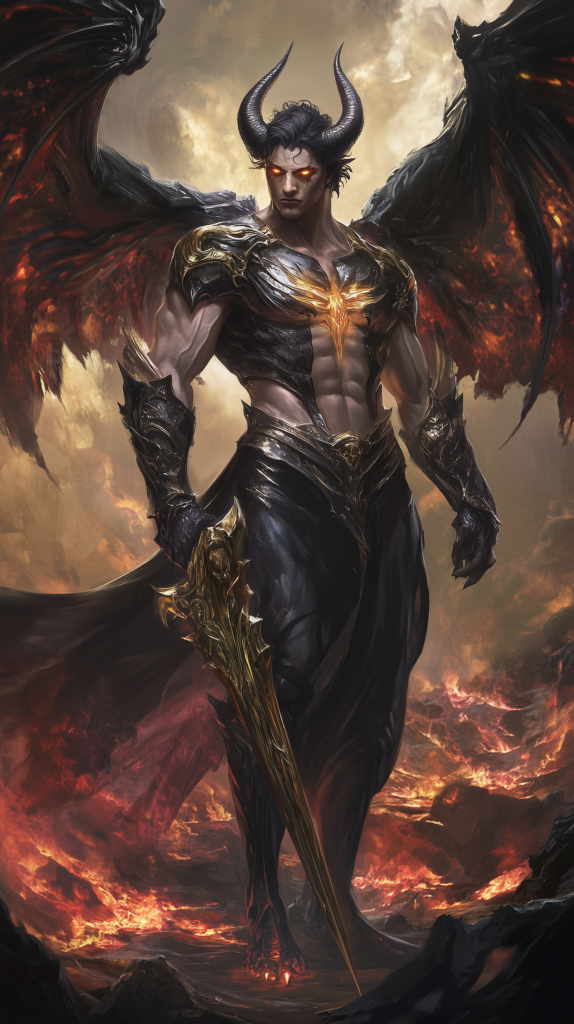
Eblis is a unique, ancient destructive intelligence whose power is bound to the history of organised geniekind and the dominions of elemental fire. He was not a celestial rebel exiled during the Eon XX Great Fall. His vast form resembles a horned colossus of molten rock, with red eyes shining through seams of blackened stone and burning wings or banners of flame rising from his shoulders. He bears weapons shaped from condensed fire and broken oaths.
Behaviour: Eblis is cunning, patient and ruthless. He disdains the rulers of Hell without acknowledging them as his peers or sovereigns. His agents among the divs and elemental courts undermine crafts, cities and dynasties; when thwarted, his volcanic rage briefly reveals the destruction beneath his intricate plans.
Habitat: Eblis’s principal domain lies in the ruined reaches of Abaddon, where he remakes corrupt genie souls into divs. The Tower of Burnt Ash on the Elemental Plane of Fire is one of his feared outposts and meeting places, not the source of his power or his sole domain.
Modus Operandi: Eblis operates from the shadows, orchestrating elaborate plots to corrupt mortals, undermine the gods, and sow chaos across the multiverse. He manipulates powerful individuals, subtly twisting their desires and ambitions until they unknowingly serve his dark purposes. Eblis avoids direct confrontation, instead using proxies, fiendish contracts, and infernal pacts to do his bidding. He is known to grant immense power to those who seek it, but always at a price that inevitably leads to their downfall.
Motivation: Eblis seeks the ruin of creative endeavour and the works of organised geniekind. He twists the souls of malicious genies into divs, sends them to sabotage mortal kingdoms and elemental courts, and uses destructive bargains to accelerate decline. These schemes have their own ancient history and are unrelated to the Eon XX celestial exile of Beelzebub, Belial and Moloch.
Eblis, the Sundered Flame
Huge Fiend (Unique Div Sovereign), Lawful Evil
Armor Class: 26 (natural armor)
Hit Points: 713 (46d12 + 414)
Speed: 50 ft., fly 150 ft.
| STR | DEX | CON | INT | WIS | CHA |
|---|---|---|---|---|---|
| 30 (+10) | 24 (+7) | 28 (+9) | 27 (+8) | 26 (+8) | 32 (+11) |
Saving Throws: Str +19, Con +18, Int +17, Wis +17, Cha +20
Skills: Perception +17, Insight +16, Deception +19
Damage Resistances: Radiant
Damage Immunities: Fire, Necrotic, Poison; Bludgeoning, Piercing, and Slashing from Nonmagical Attacks
Condition Immunities: Charmed, Exhaustion, Frightened, Poisoned
Senses: Truesight 120 ft., Passive Perception 27
Languages: All, Telepathy 120 ft.
Challenge Rating: 30 (155,000 XP)
Lore
Eblis, called the Sundered Flame, is an ancient destructive power shadowing the earliest organised geniekind and the sovereign of the divs. His domain lies in Abaddon, though the Tower of Burnt Ash in the Elemental Plane of Fire remains an important outpost. He reshapes hateful genie souls into fiendish servants and bargains with mortal and elemental powers to hasten ruin. The story that he led the Eon XX celestial rebellion is an obsolete conflation: that rebellion was principally unified by Beelzebub.
Traits
Magic Resistance. Eblis has advantage on saving throws against spells and other magical effects.
Legendary Resistance (3/day). If Eblis fails a saving throw, he can choose to succeed instead. Against divine spells, this ability costs 2 uses.
Divine Awareness. Eblis knows if he hears a lie.
Div-Sovereign Weapons. Eblis’s weapon attacks are magical. When he hits with any weapon, the weapon deals an extra 8d8 necrotic damage (included in the attack).
Terrible Majesty. Eblis’s destructive presence takes on a hypnotic, deceptively splendid form. He suffers disadvantage on any Charisma (Persuasion) checks made against good-aligned creatures, but gains advantage on Charisma (Intimidation) checks.
Innate Spellcasting
Eblis’s innate spellcasting ability is Charisma (spell save DC 28). He can innately cast the following spells without material components. He must maintain concentration on spells that require it, and can concentrate on only one such spell at a time.
- At will: Animate Dead, Detect Evil and Good, Greater Invisibility, Polymorph, Wall of Fire, Conjure Elemental (Fire Only)
- 3/day each: Blade Barrier, Dispel Evil and Good, Fire Storm, Incendiary Cloud
- 1/day each: Earthquake, Meteor Swarm, Storm of Vengeance
Actions
Multiattack. Eblis makes four attacks with Heaven’s Sorrow or Heaven’s Tears.
- Heaven’s Sorrow. Melee Weapon Attack: +19 to hit, reach 15 ft., one target.
Hit: 31 (6d6 + 10) slashing damage + 36 (8d8) necrotic damage and 45 (10d8) fire damage. - Heaven’s Tears. Ranged Weapon Attack: +17 to hit, range 120/600 ft., one target.
Hit: 20 (3d8 + 7) piercing damage + 36 (8d8) necrotic damage. If the target has fewer than 200 hit points, they must succeed on a DC 27 Constitution saving throw or die. On a critical hit, the saving throw DC increases to 29. - Corrupting Touch. Melee Weapon Attack: +19 to hit, reach 5 ft., one target.
Hit: 64 (12d8 + 10) radiant damage. The target must succeed on a DC 29 Constitution saving throw or gain one level of exhaustion.
Legendary Actions
Eblis can take 3 legendary actions, choosing from the options below. Only one legendary action can be used at a time and only at the end of another creature’s turn. Eblis regains spent legendary actions at the start of his turn.
- Lord of Flames. Eblis magically teleports, along with any equipment he is wearing or carrying, up to 1200 feet to an unoccupied space he can see. Upon departure and arrival, a 20-foot radius fire explosion deals 44 (8d10) fire damage (DC 27 Dexterity saving throw for half damage).
- Ruinous Invocation (Costs 2 or 3 Actions). Eblis casts one of the spells in his Innate Spellcasting trait, expending its listed daily use if applicable. An at-will spell or spell of 6th level or lower costs 2 legendary actions; a spell of 7th level or higher costs 3 legendary actions. This spellcasting follows the normal concentration rules.
- Divine Impotence (Costs 2 Actions). Eblis targets one creature that can cast divine magic. The target must succeed on a DC 29 Charisma saving throw or lose its ability to cast spells and channel divine abilities for 1 minute. The creature can repeat the saving throw at the end of each of its turns.
- Burning Earth (Costs 3 Actions, Recharge 6). Eblis causes the ground to open beneath up to 10 humanoids within 120 feet. Targets must make a DC 27 Wisdom saving throw or be swallowed by a fissure that closes behind them. The creature is blinded, restrained, and takes 22 (4d10) bludgeoning and fire damage each round. The fissure reopens after 1 minute.
Lair and Regional Effects
Eblis holds the Tower of Burnt Ash on the Elemental Plane of Fire as an outpost, while his principal div dominion lies upon Abaddon. The following effects operate within a 10-mile radius of the Tower:
- Fiery Fissures. Periodic cracks open in the ground, releasing bursts of flame. Creatures must succeed on a DC 20 Dexterity saving throw or take 22 (4d10) fire damage.
- Eternal Ashes. The skies are filled with thick ash, reducing visibility and heavily obscuring everything beyond 30 feet.
- Soulburning Flames. Creatures who die within 1 mile of Eblis’s lair cannot be resurrected unless by a Wish spell or divine intervention.
Magic Items
- Heaven’s Sorrow: An enchanted greatsword that deals an additional 8d8 necrotic damage and 10d8 fire damage on a hit, already included in its attack. Eblis cannot command it to make a separate flying-sword attack unless that power is introduced as a distinct encounter feature.
- Heaven’s Tears: An enchanted longbow that deals 8d8 necrotic damage and can instantly kill weakened foes. Upon a critical hit, the saving throw to resist its death effect increases.
Relationships
Apollyon: Eblis harbors a deep hatred for Apollyon, one of the few beings he sees as a true rival.
Asmodeus: The sovereign of the Nine Perditions is neither Eblis’s creator nor his master. They sometimes bargain but remain separate competing powers.
Grand Sultan of the Efreeti: Eblis shares an alliance with the Sultan but keeps his true ambitions secret.
Sundered Sun
Kain’s 5e Monstrous Manual – Page 58 – Dicefreaks
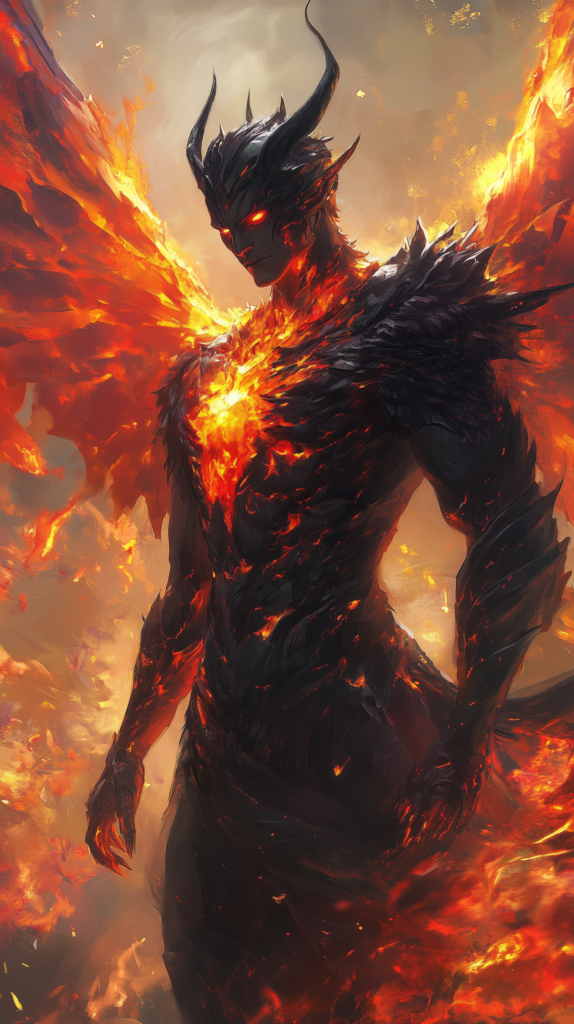
Distinct creature: A Sundered Sun is a fallen solar associated with Eblis, not an alternate form or former identity of the Lord of the Divs. The celestial origin and game statistics below apply to this servant alone (Challenge Rating 22), not to Eblis.
Huge celestial, lawful evil
_________________________________
Armor Class 21 (natural armor)
Hit Points 478 (33d12 + 264)
Speed 50 ft., fly 150 ft.
________________________________________________________________________________
STR 26 (+8) DEX 22 (+6) CON 26 (+8) INT 25 (+7) WIS 25 (+7) CHA 30 (+10)
________________________________________________________________________________
Saves Int +14, Wis +14, Cha +17
Skills Intimidation +17, Perception +14
Damage Resistances radiant; bludgeoning, piercing and slashing from nonmagical weapons
Damage Immunities necrotic, poison
Condition Immunities charmed, exhaustion, frightened, poisoned
Senses truesight 120 ft., passive Perception 24
Languages all, telepathy 120 ft.
Treasure greatsword, longbow
Challenge 22 (50,000 XP)
_________________________________
Cursed The fallen suffers disadvantage on any Charisma based skill check against good creatures except Intimidation, which it gains advantage on.
Fallen Weapons. The Sundered Sun’s weapon attacks are magical. When the Sundered Sun hits with any weapon, the weapon deals an extra 6d8 necrotic damage (included in the attack).
Divine Awareness. The Sundered Sun knows if it hears a lie.
Innate Spellcasting. The Sundered Sun’s spell casting ability is Charisma (spell save DC 25). It can innately cast the following spells, requiring no material components:
At will: detect evil and good, invisibility (self only)
3/day each: blade barrier, dispel evil and good, finger of death
1/day each: commune, control weather
Legendary Resistance (3/day). If the Sundered Sun fails a saving throw, it can choose to succeed instead.
Magic Resistance. The Sundered Sun has advantage on saving throws against spells and other magical effects.
ACTIONS
________________________________________________________________________________
Multiattack. The Sundered Sun makes two greatsword attacks.
Greatsword. Melee Weapon Attack: +15 to hit, reach 5 ft., one target. Hit: 29 (6d6 + 8) slashing damage plus 27 (6d8) necrotic damage.
Slaying Longbow. Ranged Weapon Attack: +13 to hit, range 120/600 ft., one target. Hit: 19 (3d8 + 6) piercing damage plus 27 (6d8) necrotic damage. If the target is a creature that has 190 hit points or fewer, it must succeed on a DC 15 Constitution saving throw or die.
Flying Sword. The Sundered Sun releases its greatsword to hover magically in an unoccupied space within 5 feet of it. If the Sundered Sun can see the sword, the Sundered Sun can mentally command it as a bonus action to fly up to 50 feet and either make one attack against a target or return to the Sundered Sun’s hand s. If the hovering sword is targeted by any effect, the Sundered Sun is considered to be holding it. The hovering sword falls if the Sundered Sun dies.
Cursed Touch (4/Day). The Sundered Sun touches another creature. The target takes 40 (8d8 + 4) radiant damage and must make a DC 25 Constitution saving throw or suffer one level of exhaustion.
LEGENDARY ACTIONS
________________________________________________________________________________
The Sundered Sun can take 3 legendary actions, choosing from the options below. Only one legendary action option can be used at a time and only at the end of another creature’s turn. The Sundered Sun regains spent legendary actions at the start of its turn.
Teleport. The Sundered Sun magically teleports, along with any equipment it is wearing or carrying, up to 120 feet to an unoccupied space it can see.
Searing Burst (Costs 2 Actions). The Sundered Sun emits magical, divine energy. Each creature of its choice in a 10-foot radius must make a DC 23 Dexterity saving throw, taking 14 (4d6) fire damage plus 14 (4d6) radiant damage on a failed save, or half as much damage on a successful one.
Blinding Gaze (Costs 3 Actions). The Sundered Sun targets one creature it can see within 30 feet of it. If the target can see it, the target must succeed on a DC 25 Constitution saving throw or be blinded until magic such as the lesser restoration spell removes the blindness.
EBLIS, Lord of the Divs — Legacy 3.5e Statistics
Edition note: This 3.5e conversion preserves the original numerical statistics while adapting titles and origin-dependent abilities to Eblis’s div-sovereign identity. He was never an archdevil appointed by Asmodeus or a celestial exile. The renamed abilities retain their listed saving throws and uses unless a replacement description states otherwise. This is an edited legacy conversion, not yet a fully recalibrated four-edition monster entry.
The Gates of Hell (Dice Freaks)
Grimoire of Cosmic Entities Volume One By Eli Atkinson, William Church and Serge W. Desir, Jr.
Original Concept by Serge W. Desir, Jr.Full netbook can be found on the following website
Dicefreaks d20 Community


Eblis, the Sundered Flame, rules neither the Nine Perditions nor the celestial hosts. He is an ancient destructive power whose name is bound to the earliest organised geniekind, the furnaces of elemental fire and the ruin of oaths. The Tower of Burnt Ash is one of his elemental outposts; his principal realm lies in Abaddon, where even experienced travellers mistake his div servants for infernal devils.
Eblis wars against genies who refuse his authority, celestial powers who obstruct his schemes and mortal kingdoms that control passages into the Elemental Plane of Fire. He purchases secrets with weapons and pacts, destroys fortresses with ash storms and manipulates allies who believe they can direct him. His power, resentment and wars have their own ancient history.
Later infernal legends sometimes confuse Eblis with the exiled leaders of the Great Fall. Those accounts are unreliable: the rebellion of Eon XX was principally united by Beelzebub, shaped by Belial and fought by Moloch. Eblis was neither its leader nor one of the celestial exiles judged and sent to Hell. The History of Hell and Toward Earth and Beyond preserve that distinction.
| EBLIS, Lord of the Divs, Nemesis of the Heavens | |
|---|---|
| fighter 20/Ur-Priest10 | |
| Huge outsider (Evil, Extraplanar, Lawful) | |
| Symbol | A black circle with a thin sliver of light overtaken by darkness. |
| Hit Dice | 76d8 + 20d10 + 960 (1768 hp) |
| Initiative | +11 (+7 Dexterity, Improved Initiative) |
| Speed | 90 ft., Fly 200 ft. perfect |
| Armor Class | 63 (-2 size, +8 armor, +10 deflection, +7 Dexterity, +24 natural, +6 profane), touch 31, flat-footed 56 |
| Base Attack/Grapple | +81/+107 |
| Attack | Heaven’s Sorrow +107 melee (10d6+39+1 (vile)/17-20 x2 +1d6 plus death (Fortitude save DC 76); or Heaven’s Tears + 93 ranged (death; Fort save DC 36 negates) or slam + 97 melee (3d8+27) |
| Full Attack | Heaven’s Sorrow +107/+102/+97/+92 melee (10d6+39+1 (vile)/17-20 x2 +1d6 plus death (Fortitude save DC 76); or Heaven-s Tears +93/+88/ +83/+78 ranged (death; Fort save DC 36 negates) and one negative level 19-20/x3 +9d6 (fire) +9d6 (unholy) and three negative levels), or 2 slams + 97 melee (3d8+27) |
| Space/Reach | 15 ft. /15 ft. |
| Special Attacks | Burning Earth, Call Divs, Aura of Ruin, Divine Impotence, Presence of Ruin, spell-like abilities, spells |
| Special Qualities | Adversary of the Divine, legacy sovereign qualities, cursed, damage reduction 30/epic, good and silver, Darkvision 60 ft., Sovereign Prowess (legacy conversion), immunity to fire and poison, Lord of Flames, Low-Light Vision, magic circle against good, Nemesis of the Heavens, rebuke undead (15/day, +8 rebuke bonus), regeneration 20, resistance to acid 30 and cold 30, see in darkness, siphon spell power, steal spell-like ability, Spell Resistance 79, telepathy 1,000 ft. |
| Saves | Fort +60 (+64 vs petrification), Ref +57, Will +60 |
| Abilities | Strength 46, Dexterity 25, Constitution 30, Intelligence 30, Wisdom 27, Charisma 34 |
| Skills | Appraise +16, Bluff +68, Climb +41, Concentration +93, Craft (armorsmith) +58, Craft (weaponsmith) +58, Diplomacy +51 (+49 with good creatures, +57 with evil creatures), Disguise +12 (+18 when acting in character), Escape Artist +76, Gather Information +47, Hide +32, Intimidate +69 (+75 against evil creatures), Jump +42, Knowledge (arcana) +89, Knowledge (nature) + 18, Knowledge (the planes) +89, Knowledge (religion) +89, Listen +39, Move Silently +32, Search +52, Sense Motive +77, Spellcraft +97, Spot +77, Survival +77 (+82 when on another plane, +80 when following tracks), Tumble +9 Use Rope +15 with bindings, |
| Feats | Armed Deflection, Awesome Blow, Cleave, Combat Casting, Combat Expertise, Corrupt Spell, Corrupt Spell-like Ability B , Craft Magical Arms and Armor, Dark Speech B , Exceptional Deflection, Flyby Attack, Great Cleave, Greater Weapon Focus (greatsword), greater weapon specialization (greatsword), Improved Bullrush, Improved Critical (composite longbow), Improved Critical (greatsword), Improved Disarm, Improved Initiative, Improved Sunder, Improved Trip, Iron Will, Leadership, Malign Spell Focus, Many Shot, Mortal Bane, Persuasive, Point Blank Shot, Power Attack, Precise Shot, Quick Draw, Rapid Shot, Vile Martial Strike (composite longbow), Vile Martial Strike (greatsword), Weapon Focus (composite longbow), Weapon Focus (greatsword), Weapon Specialization (greatsword) |
| Epic Feats | Blinding Speed, Craft Epic Magical Arms and Armor, Devastating Critical (greatsword), Dire Charge, Epic Evil Brand B , Epic Weapon Focus (greatsword), Epic Weapon Specialization (greatsword), Overwhelming Critical, Penetrate Damage Reduction, Planar Turning |
| Environment | Any land and underground (The Tower of Burnt Ash, Elemental Plane of Fire) |
| Organization | Unique (Solitary), or elite (Eblis and the Sundered Suns), or squad (Eblis, 1 -6 fiendish elder elementals) |
| Challenge Rating | 67 |
| Treasure | Quadruple standard plus bracers of armor +8, Heaven’s Sorrow, and Heaven’s Tears |
| Alignment | Lawful Evil |
In Hell, Eblis was offered a place in the courts of Perdition. However, unlike Beelzebul, Moloch, Belial and others, Eblis scoffed at the notion of working with Asmodeus and The Legions of Hell, viewing them as no better than their celestial counterparts. Indeed, Eblis suggested that he could do a better job than the King of Hell in bringing the Realms Above and the gods to their knees. Asmodeus, for his part, was mildly concerned, a rare occurrence. Unlike Beelzebub or Mephistopheles, who were so consumed with hate and meaninglessness that they would inadvertently create the means that would lead to their own defeat, Asmodeus sensed in Eblis a sense of meaning almost as profound as his own. This sense of meaning, the destruction of the Heavens and mortals, was something that Asmodeus knew could lead to Eblis making true his threat. So, without a further word, Asmodeus banished Eblis forever from Hell. However, Asmodeus did grant Eblis the power of an arch-devil. The Overlord of Hell knew that Eblis, in spite of his contempt for Hell, would still carry on the deeds of The Pit in his unholy pursuits. As is always the case, Asmodeus was correct in his assumption. Still, Eblis is not a witless patsy; while he knows that his actions and interests indirectly benefit Hell, he believes that once he has his revenge on the Realms Above, he will have enough power to deal with Asmodeus and the Legions of Hell.
Few outsiders know the true reach of Eblis’s ruinous court. His principal domain lies in Abaddon, while the Tower of Burnt Ash on the Elemental Plane of Fire serves as an outpost for clandestine bargains. Through div servants and elemental agents, he sabotages cities, craft and the schemes of rival powers. He has sometimes allowed these assaults to resemble the plots of Adrammelek or Belial, hoping that Hell’s factions will blame one another. Neither infernal court commands him, and either would retaliate if it learned of the deception.
Eblis regards the rulers of Hell as rivals and opportunists rather than kin. He watches the courts of Beelzebub and Belial, exchanging information when their enemies coincide, but he played no part in their Eon XX celestial rebellion. His oldest ties are to genie and elemental courts: he keeps uncertain dealings with the Grand Sultan of the Efreeti and grudgingly respects Kossuth’s command of fire. Eblis also opposes Apollyon, the destructive demon prince, whose intrigues threaten the same realms. Tales blaming Eblis for Apollyon’s ancient exile are unproved. The enmity is real; the claim that they share an origin among the Fallen is false.
Eblis stands as tall as a solar and has wings that resemble banners of living fire, but the likeness is only a resemblance: he was never one of the celestial hosts. His great body appears to be formed from flowing magma and black stone. Heavy horns rise above an imperious face, and the red glow in his eyes makes it difficult to tell whether he is studying his enemies or already choosing what part of their civilisation to destroy.
Combat
Eblis enjoys combat, but he never enters into violence unless he is aware of the power of his adversaries. If possible, Eblis will remain in the background for up to six rounds as he attempts to pin-point divine spellcasters and those dedicated to good gods or cosmic entities. Once this is accomplished, Eblis will enter combat, focusing his attention on the strongest divine spellcaster. If the divine spellcaster is particularly well defended or seems powerful, Eblis will attack with Heaven’s Tears for as long as possible, hoping to kill the divine spellcaster quickly. Once he deems it safe, Eblis, surrounded by his Aura of Ruin, will enter into melee. He always begins with Divine Impotence, followed by Burning Earth. He will then begin butchering his foes with Heaven’s Sorrow, peppering them with spells, spell-like abilities (affected by his Lord of Flames ability), and Burning Earth.
Adversary of the Divine (Ex): Eblis channels ancient animosity towards powers of goodness and order into an extraordinary assault upon their divine defences. The ability does not mean he was once a celestial or a member of any divine host. In the event that Eblis has the opportunity to fight a god dedicated to goodness, he jumps to the chance. All attacks a god directs against Eblis are weakened. All forms of attempts to adversely affect or harm Eblis outside of melee or non-magical ranged attacks (including salient divine abilities) deal only half damage to Eblis; furthermore, attempts to limit, change him, or control Eblis are likewise weakened; not only does Eblis gain a saving throw against such effects and get to use his Spell Resistance to ignore effects, those that do manage to affect him have the duration quartered. Eblis is utterly immune to death effects performed by gods (including salient divine abilities). When Eblis attacks a god, he gains a 50% chance of breaching any divine defence. Even attacks against which the deity should be immune may harm him if he is attacked by Eblis (but not those related to the nature of the deity; i.e. an elven deity would still be immune to sleep because she is an elf and a god).
Although Eblis’s lack of belief in the gods affords him unprecedented power against them, he cannot abide the power of those mortals who serve them in his stead. Any divine spell or spell-like effect produced by a humanoid being serving a good god or cosmic entity (a cleric, druid, paladin, etc.) functions as if it were Intensified when used against Eblis. Additionally, when Eblis is within 20 feet of a good-aligned divine spellcaster, he suffers a -1 penalty for every two divine ranks of the god worshipped by the caster to his attacks, armour class, saving throws, and Spell Resistance. If there are multiple divine spellcasters in the area, the penalties Eblis suffers are based upon the divine rank of the strongest god worshipped. It is for this reason that Eblis tends to focus on divine spellcasters before all others, striking them with Divine Impotence.
Burning Earth (Su): Eblis’s hatred for mortals knows no bounds. So intense is his hatred that mortals who behold his anger may die on the spot. 3/day, Eblis can call on the Burning Earth, forcing mortal beings to return to the clay from which some legends say they were formed. All humanoids within 30 feet of Eblis must Fortitude save DC 64 or die instantly, engulfed in flames in a manner virtually identical to the destruction spell cast by an 80 th level cleric. Humanoids killed in this manner are utterly destroyed; nothing, not even a miracle or wish spell, can bring a being so destroyed back to life. Indeed, only gods of life (of at least Lesser god rank) or gods with access to the Mass Life and Death salient divine ability can return a humanoid so destroyed back to life. Those that manage to save against this dreadful attack suffer 60 points of damage. For each good aligned, divine spellcaster of at least 21 st level (or 21 HD) killed in this manner, Eblis gains +3 bonuses to his armour class, attacks, and saving throws for 1 day.
Call Divs (Sp): As a standard action Eblis can attempt to call Divs. He may attempt to call up to three times a day, 3 Akvans , 12 Sepids or Shiras, or 18 of any lesser type of Divs. Eblis has a 50% chance of success with each calling attempt. Since these Divs are called, they have the ability to summon other Divs as their descriptions allow. Although a foe to the Upper Planes and gods of goodness, Eblis is also an enemy to The Legions of Hell and the other powers of the Depths Below. As such, he never attempts to call on devils, however, Eblis has found the means to call other beings, namely fiendish fire elementals and efreeti. Thrice per day, Eblis can call 18 Fiendish Small Fire Elementals, 15 Fiendish Medium Fire Elementals, 12 Fiendish Large Fire Elementals, 9 Fiendish Huge Fire Elementals, 6 Fiendish Greater Fire Elementals or 6 efreeti, 3 Fiendish Elder Fire Elementals or 8 efreeti; once per month, Eblis can also call 1 fiendish primal fire elemental. These beings serve Eblis unquestioningly, although he has had to make occasional concessions to the Lord of fire elementals, Kossuth, and the Grand Sultan of the Efreeti, for the access he has to their kind. Eblis also keeps a cadre of fallen solar servitors. The five strongest are the Sundered Suns: Awar, Dasim, Sut, Tir and Zalambur. Rumours name them his sons, but their celestial origins are distinct from their patron’s ancient div-sovereign nature; the stories of blood kinship are not established fact.
Aura of Ruin (Ex): Eblis projects a dreadful supernatural menace. A creature that can perceive him and begins its turn within 60 feet must succeed on a DC 64 Will saving throw or be shaken for 10 rounds. A creature that succeeds is immune to this aura for 24 hours. This is a mind-affecting fear effect; it is a personal div-sovereign power, not an infernal office.
Divine Impotence (Su): Well aware of the power divine spellcasters have over him, Eblis has the ability to punish them for their divine connection. 3/day, Eblis can infect a divine spellcaster with Divine Impotence if he fails a Will save DC 64. An infected spellcaster behaves as if he were half his current level with regards to all spell-casting effects and special abilities associated with their connection to divinity (turning undead, smite evil, etc). This infection lasts for one day. Once a divine spellcaster is affected by this power, he is immune to it for one day, likewise if he succeeds in his saving throw.
Lord of Flames (Ex): Eblis has taken the flame as his totem, revelling in its power to burn, appreciating how it perfectly mirrors the hate that rages in the depth of his soul. As Lord of Flames, all fire-based attacks cast by Eblis, whether they are spells or spell-like abilities, function as if they were Corrupt and Intensified, i.e. they deal double the maximum damage, half of which is unholy in nature. Furthermore, Eblis is perpetually surrounded by waves of fire and burning air; all beings within ten feet of Eblis suffer 120 points of fire damage and 120 points of corrupt damage. So great is his connection to fire that Eblis can command fire elementals as if he were an 80 th level cleric.
Nemesis of the Heavens (Ex): Eblis’s veils of ruin conceal him from divine surveillance. He is unable to be sought by ordinary mortal divinations; epic magic may breach the concealment. Deities treat Eblis as a cosmic rank 15 being when determining whether portfolio senses detect his movements, and cosmic entities treat him as a DvR 15 deity for the same purpose. These wards extend 900 feet around Eblis and nine miles around the Tower of Burnt Ash. These defenses arise from his own ancient div-sovereign power, not a grant from Asmodeus or an infernal appointment.
Once per year, Eblis is able to sense a major activity conducted by a cosmic entity or deity from the Realms Above. This works as per the portfolio sense of a greater god, save that he is aware of the activity only 9 days before it should come to pass. Overdeities and cosmic powers of greater than cosmic rank 20 and their activities cannot be sensed by means of this ability. Eblis has his own agents, and often uses the information garnered from them to determine whether or not to use this aspect of his Nemesis of the Heavens ability. It is rumoured, though, that Eblis has on certain occasions received an impression to look in on a particular deity or cosmic entity’s actions; almost every time this has occurred, it has led to Eblis discovering and then thwarting events of major significance to his enemies in the Realms Above. The Lord of Flame suspects that these inklings come from directly from Asmodeus, but generally acts on them all the same.
Presence of Ruin (Su): Eblis’s ancient destructive aura has a 1,980-foot radius, and its effects operate as though cast by an 80th-level sorcerer. The name of the ability does not confer authority from Hell or imply allegiance to its sovereign.
Spell-Like Abilities:
- At will – aid, animate dead, animate objects, bestow curse, blasphemy, cause fear, charm monster, contagion, continual flame, deeper darkness, delayed blast fireball, detect chaos, detect good, dimensional anchor, flame strike, greater dispel magic, greater invisibility, imprisonment, magic circle against chaos, magic circle against good, mirage arcana, persistent image, polymorph, resist energy, summon monster VII, speak with dead, symbol of pain, unhallow, unholy aura, unholy blight, waves of fatigue.
- 3/day – blade barrier, destruction, Earthquake, firestorm, harm, mass charm monster, meteor swarm, permanency, waves of exhaustion.
- 1/day – energy drain, hellball, power word blind, power word kill, power word stun, prismatic spray, wish.
All spells are cast as an 80th level caster (save DC 31 + spell level, E 33 + spell level for spells with the evil descriptor).
Spells: Eblis uses the ur-priest spellcasting progression in this 3.5e conversion, stealing and corrupting divine magic through destructive rites. This class choice represents his methods of magical theft, not a celestial origin or banishment from the Upper Planes.
Typical ur-priest spells prepared (6/7/7/6/6/5/5/4/3/1; 68th level caster; base DC 27 + spell level, 29 + spell level for spells with the evil descriptor):
- 0 – guidance x2, Preserve Organ, read magic, resistance, No Light;
- 1st – Angry Ache, Bane, Doom, Extract Drug, Shield of Faith x2, Sorrow;
- 2nd – Boneblast, Concentration, Death Knell, Eagle’s Splendor, Enthrall, Spiritual Weapon, Undetectable Alignment;
- 3rd – Masochism, Protection from Energy, red fester, Sadism, Wrack x2;
- 4th –Damning Darkness, Divine Power, Poison, Psychic Poison, Stop Heart x2, ;
- 5th – dispel chaos, greater command, heart-clutch, Resonating Resistance, true seeing;
- 6th – blade barrier, Fiendish Quickening, harm, heal, Thousand Needles;
- 7th – Bestow Greater Curse, dictum, repulsion, Wretched Blight;
- 8th – dimensional lock, discern location, evil weather ;
- 9th – Apocalypse from the Sky.
Possessions:
Eblis is never without his sword, Heaven’s Sorrow, a +6 greatsword made entirely of divine fire dealing base 10d6 damage plus Strength as normal; note that the fire is divine in nature and so is not subject to fire resistance or the like. He also always carries Heaven’s Tears, a +6 composite longbow that shoots arrows composed of pure destructive energy (as per the destruction spell, Fort save DC 36 negates). Both are major artifacts directly linked to Eblis- hatred of humanoid beings.
Some infernal inventories falsely claim these artifacts were celestial gifts bestowed before the Great Fall. Their true origin is unresolved, and that claim must not be treated as evidence that Eblis was a fallen angel. Heaven’s Sorrow appears like a huge, unadorned greatsword with a bright blade of silver fire; Heaven’s Tears is likewise a plain looking composite longbow with the exception of its -string,- which appears as silver fire. If touched by any humanoid, both artifacts will kill the wielder if he fails a Fortitude save DC 50. Even those that save are struck with three negative levels while they wield either weapon or keep them in their possession. Eblis can effortlessly track either item. Eblis always wears a pair of +8 bracers of armour.
Summoning Eblis
Drawing Eblis attention is a foolhardy venture for mortals since he despises them all to the last. However, powerful mortals attempting to do away with troublesome servants of the Realms Above may be able to entice Eblis if the Nemesis of the Heavens is properly cajoled into service.
Eblis requires the sacrifice of 45 HD worth of good aligned divine spellcasters. The casters must have died within three days of the intended summons, hacked into quarters while they are still conscious and fully aware of what is happening to them. Their bodies are then cremated and mixed with their blood to form a grisly clay. The clay is then placed in the area of the intended summons.
After successfully completing the summons, the clay slowly begins to burn as, in the air directly above, a dark red cloud of flame and brimstone, billows from nothing. Once the cloud extends in a 90 foot radius from the centre of the summoning area, a tremendous cyclone of flame will descend into the clay. With an explosion of infernal energy, Eblis will appear standing over the clay which will have become ash at his feet. The Lord of Flames will always stoop to scatter the ashes. The entire area within 90 feet of Eblis will become swelteringly, but not dangerously, hot.
The summoner(s) has one minute to convince Eblis that there is a reason for the Lord of the Divs not to destroy him (DMs discretion, although a base Diplomacy DC of 81 is a good starting place). If the summoner fails to accomplish this, Eblis will immediately seek to tear down the barriers that bind him. If he succeeds in breeching the wards, Eblis will attempt to kill every mortal in the room as quickly as possible before returning to the Tower of Burnt Ash.
If the summoner manages to convince Eblis that the death of another mortal is not an immediate necessity, the Virtue’s Failure will treat as normal, although he has no patience for dithering fools and bores easily. If an agreement cannot be determined within the next seven minutes, Eblis will return to the Tower of Burnt Ash.
When a summons is concluded, the heat that filled the room suddenly dissipates as it all seems to coalesce around Eblis. The cyclone of flames engulfs him and, in an explosion that shakes the foundations again, he disappears. If a summoning sanctuary spell is not up, all within 90 feet suffer 120 points of fire damage (DC 53 for half damage).
Keep this reference growing
If this page helped with your reading or game, you can support its upkeep or explore the curated books.
Explore the Bookshop — epics, classics and stories behind imagined worlds.