
History of Hell
Devils record history because history establishes precedent. A forgotten decree may still carry authority, an ancient betrayal may define a modern alliance, and a ruler deposed ages ago may leave behind claims that still matter. Yet infernal histories are also instruments of power. Archives are censored, victories enlarged, enemies erased and creation myths repeated until propaganda resembles memory.
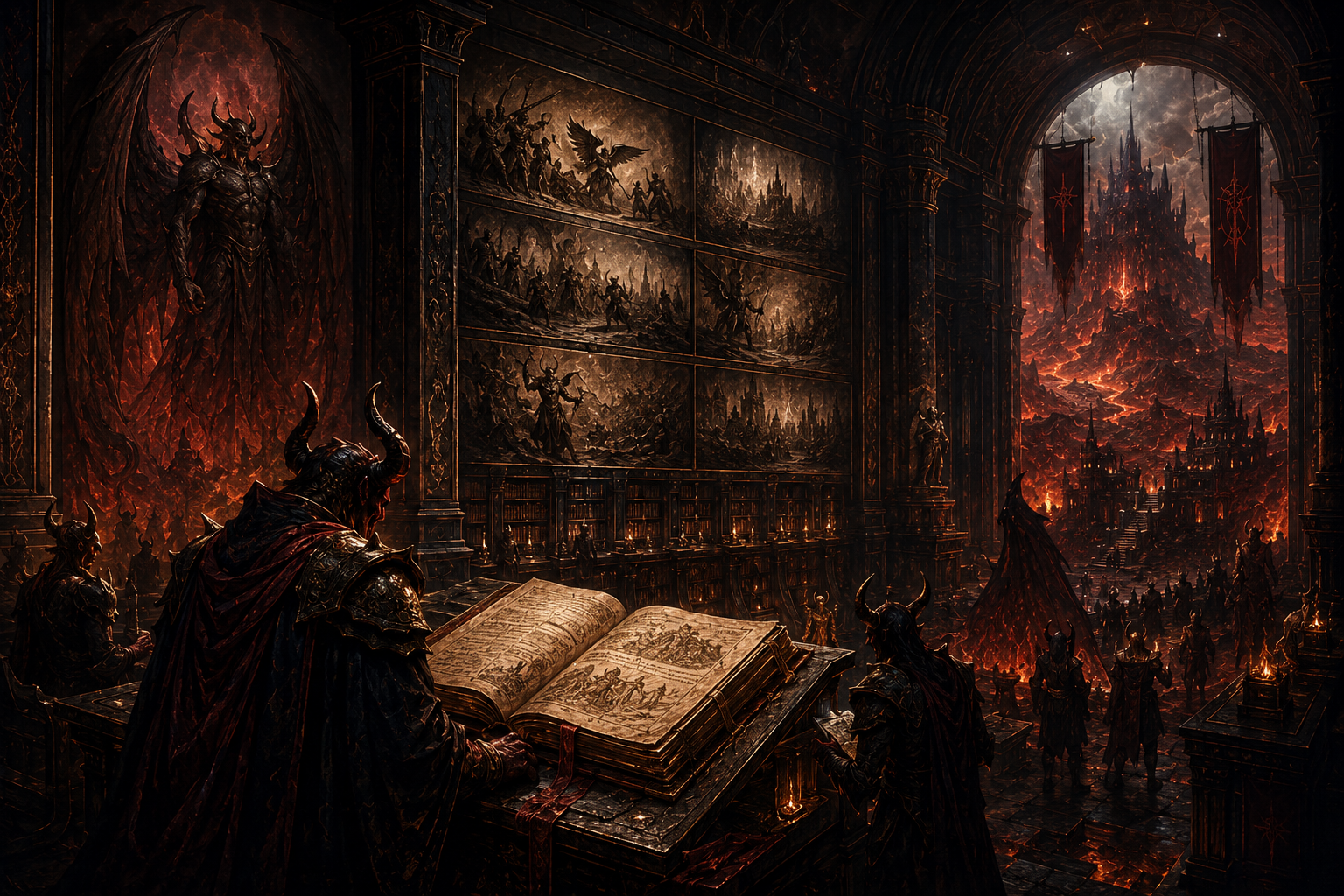
History of Hell — How to Read the Infernal Record
Hell has history, but not every story told in Hell is history.
The plane itself is vastly older than its present government. The earliest cosmic chronology records the formation of Hell as an independent Outer Plane long before recognisable devil civilisation, the Lords of the Nine, Malsheem’s bureaucracy or the later infernal courts existed.
Infernal archives nevertheless contain traditions that project later rulers, political doctrines and theological claims backwards into the earliest ages of Creation. Such accounts remain valuable because they reveal how devils understand themselves, what their rulers want believed and which ancient stories continue to carry political force.
The master timeline controls chronology. Hell forms as an Outer Plane in Eon VII. Durable devil civilisation emerges during Eon XVI. Later infernal traditions cannot move the present Lords of Hell backwards into the creation of the cosmos.
There is no hidden primordial Overlord ruling behind Asmodeus. The title Lucifer was borne by a genuine earlier sovereign of organised Hell. Asmodeus later displaced that ruler and now rules openly as Lord of Nessus and Overlord of Hell. Lucifer’s exact origin and present fate remain unresolved.
Hell Before the Devils
Hell begins as a place before it becomes a civilisation.
During the Great Separation, the First Thought-Realms become self-sustaining Outer Planes. Among the realms shaped by domination, exploitation, punishment and control is the ancient reality that later generations call Hell.
Its first landscapes and internal laws develop during this early planar age. Native phenomena and embryonic intelligences exist, but the recognisable devil hierarchy does not yet possess its later offices, legions, contracts, courts and permanent political institutions.
Nothing in this period requires Lucifer, Asmodeus or another later infernal ruler to have created the plane. Hell’s geography precedes the political regimes that eventually claim it.
This distinction is fundamental: the formation of Hell and the formation of devil civilisation are separate events.
Infernal Civilisation Becomes Enduring
Eon XVI is the beginning of Hell’s durable political history.
Devil populations develop continuity. War bands become legions. Strongholds become administrative centres. Rank survives individual office-holders. Punishment and promotion become recognised instruments of obedience. Contracts cease to be merely private bargains and become weapons of government, territory and policy.
The oldest infernal traditions remember extraordinarily powerful early fiends known as the malefircareim. They are best treated as ancient infernal great powers active during the violent consolidation of organised Hell, not as beings literally created from the blood of a secret cosmic Overlord.
Some survive the struggles surrounding the first infernal order. Others disappear through destruction, exile or political defeat. Names such as Merorem and Haagenti remain in fragmentary records, while eight great powers become associated with the earliest Luciferian division of the Perditions.
At the same time, demonic expansion from the Abyss collides with infernal attempts to secure routes, gates and borders. These first infernal–Abyssal fronts establish the ancient conflict that later ages will know as the Blood War.
The Circle of Three Tradition
One of Hell’s oldest surviving creation traditions describes a threefold cosmic power called the Circle of Three.
The Supreme Virtue
In the tradition, the Supreme Virtue represents justice, mercy and ordered benevolence.
The Progenitor
The Progenitor represents stability, mediation and the continuity of imposed order.
The Overlord
The Overlord represents tyranny, oppression and domination: the infernal claim that order reaches perfection only when someone possesses absolute authority.
In its traditional form, the story claims that the Circle established cosmic law, shattered in primordial conflict and produced the major realms of ordered Creation. Infernal versions go further, claiming that Hell and the first devils arose from the fall of the dark member.
The Circle of Three does not replace the locked cosmic chronology. It survives as infernal theology, political myth and propaganda. The Outer Planes form through the established cosmic sequence, and the later devil civilisation arises within an already ancient Hell.
The persistence of the story is nevertheless important. Infernal rulers, philosophers and propagandists have repeatedly used it to argue that tyranny is not merely one political system among many but a fundamental principle woven into Creation itself.
Lucifer and the First Securely Remembered Infernal Regime
The first securely remembered sovereign regime of organised Hell belongs to the ruler bearing the title Lucifer.
Lucifer is not another name for Asmodeus and is not an avatar through which a concealed being rules from behind the throne. It is the title borne by an actual earlier infernal sovereign whose government precedes the Asmodean order; that ruler’s exact origin and present fate remain unresolved.
Under the Luciferian settlement, eight great infernal powers are remembered as territorial rulers beneath the sovereign throne. The surviving tradition gives the following arrangement:
This arrangement is more useful as political history than as a claim that all nine modern jurisdictions already possessed their final borders, cities and institutions in precisely their present form. Hell continued to change under every later regime.
The Battles of Light and Greed
The decisive break in early infernal history is the succession struggle that displaces the sovereign bearing the title Lucifer.
Asmodeus gathers support among devils dissatisfied with the Luciferian order and among powers that believe they can profit from a change of sovereign. Astaroth becomes entangled in the conspiracy, although later infernal records disagree strongly over his intentions, the timing of his betrayal and whether his apparent failures were deliberate.
The conflict ends not with a staged dispute between two manifestations of the same hidden being, but with a genuine succession: the Luciferian sovereign is displaced and Asmodeus takes the infernal throne. The exact fate of the former sovereign remains unresolved.
Older infernal traditions disagree over Astaroth’s loss of Avernus and later claims involving Tiamat and Astarte. Those traditions remain part of the archive, but the earlier Avernian succession is not yet fully resolved. Binding present chronology securely establishes Zariel as Bael/Bel’s immediate predecessor.
The Battles of Light and Greed establish the central political fact of later infernal history: Asmodeus rules Hell because he displaced an earlier sovereign and successfully retained the state that followed.
The new regime does not eliminate the older infernal elite. Dispater, Mammon and Mephistopheles remain major territorial powers. Other seats change hands repeatedly as fallen celestials, archdevils and rival factions enter the struggle.
For the surviving contradictory traditions surrounding Astaroth, see the Astaroth archive . Those traditions are evidence for infernal memory and propaganda; where they conflict with the master chronology, the master chronology takes precedence.
The Fallen Enter Infernal Politics
The Great Fall does not create Hell and does not create devil civilisation. Both are already ancient when the event occurs.
Instead, the Fall introduces a new generation of powerful celestial exiles into an infernal state whose hierarchy, armies and territorial offices already exist. Most Fallen do not automatically become devils, nor do all enter permanent service to Hell. Several of the greatest, however, seize opportunities within the infernal courts.
Belial
Belial rises against Adrammelek and eventually becomes Lord of Phlegethos.
Moloch
Moloch displaces Lilith and takes control of Malbolge, though his possession of the Sixth will not survive Dies Irae.
Beelzebub
Beelzebub supplants Sammael and establishes himself as Lord of Maladomini.
Astarte also becomes a major Fallen power in later infernal politics. Older infernal chronicles connect her with struggles involving Tiamat and Avernus, but the earlier succession of the First Perdition remains unresolved and those claims must not override the securely established later Zariel → Bael/Bel succession.
During the same broad political age, Leviathan loses the Fifth. Asmodeus imprisons him within the frozen reaches associated with Stygia and installs Geryon in his place.
Eblis is not introduced here as a newly fallen angel. The master chronology already preserves Eblis as a destructive intelligence associated with organised geniekind. Older infernal texts that place him among this particular Fall are therefore treated as conflated tradition.
Classic Perdition
For a long age, Hell is governed by the arrangement later mortal scholars remember as Classic Perdition.
Later infernal chronicles describe a long-lived political alignment they call Classic Perdition, associating the great territorial courts of Dispater, Mammon, Belial, Geryon, Moloch, Beelzebub and Mephistopheles with older Avernian traditions involving Tiamat beneath the sovereignty of Asmodeus. The label is useful political history, but it does not settle the unresolved earlier succession of Avernus.
The arrangement is stable only in comparison with the upheavals before and after it. The Lords scheme continuously against one another, build patronage networks among the Dukes and senior devils, interfere in rival courts and compete over the direction of Hell’s military, diplomatic and mortal-world policies.
The old archives sometimes describe these struggles as a division along infernal “racial” lines. That classification is misleading. The more useful distinction is political: rival blocs of Lords with different histories, alliances and visions of infernal rule.
The Ascendant Exiles
Astarte, Belial, Moloch and Beelzebub frequently find common cause as comparatively newer powers whose authority is bound to the political consequences of the Great Fall.
The Established Courts
Dispater, Mammon, Geryon and Mephistopheles represent older infernal interests, although rivalry prevents either bloc from becoming a permanent united government.
Older infernal histories describe a prolonged Avernian struggle involving Tiamat and Astarte, but the exact offices and succession represented by those stories remain unresolved. They are retained as politically important archive traditions rather than used to displace the binding later succession from Zariel to Bael/Bel.
Dies Irae
Dies Irae is the great internal reckoning of the Asmodean age: a civil conflict that destroys the existing balance among the Lords and produces institutions that still shape present Hell.
As rival infernal blocs move from intrigue into open conflict, their armies descend upon Nessus. The decisive confrontation occurs in the sovereign territory around Malsheem. The Pit of Darkness is a distinct nearby infernal location and must not be confused with the citadel itself.
The competing Lords and their hosts gather in Nessus for the confrontation that will decide the political order of Hell.
The Lords turn their powers against one another while the assembled infernal armies wait for the outcome.
At the critical moment, Geryon signals his loyalty to Asmodeus by sounding his horn.
Asmodeus breaks the rival factions. Their great political ambitions collapse beneath the authority they had attempted to circumvent or manipulate.
Senior pit-fiend generals who remain loyal to the sovereign order become central instruments of the post-war settlement.
Moloch loses Malbolge. Lilith/Malagard is restored to the Sixth for a later period; Glasya subsequently becomes the current Lord of Malbolge, while the living Lilith remains imprisoned under her authority.
Geryon, despite his loyalty during the crisis, loses Stygia. Leviathan returns as Lord of the Fifth.
The loyal pit-fiend commanders form the institutional foundation of the Dark Ministry, giving Hell a stronger executive apparatus whose responsibilities can cross the boundaries of individual Perditions.
The later Avernian succession is not fully reconstructed from the surviving archives. Binding canon securely fixes Zariel as the immediate predecessor of Bael/Bel; Bael/Bel betrays, deposes and imprisons Zariel before becoming the present Lord of the First.
Dies Irae does not abolish the Lords of the Nine. It demonstrates that territorial lordship remains subordinate to the sovereignty of Asmodeus and strengthens Hell-wide offices capable of operating across individual jurisdictions.
The later office of Dagos, Marshal of the Pits , preserves this post-Dies-Irae military settlement. Infernal tradition places the Helm of the Pit among the symbols associated with the office.
The Gathering Darkness
The Gathering Darkness is the traditional name for the current age of Hell: the political settlement that follows Dies Irae and the final changes to the present Lords of the Nine.
The term does not describe the secret plans of a concealed Overlord. It describes a Hell whose territorial rulers remain ambitious and dangerous while the sovereign state is firmly held by Asmodeus.
The present settlement is:
Minauros
The sinking infernal jurisdiction of marsh, debt and acquisition.
Explore Minauros →Phlegethos
The volcanic Fourth, ruled by one of the great powers elevated after the Fall.
Explore Phlegethos →Malbolge
Current Lord of the Sixth and jailer of the living former ruler Lilith/Malagard.
Explore Malbolge →Maladomini
The ruined and repeatedly remade Seventh remains under the Lord of the Flies.
Explore Maladomini →Cania
The ancient Lord of the Eighth rules the glacial Perdition from Mephistar.
Explore Cania →Nessus
Lord of the Ninth and Overlord of Hell, ruling from Malsheem among the Great Rifts.
Explore Nessus →The current infernal state is one Hell with nine great jurisdictions. The Lords possess immense territorial authority, but none is a sovereign equal to Asmodeus.
Hell Seen Through Mortal Art
Mortal artists often use volcanoes, darkness, fire and catastrophic landscapes to imagine infernal realms. Such works are valuable as historical visions without being literal maps of the Nine Perditions.
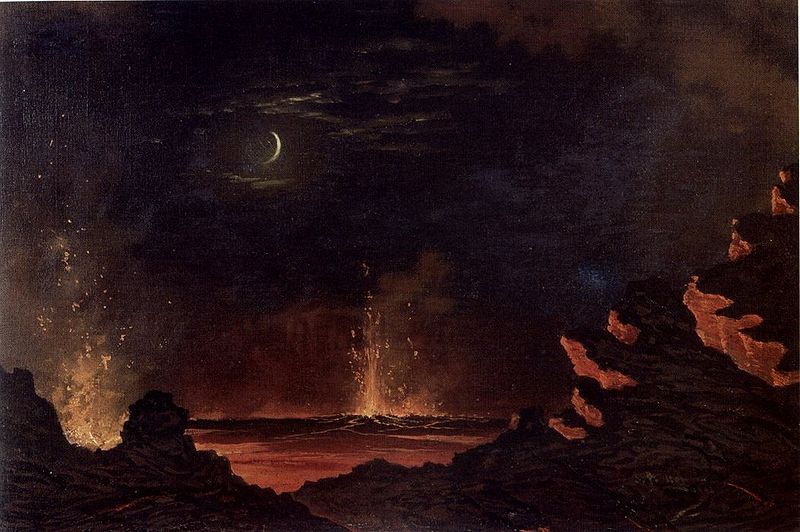
The actual Nine Perditions encompass far more than fire: iron cities, drowned marsh, volcanic wastes, frozen seas, crushing slopes, ruined monumental landscapes, moving glaciers and the colossal rifts of Nessus all belong to Hell’s geography.
Keep this reference growing
If this page helped with your reading or game, you can support its upkeep or explore the curated books.
Explore the Bookshop — epics, classics and stories behind imagined worlds.