
Magic • Transmutation • Spell Reference
Animate Objects
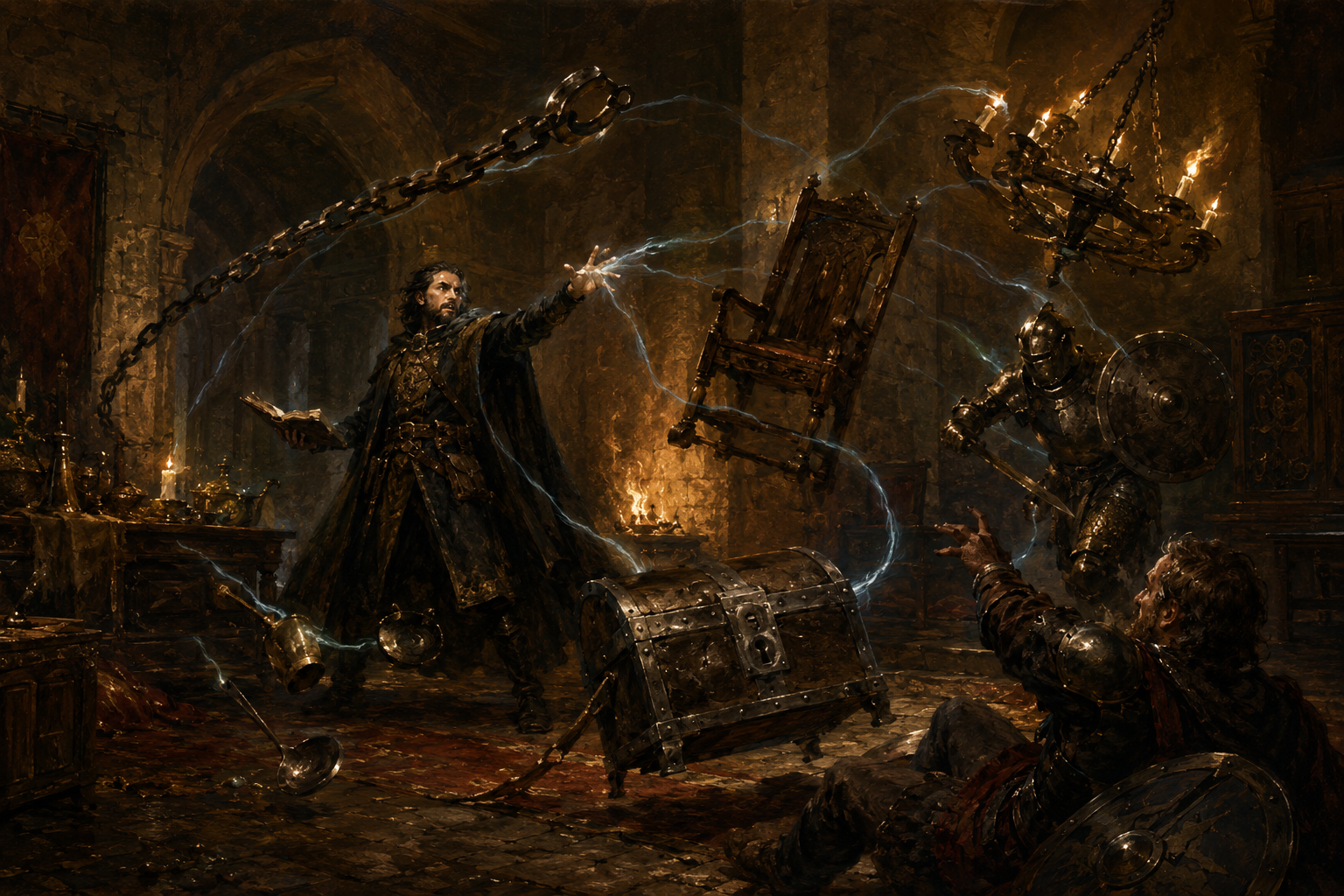
Chairs rise, chains crawl and statues step down from their plinths. Animate Objects turns unattended matter into temporary allies. Its object limit, creature statistics and control rules differ by edition.
Animate Objects at a Glance
| 5.5e / 2024 | Level 5 — Bard, Sorcerer, Wizard |
|---|---|
| 5e / 2014 | Level 5 — Bard, Sorcerer, Wizard |
| Pathfinder 1e | Level 6 |
| D&D 3.5e | Level 6 |
| Browse | Bard spells · Sorcerer and Wizard spells · Cleric spells |
Spell Rules
Animate Objects — 5.5e (2024)
| Spell | Level 5 Transmutation (Bard, Sorcerer, Wizard) |
|---|---|
| Casting Time | Action |
| Range | 120 feet |
| Components | V, S |
| Duration | Concentration, up to 1 minute |
Objects animate at your command. Choose a number of nonmagical objects within range that aren’t being worn or carried, aren’t fixed to a surface, and aren’t Gargantuan. The maximum number of objects is equal to your spellcasting ability modifier; for this number, a Medium or smaller target counts as one object, a Large target counts as two, and a Huge target counts as three. Each target animates, sprouts legs, and becomes a Construct that uses the Animated Object stat block; this creature is under your control until the spell ends or until it is reduced to 0 Hit Points. Each creature you make with this spell is an ally to you and your allies. In combat, it shares your Initiative count and takes its turn immediately after yours. Until the spell ends, you can take a Bonus Action to mentally command any creature you made with this spell if the creature is within 500 feet of you (if you control multiple creatures, you can command any of them at the same time, issuing the same command to each one). If you issue no commands, the creature takes the Dodge action and moves only to avoid harm. When the creature drops to 0 Hit Points, it reverts to its object form, and any remaining damage carries over to that form.
Using a Higher-Level Spell Slot. The creature’s Slam damage increases by 1d4 (Medium or smaller), 1d6 (Large), or 1d12 (Huge) for each spell slot level above 5.
Animated Object — 2024
Type: Huge or smaller Construct, unaligned. AC: 15. Speed: 30 feet. Hit Points: 10 (Medium or smaller), 20 (Large), 40 (Huge).
| STR | DEX | CON | INT | WIS | CHA |
|---|---|---|---|---|---|
| 16 (+3) | 10 (+0) | 10 (+0) | 3 (−4) | 3 (−4) | 1 (−5) |
Saving throw modifiers equal the ability modifiers above. Damage immunities: Poison, Psychic. Condition immunities: Charmed, Exhaustion, Frightened, Paralyzed, Poisoned. Senses: Blindsight 30 feet; Passive Perception 6. Languages: Understands the languages you know. CR: None (0 XP); Proficiency Bonus equals yours.
Slam. Melee attack using your spell attack modifier; reach 5 feet. On a hit, Force damage is 1d4 + 3 (Medium or smaller), 2d6 + 3 + your spellcasting ability modifier (Large), or 2d12 + 3 + your spellcasting ability modifier (Huge).
These objects sprout legs. The 2014 flying-speed rule does not carry over into this stat block.
Animate Objects — 5e (2014)
| Spell | 5th-level transmutation |
|---|---|
| Casting Time | 1 action |
| Range | 120 feet |
| Components | V, S |
| Duration | Concentration, up to 1 minute |
Objects come to life at your command. Choose up to ten nonmagical objects within range that are not being worn or carried. Medium targets count as two objects, Large targets count as four objects, Huge targets count as eight objects. You can’t animate any object larger than Huge. Each target animates and becomes a creature under your control until the spell ends or until reduced to 0 hit points. As a bonus action, you can mentally command any creature you made with this spell if the creature is within 500 feet of you (if you control multiple creatures, you can command any or all of them at the same time, issuing the same command to each one). You decide what action the creature will take and where it will move during its next turn, or you can issue a general command, such as to guard a particular chamber or corridor. If you issue no commands, the creature only defends itself against hostile creatures. Once given an order, the creature continues to follow it until its task is complete. Animated Object Statistics Size HP AC Attack Str Dex Tiny 20 18 +8 to hit, 1d4 + 4 damage 4 18 Small 25 16 +6 to hit, 1d8 + 2 damage 6 14 Medium 40 13 +5 to hit, 2d6 + 1 damage 10 12 Large 50 10 +6 to hit, 2d10 + 2 damage 14 10 Huge 80 10 +8 to hit, 2d12 + 4 damage 18 6 An animated object is a construct with AC, hit points, attacks, Strength, and Dexterity determined by its size. Its Constitution is 10 and its Intelligence and Wisdom are 3, and its Charisma is 1. Its speed is 30 feet; if the object lacks legs or other appendages it can use for locomotion, it instead has a flying speed of 30 feet and can hover. If the object is securely attached to a surface or a larger object, such as a chain bolted to a wall, its speed is 0. It has blindsight with a radius of 30 feet and is blind beyond that distance. When the animated object drops to 0 hit points, it reverts to its original object form, and any remaining damage carries over to its original object form. If you command an object to attack, it can make a single melee attack against a creature within 5 feet of it. It makes a slam attack with an attack bonus and bludgeoning damage determined by its size. The GM might rule that a specific object inflicts slashing or piercing damage based on its form.
At Higher Levels. If you cast this spell using a spell slot of 6th level or higher, you can animate two additional objects for each slot level above 5th.
Animate Objects — Pathfinder 1e
| School | transmutation |
|---|---|
| Level | bard 6, cleric 6 |
| Casting Time | 1 standard action |
| Components | V, S |
| Range | medium (100 ft. + 10 ft./level) |
| Targets | one Small object per caster level; see text |
| Duration | 1 round/level |
| Saving Throw | none |
| Spell Resistance | no |
You imbue inanimate objects with mobility and a semblance of life. Each such animated object then immediately attacks whomever or whatever you initially designate.
An animated object can be of any nonmagical material. You may animate one Small or smaller object or a corresponding number of larger objects as follows: A Medium object counts as two Small or smaller objects, a Large object as four, a Huge object as eight, a Gargantuan object as 16, and a Colossal object as 32. You can change the designated target or targets as a move action, as if directing an active spell.
This spell cannot affect objects carried or worn by a creature.
Animate objects can be made permanent with a permanency spell.
Animate Objects — D&D 3.5e
| School | Transmutation |
|---|---|
| Level | Brd 6, Chaos 6, Clr 6 |
| Components | V, S |
| Casting Time | 1 standard action |
| Range | Medium (100 ft. + 10 ft./level) |
| Targets | One Small object per caster level; see text |
| Duration | 1 round/level |
| Saving Throw | None |
| Spell Resistance | No |
You imbue inanimate objects with mobility and a semblance of life. Each such animated object then immediately attacks whomever or whatever you initially designate.
An animated object can be of any nonmagical material. You may animate one Small or smaller object or an equivalent number of larger objects per caster level. A Medium object counts as two Small or smaller objects, a Large object as four, a Huge object as eight, a Gargantuan object as sixteen, and a Colossal object as thirty-two. You can change the designated target or targets as a move action, as if directing an active spell.
This spell cannot animate objects carried or worn by a creature.
Animate objects can be made permanent with a permanency spell.
What Changed Between Editions?
- 2024: the object budget equals your spellcasting ability modifier; Medium or smaller costs 1, Large costs 2, Huge costs 3. Fixed objects are excluded. The objects use one stat block, act immediately after you, and deal Force damage. Higher slots increase Slam damage.
- 2014: the budget begins at 10; Tiny or Small costs 1, Medium costs 2, Large costs 4, Huge costs 8. Size determines creature statistics. Legless objects can fly and hover. Higher slots increase the object budget.
- PF1e and 3.5e: Bard and Cleric use a 6th-level spell lasting one round per caster level. Size consumes a caster-level object budget. Use each system’s Animated Object creature rules; retargeting takes a move action.
Using Animate Objects
Choose the objects before spending the action: worn and carried equipment is not eligible. In 2024, check that each object is also free of a fixed surface. A statue standing loose on a floor qualifies; a bolted gate does not.
Keep the caster protected. Concentration is the weak point in both fifth-edition versions. Another caster can provide control or protection while the objects attack; one caster cannot maintain this spell alongside another concentration spell.
The object’s shape does not automatically grant a restraining, suffocating or grappling attack. Use the chosen edition’s creature statistics and action rules. Unusual environmental interactions require the referee’s ruling.
Animate Objects in the World
A court magician can send loose chairs and bronze ornaments against intruders, while a shipboard caster can animate cargo hooks and spare timbers. Storehouses and armouries offer abundant targets, but equipment held by guards remains beyond the spell.
Permanent guardians belong to the older editions’ Permanency rules. The fifth-edition spell’s brief animation does not itself create an enduring servant.
Related Magic
Unseen Servant handles simple service; Mage Hand moves small objects; Dispel Magic can end the animating effect. Their targets and limits follow their own edition rules.
Historical and Mythic Context
Animate Objects draws on one of the oldest magical fears: the lifeless thing that should remain obedient suddenly moves with purpose. Tools, statues, weapons, doors, household goods, and sacred images all carry a strange tension. They are made by human hands, but they can outlast their makers, gather meaning, and seem almost ready to act when no one is watching.
Ancient stories often give agency to crafted things. The Greek myth of automata includes self-moving servants, divine machines, and guardian figures made by gods or master craftsmen. These are not modern robots in tone; they are wonders of craft, divine authority, and dangerous imitation of life.
The myth of Talos, the bronze guardian of Crete, is especially close to the spell’s deeper ancestry. A made thing moves, patrols, judges, and destroys. Its body is not born, but it acts with the terrifying certainty of a living sentinel.
Medieval and early modern magical traditions also feared objects that carried hidden force: cursed images, moving statues, haunted armour, self-ringing bells, hostile tools, and household things made uncanny by enchantment or spirit. In a campaign world where magic is real, Animate Objects gives that fear a practical combat form. The chair is not haunted. The sword is not possessed. The caster has simply told matter to obey.
The spell works best when it preserves that unease. It is not only a way to add more attacks to a battle. It is the moment when civilisation’s own objects—furniture, tools, chains, doors, weapons, ornaments, and treasures—stop serving their owners and begin serving the spell.
Rules Sources and Licensing
This work includes material from the System Reference Document 5.2.1 and/or 5.1 by Wizards of the Coast LLC. The original documents are available at D&D Beyond and are licensed under CC BY 4.0. Presentation and formatting have been changed.
The Pathfinder and 3.5 spell mechanics and their tables are Open Game Content under the Open Game License v1.0a. Artwork and original setting prose are excluded from that designation.
Open Game License v1.0a and copyright notices
Permission to copy, modify and distribute the files collectively known as the System Reference Document (“SRD”) is granted solely through the use of the Open Gaming License, Version 1.0a.
This material is being released using the Open Gaming License Version 1.0a and you should read and understand the terms of that license before using this material.
The text of the Open Gaming License itself is not Open Game Content. Instructions on using the License are provided within the License itself.
The following items are designated Product Identity, as defined in Section 1(e) of the Open Game License Version 1.0a, and are subject to the conditions set forth in Section 7 of the OGL, and are not Open Content: Dungeons & Dragons, D&D, Player’s Handbook, Dungeon Master, Monster Manual, d20 System, Wizards of the Coast, d20 (when used as a trademark), Forgotten Realms, Faerûn, proper names (including those used in the names of spells or items), places, Red Wizard of Thay, the City of Union, Heroic Domains of Ysgard, Ever-Changing Chaos of Limbo, Windswept Depths of Pandemonium, Infinite Layers of the Abyss, Tarterian Depths of Carceri, Gray Waste of Hades, Bleak Eternity of Gehenna, Nine Hells of Baator, Infernal Battlefield of Acheron, Clockwork Nirvana of Mechanus, Peaceable Kingdoms of Arcadia, Seven Mounting Heavens of Celestia, Twin Paradises of Bytopia, Blessed Fields of Elysium, Wilderness of the Beastlands, Olympian Glades of Arborea, Concordant Domain of the Outlands, Sigil, Lady of Pain, Book of Exalted Deeds, Book of Vile Darkness, beholder, gauth, carrion crawler, tanar’ri, baatezu, displacer beast, githyanki, githzerai, mind flayer, illithid, umber hulk, yuan-ti.
All of the rest of the SRD is Open Game Content as described in Section 1(d) of the License.
More information on the Open Game License can be found at www.wizards.com/d20.
The terms of the Open Gaming License Version 1.0a are as follows:
OPEN GAME LICENSE Version 1.0a
The following text is the property of Wizards of the Coast, Inc. and is Copyright 2000 Wizards of the Coast, Inc (“Wizards”). All Rights Reserved.
1. Definitions: (a)”Contributors” means the copyright and/or trademark owners who have contributed Open Game Content; (b)”Derivative Material” means copyrighted material including derivative works and translations (including into other computer languages), potation, modification, correction, addition, extension, upgrade, improvement, compilation, abridgment or other form in which an existing work may be recast, transformed or adapted; (c) “Distribute” means to reproduce, license, rent, lease, sell, broadcast, publicly display, transmit or otherwise distribute; (d)”Open Game Content” means the game mechanic and includes the methods, procedures, processes and routines to the extent such content does not embody the Product Identity and is an enhancement over the prior art and any additional content clearly identified as Open Game Content by the Contributor, and means any work covered by this License, including translations and derivative works under copyright law, but specifically excludes Product Identity. (e) “Product Identity” means product and product line names, logos and identifying marks including trade dress; artifacts; creatures characters; stories, storylines, plots, thematic elements, dialogue, incidents, language, artwork, symbols, designs, depictions, likenesses, formats, poses, concepts, themes and graphic, photographic and other visual or audio representations; names and descriptions of characters, spells, enchantments, personalities, teams, personas, likenesses and special abilities; places, locations, environments, creatures, equipment, magical or supernatural abilities or effects, logos, symbols, or graphic designs; and any other trademark or registered trademark clearly identified as Product identity by the owner of the Product Identity, and which specifically excludes the Open Game Content; (f) “Trademark” means the logos, names, mark, sign, motto, designs that are used by a Contributor to identify itself or its products or the associated products contributed to the Open Game License by the Contributor (g) “Use”, “Used” or “Using” means to use, Distribute, copy, edit, format, modify, translate and otherwise create Derivative Material of Open Game Content. (h) “You” or “Your” means the licensee in terms of this agreement.
2. The License: This License applies to any Open Game Content that contains a notice indicating that the Open Game Content may only be Used under and in terms of this License. You must affix such a notice to any Open Game Content that you Use. No terms may be added to or subtracted from this License except as described by the License itself. No other terms or conditions may be applied to any Open Game Content distributed using this License.
3.Offer and Acceptance: By Using the Open Game Content You indicate Your acceptance of the terms of this License.
4. Grant and Consideration: In consideration for agreeing to use this License, the Contributors grant You a perpetual, worldwide, royalty-free, non-exclusive license with the exact terms of this License to Use, the Open Game Content.
5.Representation of Authority to Contribute: If You are contributing original material as Open Game Content, You represent that Your Contributions are Your original creation and/or You have sufficient rights to grant the rights conveyed by this License.
6.Notice of License Copyright: You must update the COPYRIGHT NOTICE portion of this License to include the exact text of the COPYRIGHT NOTICE of any Open Game Content You are copying, modifying or distributing, and You must add the title, the copyright date, and the copyright holder’s name to the COPYRIGHT NOTICE of any original Open Game Content you Distribute.
7. Use of Product Identity: You agree not to Use any Product Identity, including as an indication as to compatibility, except as expressly licensed in another, independent Agreement with the owner of each element of that Product Identity. You agree not to indicate compatibility or co-adaptability with any Trademark or Registered Trademark in conjunction with a work containing Open Game Content except as expressly licensed in another, independent Agreement with the owner of such Trademark or Registered Trademark. The use of any Product Identity in Open Game Content does not constitute a challenge to the ownership of that Product Identity. The owner of any Product Identity used in Open Game Content shall retain all rights, title and interest in and to that Product Identity.
8. Identification: If you distribute Open Game Content You must clearly indicate which portions of the work that you are distributing are Open Game Content.
9. Updating the License: Wizards or its designated Agents may publish updated versions of this License. You may use any authorized version of this License to copy, modify and distribute any Open Game Content originally distributed under any version of this License.
10. Copy of this License: You MUST include a copy of this License with every copy of the Open Game Content You Distribute.
11. Use of Contributor Credits: You may not market or advertise the Open Game Content using the name of any Contributor unless You have written permission from the Contributor to do so.
12. Inability to Comply: If it is impossible for You to comply with any of the terms of this License with respect to some or all of the Open Game Content due to statute, judicial order, or governmental regulation then You may not Use any Open Game Material so affected.
13. Termination: This License will terminate automatically if You fail to comply with all terms herein and fail to cure such breach within 30 days of becoming aware of the breach. All sublicenses shall survive the termination of this License.
14. Reformation: If any provision of this License is held to be unenforceable, such provision shall be reformed only to the extent necessary to make it enforceable.
15. COPYRIGHT NOTICE
Open Game License v 1.0a Copyright 2000, Wizards of the Coast, Inc.
System Reference Document Copyright 2000-2003, Wizards of the Coast, Inc.; Authors Jonathan Tweet, Monte Cook, Skip Williams, Rich Baker, Andy Collins, David Noonan, Rich Redman, Bruce R. Cordell, John D. Rateliff, Thomas Reid, James Wyatt, based on original material by E. Gary Gygax and Dave Arneson.
Pathfinder Roleplaying Game Core Rulebook. © 2009, Paizo Publishing, LLC; Author: Jason Bulmahn, based on material by Jonathan Tweet, Monte Cook, and Skip Williams. END OF LICENSE
Keep this reference growing
If this page helped with your reading or game, you can support its upkeep or explore the curated books.
Explore the Bookshop — epics, classics and stories behind imagined worlds.