
Mirage Arcane / Mirage Arcana Spell
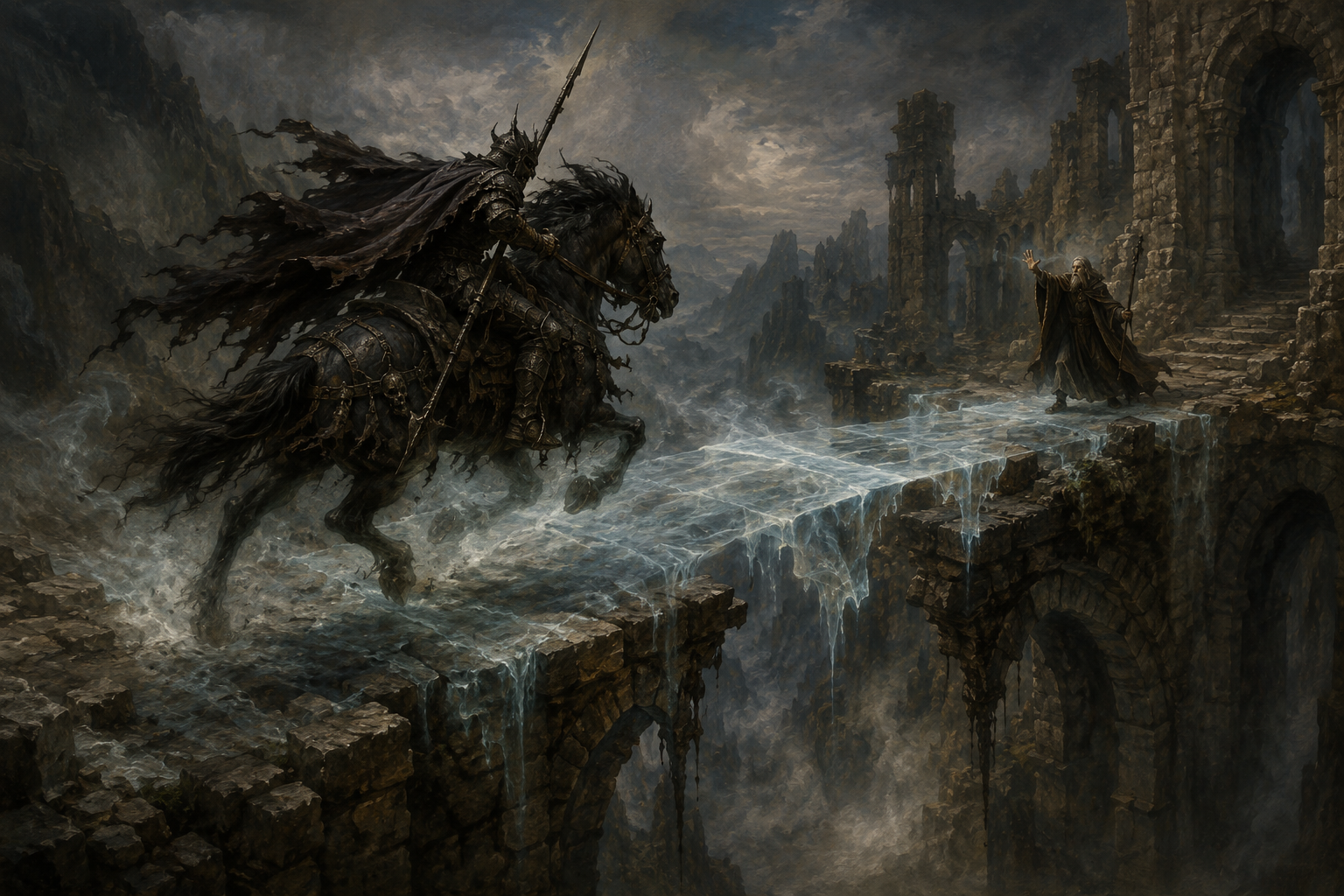
A master illusion makes roads, halls, ruins, bridges and battlefields into places the senses insist are real. Its magical scale and physical effects depend on the rules edition.
Mirage Arcane / Mirage Arcana at a Glance
| 5.5e / 2024 | Mirage Arcane — 7th-level Illusion, Bard/Druid/Wizard; up to 1 mile square, 10 days |
|---|---|
| 5e / 2014 | Mirage Arcane — 7th-level Illusion; terrain and structure illusion, 10 days |
| Pathfinder 1e | Mirage Arcana — Bard 5, Sorcerer/Wizard 5; not a base Witch spell (Trickery patron can grant it) |
| D&D 3.5e | Mirage Arcana — Bard 5, Sorcerer/Wizard 5; legacy terrain glamer |
| Witch archive | Preserved at 5th level; does not automatically grant the spell to every modern Witch |
Mirage Arcane in modern D&D and Mirage Arcana in PF1e and D&D 3.5e are spells of false places, but their level, scale, duration and counterplay differ sharply by edition.
It does not simply paint scenery over stone, mud, timber, and air. It gives an area a new apparent identity. The eye accepts it. The ear supports it. The hand feels it. The nose confirms it. Instinct begins making decisions before reason catches up.
A bare courtyard can seem to become a noble garden. A ruined bridge can appear whole. A watchtower can seem abandoned. A palace corridor can appear bricked over. A marsh road can become a dry pilgrim path leading straight into danger.
The spell is strongest when prepared before the scene begins. It rewards ambushes, escapes, false sanctuaries, hidden routes, counterfeit architecture, siege deception, smuggling, court theatre, and patient lies.
Its limit is as important as its power: Mirage Arcana changes the apparent environment. It does not hide people. It does not create monsters. It does not make assassins invisible. Creatures inside the area must still hide, move, lie, sneak, or fight for themselves.
Crude illusionists make impossible dreamscapes. Dangerous illusionists make lies boring enough to be believed.
Effect
You transform the sensory appearance of an area, making it seem to be another kind of place. The illusion can include sight, sound, touch, smell, surface texture, echoes, apparent enclosure, false furnishings, false structural detail, and convincing environmental atmosphere.
The spell can alter the apparent condition, presence, absence, or character of structures. A ruined wall may seem whole. A locked door may seem to be blank stone. An empty chamber may seem furnished. A burned hall may appear restored. A dry ditch may seem flooded. A shattered bridge may appear passable.
The spell does not alter creatures, but its physical interaction depends on edition. The 2024 and 2014 versions explicitly include tactile elements and can impede movement or change whether ground functions as Difficult Terrain. PF1e and D&D 3.5e instead use the older glamer-and-disbelief model. Do not import one edition’s limits into another.
Quick Rules Reference
- Spell role: Large-area environmental illusion.
- Core effect: Makes an area appear, sound, smell, and feel like a different place.
- Best uses: Ambushes, escapes, false roads, hidden entrances, siege deception, counterfeit sanctuaries, court theatre, and battlefield misdirection.
- Major strength: Can alter the apparent presence, absence, or condition of structures.
- Hard limit: Cannot disguise, conceal, create, remove, or alter creatures.
- Primary counterplay: 2024/2014 use Truesight to reveal the true terrain; PF1e/3.5e use Will disbelief when the illusion is interacted with. Ordinary investigation and local knowledge can still expose contradictions, but there is no universal modern Investigation check written into the spell.
- Table warning: Define the true place, the false place, and the intended deception before play begins.
Mirage Arcane — 5.5e / 2024
| Level | 7th-level Illusion |
|---|---|
| Classes | Bard, Druid, Wizard |
| Casting Time | 10 minutes |
| Range | Sight |
| Components | V, S |
| Duration | 10 days |
| Area | Up to 1 square mile |
You make the terrain throughout the chosen area seem like another sort of terrain. The illusion can be seen, heard, smelled and felt. It can also alter the apparent form of structures or add apparent structures where none exist.
The spell does not disguise, conceal or add creatures. Its tactile element is rules-significant: the illusion can make clear ground function as Difficult Terrain, remove the apparent difficulty of genuinely rough ground, and otherwise impede movement through the area. A piece of illusory terrain taken outside the spell’s area vanishes immediately.
Truesight reveals the terrain’s true form, but the other illusory elements remain. A creature with Truesight therefore knows what is false while still physically interacting with the illusion.
Mirage Arcane — 5e / 2014
| Level | 7th-level Illusion |
|---|---|
| Classes | Bard, Druid, Wizard |
| Casting Time | 10 minutes |
| Range | Sight |
| Components | V, S |
| Duration | 10 days |
| Area | Up to 1 square mile |
The 2014 version has the same broad purpose: transform how a large area of terrain looks, sounds, smells and feels; alter the appearance of structures or add apparent structures; and leave creatures themselves undisguised.
Its text explicitly states that the terrain’s general shape remains the same. The illusion nevertheless has tactile force for movement: it can make clear ground difficult to cross or make genuinely difficult ground seem and feel easier to traverse. Truesight reveals the true terrain while leaving the remaining sensory elements present.
Mirage Arcana — Pathfinder 1e
| School | Illusion (glamer) |
|---|---|
| Level | Bard 5, Sorcerer/Wizard 5 |
| Casting Time | 1 standard action |
| Range | Long (400 ft. + 40 ft./level) |
| Components | V, S |
| Area | One 20-ft. cube/level (S) |
| Duration | Concentration + 1 hour/level (D) |
| Saving Throw | Will disbelief (if interacted with) |
| Spell Resistance | No |
This version functions from the legacy hallucinatory terrain model but expands it so an area can appear to be something other than it is. The illusion includes audible, visual, tactile and olfactory elements and can alter the appearance of structures or add apparent structures.
It still cannot disguise, conceal or add creatures, although creatures can use the false environment as part of an ordinary attempt to hide. Interaction can allow a Will save to disbelieve.
Mirage Arcana — D&D 3.5e
| School | Illusion (Glamer) |
|---|---|
| Level | Bard 5, Sorcerer/Wizard 5 |
| Casting Time | 1 standard action |
| Range | Long (400 ft. + 40 ft./level) |
| Components | V, S |
| Area | One 20-ft. cube/level (S) |
| Duration | Concentration + 1 hour/level (D) |
| Saving Throw | Will disbelief (if interacted with) |
| Spell Resistance | No |
The 3.5e spell uses the same core legacy model as Pathfinder 1e: a large glamer that changes the apparent identity of an area, including visual, audible, tactile and olfactory details. It can change the apparent condition of structures or place illusory structures into the scene.
It cannot disguise, conceal or add creatures. Because it functions from hallucinatory terrain, interaction permits a Will save to disbelieve and spell resistance does not apply.
Edition Changes
What Changed?
- 2024 and 2014: the spell is Mirage Arcane, a 7th-level Bard, Druid and Wizard spell covering up to 1 square mile for 10 days.
- 2024: the sentence requiring the terrain’s general shape to remain the same is no longer present.
- PF1e and 3.5e: the spell is Mirage Arcana, a 5th-level Bard and Sorcerer/Wizard glamer with a much smaller scalable area and a concentration-based duration.
- Legacy disbelief: PF1e and 3.5e inherit Will disbelief on interaction from hallucinatory terrain; the modern spell does not use that save mechanic.
Earlier Rules
D&D 3.0e
The earlier 3.0e form belongs to the same legacy family as the later 3.5e/PF1e spell: a 5th-level environmental glamer built from hallucinatory terrain. It is retained here as historical context rather than presented as one of the four current comparison tabs.
The Three Best Mirage Arcana Lies
1. The Safe Path
Make danger look ordinary.
A broken bridge appears repaired. A flooded cellar appears dry. A pit appears paved over. A burned stair appears sound. A siege breach appears sealed. This is the cruelest use of the spell because it exploits trust rather than fear.
Use this lie when the scene depends on commitment. The victims must choose to cross, enter, charge, climb, gather, or advance before they realise the place is not what it seemed.
2. The Missing Path
Make access look impossible.
A doorway becomes blank wall. A stair becomes collapsed rubble. A side street becomes a locked shrine. A postern gate becomes stacked firewood. A smugglers’ quay becomes a reed-choked bank. This use buys time, protects fugitives, hides routes, and turns pursuit into confusion.
Use this lie when the scene depends on delay. The spell does not need to defeat the enemy forever. It only needs to make them search the wrong place first.
3. The Wrong Story
Make witnesses misunderstand what happened.
A murder chamber appears untouched. A rebel press appears to be a wine cellar. A forbidden shrine appears to be a family chapel. A battlefield appears abandoned before the bodies are moved. A noble hall appears richer, older, and more legitimate than it truly is.
Use this lie when the scene depends on testimony, politics, inheritance, fear, or reputation. The spell can make honest witnesses tell false stories because they are describing what their senses insisted was real.
Why This Spell Is Dangerous in the World
Mirage Arcana is dangerous because people trust places.
They trust roads to lead where they seem to lead. They trust doors to mark entrances. They trust bridges to bear weight. They trust walls to divide spaces. They trust shrines, gates, stairs, courtyards, banners, wells, thresholds, and ruins to mean what they appear to mean.
This spell attacks that trust.
A ruler can make a fortress look undefended. A thief can hide a postern gate in the appearance of a chapel wall. A war-mage can make a bridge seem safe long enough for cavalry to commit. A cult can turn a cellar into a convincing temple. A court illusionist can stage an audience chamber that makes a visiting lord believe he stands inside an ancestral hall that no longer exists.
The spell does not need to kill directly. It can send people the wrong way, delay rescue, conceal preparation, break morale, create false confidence, and make witnesses disagree about what they saw.
Best Uses
False Safety
Make a dangerous approach seem orderly, open, and safe. A broken causeway appears whole. A flooded courtyard looks dry. A breached wall seems repaired. This works best when the victims already expect the route to be passable.
False Obstruction
Make a usable route seem blocked, collapsed, flooded, overgrown, cursed, burning, sealed, or abandoned. This is excellent for escapes, hidden doors, smugglers’ routes, rebel sanctuaries, siege defence, and secret meetings.
False Ownership
Change the apparent identity of a place. A bandit camp becomes a pilgrim hospice. A rebel press becomes a wine cellar. A noble’s private chamber becomes a storeroom. A forbidden shrine becomes an ordinary stable. The spell buys time before anyone asks why the details are wrong.
Ambush Architecture
Create apparent walls, pillars, hedges, screens, market stalls, tents, hanging cloth, ruined masonry, smoke, or thick vegetation that explains why attackers are hard to see. The attackers still need to hide, but the illusion gives observers a believable false reason for losing track of them.
Court and Ritual Theatre
A hall can become a sacred grove, ancestral tomb, battlefield memorial, drowned palace, or judgement chamber. Used carefully, this can shape testimony, frighten oathbreakers, impress petitioners, or expose someone who knows the true room too well.
Tactical Use at the Table
Use Mirage Arcana before the encounter whenever possible. Its best scenes begin with the illusion already in place.
The caster should define three things clearly:
- What the area truly is.
- What the area appears to be.
- What decision the false place is meant to change.
Strong uses are specific. “Make the west stair look collapsed.” “Make the bridge look intact.” “Make the dry ditch look flooded.” “Make the assassins’ balcony look like a blank wall.” “Make the old shrine look recently occupied.”
Weak uses are vague. “Make everything confusing” is less useful than one convincing lie that changes movement, attention, trust, or timing.
The spell becomes fairer and more memorable when the false environment has a clear purpose and can be tested by suspicious players.
Good Combinations
- Hallucinatory Terrain: Use the lesser spell for broad wilderness deception and reserve Mirage Arcana for settlements, ruins, fortresses, roads, bridges, halls, and structures.
- Major Image: Add moving details, temporary distractions, or active phenomena that the false place does not provide well on its own.
- Silent Image: Reinforce one suspicious detail without spending another major spell.
- Invisibility: Hide a creature properly while Mirage Arcana changes the environment around them.
- Guards and Wards: Turn a defended site into a layered nightmare of false passages, misleading chambers, and hostile architecture.
- Glyph of Warding: Make the wrong door look like the safe one.
- Passwall: Create a real hidden route, then use the illusion to explain why no route appears to exist.
- Mislead: Let the caster leave a false presence behind while the environment itself tells a second lie.
Adventure and Worldbuilding Hooks
The Bridge That Was Never Repaired
A town swears the old bridge is safe because travellers have crossed it for weeks. In truth, the bridge collapsed months ago. Someone has been maintaining a false crossing, and the first heavy wagon, cavalry troop, or refugee crowd may turn the deception into a massacre.
The Masked Quarter
An entire city district appears clean, prosperous, and loyal during the duke’s inspection. Behind the glamour are plague houses, rebel presses, hidden shrines, and barricaded alleys. The spell is not hiding people directly; it is hiding the condition of the place they live in.
The False Pilgrim Road
A sacred road has begun leading travellers to the wrong valley. Pilgrims insist they followed the old milestones, smelled the shrine incense, heard bells, and saw the correct gate. The gate was never there.
Spellcasting Culture and Worldbuilding
Illusionists who master Mirage Arcana are valuable to courts, armies, thieves’ guilds, temple builders, smugglers, siege engineers, travelling theatres, and secret societies. The spell belongs as much to politics as to battle.
In cities, its use may be regulated. A false wall can conceal treason. A false road can redirect witnesses. A false shrine can profane sacred space. A false gate can cause deaths without a blade being drawn.
Among elite illusionists, the spell is treated as a test of restraint. Apprentice illusionists often overdecorate the lie: impossible towers, shining roads, dreamlike colours, too much perfume, too much music, too much wonder. Masters know better. The best false place is not the most beautiful. It is the place no one thinks to question.
Using Mirage Arcana in Play
Mirage Arcana is strongest when the false environment changes a decision rather than merely decorating a scene. Use it to redirect movement, conceal a route, disguise damage, fake a bridge or doorway, stage an ambush, or create a believable false sanctuary. Players should decide what specific mistake they want observers to make; Games Masters should preserve counterplay through testing, local knowledge, truesight, physical contradiction and careful investigation.
FAQ
What is Mirage Arcana for?
It is for changing what people think a place is. It is best used to redirect movement, hide routes, stage ambushes, disguise hazards, fake repairs, alter the apparent condition of structures, or make witnesses misread a scene.
Is Mirage Arcana better than Invisibility?
No. It solves a different problem. Invisibility hides creatures. Mirage Arcana lies about the place those creatures occupy.
Why do Pathfinder 1e and D&D 3.5e look so similar?
Because their core mechanics are effectively the same: illusion/glamer, Bard 5 and Sorcerer/Wizard 5, long range, one 20-foot cube per level, concentration plus 1 hour/level, Will disbelief on interaction, no spell resistance, altered apparent structures, and no direct creature concealment. They are kept in separate tabs so each edition remains independently usable at the table.
What makes this spell fair?
The spell should mislead decisions, not erase counterplay. Clues, testing, physical contradiction, local knowledge, truesight, true seeing, and careful investigation should all matter.
Historical, Mythic, and Optical Context
Mirages are real optical phenomena caused by light bending, or refracting, through layers of air with different temperatures and densities. That gives Mirage Arcana a strong natural image to draw from, even though the spell goes far beyond ordinary optics. For a concise real-world overview, see Encyclopaedia Britannica’s article on mirages.
The word “mirage” also carries the sense of something seen, desired, and misread: an appearance that persuades the observer before it is understood. That makes it especially fitting for a spell that does not merely hide a place but convinces the senses that the place has become something else. For the term’s linguistic background, see Merriam-Webster’s entry for mirage.
In mythic and legendary play, this spell belongs beside tales of false castles, enchanted roads, fairy glamour, phantom cities, deceptive islands, and impossible halls glimpsed through heat, mist, moonlight, or sorcery. Its best use is not spectacle for its own sake, but a believable place that leads people into the wrong choice.
Rules Sources and Licensing
D&D 2024 and 2014 rules are kept edition-pure; Pathfinder 1e and D&D 3.5e use their own legacy glamer rules. Do not combine area, duration, disbelief or tactile-interaction mechanics between editions.
Keep this reference growing
If this page helped with your reading or game, you can support its upkeep or explore the curated books.
Explore the Bookshop — epics, classics and stories behind imagined worlds.