Power Word Kill Spell – RPG Rules, Lore, Uses & Counters
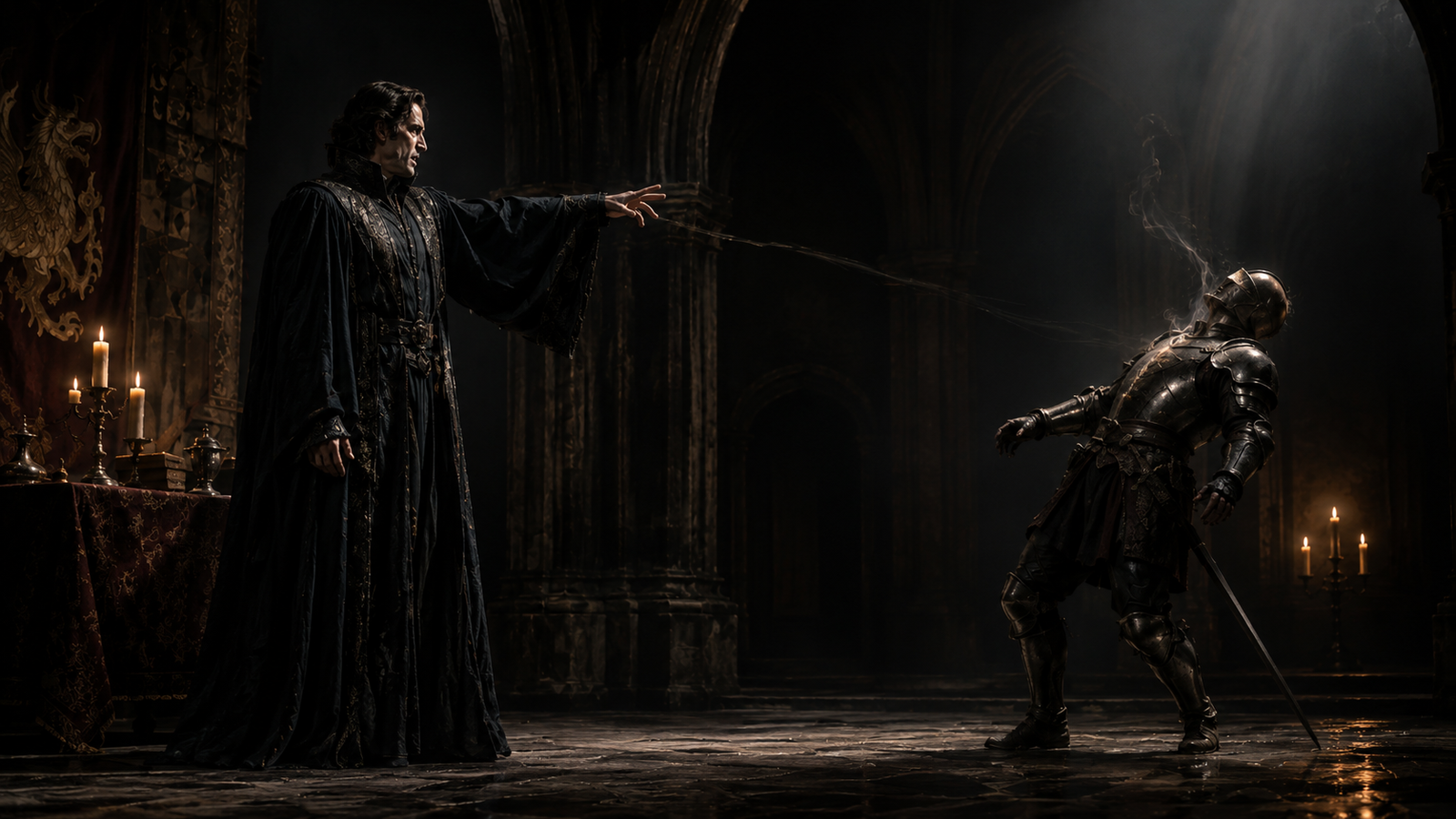
One word crosses the chamber. No flame follows it, no blade touches the target, and there is scarcely time for fear. The armoured figure simply falters, as though some hidden cord between body and life has been cut.
Power Word Kill Rules
Choose the ruleset being used at your table. Each panel is independent so that mechanics from one ruleset do not drift into another.
Power Word Kill — 5.5e
You compel one visible creature within range toward immediate death. The result depends on the target’s current Hit Points when the spell resolves.
There is no saving throw, spell attack, concentration requirement, or higher-slot scaling.
5.5e Rulings
SpiralWorlds ruling Do Temporary Hit Points count toward the 100-HP threshold?
No. Temporary Hit Points are a separate buffer rather than part of the creature’s actual Hit Point total. A creature with 100 actual Hit Points and 40 Temporary Hit Points is still at the spell’s death threshold.
SpiralWorlds ruling Does the 12d12 damage trigger a second instant-death check?
No. Resolve the spell’s conditional choice once. If the target has more than 100 Hit Points at resolution, it takes 12d12 Psychic damage. The spell does not then loop back and apply its other branch because that damage reduced the creature to 100 Hit Points or fewer.
SpiralWorlds ruling Does Psychic resistance protect against Power Word Kill?
Only against the damage branch. Psychic resistance can reduce the 12d12 Psychic damage dealt to a creature above the threshold. The 100-HP-or-fewer result is not Psychic damage; the creature simply dies.
SpiralWorlds ruling Does Death Ward stop Power Word Kill?
If the target is at 100 Hit Points or fewer, the spell would kill it instantaneously without first dealing damage. Death Ward’s protection against an instant-kill effect applies and the ward ends.
If the target is above 100 Hit Points, Power Word Kill instead deals 12d12 Psychic damage. If that damage would reduce the warded creature to 0 Hit Points, Death Ward’s protection against being reduced to 0 can instead leave it at 1 Hit Point, after which the ward ends.
Rules reading Does the target have to hear the word?
The spell requires a creature the caster can see; it does not state that the target must hear the word. The caster must still provide the spell’s verbal component, so an effect that prevents the caster from speaking can prevent the spell from being cast normally.
SpiralWorlds ruling Does the old Polymorph setup still work?
Not in the old way. The current Polymorph keeps the target’s actual Hit Points and represents the transformed body’s extra durability with Temporary Hit Points. Turning a high-HP foe into a small beast therefore does not replace the creature’s actual Hit Point total with the beast’s low total for this threshold.
Rules reading Can the spell target undead or Constructs?
Yes, unless a particular creature has a feature that says otherwise. This version targets one creature and does not impose the older “living creature” restriction.
At the table: the decisive number is the target’s current actual Hit Points when the spell resolves. Temporary Hit Points do not disguise that number, and the damage branch is a genuine fallback rather than a failed casting.
Power Word Kill — Pathfinder 1e
The word instantly kills a qualifying living creature. A creature currently at 101 or more hp is unaffected. The target does not need to hear the word, but Spell Resistance applies.
Pathfinder 1e Rulings
Rules text Does the target have to hear the word?
No. The spell explicitly functions whether or not the chosen creature can hear it. The caster still has to provide the verbal component.
Rules text Does Spell Resistance apply?
Yes. A caster must overcome the target’s Spell Resistance before the killing effect can take hold.
Rules text Can it kill undead or Constructs?
Not through the normal spell. Its target is a living creature, and its death and mind-affecting descriptors also interact with the immunities and protections associated with those categories.
Rules text How does Death Ward interact with it?
Death Ward does not simply grant blanket immunity to every death effect in this ruleset. It provides a +4 morale bonus on saves against death spells and magical death effects and, crucially, grants a save to negate such an effect even when that effect normally allows no saving throw.
Power Word Kill normally lists no save, but a creature protected by Death Ward receives the ward’s special protection.
Mythic Power Word Kill
For the spell’s threshold check, treat the target’s current hp as though it were reduced by 5 × the caster’s mythic tier.
For example, at mythic tier 3 a creature with 115 actual hp is treated as having 100 hp for the threshold check.
A target whose hp remains above the effective killing threshold can instead become exhausted. The published mythic entry does not state a duration for that exhausted result, so this page does not invent one; use official errata if available or adjudicate the omission at the table.
Augmented, 6th Tier
By expending four uses of mythic power, the killing word can linger around the target until the beginning of the caster’s next turn. If the target’s hp falls far enough during that interval that the spell would have killed it when cast, the lingering magic kills it immediately.
Source correction: the published mythic entry gives a worked tier-3 example saying the spell would kill a creature with 85 hp or fewer. That example contradicts the operative rule immediately before it: reducing the target’s effective hp by 15 raises, rather than lowers, the actual hp the spell can kill. SpiralWorlds therefore follows the operative rule and treats 115 actual hp as 100 at tier 3.
Power Word Kill — D&D 3.5e
The spell instantly kills one qualifying living creature. A creature that currently has 101 hp or more is unaffected. Hearing the word is not required, but Spell Resistance applies.
D&D 3.5e Rulings
Rules text Does the target need to hear the word?
No. The spell explicitly works whether or not the creature can hear the spoken word. The caster still requires the verbal component.
Rules text Does Spell Resistance apply?
Yes. Spell Resistance is checked normally before the instant-death effect resolves.
Rules text Can it affect a nonliving creature?
The spell specifically targets a living creature. Its Death and Mind-Affecting descriptors further matter when determining whether a creature can be affected.
Rules text Does Death Ward stop it?
Yes. In this ruleset, Death Ward grants immunity to death spells and magical death effects. That protection blocks Power Word Kill while the ward remains effective.
At the table: Power Word Kill is binary here. If the current hp threshold is met and the effect is not stopped by protection or Spell Resistance, the creature dies. If the target has 101 hp or more, the spell has no fallback damage.
Using the Final Word
The spell is strongest when the caster knows more than the target realises. Every wound, failed defence, drained reserve and desperate retreat makes the final word more dangerous. What appears to be a dramatic finishing flourish is usually the last move in a longer sequence of observation, pressure and timing.
Know When to Speak
A target near collapse is a far better candidate than one whose strength is uncertain. Track the course of the fight and look for evidence that the opponent has crossed the fatal boundary.
Protect the Voice
The spell depends on speech. A caster who cannot provide the verbal component cannot simply replace the word with a gesture. Protecting the act of casting is therefore part of using the spell well.
Expect a Counter
Powerful enemies rarely stand entirely unprotected. Wards, resistance, interrupted casting and Counterspell can matter more than raw armour when the killing word is in play.
GM use: the spell is most memorable when it feels deliberate. A feared court magician who has watched the heroes weaken, an assassin waiting for one precise opening, or a battlefield archmage saving a final word for the enemy commander creates far more tension than using it as an arbitrary surprise.
Words of Power in History & Myth
Human cultures have repeatedly imagined speech, names and formal utterances as things that can carry authority beyond ordinary conversation. None of the traditions below is a direct ancestor of the fantasy spell; they are historical and mythic parallels for the older idea that the right words, spoken or inscribed correctly, can change reality.
Heka and Effective Speech
In ancient Egypt, heka belonged to medicine, protection, justice, religious practice and everyday attempts to influence uncertain events. Spells and ritual formulae were practical instruments rather than merely theatrical language.
The Hidden Name of Re
The Egyptian tale of Isis and Re turns knowledge of a divine name into a form of power. The story links secret identity, speech and supernatural authority, making the hidden name more dangerous than any ordinary title.
Curse Tablets and Formal Vengeance
Romano-British curse tablets preserve carefully framed petitions seeking supernatural punishment. A tablet from Uley invokes Mercury against a thief and asks for the offender’s health and blood to be taken, while repeated formulae give the petition the character of a formal demand.
Power Word Kill in SpiralWorlds
In 1454 CE, learned natural philosophers disagree over whether a power word is truly a word at all. One school argues that the spoken sound is merely the audible shape of an impossibly compressed magical proposition: a complete command imposed upon a living reality before the listener has time to resist it.
Others insist that the oldest power words predate every surviving human language. According to them, mortal speech merely approaches sounds already embedded in creation, and the greatest danger lies not in understanding the word but in reproducing its structure precisely enough for the world to obey.
Courts that fear magical assassination adapt accordingly. Important audiences may be held across greater distances, sight lines can be interrupted by screens or curtains, guards watch a visiting magician’s hands and mouth, and warded chambers are valued as highly as thick walls. A ruler who fears a knife hires armour. A ruler who fears a final word hires another magician.
Among senior practitioners, the spell’s name is sometimes deliberately avoided in formal correspondence. “The final word”, “the black imperative” and “the last command” are safer phrases when scribes, messengers and rivals may all be listening.
Rules Sources, Research & Licensing
Rules References
- System Reference Document v5.2.1
- Pathfinder Roleplaying Game — Power Word Kill
- Pathfinder Mythic Adventures — Mythic Power Word Kill
- D&D 3.5 System Reference Document — Power Word Kill
- Open Game License v1.0a
Historical & Mythic References
- British Museum — Heka
- Museo Egizio — Papyrus Cat. 1993, Isis and the Name of Re
- British Museum — Uley Curse Tablet
The current-rules mechanics summary on this page is based on material from the System Reference Document v5.2.1 by Wizards of the Coast LLC, made available under the Creative Commons Attribution 4.0 International License.
Pathfinder First Edition and D&D 3.5 rules are summarised here in original editorial wording rather than reproduced as full rules text. The linked source documents identify the underlying Open Game Content, copyright notices and Open Game License material.
Original rulings, explanatory text, historical comparisons, setting material, editorial structure and the SpiralWorlds hero presentation are SpiralWorlds editorial material unless otherwise credited.
Dungeons & Dragons and related trademarks are property of their respective owners. Pathfinder and related trademarks are property of Paizo Inc. SpiralWorlds is not affiliated with or endorsed by Wizards of the Coast or Paizo.
Rules boundary: sourced mechanics and SpiralWorlds rulings are deliberately distinguished above. When a complete official rules source contains additional general rules not reproduced in this article, use the relevant current rules source for the full rules context.
Open Game License v1.0a + Section 15 Copyright Notice
Open Game Content Declaration
The Pathfinder First Edition and D&D 3.5 game-mechanics material on this page that is derived from Open Game Content is designated Open Game Content to the extent required by the Open Game License v1.0a.
SpiralWorlds setting material, original historical commentary, original editorial rulings, original prose, site design, trade dress, logos, artwork and other original expressive material are not designated Open Game Content except where such material must remain Open Game Content under the terms of the Open Game License.
OPEN GAME LICENSE Version 1.0a
The following text is the property of Wizards of the Coast, Inc. and is Copyright 2000 Wizards of the Coast, Inc (“Wizards”). All Rights Reserved.
1. Definitions:
(a) “Contributors” means the copyright and/or trademark owners who have contributed Open Game Content;
(b) “Derivative Material” means copyrighted material including derivative works and translations (including into other computer languages), potation, modification, correction, addition, extension, upgrade, improvement, compilation, abridgment or other form in which an existing work may be recast, transformed or adapted;
(c) “Distribute” means to reproduce, license, rent, lease, sell, broadcast, publicly display, transmit or otherwise distribute;
(d) “Open Game Content” means the game mechanic and includes the methods, procedures, processes and routines to the extent such content does not embody the Product Identity and is an enhancement over the prior art and any additional content clearly identified as Open Game Content by the Contributor, and means any work covered by this License, including translations and derivative works under copyright law, but specifically excludes Product Identity.
(e) “Product Identity” means product and product line names, logos and identifying marks including trade dress; artifacts; creatures characters; stories, storylines, plots, thematic elements, dialogue, incidents, language, artwork, symbols, designs, depictions, likenesses, formats, poses, concepts, themes and graphic, photographic and other visual or audio representations; names and descriptions of characters, spells, enchantments, personalities, teams, personas, likenesses and special abilities; places, locations, environments, creatures, equipment, magical or supernatural abilities or effects, logos, symbols, or graphic designs; and any other trademark or registered trademark clearly identified as Product identity by the owner of the Product Identity, and which specifically excludes the Open Game Content;
(f) “Trademark” means the logos, names, mark, sign, motto, designs that are used by a Contributor to identify itself or its products or the associated products contributed to the Open Game License by the Contributor;
(g) “Use”, “Used” or “Using” means to use, Distribute, copy, edit, format, modify, translate and otherwise create Derivative Material of Open Game Content;
(h) “You” or “Your” means the licensee in terms of this agreement.
2. The License: This License applies to any Open Game Content that contains a notice indicating that the Open Game Content may only be Used under and in terms of this License. You must affix such a notice to any Open Game Content that you Use. No terms may be added to or subtracted from this License except as described by the License itself. No other terms or conditions may be applied to any Open Game Content distributed using this License.
3. Offer and Acceptance: By Using the Open Game Content You indicate Your acceptance of the terms of this License.
4. Grant and Consideration: In consideration for agreeing to use this License, the Contributors grant You a perpetual, worldwide, royalty-free, non-exclusive license with the exact terms of this License to Use, the Open Game Content.
5. Representation of Authority to Contribute: If You are contributing original material as Open Game Content, You represent that Your Contributions are Your original creation and/or You have sufficient rights to grant the rights conveyed by this License.
6. Notice of License Copyright: You must update the COPYRIGHT NOTICE portion of this License to include the exact text of the COPYRIGHT NOTICE of any Open Game Content You are copying, modifying or distributing, and You must add the title, the copyright date, and the copyright holder’s name to the COPYRIGHT NOTICE of any original Open Game Content you Distribute.
7. Use of Product Identity: You agree not to Use any Product Identity, including as an indication as to compatibility, except as expressly licensed in another, independent Agreement with the owner of each element of that Product Identity.
You agree not to indicate compatibility or co-adaptability with any Trademark or Registered Trademark in conjunction with a work containing Open Game Content except as expressly licensed in another, independent Agreement with the owner of such Trademark or Registered Trademark. The use of any Product Identity in Open Game Content does not constitute a challenge to the ownership of that Product Identity.
The owner of any Product Identity used in Open Game Content shall retain all rights, title and interest in and to that Product Identity.
8. Identification: If you distribute Open Game Content You must clearly indicate which portions of the work that you are distributing are Open Game Content.
9. Updating the License: Wizards or its designated Agents may publish updated versions of this License. You may use any authorized version of this License to copy, modify and distribute any Open Game Content originally distributed under any version of this License.
10. Copy of this License: You MUST include a copy of this License with every copy of the Open Game Content You Distribute.
11. Use of Contributor Credits: You may not market or advertise the Open Game Content using the name of any Contributor unless You have written permission from the Contributor to do so.
12. Inability to Comply: If it is impossible for You to comply with any of the terms of this License with respect to some or all of the Open Game Content due to statute, judicial order, or governmental regulation then You may not Use any Open Game Material so affected.
13. Termination: This License will terminate automatically if You fail to comply with all terms herein and fail to cure such breach within 30 days of becoming aware of the breach. All sublicenses shall survive the termination of this License.
14. Reformation: If any provision of this License is held to be unenforceable, such provision shall be reformed only to the extent necessary to make it enforceable.
15. COPYRIGHT NOTICE
Open Game License v 1.0a Copyright 2000, Wizards of the Coast, Inc.
System Reference Document Copyright 2000-2003, Wizards of the Coast, Inc.; Authors Jonathan Tweet, Monte Cook, Skip Williams, Rich Baker, Andy Collins, David Noonan, Rich Redman, Bruce R. Cordell, John D. Rateliff, Thomas Reid, James Wyatt, based on original material by E. Gary Gygax and Dave Arneson.
Pathfinder Roleplaying Game Reference Document. © 2011, Paizo Publishing, LLC; Author: Paizo Publishing, LLC.
Pathfinder Roleplaying Game Core Rulebook. © 2009, Paizo Publishing, LLC; Author: Jason Bulmahn, based on material by Jonathan Tweet, Monte Cook, and Skip Williams.
Pathfinder Roleplaying Game Advanced Player’s Guide. Copyright 2010, Paizo Publishing, LLC; Author: Jason Bulmahn.
Pathfinder Roleplaying Game Mythic Adventures © 2013, Paizo Publishing, LLC; Authors: Jason Bulmahn, Stephen Radney-MacFarland, Sean K Reynolds, Dennis Baker, Jesse Benner, Ben Bruck, Jim Groves, Tim Hitchcock, Tracy Hurley, Jonathan Keith, Jason Nelson, Tom Phillips, Ryan Macklin, F. Wesley Schneider, Amber Scott, Tork Shaw, Russ Taylor, and Ray Vallese.
Pathfinder Roleplaying Game Occult Adventures. © 2015, Paizo Inc.; Authors: John Bennett, Logan Bonner, Robert Brookes, Jason Bulmahn, Ross Byers, John Compton, Adam Daigle, Jim Groves, Thurston Hillman, Eric Hindley, Brandon Hodge, Ben McFarland, Erik Mona, Jason Nelson, Tom Phillips, Stephen Radney-MacFarland, Thomas M. Reid, Alex Riggs, Robert Schwalb, Mark Seifter, Russ Taylor, and Steve Townshend.
SpiralWorlds Power Word Kill Spell – RPG Rules, Lore, Uses & Counters. Copyright 2026 SpiralWorlds.