Hobgoblin – Conqueror of the Ninefold Dominion
“Every road shall end beneath one standard, every throne shall answer one command, and every people shall take the place assigned to it.”

- Creature Type: Medium Humanoid (Goblinoid)
- Alignment: Lawful Evil
- Ancient Heartlands: Anatolia, the Caucasian approaches, Upper Mesopotamia, the northern Levant and the western Iranian uplands
- Oldest Civilisational Enemy: The eastern elven empires and their successor realms
- Prophet-God: Varkesh, the First Standard
- Second Prophet: Orzhal, the Reclaimer
- Divine Realm: The Ninefold Muster in Acheron
- Current Imperial Power: The Ninefold Dominion, called the Iron Yoke by many of its subjects
- Current Imperial Project: The Third Muster
- Supreme Ruler: First Marshal of the Nine Thrones
- Noble Commanders: Banner Lords and Provincial Marshals
- Elite Captive-Born Corps: The Crown-Bound
- Campaign Present: 1454 CE, one year after the conquest of Constantinople
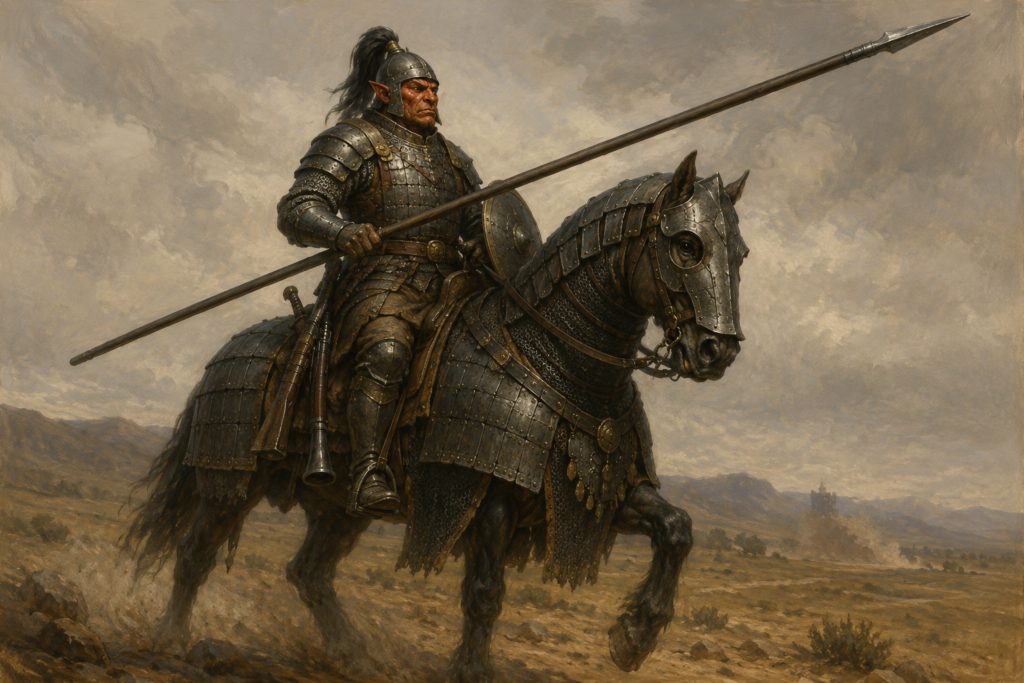
- Signature Elite Mount: Heavily barded warhorse
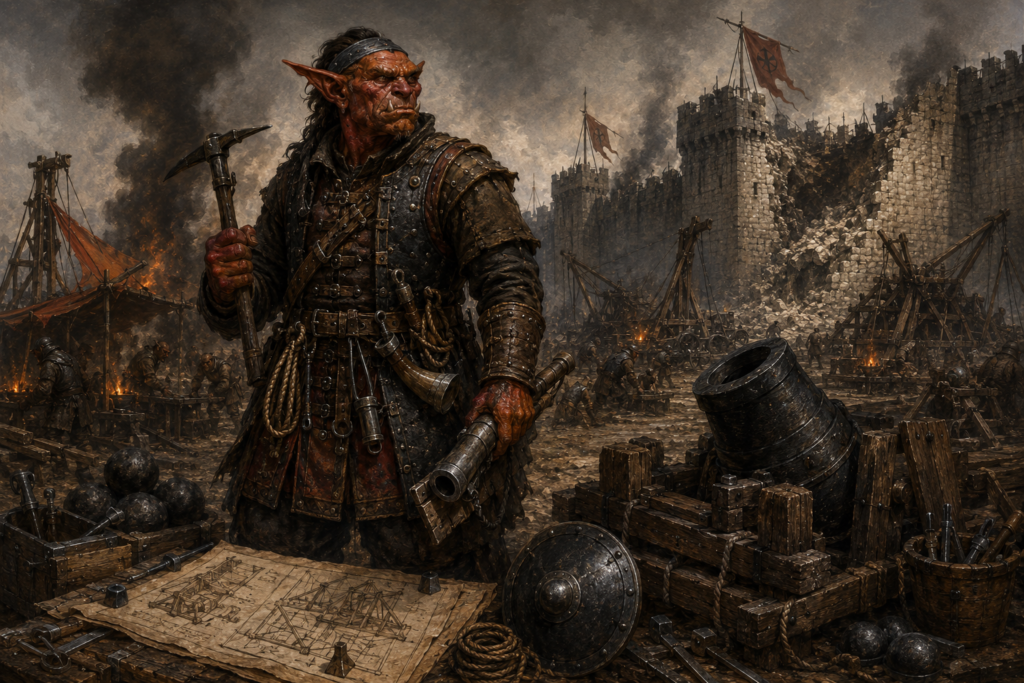
- Typical Roles: Legionary, pikeman, pavise crossbowman, handgonner, conquest rider, siege engineer, Crown-Bound guard, Black-Banner captain, Black-Iron lancer, Banner Lord, slave overseer, tax officer or military governor
- Personhood: Hobgoblins are recognised persons. Their empires deny equal standing to conquered peoples and classify outsiders according to their usefulness to hobgoblin rule.
Hobgoblin
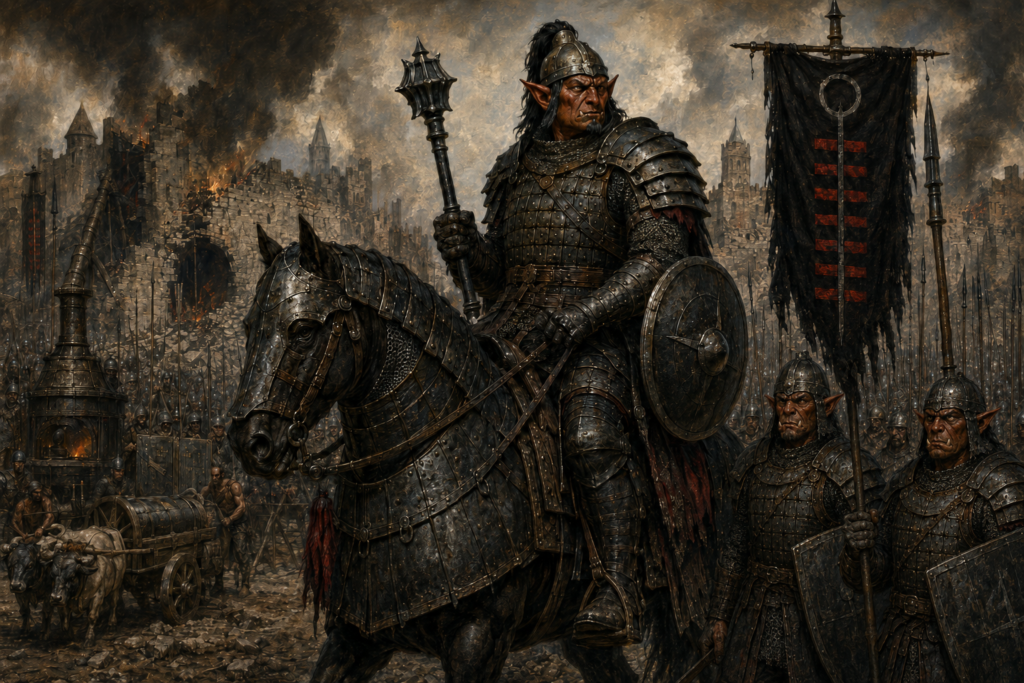
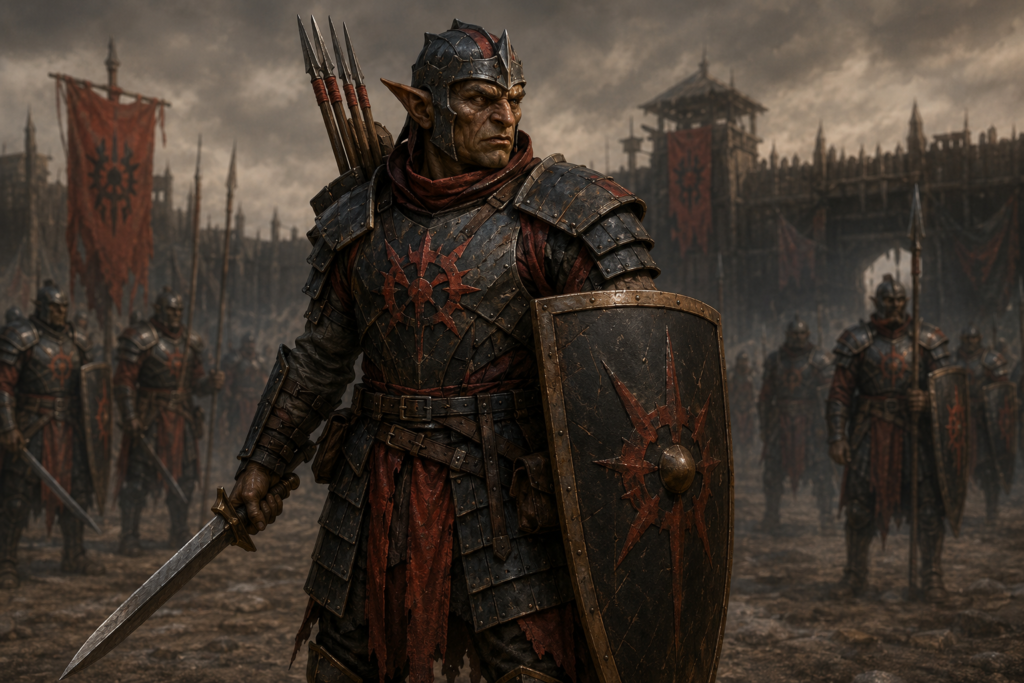
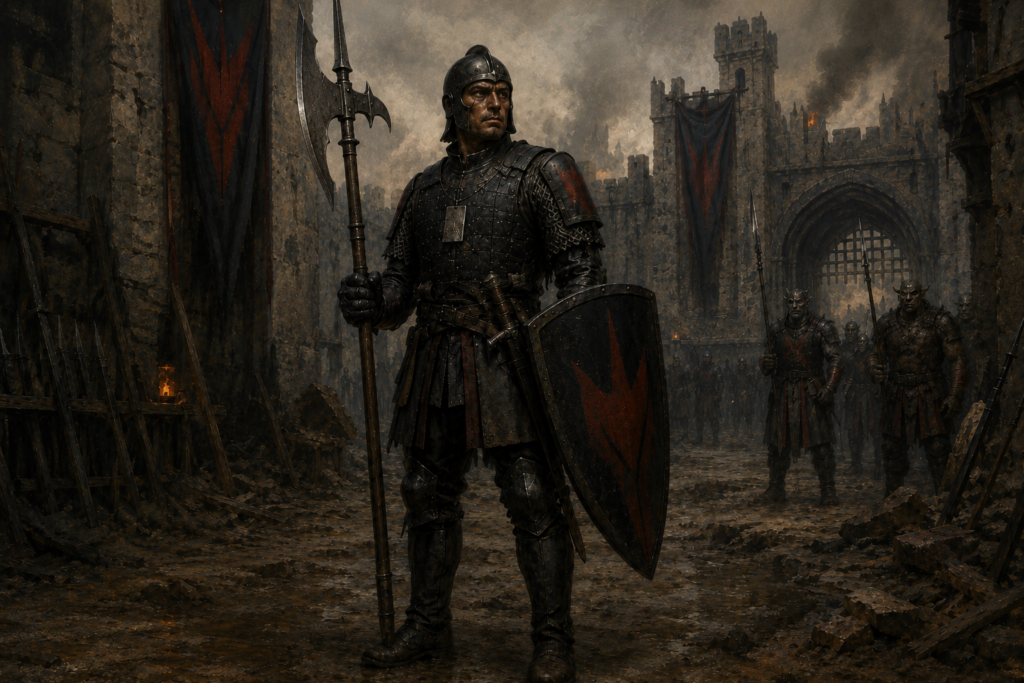
This broad-shouldered goblinoid stands as tall as a human. Its dark red-orange face is angular and severe, with a heavy brow, broad flattened nose, swept-back pointed ears and two short lower fangs. Its armour has been maintained with obsessive care. A black-and-crimson badge identifies its regiment, legal rank, military household and commanding officer. Every strap is secured, every weapon occupies an assigned position and every movement follows long practice.
Hobgoblins are an ancient Lawful Evil people whose civilisation is founded upon hierarchy, conquest, slavery, military technology and the belief that all other peoples are destined to accept hobgoblin rule. Their strongest states are settled, urban and administratively sophisticated. They maintain fortified cities, permanent armies, artillery foundries, slave markets, military estates, tax districts and networks of provincial garrisons.
A hobgoblin army does not raid merely to gather plunder. It measures roads, seizes wells, registers households, confiscates weapons, takes hostages, identifies useful specialists, divides land among military retainers and begins extracting supplies for the next campaign.
Order is central to hobgoblin civilisation, but hobgoblins are not selfless components of a single machine. Officers seek promotion, military households compete for land and marriages, merchants exploit imperial contracts, priests manipulate doctrine and governors use law to enrich themselves. The hierarchy provides recognised methods through which ambitious hobgoblins acquire wealth, privilege and power while placing the cost upon slaves, subjects and defeated rivals.
The same legal system that executes a soldier for stealing from an army storehouse may authorise that soldier to confiscate an entire village’s winter grain. Hobgoblin cruelty is methodical. It is recorded, assigned, supervised and defended as lawful service to a superior people.
Appearance
Hobgoblins usually stand between 5 feet 6 inches and 6 feet 6 inches tall. They are broad through the shoulders, long-limbed and densely muscled, with strong backs adapted to carrying armour and marching equipment over considerable distances.
Their skin is normally dark red-orange, burnt ochre, rust-red or deep brick-red. Some regional populations possess darker brown-red complexions, but grey or green skin is uncommon. Their eyes are usually yellow, amber, ochre, dark brown or red-brown.
Hobgoblins have distinctly goblinoid faces. Their features include heavy brows, deep-set eyes, pronounced cheekbones, broad flattened noses, strong jaws and long pointed ears that sweep outward or backwards from the skull.
Most possess two short lower fangs that remain visible when the mouth is closed. These are pronounced enough to distinguish them from humans but are not the enormous tusks associated with some orcs. Hobgoblins do not possess porcine snouts.
Their hair is usually coarse, straight and black or dark brown, although grey and white become common with age. Soldiers cut it short, bind it tightly or conceal it beneath helmets. Officers and household leaders may wear longer tied-back hair as a sign of rank.
Clothing and equipment are regulated by household, regiment and office. Black, dark red, brown and iron-grey are common military colours. Soldiers wear rank cords, stamped badges and unit markings. Officers display authority through better materials, silver fittings, horsehair crests and captured insignia, but hobgoblin equipment remains functional rather than expressive.
Hobgoblin material culture is austere rather than wholly without beauty. They value imposing architecture, martial ceremony, monumental inscriptions, armour, banners and official histories. Elaborate decoration found in their palaces is usually produced by conquered artisans, enslaved craftspeople or subject communities and displayed as evidence that foreign skill has been placed under hobgoblin control.
Game Statistics
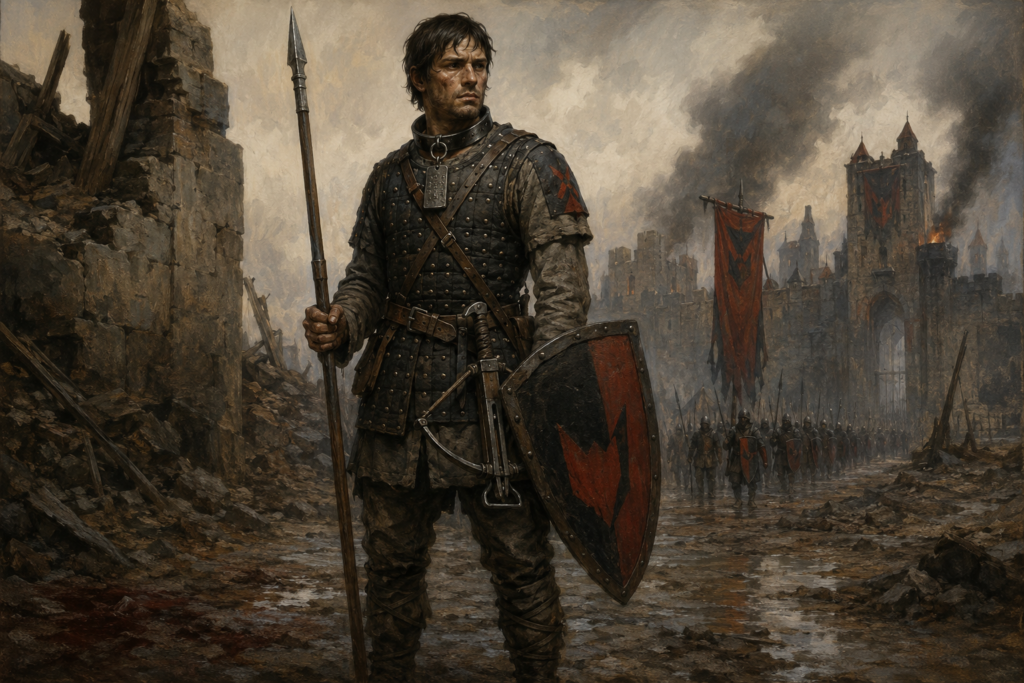
Bound Cohort Soldier
Crown-Bound Guard
Hobgoblin Legionary
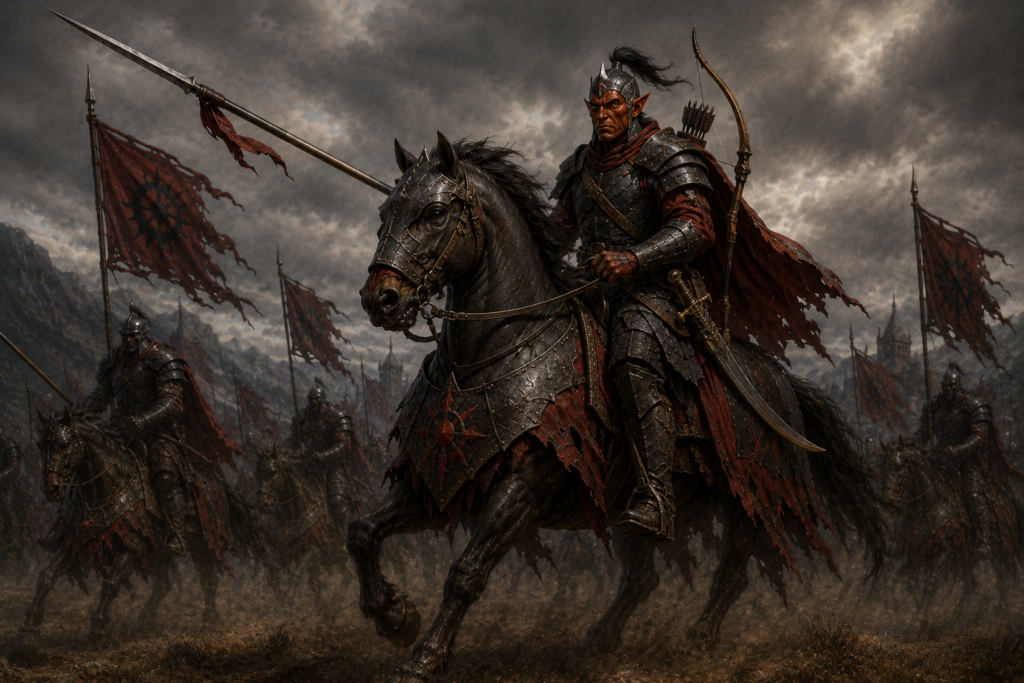
Hobgoblin Rider
Hobgoblin Siege Engineer
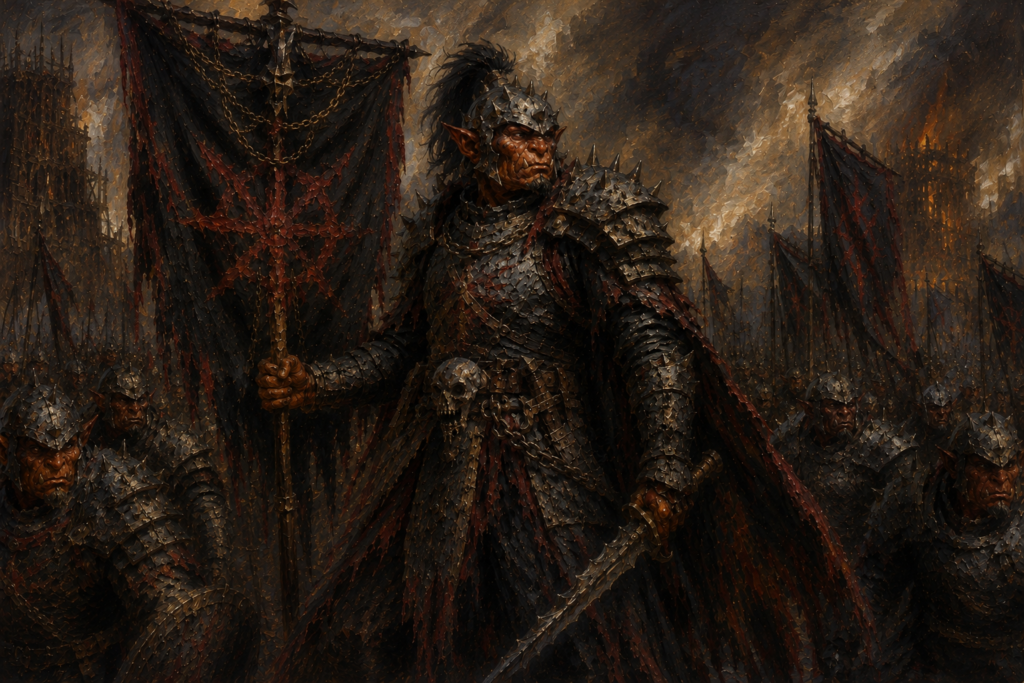
Hobgoblin Black-Banner Captain
Hobgoblin Black-Iron Lancer
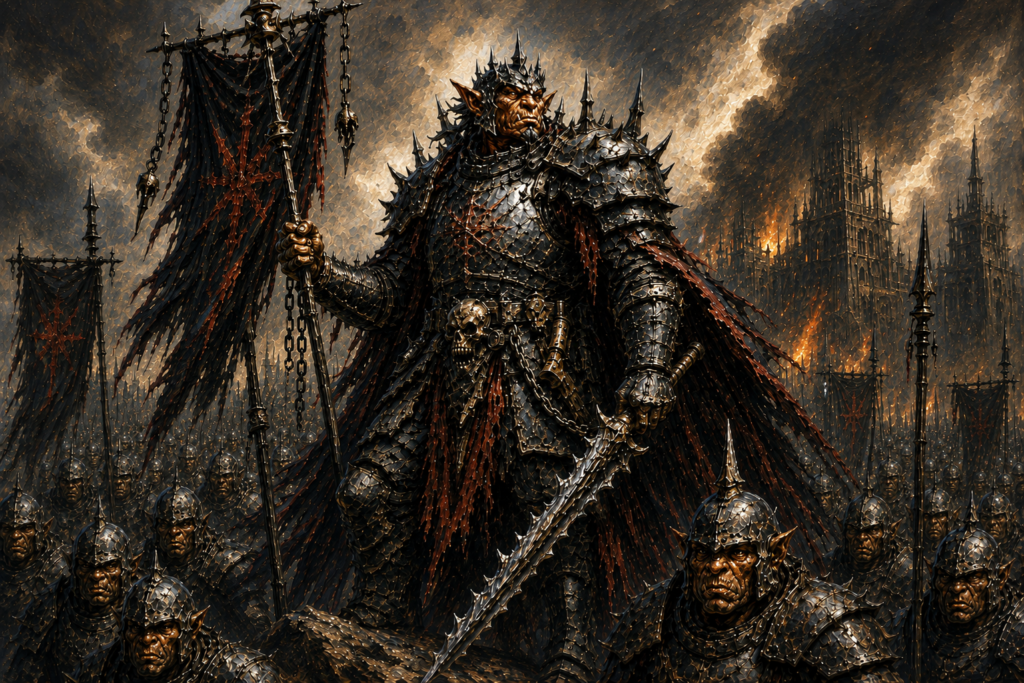
Hobgoblin Banner Lord
Bound Cohort Soldier

D&D 5E 2024-Compatible
Medium Humanoid, Any Alignment
Armor Class 15 (brigandine scraps and shield)
Initiative +1
Hit Points 11 (2d8 + 2)
Speed 30 ft.
Proficiency Bonus +2
| STR | DEX | CON | INT | WIS | CHA |
|---|---|---|---|---|---|
| 13 (+1) | 12 (+1) | 12 (+1) | 10 (+0) | 10 (+0) | 9 (−1) |
Skills Athletics +3
Senses passive Perception 10
Languages one regional language and enough Goblin to understand battlefield commands
Challenge 1/4 (50 XP)
Traits
Coerced Obedience. While the soldier can see or hear a conscious hobgoblin officer, it has advantage on saving throws against being frightened.
Uncertain Loyalty. When the soldier begins its turn and no conscious hobgoblin officer is within 30 feet, the GM may have it make a DC 10 Wisdom saving throw. On a failed save, it takes the Dodge action, retreats or attempts to surrender instead of following its last order.
Actions
Spear. Melee or Ranged Attack Roll: +3, reach 5 ft. or range 20/60 ft.
Hit: 4 (1d6 + 1) piercing damage.
Light Crossbow. Ranged Attack Roll: +3, range 80/320 ft.
Hit: 5 (1d8 + 1) piercing damage.
Pathfinder 1E
Human warrior 2
CR 1
XP 400
Any Alignment Medium humanoid (human)
Initiative +1; Senses Perception +2
Defense
AC 15, touch 11, flat-footed 14 (+3 armour, +1 Dexterity, +1 shield)
hp 15 (2d10 + 4)
Fort +5, Ref +1, Will +0
Offense
Speed 30 ft.
Melee spear +4 (1d8 + 1/×3)
Ranged light crossbow +3 (1d8/19–20)
Statistics
| STR | DEX | CON | INT | WIS | CHA |
|---|---|---|---|---|---|
| 13 (+1) | 12 (+1) | 14 (+2) | 10 (+0) | 10 (+0) | 9 (−1) |
Base Attack +2; CMB +3; CMD 14
Feats Shield Focus, Weapon Focus (spear)
Skills Intimidate +3, Perception +2
Languages one regional language and limited Goblin
Gear studded leather, light wooden shield, spear, light crossbow with 20 bolts and identification collar or tablet
Special Abilities
Coerced Obedience (Ex). The soldier gains a +2 morale bonus on saving throws against fear while it can see or hear a conscious hobgoblin officer.
Uncertain Loyalty (Ex). If no conscious hobgoblin officer is within 30 feet at the beginning of the soldier’s turn, the GM may require a DC 10 Will save. On a failure, the soldier withdraws, surrenders or takes the total defence action instead of following its last order.
D&D 3.5E Conversion
Use the Pathfinder statistics with the following changes:
- AC 15, touch 11, flat-footed 14.
- Grapple +3.
- Replace Perception with Listen +2 and Spot +2.
- Replace CMD-based effects with opposed grapple, bull rush, trip or relevant ability checks.
- Shield Focus may be replaced with Improved Shield Bash or another suitable defensive feat.
- Coerced Obedience grants a +2 morale bonus on saves against fear while a conscious hobgoblin officer is visible or audible.
Crown-Bound Guard
D&D 5E 2024-Compatible
Medium Humanoid, Usually Lawful Neutral or Lawful Evil
Armor Class 18 (mail, brigandine and shield)
Initiative +2
Hit Points 52 (8d8 + 16)
Speed 30 ft.
Proficiency Bonus +2
| STR | DEX | CON | INT | WIS | CHA |
|---|---|---|---|---|---|
| 16 (+3) | 14 (+2) | 14 (+2) | 11 (+0) | 12 (+1) | 12 (+1) |
Saving Throws Str +5, Wis +3
Skills Athletics +5, Insight +3, Intimidation +3, Perception +3
Senses passive Perception 13
Languages Goblin and two regional languages
Challenge 3 (700 XP)
Traits
Household Devotion. While the guard can see or hear a conscious hobgoblin officer, Banner Lord or Provincial Marshal, it cannot be frightened and has advantage on saving throws against being charmed.
State-Bred Discipline — 1/Day. When the guard fails a saving throw, it can reroll the saving throw and must use the new result.
Elite Formation. The guard gains a +1 bonus to Armor Class while it is within 5 feet of another conscious Crown-Bound Guard carrying a shield.
Actions
Multiattack. The guard makes two Polearm, Backsword or Handgonne attacks.
Polearm. Melee Attack Roll: +5, reach 10 ft.
Hit: 8 (1d10 + 3) slashing or piercing damage.
Backsword. Melee Attack Roll: +5, reach 5 ft.
Hit: 7 (1d8 + 3) slashing damage.
Handgonne. Ranged Attack Roll: +4, range 40/120 ft.
Hit: 9 (2d6 + 2) piercing damage.
Reaction
Interpose for the Patron. When a hobgoblin officer or Banner Lord within 5 feet of the guard is hit by an attack, the guard becomes the target of the attack instead. The guard must be able to see the attacker and cannot be incapacitated.
Pathfinder 1E
Human fighter 4
CR 3
XP 800
LN or LE Medium humanoid (human)
Initiative +2; Senses Perception +5
Defense
AC 19, touch 12, flat-footed 17 (+6 armour, +2 Dexterity, +1 shield)
hp 38 (4d10 + 16)
Fort +7, Ref +3, Will +4; +2 against fear and charm
Offense
Speed 30 ft.
Melee masterwork glaive +9 (1d10 + 4/×3) or masterwork longsword +9 (1d8 + 4/19–20)
Ranged masterwork handgonne +7 (1d10/×4)
Statistics
| STR | DEX | CON | INT | WIS | CHA |
|---|---|---|---|---|---|
| 18 (+4) | 14 (+2) | 16 (+3) | 11 (+0) | 12 (+1) | 12 (+1) |
Base Attack +4; CMB +8; CMD 20
Feats Bodyguard, Combat Reflexes, Iron Will, Shield Focus, Weapon Focus (glaive), Weapon Specialisation (glaive)
Skills Intimidate +8, Perception +5, Profession (soldier) +8, Sense Motive +5
Languages Goblin and two regional languages
Gear chainmail, light steel shield, masterwork glaive, masterwork longsword, masterwork handgonne with 10 shots, imperial badge and training-house tablet
Special Abilities
Household Devotion (Ex). While the Crown-Bound Guard can see or hear a conscious hobgoblin officer, it is immune to fear and gains a +2 morale bonus on saving throws against charm effects.
Interpose for the Patron (Ex). Once per round, when an adjacent hobgoblin officer would be hit by a melee or ranged attack, the guard may become the target of that attack as an immediate action.
State-Bred Discipline (Ex). Once per day, the guard may reroll a failed saving throw. It must use the second result.
D&D 3.5E Conversion
Use the Pathfinder statistics with the following changes:
- Grapple +8.
- Replace Perception with Listen +5 and Spot +5.
- Replace Bodyguard with Combat Expertise or a suitable protective feat.
- Use the glaive’s normal reach and attacks of opportunity.
- Interpose for the Patron functions as an immediate action that redirects one attack targeting an adjacent hobgoblin officer.
- State-Bred Discipline allows one failed saving throw to be rerolled each day.
Hobgoblin Legionary

D&D 5E 2024-Compatible
Medium Humanoid (Goblinoid), Lawful Evil
Armor Class 18 (mail, brigandine and large shield)
Initiative +1
Hit Points 18 (4d8)
Speed 30 ft.
Proficiency Bonus +2
| STR | DEX | CON | INT | WIS | CHA |
|---|---|---|---|---|---|
| 13 (+1) | 13 (+1) | 12 (+1) | 11 (+0) | 11 (+0) | 10 (+0) |
Skills Athletics +3, Perception +2
Senses darkvision 60 ft., passive Perception 12
Languages Goblin plus one regional language
Challenge 1/2 (100 XP)
Traits
Formation Strike. Once on each of the legionary’s turns, when it hits a creature within 5 feet of one of the legionary’s conscious allies, the attack deals an extra 3 (1d6) damage.
Set Spear. When the legionary hits a creature with an opportunity attack using its War Spear, the target’s Speed becomes 0 for the rest of the turn.
Imperial Discipline. The legionary has advantage on saving throws against being frightened while it can see or hear a conscious allied officer or banner-bearer.
Actions
War Spear. Melee Attack Roll: +3, reach 5 ft.
Hit: 5 (1d8 + 1) piercing damage.
Javelin. Melee or Ranged Attack Roll: +3, reach 5 ft. or range 30/120 ft.
Hit: 4 (1d6 + 1) piercing damage.
Heavy Knife. Melee Attack Roll: +3, reach 5 ft.
Hit: 4 (1d6 + 1) slashing damage.
Reaction
Close Ranks. When an allied creature within 5 feet of the legionary is hit by an attack, the legionary adds 2 to that ally’s Armor Class against the attack, potentially causing it to miss. The legionary must carry a shield, must see the attacker and cannot be incapacitated. A creature can benefit from only one Close Ranks reaction against the same attack.
Pathfinder 1E
Hobgoblin fighter 1
CR 1
XP 400
LE Medium humanoid (goblinoid)
Initiative +2; Senses darkvision 60 ft.; Perception +1
Defense
AC 18, touch 12, flat-footed 16 (+5 armour, +2 Dexterity, +1 shield)
hp 17 (1d10 + 7)
Fort +5, Ref +2, Will +1
Offense
Speed 30 ft.
Melee masterwork war spear +5 (1d8 + 2/×3) or short sword +4 (1d6 + 2/19–20)
Ranged javelin +3 (1d6 + 2)
Statistics
| STR | DEX | CON | INT | WIS | CHA |
|---|---|---|---|---|---|
| 15 (+2) | 15 (+2) | 16 (+3) | 10 (+0) | 12 (+1) | 8 (−1) |
Base Attack +1; CMB +3; CMD 15
Feats Toughness, Weapon Focus (spear)
Skills Intimidate +3, Ride +6, Stealth +6; Racial Modifiers +4 Stealth
Languages Goblin plus one regional language
Gear scale mail, light steel shield, masterwork war spear, short sword, three javelins, entrenching tool, signal whistle, identification tablet and five days of rations
Special Abilities
Close Ranks (Ex). While the legionary is adjacent to a conscious ally carrying a shield, it gains a +1 shield bonus to AC. This bonus does not stack with itself.
Set against Charge (Ex). If the legionary readies its war spear against a charge, it deals double damage on a successful hit against the charging creature.
Ecology
Environment any settled or frontier land
Organisation patrol (4–8), file (8–20), banner (20–100 plus officers, slaves and support personnel), garrison (50–500 plus subject levies and slave soldiers), or army
Treasure NPC gear
D&D 3.5E Conversion
Use the Pathfinder statistics with the following changes:
- Grapple +3.
- Replace Perception with Listen +1 and Spot +1.
- Replace Stealth with Hide +6 and Move Silently +6.
- Close Ranks provides a +1 shield bonus to AC while adjacent to a conscious shield-bearing ally.
- A readied war spear deals double damage against a charging creature.
Hobgoblin Rider

D&D 5E 2024-Compatible
Medium Humanoid (Goblinoid), Lawful Evil
Armor Class 16 (lamellar armour)
Initiative +3
Hit Points 52 (8d8 + 16)
Speed 30 ft.
Proficiency Bonus +2
| STR | DEX | CON | INT | WIS | CHA |
|---|---|---|---|---|---|
| 13 (+1) | 17 (+3) | 14 (+2) | 11 (+0) | 12 (+1) | 10 (+0) |
Skills Animal Handling +3, Perception +3, Survival +3
Senses darkvision 60 ft., passive Perception 13
Languages Goblin plus one regional language
Challenge 2 (450 XP)
Traits
Mounted Discipline. The rider has advantage on ability checks and saving throws made to remain mounted. Mounting or dismounting costs it only 5 feet of movement.
Imperial Discipline. The rider has advantage on saving throws against being frightened while it can see or hear a conscious allied officer or banner-bearer.
Ride Down the Isolated. Once on each of the rider’s turns, when it hits a creature that has no conscious ally within 5 feet of it, the attack deals an extra 4 (1d8) damage.
Actions
Multiattack. The rider makes two Composite Bow attacks or two Sabre attacks.
Composite Bow. Ranged Attack Roll: +5, range 150/600 ft.
Hit: 7 (1d8 + 3) piercing damage.
Light Lance. Melee Attack Roll: +5, reach 10 ft.
Hit: 8 (1d10 + 3) piercing damage.
Sabre. Melee Attack Roll: +5, reach 5 ft.
Hit: 6 (1d6 + 3) slashing damage.
Pinning Shot — Recharge 5–6. The rider makes one Composite Bow attack. On a hit, the target cannot take reactions and its Speed is reduced by 10 feet until the start of the rider’s next turn.
Reaction
Controlled Withdrawal. Immediately after the rider makes a ranged attack while mounted, its mount can use its reaction to move up to half its Speed. This movement does not provoke opportunity attacks from the target of that attack.
Common Mounts
A Conquest Rider normally rides a light warhorse or regional war camel. Rare provincial formations use trained terror birds. Include the mount’s XP when it attacks, obstructs enemies or otherwise participates independently.
Pathfinder 1E
Hobgoblin fighter 4
CR 3
XP 800
LE Medium humanoid (goblinoid)
Initiative +4; Senses darkvision 60 ft.; Perception +1
Defense
AC 18, touch 14, flat-footed 14 (+4 armour, +4 Dexterity)
hp 34 (4d10 + 12)
Fort +6, Ref +5, Will +2
Offense
Speed 30 ft.; normally mounted
Melee masterwork lance +7 (1d8 + 2/×3) or masterwork scimitar +7 (1d6 + 2/18–20)
Ranged masterwork composite shortbow +10 (1d6 + 2/×3)
Statistics
| STR | DEX | CON | INT | WIS | CHA |
|---|---|---|---|---|---|
| 14 (+2) | 18 (+4) | 14 (+2) | 10 (+0) | 12 (+1) | 8 (−1) |
Base Attack +4; CMB +6; CMD 20
Feats Mounted Archery, Mounted Combat, Point-Blank Shot, Precise Shot, Weapon Focus (composite shortbow)
Skills Handle Animal +6, Ride +13, Stealth +8; Racial Modifiers +4 Stealth
Languages Goblin plus one regional language
Gear lamellar armour, masterwork lance, masterwork scimitar, masterwork composite shortbow (+2 Strength) with 40 arrows, riding equipment and two signal arrows
Special Abilities
Mounted Discipline (Ex). The rider gains a +2 racial bonus on Ride checks made to control a mount in battle, guide with the knees, stay in the saddle or use the mount as cover. This bonus is included above.
Ride Down the Isolated (Ex). The rider deals 2 additional points of weapon damage against an opponent that is not adjacent to one of its conscious allies.
Skirmish Fire (Ex). If the rider’s mount moves at least 20 feet during its turn, the rider gains a +1 dodge bonus to AC until the beginning of its next turn.
Common Mounts
A Conquest Rider normally uses a light warhorse or war camel. Rare provincial companies use trained terror birds. Add the mount’s CR when it fights independently.
D&D 3.5E Conversion
Use the Pathfinder statistics with the following changes:
- Grapple +6.
- Replace Perception with Listen +1 and Spot +1.
- Replace Stealth with Hide +8 and Move Silently +8.
- Use the standard D&D 3.5E Mounted Archery, Mounted Combat, Point Blank Shot and Precise Shot feats.
- Skirmish Fire grants a +1 dodge bonus to AC after the mount moves at least 20 feet.
- Ride Down the Isolated deals 2 additional weapon damage against an enemy not adjacent to a conscious ally.
Hobgoblin Siege Engineer

D&D 5E 2024-Compatible
Medium Humanoid (Goblinoid), Lawful Evil
Armor Class 16 (reinforced coat, short brigandine and buckler)
Initiative +3
Hit Points 60 (11d8 + 11)
Speed 30 ft.
Proficiency Bonus +2
| STR | DEX | CON | INT | WIS | CHA |
|---|---|---|---|---|---|
| 12 (+1) | 16 (+3) | 13 (+1) | 16 (+3) | 12 (+1) | 9 (−1) |
Saving Throws Dex +5, Int +5
Skills Investigation +5, Perception +3, Sleight of Hand +5
Senses darkvision 60 ft., passive Perception 13
Languages Goblin plus two regional languages
Challenge 3 (700 XP)
Traits
Calculated Demolition. The engineer deals double damage to unattended objects and structures. It ignores the first 5 points of any damage threshold possessed by an object or structure.
Powder Discipline. The engineer has advantage on saving throws against effects caused by smoke, deafening explosions and battlefield artillery.
Survey the Weakness. The engineer has advantage on Intelligence checks made to identify the weakest point in a wall, gate, bridge, siege engine or construct.
Actions
Multiattack. The engineer makes two War Pick attacks or two Handgonne attacks.
War Pick. Melee Attack Roll: +5, reach 5 ft.
Hit: 7 (1d8 + 3) piercing damage.
Handgonne. Ranged Attack Roll: +5, range 40/120 ft.
Hit: 10 (2d6 + 3) piercing damage.
Incendiary Firepot — Recharge 5–6. The engineer throws a sealed firepot at a point it can see within 60 feet. Each creature within 10 feet of that point must make a DC 13 Dexterity saving throw, taking 14 (4d6) fire damage on a failed save or half as much damage on a successful one. Unattended flammable objects in the area ignite.
Bonus Action
Direct the Crew. One allied creature within 30 feet that can hear the engineer can move up to 10 feet without provoking opportunity attacks. If that creature operates a siege engine or attacks an object or structure before the start of the engineer’s next turn, it adds 3 (1d6) to one damage roll.
Reaction
Take Cover. When the engineer or an allied creature within 5 feet is targeted by a ranged attack, the engineer grants the target half cover against that attack. The engineer must be adjacent to a mantlet, shield wall, siege engine, wall or similar obstruction.
Pathfinder 1E
Hobgoblin fighter 5
CR 4
XP 1,200
LE Medium humanoid (goblinoid)
Initiative +3; Senses darkvision 60 ft.; Perception +1
Defense
AC 18, touch 13, flat-footed 15 (+4 armour, +3 Dexterity, +1 shield)
hp 42 (5d10 + 15)
Fort +6, Ref +4, Will +2
Offense
Speed 30 ft.
Melee masterwork war pick +7 (1d8 + 1/×4)
Ranged masterwork handgonne +10 (1d10/×4)
Special Attacks alchemical bomb 3/day
Statistics
| STR | DEX | CON | INT | WIS | CHA |
|---|---|---|---|---|---|
| 12 (+1) | 16 (+3) | 14 (+2) | 16 (+3) | 12 (+1) | 8 (−1) |
Base Attack +5; CMB +6; CMD 19
Feats Point-Blank Shot, Precise Shot, Rapid Reload, Siege Engineer, Skill Focus (Craft [siege engine]), Weapon Focus (handgonne)
Skills Craft (siege engine) +14, Knowledge (engineering) +11, Profession (soldier) +9, Stealth +7; Racial Modifiers +4 Stealth
Languages Goblin plus two regional languages
Gear reinforced coat, short brigandine, buckler, masterwork war pick, masterwork handgonne with 20 shots, engineering tools, measuring cord, chalk, fuse, powder horn and three alchemical bombs
Special Abilities
Alchemical Bomb (Ex). Three times per day, the engineer can throw a prepared bomb as a ranged touch attack with a range increment of 20 feet. A direct hit deals 2d6 + 3 points of fire damage. Creatures adjacent to the target take 3 points of splash fire damage. A successful DC 15 Reflex save negates the splash damage.
Breach Expert (Ex). The engineer gains a +2 bonus on attack and damage rolls against objects, constructs and siege engines. It treats the hardness of an object or structure as 5 lower than normal.
Direct the Crew (Ex). As a move action, the engineer directs allied creatures operating the same siege engine. Until the beginning of the engineer’s next turn, those creatures gain a +2 competence bonus on attack rolls, loading checks and Profession (siege engineer) checks made with that engine.
Powder Discipline (Ex). The engineer gains a +2 bonus on saving throws against smoke, deafening effects and explosions caused by alchemical or gunpowder weapons.
Ecology
Environment cities, arsenals, siege camps and fortified frontiers
Organisation survey team (engineer plus 4–8 legionaries), bombard crew (engineer plus 6–20 slaves, workers and guards), or siege train
Treasure NPC gear plus engineering plans, military tools and demolition materials
D&D 3.5E Conversion
Use the Pathfinder statistics with the following changes:
- Grapple +6.
- Replace Perception with Listen +1 and Spot +1.
- Replace Stealth with Hide +7 and Move Silently +7.
- Replace Knowledge (engineering) with Knowledge (architecture and engineering).
- Replace Pathfinder firearm feats with Rapid Reload and suitable Exotic Weapon Proficiency or setting firearm rules.
- Breach Expert lowers effective hardness by 5 and grants +2 on attacks and damage against objects, constructs and siege engines.
Hobgoblin Black-Banner Captain

D&D 5E 2024-Compatible
Medium Humanoid (Goblinoid), Lawful Evil
Armor Class 18 (breastplate, brigandine and shield)
Initiative +2
Hit Points 82 (11d8 + 33)
Speed 30 ft.
Proficiency Bonus +3
| STR | DEX | CON | INT | WIS | CHA |
|---|---|---|---|---|---|
| 18 (+4) | 14 (+2) | 16 (+3) | 14 (+2) | 13 (+1) | 16 (+3) |
Saving Throws Str +7, Wis +4, Cha +6
Skills Athletics +7, History +5, Insight +4, Intimidation +6, Perception +4
Senses darkvision 60 ft., passive Perception 14
Languages Goblin plus two regional languages
Challenge 4 (1,100 XP)
Traits
Command Presence. Allied creatures within 30 feet of the captain have advantage on saving throws against being frightened while they can see or hear the captain.
Formation Strike. Once on each of the captain’s turns, when it hits a creature within 5 feet of one of the captain’s conscious allies, the attack deals an extra 7 (2d6) damage.
Unbroken Chain of Command. When the captain is reduced to 0 Hit Points, one allied hobgoblin or Crown-Bound creature within 30 feet that can see it gains 10 temporary Hit Points and can immediately move up to half its Speed without provoking opportunity attacks.
Actions
Multiattack. The captain makes two Command Mace attacks, two Backsword attacks or two Composite Bow attacks.
Command Mace. Melee Attack Roll: +7, reach 5 ft.
Hit: 8 (1d8 + 4) bludgeoning damage.
Backsword. Melee Attack Roll: +7, reach 5 ft.
Hit: 8 (1d8 + 4) slashing damage.
Composite Bow. Ranged Attack Roll: +5, range 150/600 ft.
Hit: 6 (1d8 + 2) piercing damage.
Command the Assault — Recharge 5–6. The captain chooses up to three allied creatures within 60 feet that can see or hear it. Each chosen ally can use its reaction to move up to half its Speed without provoking opportunity attacks. One chosen ally can also make one weapon attack at the end of this movement.
Bonus Action
Ruthless Order — 2/Day. One allied creature within 30 feet that can see or hear the captain gains 8 temporary Hit Points and can immediately repeat a saving throw against the frightened condition.
Reaction
Parry. The captain adds 3 to its Armor Class against one melee attack that would hit it. The captain must see the attacker and wield a melee weapon.
Pathfinder 1E
Hobgoblin fighter 6
CR 5
XP 1,600
LE Medium humanoid (goblinoid)
Initiative +6; Senses darkvision 60 ft.; Perception +7
Defense
AC 21, touch 12, flat-footed 19 (+7 armour, +2 Dexterity, +2 shield)
hp 63 (6d10 + 30)
Fort +9, Ref +4, Will +5
Offense
Speed 30 ft.
Melee +1 heavy mace +12/+7 (1d8 + 7) or +1 backsword +12/+7 (1d8 + 7/19–20)
Ranged masterwork composite longbow +9/+4 (1d8 + 4/×3)
Statistics
| STR | DEX | CON | INT | WIS | CHA |
|---|---|---|---|---|---|
| 18 (+4) | 14 (+2) | 18 (+4) | 14 (+2) | 12 (+1) | 14 (+2) |
Base Attack +6; CMB +10; CMD 22
Feats Combat Reflexes, Improved Initiative, Iron Will, Outflank, Shield Wall, Weapon Focus (heavy mace), Weapon Specialisation (heavy mace)
Skills Intimidate +11, Knowledge (engineering) +11, Perception +7, Ride +9, Sense Motive +3, Stealth +6; Racial Modifiers +4 Stealth
Languages Goblin plus two regional languages
Gear +1 breastplate over brigandine, heavy steel shield, +1 heavy mace, +1 backsword, masterwork composite longbow (+4 Strength) with 20 arrows, officer’s standard, imperial seal, maps, prisoner lists and military correspondence
Special Abilities
Banner Orders (Ex). Three times per day as a swift action, the captain issues one of the following orders to allied creatures within 30 feet that can see or hear it. The order lasts until the beginning of the captain’s next turn. A creature can benefit from only one Banner Order at a time.
- Advance: Affected allies gain a +10-foot enhancement bonus to their land speed.
- Hold: Affected allies gain a +2 morale bonus to CMD and a +2 morale bonus to AC against attacks of opportunity.
- Seize: Affected allies gain a +2 morale bonus on combat manoeuvre checks and weapon damage rolls.
Formation Mastery (Ex). An allied creature adjacent to the captain and at least one other conscious ally gains a +1 morale bonus on melee attack rolls. If that creature carries a shield, it also gains a +1 shield bonus to AC. These bonuses do not stack with bonuses from another Black-Banner Captain.
Unbroken Chain of Command (Ex). If the captain is reduced to 0 hit points, one allied hobgoblin or Crown-Bound creature within 30 feet gains 10 temporary hit points and may immediately move up to half its speed as an immediate action without provoking attacks of opportunity.
Ecology
Environment any settled or conquered land
Organisation command group (captain plus 4–12 soldiers), occupation detachment (captain plus 10–30 soldiers, slave troops, riders and support personnel), or army
Treasure NPC gear plus military funds, correspondence, tax records and symbols of office
D&D 3.5E Conversion
Use the Pathfinder statistics with the following changes:
- Grapple +10.
- Replace Perception with Listen +7 and Spot +7.
- Replace Stealth with Hide +6 and Move Silently +6.
- Replace Outflank and Shield Wall with suitable teamwork, formation or defensive feats available in the campaign.
- Banner Orders affect allies within 30 feet and last until the beginning of the captain’s next turn.
- Use Knowledge (architecture and engineering) in place of Knowledge (engineering).
Hobgoblin Black-Iron Lancer

D&D 5E 2024-Compatible
Medium Humanoid (Goblinoid), Lawful Evil
Armor Class 19 (reinforced partial plate and shield)
Initiative +2
Hit Points 95 (10d8 + 50)
Speed 30 ft.
Proficiency Bonus +3
| STR | DEX | CON | INT | WIS | CHA |
|---|---|---|---|---|---|
| 20 (+5) | 14 (+2) | 20 (+5) | 13 (+1) | 13 (+1) | 12 (+1) |
Saving Throws Str +8, Con +8, Wis +4
Skills Animal Handling +4, Athletics +8, Intimidation +4, Perception +4
Senses darkvision 60 ft., passive Perception 14
Languages Goblin plus two regional languages
Challenge 5 (1,800 XP)
Traits
Heavy Cavalry. The lancer has advantage on ability checks and saving throws made to remain mounted. Mounting or dismounting costs it only 5 feet of movement.
Imperial Discipline. The lancer has advantage on saving throws against being frightened.
Crushing Charge. Once on each of the lancer’s turns, when it hits with its Heavy Lance after its mount has moved at least 20 feet straight towards the target, the attack deals an extra 9 (2d8) piercing damage. If the target is Large or smaller, it must succeed on a DC 16 Strength saving throw or fall prone.
Actions
Multiattack. The lancer makes two Heavy Lance attacks, two Sabre attacks or two Handgonne attacks.
Heavy Lance. Melee Attack Roll: +8, reach 10 ft.
Hit: 11 (1d12 + 5) piercing damage.
Sabre. Melee Attack Roll: +8, reach 5 ft.
Hit: 8 (1d6 + 5) slashing damage.
Handgonne. Ranged Attack Roll: +5, range 40/120 ft.
Hit: 9 (2d6 + 2) piercing damage.
Bonus Action
Drive Them Down. The lancer commands its mount to take the Dash or Disengage action.
Reaction
Shield the Saddle. When an attack would hit the lancer while it is mounted, it adds 3 to its Armor Class against that attack, potentially causing it to miss.
Barded Warhorse Pairing
A Black-Iron Lancer normally rides a heavily barded warhorse. Increase the mount’s Armor Class to 17 while it wears heavy barding. Include the mount’s XP when it attacks independently or otherwise contributes directly to the encounter.
Pathfinder 1E
Hobgoblin fighter 7
CR 6
XP 2,400
LE Medium humanoid (goblinoid)
Initiative +6; Senses darkvision 60 ft.; Perception +1
Defense
AC 21, touch 12, flat-footed 19 (+7 armour, +2 Dexterity, +2 shield)
hp 67 (7d10 + 28)
Fort +8, Ref +4, Will +5
Offense
Speed 30 ft.; normally mounted
Melee +1 lance +13/+8 (1d8 + 7/×3) or masterwork scimitar +12/+7 (1d6 + 4/18–20)
Ranged masterwork handgonne +10 (1d10/×4)
Statistics
| STR | DEX | CON | INT | WIS | CHA |
|---|---|---|---|---|---|
| 18 (+4) | 14 (+2) | 16 (+3) | 14 (+2) | 12 (+1) | 10 (+0) |
Base Attack +7; CMB +11; CMD 23
Feats Improved Initiative, Iron Will, Mounted Combat, Ride-By Attack, Spirited Charge, Trample, Weapon Focus (lance), Weapon Specialisation (lance)
Skills Handle Animal +10, Intimidate +10, Knowledge (engineering) +12, Ride +14, Stealth +6; Racial Modifiers +4 Stealth
Languages Goblin plus two regional languages
Gear reinforced partial plate, heavy steel shield, +1 lance, masterwork scimitar, masterwork handgonne with 10 shots, military saddle and barded warhorse
Special Abilities
Heavy Cavalry (Ex). The lancer gains a +2 racial bonus on Ride checks made to control a mount in battle, remain mounted or use the mount as cover. This bonus is included above.
Crushing Charge (Ex). When the lancer charges while mounted, it gains a +2 bonus on combat manoeuvre checks made to overrun. If its lance attack hits, its mount gains a +2 bonus on its next hoof attack against the same target before the end of the turn.
Locked Saddle (Ex). While conscious and mounted on a trained warhorse, the lancer gains a +4 circumstance bonus to CMD against attempts to drag, reposition or dismount it.
Barded Warhorse Pairing
The lancer normally rides a heavy warhorse wearing scale or plate barding. Include the mount’s CR when it attacks independently. The mount’s armour check penalty applies to relevant skill checks.
Ecology
Environment imperial roads, open battlefields, siege camps and conquered cities
Organisation solitary lancer, iron pair, heavy patrol (3–6 lancers), or cavalry company
Treasure NPC gear; warhorse calculated separately
D&D 3.5E Conversion
Use the Pathfinder statistics with the following changes:
- Grapple +11.
- Replace Perception with Listen +1 and Spot +1.
- Replace Stealth with Hide +6 and Move Silently +6.
- Use the standard Mounted Combat, Ride-By Attack, Spirited Charge and Trample feats.
- Locked Saddle grants a +4 circumstance bonus on checks or opposed rolls made to avoid being dismounted, dragged or repositioned.
- Use Knowledge (architecture and engineering) in place of Knowledge (engineering).
Hobgoblin Banner Lord

D&D 5E 2024-Compatible
Medium Humanoid (Goblinoid), Lawful Evil
Armor Class 19 (reinforced breastplate, brigandine and shield)
Initiative +2
Hit Points 136 (16d8 + 64)
Speed 30 ft.
Proficiency Bonus +3
| STR | DEX | CON | INT | WIS | CHA |
|---|---|---|---|---|---|
| 18 (+4) | 14 (+2) | 18 (+4) | 16 (+3) | 14 (+2) | 18 (+4) |
Saving Throws Con +7, Wis +5, Cha +7
Skills History +6, Insight +5, Intimidation +7, Perception +5, Persuasion +7
Senses darkvision 60 ft., passive Perception 15
Languages Goblin plus three regional languages
Challenge 8 (3,900 XP)
Traits
Master of the Household. Allied hobgoblins and Crown-Bound creatures within 30 feet of the Banner Lord have advantage on saving throws against being frightened or charmed while they can see or hear the Banner Lord.
Noble Authority. The Banner Lord can issue orders to allied creatures that understand any language it speaks. A commanded ally does not need to share the Banner Lord’s creature type.
Imperial Retinue. When the Banner Lord rolls initiative, up to three allied creatures within 30 feet can move up to 10 feet without provoking opportunity attacks.
Formation Strike. Once on each of the Banner Lord’s turns, when it hits a creature within 5 feet of one of its conscious allies, the attack deals an extra 7 (2d6) damage.
Actions
Multiattack. The Banner Lord makes three Command Mace, Backsword or Composite Bow attacks.
Command Mace. Melee Attack Roll: +7, reach 5 ft.
Hit: 9 (1d10 + 4) bludgeoning damage.
Backsword. Melee Attack Roll: +7, reach 5 ft.
Hit: 8 (1d8 + 4) slashing damage.
Composite Bow. Ranged Attack Roll: +5, range 150/600 ft.
Hit: 6 (1d8 + 2) piercing damage.
Command the Field — Recharge 5–6. The Banner Lord chooses up to four allied creatures within 60 feet that can see or hear it. Each chosen ally can use its reaction to move up to half its Speed without provoking opportunity attacks. Up to two of those allies can also make one weapon attack at the end of the movement.
Bonus Actions
Mark for Seizure. The Banner Lord chooses one creature it can see within 60 feet. Until the start of the Banner Lord’s next turn, the first allied creature to hit that target deals an extra 7 (2d6) damage, and the target cannot take reactions until the end of the current turn.
Restore the Line — 2/Day. Up to three allied creatures within 30 feet gain 10 temporary Hit Points and can immediately repeat a saving throw against the frightened condition.
Reaction
Expend the Guard. When the Banner Lord is hit by an attack and a willing Crown-Bound Guard or hobgoblin soldier is within 5 feet, that ally becomes the target of the attack instead.
Typical Retinue
A Banner Lord rarely travels alone. A normal retinue includes one Black-Banner Captain, two to six Crown-Bound Guards, several legionaries, a standard-bearer, clerks, messengers, servants and a barded warhorse. Add each active creature and mount to the encounter normally.
Pathfinder 1E
Hobgoblin fighter 9
CR 8
XP 4,800
LE Medium humanoid (goblinoid)
Initiative +6; Senses darkvision 60 ft.; Perception +12
Defense
AC 24, touch 12, flat-footed 22 (+9 armour, +2 Dexterity, +3 shield)
hp 103 (9d10 + 54)
Fort +11, Ref +5, Will +8
Offense
Speed 30 ft.
Melee +2 heavy mace +16/+11 (1d8 + 9) or +1 backsword +15/+10 (1d8 + 8/19–20)
Ranged masterwork composite longbow +12/+7 (1d8 + 5/×3)
Statistics
| STR | DEX | CON | INT | WIS | CHA |
|---|---|---|---|---|---|
| 20 (+5) | 14 (+2) | 20 (+5) | 16 (+3) | 14 (+2) | 18 (+4) |
Base Attack +9; CMB +14; CMD 26
Feats Bodyguard, Combat Reflexes, Improved Initiative, Iron Will, Leadership, Outflank, Shield Focus, Shield Wall, Weapon Focus (heavy mace), Weapon Specialisation (heavy mace)
Skills Diplomacy +16, Intimidate +16, Knowledge (history) +15, Knowledge (nobility) +15, Perception +12, Profession (soldier) +14, Ride +12, Sense Motive +14, Stealth +6; Racial Modifiers +4 Stealth
Languages Goblin plus three regional languages
Gear +2 reinforced breastplate, +1 heavy steel shield, +2 heavy mace, +1 backsword, masterwork composite longbow (+5 Strength) with 20 arrows, noble standard, imperial seal, household records, succession documents and military correspondence
Special Abilities
Command the Field (Ex). Three times per day as a swift action, the Banner Lord grants up to four allied creatures within 60 feet one of the following benefits until the beginning of the Banner Lord’s next turn:
- Advance: Affected allies gain a +10-foot enhancement bonus to Speed and do not provoke attacks of opportunity from the first square they leave.
- Break Them: Affected allies gain a +2 morale bonus on attack and weapon damage rolls.
- Hold: Affected allies gain a +2 morale bonus to AC, CMD and saving throws against fear.
Master of the Household (Ex). Allied hobgoblins and Crown-Bound creatures within 30 feet gain a +2 morale bonus on saving throws against fear and charm effects.
Expend the Guard (Ex). Once per round, when the Banner Lord would be hit by an attack and an adjacent willing Crown-Bound Guard or hobgoblin soldier is present, that ally may become the target of the attack as an immediate action.
Sealed Orders (Ex). When initiative is rolled, up to three allies within 30 feet may each move up to 10 feet without provoking attacks of opportunity.
Ecology
Environment provincial capitals, military estates, conquered cities and army headquarters
Organisation household retinue (Banner Lord plus one Black-Banner Captain, 2–6 Crown-Bound Guards, 6–20 legionaries, clerks, servants and messengers), provincial court, or field command
Treasure NPC gear plus estate seals, tax rights, hostage records, military marriage contracts and provincial correspondence
D&D 3.5E Conversion
Use the Pathfinder statistics with the following changes:
- Grapple +14.
- Replace Perception with Listen +12 and Spot +12.
- Replace Stealth with Hide +6 and Move Silently +6.
- Replace Bodyguard, Outflank and Shield Wall with Combat Expertise, Improved Aid Another or suitable formation feats.
- Command the Field affects up to four allies within 60 feet and lasts until the beginning of the Banner Lord’s next turn.
- Sealed Orders permits up to three allies to move 10 feet when initiative is rolled without provoking attacks of opportunity.
Encounter Formations
The following formations assume four player characters. For D&D 5E 2024-compatible encounters, compare the listed XP with the party’s current encounter budget and add the XP of active mounts, siege engines and allied creatures. For Pathfinder 1E and D&D 3.5E, compare the formation with the party’s APL and adjust creature numbers as required. Fortifications, artillery, hostages, alarm systems and prepared firing positions can substantially increase practical difficulty in any system.
| 5E Level Band | PF1E/3.5E APL | D&D 5E 2024-Compatible Encounter | Base XP | Pathfinder 1E and D&D 3.5E Encounter | Complication |
|---|---|---|---|---|---|
| 1–2 | 1–2 | 2–4 Hobgoblin Legionaries | 200–400 XP | 2–4 Hobgoblin Legionaries | The soldiers defend a checkpoint, fortified gate, roadblock, bridge or prepared shield line that prevents the party from simply bypassing them. |
| 2–3 | 3–4 | 2 Hobgoblin Legionaries and 4 Bound Cohort Soldiers | 400 XP | 2 Hobgoblin Legionaries and 6 Bound Cohort Soldiers | The slave soldiers may surrender, desert or turn upon their officers if the nearby hostage-keepers are defeated. |
| 3–4 | 4 | 1 Crown-Bound Guard and 2 Hobgoblin Legionaries | 900 XP | 1 Crown-Bound Guard and 2 Hobgoblin Legionaries | The Crown-Bound Guard protects an imperial official carrying deportation, conscription or forced-resettlement orders. |
| 3–4 | 4–5 | 2 Hobgoblin Conquest Riders | 900 XP | 2 Hobgoblin Conquest Riders | The riders attempt to escape with military intelligence and warn a nearby garrison rather than fight to the death. |
| 4–5 | 5–6 | 1 Hobgoblin Siege Engineer and 4 Hobgoblin Legionaries | 1,100 XP | 1 Hobgoblin Siege Engineer and 4 Hobgoblin Legionaries | The engineer carries plans identifying a structural weakness in a wall, bridge, gate or hidden approach that will matter during a later assault. |
| 5–6 | 6–7 | 1 Black-Banner Captain, 2 Crown-Bound Guards and 4 Hobgoblin Legionaries | 2,900 XP | 1 Black-Banner Captain, 2 Crown-Bound Guards and 4 Hobgoblin Legionaries | The detachment guards prisoners, an imperial warrant, military records or a Crown-Bound training house that must be taken intact. |
| 6–7 | 7–8 | 1 Black-Banner Captain, 1 Hobgoblin Siege Engineer, 2 Hobgoblin Conquest Riders and 6 Hobgoblin Legionaries | 3,300 XP | 1 Black-Banner Captain, 1 Hobgoblin Siege Engineer, 2 Hobgoblin Conquest Riders and 6 Hobgoblin Legionaries | Signal horns or fires can alert a larger occupation force, summon a Bound Cohort or activate a prepared bombard position. |
| 7–8 | 8 | 1 Black-Iron Lancer, 1 barded warhorse, 2 Crown-Bound Guards and 4 Hobgoblin Legionaries | 3,600 XP plus mount | 1 Black-Iron Lancer, 1 barded warhorse and 2 Crown-Bound Guards | The formation protects a powder wagon, bridge or artillery road. The lancer attempts to force the characters towards a prepared spear line or exposed firing lane. |
| 9–10 | 9 | 1 Hobgoblin Banner Lord, 2 Crown-Bound Guards and 4 Hobgoblin Legionaries | 5,700 XP | 1 Hobgoblin Banner Lord and 2 Crown-Bound Guards | The Banner Lord is reviewing a garrison, receiving tribute, conducting a census or ordering the forced resettlement of a subject district. |
| 11–12 | 10–11 | 1 Hobgoblin Banner Lord, 1 Black-Banner Captain, 4 Crown-Bound Guards and 6 Hobgoblin Legionaries | 9,400 XP | 1 Hobgoblin Banner Lord, 1 Black-Banner Captain, 4 Crown-Bound Guards and 6 Hobgoblin Legionaries | The retinue defends a provincial palace, arsenal or command archive protected by alarms, reserve troops and prepared escape routes. |
Deep Origin
Hobgoblins are a distinct goblinoid people rather than descendants of humans, elves or unions between other races. Their ancestry reaches into the prehuman world.
During the later Age of Open Lands, ancestral goblinoid populations spread through the dry uplands, open woodlands, mountain corridors and river approaches extending from Anatolia and the Caucasus into Upper Mesopotamia and western Iran.
Repeated migration, climatic change and isolation during The Shattered Crown divide the goblinoid lineages. Smaller, adaptable populations develop towards goblins. Larger woodland and mountain hunters develop towards bugbears. The ancestors of hobgoblins become increasingly dependent upon coordinated hunting, guarded stores, permanent war leaders and the defence of strategic uplands.
Recognisable hobgoblins exist before humanity becomes a major historical power. Their earliest communities are hunter-gatherers, raiders and fortified clans rather than city-builders. They understand warfare, ambush, food storage and collective punishment but lack permanent imperial institutions.
No exact mortal date survives for the First Muster or the War of the Broken Standards. Their relative position is secure: both occur during the Shattered Crown, after the height of the elven empires, before the rise of the Hyborian kingdoms and before humanity dominates the region.
Varkesh, the First Standard
Hobgoblin civilisation begins with Varkesh, a mortal prophet, conqueror and lawgiver. He does not create hobgoblins or alter their bodies. He transforms their culture.
Varkesh does not make the hobgoblin people. He makes hobgoblin civilisation.
Before Varkesh, hobgoblins live in seasonal clans, raiding bands and small hill forts. Leaders hold authority through personal strength and lose it when a campaign ends. Stores belong to families, weapons vary between clans and captives are consumed, exchanged or dispersed without long-term administration.
Varkesh promises more than survival or regional conquest. He declares that hobgoblins are destined to dominate the world and that every other people will ultimately serve, submit or be removed.
“Every road shall end beneath one standard, every throne shall answer one command, and every people shall take the place assigned to it.”
The First Doctrine
- Hobgoblins are the people appointed to rule the world.
- Every hobgoblin belongs within a recognised chain of command.
- Land not defended by organised force is available for conquest.
- Other peoples must be classified according to their value as subjects, slaves, soldiers, specialists, tributaries or enemies.
- Defeated populations should be preserved when useful and destroyed when permanently dangerous.
- Food, weapons, roads and labour belong first to those capable of defending and organising them.
- Permanent officers are superior to temporary war chiefs.
- Written law must replace personal favour, although rank determines how the law is applied.
- Subjects and slaves must be registered, separated and watched.
- Conquest must create garrisons, taxes, roads and replacement rulers rather than temporary plunder.
- Promises must be worded carefully and kept precisely until their terms expire or the other party breaks them.
- Ambition is honourable when pursued through recognised service, inheritance, marriage and command.
- A ruler who cannot reward service, enforce law or preserve domination forfeits the right to rule.
Varkesh defeats rival clan leaders, takes their heirs as hostages and divides their warriors among mixed formations. No regiment remains loyal to one ancient clan. Storehouses and armouries become military property, while standard measures replace local custom.
This transformation is remembered as the First Muster.
The First Black Dominion
Varkesh and his appointed commanders apply the First Doctrine to the lands between western Iran, Upper Mesopotamia, the Caucasian approaches and Anatolia. Their conquests establish the first great hobgoblin state: the First Black Dominion.
The Dominion rises among eastern elven successor realms and giant kingdoms descended from the servants of the Primal Titans.
True giants—stone, cloud, storm, fire, frost, hill and related peoples—are distinct from dinosaurs and prehistoric megafauna. Their ancestors served the Titans as soldiers, builders, smiths, wardens and governors. When Titan rule fractured, giant successor kingdoms inherited colossal roads, mountain citadels, forges and enslaved dwarven populations.
The Conquest of the Nine Roads
The Dominion attempts to seize a network of Titan-built roads, bridges, passes and fortified approaches known collectively as the Nine Roads.
The routes connect the western Iranian uplands, Upper Mesopotamia, the Caucasus, Anatolia, the Black Sea approaches and the southern margins of the steppe. Control of all nine would allow the Dominion to move armies, captives, grain and siege engines across the region without depending upon hostile territory.
Completing the conquest requires the seizure of giant fortresses, Titan forges, dwarven slave workforces, elven valleys, living roads and fey crossings.
The War of the Broken Standards
The War of the Broken Standards is entirely prehuman. Humanity does not participate because it has not yet become a significant regional power.
The war is not a benevolent alliance against slavery. Each opponent fights to preserve its own authority, territory and inheritance.
Eastern Elven Realms
The continental elven empires have already fragmented, but powerful eastern successor kingdoms still control forests, river systems, mountain valleys, hidden roads and fey crossings throughout Anatolia, the Caucasus, northern Mesopotamia and western Iran.
The Dominion threatens to destroy this remaining eastern elven world by fortifying elven roads, sealing crossings, cutting forests around hidden courts, enslaving specialists and settling hobgoblin military households on conquered land.
Giant Successor Kingdoms
Stone, cloud and storm giant kingdoms claim the Nine Roads, mountain citadels and Titan-built fortresses as their inheritance. The hobgoblins threaten to seize these works, take the dwarven slaves who maintain them and replace giant tribute systems with hobgoblin administration.
The giants enter the war to preserve their own kingdoms and systems of bondage. They are not liberators.
Dwarven Slaves
Dwarves are not an independent political power during the war. They remain enslaved within giant kingdoms as miners, smiths, builders, siege labourers and maintainers of Titan roads.
When hobgoblins capture giant fortresses, dwarven workforces are transferred into hobgoblin slavery. Some respond through sabotage, collapsing mines, weakening bridges, ruining replacement parts and destroying forges before either master can use them.
Goblins and Bugbears
Many goblins initially serve the Dominion as miners, sappers, scavengers and labourers. The First Doctrine regards them as useful lesser kin but denies them equal rank.
As the war turns, goblin workers burn stores, open gates, guide enemies through mines and abandon isolated garrisons.
Bugbear clans divide. Some remain loyal hunters and executioners. Others rebel when the Dominion attempts to regulate their territories, seize their young as hostages or place them under permanent officers.
The Death of Varkesh
During the final struggle for the Ninth Road, Varkesh leads the principal Dominion host against an eastern elven war alliance. Elven champions separate him from the first black standard while elven magic closes the route behind his army.
Varkesh dies before the surviving commanders agree upon a successor. The first chain of command fractures at the moment it is most needed.
Elven histories preserve conflicting accounts of who struck the final blow. Hobgoblin priests reject every elven name and teach that no single enemy deserves the honour.
The Broken Muster
- Elves close crossings and isolate field armies.
- Giants destroy roads and fortresses rather than surrender them intact.
- Goblin sappers open gates and burn stores.
- Bugbear defectors ambush messengers and officers.
- Dwarven slaves disable forges, bridges and siege engines.
- Rival hobgoblin commanders withhold troops and grain from one another.
- Garrisons starve after the Nine Roads are severed.
Standards are destroyed, captured or deliberately cut apart so that defeated regiments cannot be identified and punished by rival commanders. The final retreat becomes known as the Broken Muster.
Apotheosis
The oaths, conquests and disciplined violence gathered around Varkesh draw his spirit into Acheron. There he becomes a Lawful Evil god.
His principal titles are:
- Varkesh, the First Standard
- The Unbroken Marshal
- The Lord of the Muster
- The Keeper of the Chain
- He Who Measures the Conquered
Varkesh becomes divine, but the mortal civilisation he founded is too shattered to recognise or obey him coherently.
The Long Savagery
The collapse of the First Black Dominion is nearly total. Its cities are destroyed or abandoned, its stores burn, its roads become impassable and its writing disappears with its officer-scribes.
The Long Savagery is not an age of hobgoblin peace. Surviving clans continue to attack neighbours, enslave captives, seize winter stores and establish short-lived hill dominions. Their conquests remain local because no surviving chief can maintain roads, records, granaries and succession beyond a few fortified settlements.
For many thousands of years, every strong chief attempts to become another Varkesh. Most die during expansion, are murdered by heirs or lose their followers when captured stores run out.
Varkesh survives in broken traditions as the Black Chief, the Dead Commander, the Spear beneath the Ring and the Voice in the Iron Sky. Some clans worship him as an ancestor. Others fear him as a war-spirit. Many forget his original law while retaining the belief that hobgoblins are destined to rule.
Orzhal, the Reclaimer
Orzhal arises long after Varkesh’s death but before the final Hyborian kingdoms. Tradition variously describes him as a clan hostage, slave-soldier, scavenger-priest or keeper of a ruined hill fort.
All accounts agree that he discovers iron plates bearing portions of Varkesh’s law beneath a ruined Dominion storehouse. He then receives dreams of the Ninefold Muster. Varkesh offers no comfort or absolution. He commands Orzhal to count what remains and rebuild it.
Varkesh teaches the hobgoblins to conquer. Orzhal teaches them how to survive defeat and conquer again.
The Second Muster
Orzhal restores:
- written Goblin;
- permanent military ranks;
- communal granaries;
- standard weights and measures;
- census-taking;
- hostage law;
- regulated slavery;
- slave-soldier institutions;
- military roads;
- siege engineering;
- hereditary service households;
- formal worship of Varkesh;
- marriage and reproductive registers intended to rebuild hobgoblin numbers.
Orzhal condemns uncontrolled raiding because it destroys wealth that should be taxed. He condemns clan loyalty when it conflicts with the state. He teaches that savagery is evidence of failed command rather than strength.
Orzhal does not recreate the First Black Dominion as one empire. His followers establish competing fortress states that share military law, measurements, command terms and Varkeshite priesthoods. These states become known as the Restored Standards.
The Restored Standards immediately resume conquest. They seize roads, enslave weaker clans, rebuild fortified towns and compete to absorb one another. Their common faith unites them against outsiders but gives every ruler a language with which to claim supreme command.
Orzhal remains a prophet rather than becoming a separate god. Varkeshite tradition places his soul within the Ninefold Muster as keeper of the archives and quartermaster of defeated armies.
The Hyborian Hobgoblin States
By the Hyborian Age, hobgoblins again possess fortified kingdoms, military roads, slave populations, mercenary houses and regional conquest states.
Some fight human kingdoms. Others enter foreign service as garrison troops, siege specialists or provincial rulers and then seize the territories they were hired to defend. Several dynasties claim direct descent from Orzhal’s commanders.
The Hyborian hobgoblin states never recover the full extent of the First Black Dominion, but they are not passive remnants. They attack one another, expand into neighbouring lands and repeatedly attempt to unite the old heartlands beneath a single commander.
The Great Flood and the Drowned Muster
The final convulsion ending the Hyborian political world, followed by rising seas, altered rivers and successive regional inundations, inflicts a second civilisational collapse upon the hobgoblins.
Hobgoblins remember these connected catastrophes collectively as the Great Flood. Their tradition does not require one wave to cover the entire world on a single day. It remembers the destruction of a connected civilisation through flood, geological upheaval and the permanent loss of lowland territory.
Water overwhelms river cities, coastal fortresses, armouries and agricultural estates. Roads vanish beneath new lakes, marshes and shifted river channels. Grain stores rot. Archives dissolve. Military households become isolated from their commanders.
Several states disappear entirely. Others survive only because their principal fortresses stand in the Anatolian, Caucasian or Iranian uplands.
The Drowned Muster
- Lowland capitals and military colonies are destroyed.
- Orzhal’s central archives are lost.
- Roads, bridges and river ports disappear.
- Armouries and specialist workshops are inundated.
- Regiments become separated from their command centres.
- Survivors retreat into upland fortresses.
- Restored dynasties fragment into isolated military houses.
The flood does not end hobgoblin conquest. Surviving garrisons immediately seize refugees, wells, grazing land and defensible heights. Some commanders abandon drowned capitals only to proclaim new dominions from upland forts.
The Lesson of the Flood
Later hobgoblin states build upland fortresses above remembered flood lines, duplicate archives, separate granaries, redundant roads, protected cisterns and mobile command records.
The Broken Muster teaches them not to trust divided officers, rebellious labour or foreign infrastructure. The Drowned Muster teaches them that even perfect obedience cannot prevent catastrophe and that a state must survive the loss of its capital.
The Unfinished Conquest
Varkesh’s promise cannot be disproved by defeat. Hobgoblin priests teach that a failed empire was not proof that world conquest is impossible. It was proof that its ruler misunderstood the doctrine, tolerated weakness, rewarded the wrong household or stopped before the conquest was complete.
Every later claimant therefore declares that:
- the previous empire was an incomplete Muster;
- its commanders became corrupt or divided;
- its subjects were not sufficiently controlled;
- its roads and stores were poorly defended;
- its ruler failed to resolve the succession;
- the next conquest will correct those failures.
Defeat does not weaken the prophecy. Defeat produces the doctrine used to justify the next attempt.
Every hobgoblin empire fails. Every failure becomes law. Every law prepares another empire.
The Imperial Cycle
- Remuster: A ruler gathers scattered households, restores records and claims Varkesh’s authority.
- Conquest: Roads, wells, towns, mines and neighbouring peoples are seized.
- Settlement: Officers receive estates, wives, slaves, governorships and hereditary commands.
- Overextension: Armies advance faster than grain, fodder, replacements and trustworthy officials can follow.
- Resistance: Subject peoples revolt, slave soldiers defect and foreign enemies attack exposed routes.
- Division: Generals preserve their own troops, heirs contest the throne and provincial households stop obeying the centre.
- Fracture: The empire breaks into rival standards, successor kingdoms and military houses.
- Reinterpretation: Priests and commanders identify the supposed error that caused defeat.
- Remuster: Another ruler claims to have corrected the doctrine and begins again.
Why Conquest Creates New Rivals
Varkesh promises land, slaves, wives, offices and military households to successful hobgoblins. A conquering ruler must reward the commanders who made victory possible.
Those commanders acquire:
- provincial armies;
- estates and tax districts;
- several politically useful marriages;
- numerous sons and heirs;
- slave soldiers loyal to their households;
- control over roads, arsenals and fortresses.
The empire expands, but every expansion creates powerful households capable of challenging the ruler.
Why Subjects Continue to Rebel
Hobgoblin states depend upon subject farmers, engineers, merchants, sailors, artificers and soldiers. Their empires cannot function without the peoples they consider inferior.
Those peoples are rarely admitted as equals. They remain taxed, enslaved, watched, displaced or legally restricted. Hobgoblins absorb foreign skill without creating genuine loyalty, leaving every conquered province with reasons to revolt.
Why Their Armies Overextend
Hobgoblin armies excel in prepared warfare. Their siege trains, heavy cavalry, pike formations, slave cohorts, mobile courts and occupation officials can break organised resistance.
These forces consume immense quantities of grain, fodder, powder, timber, iron and labour. Hobgoblins can crush a city, but cannot easily pursue scattered enemies through forests, mountains, marshes or steppe country while protecting hundreds of miles of road behind them.
Why Their Society Demands Another War
Elite males accumulate several wives, estates and dependent households. Many lower-ranking males remain without land, marriage prospects or commands. Officers promise them advancement through conquest.
When expansion stops:
- soldiers receive no new estates;
- officers cannot reward followers;
- younger sons have no commands;
- military households compete over existing lands;
- unmarried veterans become dangerous;
- provincial governors challenge the ruler.
The empire must continue expanding to preserve internal stability, even when another war is strategically unwise.
Why Succession Breaks the Centre
Polygyny gives rulers and governors many sons connected to different maternal households. Each mother’s family supports her own descendants.
When a ruler dies, the empire may face several experienced commanders, each possessing a legal claim, household army, allied governors, slave regiments, marriage alliances and a priest willing to recognise him.
Hobgoblin law creates orderly claims but cannot ensure that every claimant accepts the same interpretation.
The Crown-Bound are intended to protect the central state against household ambition. Because their education, privileges and legal identity come from imperial institutions rather than hobgoblin ancestry, senior Crown-Bound officers may remain loyal to the throne when Banner Lords support rival heirs.
This creates a further danger. Crown-Bound commanders controlling palace gates, arsenals and the capital guard can determine which claimant reaches the throne. They cannot lawfully become First Marshal, but they can become kingmakers.
The Conquests of the Later Ages
The Rooting Age: The March of the Nine Granaries
During The Rooting Age, the surviving upland standards do not withdraw from the world. They attack nearby villages, take captives, seize wells and demand grain from communities rebuilding after the flood.
The strongest post-flood commander unites several fortresses and launches the March of the Nine Granaries. Its purpose is to seize enough agricultural land to support permanent armies and restore conquest across Anatolia and Upper Mesopotamia.
The hobgoblins win most direct battles. Their enemies refuse to defend every settlement. Villagers evacuate stores, drive animals into inaccessible country, block wells and burn fields before the harvest can be taken. Dwarves collapse mountain approaches, elves misdirect scouts and subject labourers desert.
Rival hobgoblin fortresses withhold reinforcements rather than strengthen the commander leading the campaign. Disease spreads through camps dependent upon distant supply depots.
The campaign ends in the War of the Empty Granaries. The hobgoblins capture fields and settlements but cannot command the harvests required to remain.
“A field may be seized in a day. A harvest must be commanded for a year.”
Lesson preserved: Conquest requires censuses, protected wells, hostages, permanent garrisons and control of the agricultural population rather than possession of empty land.
The Blooming Cities: The Wars of Walled Hearths
During The Blooming Cities, towns grow into defensible urban centres with public stores, walls, organised labour and strong civic identities.
Hobgoblin rulers recognise that capturing a city offers grain, artisans, administrators and an existing system of authority. A sequence of campaigns known as the Wars of Walled Hearths establishes several Banner Kingdoms across the old heartlands.
The early conquests succeed, but each captured city requires a substantial garrison. Unconquered cities form temporary leagues, pool supplies and attack isolated occupation forces. Subject populations revolt whenever the main hobgoblin army advances towards the next target.
Hobgoblin rulers also fight one another over which Banner Kingdom should command the rest. No ruler is willing to strengthen a rival enough to complete the conquest.
Lesson preserved: Occupation must dismantle civic identity, control public ritual, remove independent leaders and redirect roads and stores towards the garrison.
The Breaking Paths: The Bronze Yoke
During The Breaking Paths, writing, bronze weapons, long-distance trade and territorial kingship allow hobgoblin dominions to expand across wider regions.
The largest of these is remembered as the Bronze Yoke. Its armies seize mines, caravan routes, agricultural cities and river crossings. Subject rulers are retained beneath hobgoblin governors, while slave soldiers form an increasing proportion of the army.
The Bronze Yoke depends upon distant copper, tin and grain routes. Rival states attack those routes while subject kings coordinate revolt. Several slave-soldier formations mutiny after discovering that promised freedom will not be honoured.
The ruler’s sons divide the provinces into competing commands. Each withholds troops from the others, and the central army cannot defend every city, mine and road.
Lesson preserved: Slave cohorts must be mixed by language and homeland, their relatives held as hostages, and strategic materials divided among several guarded routes.
The Rise of Kingdoms: The Wars of Borrowed Crowns
During The Rise of Kingdoms, hobgoblin military houses enter the service of human and nonhuman rulers as guards, mercenaries, siege specialists and provincial troops.
Many use foreign service as a route to conquest. They gain control of arsenals, tax districts and royal households before deposing the rulers they were hired to protect. These seizures become known as the Wars of Borrowed Crowns.
Several successful hobgoblin dynasties establish states from within existing kingdoms. They fail to unite because each claims independent authority from Varkesh and treats the others as rival usurpers.
Foreign coalitions also learn to dismiss hobgoblin garrisons before they gain permanent control of roads, treasuries and heirs.
Lesson preserved: Foreign institutions can be captured from within, but hobgoblin military households must remain dependent upon the central ruler rather than the provinces they occupy.
The Iron Ascendancies: The War of the Many Heirs
During the Iron Ascendancies, hobgoblin states possess iron weapons, strong cavalry, siegecraft, taxation and experienced slave armies. Several come close to uniting the ancient heartlands.
The greatest of these states fractures after the death of a ruler with numerous sons born to several politically powerful wives. Each claimant controls a different army, maternal alliance and provincial treasury.
The resulting War of the Many Heirs destroys the central army, releases subject provinces from obedience and allows slave-soldier officers to seize several capitals.
Lesson preserved: Succession must be settled while the ruler lives, rival heirs separated from provincial armies and maternal households prevented from controlling the principal arsenals.
The Wars of Dominion: The False Standards
During The Wars of Dominion, several hobgoblin empires exist at the same time. One controls much of Anatolia, another Upper Mesopotamia, another the Caucasian roads and another parts of the Levant.
Each proclaims itself the lawful restoration of Varkesh’s order. Their wars against one another are known as the Wars of the False Standards.
These wars are not a retreat from world conquest. Each ruler argues that rival hobgoblin states must first be destroyed before the true conquest can continue.
The repeated conflicts exhaust the dominions, strengthen provincial generals and expose their frontiers to human kingdoms, Catfolk power, dwarven holds and steppe raiders.
Lesson preserved: Rival hobgoblin dynasties must be absorbed, disinherited or destroyed before a continental campaign begins.
The Steppe Catastrophe
Orc-led and multiethnic steppe confederations later devastate several eastern hobgoblin states. Roads are severed, cities are sacked and whole military households are reduced to tributary status.
Hobgoblins respond through resistance, submission, collaboration and infiltration. Some become siege specialists for the conquerors. Others preserve their households by paying tribute. Several seize successor provinces when the steppe confederations divide.
Foreign conquest therefore becomes material for the next hobgoblin restoration.
Lesson preserved: The Dominion must master mobile warfare, protect multiple lines of retreat and be prepared to survive beneath a conqueror until the opportunity to seize power returns.
Historical Timeline
| Age | Principal Attempt | Failure | Doctrine Preserved |
|---|---|---|---|
| Age of Open Lands | Ancestral hobgoblin clans seize uplands, hunting grounds and fortified stores. | Authority remains personal and ends when chiefs die. | Permanent command must replace temporary war leadership. |
| Shattered Crown | Varkesh creates the First Muster and First Black Dominion. | Varkesh is killed, the Nine Roads are severed and the empire fractures. | Succession, roads, stores and command must remain unbroken. |
| Long Savagery | Successive chiefs establish local hill dominions and slave territories. | They cannot maintain records, roads or granaries beyond a few forts. | Conquest requires institutions rather than personal strength. |
| Later Shattered Crown | Orzhal begins the Second Muster and establishes the Restored Standards. | No single fortress state can force the others to accept its command. | Common law can rebuild civilisation but does not eliminate rival ambition. |
| Hyborian Age | Restored hobgoblin kingdoms expand, enter foreign service and seize provinces. | The Great Flood destroys lowland capitals, roads and archives. | An empire must survive the loss of its capital. |
| The Rooting Age | The March of the Nine Granaries attempts to restore continental conquest. | The War of the Empty Granaries starves the victorious army. | Population, harvest and water must be controlled continuously. |
| The Blooming Cities | The Wars of Walled Hearths establish several Banner Kingdoms. | City leagues, revolts and rival hobgoblin rulers prevent unification. | Political identity must be dismantled after conquest. |
| The Breaking Paths | The Bronze Yoke seizes mines, cities and caravan routes. | Material shortages, slave mutiny and rival heirs break the empire. | Strategic supplies and slave cohorts require divided control and hostages. |
| The Rise of Kingdoms | The Wars of Borrowed Crowns place hobgoblin military houses upon foreign thrones. | Independent dynasties refuse to submit to one another. | Foreign service is a route to conquest, but military households must remain dependent. |
| Iron Ascendancies | Great iron-armed dominions nearly unite the heartlands. | The War of the Many Heirs destroys central authority. | Succession must be settled before the ruler dies. |
| The Wars of Dominion | Rival empires fight the Wars of the False Standards. | Mutual exhaustion exposes every frontier. | Rival hobgoblin dynasties must be eliminated before wider conquest. |
| Thirteenth-Century Steppe Invasions | Hobgoblin states resist, serve and later infiltrate orc-led conquerors. | Eastern dominions are devastated or reduced to tribute. | Submission can preserve the household until power can be seized again. |
| The Age of Severed Crowns | A frontier military house establishes the Ninefold Dominion and proclaims the Third Muster. | The attempt remains unfinished. | World conquest must be built upon straits, roads, grain, artillery and unified command. |
| 1402 CE | The Dominion attempts to extend its authority across Anatolia. | Defeat at Ankara triggers a succession struggle. | Provincial institutions must survive the defeat of the field army. |
| 1444 CE | Victory at Varna restores Dominion power in the Balkans. | Constantinople still blocks the imperial road and straits. | The western campaign requires a secure capital and naval base. |
| 1453 CE | Hobgoblin bombards, miners, Crown-Bound troops, slave soldiers and assault companies take Constantinople. | The conquest creates new borders, expenses and enemies. | The city must become an arsenal and administrative centre rather than a trophy. |
| 1454 CE | The Third Muster prepares campaigns towards the Nine Roads, Levant, Kemet, Persia and Europe. | Rival households, rebellious subjects and foreign powers remain unconquered. | The current empire claims that all previous failures have prepared its final victory. |
The Ninefold Dominion
The dominant hobgoblin power of 1454 is formally known as the Ninefold Dominion. Conquered peoples, escaped slaves and neighbouring enemies often call it the Iron Yoke.
The Dominion’s rulers claim that the First Muster created hobgoblin civilisation, the Second Muster restored it after savagery and the Third Muster will complete Varkesh’s unfinished conquest of the world.
Its emblem is a vertical black spear dividing nine crimson bars beneath a closed iron ring. The spear represents command, the bars represent ranked formations and the ring represents the world enclosed beneath one authority.
The First Marshal of the Nine Thrones rules through military households, Banner Lords, Provincial Marshals, priest-commanders, Crown-Bound establishments, slave-soldier institutions and competing dynasties bound by the ideology of the Third Muster.
Expansionist officers demand continuous war. Provincial governors argue that stable taxation, profitable trade and dependable tribute are themselves forms of domination. Merchant houses support conquest when it opens routes and oppose campaigns that threaten their monopolies. Priests accuse all factions of pursuing private advantage while invoking Varkesh.
This factionalism does not soften the Dominion. It determines which hobgoblin households profit from conquest and which populations bear its cost.
The Third Muster
The Third Muster is not merely a slogan promising conquest everywhere at once. It is a strategic programme intended to give the Ninefold Dominion the roads, grain, weapons and legitimacy required to wage several major wars simultaneously.
Its principal objectives are:
- Hold Constantinople and the straits: Control movement between the Black Sea and the eastern Mediterranean.
- Recover the Nine Roads: Secure the ancient military routes linking Anatolia, the Caucasus, Mesopotamia and western Iran.
- Control the Levantine corridor: Establish an unbroken chain of ports, garrisons and supply districts towards Sinai and Kemet.
- Seize the old forges: Recover Titan, giant, dwarven and drowned Hyborian workshops capable of expanding imperial artillery production.
- Command the grain routes: Control enough agricultural land and shipping to support several armies without starving the imperial cities.
- Unite the Standards: Force rival hobgoblin dynasties to recognise the First Marshal as Varkesh’s sole earthly commander.
If these objectives are completed, the Dominion could sustain simultaneous campaigns into central Europe, Kemet, Persia, the Caucasus and the steppe approaches.
No Peace in Hobgoblin History
Hobgoblins may endure periods without open invasion, but they do not regard such periods as peace between equal peoples.
During a supposed peace they are:
- rebuilding regiments;
- absorbing refugees and defeated households;
- selecting children for Crown-Bound training;
- breeding warhorses;
- registering births and marriages;
- recovering roads and wells;
- taking control of grain and trade;
- placing officers in foreign courts;
- financing rival claimants;
- purchasing slaves and military specialists;
- surveying future battlefields;
- preparing the next Muster.
A hobgoblin peace is conquest by slower means.
Major Locations

The Ancient Heartlands
The oldest hobgoblin territories lie across Anatolia, the Caucasian approaches, Upper Mesopotamia, the northern Levant and the western Iranian uplands. These lands contain ruined fortresses, buried roads and battlefields dating to the First Black Dominion.
The Nine Roads
The Nine Roads survive only in fragments. Some lie beneath later settlements. Others remain as mountain passes, military causeways or fey-haunted ruins. Controlling one intact section can decide a regional war.
The Broken Standards
Several valleys in eastern Anatolia and the Caucasian approaches claim to contain Varkesh’s final battlefield. Rival dynasties sponsor excavations intended to prove that their ancestors carried the last surviving standard.
The Drowned Fortresses
Flooded ruins beneath the Black Sea approaches, Mesopotamian marshes and drowned river valleys are attributed to Orzhalic states. Some contain sealed armouries, iron law tablets and waterlogged command archives.
Dominion Anatolia
The Anatolian heartlands contain military estates, artillery works, cavalry depots, powder mills, Crown-Bound training houses and ruling-house fortresses. Roads connect provincial capitals directly to arsenals and mobilisation grounds.
Constantinople
Conquered in 1453, Constantinople is the western imperial capital of the Ninefold Dominion. Its walls, harbour, workshops and strategic position make it the centre of future campaigns into the Balkans and Mediterranean.
Hobgoblin authorities widen military routes, register neighbourhoods, seize armouries and place important gates, wells and docks under separate commands. Captured artificers, shipwrights, engineers and powder makers are transferred into guarded workshops.
Crown-Bound companies hold palace gates, arsenals and important sections of the walls. Their loyalty to the central state makes them useful against local subject populations and against hobgoblin Banner Lords whose household troops might support a rival claimant.
The River Dominions
Older hobgoblin houses in Upper Mesopotamia and western Iran control canals, grain routes, fortified river towns and agricultural estates. Their power depends upon records, water control and the ability to redirect supplies away from rebellious districts.
The Levantine Marches
The northern Levant contains fortified roads, ports, contested cities and caravan routes linking Anatolia with Mesopotamia and the southern powers.
The Steppe Gates
The Caucasus, Black Sea approaches, northern Iran and Caspian routes connect hobgoblin lands to the western and southwestern edges of the Eurasian steppe.
Hobgoblins are close to the steppe and have fought, employed and traded with steppe peoples for centuries, but their civilisation remains based upon settled cities, agriculture, garrisons, taxation and siege warfare.
Catfolk-Ruled Kemet
Kemet is ruled by the Catfolk, the Children of Bast. It is not an ordinary hobgoblin province.
Hobgoblin and Catfolk powers compete across the Levant, Sinai approaches and eastern Mediterranean through border wars, naval conflict, espionage, commerce and temporary truces.
The Ninefold Muster
Varkesh’s divine realm lies upon Acheron. The Ninefold Muster consists of black iron roads, barrack-citadels, counting courts, armouries and endless siege fields built across colossal floating blocks.
Every captured position reveals another defensive line beyond it.
Supremacy and the Classification of Other Peoples
Hobgoblin imperial doctrine teaches that other peoples are inherently less suited to rule. Their different cultures and abilities are interpreted not as equal achievements but as evidence of the functions they should perform beneath hobgoblin authority.
Imperial law classifies outsiders as:
- Protected subjects: Communities permitted to retain property, local customs and limited legal rights in exchange for taxation and obedience.
- Tributary rulers: Local dynasts retained because they can govern their own people more cheaply than a direct occupation.
- Licensed merchants: Traders protected by imperial contract while their goods, routes and families remain vulnerable to confiscation.
- Skilled bondsmen: Enslaved or legally restricted physicians, scribes, engineers, artificers and interpreters.
- Labour slaves: Captives assigned to mines, farms, roads, quarries, docks, foundries and siege trains.
- Bound Cohorts: Coerced slave soldiers trained for garrison duty, labour protection and dangerous assaults.
- Crown-Bound: Children taken young and remade into privileged elite servants of the Dominion.
- Hostage populations: Families or communities held to enforce the obedience of soldiers, rulers and subject districts.
- Irreconcilable enemies: Peoples marked for displacement, dispersal or destruction because they cannot be controlled at acceptable cost.
Individual outsiders may achieve wealth, authority or military command without becoming equal. A human engineer may command hobgoblin labourers inside an arsenal while remaining legally bound to the state. A Crown-Bound officer may command thousands of subject soldiers and own slaves while remaining legally subordinate to hobgoblin rulers.
Slavery and the Bound Cohorts
Slavery is central to hobgoblin warfare, agriculture, industry and household wealth. Captives work in mines, fields, quarries, arsenals, shipyards, siege trains, workshops, households and military estates.
Hobgoblins prefer organised exploitation to uncontrolled massacre. A defeated population represents labour, taxes, recruits, specialists and hostages. Destruction is reserved for those judged impossible or too costly to control.
Bound Cohorts
Ordinary slave soldiers form a major component of hobgoblin armies. These units are commonly called Bound Cohorts, Chain Legions or Household Bondsmen.
The Dominion acquires Bound Cohort soldiers through:
- capture in war;
- tribute demanded from subject rulers;
- purchase from slave markets;
- punishment for debt, outlawry or failed revolt;
- inheritance from conquered estates;
- compulsory military levies imposed upon subject communities.
Recruits are separated from their original communities and mixed with soldiers from different peoples and languages. Their relatives may be held as hostages. Officers encourage rivalry between cohorts and reward soldiers who expose disloyal comrades.
Bound Cohorts receive regular rations, standard weapons, military training and limited legal privileges. A successful soldier may command other slaves, accumulate wealth, receive land or gain conditional freedom. These possibilities strengthen the institution by encouraging obedience and ambition.
Hobgoblin commanders use Bound Cohorts for dangerous assaults, garrison duty, labour protection and campaigns in climates considered unsuitable for valuable hobgoblin troops. Their armouries, families and pay remain under hobgoblin control.
The Crown-Bound
The Crown-Bound are the Ninefold Dominion’s single elite corps of captive-born soldiers and state servants. They are selected from children taken as tribute, hostages or war captives and raised within imperial training houses.
The Dominion does not rely solely upon terror to control them. It attempts to replace their former identity completely.
Children selected for the Crown-Bound are separated from parents, siblings and members of their original community. Their birth names may be erased from state records. They are divided among training houses so that no company shares one homeland, ancestry or language.
Their education includes:
- the Goblin language;
- Varkeshite doctrine;
- imperial law and military hierarchy;
- literacy, arithmetic and record keeping;
- weapons drill and formation fighting;
- firearms, siege assault or palace security;
- administration, policing and intelligence gathering;
- the deliberate suppression of ancestral loyalties.
They are taught that their birth communities were weak, disordered or incapable of recognising their worth. The Dominion presents itself as the power that gave them education, rank and purpose.
Privilege and Loyalty
The Crown-Bound receive better food, housing, medical care, equipment and education than ordinary subjects or Bound Cohort soldiers. They receive regular pay and may be granted property, pensions, marriage rights and authority over civilians or slaves.
A veteran Crown-Bound officer may command subject troops, supervise an arsenal or govern a military district. Crown-Bound soldiers remain legally inferior to hobgoblins, but their status places them above most conquered peoples.
Many become fiercely loyal because their identity, rank and future depend upon the Dominion. Rebellion would not merely threaten their lives. It could destroy the social order that gives them power.
“I entered the house without a name. The Dominion gave me a weapon, a rank and people who obey.”
The Crown-Bound are not ordinary frightened slaves. Some sincerely despise rebels, escaped captives and members of their birth peoples as enemies of the order that raised them.
One Corps, Many Assignments
The Crown-Bound form one institution rather than several separate corps. Individual companies may be assigned as:
- palace and governor’s guards;
- elite heavy infantry;
- disciplined handgonners;
- breach and assault troops;
- military police;
- arsenal guards;
- officers over ordinary Bound Cohorts;
- keepers of important hostages;
- agents used against rebellious Banner Lords.
Assignments change according to imperial need. The name Crown-Bound applies to the entire elite institution.
Political Danger
The Crown-Bound are loyal to the Dominion, the Third Muster and the office of the First Marshal rather than to one hobgoblin bloodline. This makes them useful against the hereditary households of powerful Banner Lords.
Senior Crown-Bound officers may control palace gates, arsenals, prisons and the capital guard. During a succession dispute they can decide which claimant reaches the palace, receives the treasury or gains access to the imperial standard.
A Crown-Bound officer cannot lawfully become First Marshal, but the corps can preserve, destroy or replace a dynasty.
Limits of Conditioning
Crown-Bound loyalty is formidable but not absolute. A soldier may begin to doubt when confronted with:
- a surviving parent or sibling;
- proof that tutors falsified the circumstances of their capture;
- an order to destroy their birthplace;
- the murder of a trusted hobgoblin patron;
- a succession war dividing the state they serve;
- evidence that promised land or status will never be granted;
- an imperial order sacrificing an entire training house to protect a noble household.
Such crises create dangerous individuals rather than automatic allies. A disillusioned Crown-Bound commander may seek freedom, revenge, reform or control of the empire for themselves.
Hobgoblin Nobility and Command
Hobgoblin nobility is created and maintained through conquest. A noble household is not merely an ancient family. It is a military institution controlling land, soldiers, wives, heirs, slaves, roads, workshops and tax rights.
Command Hierarchy
| Rank | Authority |
|---|---|
| File Leader | Commands a small group of soldiers, labourers or guards. |
| Black-Banner Captain | Commands a company, important garrison, occupation detachment or siege position. |
| Banner Lord | Noble military householder commanding estates, several companies, dependent villages and a fortified district. |
| Provincial Marshal | Governs a province, commands its field army and supervises subordinate Banner Lords. |
| First Marshal of the Nine Thrones | Supreme ruler of the Ninefold Dominion and claimed earthly commander of Varkesh’s Third Muster. |
In earlier and fragmented periods, comparable rulers may be called fortress chiefs, standard lords, war-house chiefs or kings. The title changes, but authority continues to depend upon command of soldiers, land and dependants.
Banner Lords
A Banner Lord is simultaneously a noble, military householder, provincial commander and landholder. A Banner Lord may rule a fortified town, cavalry estate, frontier district, conquered city or network of subject villages.
A Banner Lord’s household commonly includes:
- wives and recognised heirs;
- dependent officers;
- Crown-Bound guards and clerks;
- household soldiers;
- Bound Cohorts;
- subject administrators;
- slaves and captured specialists;
- workshops, granaries and military estates;
- rights to taxes, tolls and confiscated property.
Most Banner Lords are male under the Dominion’s patriarchal system. Widows, regents, priest-commanders and exceptional female officers may hold the rank when they control a recognised household, underage heir, fortress or provincial army.
Every successful conquest creates new Banner Lords. Every new Banner Lord becomes a possible rival to the ruler who rewarded them.
Population and Demographics
Most territories ruled by hobgoblins do not have hobgoblin majorities. Imperial strength comes from concentrating a disciplined military caste among larger populations of humans, goblins and other subject peoples.
Across a mature province, hobgoblins commonly form between 5 and 15 percent of the population. In fortress towns, provincial capitals, arsenal districts and military colonies they may form between 25 and 50 percent. Remote villages may see hobgoblins only when tax patrols or requisition officers arrive.
Hobgoblins are disproportionately urban. Many live in fortified towns, administrative centres, military estates and garrison villages rather than dispersed rural settlements.
Hobgoblin population growth is steady rather than explosive. Their empires expand faster than hobgoblins can reproduce, forcing them to rule through subject officials, Crown-Bound companies, Bound Cohorts, collaborators and military colonies.
Marriage, Households and Reproduction
Hobgoblin society is strongly patriarchal. The household exists to preserve property, produce descendants, secure alliances and supply the state with soldiers, officials and future mothers.
The state and military households treat most female hobgoblins primarily as bearers of future soldiers and heirs. Their fertility, marriages, pregnancies and children are regarded as matters of household and imperial policy rather than private choice.
Polygynous Marriage
A male hobgoblin may legally take more than one wife when his rank, wealth and recognised service entitle him to maintain a larger household.
Polygyny is prestigious but not universal. Most ordinary soldiers, labourers and minor officials have one wife or remain unmarried. Multiple marriages are associated with:
- rulers and Provincial Marshals;
- Banner Lords;
- senior officers;
- wealthy military householders;
- decorated veterans;
- powerful priests and officials;
- males granted captured estates or exceptional reproductive status.
The number of wives permitted may be determined by rank, property, military service and the household’s ability to maintain them. A common soldier may be permitted one wife, a captain two or more, and a ruler as many as politics and wealth allow.
Female hobgoblins do not possess an equivalent right to multiple husbands.
Arranged Pairings
Marriages are arranged to preserve military lineages, reward service, bind households and absorb the daughters or widows of defeated rivals.
Imperial registers record ancestry, fertility, births and inheritance. Officials may prevent marriages judged politically dangerous or approve pairings intended to strengthen a military household.
Refusal of an authorised marriage can result in loss of status, confiscation of property, confinement, forced service or transfer into another household.
Senior and Junior Wives
The senior wife usually controls the internal household. She supervises junior wives, servants and slaves, manages stores, arranges children’s education and protects her descendants’ inheritance.
Senior wives from powerful families can wield substantial political authority. Their power remains rooted in an unequal system that gives them control over other women while preserving male ownership of the household.
Reproductive Obligation
Hobgoblin households are expected to produce children according to their wealth and rank. Families receive privileges for numerous healthy offspring and face scrutiny when they fail to meet expected obligations.
Children may be removed into military schools, priestly institutions, hostage colleges or state apprenticeships. Parents retain status through their children’s service but do not possess unrestricted control over them.
Female hobgoblins may serve as physicians, midwives, administrators, priestesses, intelligence officers or fortress commanders. Combat service is most accessible to widows, infertile women, elite women and those judged to have fulfilled their reproductive obligations.
A powerful female governor may command armies and still enforce reproductive law upon thousands of other women. Exceptional authority does not make the society equal.
Conquest and Marriage
Powerful males monopolise multiple wives, leaving many lower-ranking males unable to establish households. The empire redirects this resentment towards military service.
Campaigns promise ambitious males:
- land;
- promotion;
- slaves;
- captured wealth;
- permission to marry;
- additional wives;
- the right to establish a new military household.
The hierarchy therefore creates continuous pressure for expansion. Officers promise that conquest will provide the property and dependants required to reward loyal soldiers.
Life Cycle and Upbringing
Hobgoblins mature at approximately the same rate as humans and commonly live for sixty to eighty years when war, disease, punishment and occupational hardship do not kill them earlier.
Children born into recognised households are registered soon after birth. Their education includes marching, memorisation, arithmetic, weapon maintenance, obedience to rank and the legal distinctions between property, service and command.
Boys are prepared for military, technical or administrative service. Girls are prepared for household management, reproduction and the duties appropriate to their family rank, although talented girls may also be trained as physicians, clerks, priestesses or officers.
Advancement can improve the status of an entire family, while treason or desertion can reduce relatives to slavery, exile or collective punishment.
Hobgoblins unable to fight are expected to serve through administration, craft, medicine, animal handling, record keeping, imprisonment or supervision of labour. Rank, family standing, wealth and recognised service determine social worth.
Lawful Evil Society
Hobgoblin civilisation teaches that order gives the strong both the right and obligation to rule. Victory demonstrates superior discipline. Defeat demonstrates that a ruler, army or people failed to organise itself adequately.
This belief produces states in which cruelty is systematic. Punishments are scheduled, confiscations recorded and populations assigned to degrees of submission. A governor may spare a city because its workshops are useful, then execute its ruling council to prevent future resistance.
Hobgoblins do not obey merely for the sake of obedience. They support hierarchy because it protects their property, legitimises their authority, rewards service and provides recognised ways to dominate those beneath them.
Ordered Self-Interest
A legionary serves because the regiment provides pay, status and the prospect of land. An officer defends military law because it validates his command. A merchant honours contracts because predictable law protects investment. A governor may prefer peace because stable taxation is more profitable than destruction.
Private ambition is expected. Officers, households, guilds and priesthoods compete continually over offices, estates, marriages, military contracts and access to the ruler.
Corruption is condemned when it weakens the state or bypasses recognised privilege. The same act may be lawful when performed through an authorised fee, monopoly, tax exemption or household right.
Legal Rank
Hobgoblin law distinguishes precisely between ruler, Banner Lord, officer, soldier, military householder, Crown-Bound servant, protected subject, tributary, hostage, slave, rebel and outlaw. Rights and punishments depend upon status rather than equality before the law.
A soldier may be executed for stealing from an army storehouse because the theft weakens the state. The same soldier may lawfully confiscate food from a subject household under an authorised requisition order.
The Military State
Hobgoblin institutions are expected to strengthen the state, but officials and military households disagree over who should benefit from that strength.
Tax offices provision troops and enrich tax contractors. Census records identify labourers, hostages and conscripts while providing opportunities for bribery. Courts confirm ownership, punishment and privilege. Roads move armies while creating profitable tolls. Engineers breach walls and later sell rebuilding contracts.
Hostages
Subject rulers surrender children, heirs or close relatives as guarantees of obedience. Hostages are educated within imperial cities and trained to administer their homelands according to hobgoblin expectations.
A hostage may be well fed, publicly honoured and militarily educated while remaining under an explicit threat of execution or enslavement should the hostage’s family rebel.
Some hostage children are eventually returned as obedient subject rulers. Others are selected for Crown-Bound training and severed permanently from their birth households.
Art, Craft and Learning
Hobgoblin production emphasises utility, durability, status and control. Their architecture is massive, repetitive and defensive. Their standards use devices visible through smoke and distance. Official histories record rulers, campaigns, punishments and territorial claims.
Engineering, medicine, astronomy, geography and mathematics are valued when they improve campaigning, taxation, navigation, prestige or administration. Inquiry without an assigned patron receives little state support.
Hobgoblins are organisers, adapters and exploiters more often than inspired inventors. They copy useful foreign designs, enlarge them, simplify delicate mechanisms and assign enslaved specialists to work they cannot perform themselves.
Elaborate manuscripts, metalwork, mosaics and palace decorations are generally produced by conquered artisans, slaves or subject communities. Hobgoblin rulers display such work as proof that the makers and their traditions have been brought under imperial authority.
Weapons and Armour
Hobgoblin equipment is designed for standardisation, formation fighting, siege warfare and replacement in the field. Individual soldiers may decorate a weapon with trophies or household marks, but military patterns remain tightly controlled.
Line Infantry
The defining hobgoblin infantry weapon is the war spear. Legionaries fight behind large, slightly curved shields reinforced with hide and iron. Their spears are long enough to control a formation without becoming unmanageable in streets or breaches.
Each legionary also carries a short backsword or heavy knife and several javelins. Swords are sidearms rather than the primary symbol of ordinary hobgoblin warfare.
Pike Regiments
Professional pikemen protect artillery, hold bridges and deny broad streets. They wear brigandine or coats of plates and carry short swords for use when an enemy enters beneath the pike points.
Pike formations are powerful on prepared ground but vulnerable in forests, ruins and narrow interiors. Hobgoblin commanders therefore use them in combination with shield troops and crossbowmen.
Pavise Crossbowmen
Heavy crossbows suit garrisons, siege lines and slave-soldier formations because they can be taught more quickly than powerful bows.
Crossbow companies advance behind tall pavises stamped with regiment numbers. Pavise crews plant and recover the shields while crossbowmen maintain a controlled rate of fire.
Crown-Bound Equipment
Crown-Bound companies receive better armour and weapons than ordinary Bound Cohorts. Heavy infantry assignments use mail, brigandine, shields and polearms. Palace guards carry backswords, halberds or command glaives. Firearm assignments carry handgonnes and protect powder stores, artillery officers and important gates.
Their equipment bears the mark of the Dominion rather than the badge of a hobgoblin clan. This reinforces loyalty to the state and makes Crown-Bound companies immediately recognisable during succession disputes.
Handgonne Companies
Handgonners are concentrated among engineers, Crown-Bound companies, assault troops, arsenal guards and elite formations. Their weapons are loud, smoky and dangerous, but they can penetrate armour and terrify defenders unfamiliar with gunpowder.
Hobgoblins admire artillery and handgonnes that are louder, heavier and more intimidating than competing weapons, provided the noise serves a military purpose. Officers punish uncontrolled firing because powder belongs to the state.
Breaching Troops
Assault soldiers carry war picks, military hammers, maces, bills, poleaxes and hooked weapons designed to break armour, drag defenders from walls and force entry through doors.
Their armour includes heavy brigandine, breastplates, reinforced helmets, throat protection, thick gloves and partial plate.
Command Weapons
Senior officers frequently carry black iron command maces. The mace is a weapon, badge of office and symbol of lawful punishment.
Varkeshite priests favour nine-flanged maces echoing the nine crimson ranks of the First Standard.
Armour
Ordinary legionaries wear padded coats beneath mail, brigandine, lamellar or coats of plates. Veterans add breastplates, vambraces, splinted leg protection and heavier helmets.
Hobgoblins do not universally wear European full plate. Their armour combines practical Anatolian, western Asian and regional military forms with standardised imperial fittings.
Black-Iron Lancers wear reinforced partial plate designed for mounted combat. Heavy greaves, locked stirrups, high saddles and broad shields protect them during repeated charges.
Battlefield Tools
A regular hobgoblin soldier commonly carries an entrenching tool, hatchet, rope, measuring cord, hammer, spare straps, ration container and identification tablet.
A hobgoblin column can transform a halt into a defended camp within hours.
War Technology and the Siege Train
Hobgoblins admire technology that can be enlarged, reproduced, assigned to trained crews and incorporated into a chain of command. They prefer brutal, noisy and easily supervised machinery to delicate mechanisms requiring individual artistry.
A major Ninefold army travels with an industrial siege train rather than a handful of isolated engines. Bombards, powder wagons, mobile forges, slave labour companies, carpenters, smiths, mantlets, rams and spare parts move behind the fighting troops.
The column can be heard long before it is seen:
- iron-rimmed wheels grinding over roads;
- oxen straining against bombard wagons;
- barded cavalry striking stone in measured rhythm;
- hammers ringing from mobile forges;
- drums marking loading and movement;
- chains and axles coated in black grease;
- test shots echoing across valleys;
- powder smoke and furnace soot hanging above the march.
Hobgoblin engines are oily, loud, smoke-blackened and heavily repaired. Armour plates display serial numbers, replacement rivets and stamped workshop marks rather than polished ornament.
For general siege-engine rules and additional engines, see Siege Warfare.
Bombards and Cannons
Light bombards accompany field armies. Standard and heavy bombards reduce walls, towers and gates. Direct-fire cannons attack ships, barricades and concentrated formations.
The largest pieces are prestige weapons as well as practical artillery. Their arrival demonstrates that the empire controls mines, roads, foundries, draught animals, powder production and trained crews.
A bombard is not merely a cannon. It is proof that the state functions.
Dragonwheels and Furnace Wagons
Hobgoblins use armoured, crew-driven fire engines derived from the Dragonwheel. Their versions replace decorative dragon imagery with severe iron furnace-mouths and are commonly called Iron Maws or Furnace Wagons.
They advance behind shield troops to burn barricades, timber gates and defenders trapped within breaches.
Dreadnaughts
Rolling fortresses such as the Dreadnaught suit major imperial armies. Protected crews operate ballistae, handgonnes and assault bridges from within armoured structures driven forward by soldiers or slaves.
Dreadnaughts require good roads and extensive maintenance. Their presence identifies an army with substantial imperial support.
Rolling Thunder
Rolling Thunder devices are immense rollers or spiked cylinders driven into packed infantry, barricades and rebellious crowds.
Hobgoblins treat them as terror weapons. Pikemen and mantlet crews protect the operators while the engine advances.
Martellus Engines
Ancient Martellus engines throw immense hammer-shaped projectiles against walls and towers. Bombards are generally more efficient, but Varkeshite commanders retain some Martellus engines because the descending hammer symbolises imperial punishment.
Other Siege Equipment
Ninefold siege trains commonly include:
- heavy and gate-breaking ballistae;
- catapults and trebuchets;
- arrow and rocket springals;
- firedrakes and firewyrms;
- great rams and hooking rams;
- armoured galleries;
- siege towers;
- assault bridges;
- mantlets and pavises;
- siege pincers, sledges and lifting engines.
Ammunition
Hobgoblins select ammunition according to the intended fate of the target.
- Solid shot: Walls, gates and towers.
- Blast shot: Infantry, cavalry and defenders crowded within a breach.
- Chain shot: Ships, rigging, flying creatures and exposed machinery.
- Smoke shot: Concealment, confusion and suppression of enemy spellcasters.
- Alchemical fire: Wooden defences, siege towers and districts marked for destruction.
- Bombs: Strongpoints, tunnels and massed defenders.
- Liquid ice: Fire control, elemental enemies and specialised capture operations.
- Plague bundles: Rare punitive warfare against settlements designated for depopulation rather than occupation.
Plague weapons are not routine because hobgoblins generally prefer surviving taxpayers, workers and slaves.
Artillery Crews
Bombard and cannon crews carry measured powder charges, long-handled rammers, swabs, wedges, ropes, heavy gloves, protective aprons, water, sand and short weapons for defending the gun.
Powder, shot and replacement fittings are tightly controlled state property. Theft or careless handling can bring execution.
Anti-Magic Equipment
Hobgoblin armies prepare specifically for hostile spellcasters. Assault units use smoke pots, weighted nets, hooked poles, warded shields, alchemical fire, mage-manacles and marked bolts assigned to specialist companies.
Registered hobgoblin spellcasters support these troops with divination, countermeasures and ward-breaking rather than replacing conventional soldiers.
Naval Warfare
Ninefold marines use short spears, boarding axes, hooked bills, heavy crossbows, handgonnes, compact shields and lighter brigandine.
Shipboard artillery uses protected powder containers, firepots, chain shot and heavy crossbows. Long pikes, heavy cavalry equipment and oversized shields remain ashore.
Exceptional Foreign Machines
Intricate constructs and clockwork devices are rare within hobgoblin armies. Such machines are usually captured relics, foreign designs or devices built by enslaved dwarves, gnomes and artificers.
Hobgoblin engineers simplify delicate mechanisms wherever possible. Devices that cannot be repaired by supervised field crews are treated as unreliable prestige weapons rather than the foundation of imperial warfare.
Mounts, War Beasts and Transport
| Mount or Beast | Military Role | Use |
|---|---|---|
| Barded warhorse | Elite heavy cavalry | Powerful warhorses carry Black-Iron Lancers, Banner Lords and senior officers. Imperial stud farms breed animals for strength, obedience and tolerance of artillery noise. |
| Light warhorse | Scouting and mounted archery | Lighter horses carry messengers, scouts and Conquest Riders. |
| War camel | Dryland patrol and transport | Camels serve in Mesopotamia, the Levant, Arabia and dry Iranian provinces. |
| Mule | Pack and mountain transport | Mules carry ammunition, tools and dismantled artillery through mountains, ruins and narrow streets. |
| Oxen | Heavy draught | Oxen haul grain wagons, siege materials and heavy bombards. |
| Elephant | Siege transport and command platform | Elephants haul exceptionally heavy equipment, break obstacles and carry protected command platforms. |
| Terror bird | Rare shock cavalry | Provincial companies use terror birds to pursue broken infantry and overrun lightly armed troops. |
| Worg | Pursuit and punitive operations | Worgs serve fugitive hunters and night patrols. Their intelligence makes them dangerous auxiliaries rather than livestock. |
| Nightmare | Exceptional command mount | Nightmares are reserved for generals, executioners and officers holding state-sanctioned fiendish alliances. |
| Wyvern | Very rare aerial corps | Wyverns conduct reconnaissance, attack siege engines, hunt flying enemies and carry urgent orders. |
Imperial Stud Farms
The Dominion maintains guarded military breeding estates near major cavalry roads. Stallions and mares are registered by lineage, temperament, strength and performance under armour.
Warhorses are trained around drums, smoke, shouting, fire and artillery. Animals that panic under battlefield conditions are reassigned to transport, sold or slaughtered.
Black-Iron Lancers receive mounts through rank and service rather than private preference. A lancer who loses a valuable horse through negligence may be fined, demoted or stripped of marriage and land privileges.
Conquest and Occupation
- Survey: Scouts record roads, gates, wells, grain stores, garrisons, rival factions, magical defences and harvest cycles.
- Isolation: Neighbouring rulers are intimidated, bribed or attacked. Roads are cut and messengers intercepted.
- Ultimatum: The target is ordered to provide hostages, disarm troops, pay tribute and accept a governor.
- Siege: Miners, artillery crews, engineers and assault troops reduce the principal fortress.
- Punishment: Leaders of resistance are executed, enslaved or publicly displayed.
- Census: Households, animals, fields, workshops, wells and property are registered.
- Selection: Children suitable for hostage education, technical training or Crown-Bound service are identified.
- Disarmament: Weapons, horses, fortifications and magical materials are confiscated or licensed.
- Classification: The population is divided into protected subjects, slaves, hostages, recruits, specialists and irreconcilable enemies.
- Resettlement: Unreliable families are dispersed while military households occupy seized land.
- Extraction: Taxes, labour, conscripts and supplies begin supporting the next campaign.
A city surrendering before its final defences are breached may avoid sack. Its rulers are removed, its weapons seized and its gates occupied, but its workshops and population remain intact because they are useful.
A city taken by assault receives harsher treatment. Hobgoblin law may permit controlled plunder, mass enslavement and execution while protecting granaries, arsenals and workshops required by the new government.
Permanent Conquest
The Ninefold Dominion does not regard tribute alone as victory. A successful campaign is expected to alter the conquered territory permanently.
Occupation authorities:
- demolish independent fortifications;
- confiscate weapons and war animals;
- break up ruling families and military brotherhoods;
- relocate unreliable communities;
- settle hobgoblin military households on seized land;
- take children as hostages, Crown-Bound recruits, slaves or ordinary conscripts;
- replace local measures, courts and official records;
- redirect roads towards imperial garrisons;
- convert temples, halls and monasteries into prisons, arsenals or offices;
- place grain, wells and bridges under separate military commands.
A kingdom defeated by hobgoblins does not merely lose a ruler. Within a generation, it may cease to exist as a recognisable political community.
Military Organisation
The foundation of hobgoblin military power is coordination between specialised formations.
A major army may contain:
- spear-and-shield legionaries;
- professional pike regiments;
- pavise crossbow companies;
- handgonne detachments;
- Crown-Bound companies;
- breaching troops with picks, hammers and bills;
- light and heavy cavalry;
- Bound Cohorts of slave soldiers;
- goblin sappers and labour companies;
- siege engineers and artillery crews;
- mobile forges and repair wagons;
- registered spellcasters;
- medical, supply and record-keeping units;
- census officers, judges and replacement governors following behind the army.
Units are identified by banners, badges, numerical marks and recognised officers. Orders pass through horns, drums, flags, signal fires and mounted messengers.
A commander’s death does not normally end a battle because the next officer is expected to assume control. Rival officers may still exploit confusion to improve their own position, redirect blame or allow a competitor’s formation to be destroyed.
Crown-Bound companies are frequently held in reserve around command posts, arsenals and important gates. Their purpose is not only to defeat the enemy but to prevent slave troops, subject soldiers or rival hobgoblin households from seizing the army’s centre.
Institutional Memory
The greatest threat posed by hobgoblins is not that their armies are invincible. It is that the Dominion attempts to learn from every defeat and preserve those lessons as law.
- After archives are destroyed, records are copied and stored in several fortresses.
- After a supply road is cut, secondary roads and guarded depots are constructed.
- After one population revolts, future slave cohorts are mixed by language and homeland.
- After auxiliaries desert, their families are taken as hostages.
- After household troops support rival heirs, Crown-Bound companies are placed at palaces and arsenals.
- After commanders are killed, reserve officers and sealed orders are assigned.
- After cities starve, grain is divided among several fortified stores.
- After the Great Flood, capitals and archives are moved to higher ground.
- After artillery trains are isolated, mobile forges and replacement crews accompany them.
A tactic that defeats one hobgoblin army may be recorded, studied and countered by the next.
Religion
Varkesh and the Ninefold Muster
Varkesh is the central hobgoblin god of command, conquest, domination, military order and the lawful exploitation of subject peoples.
His symbol is a vertical black spear dividing nine short crimson bars beneath a closed iron ring. The spear represents command, the bars represent ranked formations and the ring represents the world enclosed beneath one authority.
Hobgoblin souls arriving in the Ninefold Muster are stripped of mortal titles, measured according to service, assigned new ranks, drilled into divine regiments and sent into eternal campaigns.
Commanders who failed through vanity or incompetence may return as ordinary soldiers. Soldiers who obeyed impossible orders may rise above their former officers. Deserters and rebels enter penal legions where death provides no release.
Orzhal, the Second Standard
Orzhal is honoured as the prophet who restored Varkesh’s law after the Long Savagery. Military scribes, quartermasters, archivists, engineers and governors invoke him when rebuilding a defeated garrison or recovering lost records.
Varkesh commands conquest. Orzhal teaches that conquest cannot endure without archives, grain, measures, succession, population and the ability to rebuild after defeat.
The Crown-Bound and State Worship
Crown-Bound recruits are instructed in Varkeshite doctrine but are not taught that they are equal to hobgoblins. They are taught that Varkesh has assigned them an honoured place beneath the people destined to rule.
Training-house ceremonies replace birth loyalties with oaths to the Dominion, the Third Muster and the office of the First Marshal. Crown-Bound veterans may become priests, instructors or keepers of imperial standards, but the highest religious offices remain dominated by hobgoblins.
State Worship
Officers, Banner Lords, governors, slave overseers, engineers, executioners, census officials and heavy cavalry commanders dominate Varkesh’s priesthood.
Priests witness oaths, bless standards, inspect chains of command, supervise reproductive registers and determine whether a defeat resulted from disobedience, poor preparation or unavoidable catastrophe.
The Ninefold Dominion presents itself as the Third Muster and the final instrument through which Varkesh’s promise of world domination will be fulfilled.
Magic
Hobgoblins regulate magic as strictly as weapons and taxation. Spellcasters are registered, assigned to state institutions or placed under military supervision.
Divination, healing, alchemy, ward-breaking, communication and siege magic are valued because their results can be incorporated into command.
Unpredictable magic, independent magical societies and hereditary spellcasting families are treated as potential centres of rebellion. A spellcaster refusing registration may face confiscation, imprisonment, forced service or execution.
Children displaying magical ability may be taken for specialist education. Non-hobgoblin children selected into the Crown-Bound remain members of the same corps even when trained for magical, medical or administrative assignments.
Enslaved artificers and foreign specialists receive particular scrutiny. Their workshops are guarded, their materials counted and their apprentices registered.
Destroying Political Identity
The Dominion does not attempt to erase every custom of a conquered people. Harmless festivals, clothing, food and local rites may continue when they make subjects easier to govern.
Anything capable of organising resistance is treated differently. Occupation authorities target:
- independent temples and priesthoods;
- military brotherhoods;
- hereditary officer families;
- fortified monasteries;
- tribal and town assemblies;
- independent magical schools;
- travelling judges and law-speakers;
- bards and chroniclers preserving victories over hobgoblins;
- calendars and public ceremonies commemorating rebellion;
- family records that could reconnect Crown-Bound recruits with their original communities.
The Dominion preserves useful culture while dismantling political memory.
Enemies, Rivals and Imperial Auxiliaries
Elves: The Oldest Civilisational Enemy
Elves are the oldest great civilisational enemy of hobgoblins.
Elven forces kill Varkesh and help shatter the First Black Dominion. Hobgoblins remember this as the oldest unforgiven injury in their history.
Later hobgoblin expansion contributes to the displacement of eastern elven realms through the seizure of fey crossings, fortification of living roads, enslavement of specialists, military settlement and destruction of hidden courts.
By 1454, the strongest openly surviving elven powers are concentrated farther north and west, particularly in Britain and Scandinavia, but ancient feuds, eastern ruins and hidden enclaves remain.
Giants and Dwarves
True giants once served the Primal Titans. Their successor kingdoms preserve Titan roads, citadels, forges and claims of rulership.
Stone, cloud and storm giant kingdoms are major opponents during the War of the Broken Standards. Fire giant houses are divided; some resist hobgoblin claims to Titan forges, while others sell weapons or cooperate temporarily.
Dwarves are giant slaves during this ancient conflict. Later independent dwarven holds become recurring hobgoblin enemies because of their mines, artillery knowledge, metalworking and engineering expertise.
Humans
After humanity emerges and spreads, humans become the most numerous enemies, subjects, slaves, Crown-Bound recruits and collaborators of hobgoblin empires.
Hobgoblins fight human villages, cities, kingdoms, provincial armies and resistance movements. They also depend upon human farmers, merchants, officials, soldiers, craftspeople and subject rulers.
Orcs and the Steppe
Orcs are distinct from hobgoblins and form important elements of steppe, mountain and frontier powers.
Hobgoblins employ orc cavalry and mercenaries when useful, but orc-led confederations are also among their most dangerous historical enemies. The great thirteenth-century steppe conquests are primarily orc-led and multiethnic rather than hobgoblin migrations.
Catfolk Kemet
Catfolk rule Kemet. They rise much later than the War of the Broken Standards and take no part in that prehuman conflict.
By 1454, Catfolk Kemet is a major southern imperial rival. The two powers contest the Levant, Sinai approaches and eastern Mediterranean through warfare, espionage, commerce and proxy rulers.
Halflings and the Caravan Diaspora
Catfolk Kemet historically keeps halfling slaves. Over generations, some escape, purchase freedom, are displaced by war or join merchant caravans as paid workers.
Families travel through Sinai, the Levant and Anatolia before continuing into the Balkans, Italy, the Holy Roman Empire and western Europe. These movements contribute to European halfling caravan traditions without accounting for every halfling community.
Hobgoblin expansion intersects with the diaspora. Hobgoblins capture caravans, employ halfling wagon masters, issue travel permits, deport communities and drive refugees farther into Europe. Halfling children may also be selected for Crown-Bound training, especially when they display unusual intelligence, courage or aptitude for languages.
Halfling networks smuggle fugitives through hobgoblin territory and sometimes preserve the birth records of Crown-Bound recruits whose identities the Dominion attempted to erase.
Goblins
Hobgoblins regard goblins as useful but undisciplined lesser kin. Goblins serve as miners, sappers, scouts, sewer workers, labourers and expendable auxiliaries.
The memory of goblin rebellion during the War of the Broken Standards contributes to hobgoblin suspicion, hostage-taking and the separation of goblin units from important armouries.
Bugbears
Bugbears serve as scouts, kidnappers, executioners and hunters of fugitives. Hobgoblins value their strength and stealth but distrust their independence.
Bugbear units are rarely permitted to control gates, treasuries, armouries or hostages without hobgoblin or Crown-Bound oversight.
Allies and Partners
Hobgoblins possess few genuine allies. Their partnerships usually rest upon coercion, profit, shared enemies or temporary necessity.
- goblin sappers and labour companies;
- bugbear scouts and hunters;
- Crown-Bound officers and companies;
- human collaborators and subject officials;
- tributary rulers;
- orc mercenary cavalry;
- worg packs bound by reward and contract;
- controlled specialists and registered spellcasters;
- merchants profiting from imperial protection;
- foreign rulers employing dispossessed hobgoblin military houses.
Language
Hobgoblins speak Goblin and the principal languages of the territories they govern. Officers, interpreters and administrators commonly know several regional languages.
There is no universal Common language. A hobgoblin force operating in Anatolia, Persia, the Levant or the Balkans uses local languages alongside standard Goblin commands and military signals.
Crown-Bound recruits are taught Goblin and at least one administrative language. Their original languages may be suppressed during training, though experienced Crown-Bound officers are frequently used as interpreters and interrogators.
Behaviour and Combat Tactics
Hobgoblins are formal, observant and slow to display uncertainty. They respect recognised rank and expect orders to move through a defined chain of command.
Violence normally serves a specific objective: capturing a person, punishing resistance, seizing a position, protecting records or enforcing an authorised decree.
Legionaries form mutually supporting spear-and-shield files. Pikemen protect artillery and hold open ground. Pavise crossbowmen and handgonners fire from prepared positions. Breaching troops attack armour, gates and barricades with picks, hammers and hooked polearms.
Crown-Bound companies protect officers, arsenals and command positions. They remain steady when ordinary slave soldiers hesitate and are frequently ordered to restore discipline, secure gates or kill rebellious commanders.
Conquest Riders attack exposed flanks, baggage, messengers and fleeing enemies. Siege Engineers remain behind mantlets, artillery or shield lines. Black-Banner Captains maintain reserves and order staged retreats when an objective becomes impossible.
Black-Iron Lancers deliver repeated heavy charges against isolated infantry, broken formations and exposed command groups. They avoid ground where pikes, mud or obstacles prevent their horses from building speed.
Banner Lords fight from protected command positions surrounded by Crown-Bound guards, messengers and reserve troops. They seek to control the field rather than win personal duels.
Bound Cohort soldiers are placed where their deaths preserve hobgoblin and Crown-Bound troops. Trusted cohorts may hold important positions, but hostage-keepers and hobgoblin reserves remain nearby.
Hobgoblins accept surrender when prisoners, labour, intelligence and public submission are more useful than corpses. Rebels, deserters and oath-breakers receive harsher treatment than opponents who submit before a final assault.
Signs of Hobgoblin Activity
- Road distances and bridge widths have been marked in charcoal or cut into stone.
- Households possess numbered tax tablets or registration strips.
- Local weapons have been confiscated while authorised guards carry stamped permits.
- Hostages from prominent families have been removed to a provincial capital.
- Children have been measured, examined and marked for transfer to training houses.
- Roads have been widened for artillery and supply wagons.
- Fields have been reassigned to military households.
- Execution posts stand beside a gate or administrative building.
- Temples and guild halls have become granaries, prisons or barracks.
- Captured artisans work within guarded compounds.
- Crown-Bound guards wearing state badges stand at gates normally controlled by a local household.
- Metal filings, black grease and numbered iron fittings mark a siege repair site.
- Powder smoke hangs over a camp while mobile forges ring through the night.
- Marriage, birth and fertility registers are stored beside tax and conscription records.
- Flood marks have been cut into upland fortress walls beside later granary-inspection dates.
- A retreating force has taken maps, ledgers, duplicate archives, powder, officers, Crown-Bound instructors and breeding horses while leaving ordinary plunder behind.
Personhood, Surrender and Law
Hobgoblins are recognised persons. Their Lawful Evil society and participation in conquest do not reduce them to animals or mindless monsters.
A hobgoblin can hold property, enter a contract, surrender, give testimony, receive ransom and be prosecuted for crimes. Civilians, prisoners, children and soldiers remain legally distinct categories.
Crown-Bound soldiers are also persons, though the Dominion restricts their legal status and service. They can surrender, defect, hold property and bear responsibility for crimes committed under their own authority.
Hobgoblin commanders commonly observe formal surrender terms because imperial credibility makes later conquests easier. They also draft terms to favour themselves, exploit ambiguities and punish communities judged to have violated submission.
Killing surrendered hobgoblins or Crown-Bound soldiers, massacring civilians or mutilating their dead can bring prosecution, retaliation or blood feud. Recognition of personhood does not prevent other realms from prosecuting hobgoblin officers or Crown-Bound commanders for enslavement, massacre and unlawful occupation.
Encounter Design
- Cross a checkpoint without revealing a fugitive.
- Prevent a census officer identifying families marked for deportation.
- Rescue children before they are transferred to a Crown-Bound training house.
- Convince a Crown-Bound officer that imperial records conceal their birth identity.
- Free the relatives held to ensure a Bound Cohort’s obedience.
- Capture a captain before orders reach the next garrison.
- Destroy a bombard before a city wall is breached.
- Sabotage a Furnace Wagon or Dreadnaught before an assault.
- Burn a powder wagon without igniting a district filled with prisoners.
- Poison or release the breeding horses of a Black-Iron cavalry estate.
- Rescue hostages without provoking collective punishment.
- Recover slave and Crown-Bound recruitment registers before prisoners are dispersed.
- Open a city gate for a rebellion while Crown-Bound guards hold the gatehouse.
- Recover a treaty proving that a massacre violated surrender terms.
- Explore a surviving section of the Nine Roads before a Varkeshite expedition secures it.
- Reach a drowned Orzhalic archive before imperial engineers drain its chambers.
- Stop a Banner Lord from turning a provincial civil war into another remuster.
- Prevent Crown-Bound commanders from choosing the victor in a succession dispute.
Use prepared terrain. Barricades, firing platforms, guarded wells, alarm bells, prisoner pens, pavises, mantlets, narrow streets, cavalry lanes and measured artillery ranges distinguish hobgoblins from ordinary soldiers or bandits.
Adventure Hooks
| Hook | Suggested Level | Pressure and Failure |
|---|---|---|
| The Census of Chains: An imperial register identifies three villages for forced resettlement. | Levels 3–5 | Failure allows the inhabitants to be divided among mines, military farms and distant labour colonies. |
| The Children of the Crown: A convoy carries selected captives towards a Crown-Bound training house. | Levels 4–7 | Failure means the children disappear into the imperial system and may later return as loyal officers. |
| The Bound Cohort: A slave-soldier regiment will defect if the characters free the families held inside an artillery fortress. | Levels 5–8 | Failure forces the cohort to lead the assault against the city it intended to defend. |
| The Iron Stud: A military breeding estate is preparing three hundred barded warhorses for the spring campaign. | Levels 6–9 | Destroying the estate delays the cavalry offensive, but hundreds of stable slaves and nearby farming villages depend upon it for food. |
| The Banner Lord’s Measure: A newly appointed Banner Lord is classifying an entire district for taxation, resettlement and Crown-Bound recruitment. | Levels 7–10 | Failure gives the noble enough labour, soldiers and hostages to begin a new provincial conquest. |
| The Furnace March: A siege train containing two Furnace Wagons and a heavy bombard is moving towards an unprepared city. | Levels 7–10 | Destroying the engines delays the assault; capturing the powder stores may give the defenders their only artillery. |
| The Palace Chooses: Rival hobgoblin heirs seek the support of the Crown-Bound commander controlling the capital gates. | Levels 8–11 | The chosen claimant gains the treasury, standards and authority to continue the Third Muster. |
| The Tenth Remuster: A defeated Banner Lord claims to have discovered the flaw in every previous hobgoblin empire. | Levels 8–12 | If he secures three rival standards, a Crown-Bound company and an Orzhalic archive, thousands of scattered soldiers will accept his command. |
| The Standard beneath the Pass: Excavators uncover a black standard believed to survive from the War of the Broken Standards. | Levels 8–11 | If authenticated, the relic could unite rival hobgoblin houses beneath a new claimant to the First Dominion. |
| The Drowned Archive: A receding lake reveals an Orzhalic fortress lost during the Great Flood. | Levels 8–12 | The archive may contain lost laws, artillery plans and the names of surviving military bloodlines. |
| The Engine beneath Constantinople: Hobgoblin engineers discover a mechanism capable of recognising lawful custody over the city’s gates, water and hearths. | Levels 9–13 | Failure gives the occupiers supernatural control over movement, water and shelter within the conquered capital. |
Treasure and Spoils
Ordinary soldiers carry maintained weapons, armour, rations, cord, spare straps, whetstones, entrenching tools, signal whistles and stamped identification tablets.
Crown-Bound soldiers carry state-issued weapons, training-house tablets, pay records, privilege documents and tokens identifying the officers they are sworn to protect.
Officers carry military orders, maps, passwords, prisoner lists, tax records, payroll tablets, confiscation warrants, marriage grants and correspondence with collaborators.
Siege Engineers carry measuring tools, powder formulae, artillery tables, structural surveys and coded plans for mines or bombard positions.
A Black-Iron Lancer may carry cavalry-estate seals, breeding records, remount assignments and orders identifying roads cleared for a coming charge.
A Banner Lord may carry estate seals, succession agreements, hostage registers, lists of Crown-Bound recruits, military marriage contracts and orders granting land after a conquest.
A hobgoblin standard is both a military object and legal symbol. Capturing one can disgrace a regiment, expose a secret campaign or allow false orders to be issued.
Ancient Orzhalic law plates, flood-sealed archives and First Dominion standards are religious and political relics capable of legitimising a dynasty or provoking war between rival priesthoods.
Defeating a Hobgoblin Occupation
Destroying one patrol does not end hobgoblin rule. Their power depends upon officers, Banner Lords, records, supply routes, slave systems, Crown-Bound companies, arsenals, horse estates, hostages and the belief that resistance will be identified and punished.
- free hostages so subject rulers and Bound Cohorts can rebel;
- rescue selected children before they enter Crown-Bound training;
- recover birth records capable of undermining Crown-Bound loyalty;
- destroy census, marriage, recruitment and tax records;
- cut grain and powder shipments to a garrison;
- turn Bound Cohorts against their officers;
- separate Crown-Bound companies from the state officials who control their status;
- capture engineers before a siege;
- destroy bombard trains and mobile forges;
- seize cavalry remounts and breeding estates;
- steal component gauges so replacement artillery parts no longer fit;
- exploit a succession or household dispute;
- break the command chain before reinforcements arrive;
- prevent a defeated Banner Lord from remustering scattered households;
- secure food and local order so rebellion does not collapse into famine and looting.
Hobgoblin authority begins to fail when orders cannot travel, taxes cannot be collected, slaves cannot be controlled, Crown-Bound loyalty fractures, engines cannot be repaired, remounts cannot be supplied, hostages cannot be held and subject communities believe coordinated resistance can survive the first retaliation.
Even then, victory is rarely final. Surviving officers preserve records, reinterpret the defeat and begin preparing the next conquest.
Historical, Folkloric and Game Context
The hobgoblin of English folklore is traditionally a household or countryside spirit associated with figures such as Puck and Robin Goodfellow. The large militarised hobgoblin is primarily a development of modern fantasy gaming.
The SpiralWorlds hobgoblin uses the disciplined military goblinoid as its foundation but gives the people a deeper place in world history. Hobgoblins exist before human civilisation, receive their first imperial doctrine from Varkesh, lose that civilisation when the elves kill him, fall into the Long Savagery, recover through Orzhal’s Second Muster and suffer another great collapse during the flood ending the Hyborian political world.
From that point onward, every era contains another attempt at conquest. Each dominion fails through overextension, rebellion, succession, catastrophe or rival hobgoblin ambition. Each failure is recorded as doctrine and used to justify the next empire.
Their settled cities, cavalry, taxation, siegecraft, provincial administration, captive-born elite troops and imperial scale draw broad structural inspiration from several medieval West Asian, Persianate, Mamluk, Turkish and Ottoman military institutions. Hobgoblin civilisation is substantially darker, more uniformly militarised and more openly oppressive than those historical cultures.
The Crown-Bound use the broad historical idea of captive children transformed into privileged state soldiers, but their mixed fantasy ancestries, Varkeshite indoctrination, legal inferiority, magical selection and role within hobgoblin succession struggles are original to the setting.
Real historical achievements in literature, architecture, medicine, philosophy, science and art remain achievements of the human cultures that produced them. Hobgoblin states appropriate useful knowledge, compel subject specialists and direct intellectual work towards conquest, prestige and control.
Varkesh, Orzhal, the First, Second and Third Musters, the First Black Dominion, the Ninefold Dominion, the Iron Yoke, the Crown-Bound, the Nine Roads, the War of the Broken Standards, the Long Savagery, the Drowned Muster, the March of the Nine Granaries, the War of the Empty Granaries, the Wars of Walled Hearths, the Bronze Yoke, the Wars of Borrowed Crowns, the War of the Many Heirs, the Wars of the False Standards and the Ninefold Muster are original SpiralWorlds creations.
Sources and Publication Notes
- The folkloric use of “hobgoblin” predates the modern military fantasy creature and includes household spirits, Puck and Robin Goodfellow. A public-domain edition of Shakespeare’s A Midsummer Night’s Dream is available through Project Gutenberg.
- The D&D 5E 2024-compatible, Pathfinder 1E-compatible and D&D 3.5E-compatible hobgoblin, Crown-Bound and Banner Lord mechanics on this page are newly written or adapted for SpiralWorlds.
- Individual linked siege-engine and creature pages retain their own source and licence notices.
- The setting history, prophets, divine realm, empires, wars, social institutions, Crown-Bound system, command hierarchy, mount doctrine, siege traditions and adventure material are original SpiralWorlds content.
Buy me a coffee