
Character Class · Invention, Craft and Practical Magic
The Artificer — Architects of Arcane Ingenuity
Artificers are makers, investigators and magical engineers. They solve problems with knowledge, preparation, tools and devices: reinforced armour, alchemical medicines, warded locks, siege engines, measuring instruments, constructed companions and temporary magical inventions.
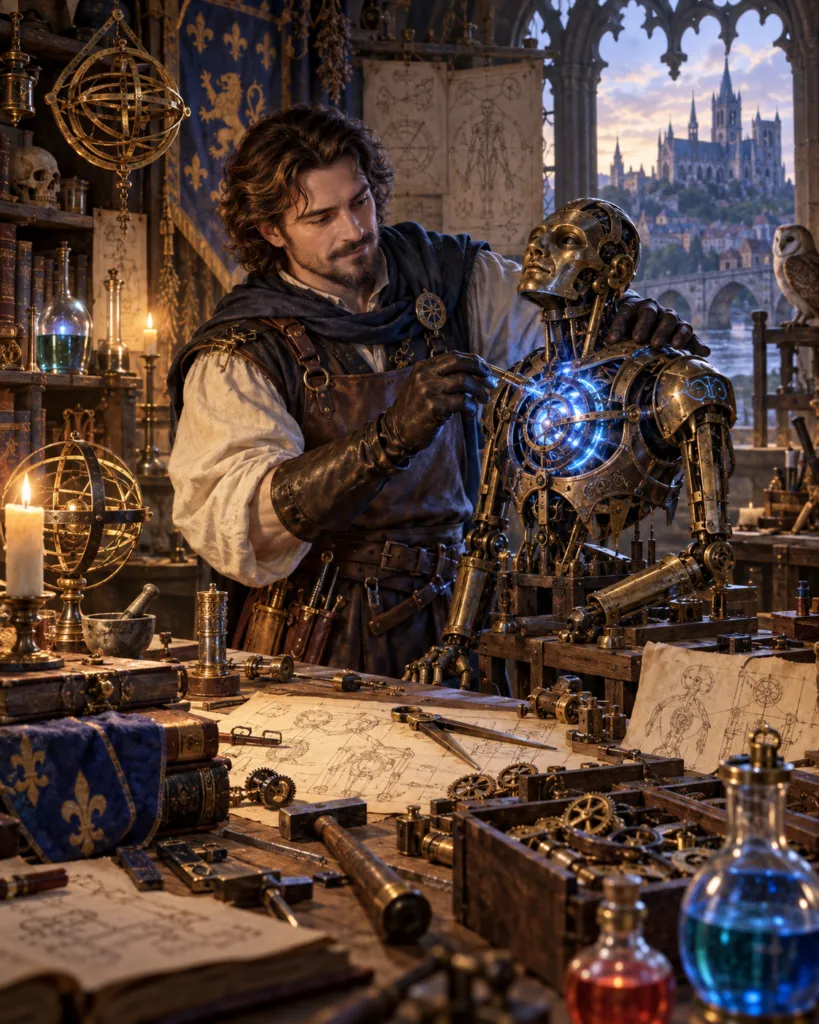
Choose an Artificer if you want a character who understands how things work and can turn that knowledge into practical advantages for the whole party.
An Artificer may be a guild engineer, gunsmith, armourer, alchemist, physician, clockmaker, surveyor, navigator, siege specialist, apothecary, mine engineer or independent inventor. What unites them is not a particular technology but an approach: observe the problem, understand its workings, then build the answer.
Artificers treat magic as something that can be studied, measured, prepared, contained and worked through material objects. Their inventions may use wood, iron, bronze, parchment, glass, leather, alchemical compounds, gears, cord, armour plates, powder, engraved wards or other materials appropriate to their craft.
| Primary Ability | Intelligence |
|---|---|
| Party Role | Problem-solver, magical support, investigator, crafter and specialist combatant. |
| Typical Equipment | Tools, armour, crossbows or firearms where available, measuring instruments, alchemical supplies and field-made devices. |
| Campaign Present | 1454 CE |
| Best For | Players who enjoy preparation, improvisation, equipment, investigation and practical solutions. |
Creating an Artificer
First decide what your character made or repaired before becoming an adventurer. A good Artificer concept begins with a profession or problem-solving tradition rather than with a collection of gadgets.
Then choose how your character learned. Artificers may be trained through guild apprenticeship, private masters, universities, court scholars, military workshops, civic schools, craft households or independent magical circles.
Finally, choose your specialisation. An Alchemist changes the body and materials. An Armourer turns protection into a magical system. A Bombardier controls force, powder and range. A Construct-Smith creates mechanical or magical assistants. A Cartographer masters measurement, navigation and distance.
Artificer Rules by Edition
Choose the ruleset used by your campaign. Each tab contains a complete version of the class for that edition. Do not combine progression, Device Designs, spell systems or specialisation rules between editions unless the GM deliberately creates a hybrid version.
Artificer — 5.5e / 2024-Compatible
This is an original Artificer class written for the 2024 rules framework. It does not reproduce the separately published official Artificer class.
Hit Point Die: d8 per Artificer level.
Hit Points at 1st Level: 8 + your Constitution modifier.
Hit Points at Higher Levels: 1d8 (or 5) + your Constitution modifier for each Artificer level after 1st.
Primary Ability: Intelligence.
Saving Throw Proficiencies: Constitution and Intelligence.
Armour: Light armour, medium armour and Shields.
Weapons: Simple weapons.
Tools: Thieves’ Tools and two Artisan’s Tool sets of your choice.
Skills: Choose two: Arcana, History, Investigation, Medicine, Nature, Perception or Sleight of Hand.
Firearm proficiency is not automatically granted. Firearms exist in the campaign, but access and proficiency depend on training, homeland, law and supply.
Starting Equipment
Choose either starting wealth allowed by your campaign or the following equipment: scale mail or leather armour; a light crossbow and 20 bolts or two simple weapons; Thieves’ Tools; one Artisan’s Tool set with which you are proficient; a scholar’s pack; and 15 gp.
| Level | PB | Features | Active Designs | Cantrips | 1st | 2nd | 3rd | 4th | 5th |
|---|---|---|---|---|---|---|---|---|---|
| 1 | +2 | Workshop Magic, Practical Spellcasting | — | 2 | 2 | — | — | — | — |
| 2 | +2 | Device Designs | 2 | 2 | 2 | — | — | — | — |
| 3 | +2 | Specialisation, Field Workshop | 2 | 2 | 3 | — | — | — | — |
| 4 | +2 | Feat | 2 | 2 | 3 | — | — | — | — |
| 5 | +3 | Specialisation Feature | 2 | 2 | 4 | 2 | — | — | — |
| 6 | +3 | Rapid Refit | 3 | 2 | 4 | 2 | — | — | — |
| 7 | +3 | Calculated Intervention | 3 | 2 | 4 | 3 | — | — | — |
| 8 | +3 | Feat | 3 | 2 | 4 | 3 | — | — | — |
| 9 | +4 | Specialisation Feature | 3 | 2 | 4 | 3 | 2 | — | — |
| 10 | +4 | Superior Designs | 4 | 3 | 4 | 3 | 2 | — | — |
| 11 | +4 | Stored Working | 4 | 3 | 4 | 3 | 3 | — | — |
| 12 | +4 | Feat | 4 | 3 | 4 | 3 | 3 | — | — |
| 13 | +5 | — | 4 | 3 | 4 | 3 | 3 | 1 | — |
| 14 | +5 | Greater Workshop | 5 | 3 | 4 | 3 | 3 | 1 | — |
| 15 | +5 | Specialisation Feature | 5 | 3 | 4 | 3 | 3 | 2 | — |
| 16 | +5 | Feat | 5 | 3 | 4 | 3 | 3 | 2 | — |
| 17 | +6 | — | 5 | 3 | 4 | 3 | 3 | 3 | 1 |
| 18 | +6 | Grand Designs | 6 | 3 | 4 | 3 | 3 | 3 | 1 |
| 19 | +6 | Epic Boon | 6 | 3 | 4 | 3 | 3 | 3 | 2 |
| 20 | +6 | Master of Wonders | 6 | 3 | 4 | 3 | 3 | 3 | 2 |
Workshop Magic — Level 1
You understand the magical behaviour of worked materials. You gain proficiency with one additional Artisan’s Tool set.
During a Long Rest, you can place minor magical functions on a number of Tiny nonmagical objects equal to your Intelligence modifier, minimum one. Choose one function for each object:
- Produce steady light sufficient for a small workspace.
- Remain safely warm or cool enough to protect ordinary workshop contents.
- Display a maker’s mark visible only when touched.
- Tick, vibrate or change colour after a period of up to 8 hours.
- Indicate level, plumb, direction or elapsed time.
These effects end at your next Long Rest or when you dismiss them. They cannot deal damage, reproduce a spell, create valuable material or function as permanent magic items.
Practical Spellcasting — Level 1
You cast Artificer spells through formulae, tools, temporary mechanisms, alchemical preparations and engraved wards. Intelligence is your spellcasting ability.
Spell Save DC = 8 + Proficiency Bonus + Intelligence modifier
Spell Attack Modifier = Proficiency Bonus + Intelligence modifier
Prepare a number of Artificer spells equal to your Intelligence modifier plus half your Artificer level, rounded down, minimum two. You can change your prepared spells when you finish a Long Rest.
You know two Artificer cantrips at 1st level and three at 10th level. Whenever you gain an Artificer level, you may replace one Artificer cantrip you know with another.
You may use an Artisan’s Tool set with which you are proficient as your spellcasting focus. A prepared Artificer spell with the Ritual tag may be cast as a Ritual.
Device Designs — Level 2
At 2nd level, you learn three Device Designs. You learn one additional design at levels 6, 10, 14 and 18. Whenever you gain an Artificer level, you may replace one design you know with another design for which you meet the minimum level.
When you finish a Long Rest, build the number of active designs shown on the class table.
A device stops functioning when you replace it, finish your next Long Rest or die. Temporary class devices have no meaningful resale value and are not permanent magic items.
Unless a design states otherwise, any creature holding or wearing the device may activate it. Attacks and saving throws made through a device use your Artificer spell attack modifier or spell save DC. Limited uses belong to the device and are shared by all creatures using it.
You can maintain only one active copy of a particular Device Design unless the design specifically states otherwise.
Specialisation — Level 3
Choose Alchemist, Armourer, Bombardier, Construct-Smith or Cartographer. Your specialisation grants features at levels 3, 5, 9 and 15.
Field Workshop — Level 3
During a Short Rest, you can repair damaged mundane equipment if suitable tools and materials are available. Appropriate targets include weapons, shields, tools, locks, mechanisms and similar manufactured objects.
You also have Advantage on Intelligence checks made to understand mundane machines, locks, traps, siege engines and manufactured devices.
Rapid Refit — Level 6
Once per Long Rest, spend 10 minutes replacing one active Device Design with another design you know. At level 14, you may do this twice per Long Rest.
Calculated Intervention — Level 7
When you or a creature you can see within 30 feet fails an ability check or saving throw, you may use your Reaction to add your Intelligence modifier to the roll.
You may use this feature a number of times equal to your Proficiency Bonus and regain all uses when you finish a Long Rest.
Superior Designs — Level 10
You can learn level-10 Device Designs. The time required for mundane crafting that you personally perform is halved.
Stored Working — Level 11
When you finish a Long Rest, choose one prepared Artificer spell of level 1 or 2 with a casting time of an Action and no costly consumed material component.
Store the spell in a weapon, tool, piece of jewellery or handheld device. A creature holding the object can take a Magic action to produce the stored spell using your spellcasting modifier.
The object has a number of uses equal to your Intelligence modifier, minimum two. Unused activations disappear when you create another Stored Working or finish your next Long Rest.
Greater Workshop — Level 14
You can learn level-14 Device Designs. You also gain Expertise with two Artisan’s Tool sets with which you are proficient.
Grand Designs — Level 18
You can learn level-18 Device Designs. When you roll Initiative with no uses of Calculated Intervention remaining, regain one use.
Epic Boon — Level 19
Gain an Epic Boon feat for which you qualify, or another feat allowed by the campaign’s 2024 rules.
Master of Wonders — Level 20
At the end of every Short Rest, you can replace one active Device Design with another design you know.
Once per turn when you use an active Device Design or cast an Artificer spell through your tools, choose one:
- Gain Temporary Hit Points equal to your Intelligence modifier.
- Move up to 10 feet without provoking Opportunity Attacks.
- Give one creature you can see within 30 feet +2 AC until the start of your next turn.
5.5e Device Designs
| Design | Minimum Level | Effect |
|---|---|---|
| Surveyor’s Lens | 2 | Advantage on Intelligence (Investigation) checks concerning architecture, mechanisms, traps or manufactured objects. |
| Springline Grapnel | 2 | Launch a secure line to a solid point within 30 feet as an Action. It supports up to 500 pounds and can retract as a Bonus Action. |
| Field Crucible | 2 | After a Short Rest, produce one draught. A creature drinking it gains Temporary Hit Points equal to 1d6 + your Intelligence modifier. |
| Spark Coil | 2 | Action: ranged spell attack, 60 feet, 1d8 Lightning damage. Damage becomes 2d8 at level 11 and 3d8 at level 17. |
| Warding Buckle | 2 | When hit by an attack, use your Reaction to gain +2 AC against that attack. Uses equal your Proficiency Bonus per Long Rest. |
| Preservation Flask | 2 | Contents remain at a chosen safe temperature, and ordinary food, medicine, blood samples or alchemical ingredients do not spoil while sealed inside. |
| Aegis Plate | 6 | While worn, gain +1 AC. A creature can benefit from only one Aegis Plate. |
| Medical Reservoir | 6 | Three charges. Action: expend one charge to restore 1d8 + Intelligence modifier Hit Points to a touched creature. Charges return after a Long Rest. |
| Smoke Condenser | 6 | Once per Long Rest, create a 10-foot-radius Heavily Obscured cloud within 30 feet for 1 minute. Wind can disperse it. |
| Manipulator Hand | 6 | Manipulate unattended objects weighing up to 20 pounds at a range of 30 feet. It cannot attack or activate magic items. |
| Wing Harness | 10 | Once per Long Rest, gain a Fly Speed of 30 feet for 10 minutes. |
| Force Ram | 10 | Once per Short or Long Rest, project a 30-foot line. Dexterity save; 4d6 Force damage and pushed 10 feet on failure, half damage and no push on success. |
| Null Key | 10 | Advantage on checks and saves against magical locks and traps. Once per Long Rest, make an Intelligence check against DC 10 + spell level to suppress one magical lock for 1 minute. |
| Phase Dial | 14 | Bonus Action: teleport up to 30 feet to a space you can see. Uses equal Intelligence modifier per Long Rest, minimum one. |
| Restoration Engine | 14 | Once per Long Rest, take an Action to touch a creature and end Charmed, Frightened, Paralyzed or Poisoned on it. |
| Bastion Frame | 14 | Bonus Action: deploy a waist-high defensive frame in an adjacent space. It provides Half Cover to creatures immediately behind it and lasts 10 minutes. |
| Master Transit Rig | 18 | Once per Long Rest, you and up to five willing creatures within 10 feet teleport to a location you can see within 500 feet. |
| Emergency Reconstructor | 18 | Once per Long Rest, when a creature within 5 feet would drop to 0 Hit Points, use your Reaction to leave it at 1 Hit Point instead. |
5.5e Artificer Specialisations
Alchemist
You specialise in medicines, solvents, acids, dyes, metals, smoke, heat, poisons, distillation and magical reactions.
Level 3 — Reagent Dice. You have a pool of d6 Reagent Dice equal to your Proficiency Bonus. As a Bonus Action, spend one die to do one of the following: restore Hit Points equal to the die + Intelligence modifier to a creature within 5 feet; grant that amount as Temporary Hit Points; or add the die as Acid, Fire or Poison damage to one damage roll you make that turn. Regain all dice after a Long Rest.
Level 5 — Catalysis. Once per turn when an Artificer spell or Reagent Die restores Hit Points or deals Acid, Fire or Poison damage, add your Intelligence modifier to one roll.
Level 9 — Emergency Antidote. When you use a Reagent Die to restore Hit Points, you may also end Poisoned on the target. Once per Long Rest, you may instead end one disease or one nonmagical poison without spending a die.
Level 15 — Grand Distillation. You gain Resistance to Acid and Poison damage and Advantage on saving throws against Poisoned. Your Reagent Dice become d10s.
Armourer
You specialise in articulated armour, hidden fittings, counterweights, wards, shock absorbers and magical reinforcement.
Level 3 — Arcane Harness. During a Long Rest, modify one suit of armour with which you are proficient. It becomes your Arcane Harness and may serve as your spellcasting focus. Choose Bulwark or Skirmisher.
Bulwark: Once per round when an attack hits you while wearing your Arcane Harness, reduce the damage by your Intelligence modifier, minimum 1.
Skirmisher: Your Speed increases by 10 feet, and standing from Prone costs only 5 feet of movement.
Level 5 — Harness Assault. You can attack twice instead of once whenever you take the Attack action while wearing your Arcane Harness.
Level 9 — Reconfigurable Harness. You know both Bulwark and Skirmisher. Whenever you finish a Short or Long Rest, choose which configuration is active.
Level 15 — Perfected Harness. While Bulwark is active, its damage reduction becomes twice your Intelligence modifier. While Skirmisher is active, you gain a Climb Speed equal to your Speed and can move across vertical surfaces during your turn without falling until the turn ends.
Bombardier
You specialise in powder, pressure, incendiaries, projectiles, demolition and controlled force.
Level 3 — Portable Engine. During a Long Rest, build one Portable Engine. As an Action, choose one firing mode. Its save DC equals your spell save DC.
| Mode | Effect |
|---|---|
| Shrapnel | 15-foot cone; Dexterity save; 2d6 Piercing damage, half on success. |
| Concussion | One creature within 60 feet; ranged spell attack; 2d8 Thunder damage and push 5 feet. |
| Smoke | Create a 10-foot-radius Heavily Obscured smoke cloud within 60 feet until the start of your next turn. |
You may fire the engine a number of times equal to your Proficiency Bonus per Long Rest.
Level 5 — Rangefinder. Once per turn, add 1d8 to one damage roll made by your Portable Engine or an Artificer spell with a range greater than Touch.
Level 9 — Breach Mastery. Your Portable Engine deals double damage to unattended objects and structures. Shrapnel and Concussion each gain one additional damage die.
Level 15 — Grand Bombard. Once per Long Rest, choose a point within 120 feet. Creatures in a 20-foot-radius sphere make a Dexterity save, taking 8d6 Fire or Thunder damage on failure or half on success.
Construct-Smith
You build practical companions: carriers, scouts, climbing machines, assistants, lifting frames and guardians.
Level 3 — Crafted Companion. At the end of a Long Rest, build a Small construct. Choose Carrier, Scout or Guard.
| Creature Type | Small Construct |
|---|---|
| Armour Class | 13 + your Proficiency Bonus |
| Hit Points | 5 + five times your Artificer level |
| Speed | 30 feet |
| STR | 12 (+1) |
| DEX | 14 (+2) |
| CON | 14 (+2) |
| INT | 6 (−2) |
| WIS | 12 (+1) |
| CHA | 6 (−2) |
| Saving Throws | Dexterity +2 + PB, Constitution +2 + PB |
| Senses | Darkvision 60 feet; Passive Perception 11 |
| Languages | Understands the languages you speak but cannot speak |
| Construct Strike | Your spell attack modifier to hit, reach 5 feet, one target; 1d6 + your Proficiency Bonus Bludgeoning, Piercing or Slashing damage, chosen when built. |
The companion acts immediately after your turn. Unless you use a Bonus Action to command it, it takes the Dodge action.
If reduced to 0 Hit Points, it becomes inert. You can repair or rebuild it when you finish a Long Rest while you have appropriate tools. You can have only one Crafted Companion at a time.
Carrier: counts as one size larger for carrying and can Help with Strength checks.
Scout: has a Climb Speed of 30 feet and Advantage on Perception checks relying on sight.
Guard: when a creature within 5 feet of it is attacked, it may use its Reaction to impose Disadvantage on that attack.
Level 5 — Coordinated Attack. When you take the Attack action, you can attack twice, or attack once and command your companion to attack without using your Bonus Action.
Level 9 — Repair Matrix. When your companion is within 5 feet, you can use a Bonus Action and expend a spell slot to restore 2d8 Hit Points per slot level to it or another construct.
Level 15 — Master Construct. Your companion’s attack deals 2d6 + PB damage, its AC increases by 2, and it gains Resistance to Bludgeoning, Piercing and Slashing damage from nonmagical attacks.
Cartographer
You specialise in measurement, maps, navigation and the magical manipulation of distance.
Level 3 — Living Atlas. You always know north while on the Material Plane and cannot become lost by nonmagical means while carrying your own maps. You gain proficiency with Cartographer’s Tools; if already proficient, gain Expertise.
After a Long Rest, mark a number of locations equal to your Intelligence modifier. Each mark must be a place you personally visited during the previous 24 hours. You always know the direction to each mark while within 10 miles.
Level 5 — Short Road. After casting an Artificer spell or using a Device Design, teleport up to 10 feet to an unoccupied space you can see. Uses equal your Proficiency Bonus per Long Rest.
Level 9 — Relay Mark. When you use Short Road, you may instead teleport one willing creature you can see within 30 feet up to 15 feet.
Level 15 — Folded Distance. Once per Long Rest, as an Action, teleport yourself and up to five willing creatures within 10 feet to a location you can see or one of your Living Atlas marks within 1 mile.
5.5e Artificer Spell List
Cantrips
Acid Splash, Guidance, Light, Mending, Mage Hand, Message, Prestidigitation, Ray of Frost, Resistance and Shocking Grasp.
1st Level
Alarm, Cure Wounds, Detect Magic, Disguise Self, Expeditious Retreat, Faerie Fire, False Life, Feather Fall, Grease, Identify, Jump, Longstrider and Sanctuary.
2nd Level
Aid, Alter Self, Arcane Lock, Continual Flame, Darkvision, Enhance Ability, Enlarge/Reduce, Invisibility, Levitate, Magic Weapon, Protection from Poison, Rope Trick, See Invisibility and Spider Climb.
3rd Level
Dispel Magic, Fly, Haste, Protection from Energy, Sending, Water Breathing and Water Walk.
4th Level
Arcane Eye, Fabricate, Freedom of Movement, Greater Invisibility and Stone Shape.
5th Level
Creation, Greater Restoration, Passwall, Telekinesis and Wall of Stone.
Artificer — 5e / 2014-Compatible
This version uses the 2014-style 5e action economy and advancement structure while retaining the same original class identity.
Hit Die: d8.
Hit Points at 1st Level: 8 + your Constitution modifier.
Hit Points at Higher Levels: 1d8 (or 5) + your Constitution modifier for each Artificer level after 1st.
Saving Throws: Constitution, Intelligence.
Armour: Light armour, medium armour, shields.
Weapons: Simple weapons.
Tools: Thieves’ Tools and two artisan’s tool sets.
Skills: Choose two from Arcana, History, Investigation, Medicine, Nature, Perception and Sleight of Hand.
Starting Equipment
Choose either starting wealth appropriate to your campaign or the following: scale mail or leather armour; a light crossbow and 20 bolts or two simple weapons; Thieves’ Tools; one artisan’s tool set with which you are proficient; an explorer’s or scholar’s pack; and 15 gp.
| Level | PB | Features | Active Designs | 1st | 2nd | 3rd | 4th | 5th |
|---|---|---|---|---|---|---|---|---|
| 1 | +2 | Workshop Magic, Practical Spellcasting | — | 2 | — | — | — | — |
| 2 | +2 | Device Designs | 2 | 2 | — | — | — | — |
| 3 | +2 | Specialisation, Field Workshop | 2 | 3 | — | — | — | — |
| 4 | +2 | Ability Score Improvement | 2 | 3 | — | — | — | — |
| 5 | +3 | Specialisation Feature | 2 | 4 | 2 | — | — | — |
| 6 | +3 | Rapid Refit | 3 | 4 | 2 | — | — | — |
| 7 | +3 | Calculated Intervention | 3 | 4 | 3 | — | — | — |
| 8 | +3 | Ability Score Improvement | 3 | 4 | 3 | — | — | — |
| 9 | +4 | Specialisation Feature | 3 | 4 | 3 | 2 | — | — |
| 10 | +4 | Superior Designs | 4 | 4 | 3 | 2 | — | — |
| 11 | +4 | Stored Working | 4 | 4 | 3 | 3 | — | — |
| 12 | +4 | Ability Score Improvement | 4 | 4 | 3 | 3 | — | — |
| 13 | +5 | — | 4 | 4 | 3 | 3 | 1 | — |
| 14 | +5 | Greater Workshop | 5 | 4 | 3 | 3 | 1 | — |
| 15 | +5 | Specialisation Feature | 5 | 4 | 3 | 3 | 2 | — |
| 16 | +5 | Ability Score Improvement | 5 | 4 | 3 | 3 | 2 | — |
| 17 | +6 | — | 5 | 4 | 3 | 3 | 3 | 1 |
| 18 | +6 | Grand Designs | 6 | 4 | 3 | 3 | 3 | 1 |
| 19 | +6 | Ability Score Improvement | 6 | 4 | 3 | 3 | 3 | 2 |
| 20 | +6 | Master of Wonders | 6 | 4 | 3 | 3 | 3 | 2 |
Workshop Magic
At 1st level, gain proficiency with one additional artisan’s tool set. After a long rest, you may place minor measuring, illumination, timing, temperature-control or maker’s-mark effects on a number of Tiny mundane objects equal to your Intelligence modifier, minimum one.
Practical Spellcasting
Spell Save DC = 8 + proficiency bonus + Intelligence modifier
Spell Attack Modifier = proficiency bonus + Intelligence modifier
Prepare a number of Artificer spells equal to your Intelligence modifier plus half your Artificer level, rounded down, minimum two. Artisan’s tools may serve as your spellcasting focus.
Cantrips
At 1st level, you know two Artificer cantrips. At 10th level, you know three. Whenever you gain an Artificer level, you may replace one Artificer cantrip you know with another.
Device Designs
At 2nd level, learn three Device Designs. Learn one additional design at levels 6, 10, 14 and 18. Whenever you gain an Artificer level, you may replace one known design with another for which you meet the minimum level.
After each long rest, build the number of active devices shown on the class table. They stop functioning at your next long rest or when replaced.
Unless a design states otherwise, a creature holding or wearing the device can activate it. Device attacks and saving throws use your Artificer spell attack modifier or spell save DC. Limited uses belong to the device and are shared by all creatures using it.
You can maintain only one active copy of a particular Device Design unless the design states otherwise.
Specialisation
Choose Alchemist, Armourer, Bombardier, Construct-Smith or Cartographer at 3rd level. Gain additional features at levels 5, 9 and 15.
Field Workshop
At 3rd level, you can repair appropriate mundane equipment during a short rest when tools and materials are available. You also have advantage on Intelligence checks made to understand a mundane machine, trap, lock, siege engine or manufactured mechanism.
Rapid Refit
At 6th level, once per long rest, spend 10 minutes replacing one active Device Design with another design you know. At 14th level, you may do this twice per long rest.
Calculated Intervention
At 7th level, when you or a creature within 30 feet fails an ability check or saving throw, use your reaction to add your Intelligence modifier to the result. Uses equal your proficiency bonus per long rest.
Superior Designs
At 10th level, gain access to level-10 designs and halve the time required for mundane crafting you perform yourself.
Stored Working
At 11th level, after a long rest, place one prepared 1st- or 2nd-level Artificer spell with a casting time of 1 action and no consumed costly component into a handheld object.
A creature holding the object may use an action to produce the spell using your spellcasting modifier. It has uses equal to your Intelligence modifier, minimum two, and expires at your next long rest.
Greater Workshop
At 14th level, gain expertise with two artisan’s tool sets and access to level-14 designs.
Grand Designs
At 18th level, gain access to level-18 designs. When you roll initiative with no Calculated Intervention uses remaining, regain one use.
Master of Wonders
At 20th level, you may replace one active design after every short rest. Once per turn after using an Artificer spell or Device Design, choose one:
- Gain temporary hit points equal to your Intelligence modifier.
- Move 10 feet without provoking opportunity attacks.
- Grant a creature within 30 feet +2 AC until the start of your next turn.
5e Device Designs
| Design | Minimum Level | Effect |
|---|---|---|
| Surveyor’s Lens | 2 | Advantage on Intelligence (Investigation) checks concerning architecture, mechanisms, traps or manufactured objects. |
| Springline Grapnel | 2 | Launch a secure line to a solid point within 30 feet as an action. It supports up to 500 pounds and can retract as a bonus action. |
| Field Crucible | 2 | After a short rest, produce one draught. A creature drinking it gains temporary hit points equal to 1d6 + Intelligence modifier. |
| Spark Coil | 2 | Action: ranged spell attack, 60 feet, 1d8 lightning damage. Damage becomes 2d8 at level 11 and 3d8 at level 17. |
| Warding Buckle | 2 | When hit by an attack, reaction to gain +2 AC against that attack. Uses equal proficiency bonus per long rest. |
| Preservation Flask | 2 | Contents remain at a chosen safe temperature and ordinary food, medicine, blood samples or alchemical ingredients do not spoil while sealed inside. |
| Aegis Plate | 6 | While worn, gain +1 AC. A creature can benefit from only one Aegis Plate. |
| Medical Reservoir | 6 | Three charges. Action: expend one charge to restore 1d8 + Intelligence modifier hit points to a touched creature. Charges return after a long rest. |
| Smoke Condenser | 6 | Once per long rest, create a 10-foot-radius heavily obscured cloud within 30 feet for 1 minute. Wind can disperse it. |
| Manipulator Hand | 6 | Manipulate unattended objects weighing up to 20 pounds at a range of 30 feet. It cannot attack or activate magic items. |
| Wing Harness | 10 | Once per long rest, gain a flying speed of 30 feet for 10 minutes. |
| Force Ram | 10 | Once per short or long rest, project a 30-foot line. Dexterity save; 4d6 force damage and pushed 10 feet on failure, half damage and no push on success. |
| Null Key | 10 | Advantage on checks and saves against magical locks and traps. Once per long rest, make an Intelligence check against DC 10 + spell level to suppress one magical lock for 1 minute. |
| Phase Dial | 14 | Bonus action: teleport up to 30 feet to a space you can see. Uses equal Intelligence modifier per long rest, minimum one. |
| Restoration Engine | 14 | Once per long rest, action to touch a creature and end charmed, frightened, paralyzed or poisoned on it. |
| Bastion Frame | 14 | Bonus action: deploy a waist-high defensive frame in an adjacent space. It provides half cover to creatures immediately behind it and lasts 10 minutes. |
| Master Transit Rig | 18 | Once per long rest, you and up to five willing creatures within 10 feet teleport to a location you can see within 500 feet. |
| Emergency Reconstructor | 18 | Once per long rest, when a creature within 5 feet would drop to 0 hit points, reaction to leave it at 1 hit point instead. |
5e Artificer Specialisations
Alchemist
Level 3 — Reagent Dice. You have a pool of d6 Reagent Dice equal to your proficiency bonus. As a bonus action, spend one die to restore hit points equal to the die + Intelligence modifier to a creature within 5 feet, grant that amount as temporary hit points, or add the die as acid, fire or poison damage to one damage roll you make that turn. Regain all dice after a long rest.
Level 5 — Catalysis. Once per turn when an Artificer spell or Reagent Die restores hit points or deals acid, fire or poison damage, add your Intelligence modifier to one roll.
Level 9 — Emergency Antidote. When you use a Reagent Die to restore hit points, you may also end poisoned on the target. Once per long rest, you may instead end one disease or one nonmagical poison without spending a die.
Level 15 — Grand Distillation. You gain resistance to acid and poison damage and advantage on saving throws against being poisoned. Your Reagent Dice become d10s.
Armourer
Level 3 — Arcane Harness. During a long rest, modify one suit of armour with which you are proficient. It becomes your Arcane Harness and can serve as your spellcasting focus. Choose Bulwark or Skirmisher.
Bulwark: Once per round when an attack hits you while wearing your Arcane Harness, reduce the damage by your Intelligence modifier, minimum 1.
Skirmisher: Your speed increases by 10 feet, and standing from prone costs only 5 feet of movement.
Level 5 — Harness Assault. You can attack twice instead of once whenever you take the Attack action while wearing your Arcane Harness.
Level 9 — Reconfigurable Harness. You know both configurations. Whenever you finish a short or long rest, choose Bulwark or Skirmisher as the active configuration.
Level 15 — Perfected Harness. While Bulwark is active, its damage reduction becomes twice your Intelligence modifier. While Skirmisher is active, you gain a climb speed equal to your speed and can move across vertical surfaces during your turn without falling until the turn ends.
Bombardier
Level 3 — Portable Engine. During a long rest, build one Portable Engine. As an action, choose one firing mode. Its save DC equals your spell save DC.
| Mode | Effect |
|---|---|
| Shrapnel | 15-foot cone; Dexterity save; 2d6 piercing damage, half on success. |
| Concussion | One creature within 60 feet; ranged spell attack; 2d8 thunder damage and push 5 feet. |
| Smoke | Create a 10-foot-radius heavily obscured smoke cloud within 60 feet until the start of your next turn. |
You may fire the engine a number of times equal to your proficiency bonus per long rest.
Level 5 — Rangefinder. Once per turn, add 1d8 to one damage roll made by your Portable Engine or an Artificer spell with a range greater than touch.
Level 9 — Breach Mastery. Your Portable Engine deals double damage to unattended objects and structures. Its Shrapnel and Concussion damage each gain one additional damage die.
Level 15 — Grand Bombard. Once per long rest, choose a point within 120 feet. Creatures in a 20-foot-radius sphere make a Dexterity save, taking 8d6 fire or thunder damage on failure or half on success.
Construct-Smith
Level 3 — Crafted Companion. At the end of a long rest, build a Small construct. Choose Carrier, Scout or Guard.
| Creature Type | Small Construct |
|---|---|
| Armour Class | 13 + your proficiency bonus |
| Hit Points | 5 + five times your Artificer level |
| Speed | 30 feet |
| STR | 12 (+1) |
| DEX | 14 (+2) |
| CON | 14 (+2) |
| INT | 6 (−2) |
| WIS | 12 (+1) |
| CHA | 6 (−2) |
| Saving Throws | Dexterity +2 + PB, Constitution +2 + PB |
| Senses | Darkvision 60 feet; passive Perception 11 |
| Languages | Understands the languages you speak but cannot speak |
| Construct Strike | Your spell attack modifier to hit, reach 5 feet, one target; 1d6 + proficiency bonus bludgeoning, piercing or slashing damage. |
The companion acts immediately after your turn. Unless you use a bonus action to command it, it takes the Dodge action. If reduced to 0 hit points, it becomes inert.
You can repair or rebuild it after a long rest with appropriate tools. You can have only one Crafted Companion at a time.
Carrier: counts as one size larger for carrying and can Help with Strength checks.
Scout: has a climbing speed of 30 feet and advantage on Perception checks relying on sight.
Guard: when a creature within 5 feet of it is attacked, it may use its reaction to impose disadvantage on that attack.
Level 5 — Coordinated Attack. When you take the Attack action, you can attack twice, or attack once and command your companion to attack without using your bonus action.
Level 9 — Repair Matrix. When your companion is within 5 feet, use a bonus action and expend a spell slot to restore 2d8 hit points per slot level to it or another construct.
Level 15 — Master Construct. Your companion’s attack deals 2d6 + proficiency bonus damage, its AC increases by 2, and it gains resistance to bludgeoning, piercing and slashing damage from nonmagical attacks.
Cartographer
Level 3 — Living Atlas. You always know north while on the Material Plane and cannot become lost by nonmagical means while carrying your own maps. You gain proficiency with Cartographer’s Tools; if already proficient, double your proficiency bonus for checks using them.
After a long rest, mark a number of locations equal to your Intelligence modifier. Each mark must be a place you personally visited during the previous 24 hours. You always know the direction to each mark while within 10 miles.
Level 5 — Short Road. After casting an Artificer spell or using a Device Design, teleport up to 10 feet to an unoccupied space you can see. Uses equal proficiency bonus per long rest.
Level 9 — Relay Mark. When you use Short Road, you may instead teleport one willing creature you can see within 30 feet up to 15 feet.
Level 15 — Folded Distance. Once per long rest, as an action, teleport yourself and up to five willing creatures within 10 feet to a location you can see or to one of your Living Atlas marks within 1 mile.
5e Artificer Spell List
Cantrips
Acid Splash, Guidance, Light, Mending, Mage Hand, Message, Prestidigitation, Ray of Frost, Resistance and Shocking Grasp.
1st Level
Alarm, Cure Wounds, Detect Magic, Disguise Self, Expeditious Retreat, Faerie Fire, False Life, Feather Fall, Grease, Identify, Jump, Longstrider and Sanctuary.
2nd Level
Aid, Alter Self, Arcane Lock, Continual Flame, Darkvision, Enhance Ability, Enlarge/Reduce, Invisibility, Levitate, Magic Weapon, Protection from Poison, Rope Trick, See Invisibility and Spider Climb.
3rd Level
Dispel Magic, Fly, Haste, Protection from Energy, Sending, Water Breathing and Water Walk.
4th Level
Arcane Eye, Fabricate, Freedom of Movement, Greater Invisibility and Stone Shape.
5th Level
Creation, Greater Restoration, Passwall, Telekinesis and Wall of Stone.
Artificer — Pathfinder 1e-Compatible
Hit Die: d8.
Base Attack Bonus: 3/4 progression.
Good Saves: Fortitude and Will.
Poor Save: Reflex.
Skill Ranks: 4 + Intelligence modifier per level.
Primary Ability: Intelligence.
Class skills include Appraise, Craft, Disable Device, Fly, Heal, Knowledge (arcana), Knowledge (dungeoneering), Knowledge (engineering), Knowledge (geography), Knowledge (local), Knowledge (nature), Knowledge (planes), Linguistics, Perception, Profession, Spellcraft and Use Magic Device.
| Level | Features | Active Designs | Maximum Formula Level |
|---|---|---|---|
| 1 | Practical Artifice, Formulae, Trap Mechanic | — | 1st |
| 2 | Device Designs | 2 | 1st |
| 3 | Specialisation | 2 | 1st |
| 4 | Workshop Secret | 2 | 2nd |
| 5 | Calculated Intervention +1 | 2 | 2nd |
| 6 | Rapid Refit | 3 | 2nd |
| 7 | Improved Workshop | 3 | 3rd |
| 8 | Specialisation Feature, Workshop Secret | 3 | 3rd |
| 9 | Calculated Intervention +2 | 3 | 3rd |
| 10 | Superior Designs | 4 | 4th |
| 11 | Stored Working | 4 | 4th |
| 12 | Workshop Secret | 4 | 4th |
| 13 | Specialisation Feature | 4 | 5th |
| 14 | Greater Workshop | 5 | 5th |
| 15 | Calculated Intervention +3 | 5 | 5th |
| 16 | Workshop Secret | 5 | 6th |
| 17 | Grand Designs | 5 | 6th |
| 18 | Specialisation Feature | 6 | 6th |
| 19 | Master Craftsman | 6 | 6th |
| 20 | Master of Wonders | 6 | 6th |
Practical Artifice
You gain proficiency with light armour, medium armour, shields, simple weapons and one martial weapon of your choice. You are proficient with artisan’s tools appropriate to your trained Craft skills. You do not automatically gain firearm proficiency.
Formulae
You learn magical formulae rather than preparing conventional spells. You may activate any formula you know. Formulae count as arcane spells for effects that interact with spells.
Your Formula Points equal your Artificer level + your Intelligence modifier, minimum 1. You regain all Formula Points after 8 hours of rest and one hour of preparation.
Activating a formula costs Formula Points equal to its spell level. 0-level formulae cost no points but otherwise follow Pathfinder’s normal cantrip rules.
Formula Save DC = 10 + formula level + Intelligence modifier
Your caster level equals your Artificer level. At 1st level, you know four 1st-level formulae plus a number equal to your Intelligence modifier. Learn two additional formulae whenever you gain an Artificer level.
Trap Mechanic
You can use Disable Device to disarm magical traps. Add half your Artificer level, minimum +1, to Perception checks made specifically to locate mechanical traps, concealed mechanisms and structural weaknesses.
Device Designs
At 2nd level, learn three Device Designs. Learn one additional design at levels 6, 10, 14 and 18. Whenever you gain an Artificer level, you may replace one known design with another for which you meet the minimum level.
Prepare the number of active designs shown on the class table after daily preparation.
Unless a design states otherwise, a creature holding or wearing the device may activate it. When a design requires a saving throw, use your Formula save DC. When it requires a caster-level check, use your Artificer caster level.
Limited uses belong to the device and are shared by all creatures using it.
Specialisation
Choose Alchemist, Armourer, Bombardier, Construct-Smith or Cartographer at level 3. Gain additional abilities at levels 8, 13 and 18.
Workshop Secret
At levels 4, 8, 12 and 16, choose one item-creation feat for which you qualify or one of the following workshop secrets:
- Efficient Crafter: +2 competence bonus on one Craft skill.
- Field Repair: repair mundane equipment in half normal time.
- Arcane Appraiser: +2 on Spellcraft checks to identify magic items.
- Mechanist: +2 on Disable Device and Knowledge (engineering).
Calculated Intervention
At level 5, as an immediate action, add +1 to an ally’s failed saving throw or skill check within 30 feet. The bonus rises to +2 at level 9 and +3 at level 15. Uses per day equal your Intelligence modifier, minimum one.
Rapid Refit
At level 6, once per day, spend 10 minutes changing one active Device Design to another design you know.
Improved Workshop
At level 7, you may take 10 on Craft checks even when distraction would normally prevent it.
Superior Designs
At level 10, gain access to level-10 designs.
Stored Working
At level 11, place one formula of 2nd level or lower into a handheld object during daily preparation. The object can activate it three times before your next daily preparation. Save DC and caster level use your statistics.
Greater Workshop
At level 14, gain access to level-14 designs. Masterwork artisan’s tools you personally use grant a +4 circumstance bonus on the relevant Craft check instead of their normal +2 circumstance bonus.
Grand Designs
At level 17, gain access to level-18 designs.
Master Craftsman
At level 19, you may take 20 on Craft checks without increasing the normal time required, provided failure during construction would not itself destroy irreplaceable materials.
Master of Wonders
At level 20, once per round after activating a formula or Device Design, choose one: gain temporary hit points equal to your Intelligence modifier; move 10 feet without provoking attacks of opportunity; or grant an ally within 30 feet a +2 dodge bonus to AC until your next turn.
Pathfinder 1e Device Designs
| Design | Minimum Level | Effect |
|---|---|---|
| Surveyor’s Lens | 2 | +2 competence bonus on Appraise, Disable Device, Perception or Knowledge (engineering) checks concerning manufactured objects. |
| Springline Grapnel | 2 | Launch to a solid point within 30 feet as a standard action. Grants +5 circumstance bonus on appropriate Climb checks using the line. |
| Field Crucible | 2 | After resting at least 1 hour, produce one draught granting temporary hit points equal to 1d6 + Intelligence modifier for 1 hour. |
| Spark Coil | 2 | Ranged touch attack 60 feet dealing 1d6 electricity damage +1 per three Artificer levels, maximum +6. |
| Warding Buckle | 2 | Immediate action to gain +2 dodge AC against one attack. Uses per day equal Intelligence modifier, minimum one. |
| Preservation Flask | 2 | Grants +4 circumstance bonus on checks made to preserve stored biological or alchemical samples. |
| Aegis Plate | 6 | Grants +1 deflection bonus to AC. |
| Medical Reservoir | 6 | Three charges/day. Standard action touch heals 1d8 + Intelligence modifier hit points. |
| Smoke Condenser | 6 | Once/day, produces a 10-foot-radius smoke cloud providing concealment for 1 minute. |
| Manipulator Hand | 6 | Manipulates unattended objects of up to 20 pounds within 30 feet as a move action. |
| Wing Harness | 10 | Once/day, gain fly speed 40 feet, average manoeuvrability, for 10 minutes. |
| Force Ram | 10 | Three times/day, 30-foot line; Reflex save for half. Deals 4d6 force damage and pushes failed targets 5 feet. |
| Null Key | 10 | +4 competence bonus against magical locks and traps. Once/day, make a caster-level check to suppress one magical locking effect for 1 minute. |
| Phase Dial | 14 | Swift action: teleport up to 30 feet. Uses/day equal Intelligence modifier. |
| Restoration Engine | 14 | Once/day, remove frightened, paralyzed or poisoned from a touched creature, subject to effects that explicitly cannot be removed. |
| Bastion Frame | 14 | Move action to deploy. Grants cover to appropriately positioned creatures. Lasts 10 minutes. |
| Master Transit Rig | 18 | Once/day, transport yourself and up to five willing creatures to a visible location within 500 feet as a full-round action. |
| Emergency Reconstructor | 18 | Once/day, immediate action when an adjacent creature would fall below 0 hit points; it instead remains at 1 hit point. |
Pathfinder 1e Specialisations
Alchemist
At level 3, gain a pool of Reagent Dice usable Intelligence modifier + 1 times per day. Healing or damage begins at 1d6, rises to 2d6 at level 8, 3d6 at level 13 and 4d6 at level 18. Reagents can restore hit points, grant temporary hit points, or deal acid, fire or poison damage as appropriate.
At level 8, add Intelligence modifier to one healing or qualifying damage roll. At level 13, a healing reagent may also remove the poisoned condition. At level 18, gain acid resistance 10 and poison resistance 10.
Armourer
At level 3, choose Bulwark or Skirmisher when preparing your modified armour. Bulwark grants DR 2/—. Skirmisher grants a +10-foot enhancement bonus to land speed.
At level 8, Bulwark becomes DR 3/—. At level 13, it becomes DR 4/—; Skirmisher gains +2 dodge AC. At level 18, Bulwark becomes DR 5/— and Skirmisher gains a climb speed equal to land speed.
Bombardier
At level 3, create a Portable Engine usable Intelligence modifier times per day. Shrapnel deals 2d6 damage in a 15-foot cone, Reflex half. Concussion is a ranged touch attack dealing 2d8 sonic damage. Smoke provides concealment in a 10-foot radius.
Damage increases by one die at levels 8 and 13. At level 18, Grand Bombard deals 8d6 fire or sonic damage in a 20-foot radius, Reflex half, once per day.
Construct-Smith
At level 3, create a Small construct companion with Hit Dice equal to your Artificer level, 3/4 BAB, good Fortitude and Reflex saves, construct traits, natural armour equal to +2 plus one per four Artificer levels, speed 30 feet and one natural attack dealing 1d6 damage.
Choose Carrier, Scout or Guard. Carrier counts as one size larger for carrying capacity. Scout gains a climb speed equal to land speed and +4 Perception. Guard may use an immediate action once per round to impose a −2 penalty on an attack against an adjacent ally.
At levels 8, 13 and 18, improve its natural armour by +1 and its attack damage by one step where appropriate. It is a class companion and cannot be sold as a permanently created magic item.
Cartographer
At level 3, gain +4 competence bonus on Survival and Knowledge (geography) checks involving navigation. At level 8, teleport yourself 10 feet as a swift action Intelligence modifier times per day. At level 13, you may move an adjacent willing creature instead. At level 18, teleport yourself and up to five willing creatures to a personally visited location within 1 mile once per day.
Pathfinder 1e Formula List
0-Level
Acid Splash, Detect Magic, Guidance, Light, Mage Hand, Mending, Message, Prestidigitation, Resistance.
1st Level
Alarm, Cure Light Wounds, Disguise Self, Expeditious Retreat, Faerie Fire, Feather Fall, Grease, Identify, Jump, Longstrider, Sanctuary.
2nd Level
Aid, Alter Self, Arcane Lock, Continual Flame, Darkvision, Invisibility, Levitate, Protection from Poison, Rope Trick, See Invisibility, Spider Climb.
3rd Level
Dispel Magic, Fly, Haste, Protection from Energy, Sending, Water Breathing, Water Walk.
4th Level
Arcane Eye, Fabricate, Freedom of Movement, Greater Invisibility, Stone Shape.
5th Level
Creation, Greater Restoration, Passwall, Telekinesis, Wall of Stone.
6th Level
Analyze Dweomer, Greater Dispel Magic, Move Earth, Stone to Flesh, True Seeing.
Artificer — D&D 3.5e-Compatible
Hit Die: d8.
Base Attack Bonus: 3/4 progression.
Good Saves: Fortitude and Will.
Poor Save: Reflex.
Skill Points: 4 + Intelligence modifier per level.
Class skills are Appraise, Concentration, Craft, Disable Device, Knowledge (arcana), Knowledge (architecture and engineering), Knowledge (dungeoneering), Open Lock, Profession, Search, Spellcraft and Use Magic Device.
| Level | Features | Active Designs | Maximum Formula Level |
|---|---|---|---|
| 1 | Practical Artifice, Formulae, Trap Mechanic | — | 1st |
| 2 | Device Designs | 2 | 1st |
| 3 | Specialisation | 2 | 1st |
| 4 | Workshop Secret | 2 | 2nd |
| 5 | Calculated Intervention +1 | 2 | 2nd |
| 6 | Rapid Refit | 3 | 2nd |
| 7 | Improved Workshop | 3 | 3rd |
| 8 | Specialisation Feature, Workshop Secret | 3 | 3rd |
| 9 | Calculated Intervention +2 | 3 | 3rd |
| 10 | Superior Designs | 4 | 4th |
| 11 | Stored Working | 4 | 4th |
| 12 | Workshop Secret | 4 | 4th |
| 13 | Specialisation Feature | 4 | 5th |
| 14 | Greater Workshop | 5 | 5th |
| 15 | Calculated Intervention +3 | 5 | 5th |
| 16 | Workshop Secret | 5 | 6th |
| 17 | Grand Designs | 5 | 6th |
| 18 | Specialisation Feature | 6 | 6th |
| 19 | Master Craftsman | 6 | 6th |
| 20 | Master of Wonders | 6 | 6th |
Practical Artifice
You are proficient with light and medium armour, shields, simple weapons and one martial weapon. You may cast Artificer formulae in light armour without arcane spell failure. Normal arcane spell failure applies in medium or heavy armour.
Formulae
You learn magical formulae rather than preparing conventional spells. You may activate any formula you know.
Your Formula Points equal your Artificer level + Intelligence modifier. Activating a formula costs points equal to its spell level; a 0-level formula costs 1 point in this edition.
Formula Save DC = 10 + formula level + Intelligence modifier
Caster level equals Artificer level. At 1st level, you know four 1st-level formulae plus your Intelligence modifier. Learn two additional formulae whenever you gain a class level.
Trap Mechanic
You can use Search to locate traps with DCs above 20 and Disable Device to disarm magical traps. Add half your class level, minimum +1, on Search checks involving mechanical traps or hidden mechanisms.
Device Designs
At level 2, learn three designs. Learn one additional design at levels 6, 10, 14 and 18. Whenever you gain an Artificer level, you may replace one known design with another for which you meet the minimum level.
Prepare the number of active designs shown on the class table each day. Unless a design states otherwise, a creature holding or wearing the device may activate it.
When a design requires a saving throw, use your Formula save DC. When it requires a caster-level check, use your Artificer caster level. Limited uses belong to the device and are shared by all creatures using it.
Specialisation
Choose Alchemist, Armourer, Bombardier, Construct-Smith or Cartographer at level 3. Gain further benefits at levels 8, 13 and 18.
Workshop Secret
At levels 4, 8, 12 and 16, choose an item-creation feat for which you qualify, or one of the following:
- Efficient Crafter: +2 competence bonus on one Craft skill.
- Field Repair: Repair mundane equipment in half the normal time.
- Arcane Appraiser: +2 on Spellcraft checks made to identify magic items.
- Mechanist: +2 on Disable Device and Knowledge (architecture and engineering).
Calculated Intervention
Beginning at level 5, use an immediate action to grant +1 to a failed save or skill check made by a creature within 30 feet. This rises to +2 at level 9 and +3 at level 15. Uses per day equal Intelligence modifier, minimum one.
Rapid Refit
At level 6, spend 10 minutes once per day changing one active Device Design.
Improved Workshop
At level 7, you may take 10 on Craft checks despite ordinary distractions.
Superior Designs
At level 10, gain access to level-10 designs.
Stored Working
At level 11, store one formula of 2nd level or lower inside an object. It can be activated three times before your next daily preparation.
Greater Workshop
At level 14, gain level-14 designs. Masterwork artisan’s tools you personally use grant a +4 circumstance bonus on the relevant Craft check instead of the normal +2.
Grand Designs
At level 17, gain level-18 designs.
Master Craftsman
At level 19, you may take 20 on appropriate Craft checks without multiplying the normal crafting time.
Master of Wonders
At level 20, once per round after activating a formula or design, choose one: gain temporary hit points equal to Intelligence modifier; move 10 feet without provoking attacks of opportunity; or give an ally within 30 feet +2 dodge AC until your next turn.
D&D 3.5e Device Designs
| Design | Minimum Level | Effect |
|---|---|---|
| Surveyor’s Lens | 2 | +2 competence bonus on Appraise, Disable Device, Search or Knowledge (architecture and engineering) checks concerning manufactured objects. |
| Springline Grapnel | 2 | Launch to a solid point within 30 feet as a standard action. Grants +5 circumstance bonus on appropriate Climb checks using the line. |
| Field Crucible | 2 | After resting at least 1 hour, produce one draught granting temporary hit points equal to 1d6 + Intelligence modifier for 1 hour. |
| Spark Coil | 2 | Ranged touch attack 60 feet dealing 1d6 electricity damage +1 per three Artificer levels, maximum +6. |
| Warding Buckle | 2 | Immediate action to gain +2 dodge AC against one attack. Uses/day equal Intelligence modifier, minimum one. |
| Preservation Flask | 2 | +4 circumstance bonus on checks made to preserve stored biological or alchemical samples. |
| Aegis Plate | 6 | Grants +1 deflection bonus to AC. |
| Medical Reservoir | 6 | Three charges/day. Standard action touch heals 1d8 + Intelligence modifier hit points. |
| Smoke Condenser | 6 | Once/day, produces a 10-foot-radius smoke cloud providing concealment for 1 minute. |
| Manipulator Hand | 6 | Manipulates unattended objects of up to 20 pounds within 30 feet as a move action. |
| Wing Harness | 10 | Once/day, gain fly speed 40 feet, average manoeuvrability, for 10 minutes. |
| Force Ram | 10 | Three times/day, 30-foot line; Reflex save for half. Deals 4d6 force damage and pushes failed targets 5 feet. |
| Null Key | 10 | +4 competence bonus against magical locks and traps. Once/day, make a caster-level check to suppress one magical locking effect for 1 minute. |
| Phase Dial | 14 | Swift action: teleport up to 30 feet. Uses/day equal Intelligence modifier. |
| Restoration Engine | 14 | Once/day, remove frightened, paralyzed or poisoned from a touched creature, subject to effects that explicitly cannot be removed. |
| Bastion Frame | 14 | Move action to deploy. Grants cover to appropriately positioned creatures. Lasts 10 minutes. |
| Master Transit Rig | 18 | Once/day, transport yourself and up to five willing creatures to a visible location within 500 feet as a full-round action. |
| Emergency Reconstructor | 18 | Once/day, immediate action when an adjacent creature would fall below 0 hit points; it instead remains at 1 hit point. |
D&D 3.5e Specialisations
Alchemist
At level 3, gain a pool of Reagent Dice usable Intelligence modifier + 1 times per day. Healing or damage begins at 1d6, rises to 2d6 at level 8, 3d6 at level 13 and 4d6 at level 18. Reagents can restore hit points, grant temporary hit points or deal acid, fire or poison damage.
At level 8, add Intelligence modifier to one healing or qualifying damage roll. At level 13, a healing reagent may also remove poison. At level 18, gain resistance 10 to acid and poison.
Armourer
At level 3, choose Bulwark or Skirmisher when preparing your modified armour. Bulwark grants DR 2/—. Skirmisher grants +10-foot enhancement bonus to land speed.
At level 8, Bulwark becomes DR 3/—. At level 13, it becomes DR 4/— and Skirmisher gains +2 dodge AC. At level 18, Bulwark becomes DR 5/— and Skirmisher gains a climb speed equal to land speed.
Bombardier
At level 3, create a Portable Engine usable Intelligence modifier times per day. Shrapnel deals 2d6 damage in a 15-foot cone, Reflex half. Concussion is a ranged touch attack dealing 2d8 sonic damage. Smoke provides concealment in a 10-foot radius.
Damage increases by one die at levels 8 and 13. At level 18, Grand Bombard deals 8d6 fire or sonic damage in a 20-foot radius, Reflex half, once per day.
Construct-Smith
At level 3, create a Small construct companion with Hit Dice equal to your Artificer level, 3/4 BAB, good Fortitude and Reflex saves, construct traits, natural armour equal to +2 plus one per four Artificer levels, speed 30 feet and one natural attack dealing 1d6 damage.
Choose Carrier, Scout or Guard. Carrier counts as one size larger for carrying capacity. Scout gains a climb speed equal to land speed and +4 Search and Spot. Guard may use an immediate action once per round to impose a −2 penalty on an attack against an adjacent ally.
At levels 8, 13 and 18, improve its natural armour by +1 and its attack damage by one step where appropriate. It is a class companion and cannot be sold as a permanently created magic item.
Cartographer
At level 3, gain +4 competence bonus on Survival and Knowledge (geography) checks involving navigation. At level 8, teleport yourself 10 feet as a swift action Intelligence modifier times per day. At level 13, you may move an adjacent willing creature instead. At level 18, teleport yourself and up to five willing creatures to a personally visited location within 1 mile once per day.
D&D 3.5e Formula List
0-Level
Acid Splash, Detect Magic, Guidance, Light, Mage Hand, Mending, Message, Prestidigitation, Resistance.
1st Level
Alarm, Cure Light Wounds, Disguise Self, Expeditious Retreat, Faerie Fire, Feather Fall, Grease, Identify, Jump, Longstrider, Sanctuary.
2nd Level
Aid, Alter Self, Arcane Lock, Continual Flame, Darkvision, Invisibility, Levitate, Protection from Poison, Rope Trick, See Invisibility, Spider Climb.
3rd Level
Dispel Magic, Fly, Haste, Protection from Energy, Sending, Water Breathing, Water Walk.
4th Level
Arcane Eye, Fabricate, Freedom of Movement, Greater Invisibility, Stone Shape.
5th Level
Creation, Greater Restoration, Passwall, Telekinesis, Wall of Stone.
6th Level
Analyze Dweomer, Greater Dispel Magic, Move Earth, Stone to Flesh, True Seeing.
Artificer Traditions
Artificers are found wherever skilled makers combine craft with magic. The form their art takes depends on the materials, institutions, problems and traditions around them.
Guild Engineer
In Imperial cities, an Artificer may begin as a locksmith, clockmaker, millwright, metalworker, surveyor, armourer, engraver or specialist retained for difficult work. Cities such as Strasbourg, Haguenau and Colmar provide natural homes for guild Artificers.
Siege Engineer
Siege engineers calculate ranges, inspect walls, prepare mines, build bridges, organise artillery, plan fieldworks and determine where heavy engines can actually be moved. Those same skills are useful in ruins, tunnels, collapsing buildings and underground complexes.
Gunfounder and Gunsmith
A gunsmith Artificer understands powder quality, casting, boring, ignition, ammunition, maintenance and the dangerous proving of new weapons.
Use the Firearms rules for weapons rather than treating Artificer levels as automatic firearm proficiency.
Gnome Gunsmith Exile
Gnome workshops can be among the most technically adventurous in the world. Some specialise in precision gunsmithing, optics, engraving, measuring instruments and compact mechanisms.
In North America, exiled gnome gunsmith communities have produced isolated workshops where firearm development has advanced far beyond ordinary European practice. Those inventions remain local rather than globally available.
Dwarven Guild Artificer
Dwarven Artificers work in mines, holds, cities, craft enclaves, guild quarters, warden networks and travelling families. Common fields include metallurgy, stonework, locks, armour, assaying and mine engineering.
Alchemist and Apothecary
Alchemical Artificers work with distillation, minerals, metals, medicines, dyes, furnaces, acids, poisons and compounds.
Use Poisons and Toxins for dangerous substances rather than treating every compound as a spell effect.
Armourer
An Armourer may begin as a plate-armour specialist, harness fitter or military smith. Their magic improves protection through articulated construction, wards, fittings, counterweights and specialised materials.
Clockmaker and Instrument Maker
Clocks, astrolabes, lenses, compasses, measuring instruments and astronomical devices are natural tools for Artificers concerned with precision and observation.
Navigator and Shipboard Artificer
Shipboard Artificers work with hulls, rigging, pumps, navigation, preserved supplies, weather, repair and the practical demands of keeping complex equipment functional at sea.
Real-World Inspirations
The Artificer draws on a long history of engineers, smiths, alchemists, architects, navigators, physicians, clockmakers, military specialists and instrument makers.
Leonardo and the Artificer Tradition
Leonardo da Vinci is one of the strongest inspirations for an Artificer: artist, engineer, anatomist, architect, designer and relentless observer of how things work. His machines, sketches, experiments and habit of combining disciplines make him a natural model for characters who approach magic through invention, investigation and practical craft.
Nor does the Artificer tradition begin or end with Leonardo. Engineers, metallurgists, alchemists, architects, clockmakers, physicians, navigators and military specialists from many cultures provide equally strong foundations for the class.
Konrad Kyeser’s Bellifortis is an illustrated military-technology manuscript containing siege machinery, portable bridges, cannon, rockets, mills, ships, incendiaries and other devices. It provides especially useful inspiration for the practical, military and experimental side of the Artificer.
Library of Congress — Bellifortis (Strong in War)
Other useful inspirations include sophisticated astronomical clocks in Song China, Islamic mechanical and hydraulic engineering, Mediterranean military architecture, Indian metallurgy, Japanese sword-making, African ironworking, Pacific navigation and the practical knowledge of generations of specialist craft workers.
Nikola Tesla is a strong model for an Artificer concerned with energy and dangerous experimentation, while Victor Frankenstein offers a darker model of invention without restraint.
Steampunk can provide visual inspiration, but Artificer equipment need not look Victorian. Brass instruments, furnaces, water power, pulleys, armour, gunpowder, wooden mechanisms and alchemical apparatus are all equally appropriate.
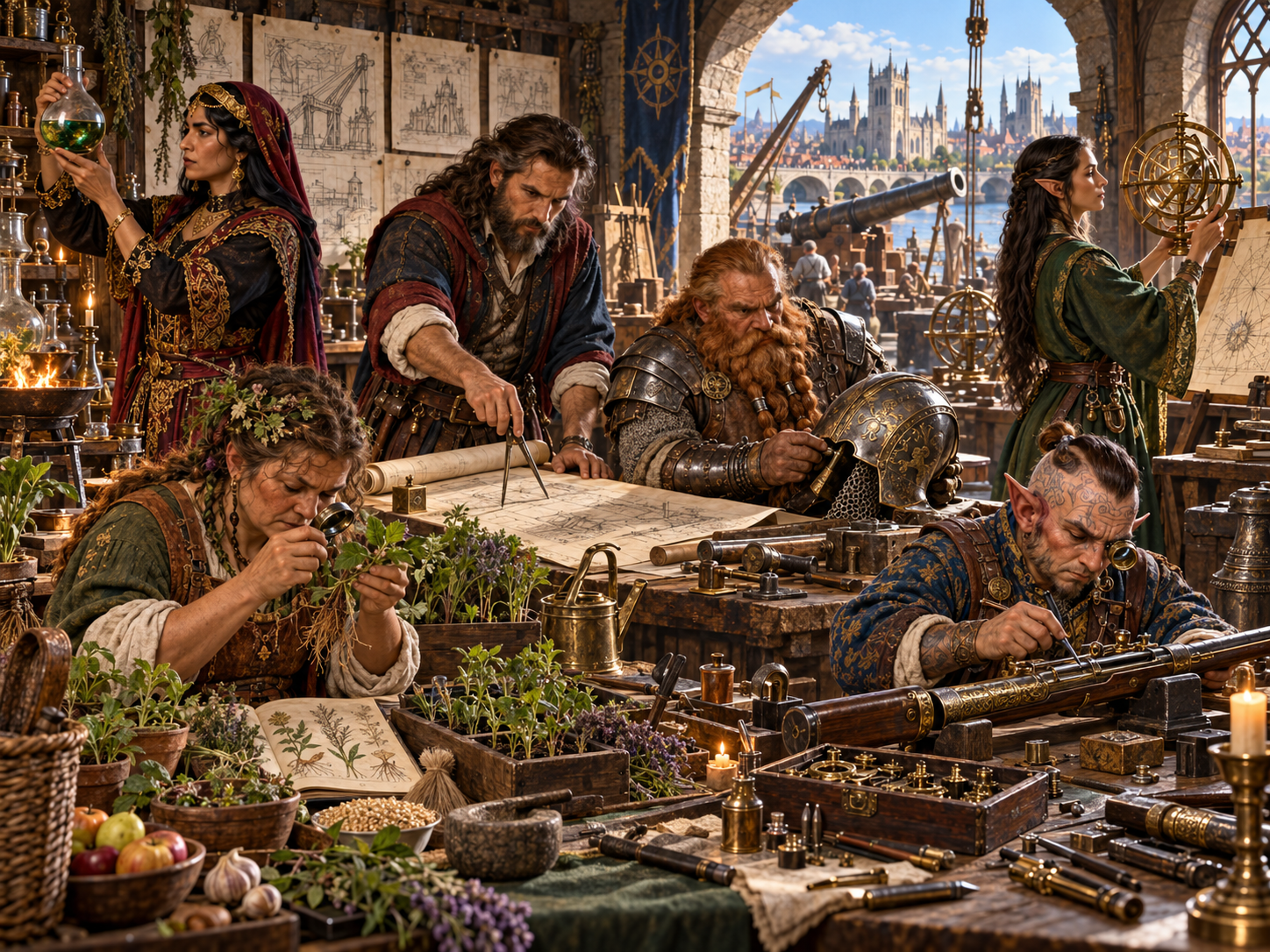
Sample Human Artificers
Use these examples as ready-made character foundations, NPC concepts or starting points for your own Artificer.
1. Byzantine Siege Engineer
- Tradition
- Eastern Roman military engineering, inherited siege manuals and Constantinopolitan technical practice.
- Backgrounds
- Guild Artisan, Soldier, court engineer or military retainer.
- Primary Equipment
- Fire siphon apparatus, bolt thrower, measuring staff, composite bow or heavy crossbow.
- Protection
- Lamellar or mail with a practical helmet suited to work near walls and engines.
- Special Equipment
- Surveying dioptra, range tables, wax tablets, cord, plumb line and siege diagrams.
- Specialisation
- Bombardier or Cartographer.
- Possible Patrons
- Hephaestus or Athena.
2. Song-Dynasty Horologist
- Tradition
- Astronomical, hydraulic and clockmaking knowledge.
- Backgrounds
- Sage, court scholar, observatory technician or master clockmaker.
- Primary Equipment
- Armillary sphere, celestial globe, geared model, repeating crossbow or staff.
- Protection
- Practical clothing or ceremonial lamellar where appropriate.
- Special Equipment
- Precision gears, calibrated water vessels, star tables and chain-drive components.
- Specialisation
- Cartographer or Construct-Smith.
- Possible Patrons
- Jade Emperor or a local craft tradition.
3. French Trebuchet Master
- Tradition
- French and Burgundian siegecraft.
- Backgrounds
- Guild engineer, soldier, mercenary specialist or master carpenter.
- Primary Equipment
- Trebuchet rigging, pavises, crossbows, axes and demolition tools.
- Protection
- Brigandine or mail over a padded jack.
- Special Equipment
- Release hooks, throwing tables, rope gauges and wall-angle diagrams.
- Specialisation
- Bombardier.
- Possible Patrons
- Local craft gods, war gods or none.
4. English Market-Town Blacksmith
- Tradition
- Forge work, agricultural tools, locks, household ironwork and weapons.
- Backgrounds
- Guild Artisan, Folk Hero, travelling smith or village specialist.
- Primary Equipment
- Warhammer, axe, sword, tongs and forge hammers.
- Protection
- Mail, leather apron, padded clothing and an open helmet where needed.
- Special Equipment
- Portable bellows, travelling forge kit, punches, files, chisels and tempering tools.
- Specialisation
- Armourer or Construct-Smith.
- Possible Patrons
- Wayland the Smith or Brigid.
5. Italian Court Engineer
- Tradition
- Architecture, surveying, art, military design and experimental machinery.
- Backgrounds
- Sage, Guild Artisan, court retainer or artist-engineer.
- Primary Equipment
- Crossbow, hand cannon where available, drafting tools and experimental mechanisms.
- Protection
- Light brigandine or concealed mail.
- Special Equipment
- Drafting compass, scale ruler, casting moulds, perspective drawings and notebooks.
- Specialisation
- Construct-Smith, Cartographer or Bombardier.
- Possible Patrons
- Hermes, Athena or Ptah.
6. Muromachi Swordsmith
- Tradition
- Blade-making, metallurgy, polishing, heat treatment and armour craft.
- Backgrounds
- Guild Artisan, master-apprentice smith, martial retainer or travelling specialist.
- Primary Equipment
- Katana, wakizashi, tantō, forge hammer and finishing tools.
- Protection
- Lamellar armour or practical workshop clothing.
- Special Equipment
- Quenching trough, polishing stones, charcoal, clay mixtures and forging tools.
- Specialisation
- Armourer.
- Possible Patrons
- Amaterasu or Inari.
7. Ottoman Gunfounder and Siege Engineer
- Tradition
- Gunfounding, siege logistics, artillery mathematics and field engineering.
- Backgrounds
- Soldier, Guild Artisan, mercenary engineer or foundry specialist.
- Primary Equipment
- Bombards, hand cannons, swivel guns, powder measures and demolition charges.
- Protection
- Mail-and-plate or lighter armour suited to foundry and siege work.
- Special Equipment
- Powder gauges, shot moulds, measuring rods, foundry tools and siege carts.
- Specialisation
- Bombardier.
- Possible Patrons
- Tengri, older forge spirits or none.
8. Delhi Court Alchemist
- Tradition
- Court medicine, mineral chemistry, distillation, metallurgy, dyes, perfumes and compounds.
- Backgrounds
- Sage, court apothecary, physician, Guild Artisan or poison specialist.
- Primary Equipment
- Reagent flasks, smoke vessels, staff, dagger and portable laboratory gear.
- Protection
- Quilted coat or light mail where appropriate.
- Special Equipment
- Alembics, crucibles, mortar and pestle, scales, mineral samples and furnace tools.
- Specialisation
- Alchemist.
- Possible Patrons
- Shiva, Kubera or a secular natural-philosophical tradition.
9. Ming Gunpowder Technologist
- Tradition
- Military workshops, gunpowder, artillery, rockets, signalling and printed technical knowledge.
- Backgrounds
- Sage, military engineer, arsenal worker, Guild Artisan or imperial instructor.
- Primary Equipment
- Hand cannon, fire lance, rockets, fire arrows and signalling charges.
- Protection
- Lamellar armour when attached to military formations.
- Special Equipment
- Powder recipes, moulds, measuring spoons, block-printed diagrams and fuse-making equipment.
- Specialisation
- Bombardier or Cartographer.
- Possible Patrons
- Lu Ban, Zao Jun or another appropriate Chinese craft tradition.
10. Mali Smith and Metallurgist
- Tradition
- West African ironworking, tools, weapons, charcoal furnaces and specialist craft lineages.
- Backgrounds
- Guild Artisan, community smith, Folk Hero, military armourer or hereditary specialist.
- Primary Equipment
- Spear, axe, sword, hammer and forge tools.
- Protection
- Layered cloth, leather or locally appropriate armour.
- Special Equipment
- Charcoal furnace equipment, bellows, tongs, ore samples and maker’s tools.
- Specialisation
- Armourer or Construct-Smith.
- Possible Patrons
- Ogun or a local craft power.
11. Mexica Warrior-Artisan
- Tradition
- Obsidian working, featherwork, woodcraft, weapons manufacture, causeway engineering and urban craft production.
- Backgrounds
- Artisan, Soldier, noble retainer or temple-associated specialist.
- Primary Equipment
- Macuahuitl, atlatl, bow and obsidian-edged tools.
- Protection
- Ichcahuipilli cotton armour and appropriate shields.
- Special Equipment
- Obsidian-knapping kit, pigments, codex plans, measurement cords and adhesives.
- Specialisation
- Armourer, Bombardier or Construct-Smith.
- Possible Patrons
- Quetzalcoatl or Tezcatlipoca.
12. Polynesian Wayfinder
- Tradition
- Navigation through stars, wave patterns, winds, birds, currents and inherited route knowledge.
- Backgrounds
- Sailor, Outlander, navigator, boat-builder or star reader.
- Primary Equipment
- Spear, club, knife and shipboard tools.
- Protection
- Woven protection suited to climate and seafaring.
- Special Equipment
- Star-compass teaching aids, shell or wood markers, cordage, route records and boat-repair tools.
- Specialisation
- Cartographer.
- Possible Patrons
- Tangaroa or appropriate local atua.
13. Itinerant Alchemist
- Tradition
- A travelling experimenter seeking patrons, ingredients and discoveries.
- Backgrounds
- Guild Artisan, Hermit, apothecary, physician or dubious compounder.
- Primary Equipment
- Staff, dagger, reagent flasks and improvised compound launchers.
- Protection
- Quilted coat, heavy gloves, apron and eye protection suited to sparks and splashes.
- Special Equipment
- Portable distillation kit, crucible, furnace, scales and notebooks.
- Specialisation
- Alchemist.
- Possible Patrons
- Hermes or another power of knowledge and transformation.
14. Court Savant
- Tradition
- A mathematical scholar and engineer retained by a court, prince or wealthy city.
- Backgrounds
- Noble retainer, Sage, Guild Artisan or master builder.
- Primary Equipment
- Crossbow, polearm, measuring staff, surveying tools and early firearm where available.
- Protection
- Brigandine, mail sleeves or concealed armour.
- Special Equipment
- Drafting compass, perspective frame, astrolabe, map case and coded design book.
- Specialisation
- Cartographer or Bombardier.
- Possible Patrons
- Athena or Hermes.
15. Central European Clay-and-Stone Construct-Smith
- Tradition
- Animated guardians made from clay, stone, wood and worked metal.
- Backgrounds
- Sage, mason, sculptor, Guild Artisan, Hermit or civic workshop keeper.
- Primary Equipment
- Staff, mason’s hammer, chisel, sling and engraved control tablets.
- Protection
- Layered work clothing, leather bracers or mail.
- Special Equipment
- Prepared clay, rare earths, moulds, geometric templates, engraving tools and pigments.
- Specialisation
- Construct-Smith.
- Possible Patrons
- No patron is required; the tradition may be guild-based, philosophical, civic or inherited.
Non-Human Artificers
Artifice is learned. A character’s homeland, apprenticeship, profession and interests matter more than species. The following traditions are common starting points, not restrictions.
Dwarf Artificer
Dwarven Artificers come from mines, cities, holds, craft enclaves, guilds, warden networks and travelling families.
- Common Backgrounds
- Guild Artisan, miner, assayer, armourer, military engineer, warden or travelling smith.
- Strong Traditions
- Metallurgy, mining, stonework, armour, locks, structural engineering and durable mechanisms.
- Typical Arms
- Hammer, axe, crossbow, mining tools or locally adopted firearms.
- Special Equipment
- Assaying kit, portable anvil, rune punches, measuring tools and mining equipment.
- Natural Specialisations
- Armourer, Construct-Smith or Bombardier.
- Possible Patrons
- Hephaestus, Wayland or another forge power; no patron is required.
Elf Artificer
Elven Artificers in Britain and Scandinavia often work with fine materials, astronomical observation, subtle enchantment, wood, metal and glass.
- Common Backgrounds
- Sage, woodland craftworker, court artisan, navigator or specialist attached to an old estate or hidden settlement.
- Strong Traditions
- Fine woodworking, astronomical instruments, subtle enchantment, archery equipment and carefully balanced mechanisms.
- Typical Arms
- Bow, sword, spear, knife or tools adapted to local custom.
- Special Equipment
- Woodcarving tools, engraving tools, lenses, star charts and precision measuring devices.
- Natural Specialisations
- Cartographer, Alchemist or Construct-Smith.
- Possible Patrons
- Flidais, Brigid or another regional power.
Gnome Artificer
Gnome Artificers are often associated with precision craft, but they are not comic tinker stereotypes. Their workshops may be among the most technically daring in the world.
Fields include gunsmithing, optics, engraving, compact mechanisms, pigments, measuring instruments, metallurgy and alchemy.
- Common Backgrounds
- Gunsmith, instrument maker, engraver, Guild Artisan, exile, alchemist, surveyor or travelling specialist.
- Strong Traditions
- Precision mechanics, firearms, optics, compact devices, measuring instruments and experimental materials.
- Typical Arms
- Crossbow, firearm where available, short blade or workshop implement.
- Special Equipment
- Precision gauges, lenses, engraving tools, powder measures, fine files and custom instruments.
- Natural Specialisations
- Bombardier, Cartographer, Alchemist or Construct-Smith.
- Possible Patrons
- Hermes or another craft or knowledge power.
Halfling Artificer
Halfling Artificers come from a wide range of settled, travelling, riverine, agricultural, forest, island and caravan traditions.
Many families descended from communities once forced into agricultural labour along the Nile became famous for horticultural knowledge. Their expertise in irrigated gardens, orchards, vineyards, seed beds and medicinal plots travelled west and became influential in communities including the English Cotswolds, the South Downs and the Upper Rhine.
Other halfling traditions developed independently in South and Southeast Asia, Sundaland, Wallacea, New Guinea, parts of the western Pacific, Central Asian uplands and the Americas.
A halfling Artificer may therefore be a horticultural experimenter, irrigation designer, seed keeper, boat-builder, mill mechanic, wagon repairer, apothecary or navigator.
- Common Backgrounds
- Horticulturist, gardener, herbalist, caravan repairer, river worker, seed keeper, brewer, boat-builder or village engineer.
- Strong Traditions
- Irrigation, grafting, soil improvement, seed selection, medicinal plants, food preservation, portable tools and practical repairs.
- Typical Arms
- Sling, bow, knife, staff or another locally appropriate weapon.
- Special Equipment
- Grafting knives, seed cases, soil samples, irrigation gauges, pruning tools, botanical notebooks, drying racks and portable alchemical equipment.
- Natural Specialisations
- Alchemist, Cartographer or Construct-Smith.
- Possible Patrons
- Hestia, Brigid or a regional agricultural or household power.
Half-Orc Artificer
Half-Orc Artificers may come from orcish successor states, frontier markets, mercenary companies, captured workshops, caravan routes or mixed settlements.
- Common Backgrounds
- Armourer, mercenary engineer, caravan smith, military quartermaster, exile or frontier craftworker.
- Strong Traditions
- Heavy equipment, armour, siege repair, battlefield improvisation, saddlery and durable field construction.
- Typical Arms
- Axe, spear, bow, hammer or weapons appropriate to homeland and military service.
- Special Equipment
- Portable forge tools, armour rivets, harness-repair gear, measuring cords and field repair kits.
- Natural Specialisations
- Armourer, Bombardier or Construct-Smith.
- Possible Patrons
- Tengri, regional forge powers or none.
Dragonborn Artificer
Dragonborn Artificers develop according to the communities, lineages and polities in which they are trained rather than following a single species-wide craft tradition.
- Common Backgrounds
- Guild Artisan, military engineer, noble specialist, scholar, weaponsmith or diplomatic retainer.
- Strong Traditions
- Heat-resistant materials, armour, metallurgy, ceremonial craft, large instruments and elemental experimentation.
- Typical Arms
- Spear, sword, polearm, crossbow or locally appropriate firearm.
- Special Equipment
- Heat-resistant crucibles, heavy engraving tools, seals, scale templates and reinforced laboratory gear.
- Natural Specialisations
- Armourer, Bombardier or Alchemist.
- Possible Patrons
- Depends on homeland, lineage and personal allegiance.
Tiefling Artificer
Tiefling Artificers may be especially familiar with dangerous materials, infernal metals, seals, cursed mechanisms and objects from other planes, but no infernal allegiance is assumed.
- Common Backgrounds
- Guild Artisan, alchemist, metallurgist, occult investigator, armourer, scholar or urban engineer.
- Strong Traditions
- Planar materials, heat-resistant alloys, alchemy, seals, wards and identification of dangerous objects.
- Typical Arms
- Crossbow, blade, hammer, staff or another locally appropriate weapon.
- Special Equipment
- Silvered tools, protective tongs, warding materials, mineral samples and sealed reagent vessels.
- Natural Specialisations
- Alchemist, Armourer or Construct-Smith.
- Possible Patrons
- Entirely dependent on the individual character.
Artificer Concepts
| Concept | Former Occupation | Useful Tools | Likely Specialisation |
|---|---|---|---|
| City Locksmith | Guild locksmith or security maker | Thieves’ Tools, smithing tools | Armourer or Construct-Smith |
| Campaign Engineer | Siege train engineer | Carpenter’s, mason’s and smithing tools | Bombardier |
| Field Apothecary | Healer, compounder or poison examiner | Alchemist’s supplies, Surgeon’s Tools | Alchemist |
| Mine Engineer | Surveyor, assayer or mine mechanic | Mason’s tools, measuring gear | Cartographer or Bombardier |
| Travelling Repairer | Wagon, mill or household repair specialist | Tools & Kits | Construct-Smith |
| Gunfounder’s Apprentice | Cannon foundry or gunsmith workshop | Smithing tools, measuring instruments | Bombardier |
| Instrument Maker | Clockmaker, engraver or astronomical instrument maker | Jeweller’s and fine metalworking tools | Cartographer |
| Armour Workshop Veteran | Plate-armour maker and fitter | Smithing and leatherworking tools | Armourer |
| Horticultural Artificer | Seed keeper, orchard worker, irrigation specialist or medicinal gardener | Herbalism, grafting, measuring and alchemical tools | Alchemist or Cartographer |
Magic Items and Crafting
Artificer class features do not automatically bypass the permanent magic-item creation rules of the edition being played.
Device Designs are temporary class features. Permanent enchanted objects follow the normal costs, prerequisites, downtime and creation rules.
Use Magic Items: Basics, Identification & Creation for permanent crafting and Magic Item Descriptions for recovered enchanted objects.
Identify is useful to an Artificer, but it does not replace investigation, engineering judgement, provenance, historical research or mundane examination.
Related Artifice, Craft and Magic
Follow the Artificer’s wider craft network through Creating Magic Items, the Portable Artificer’s Lab, Alchemical Items, Firearms, the Magic reference, the Artifice Domain, and the clockwork cosmology of the Great Mechanism.
For character and cultural inspiration, see Leonardo da Vinci, Tycho Brahe, Gnomes, Elves and the wider Player Resources hub.
Historical and Mythic Context
Engineering and Invention
Artificer-style characters can draw inspiration from real military engineers, metallurgists, armourers, alchemists, builders, physicians, navigators and instrument makers.
Konrad Kyeser’s Bellifortis contains artillery, rockets, portable bridges, siege machinery, mills, ships, incendiaries and other technical designs.
Library of Congress — Bellifortis (Strong in War)
Alchemy
Historical alchemy provides strong inspiration for laboratory Artificers: distillation, minerals, metals, medicines, dyes, furnaces, compounds and practical experimentation.
Science History Institute — Fifteenth-Century Alchemical Miscellany
Craft Gods and Legendary Makers
In a world where myth is real, Artificers may encounter surviving objects, workshops, techniques or traditions associated with supernatural makers.
Useful traditions include Hephaestus, Athena, Wayland the Smith, Brigid, Ptah and Hermes.
No Artificer is required to serve a god. Craft knowledge can be religious, philosophical, academic, military, commercial, guild-controlled, hereditary or personal.
Playing an Artificer
Look for problems that can be solved through preparation, knowledge and equipment. A broken mechanism can be a clue. A badly cast cannon can reveal its foundry. A strange alloy can point toward a mine. A lock can reveal the habits of its maker.
An Artificer also gives the party reasons to care about workshops, guild privileges, rare materials, stolen plans, specialist NPCs and access to skilled labour. Knowing how to build something does not mean the necessary furnace, lens grinder, bronze, timber or laboratory is immediately available.
Adventure Hooks
| d8 | Hook |
|---|---|
| 1 | A guild master’s new lock opens perfectly for everyone except the man who commissioned it. |
| 2 | A bombard bursts during proofing. The founder insists the bronze was deliberately adulterated. |
| 3 | A travelling Artificer disappears, leaving behind a mechanism that completes one new movement every midnight. |
| 4 | A mine’s survey maps show a tunnel that none of the miners remember digging. |
| 5 | A noble owns an enchanted device but refuses to permit Identify because he fears what its provenance will reveal. |
| 6 | A gnome gunsmith is accused of selling an advanced mechanism to both sides of a frontier war. |
| 7 | A centuries-old automaton resumes its work and begins dismantling a building erected over its workshop. |
| 8 | Someone has copied a guild master’s maker’s mark perfectly, including a magical flaw known only to three living people. |
Video — Medieval Alchemy
This Royal Society of Chemistry lecture by Peter Forshaw examines medieval alchemy and the intellectual world in which practical laboratory work, natural philosophy and magical ideas overlapped.
Artificer FAQ
Is this the official D&D Artificer class?
No. This page presents an original Artificer class compatible with several rules editions. It does not reproduce the separately published official Artificer class.
Why are there separate 5.5e and 5e tabs?
The 2024 and 2014 rules frameworks use different terminology, progression and supporting rules. Use the tab that matches your campaign.
Does an Artificer automatically gain firearm proficiency?
No. Firearm proficiency depends on training, homeland and the rules edition being used.
Are Device Designs permanent magic items?
No. They are temporary class features. Permanent items use the normal magic-item creation rules.
Can an Artificer sell temporary devices?
Not as permanent functioning magic items. Their magical operation ends according to the Device Design rules.
Does the class require clockwork or steampunk technology?
No. Devices may use metal, wood, leather, glass, parchment, stone, cord, alchemical materials or other appropriate media.
Can a nonhuman character become an Artificer?
Yes. Artifice is learned. Different peoples may have different craft traditions, but no specialisation is species-locked.
Can a halfling Artificer specialise in agriculture?
Yes. Irrigation, horticulture, grafting, seed selection, soil improvement, food preservation, medicinal plants and agricultural tools are all valid forms of practical artifice.
Can an Artificer make any magic item?
Only by following the permanent magic-item crafting rules for the edition in play. Device Designs do not bypass those requirements.
What ability score matters most?
Intelligence governs the class’s magic and many of its features. Constitution helps survival, while Dexterity or Strength depends on your chosen equipment and specialisation.
Where can an Artificer learn magic?
Guild apprenticeships, private masters, universities, court scholars, military engineers, civic workshops, specialist households and independent magical circles are all suitable.
Sources, Attribution and Licensing
Historical Sources
Library of Congress — Bellifortis (Strong in War). Konrad Kyeser’s illustrated manual of military technology, including artillery, rockets, bridges, siege machines, ships and related devices.
Science History Institute — Fifteenth-Century Alchemical Miscellany. A northern Italian manuscript containing practical and theoretical alchemical material and illustrations of laboratory apparatus.
Science History Institute — Fire and Gold: The Art of Alchemy. Historical context for alchemical work with metals, minerals, medicines, heat and distillation.
SpiralWorlds Setting Material
The campaign integration, Artificer traditions, Real-World Inspirations commentary, Sample Human Artificers, Non-Human Artificers, adventure hooks, original class features, Device Designs, specialisations, editorial presentation, CSS and artwork are SpiralWorlds material.
Artwork
Artificer class hero illustration, SpiralWorlds, 2026: spiralworlds-artificer-class-1454.png.
Artificer traditions illustration, SpiralWorlds, 2026: spiralworlds-artificer-traditions-1454.png.
SRD 5.2.1 Attribution
This work includes material from the System Reference Document 5.2.1 (“SRD 5.2.1”) by Wizards of the Coast LLC. The SRD 5.2.1 is licensed under the Creative Commons Attribution 4.0 International License.
The Artificer class published separately by Wizards of the Coast is not included in SRD 5.2.1 and is not reproduced here. The class progression, Device Designs, specialisations and setting implementation on this page are original material.
SRD 5.1 Attribution
Compatible 2014-era rules terminology is based on the System Reference Document 5.1 by Wizards of the Coast LLC, licensed under the Creative Commons Attribution 4.0 International License.
Legacy Open Game Content
Mechanical rules material inside the Pathfinder 1e and D&D 3.5e mechanics panels is designated Open Game Content only to the extent that it derives from material already released as Open Game Content under the Open Game License version 1.0a.
No other portion of this page is designated Open Game Content. SpiralWorlds setting material, campaign material, original explanatory prose, original class features, artwork, CSS, page design, adventure material and editorial presentation are excluded from that designation.
Open Game License v1.0a + Applicable Section 15 Notices
OPEN GAME LICENSE Version 1.0a
The following text is the property of Wizards of the Coast, Inc. and is Copyright 2000 Wizards of the Coast, Inc (“Wizards”). All Rights Reserved.
1. Definitions: (a) “Contributors” means the copyright and/or trademark owners who have contributed Open Game Content; (b) “Derivative Material” means copyrighted material including derivative works and translations (including into other computer languages), potation, modification, correction, addition, extension, upgrade, improvement, compilation, abridgment or other form in which an existing work may be recast, transformed or adapted; (c) “Distribute” means to reproduce, license, rent, lease, sell, broadcast, publicly display, transmit or otherwise distribute; (d) “Open Game Content” means the game mechanic and includes the methods, procedures, processes and routines to the extent such content does not embody the Product Identity and is an enhancement over the prior art and any additional content clearly identified as Open Game Content by the Contributor, and means any work covered by this License, including translations and derivative works under copyright law, but specifically excludes Product Identity; (e) “Product Identity” means product and product line names, logos and identifying marks including trade dress; artifacts; creatures characters; stories, storylines, plots, thematic elements, dialogue, incidents, language, artwork, symbols, designs, depictions, likenesses, formats, poses, concepts, themes and graphic, photographic and other visual or audio representations; names and descriptions of characters, spells, enchantments, personalities, teams, personas, likenesses and special abilities; places, locations, environments, creatures, equipment, magical or supernatural abilities or effects, logos, symbols, or graphic designs; and any other trademark or registered trademark clearly identified as Product identity by the owner of the Product Identity, and which specifically excludes the Open Game Content; (f) “Trademark” means the logos, names, mark, sign, motto, designs that are used by a Contributor to identify itself or its products or the associated products contributed to the Open Game License by the Contributor; (g) “Use”, “Used” or “Using” means to use, Distribute, copy, edit, format, modify, translate and otherwise create Derivative Material of Open Game Content; (h) “You” or “Your” means the licensee in terms of this agreement.
2. The License: This License applies to any Open Game Content that contains a notice indicating that the Open Game Content may only be Used under and in terms of this License. You must affix such a notice to any Open Game Content that you Use. No terms may be added to or subtracted from this License except as described by the License itself. No other terms or conditions may be applied to any Open Game Content distributed using this License.
3. Offer and Acceptance: By Using the Open Game Content You indicate Your acceptance of the terms of this License.
4. Grant and Consideration: In consideration for agreeing to use this License, the Contributors grant You a perpetual, worldwide, royalty-free, non-exclusive license with the exact terms of this License to Use the Open Game Content.
5. Representation of Authority to Contribute: If You are contributing original material as Open Game Content, You represent that Your Contributions are Your original creation and/or You have sufficient rights to grant the rights conveyed by this License.
6. Notice of License Copyright: You must update the COPYRIGHT NOTICE portion of this License to include the exact text of the COPYRIGHT NOTICE of any Open Game Content You are copying, modifying or distributing, and You must add the title, the copyright date, and the copyright holder’s name to the COPYRIGHT NOTICE of any original Open Game Content you Distribute.
7. Use of Product Identity: You agree not to Use any Product Identity, including as an indication as to compatibility, except as expressly licensed in another, independent Agreement with the owner of each element of that Product Identity.
You agree not to indicate compatibility or co-adaptability with any Trademark or Registered Trademark in conjunction with a work containing Open Game Content except as expressly licensed in another, independent Agreement with the owner of such Trademark or Registered Trademark. The use of any Product Identity in Open Game Content does not constitute a challenge to the ownership of that Product Identity.
The owner of any Product Identity used in Open Game Content shall retain all rights, title and interest in and to that Product Identity.
8. Identification: If you distribute Open Game Content You must clearly indicate which portions of the work that you are distributing are Open Game Content.
9. Updating the License: Wizards or its designated Agents may publish updated versions of this License. You may use any authorized version of this License to copy, modify and distribute any Open Game Content originally distributed under any version of this License.
10. Copy of this License: You MUST include a copy of this License with every copy of the Open Game Content You Distribute.
11. Use of Contributor Credits: You may not market or advertise the Open Game Content using the name of any Contributor unless You have written permission from the Contributor to do so.
12. Inability to Comply: If it is impossible for You to comply with the terms of this License with respect to some or all of the Open Game Content due to statute, judicial order, or governmental regulation then You may not Use any Open Game Material so affected.
13. Termination: This License will terminate automatically if You fail to comply with all terms herein and fail to cure such breach within 30 days of becoming aware of the breach. All sublicenses shall survive the termination of this License.
14. Reformation: If any provision of this License is held to be unenforceable, such provision shall be reformed only to the extent necessary to make it enforceable.
15. COPYRIGHT NOTICE
Open Game License v 1.0a Copyright 2000, Wizards of the Coast, Inc.
System Reference Document. Copyright 2000, Wizards of the Coast, Inc.; Authors Jonathan Tweet, Monte Cook, Skip Williams, based on material by E. Gary Gygax and Dave Arneson.
Pathfinder Roleplaying Game Reference Document. © 2011, Paizo Publishing, LLC; Author: Paizo Publishing, LLC.
Pathfinder Roleplaying Game Core Rulebook. © 2009, Paizo Publishing, LLC; Author: Jason Bulmahn, based on material by Jonathan Tweet, Monte Cook, and Skip Williams.
Pathfinder Roleplaying Game Bestiary. © 2009, Paizo Publishing, LLC; Author: Jason Bulmahn, based on material by Jonathan Tweet, Monte Cook, and Skip Williams.
END OF LICENSE
Keep this reference growing
If this page helped with your reading or game, you can support its upkeep or explore the curated books.
Explore the Bookshop — epics, classics and stories behind imagined worlds.