
Eon XLV — The Age of Severed Crowns
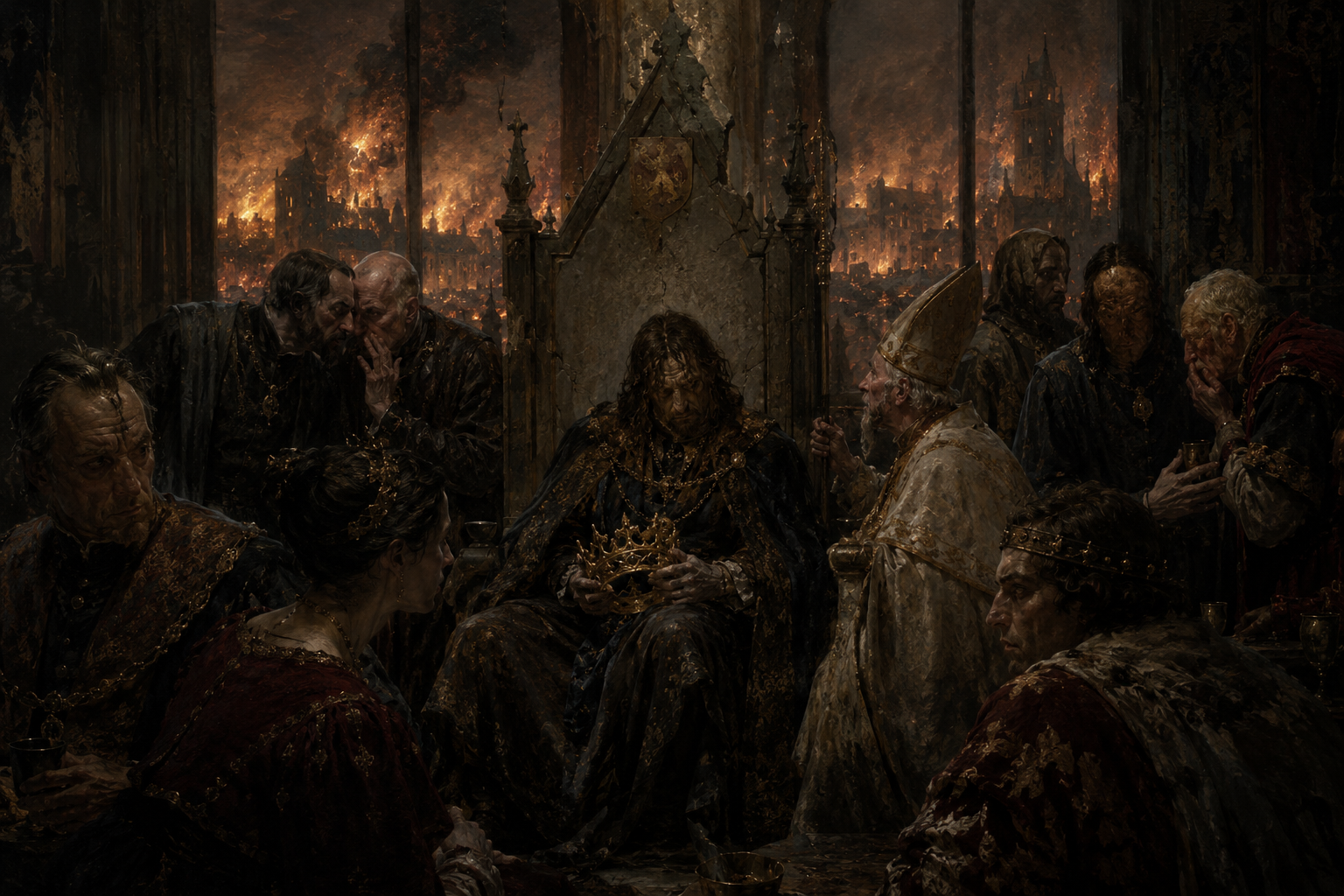
Steppe Conquest, Plague and the Breaking of Inherited Rule
The Age of Severed Crowns begins when fortified kingdoms discover that walls, sacred titles and ancient bloodlines cannot withstand every conqueror. It ends in 1454 with Constantinople occupied, plague graves still guarded, artillery reshaping war and colonial towns advancing through the inhabited lands of North America.
Across four completed periods, the age follows the rise and division of Mhurak Stone-Blood’s Great Muster, the growing connection of distant political worlds, the Black Death and Red Death, conflicts over labour and inheritance, the expansion of artillery and printing, permanent Atlantic colonisation and the Ninefold Dominion’s seizure of Constantinople.
| Time frame | 1200–1454 CE |
|---|---|
| Previous age | The Wars of Dominion |
| Chronology | Four completed periods covering conquest, successor powers, plague, labour conflict, artillery, colonisation and the campaign present |
| Orc powers | The Great Muster, followed by the Eastern Fang Host, Ash-Standard Host, Red Fang Reach and Black Anvil Realm |
| Defining crises | Conquest, dynastic division, the Black Death, the Red Death, labour scarcity, artillery warfare, colonial expansion and the Ninefold occupation of Constantinople |
| Campaign threshold | The world of 1454 CE |
The Character of the Age
The Age of Severed Crowns follows The Wars of Dominion. Fortified lordships, dynastic kingdoms, trading cities, temple estates, sacred colleges and ancient courts enter the thirteenth century rich in authority and political memory. During the next two and a half centuries, every form of inherited rule is tested by conquest, epidemic disease, economic disruption, rebellion and new methods of war.
In 1206, Mhurak Stone-Blood compels rival orc tribes of the eastern grasslands to ride beneath the Great Muster. The Muster is a vast tribal confederation held together by Mhurak’s personal might, victories, reputation, rewards and readiness to destroy rivals. Chiefs retain their own tribes, households, customs, possessions and feuds, but Mhurak makes those divisions serve campaigns extending across northern China, Central Asia, Persia, the Rus lands and the approaches to Central Europe.
The Great Muster weakens when no successor can reproduce Mhurak’s command. Four rival powers emerge from its inheritance: the Eastern Fang Host, Ash-Standard Host, Red Fang Reach and Black Anvil Realm. Their territories contain clan-hosts, herding families, farming settlements, subject cities, artisans, merchants and competing chiefs. Their frontiers overlap, and allegiance shifts with kinship, fear, opportunity and victory.
The same roads, ports, markets, grain routes and military movements that enrich the connected world carry the Black Death across Central Eurasia, western Asia, North Africa and Europe. Its rare sister infection, the Red Death, creates isolated cases in which death, memory and burial fail to proceed normally. The greater transformation comes from the survivors, who contest wages, tenancy, movement, abandoned land, disputed inheritance and rulers who attempt to restore obligations from a vanished population.
During the later fourteenth century, the human conqueror Timur rises through territories fractured by the Red Fang Reach. He binds several Red Fang chiefs to a wider coalition through victory, calculated fear and the distribution of wealth. Human and half-orc commanders, Persian administrators, merchants, engineers and captured specialists also sustain his campaigns. The coalition’s strength depends upon Timur’s continued success, and its divisions return after his death.
Artillery changes the political value of walls. Bombards, mining, powder production, transport, engineering and credit become parts of the same military effort. European movable-type printing develops beside much older East Asian traditions of paper, woodblock printing and movable type, accelerating the circulation of law, propaganda, technical knowledge and magical diagrams.
The hobgoblin Ninefold Dominion expands through the Balkans and Anatolian frontier as a separate conquest power. Its armies combine disciplined assault, artillery, slavery, forced service and fortified occupation. In 1453, the Dominion commands the final siege of Constantinople and takes the imperial city for its own strategic and ideological purposes.
Across the Atlantic, earlier routes develop into permanent colonisation. English, Dutch, French and Norse settlements establish growing populations along the North American coast. Settler expansion then follows rivers, Indigenous paths and overland trails into fortified market towns, ferry settlements, mining districts, stock-raising communities, caravan depots and frontier forts. Some become small inland cities.
This expansion crosses inhabited Indigenous lands. Settlements survive through combinations of trade, treaty, alliance, kinship, intermarriage, tribute, coercion, land seizure and recurring war. Indigenous nations retain control of crossings, hunting grounds, food supplies, river access and regional alliances while epidemic disruption alters power without ending Indigenous government or military resistance.
North American gnome gunsmiths improve barrel-making, ignition, protected priming, powder handling and field repair. Their compact pistols and lighter shoulder guns remain expensive workshop products, but greater reliability makes them valuable to colonial militias, inland towns, caravan guards, traders, Indigenous allies and rival powers.
The Caribbean becomes a heavily colonised and contested political centre. Indigenous island powers, rival European and mixed settlements, maroon communities, escaped slaves, privateers, free ports and the Brethren of the Coast compete for land, labour, shipping, harbour access and freedom.
A global age: Mali, Great Zimbabwe, the Swahili coast, Kemet, Vijayanagara, the Bahmani state, Bengal, Majapahit, Ayutthaya, Melaka, Ming China, Ashikaga Japan, the Mexica Triple Alliance, expanding Inca Cuzco, Maya kingdoms, Mississippian societies, Aotearoa and Terra Australis follow histories shaped by their own rulers, communities, environments, gods and rivalries.
The World in 1200
At the beginning of the age, many powers later remembered through conquest or collapse still appear ancient, wealthy and capable of surviving any ordinary crisis.
Europe and the Mediterranean
- Constantinople remains the fortified capital of the Eastern Roman Empire, rich in palaces, workshops, archives, relics and accumulated ceremony.
- The Empire contains princes, cities, regional lords and layered jurisdictions beneath an elective imperial crown.
- Western armies, Venetian wealth and Roman dynastic rivalry are already drawing danger towards Constantinople.
- Catfolk Kemet governs the Nile through ancient cities, temple lands, ports and military traditions.
Asia
- Song China remains one of Earth’s wealthiest and most technically accomplished states while Jin and Western Xia command powerful northern kingdoms.
- The eastern grasslands contain rival orc tribes competing over herds, pasture, water, marriage, vengeance and prestige.
- Delhi is becoming a northern Indian centre while Rajput, Bengali, Himalayan and southern powers retain independent authority.
- Angkor, Pagan, Singhasari and other Southeast Asian states command distinct river, agricultural and maritime worlds.
- Kamakura warrior rule grows in Japan beside the imperial court, provincial families and Shinto shrine networks.
Africa and the Indian Ocean
- Manding communities, Sosso power and trans-Saharan exchange prepare the conditions from which Mali will rise.
- Great Zimbabwe is developing into a major inland centre of cattle wealth, gold, craft, ceremony and exchange with the Swahili coast.
- Nile, Sahelian, highland, forest, savanna and coastal powers pursue separate political histories across the continent.
The Americas and Pacific
- Cahokia is contracting while Mississippian towns, mound centres and river networks remain active.
- Maya courts and Chimú power continue through cities, dynasties, markets, irrigation and warfare.
- Norse Greenland and Vinland preserve permanent northern Atlantic communities and sea routes.
- Polynesian voyagers are establishing permanent communities in Aotearoa.
- The Caribbean remains governed primarily by Indigenous island societies and maritime powers.
Mhurak has yet to gather the Great Muster. The Black Death and Red Death have yet to transform society. European artillery and mechanical printing remain developing technologies, and Constantinople’s ancient protections still recognise an emperor seated within the city.
Four Periods of the Age
The complete chronology is divided across four finished period pages. Each period develops a distinct transformation while carrying forward the political, social and supernatural consequences of the one before it.
Crowns Broken by Conquest
Constantinople is sacked by western invaders, Mhurak Stone-Blood raises the Great Muster and conquest overturns kingdoms across northern and central Eurasia. The period also follows the rise of Mali, the growth of Great Zimbabwe, the consolidation of Delhi, political change across Southeast Asia, continuing American histories and Polynesian settlement in Aotearoa.
- The War of the Broken Eagles and the sack of Constantinople
- Mhurak Stone-Blood’s unification of the orc tribes
- The northern, western and river campaigns of the Great Muster
- Mali, Great Zimbabwe, Delhi, Singhasari and Kamakura Japan
- The Battle of the Hidden Springs and the defence of catfolk Kemet
Successor Empires and Connected Worlds
Mhurak’s former companions, heirs and rival chiefs gather tribes, families, settlements and conquered territories into four successor powers. Roman rule returns to Constantinople, Eastern Fang expeditions meet fierce resistance in Japan and Southeast Asia, Mali achieves international prestige and commercial connections carry wealth, warfare, famine and disease across great distances.
- The Eastern Fang Host, Ash-Standard Host, Red Fang Reach and Black Anvil Realm
- Japanese, Đại Việt, Champa and Javanese resistance
- Mansa Musa and Mali’s international wealth
- Majapahit, Vijayanagara, Tenochtitlan and new regional powers
- The plague lineage moving towards the Black Sea and Mediterranean
Plague, Labour and Broken Authority
The Black Death kills across connected regions of Eurasia and North Africa while the rare Red Death creates isolated cases of failed death. Labour scarcity, disputed inheritance, persecution and recurrent plague expose the weakness of inherited authority. Ming victory drives the Eastern Fang court from China’s imperial heartland, and human Timur begins exploiting divisions within the Red Fang Reach.
- The Black Death and the rare Red Death
- The dwarven Stone-Chains and mutual defence during persecution
- Wages, movement, land and inheritance after mass mortality
- The Ming restoration and Broken Dragon Standards
- Timur’s rise through divided Red Fang territories
Artillery, Colonies and Rival Powers
Workers, rulers and towns struggle over post-plague obligations while artillery transforms siege warfare. Timur’s coalition devastates regions held together by Red Fang alliances and settled military expertise. Atlantic colonies become permanent, western towns spread into the North American interior, gnome gunsmiths improve firearms, the Caribbean becomes a contested colonial sea and the Ninefold Dominion seizes Constantinople.
- The Peasants’ Revolt and continuing labour conflict
- Bombards, handguns, wagon warfare and professional siege crews
- Human Timur and his unstable Red Fang allies
- Established colonies, inland western towns and small cities
- Gnome firearms advances and the contested Caribbean
- The Ninefold siege and occupation of Constantinople
- John Hawkwood, born in 1400, founds the White Company in 1435 and continues commanding it in the campaign present
The Four Orc Successor Powers
Mhurak Stone-Blood leaves an immense conquered inheritance without leaving a ruler capable of commanding it whole. The four successor powers emerge gradually from competing clan-hosts, court households, subject cities, herding communities, conquered districts and ambitious chiefs.
Eastern Fang Host
The Eastern Fang Host conquers Southern Song and commands China’s imperial court while depending upon Chinese agriculture, cities, irrigation, administration and shipyards. Defeats in Japan, Đại Việt, Champa and Java expose divided command. Ming armies drive the court from China’s imperial heartland in 1368, after which rival Eastern Fang houses and northern chiefs preserve competing claims.
Ash-Standard Host
The Ash-Standard Host commands western grasslands, river strongholds, tributary relationships and scattered settlements. Plague, succession disputes and the ambitions of individual chiefs repeatedly alter its shape. Authority depends upon visible strength and regional bargains.
Red Fang Reach
The Red Fang Reach contains oasis cities, pasture, mountain districts, caravan routes and rival clan leaders. Timur rises through these divisions as a human conqueror, binding several Red Fang clan-hosts to his wider coalition through victory, fear and reward. His death releases chiefs and commanders to support rival heirs, return home or seize territories of their own.
Black Anvil Realm
The Black Anvil Realm holds mountain, foundry and urban centres across parts of Iran, Mesopotamia, the Caucasus and neighbouring uplands. Local dynasties and chiefs exploit every succession struggle. Plague, revolt and rivalry turn much of its strength towards holding contested lands.
By 1454, Eastern Fang, Ash-Standard, Red Fang and Black Anvil communities remain politically divided. Their chiefs, settlements, courts and war-hosts preserve memories of Mhurak’s victories while pursuing local power, survival, revenge and renewed expansion.
The World in 1454
By 1454, the Age of Severed Crowns has destroyed confidence that inherited title, ancient walls or sacred recognition can guarantee survival. Strong courts and fortified cities remain, but they share the world with rival dynasties, armed communities, colonial settlements, merchant powers, subject peoples and clan-hosts whose loyalties remain conditional.
Constantinople and the Mediterranean
- The Ninefold Dominion occupies Constantinople after commanding the siege of 1453.
- Roman inhabitants, law, archives, workshops, sacred memories and networks of loyalty survive within and beyond the occupied city.
- The conquest redirects refugees, trade, diplomacy and military planning across Europe, the Black Sea, Kemet and western Asia.
- Ottoman rulers remain a separate regional power with their own territories, armies and ambitions.
Europe after the Long Wars
- France emerges from the Hundred Years’ War strengthened by political recovery, finance, field armies and artillery.
- England retains dynastic claims while approaching a new struggle over royal succession.
- The Empire remains divided among princes, cities, leagues, regional laws and layered jurisdictions.
- Plague graves, abandoned holdings and disputed titles continue to shape law and memory.
- Sir John Hawkwood, born in 1400, commands the White Company he founded in 1435. His seasoned soldiers operate around Florence, seeking employers and carrying old military debts into a new peace.
The Orc Successors and Timur’s Aftermath
- Timur’s coalition has divided among relatives, commanders and Red Fang chiefs.
- The Eastern Fang Host survives beyond Ming China through rival northern houses and communities.
- Ash-Standard, Red Fang and Black Anvil chiefs preserve regional powers through unstable alliances.
- No single ruler possesses Mhurak Stone-Blood’s command over the tribes.
Asia, Africa and the Indian Ocean
- Ming China commands the imperial heartland while confronting powerful northern frontier enemies.
- Vijayanagara, the Bahmani state, Bengal, Majapahit, Ayutthaya and Melaka shape Asian political and commercial life.
- Mali remains influential as Songhai and Tuareg power grow across the western Sahel.
- Great Zimbabwe’s networks shift towards successor centres while Swahili city-states connect African producers and rulers to the Indian Ocean.
The Americas and Pacific
- The Mexica Triple Alliance expands through war, tribute, diplomacy and the power of Tenochtitlan.
- Inca Cuzco grows through conquest, negotiation, labour obligations and sacred kingship.
- Maya successor kingdoms and Mississippian societies remain active political worlds.
- Aotearoa and Terra Australis remain ancient lands governed by their own peoples.
The Atlantic Colonies and Western Towns
- North America contains established English, Dutch, French and Norse colonial populations.
- The six English colonies are Virginia, Massachusetts, New Hampshire, Maryland, Connecticut and Rhode Island.
- Dutch New Netherland, a Norse Delaware trading colony, Vinland, Greenland traditions and New France remain separate presences.
- Fortified market towns, river ports, mining settlements, ranching communities and caravan depots spread into the interior.
- Several coastal and inland settlements possess the markets, workshops and ambitions of small cities.
Indigenous Power and Colonial Conflict
- Settlements occupy inhabited Indigenous lands governed through distinct laws, alliances and territorial traditions.
- Trade, treaty, intermarriage and kinship coexist with coercion, epidemic disruption, land seizure and war.
- Indigenous nations control crossings, river access, food supplies, hunting grounds and the safest inland routes.
- Colonial governments claim more territory than they can reliably command.
Gnome Firearms and the Contested Caribbean
- Gnome workshops improve barrels, ignition, protected priming, powder handling and repairable lockwork.
- Production remains artisanal, expensive and unevenly distributed.
- The Caribbean contains rival settlements, Indigenous island powers, maroon communities, escaped slaves, free ports and privateers.
- The Brethren of the Coast operate as a loose coalition centred principally upon Tortuga and Port Royal.
The playable present: recent wars still have living veterans, refugees still carry keys to occupied homes, plague can return, artillery masters can be hired or murdered, colonial frontiers continue moving and every great victory has created new enemies.
The full events that create this campaign world appear in Artillery, Colonies and Rival Powers, 1381–1454 .
Lasting Changes
Sacred Kingship Becomes Conditional
Ancient bloodlines, coronation rites and divine recognition remain politically powerful, but conquest, captivity, deposition and the loss of a capital can break the authority built around them.
The Great Muster Becomes a Divided Inheritance
Mhurak’s personal command gives way to four successor worlds. Chiefs preserve memories and claims from the Great Muster while building power through regional alliances, settlements, clan-hosts and subject communities.
Plague Rewrites Society
Mass death changes wages, tenancy, movement, inheritance, burial law and the authority of surviving communities. The Red Death adds rare supernatural danger to a catastrophe driven principally by disease, ecology and human connection.
Labour Becomes Openly Political
Workers, tenants, craftspeople and towns challenge taxes, movement restrictions and inherited obligations. Governments learn that efforts to restore the old labour order can produce organised resistance.
Artillery Changes the Meaning of Walls
Fortifications retain military value, but survival increasingly depends upon guns, earthworks, engineers, powder, credit, transport and armies capable of relieving a siege.
Older Wards Enter New Manuscripts
During the fourteenth century, the rare Sigsand Manuscript compiles substantially older boundary wards, signs, diagrams and ritual procedures, including the Saaamaaa tradition. It does not invent magic or warding. By 1454 complete copies are rare, while excerpts, commentaries, derivative diagrams and disputed copies circulate among occult scholars and monster-hunters.
Weapons and Knowledge Travel Faster
Gnome firearms advances circulate through frontier alliances and rivalries, while printing expands the reproduction of law, propaganda, technical knowledge and magical forms.
Maritime Contact Becomes Colonisation
Permanent populations, locally born generations, land seizure, intermarriage, epidemic disruption and recurring war replace the older pattern of isolated voyages and temporary outposts.
Colonial Settlement Moves Inland
Coastal colonies no longer contain settler expansion. Fortified western towns, river ports and resource settlements spread through Indigenous lands, and several develop the markets and ambitions of small cities.
The Caribbean Becomes a Political Centre
Indigenous powers, colonial settlements, maroons, privateers, enslaved people, free sailors and rival governors make the islands central to Atlantic warfare, commerce and resistance.
Constantinople Becomes an Occupied Frontier Capital
The Ninefold conquest redirects trade, refugee movement, diplomacy, sacred claims and military planning across Europe, Kemet, the Black Sea and western Asia.
Historical and Mythic Context
The Age of Severed Crowns combines documented history, archaeology, oral tradition and later literary preservation with the maintained campaign chronology. Its historical frame includes the sack and restoration of Constantinople, thirteenth-century steppe conquest, Mali, Great Zimbabwe, Yuan and Ming China, the invasions of Japan, the Great Famine, the Black Death, the Hundred Years’ War, Majapahit, Vijayanagara, Ashikaga rule, Māori settlement, Mexica and Inca expansion, Atlantic navigation, gunpowder warfare, printing and the conquest of Constantinople.
Mhurak Stone-Blood, the Great Muster, the Eastern Fang Host, Ash-Standard Host, Red Fang Reach and Black Anvil Realm belong to the maintained chronology. Historical steppe chronology supplies part of their geographical background, while their rulers, tribal politics, cultures and overlapping territories follow the setting’s independent orc history.
Timur remains the human conqueror who rises through territories fractured by the Red Fang Reach and draws Red Fang clan-hosts into his wider coalition. Their allegiance depends upon Timur’s victories, rewards and coercive authority, and their divisions return when his personal command ends.
In 1453, the hobgoblin Ninefold Dominion commands the final siege of Constantinople and occupies the city. Mehmed II and the Ottoman state remain an independent regional power within the resulting struggle.
The Black Death remains an infectious pandemic shaped by animal reservoirs, ecology, warfare, commerce and human movement. The Red Death is a rare sister infection that adds one form of failed death to a world where vampires, revenants, mummies, wights, liches and other undead already possess ancient histories.
North America contains established colonies, inland western settlements, gnome firearms workshops, a contested Caribbean and the fifteenth-century Brethren of the Coast. Indigenous nations, island societies, gods, ancestors and territorial powers retain their own identities, governments and histories throughout that expansion.
Gods, spirits, outsiders and alien powers exploit mortal crises without replacing their material causes. Hauntings gather around abandoned burial grounds, devils corrupt contracts and institutions, demons exploit massacre, daemons profit from war and plague, and alien powers enter dreams and damaged places. Conquerors, rulers, merchants, soldiers and communities remain responsible for the choices that allow those forces to act.
Frequently Asked Questions
When does the Age of Severed Crowns take place?
The age covers 1200–1454 CE. Its final year is the active campaign present.
Who creates the Great Muster?
Mhurak Stone-Blood unites rival orc tribes in 1206. His personal might, victories, reputation, rewards and coercive authority hold the Great Muster together.
What are the four orc successor powers?
They are the Eastern Fang Host, Ash-Standard Host, Red Fang Reach and Black Anvil Realm. Each develops from Mhurak’s divided inheritance through overlapping tribes, settlements, subject rulers and rival leaders.
Who is Timur?
Timur is a human conqueror. He rises through lands fractured by the Red Fang Reach and recruits several Red Fang chiefs into a wider coalition through victory, fear and rewards. Their allegiance weakens rapidly after his death.
Who seizes Constantinople in 1453?
The hobgoblin Ninefold Dominion commands the final in-world siege and occupies Constantinople. The Ottoman state remains a separate neighbouring power.
How developed are the North American colonies by 1454?
They contain established English, Dutch, French and Norse populations, locally born generations, regular Atlantic shipping and permanent coastal towns. Settlement has also moved inland through fortified market towns, river ports, mining settlements, stock-raising communities, caravan depots and frontier forts. Some coastal and inland towns have become small cities.
How advanced are North American gnome firearms?
Gnome workshops improve barrel quality, ignition, protected priming, powder handling and field repair. Their weapons remain handmade, expensive and scarce, but advanced pieces circulate among settlers, traders, militias, Indigenous allies and rival powers.
What is the Caribbean like in 1454?
It is a heavily colonised and contested political world of Indigenous island societies, rival settlements, maroon communities, escaped slaves, privateers, free ports and the Brethren of the Coast. Tortuga and Port Royal are principal Brethren bases.
What are the four completed period pages?
Selected Historical and Archaeological References
The four period pages contain fuller source lists for individual events. These references provide starting points for the age as a whole.
Explore the Complete Age
Keep this reference growing
If this page helped with your reading or game, you can support its upkeep or explore the curated books.
Explore the Bookshop — epics, classics and stories behind imagined worlds.