
Studded Leather Armor
Studded leather is a light armour option for adventurers who favour agility over the bulk of metal harness. In the game rules it is tougher and more expensive than ordinary leather, but it does not automatically make the wearer clumsy or noisy in fifth edition. Pathfinder 1e and D&D 3.5e describe a +3 armour bonus instead, with a small skill-check penalty. Those mechanical differences are why the edition tabs matter.
Studded Leather at a Glance
- Form: a protective game-world garment of supple leather strengthened with close-set rivets or studs.
- Protection: a little more AC than ordinary leather in each edition, with a greater price and weight.
- Who uses it: scouts, thieves, skirmishers and adventurers wanting protection without heavy armour.
- Why it matters: fifth edition avoids a built-in Stealth penalty; Pathfinder/3.5e impose an armour-check penalty of −1 on certain skills.
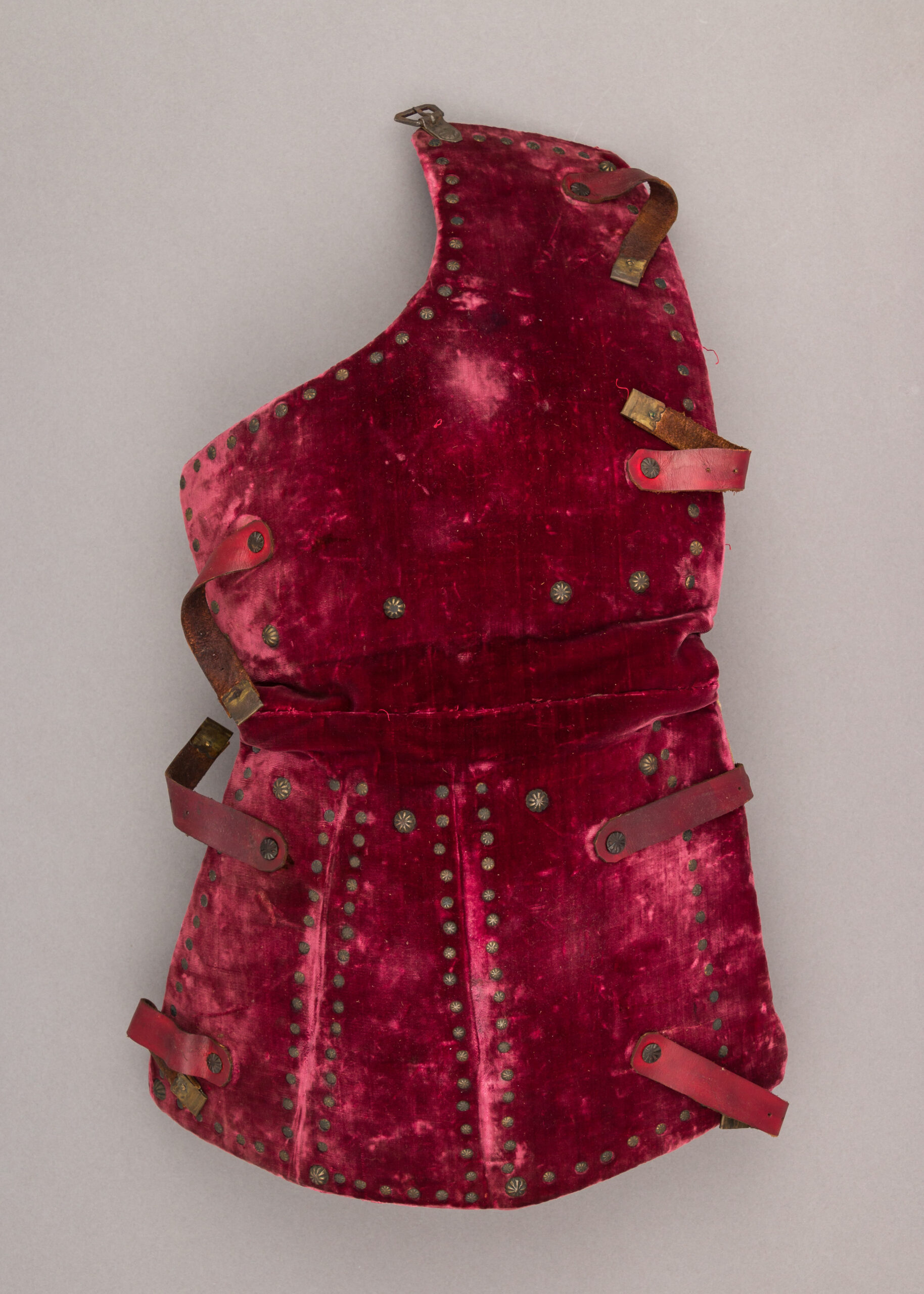
- Historical comparison: real brigandines expose rivet heads, but those rivets secure hidden metal plates; they are not proof of the fantasy item’s construction.
Four-edition statistics · At the table · Original Pathfinder reference
Studded Leather Rules by Edition
Use the actual equipment table of your edition: in fifth edition the armour sets a base AC formula, while the two legacy editions provide an additive armour bonus.
Studded Leather — D&D 2024
Category: Light Armor.
| Armor | Armor Class (AC) | Strength | Stealth | Weight | Cost |
|---|---|---|---|---|---|
| Studded Leather Armor | 12 + Dex modifier | — | — | 13 lb. | 45 GP |
Edition-specific rules: Light Armour Training. A character lacking training suffers the 2024 Strength/Dexterity D20 Test and spellcasting restrictions. It takes 1 minute to don or doff. Dexterity contributes its entire modifier; the armour has no inherent Stealth Disadvantage.
Source: D&D 2024 equipment.
Studded Leather — D&D 2014
Category: Light armor.
| Armor Name | Cost | Armor Class (AC) | Strength | Stealth | Weight |
|---|---|---|---|---|---|
| Studded leather | 45 gp | 12 + Dex modifier | — | — | 13 lb. |
Edition-specific rules: Light armour proficiency, with the 2014 penalties for lacking proficiency rather than the 2024 Training terminology. Don and doff each take 1 minute. There is no built-in Stealth Disadvantage.
Source: D&D 2014 equipment.
Studded Leather — Pathfinder 1e
Category: Light armor.
| Armor | Cost | Armor/Shield Bonus | Maximum Dex Bonus | Armor Check Penalty | Arcane Spell Failure Chance | Speed (30 ft.) | Speed (20 ft.) | Weight |
|---|---|---|---|---|---|---|---|---|
| Studded leather | 25 gp | +3 | +5 | −1 | 15% | 30 ft. | 20 ft. | 20 lb. |
Edition-specific rules: The +3 is an additive armour bonus to AC. Apply a maximum Dexterity bonus of +5 to AC, armour-check penalty −1 where that edition requires it, and the 15% arcane spell failure rule where applicable. Normal donning takes 1 minute; hasty donning 5 rounds.
Source: Pathfinder 1e equipment.
Studded Leather — D&D 3.5e
Category: Light armor.
| Armor | Cost | Armor/Shield Bonus | Maximum Dex Bonus | Armor Check Penalty | Arcane Spell Failure Chance | Speed (30 ft.) | Speed (20 ft.) | Weight |
|---|---|---|---|---|---|---|---|---|
| Studded leather | 25 gp | +3 | +5 | −1 | 15% | 30 ft. | 20 ft. | 20 lb. |
Edition-specific rules: The +3 is an armour bonus, not a fifth-edition AC calculation. Check 3.5e armour proficiency, the named skills affected by its −1 check penalty, arcane spell failure and 1-minute donning (or 5 rounds hastily).
Source: D&D 3.5e equipment.
Studded Leather in Play
Past the sentries. A scout needs to circle a sleeping camp without waking its guards. In D&D 2014 and 2024, neither leather nor studded leather imposes automatic Stealth Disadvantage, so the scout chooses the stronger armour if money and weight permit. In Pathfinder 1e or D&D 3.5e, studded leather’s −1 armour-check penalty can affect the relevant skill; plain leather has no such penalty. The GM still considers the ground, light, footwear and other conditions.
When the fastenings fail: armour that hangs loose can snag underbrush or rub a shoulder raw. A leatherworker or armourer can tighten straps and replace damaged fasteners. Treat this as a meaningful equipment and repair problem, not an automatic new numerical penalty unless your chosen rules provide one.
Rivets, Leather and Brigandine
The name studded leather describes an RPG convention more than a single standard medieval harness. Riveted armour certainly existed, but the heads of rivets often show where small metal plates were attached inside a textile or leather cover. This is how a brigandine works. Scattered decorative studs alone do not reproduce the protective effect of a concealed plate defence.
The surviving Italian brigandine pictured above provides a real late-medieval comparison, not an authentic photograph of the fantasy item. A GM can use the printed armour statistics without pretending that brigandine, leather jerkin and studded leather are historically identical. Compare Leather Armor for the lighter alternative and Chain Shirt for a metal-ring defence.
Original Video References
Both videos from the previous page are retained as optional further viewing. Their publication and playback have not been independently verified.
Show the two original equipment videos
Original Pathfinder 1e Reference
The original Pathfinder listing is preserved in a clean source table. It is light armour: 25 gp, +3 bonus to AC, maximum Dexterity bonus +5, armour-check penalty −1, arcane spell failure 15%, and 20 lb. weight. Its values are not fifth-edition AC formulas.
Show the preserved Pathfinder 1e table
| Armor | Cost | Armor/Shield Bonus | Maximum Dex Bonus | Armor Check Penalty | Arcane Spell Failure Chance | Speed (30 ft.) | Speed (20 ft.) | Weight |
|---|---|---|---|---|---|---|---|---|
| Studded leather | 25 gp | +3 | +5 | −1 | 15% | 30 ft. | 20 ft. | 20 lb. |
Source: Pathfinder Roleplaying Game Core Rulebook equipment. The original page noted that the armour is reinforced with small metal studs.
Related Equipment and Sources
Armour & Shields · Leather Armor · Quilted Cloth · Chain Shirt. Sources: D&D 2024, D&D 2014, Pathfinder 1e, and D&D 3.5e.
Rules Credits
Original Pathfinder data: Pathfinder Roleplaying Game Core Rulebook, Copyright 2009, Paizo Publishing, LLC, author Jason Bulmahn, based on material by Jonathan Tweet, Monte Cook and Skip Williams. Legacy System Reference Document, Copyright 2000, Wizards of the Coast, Inc.; Open Game License v1.0a, Copyright 2000, Wizards of the Coast, Inc.; OGL v1.0a text. Fifth-edition SRD material is credited to Wizards of the Coast LLC under CC BY 4.0. The Met brigandine image is public domain. Full legal licence-chain verification remains a separate check.
Keep this reference growing
If this page helped with your reading or game, you can support its upkeep or explore the curated books.
Explore the Bookshop — epics, classics and stories behind imagined worlds.