
SpiralWorlds Bestiary · Humanoid
Catfolk
One ancient people, many lineages, many cultures
Catfolk are an ancient feline humanoid people whose history reaches deep into the elder ages of Earth. Their greatest known surviving civilisation is Kemet upon the Nile, where they are widely called the Children of Bast, but Catfolk populations survive throughout distant continents, forests, jungles, mountains, islands, savannas and forgotten refuges.
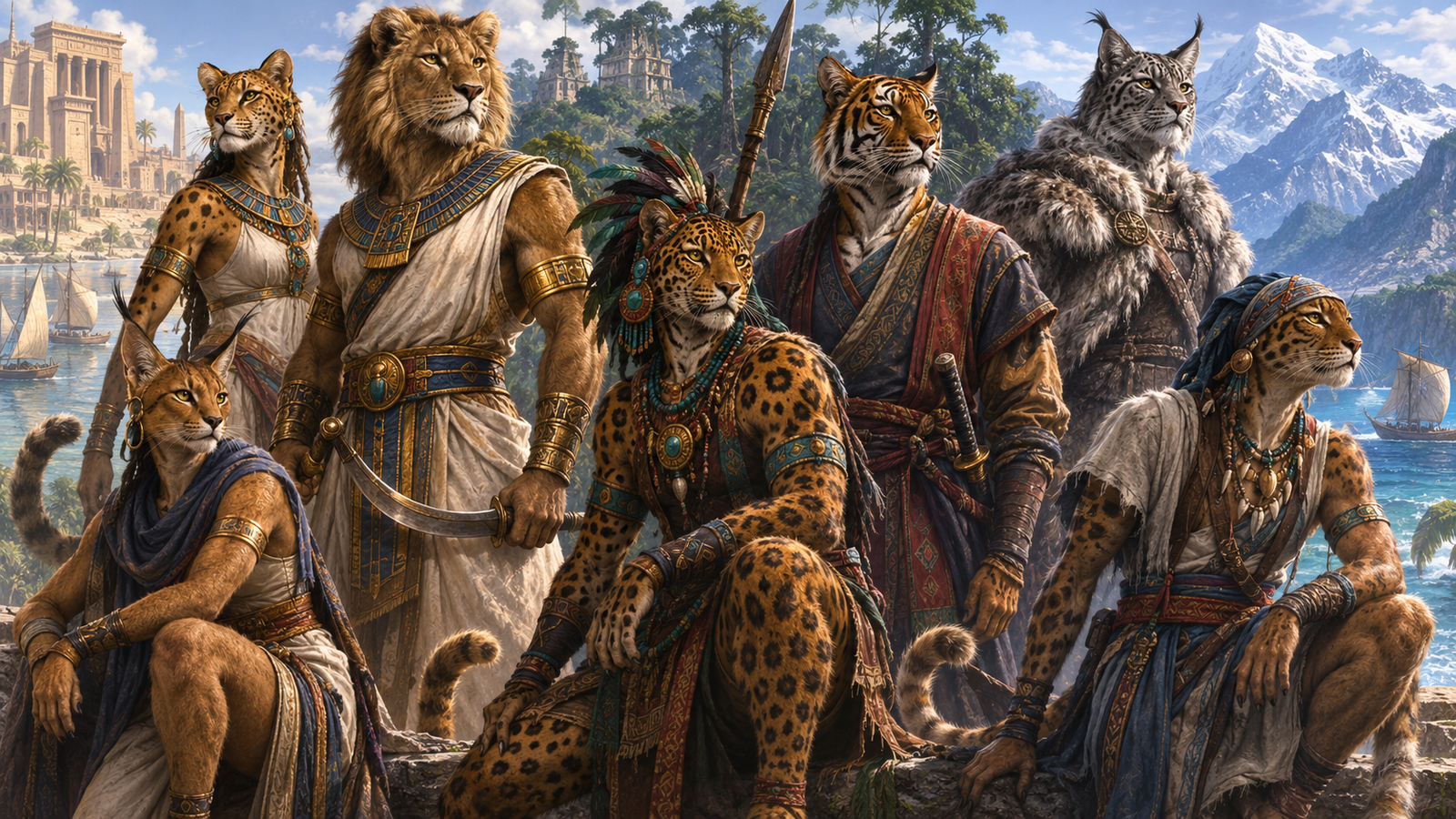
Catfolk Peoples and Traditions
Catfolk do not form a single worldwide culture. Ancient migration, isolation, climate, warfare, trade and the fall of old realms have produced many different societies.
Kemetite Catfolk
The people of the Nile cities, temples, estates, ports, villages and military war-prides.
Common lineages: lion, leopard, cheetah, serval, caracal and wildcat.
Traditions: Bastite temples, khopesh, spear, bow, Nile agriculture, commerce and organised war-pride warfare.
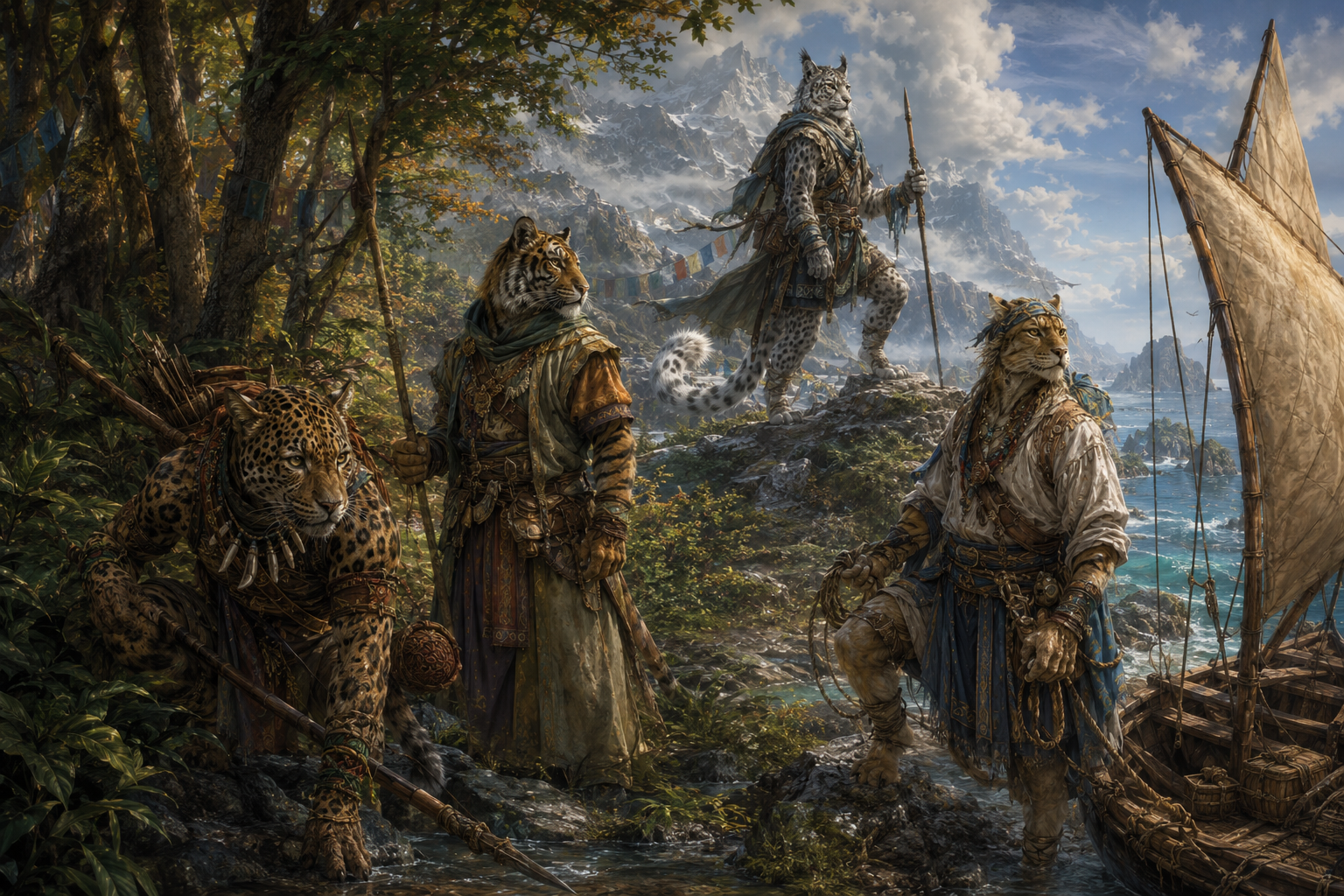
American Forest Catfolk
Ancient forest and upland populations of the Americas, some isolated from other Catfolk for immense spans of time.
Common lineages: jaguar, puma, ocelot, margay and other American cats.
Traditions: jungle travel, climbing, stalking, ambush, regional weapons and local faiths.
Eastern Woodland Catfolk
Forest, river and upland societies of Asia, including populations that developed far beyond Kemetite influence.
Common lineages: tiger, leopard, clouded leopard and other eastern cats.
Traditions: woodland scouting, regional martial cultures, hunting and forest survival.
Highland Catfolk
Mountain and cold-upland peoples occupying valleys, cliffs, high forests and inaccessible refuges.
Common lineages: lynx, snow leopard, puma and other mountain cats.
Traditions: climbing, scouting, missile warfare and defence of narrow approaches.
Island and Coastal Catfolk
Maritime peoples of remote islands, coastal enclaves, ports and trading settlements.
Common lineages: highly variable according to ancestry and migration.
Traditions: sailing, fishing, navigation, trade, coastal defence and exploration.
These five categories are broad examples rather than rigid subraces. Smaller populations may fit none of them, combine elements from several, or preserve cultures unknown elsewhere.
One People, Many Lineages
Catfolk are upright humanoids with recognisably feline features. Most possess fur, mobile ears, feline eyes, sensitive whiskers, a tail and clawed fingers and toes.
Long geographic separation has produced considerable variation in stature, coat, colouration and facial structure.
African lineages commonly resemble lions, leopards, cheetahs, servals, caracals and wildcats. Asian populations may possess tiger, leopard and mountain-cat traits. American lineages include jaguar, puma, ocelot and margay features.
These differences do not create separate biological peoples. Lion-, tiger-, jaguar-, lynx- and other feline-featured Catfolk remain members of the same broad species.
Physical lineage does not determine morality, profession, religion, personality or social role.
An Ancient Worldwide People
Catfolk are among Earth’s older intelligent peoples. Their presence predates many surviving kingdoms and modern political boundaries.
Some communities descend from ancient migrations. Others were isolated through climatic upheaval, magical catastrophe, war, the destruction of old realms or the disappearance of roads and sea routes that once connected distant populations.
The most isolated Catfolk cultures may have had no contact with other Catfolk for thousands of years.
Kemet — Greatest Catfolk Civilisation
The greatest surviving Catfolk state is Kemet, the ancient civilisation of the Nile.
Its cities, temple estates, farms, ports, workshops, trading houses and armies have developed around Catfolk society and physical capabilities.
Kemetite Catfolk commonly call themselves the Children of Bast, acknowledging their sacred relationship with Bast .
This title is principally Kemetite. A remote Catfolk culture elsewhere may worship entirely different gods and may never have heard Bast’s Kemetite name.
Society and Culture
There is no single Catfolk culture.
Many Catfolk societies nevertheless place considerable importance on kinship, cooperation and reciprocal obligation. Households, clans, prides, guilds, temple communities, hunting groups, military companies and ship crews often form strong social units.
Settled Peoples
Catfolk cities and towns support farmers, merchants, artisans, sailors, scholars, priests, soldiers, administrators, healers and craftsmen.
Kemet is the greatest surviving example, but it need not be the only Catfolk urban civilisation.
Hunting Peoples
Forest, upland and savanna communities may organise around seasonal movement, territorial hunting, stalking and intimate knowledge of difficult terrain.
Hidden Enclaves
Remote valleys, islands, ruins and deep forests can preserve Catfolk communities almost unknown to surrounding kingdoms.
Diaspora Communities
Merchants, sailors, mercenaries, diplomats, refugees and travelling families have established Catfolk communities far beyond older ancestral territories.
Religion
Catfolk possess no universal racial religion.
In Kemet, Bast is the foremost Catfolk patron. Household shrines, music, dancing, protective rites and temple festivals form important parts of her worship.
Elsewhere, Catfolk may honour local gods, ancestors, spirits or regional supernatural powers.
The title Children of Bast therefore describes an especially important Kemetite identity rather than the religious allegiance of every Catfolk in the world.
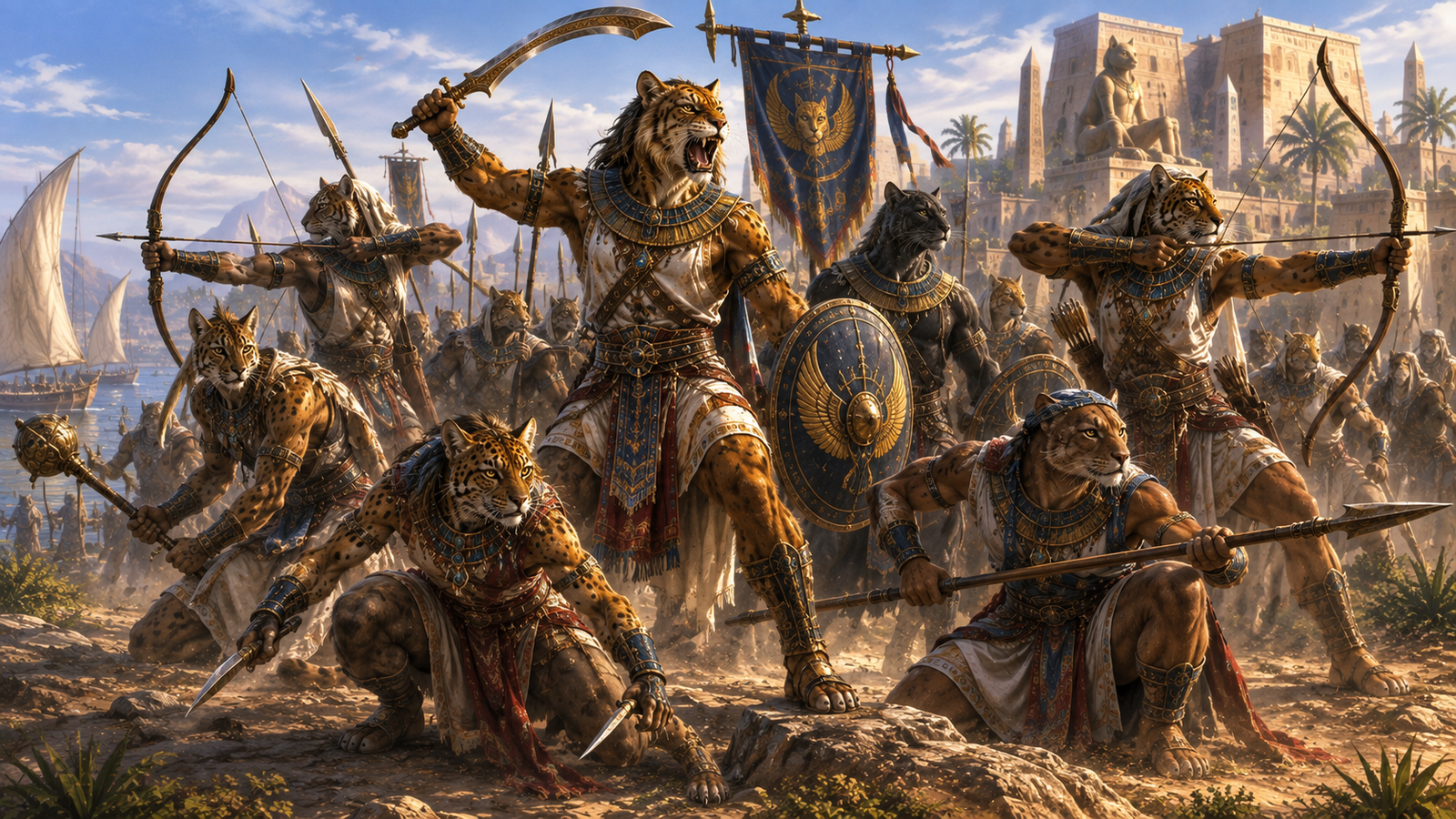
Kemetite War-Prides
Kemetite armies use bows, throwing spears, long thrusting spears, khopeshes , maces, axes and daggers.
The war-pride is a flexible fighting group whose members exploit Catfolk perception, balance and mobility rather than relying entirely upon a single rigid battle line.
This military tradition became particularly renowned at the Battle of the Hidden Springs in 1260 CE.
The World in 1454
By 1454 CE, Kemet remains the greatest known Catfolk power, controlling important Nile territories and maintaining interests along Red Sea and Mediterranean routes.
The Ninefold Dominion’s seizure of Constantinople has increased the importance of fortified ports, naval security, intelligence and diplomacy.
Elsewhere, Catfolk communities range from openly recognised regional peoples to isolated settlements unknown beyond their immediate surroundings.
Travellers may encounter Catfolk merchants in major ports, mercenaries in foreign armies, scholars at distant courts, forest hunting prides, highland villages, island communities or families whose ancestors left older homelands many generations ago.
Ecology and Distribution
| Environment | Worldwide: cities, river valleys, forests, jungles, savannas, mountains, islands, woodland, coasts, trade routes and isolated refuges. |
| Rarity | Uncommon globally; locally common within established Catfolk territories. |
| Organisation | Individual, household, hunting band, clan, pride, war-pride, village, enclave, city or state. |
| Diet | Omnivorous. Meat and fish are important in many regional cuisines, but diet varies by culture and environment. |
| Languages | Regional. Catfolk possess no universal racial language. |
| Religion | Regional. Bast is the foremost patron in Kemet; distant populations may possess completely different faiths. |
| Advancement | By character class. Catfolk possess no mandatory racial Hit Dice. |
Quick Rules Reference
- Type: Humanoid (Catfolk).
- Size: Usually Medium.
- Shared strengths: Agility, perception, climbing and rapid movement.
- Natural weapons: Claws.
- Vision: Darkvision or low-light vision according to ruleset.
- Alignment: Any.
- Advancement: By class or NPC role.
- Culture: Regional abilities and weapon proficiencies are not universal racial traits.
Game Statistics
The primary statistics below represent a trained Kemetite Catfolk War-Pride Hunter. They are not the statistics of every adult Catfolk and are not a universal Catfolk fighting style.
Regional cultural variants follow the main stat blocks.
Catfolk War-Pride Hunter
Medium Humanoid (Catfolk), Neutral Good
AC 15
Initiative +3 (13)
HP 38 (7d8 + 7)
Speed 35 ft., Climb 30 ft.
Saving Throws
Dex +5
Skills
Acrobatics
+5,
Perception
+3,
Stealth
+5,
Survival
+3
Senses
Darkvision 60 ft.; passive Perception 13
Languages
Nurian plus one regional language
CR
1 (XP 200; PB +2)
Traits
Feline Balance. The hunter has Advantage on Dexterity (Acrobatics) checks made to keep its balance while crossing narrow, steep or unstable surfaces.
Sure Climber. The hunter has a Climb Speed of 30 feet.
Kemetite Weapon Training. The hunter is trained with the regional weapons of a Kemetite war-pride, including the khopesh . This is cultural training rather than a universal Catfolk trait.
Pride Rush (Recharge 5–6). As a Bonus Action, the hunter takes the Dash or Disengage action.
Actions
Multiattack. The hunter makes two attacks using its Khopesh, Claws or Shortbow.
Khopesh. Melee Attack Roll: +3, reach 5 ft. Hit: 5 (1d8 + 1) Slashing damage.
Claws. Melee Attack Roll: +5, reach 5 ft. Hit: 5 (1d4 + 3) Slashing damage.
Shortbow. Ranged Attack Roll: +5, range 80/320 ft. Hit: 6 (1d6 + 3) Piercing damage.
The CR 1 rating assumes the hunter’s normal two-attack routine, AC 15, 38 hit points and mobility. The regional cultural variants below do not materially increase that rating.
Catfolk War-Pride Hunter
Pathfinder 1e
CR
1/2;
XP
200
Catfolk ranger 1
NG Medium humanoid (catfolk)
Init
+3;
Senses
low-light vision;
Perception
+7
Defense
AC
16, touch 13, flat-footed 13
(+3 armor, +3 Dex)
hp
11 (1d10+1)
Fort
+3,
Ref
+5,
Will
+1
Offense
Speed
30 ft., climb 20 ft.
Melee
2 claws +4 (1d4+1)
or
khopesh
+2 (1d8+1/19–20)
Ranged
shortbow +4 (1d6/×3)
Special Attacks
favored enemy (humanoid [orc] +2)
Statistics
Str 12,
Dex 17,
Con 12,
Int 10,
Wis 13,
Cha 10
Base Atk
+1;
CMB
+2;
CMD
15 (17 vs. trip)
Feats
Weapon Finesse
Skills
Climb
+13,
Handle Animal
+4,
Knowledge (nature)
+4,
Perception
+7,
Stealth
+9,
Survival
+5
Languages
Nurian plus one regional language
SQ
feline balance, feline senses,
Kemetite weapon training, natural climber,
pride rush, track +1, wild empathy +1
Special Abilities
Claws (Ex). A Catfolk possesses two claw attacks dealing 1d4 points of slashing damage. They are primary natural attacks when the Catfolk is not attacking with manufactured weapons.
Feline Balance (Ex). Catfolk gain a +2 racial bonus on Acrobatics checks made to maintain balance and a +2 racial bonus to CMD against trip attempts.
Feline Senses (Ex). Catfolk gain a +2 racial bonus on Perception and Stealth checks.
Natural Climber (Ex). Catfolk have a climb speed of 20 feet. They gain the normal +8 racial bonus on Climb checks granted by a climb speed and can take 10 on Climb checks even when rushed or threatened.
Pride Rush (Ex). Once per minute as a swift action, a Catfolk can increase its land speed by 10 feet until the end of its turn.
Kemetite Weapon Training (Ex). A Catfolk raised and trained in a Kemetite martial tradition treats the khopesh as a martial weapon rather than an exotic weapon. This is cultural training possessed by the hunter presented here, not a universal racial proficiency.
Ecology
Environment
Kemetite settlements, Nile country, warm plains,
woodland and regional trade routes
Organization
solitary, household, hunting band, pride,
war-pride or settlement
Treasure
NPC gear (masterwork studded leather,
khopesh, shortbow with 20 arrows and
other possessions)
Catfolk have no racial Hit Dice. Their Hit Dice, base attack bonus, saving throws, skill ranks and class abilities derive from their character classes.
The skill totals above use 1 rank each in Climb, Handle Animal, Knowledge (nature), Perception, Stealth and Survival. Masterwork studded leather reduces its armor check penalty to 0.
Catfolk War-Pride Hunter
D&D 3.5e
CR
1
Catfolk ranger 1
NG Medium humanoid (catfolk)
Initiative
+3
Senses
low-light vision;
Listen
+7,
Spot
+7
Defense
AC
16, touch 13, flat-footed 13
(+3 Dex, +3 masterwork studded leather)
hp
9 (1d8+1)
Fort
+3,
Ref
+5,
Will
+1
Offense
Speed
30 ft., climb 20 ft.
Melee
2 claws +4 (1d4+1)
or
khopesh
+2 (1d8+1/19–20)
Ranged
shortbow +4 (1d6/×3)
Special Attacks
favored enemy (orc +2)
Statistics
Str 12,
Dex 17,
Con 12,
Int 10,
Wis 13,
Cha 10
Base Atk
+1;
Grapple
+2
Feats
Track
B,
Weapon Finesse
Skills
Balance
+5,
Climb
+13,
Hide
+9,
Listen
+7,
Move Silently
+9,
Spot
+7,
Survival
+5
Languages
Nurian plus one regional language
SQ
feline balance, feline senses,
Kemetite weapon training, natural climber,
pride rush, wild empathy +1
Special Qualities
Claws (Ex). A Catfolk has two claw attacks dealing 1d4 points of slashing damage. They are primary natural weapons when no manufactured weapon is used with the corresponding hand.
Feline Balance (Ex). Catfolk gain a +2 racial bonus on Balance checks.
Feline Senses (Ex). Catfolk gain a +2 racial bonus on Hide , Listen , Move Silently and Spot checks.
Natural Climber (Ex). Catfolk have a climb speed of 20 feet. They receive the normal +8 racial bonus on Climb checks and can take 10 on Climb checks even when rushed or threatened.
Pride Rush (Ex). Once per minute as a swift action, a Catfolk increases its land speed by 10 feet until the end of its turn.
Kemetite Weapon Training (Ex). A Catfolk trained in a Kemetite martial tradition treats the khopesh as a martial weapon rather than an exotic weapon. This is cultural training possessed by this Kemetite hunter rather than a universal Catfolk trait.
Ecology
Environment
Kemetite settlements, Nile country, warm plains,
woodland and regional trade routes
Organization
solitary, household, hunting band, pride,
war-pride or settlement
Treasure
standard NPC gear (masterwork studded leather,
khopesh, shortbow with 20 arrows and
other possessions)
Advancement
by character class
Catfolk possess no racial Hit Dice. A 1st-level Catfolk ranger therefore has one Hit Die.
The hunter has 24 ranger skill points: 4 ranks each in Climb, Hide, Listen, Move Silently, Spot and Survival. Balance +5 is untrained (+3 Dex, +2 racial). Masterwork studded leather has no armor check penalty.
Regional Catfolk Variants
The following options modify the cultural training of the Catfolk hunter above.
They represent upbringing, profession and environment rather than separate species, biological subraces or compulsory traits of a particular feline lineage.
American Forest Hunter
Replace Kemetite Weapon Training and Kemetite equipment with weapons and training appropriate to the hunter’s own American community.
A jaguar-, puma- or ocelot-featured Catfolk is not automatically an American Forest Hunter; this variant represents culture and training rather than appearance.
D&D 5.5e — Forest Stalker. The hunter has Advantage on Dexterity (Stealth) checks made while lightly obscured by natural foliage. On a turn when it uses Pride Rush, nonmagical difficult terrain caused by dense undergrowth costs it no extra movement.
Pathfinder 1e. The hunter gains a +2 competence bonus on Stealth and Survival checks made in jungle or dense forest.
D&D 3.5e. The hunter gains a +2 competence bonus on Hide , Move Silently and Survival checks made in jungle or dense forest.
Eastern Woodland Warrior
Replace Kemetite Weapon Training and Kemetite equipment with swords, spears, bows, polearms or other weapons appropriate to the warrior’s homeland.
Tiger and leopard lineages are common among some eastern populations, but appearance does not determine this cultural variant.
D&D 5.5e — Woodland Tracker. The hunter has Advantage on Wisdom (Survival) checks made to track creatures through forest and woodland.
Pathfinder 1e. The hunter gains a +2 competence bonus on Survival and Knowledge (nature) checks concerning its home forests and woodland.
D&D 3.5e. The hunter gains a +2 competence bonus on Survival and Knowledge (nature) checks concerning its home forests and woodland.
Highland Stalker
Replace Kemetite Weapon Training and Kemetite equipment with bows, spears, axes, knives or other weapons of the local highland tradition.
D&D 5.5e — Highland Footing. Nonmagical difficult terrain caused by loose rock, scree or steep natural stone costs the hunter no extra movement. It also has Advantage on Dexterity (Acrobatics) checks made to maintain its footing on natural ledges and mountain paths.
Pathfinder 1e. The hunter gains a +2 competence bonus on Acrobatics and Survival checks made in mountain terrain.
D&D 3.5e. The hunter gains a +2 competence bonus on Balance and Survival checks made in mountain terrain.
Island and Coastal Mariner
Replace Kemetite Weapon Training and Kemetite equipment with spears, knives, bows, axes or other weapons of the local maritime tradition.
D&D 5.5e — Sea Legs. The mariner has Advantage on Dexterity (Acrobatics) checks made to keep its footing aboard a vessel or other moving surface.
Pathfinder 1e — Sea Legs. Replace the hunter’s 1 rank in Handle Animal with 1 rank in Profession (sailor) . The mariner gains a +2 competence bonus on Acrobatics , Profession (sailor) and Swim checks directly associated with ships, boats, rigging or other maritime activity.
For the sample Pathfinder hunter this gives Profession (sailor) +7 during maritime activity; its effective Acrobatics modifier is +5 and Swim modifier is +3 for the same activities.
D&D 3.5e — Sea Legs. Replace the hunter’s 4 ranks in Survival with 4 ranks in Profession (sailor) . The mariner gains a +2 competence bonus on Balance , Profession (sailor) and Swim checks directly associated with maritime activity.
For the sample D&D 3.5e hunter this produces Profession (sailor) +7. Its normal Survival modifier becomes +1 after the rank substitution. When Sea Legs applies, its effective Balance modifier is +7 and its Swim modifier is +3.
Advancement and Rarity
Catfolk advance through profession, martial training, magical study, religious service and character classes.
They do not gain unexplained racial Hit Dice as they become more experienced.
| Role | Typical Example | Relative Threat |
|---|---|---|
| Commoner | Farmer, artisan, sailor, servant, labourer or student. | Low |
| Hunter / Guard | Village hunter, patrol member or local defender. | Low |
| War-Pride Hunter | Trained Kemetite military hunter. | Low–moderate |
| Regional Specialist | American forest hunter, eastern woodland warrior, highland stalker or island mariner. | Low–moderate |
| Veteran | Experienced soldier, scout, officer or monster hunter. | Moderate |
| Priest / Mage | Religious specialist, ritualist or arcane practitioner. | Varies |
| Pride Leader | Clan chief, war leader, captain or regional ruler. | Moderate–high |
| Named Hero | Exceptional individual with class levels, magic and specialised equipment. | Potentially very high |
Catfolk are uncommon globally, but their distribution is highly uneven. They may constitute the dominant population of a particular city, valley, island or forest territory while remaining almost unknown in another region.
Natural History and Mythic Context
Feline-headed gods, sacred cats, lion guardians, supernatural jaguars, were-creatures and feline spirits occur in many traditions.
They should not automatically be interpreted as Catfolk.
A human jaguar shapechanger remains a shapechanger. A lion spirit remains a spirit. A feline deity remains divine.
Catfolk are instead one ancient humanoid people whose physical lineages and cultures have diversified across Earth.
Adventure Hooks
The Jaguar Valley
Explorers encounter an ancient American Catfolk state whose rulers have no knowledge of Kemet but possess ruins suggesting an extraordinarily old civilisation.
Kin Without a Shared Tongue
Two isolated Catfolk peoples meet for the first time in recorded history and discover that their oldest legends describe the same catastrophe differently.
The Eastern Road
A forgotten mountain route connects several isolated eastern Catfolk settlements whose rulers are preparing for a threat approaching through the high forests.
The Drowned Pride
Island Catfolk navigators claim that stone towers beneath the sea mark the capital of an ancient Catfolk maritime realm.
Bast’s Silent Temple
Every sacred cat abandons a Kemetite temple district on the same night.
The Pride That Never Returned
A Kemetite patrol vanishes near ruins predating the current dynasties.
Explore Catfolk in SpiralWorlds
Catfolk at a Glance
Catfolk are one ancient feline humanoid species distributed across the world.
Kemet is their greatest known surviving civilisation, not their universal homeland or point of origin.
Kemetite, American Forest, Eastern Woodland, Highland and Island-Coastal Catfolk describe broad cultural traditions and environments rather than biological subraces.
Lineage describes feline ancestry and appearance. Culture determines language, religion, weapons, clothing, tactics, social institutions and upbringing.
Other isolated Catfolk peoples can exist wherever the history and geography of SpiralWorlds support them.
Catfolk possess no mandatory racial Hit Dice and advance through class, profession, training and experience.
Keep this reference growing
If this page helped with your reading or game, you can support its upkeep or explore the curated books.
Explore the Bookshop — epics, classics and stories behind imagined worlds.