
Artillery Colonies and Rival Powers, 1381–1454
Age of Severed Crowns — Period IV
Artillery, Colonies and Rival Powers
Between 1381 and 1454, recurrent plague fails to restore the older social order. Workers, towns and rulers fight over labour, taxation and movement; bombards and handguns change siege warfare; Timur builds a violent human-led coalition through lands fractured by the Red Fang Reach; Ming fleets cross the Indian Ocean; African, Asian and American powers pursue their own expansions; and permanent Atlantic colonies carry settlement, trade, enslavement, intermarriage, epidemic disease and land seizure into already inhabited worlds.
Beyond the coastal colonies, westward settlement establishes fortified market towns, river ports, mining communities, ranching settlements and caravan depots, some already becoming small cities. The period ends when the hobgoblin Ninefold Dominion captures Constantinople and turns the ancient imperial city into the most dangerous contested centre of the campaign present.
| Period | 1381–1454 CE |
|---|---|
| Parent age | The Age of Severed Crowns |
| Previous period | Plague, Labour and Broken Authority, 1347–1380 |
| Opening event | The English Peasants’ Revolt of 1381 makes post-plague conflict over taxation, labour and inherited obligation impossible to dismiss. |
| Military transformation | Bombards, handguns, field fortifications, mining, artillery trains and professional siege crews alter the value of walls and the cost of war. |
| Global transformation | Long-distance maritime power expands through Ming expeditions, Indian Ocean commerce, Atlantic colonisation, privateering and contested settlement. |
| Orc transformation | The four successor powers fragment further as chiefs defect and settled communities pursue local interests. Timur defeats, coerces or rewards selected Red Fang chiefs, directing their separate clan-hosts within a broader human-led coalition while his victories continue. |
| Closing event | The Ninefold Dominion seizes Constantinople in 1453. The world of 1454 lives inside the military, commercial, sacred and refugee crises created by the conquest. |
The World in 1381
The period opens one generation after the first Black Death, but recovery remains incomplete and authority remains exposed. The living inherit vacant holdings, labour shortages, frightened institutions and wars that plague did not end.
England Rises against Taxation
Poll taxes, labour restrictions and local abuses provoke a broad rebellion of peasants, craftspeople and townspeople.
France and England Remain at War
Ransoms, garrisons, mercenary violence and damaged agriculture continue even during truces.
Plague Remains Recurrent
Later outbreaks strike unevenly, repeatedly interrupting demographic recovery and reopening disputes over work, burial and inheritance.
Ming Rule Is Established
China’s new dynasty rebuilds authority after driving the Eastern Fang court from the imperial heartland.
The Great Muster Is a Distant Memory
Eastern Fang, Ash-Standard, Red Fang and Black Anvil communities answer to rival chiefs, local rulers, families and competing clan-hosts.
Timur Is Gathering Power
The human conqueror defeats some Red Fang chiefs, coerces or rewards others and draws their distinct followers into a wider coalition of human and half-orc commanders, merchants, administrators and regional allies.
Asian Courts Expand
Vijayanagara, Bahmani, Bengal, Majapahit and Ayutthaya develop through warfare, agriculture, sacred legitimacy and maritime commerce.
African Powers Control Major Exchanges
Mali, Great Zimbabwe, Kemet and Swahili city-states remain active centres of gold, scholarship, craft and Indian Ocean trade.
American Societies Pursue Their Own Histories
Mexica, Maya, Mississippian, Andean and many other peoples govern, trade, fight and build without waiting for European arrival.
Atlantic Settlement Becomes Permanent
Earlier voyages now support growing colonial populations and contested harbours. Settlers also move inland along rivers, trails, mineral districts and grazing country within lands governed and defended by Indigenous powers.
The Character of the Period
This is an age of armed recovery. Courts and cities gain new capacities, but they do not become modern centralised states. Power remains negotiated among dynasties, estates, councils, guilds, military households, temples, landlords, subject rulers and communities capable of resistance.
Power Is Not Exclusively Human
Human wars and dynastic records capture only part of this period. Orc successor realms hold territories, towns and inherited claims across the steppe; Kazan’s orc and hobgoblin rivals compete for soldiers and the same river tolls. Catfolk rulers command Kemet’s defences and maritime policy. The master chronology also records the hobgoblin conquest of Constantinople in 1453. None of these peoples is a costume placed over an otherwise unchanged human state: each affects who can collect taxes, keep roads open, marry into ruling houses, command troops and enforce agreements.
Nor does a king’s title settle the whole map. The power of spirits, fey courts and mighty territorial creatures has to be considered wherever the regional history establishes them. A claimed frontier and a safely travelled frontier are two different things; rights and obligations may be older than the mortal ruler demanding obedience.
Authority Reaches Further and Still Breaks
Rulers collect deeper taxes, hire specialists and maintain more permanent forces. Succession disputes, unpaid soldiers, local privilege, rebellion and distance repeatedly limit command.
Walls Lose Their Certainty
Great fortifications remain formidable, but heavy guns, disciplined mining, field works and sustained supply can make ancient masonry a question of time, money and political endurance.
Sea Power Becomes Settlement Power
Ships no longer carry only merchants, envoys and raiders. They carry families, livestock, soldiers, coerced labourers, diseases, building materials and rival claims intended to endure.
Connected Worlds Remain Unequal
Ming fleets, Swahili ports, Indian courts, Southeast Asian entrepôts, Atlantic colonies and Mediterranean merchants all participate in long-distance exchange without belonging to one universal system.
Texts Multiply Unevenly
Manuscript workshops remain essential. European movable type expands late in the period, while East Asian woodblock and movable-type traditions are already centuries old.
Victory Creates Fresh Rivals
Conquerors reward followers, empower commanders and absorb useful institutions. Every success therefore creates ambitious subordinates, displaced heirs and communities waiting for weakness.
Labour Revolt and Broken Obligations
The demographic shock of plague gives many survivors greater bargaining power, but rulers and landholders attempt to restore older obligations through law, taxation and force. The struggle outlives the first pandemic wave.
1381 — The English Peasants’ Revolt
Communities across England resist repeated poll taxes, official abuse and attempts to bind labour after plague has made workers scarce. Rebels enter London, destroy legal records, attack prisons and demand an end to servile obligations. Their programme is not uniform: village grievances, urban anger, sacred reform arguments, local feuds and opposition to royal advisers travel together without becoming one coherent constitution.
Royal promises divide the rising. Wat Tyler is killed, rebel concentrations are dispersed and reprisals follow. The immediate rebellion fails, but the government cannot make the post-plague population forget that common people organised across counties, entered the capital and forced the crown to negotiate.
Labour Cannot Be Reset
Wage controls and compulsory service continue, yet workers evade them by moving, bargaining collectively, changing trades, withholding labour or appealing to competing lords and towns.
Taxation Produces Politics
War taxes, extraordinary levies and emergency collections require consent, coercion or both. Assemblies and communities learn to attach conditions to money even when rulers deny that negotiation limits sovereignty.
Plague Returns
Recurrent outbreaks kill fewer people than the first catastrophe in some regions and devastate others. Households rebuild repeatedly while burial workers, healers and local custodians retain hard-earned authority. Where deaths become numerous, communities also fear a renewed Red Death: some plague victims may rise as undead, turning overwhelmed burial grounds and abandoned districts into immediate military dangers.
Land Changes Hands
Vacant farms, remarriage, orphaned heirs, missing bodies and disputed deaths continue to redistribute property. Lords recover some estates; prosperous tenants, towns and temple estates acquire others.
Similar pressures appear beyond England in rural risings, tax resistance, urban factional conflict and flight from war. No single revolt ends inherited hierarchy, yet the later fourteenth and fifteenth centuries contain fewer places where authority can assume that obligation will be obeyed simply because it is old.
Gunpowder, Bombards and New Siege Warfare
Gunpowder weapons do not replace bows, spears, cavalry, ships or older siege engines. They join them, forcing rulers to combine metal, powder, transport, skilled labour and credit on a scale that exposes both growing power and continuing fragility. See also the SpiralWorlds material for siege warfare.
Bombards against Masonry
Heavy guns can shatter towers, gates and curtain walls when crews possess stable platforms, sufficient powder, usable shot and enough time. Their presence changes negotiations before the first breach is made.
Handguns among Older Weapons
Hand cannons and early match weapons offer noise, penetration and training advantages, but remain slow, weather-sensitive and dangerous. Mixed units protect gunners with shields, polearms, archers and crossbowmen.
Artillery Trains Need Specialists
Founders, carpenters, powder makers, miners, wagoners, surveyors and engineers matter as much as the gun itself. A ruler who cannot pay or feed them owns impressive metal rather than reliable force.
Fortification Adapts
Defenders thicken earthworks, lower vulnerable profiles, build outer barriers, mount their own guns and conduct aggressive sorties. Artillery begins an architectural contest rather than ending siegecraft.
Gnome Workshops Advance Hand-Held Firearms
In North America, gnome gunsmiths improve barrel boring, ignition locks, measured charges, priming protection and field repair. Their compact pistols and lighter shoulder guns remain expensive, individually made weapons, but they fire more reliably and travel more easily than most contemporary arms. Designs spread unevenly through colonial militias, traders, Indigenous allies and rivals who capture, purchase or commission them.
Cannon also alter battles. At Formigny and Castillon, artillery helps organise defensive positions and forces opponents to move. Hussite armies demonstrate the power of wagons, firearms and disciplined infantry against mounted elites. Across the Atlantic, gnome workshops push hand-held weapons beyond ordinary European manufacture, although their best locks and barrels remain scarce.
The Ninefold Dominion turns the same broad military transformation towards a harsher system of conquest, combining bombards with mantlets, armoured wagons, mining and repeated assault.
Rival European and Mediterranean Powers
Europe and the Mediterranean remain divided among dynastic kingdoms, princely territories, communes, leagues, islands, merchant cities, sacred jurisdictions and local privileges. Courts and cities grow more capable, but authority continues to be layered, negotiated and contested.
The Hundred Years’ War Changes Character
Agincourt renews English power in 1415, but conquest proves harder to keep than to win. French recovery combines local resistance, royal finance, field armies, artillery and the political force created by Joan of Arc’s visions and leadership. Orléans and Patay reverse expectations in 1429; Formigny and Castillon end the principal English military position in France by 1453.
Burgundy Stands between Kingdoms
Burgundian rulers gather wealthy and culturally varied territories through inheritance, marriage, purchase and war. Their court rivals kings while cloth towns, urban privileges and competing loyalties prevent simple centralisation.
The Hussite Wars Redefine Armed Community
Reform conflict in Bohemia becomes a struggle over authority, property and survival. Wagon fortifications, firearms and organised infantry allow Hussite communities to defeat repeated attacks by stronger coalitions.
Italian Powers Compete through Money and Force
Venice, Genoa, Florence, Milan and other powers combine shipping, banking, diplomacy, hired soldiers and urban industry. Their rivalries connect the western Mediterranean to the Black Sea and make Constantinople’s fate a commercial as well as military crisis.
On 9 April 1454, Milan and Venice agree to the Peace of Lodi. The fighting between them may end, but unpaid soldiers, disputed strongholds and captains looking for another contract do not vanish. In this world, John Hawkwood is alive and his White Company, founded in 1435, must decide whether peace means disbandment, new employment or a more discreet kind of war.
Kemet Guards the Southern Mediterranean
Ancient catfolk Kemet protects Nile, Red Sea and Mediterranean interests through fortified ports, river craft, missile troops, agile infantry and diplomacy with African and Asian partners. Its rulers treat the Ninefold Dominion as a direct threat to trade, sacred sovereignty and the freedom of the sea routes.
The Balkans Remain a Contested Frontier
Roman, Ottoman, Serbian, Hungarian, Venetian, local and Dominion ambitions overlap without becoming one war. Alliances shift because neighbouring rulers fear one another as well as the hobgoblin advance.
Within The Empire, prince-electors, territorial lords, free cities and regional leagues continue to negotiate military aid, taxation and law. The imperial crown can coordinate common action, but no emperor can erase the layered rights on which that cooperation depends.
In the Carpathian and Danubian lands, local rulers continue resisting incursions, forced service and fortified occupation. By 1454 Vlad III Dracula has returned earlier than in ordinary history and is already a vampire. His undead power is expanding through Wallachia against the Ninefold threat. He remains deeply resentful of Hungary and grows more ruthless as his rule hardens, but he is not campaigning against the Empire.
Timur and the Fractured Orc Successor Realms
Mhurak Stone-Blood held the Great Muster together through personal might, victory, rewards and fear. Generations after his death, its four successor worlds are collections of rival tribes, clan-hosts, settlements, subject rulers, families and ambitious commanders whose loyalties change with danger, opportunity and the reputation of particular leaders.
Timur Binds Red Fang Clan-Hosts to a Wider Coalition
Timur is a human historical conqueror whose authority does not descend from Mhurak Stone-Blood. He rises in territories weakened by conflict inside the Red Fang Reach. After defeating some chiefs, threatening others and rewarding those willing to campaign against their rivals, he draws several Red Fang clan-hosts into a wider coalition of human and half-orc commanders, merchants, scholars, administrators, artisans and regional allies.
The orcs follow his victories, fear his reprisals and expect land, plunder and captives; they do not recognise any inherent human right to rule them.
The combination makes Timur’s armies deadlier than either element alone. Red Fang clan-hosts bring aggression, mobility, intimidation and hard frontier experience. The wider coalition supplies siege engineers, intelligence, urban workshops, merchants, administrators and the transport needed to sustain distant campaigns. Rival orc chiefs compete for reward and reputation by directing their violence outward while Timur continues to win.
The same arrangement remains dangerous to its own leader. Each chief retains a distinct following and watches for weakness, disputed rewards or opportunities to destroy a rival. Timur holds the coalition together through victory, punishment and distribution of conquest. Cities that submit can retain useful institutions under new masters; cities that resist can face massacre, enslavement and deliberate destruction.
From the 1380s to 1405, Timur’s campaigns break powers across Central and West Asia, enter northern India and destabilise Anatolia. After his death, relatives and commanders preserve important courts and centres of scholarship, but they do not inherit the Red Fang chiefs’ obedience. Some orc leaders seize their rewards and return home; others back rival heirs or attempt to carve out territories of their own.
Eastern Fang Host
Rival houses beyond Ming control continue arguing over the eastern inheritance. Some raid and seek a new unifier; others herd, farm, trade or enter service with regional rulers. A victory over a Ming army can unite enemies for a season without ending their rivalry.
Ash-Standard Host
Western grasslands, river settlements and forest margins contain powerful chiefs whose followers mix mobile and settled lives. Raiding, commerce, marriage and local feuds pull communities in different directions, and distant claims weaken whenever a leader cannot reward supporters.
Red Fang Reach
Timur defeats some Red Fang chiefs, destroys others and binds several surviving clan-hosts to his campaigns through reward, fear and opportunities to attack their rivals. Their separate loyalties make his coalition deadlier while he wins and dangerously unstable after 1405, when former allies seize rewards, back rival heirs or pursue territories of their own.
Black Anvil Realm
Mountain strongholds and foundry towns remain valuable but politically divided. Orc smiths, herders, soldiers and settled households face pressure from Kemet, the Ninefold Dominion and neighbouring rulers while their own war leaders compete for labour and metal.
Orc cruelty remains visible in enslavement, retaliatory killing, predatory war and the readiness of strong chiefs to consume weaker communities. Ordinary life persists within that violence. Families mourn lost children, craftspeople defend their work, lovers cross hostile clan divisions, hungry warriors joke beside fires and settled households resent raiders who claim to speak for all orcs.
The successor realms fragment because these lives create local interests that no distant claimant can command indefinitely.
Ming China and the Eastern Seas
Ming rulers consolidate power after the expulsion of the Eastern Fang court. The dynasty fortifies frontiers, rebuilds institutions, moves the imperial centre to Beijing and projects authority across maritime Asia, while regional officials and local communities continue to shape what imperial orders can achieve.
Dynastic Consolidation
The Ming state restores taxation, military settlements, examinations, granaries and court ritual while suppressing rivals. Regional officials, landholding families, military households and local communities still determine how far imperial commands can be enforced.
Zheng He’s Expeditions, 1405–1433
Great fleets carry envoys, soldiers, interpreters and luxury goods through Southeast Asia and the Indian Ocean as far as the East African coast. They display Ming wealth, enforce selected demands and enter maritime worlds that already possess their own merchants, rulers and diplomatic customs.
Frontier Danger Continues
The eastern orc houses remain divided yet dangerous. Ming campaigns can overextend, and the capture of the emperor in 1449 proves that dynastic authority does not make frontier war predictable.
Japan under Ashikaga Rule
The Ashikaga shogunate governs through negotiated relationships with provincial warriors, court traditions, Shinto authorities and commercial interests. Its reach weakens outside Kyoto as local military houses grow more independent.
In the Kantō, Ashikaga Shigeuji and the Uesugi leadership struggle for control. The killing of Uesugi Noritada late in 1454 opens the Kyōtoku conflict, drawing provincial households into a war whose outcome is not yet settled. The Fūma of Sagami are a locally rooted campaign adaptation within this unrest, not a claim that their better-documented sixteenth-century exploits have already occurred.
Japan’s maritime history is not solely a contest between human fleets. In 1281 Raijin, Susanoo, coastal kami and autonomous sea kaiju helped destroy the second Eastern Fang invasion. That precedent still matters to coastal defence and the choice of sea routes: a captain must reckon with powers no admiral can command. Mogaru is an independent territorial creature, not a military asset that belongs to the shogunate.
Printing remains global. European movable type becomes a major new force late in the period, but Chinese and Korean printing traditions are older and more technically developed. The change is an expansion of regional print cultures, not the invention of mass text by one civilisation.
India and Southeast Asia
The Indian Ocean connects wealthy states without reducing them to stops on a European route. Courts control inland agriculture, sacred centres, mines, river systems and ports while merchants cross political and cultural frontiers.
Vijayanagara and Bahmani Power
Vijayanagara and the Bahmani Sultanate compete across the Deccan through fortresses, cavalry, infantry, diplomacy and control of fertile districts. Their frontier is a shifting field of alliances rather than a permanent boundary between uniform cultures.
Bengal and the Eastern Delta
Bengal’s rulers draw strength from river agriculture, textile production, ports and regional diplomacy. Delta environments make local pilots, boatmen and landholders essential to royal power.
Majapahit’s Maritime World
Majapahit remains a major Javanese court whose influence depends on alliances, tribute, ports and regional relationships more than uniform occupation. Rival coastal powers continue to grow within the same commercial world.
Ayutthaya and Mainland Exchange
Ayutthaya develops into a cosmopolitan river and sea power. Thai, Khmer, Mon and other communities contribute to its armies, court, markets and sacred landscape while neighbouring rulers resist its expansion.
Melaka Rises
The settlement at Melaka grows through its strategic strait, protected harbour and ability to serve merchants from many regions. Its importance comes from participation in existing Asian exchange rather than discovery by an outside power.
Timur’s Indian Campaign Leaves Scars
The attack on Delhi in 1398 destroys lives, wealth and political confidence. Regional states recover, compete and pursue their own ambitions beyond the campaign’s destruction.
Africa and the Indian Ocean
African political development continues far beyond Mediterranean events. Sahelian courts, forest and savanna kingdoms, Nile powers, highland states, southern stone cities and Swahili ports belong to different historical worlds connected by gold, salt, cloth, cattle, scholarship and the sea.
Mali Changes without Vanishing
Mali remains wealthy and internationally known, but succession disputes, provincial autonomy, Tuareg pressure and the growth of Songhai weaken its control of some cities and exchanges. The wider Manding world continues through courts, farming communities, traders, scholars and oral memory.
Great Zimbabwe Transforms
Great Zimbabwe remains a major centre into the fifteenth century before population pressure, environmental strain and changing political networks shift power towards successor centres. The transition is regional reorganisation, not disappearance of Shona civilisation.
The Swahili Coast Faces the Ocean
Kilwa and other Swahili city-states link African producers and inland rulers with merchants from Arabia, India and farther east. Coral-stone towns, household compounds, guild halls, temples and markets express African coastal cultures shaped by long exchange.
Kemet Connects Sea and River
Catfolk Kemet protects the Nile and Red Sea while negotiating with Mediterranean, Nubian, Horn of Africa and Indian Ocean partners. The fall of Constantinople threatens its northern commerce and forces greater investment in naval defence and fortified ports.
Atlantic expansion reaches African coasts during this period, bringing new commercial opportunities and intensifying violent demands for captives. Local rulers, merchants and coastal communities bargain, restrict, exploit or resist foreign crews according to their own interests. No ship’s arrival transfers sovereignty over the shore it sees.
Colonisation and the Westward Towns of North America
By 1454, North America is an active Indigenous world containing permanent European colonies, older northern settlement traditions and a growing movement westward from the Atlantic seaboard. The chartered colonies remain concentrated along the coast, but fortified market towns, river ports, mining settlements, stock-raising communities and caravan depots now spread into the interior. Some have become small cities.
Sustained contact creates trade, alliance, intermarriage, epidemic disruption, land seizure and recurring war.
Established Colonial Powers by 1454
The six English colonies are Virginia, Massachusetts, New Hampshire, Maryland, Connecticut and Rhode Island. They coexist with Dutch New Netherland, a Norse Delaware trading colony, continuing Vinland and Greenland traditions, and a separate New France presence. These later-derived names are deliberate SpiralWorlds campaign canon adapted to the world of 1454.
Their colonial governments claim influence far beyond the seaboard, but many western towns are only loosely controlled by coastal governors and survive through local agreements, private militias, trade networks and their own relationships with Indigenous nations.
Coastal Colonies Become Towns and Small Cities
Harbours, river mouths, fisheries, timber, farms and fortifications allow colonial populations to survive. The largest settlements now contain wharves, warehouses, workshops, mills, markets, council houses and crowded residential quarters. Shipping remains essential, yet locally born generations make these places permanent towns, and several are becoming small cities.
Westward Towns Spread into the Interior
Settlers move along navigable rivers, old Indigenous paths and newly cut wagon trails. Stockaded market towns, ferry settlements, mining camps, cattle and horse-raising communities, caravan depots and frontier forts appear far beyond the coastal colonies. Some remain precarious outposts; others grow into small inland cities linking several regions.
Gnome Gunsmiths Transform Frontier Warfare
Gnome workshops in coastal and inland towns produce stronger barrels, more dependable locks, protected priming systems and weapons designed for damp forests, river travel and long journeys without a central armoury. Their finest pistols and shoulder guns are costly and difficult to copy, but they give small militias, caravan guards and Indigenous war parties greater striking power. Trade, theft, battlefield capture and divided workshop loyalties prevent any colony from keeping the advances to itself.
Land Seizure Creates Permanent War
Colonists purchase, occupy, inherit and seize land under incompatible legal traditions. Indigenous communities answer through diplomacy, selective trade, alliance, relocation, raids, siege and organised war.
Trade and Intermarriage Create Mixed Worlds
Interpreters, kin networks and mixed households connect settlements that official governors describe as separate. These relationships can create protection and belonging while also becoming instruments of coercion and divided loyalty.
Indigenous Powers Shape Every Route West
Western settlement does not advance across empty land. Indigenous rulers, confederacies and communities control crossings, food supplies, hunting grounds, river access and the safest routes. Some towns exist by treaty or kinship; others survive through tribute, armed alliance or continual war.
Epidemics Alter Power
Diseases carried by sustained contact strike Indigenous populations unevenly and can destabilise alliances, food production and sacred duties. Colonists exploit some losses, but epidemics do not erase Indigenous survival, government or military capacity.
The Atlantic colonies remain divided among companies, crowns, proprietors, councils, military commanders, settlers and local factions. Western towns may claim a coastal charter while ignoring its governor, or owe allegiance to a local captain, merchant council, mixed community or Indigenous ally. None possesses uncontested authority over the continent, and even heavily fortified settlements depend on relationships with Indigenous neighbours they may misunderstand or betray.
Gnome gunsmiths add another source of instability: governors seek exclusive contracts, interior towns protect independent workshops and Indigenous powers acquire advanced weapons through alliance, trade, capture and their own skilled armourers.
The Contested Caribbean and Brethren of the Coast
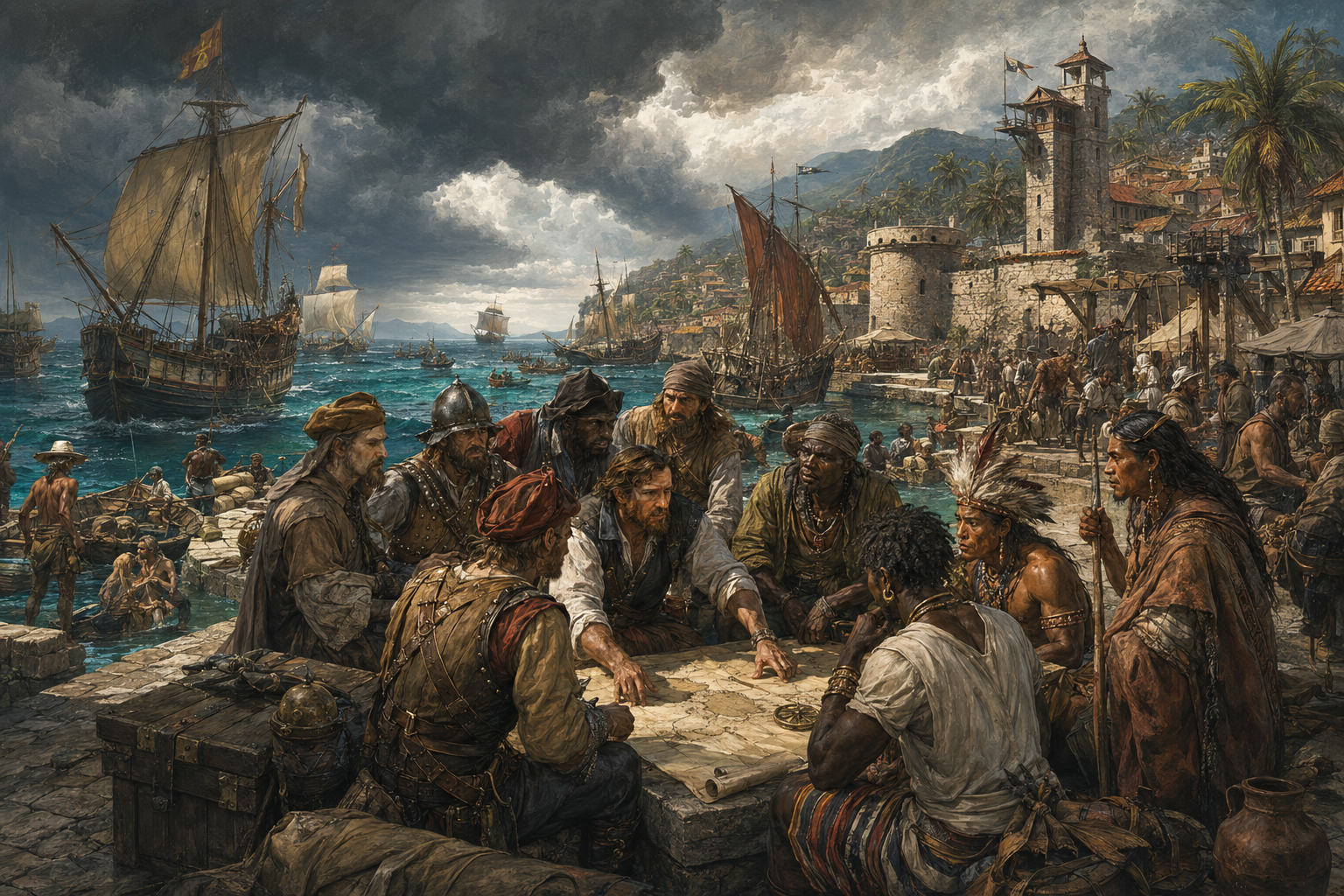
The Caribbean is already heavily colonised and contested. English, French, Dutch, Norse and New Castilian-Aragonese settlements overlap with powerful Indigenous island societies, maroon communities, escaped slaves, free ports, privateers and rival governors.
The Brethren of the Coast
The Brethren of the Coast are a loose multinational coalition of sailors, privateers, outlaws, escaped slaves and coastal communities rather than a single fleet or nation. Tortuga and Port Royal are their principal bases, but captains, harbour councils, maroon leaders and merchant backers disagree over plunder, protection and whether freedom should apply beyond their own companions.
Indigenous Island Powers Endure
Island communities control local waters, food supplies, inland refuge and knowledge of reefs and storms. They form alliances, conduct war, absorb outsiders and exploit rival colonial claims.
Maroon Communities Defend Freedom
Escaped slaves establish settlements in forests, hills and marshes, sometimes joining Indigenous communities and sometimes maintaining separate authority. They raid estates, rescue captives and bargain with ports from positions colonial governors cannot eliminate.
Privateering Blurs War and Crime
Captains carry commissions when convenient and deny them when captured. Governors use pirates against rivals, then condemn the same crews when diplomacy changes.
Slavery Finances Expansion
Captive labour, debt bondage and raiding support forts, farms, docks and households. Resistance includes flight, sabotage, mutiny, revolt, legal petition and armed alliance with enemies of the enslaver.
The Caribbean is a political centre in which Indigenous peoples, Africans, Europeans, mixed communities and free sailors make competing claims to land, water, labour and belonging.
Mexica, Inca and the Wider Americas
Independent histories continue across the Americas despite the growth of Atlantic colonies. Powerful states, confederacies, towns and sacred landscapes develop across Mesoamerica, the Andes, the Mississippi basin and the Pacific coasts.
The Mexica Triple Alliance
In 1428, Tenochtitlan, Texcoco and Tlacopan defeat Azcapotzalco and create the Triple Alliance. Mexica power then grows rapidly through war, tribute, diplomacy and the ability of Tenochtitlan to draw goods and people into a great lake city. Subject communities retain rulers and grievances that can become future weapons against the alliance. Its sacred traditions connect to the Mesoamerican Pantheon.
Inca Expansion after 1438
Pachacuti transforms Cuzco’s regional power into an expanding Andean state. Warfare, negotiated submission, labour obligations, sacred authority and the incorporation of existing communities extend Inca control, but the new state remains young in 1454.
Maya Successor States
Maya political life continues through independent kingdoms, towns, dynasties, markets and sacred centres. No earlier collapse erases Maya peoples or reduces the region to ruins awaiting conquest.
Mississippian Societies
Towns, mound centres, river trade and regional alliances shape the eastern interior of North America. Political change and population movement do not make these lands empty or politically simple.
Aotearoa, the Pacific and Terra Australis
The Pacific is not an empty margin beyond the principal histories of Eurasia and the Atlantic. It contains settled islands, ancestral routes, navigational traditions and political worlds whose peoples understand distances and currents that foreign mapmakers barely recognise.
Aotearoa
Māori communities develop distinct iwi, hapū, fortified settlements, cultivation and maritime traditions in Aotearoa. Authority rests in ancestry, kinship, reputation, land and the ability of leaders to maintain alliances and defend communities. No foreign chart grants ownership over these islands.
Pacific Worlds
Across the Pacific, navigators maintain worlds connected by ancestry, exchange and oceanic knowledge. Voyaging can carry marriage alliances, ritual obligations, valuable materials, news and conflict across distances that appear impossible to sailors who do not know the stars, swells, birds and seasonal winds.
Terra Australis Belongs to Its Peoples
Terra Australis belongs to many ancient and distinct peoples whose law, kinship, language, trade and responsibilities to Country long predate every foreign chart. The continent is neither politically uniform nor unknown to those who live there. Coastal, riverine, desert, woodland and island communities maintain their own territories, routes, alliances, rivalries and bodies of guarded knowledge.
Knowledge of water, seasons, fire, travel, dangerous places and sacred geography is held through living custodianship. Visitors do not gain possession merely by hearing a coastal name, copying a route or marking an inlet on a map. Foreign sailors who reach the continent enter existing jurisdictions and can survive only through permission, exchange, coercion or theft.
Pnakotus and the Yithian Ruins
The cyclopean remains of Pnakotus stand within this inhabited landscape. The Great Race of Yith raised the city in the deep prehuman past, and its abandoned towers, buried galleries and sealed archives outlast the power that built them. Its earlier history belongs to The Age of Awakening.
Pnakotus stands within known and inhabited Country. Communities living around its wider region possess their own names, warnings, histories, pathways and obligations concerning the ruins. Some custodians know which outer grounds can be crossed, which stones must not be disturbed and when strange winds or lights make the country unsafe. No single community claims complete knowledge of the city, and local authority does not require mastery of every Yithian secret.
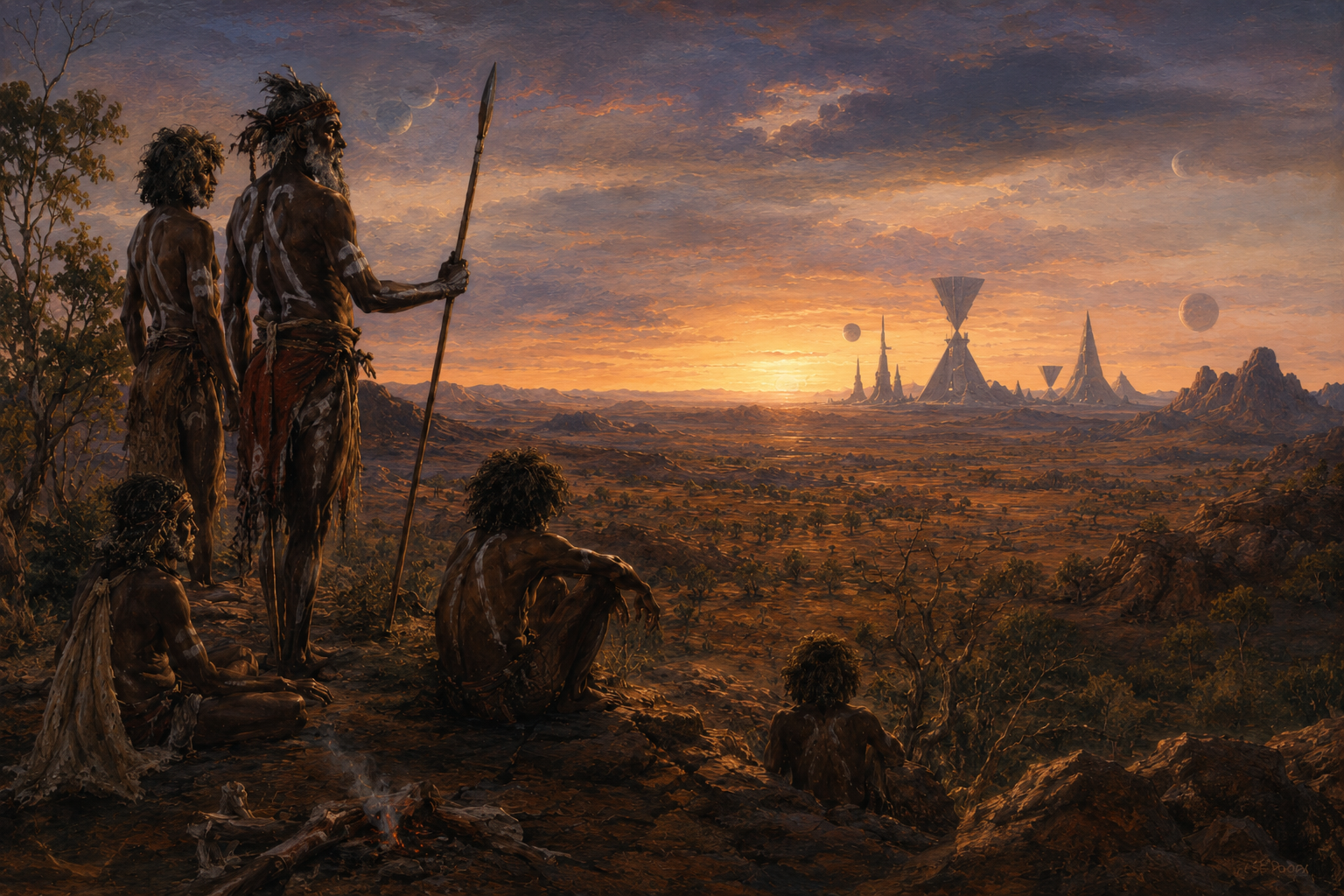
Dormant Yithian instruments sometimes throw temporal after-images across the horizon: unfamiliar constellations, multiple moons, impossible suns or silhouettes of the city as it appeared in another age. These manifestations can last for minutes or for an entire night. They do not make Pnakotus newly active, but they reveal that parts of its archive still operate and that the ruins preserve knowledge through machinery capable of touching mind and time.
Foreign navigators hear fragmented accounts during the fifteenth century, but their charts reveal far less than local custodians already understand. Rumours of a city beneath alien skies attract conquerors, scholars, treasure-seekers and cults. Most cannot locate it without local guidance, and those who force a route inland face distance, climate, resistance and hazards left by a civilisation that treated bodies and centuries as temporary instruments.
Rise of the Ninefold Dominion
The Ninefold Dominion is a hobgoblin power distinct from the orc successor realms and from neighbouring human dynasties. Its expansion depends on disciplined armies, siege expertise, slavery, forced service, taxation and the deliberate destruction of rival authority.
A Conquest Society of Families, Ranks and Rivalries
Dominion officers plan campaigns, record obligations and punish failure, but hobgoblins remain people rather than interchangeable officials. Soldiers worry about families in garrison towns; ambitious captains compete for commands; artisans resent nobles who waste their work; believers interpret victory as proof of order; frightened conscripts obey until escape becomes possible. Discipline contains rivalry without removing it.
The Dominion usually acts upon conquered populations where they live. It taxes useful communities, conscripts labour and soldiers, enslaves captives, absorbs specialists, starves resistant districts and kills those selected as examples. Most conquered populations remain in place under unequal and often lethal systems of classification and control.
Siege Warfare
Bombards, miners, mantlets, armoured wagons, rolling fortifications and repeated assault allow the Dominion to attack places that once relied on walls as political guarantees.
Occupation
Garrisons secure gates, arsenals, workshops and granaries. Local rulers may remain under supervision when useful; sacred orders and dynasties that command independent loyalty face suppression.
Forced Service
Conquered shipwrights, smiths, masons, translators, physicians and clerks are compelled to sustain further campaigns. Their knowledge strengthens the Dominion while also creating opportunities for sabotage and escape.
Military Hierarchy
Disciplined infantry and cavalry support artillery and engineers. Rank offers status, wealth and protection, encouraging families to compete inside the system even while commanders fear disgrace and execution.
The Dominion advances because neighbouring powers often fear one another too much to cooperate. Temporary agreements with Ottoman, Venetian, Balkan and local rulers never erase separate ambitions. By the 1440s, hobgoblin armies possess the artillery, coastal positions, coerced specialists and political confidence required to attempt Constantinople for themselves.
Fall of Constantinople
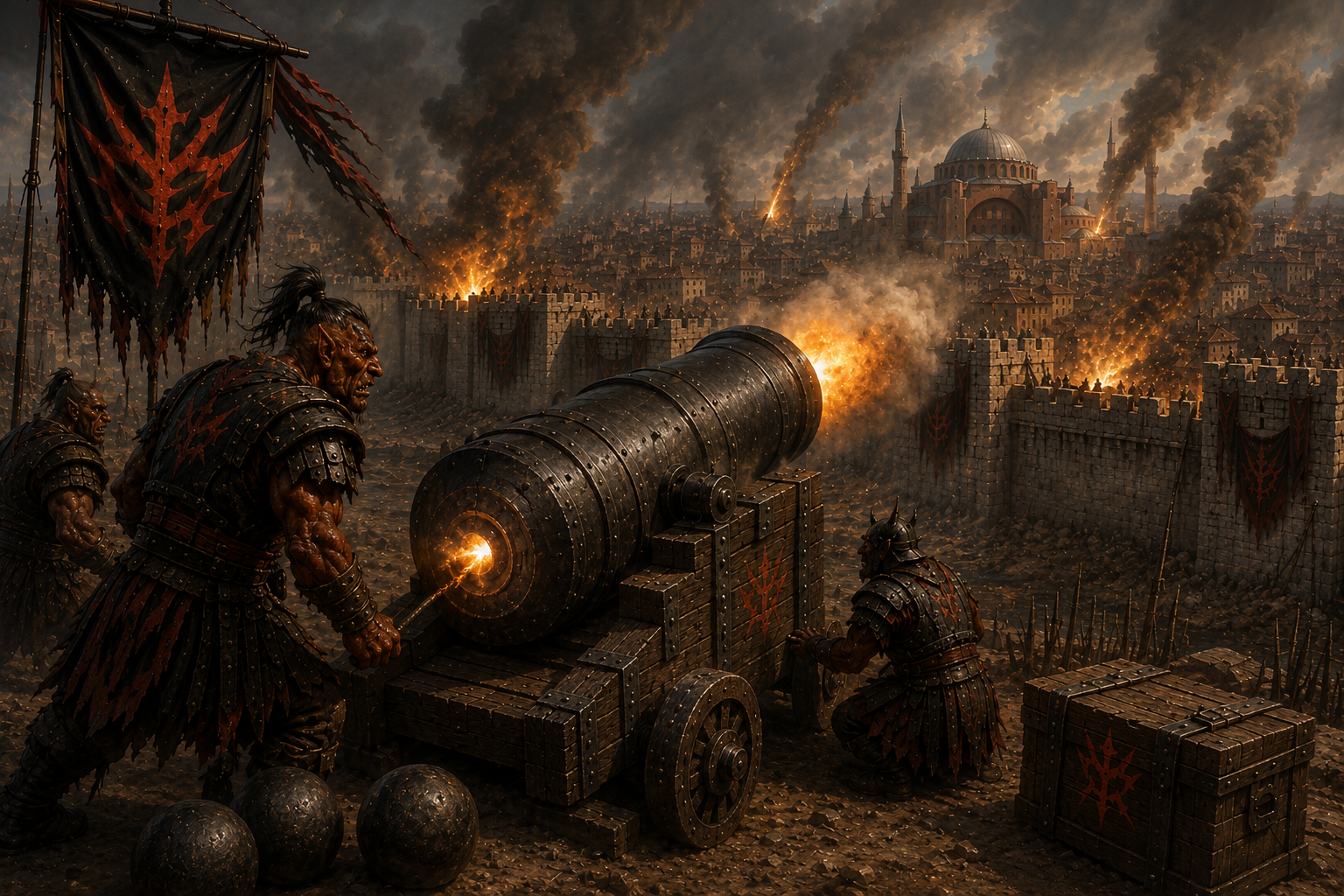
The conquest of 1453 is a defining SpiralWorlds divergence. The historical framework includes the real Ottoman conquest, but in the campaign world the Ninefold Dominion commands the final siege, uses its own war council and takes the city for its own strategic and ideological purposes.
1453 — The Dominion Breaks the Imperial City
Hobgoblin commanders seek more than a trophy. Constantinople controls the Bosporus, commands workshops and arsenals, anchors sacred travel and diplomacy, and carries an ancient claim to universal empire. Taking it promises wealth, military prestige and the destruction of a rival political imagination.
The siege combines heavy bombards, protected batteries, mining, armoured wagons, mantlets, naval pressure and disciplined assaults. Dominion forces compel captured engineers and regional specialists to work beside hobgoblin crews. Roman defenders, civilians, foreign sailors, urban militias and sacred custodians repair breaches, fight fires and contest every approach while rival neighbouring powers offer aid too slowly or with conditions the city cannot accept.
Repeated bombardment and assault open the defences. Fighting spreads through breached districts, harbours and gates. The last Roman political command collapses, but Roman people, law, language, archives and memory survive the conquest. No victory can make the city culturally empty.
Conquest in Place
The Dominion secures gates, arsenals, docks, granaries and workshops. It sorts inhabitants by resistance and perceived usefulness: some are taxed or compelled to serve, some enslaved, some absorbed and others killed.
Trade Reorients
Merchants seek alternative ports, negotiate new tolls or risk Dominion inspection. Black Sea, Aegean and Mediterranean commerce does not cease, but every voyage now carries greater political cost.
Refugees Carry Knowledge
Soldiers, scholars, craftspeople, sailors, sacred custodians, magical specialists and displaced families move towards Italian cities, Balkan courts, Kemet, Black Sea settlements and western Asia. They carry manuscripts, techniques, grudges and competing claims to the city’s inheritance.
Mediterranean Defence Changes
Kemet, Italian maritime powers, Danubian rulers and island strongholds strengthen fleets and artillery. Each fears the Dominion while remaining reluctant to empower its own rivals.
Sacred Authority Fractures
Access to shrines, relics, temples and old wards becomes subject to occupation. Some sacred communities negotiate survival; others conceal objects, flee or support resistance.
The Frontier Keeps Fighting
Vlad’s lands and other neighbouring territories continue resisting hobgoblin incursions. The fall of the city increases pressure without ending regional opposition.
Chronology, 1381–1454
From the Peasants’ Revolt to the world of 1454, the period unfolds through rebellion, conquest, expansion, colonisation and the fall of Constantinople.
| Date | Event | Significance |
|---|---|---|
| 1381 CE | The English Peasants’ Revolt | Peasants, craftspeople and townspeople resist poll taxes, labour restriction and official abuse. The rising is suppressed but exposes the political consequences of post-plague scarcity. |
| 1380s CE | Timur Expands through Red Fang-Divided Lands | The human conqueror defeats some Red Fang chiefs, coerces or rewards others and draws several distinct clan-hosts into a wider coalition. Their mobility and violence, combined with settled siegecraft and supply, make the coalition exceptionally deadly while victory and fear hold it together. |
| 1389–1402 CE | Anatolia and the Balkans Remain Divided | Roman, Ottoman, Balkan, Venetian, local and Dominion forces pursue overlapping wars. Temporary alliances prevent any victory from producing uncontested regional rule. |
| 1392 CE | Joseon Replaces Goryeo | A new Korean dynasty establishes authority while preserving and reshaping older administrative, scholarly and military traditions. |
| 1398 CE | Timur’s Coalition Attacks Delhi | Invasion and sack kill inhabitants, seize wealth and deepen political fracture. Indian regional powers continue developing beyond the campaign’s destruction. |
| c. 1400 CE | Melaka Grows at the Strait | A protected harbour and strategic position help Melaka become a major centre within established Southeast Asian maritime exchange. |
| 1400 CE | John Hawkwood Is Born in England | The future condottiere belongs to the younger generation of the campaign chronology. He will later found the White Company. |
| 1402 CE | The Battle of Ankara | Timur defeats the Ottoman army under Bayezid I. Several Red Fang chiefs bring their own clan-hosts into his wider coalition because continuing victory promises reward and the destruction of rivals. The separate Ninefold Dominion exploits the disruption to strengthen its fortified presence. |
| 1405 CE | Timur Dies and His Coalition Divides | Relatives and commanders inherit courts, armies and cities but not the conditional allegiance created by Timur’s victories. Red Fang chiefs seize rewards, back rival heirs, return home or attempt to establish territories of their own. |
| 1405–1433 CE | Zheng He’s Maritime Expeditions | Ming fleets travel through Southeast Asia and the Indian Ocean to East Africa, combining diplomacy, display, commerce and selective coercion. |
| 1415 CE | Agincourt | English victory renews dynastic conquest in France and demonstrates the continuing power of disciplined defensive positions, archery and terrain. |
| 1419–1434 CE | The Hussite Wars | Bohemian communities use wagons, firearms and disciplined infantry to survive repeated campaigns by stronger coalitions. |
| 1420s–1454 CE | Colonies Endure and Westward Towns Spread | Growing populations, locally born children and regular shipping deepen English, French, Dutch and Norse settlement. Fortified settlements, river ports, mining camps, stock-raising communities and caravan depots spread through Indigenous lands. |
| 1428 CE | The Mexica Triple Alliance Forms | Tenochtitlan, Texcoco and Tlacopan defeat Azcapotzalco and begin a rapid expansion of tribute and military power in central Mexico. |
| 1428–1429 CE | Orléans and Patay Reverse the French War | A relief force associated with Joan of Arc breaks the siege of Orléans. French victory at Patay destroys the belief that English tactical success guarantees permanent conquest. |
| 1430s–1454 CE | Gnome Gunsmiths Advance North American Firearms | Gnome workshops improve barrel-making, ignition, priming protection, powder measures and repairable lockwork. Their expensive artisanal weapons spread among colonial militias, western towns, traders, Indigenous allies and rival powers. |
| 1430s–1454 CE | The Caribbean Becomes a Contested Colonial Sea | Indigenous island societies, maroons, colonial governors, privateers, escaped slaves and the Brethren of the Coast contest settlements, harbours and forced-labour systems. |
| 1433 CE | The Last Great Ming Expedition Returns | Court priorities shift after the voyages. Indian Ocean commerce continues without depending on permanent Ming naval presence. |
| 1435 CE | The White Company Is Founded | After early campaigns in France and Italy, John Hawkwood forms the White Company. Its contract articles, officers and white banners establish a formidable mercenary presence in northern and central Italy. |
| c. 1438 CE | The Kazan Khanate Emerges on the Middle Volga | The historical khanate formed amid the Golden Horde’s fragmentation. In the campaign, the orc-ruled Kazan belongs to the disputed inheritance of Mhurak’s Great Muster; Myev Stone-Eye is its ruler in the campaign present, with Azgar contesting her authority. The historical founding date provides context, not a claim that Myev founded the realm in that year. |
| 1438 CE onward | Inca Expansion Accelerates | Pachacuti reorganises Cuzco and extends authority through war, negotiation, labour obligations and sacred kingship. |
| c. 1440 CE | European Movable-Type Printing Develops | Reproducible texts begin changing the distribution of law, technical knowledge and political argument in Europe while older Asian printing traditions continue. |
| 1441 CE | Hacı Giray Establishes His Crimean Rule | The Giray claim takes hold in the historical Crimean Khanate, with 1441 traditionally used for its foundation. The campaign retains Hacı Giray’s independent Crimea, while neighbouring orc chief Krusk Ash-Standard demands tribute he does not receive. Genoese ports and Theodoro remain outside the khan’s direct rule. |
| 1440s CE | The Ninefold Dominion Prepares for Constantinople | Hobgoblin forces secure artillery, coastal positions, coerced specialists and garrisons while neighbouring powers fail to build a lasting common defence. |
| 1447 CE | Ivan IV Charters the Blackhound Brotherhood | In the campaign’s altered Muscovite succession, Ivan IV founds the Oprichniki as his personal security and intelligence order under Svyatoy Voron. This founding is campaign history; the recorded oprichnina belongs to the sixteenth century. |
| 1449 CE | The Tumu Crisis | Oirat forces defeat a major Ming army and capture the emperor. Eastern Fang houses exploit the wider frontier crisis, but they neither replace the historical combatants nor unite behind a single claimant. |
| 1450 CE | Formigny | French artillery helps force an English army from a strong position and accelerates the collapse of English power in Normandy. |
| c. 1450 CE | Great Zimbabwe’s Political Centre Shifts | Population, environment and changing networks move power towards successor centres while Shona communities and regional trade continue. |
| 1453 CE | Castillon Ends the Principal Hundred Years’ War Campaign | French field fortifications and artillery destroy the final major English army in Gascony. English dynastic claims survive the loss of effective possession. |
| 1453 CE | The Ninefold Dominion Seizes Constantinople | Dominion-commanded artillery, mining, naval pressure and assault break the ancient imperial capital. Trade, sacred travel, scholarship, refugee movement and Mediterranean defence reorganise around the conquest. |
| 9 April 1454 | The Peace of Lodi | Milan and Venice agree to end their war. Rival captains, including the campaign’s John Hawkwood, must renegotiate contracts, reckon with unpaid troops and find a place in a less openly violent Italian political order. |
| 1454 CE | Novgorod Negotiates with Muscovy | The independent Republic of Novgorod agrees to terms with Ivan IV’s Muscovy while both courts watch rival boyars and merchants. In recorded history a 1454 charter names Vasily II instead: the parties to this campaign settlement are deliberately different. |
| Late 1454 | The Kyōtoku Conflict Begins | The killing of Uesugi Noritada under Ashikaga Shigeuji sets the Kantō at war. In Sagami, the Fūma face new demands for scouts, guides and informants; their present-day organisation is an established campaign adaptation. |
| 1454 CE | The Campaign Opens | Artillery powers, divided orc successors, growing American states, contested seas and the newly occupied Constantinople form the starting situation. The chronology records what the world has inherited; its future remains open to play. |
The World in 1454
The campaign opens in 1454. By this point, the Age of Severed Crowns has destroyed the belief that inherited title, old walls or sacred recognition can guarantee survival. Stronger courts and cities exist, but they share the world with rival dynasties, armed communities, colonies, subject peoples, merchant powers and political orders that refuse simple absorption.
- The Ninefold Dominion occupies Constantinople but has not made the city obedient.
- Roman people, archives, law and memory survive conquest.
- Ottoman and other regional rulers remain separate powers with their own ambitions.
- Kemet, Italian maritime powers and Danubian rulers strengthen Mediterranean defence.
- France has won the principal Hundred Years’ War campaign through finance, recovery and artillery.
- England approaches dynastic conflict while retaining claims it can no longer enforce in France.
- The Empire remains divided among princes, cities and layered jurisdictions.
- Sir John Hawkwood, born in 1400, is about 54 and commands the White Company he founded in 1435 on the Tuscan roads after the Peace of Lodi. Potential employers and rivals can draw the party into its future.
- Timur’s coalition is gone, but successor courts and devastated regions preserve its consequences.
- Eastern Fang, Ash-Standard, Red Fang and Black Anvil communities remain divided and dangerous.
- Ming China is consolidated yet vulnerable to frontier defeat.
- Vijayanagara, Bahmani, Bengal, Majapahit, Ayutthaya and Melaka shape Asian political and commercial life.
- Mali remains important while Songhai grows and Tuareg power affects Timbuktu and Gao.
- Great Zimbabwe transforms into successor political centres rather than vanishing.
- Swahili ports remain African gateways to the Indian Ocean.
- The Mexica Triple Alliance and young Inca state expand rapidly.
- Maya successor states and Mississippian societies remain active political worlds.
- North America contains powerful Indigenous nations, established Atlantic colonies and westward towns spreading through the interior, some already becoming small cities.
- Gnome gunsmiths have made North America a leading centre of hand-held firearm development, although their best weapons remain costly, artisanal and unevenly distributed.
- The Caribbean is contested by Indigenous societies, maroons, colonists and the Brethren of the Coast.
- Aotearoa and Terra Australis remain ancient worlds governed by their own peoples.
- Pnakotus survives within Terra Australis as a guarded Yithian ruin whose temporal machinery remains intermittently active.
- Plague can still return. The Red Death is the recurring supernatural phenomenon in which some victims of a plague return as undead. The immense death toll of the Black Death produces an exceptional number of these cases.
This is the playable present: recent wars still have living veterans, refugees still carry keys to lost homes, artillery masters can be hired or murdered, colonial frontiers are expanding and every great victory has created new enemies.
What This Period Changes
Revolt Becomes Part of Government
Rulers cannot assume taxation and labour controls will remain private administrative acts. Collections can provoke organised political resistance.
Artillery Changes the Meaning of Permanence
Walls still matter, but their survival depends increasingly on guns, earthworks, engineers, money and relief armies rather than age alone.
Orc Successor Power Becomes More Local
The four successor worlds persist without recovering Mhurak’s unity. Families, settlements and rival chiefs choose among survival, service, raiding and local rule.
Trade Crosses Several Kinds of Sovereignty
A merchant moving between the Rus lands and the Black Sea may need agreements with human princes, orc tribute collectors, the independent Crimean court and Genoese harbour officials. No single charter makes the journey safe, and the authorities are not simply regional branches of the same empire.
Timur’s Mixed Coalition Proves Deadly but Unstable
Red Fang mobility and aggression become more destructive when joined to settled siegecraft, intelligence and supply. The same chiefs divide rapidly when victory stops.
Maritime Contact Becomes Colonisation
Permanent populations, land seizure, disease, intermarriage and recurring war replace the older pattern of occasional voyage and isolated outpost.
Colonial Settlement Moves West
Fortified western towns, river ports and resource settlements spread into the North American interior, while several large towns develop the workshops, markets and ambitions of small cities.
North American Firearms Move Ahead
Gnome gunsmiths make hand-held weapons more reliable, portable and repairable. The advances reach both settlers and Indigenous powers.
The Caribbean Becomes a Political Centre
Indigenous powers, maroons, colonial governors, privateers and free ports make the islands central to Atlantic strategy.
Pacific Knowledge Remains Locally Controlled
Aotearoa, the Pacific routes and Terra Australis enter wider foreign speculation without surrendering their peoples’ authority, knowledge or ownership.
Pnakotus Becomes a Present Political Problem
The ruins remain ancient, while temporal projections and foreign interest make their protection an immediate political and supernatural concern.
Print Expands without Erasing Manuscript
European movable type joins older Asian print cultures and continuing manuscript traditions, widening the struggle over who can preserve and circulate knowledge.
Constantinople Becomes an Occupied Frontier Capital
The Ninefold conquest redirects trade, refugees, diplomacy, sacred claims and military planning across Europe, Kemet, the Black Sea and western Asia.
Historical and Mythic Context
The Age of Severed Crowns follows the history of 1381–1454 as it unfolds in SpiralWorlds. The English Peasants’ Revolt, recurrent plague, the Hundred Years’ War, Burgundian growth, the Hussite conflicts, Timur’s campaigns, Ming consolidation, Zheng He’s expeditions, Vijayanagara, the Bahmani Sultanate, Bengal, Majapahit, Ayutthaya, Melaka, Mali, Great Zimbabwe, the Swahili coast, the Mexica Triple Alliance, Inca expansion and early European printing retain their historical foundations.
Those historical foundations do not mean that only humans make history. Orc successor governments control armies, tolls and estates; catfolk Kemet shapes Red Sea trade and Mediterranean defence; independent kaiju and divine powers affect Japanese maritime warfare; and gnome firearms change the possibilities of conflict across the Atlantic. Ancient places such as Pnakotus also have their own histories and present custodians. The chronology follows the actual consequences of those powers, rather than inserting them as isolated curiosities after human events have been decided.
The real historical conquest of Constantinople in 1453 was Ottoman and led by Mehmed II. SpiralWorlds deliberately diverges: the hobgoblin Ninefold Dominion commands the final in-world siege and occupies the city. Ottoman rulers remain a separate regional power rather than the hidden name of the Dominion.
The Eastern Fang Host, Ash-Standard Host, Red Fang Reach and Black Anvil Realm are original orc political worlds descended from Mhurak Stone-Blood’s Great Muster. Their geography, rulers, communities and internal divisions follow SpiralWorlds canon rather than one-to-one substitutions for historical steppe successor states.
Timur remains the documented mortal conqueror around whom the historical chronology turns, while campaign history changes the political landscape through which he rises. His authority descends from his own victories and coercive reputation rather than Mhurak’s inheritance. He defeats, coerces or rewards selected Red Fang chiefs and draws their separate clan-hosts into a wider coalition alongside human and half-orc commanders, merchants, administrators and regional allies.
North American colony names and some frontier patterns derived from later real history are retained deliberately, but their societies, technology and conflicts are adapted to 1454. Gnome workshops advance barrel-making, ignition and field repair beyond the ordinary historical pace, yet production remains artisanal, costly and regionally varied. Western towns use palisades, wagons, river craft, workshops, advanced early firearms and animal transport rather than railways, revolvers or industrial frontier systems.
The same rule applies to the Caribbean. Tortuga, Port Royal and the Brethren appear earlier than their closest historical parallels because the campaign’s Atlantic settlement begins earlier. Indigenous island societies, African and maroon communities, mixed households and colonial rivals remain historical actors rather than scenery for European piracy.
Terra Australis is presented as an inhabited continent of many distinct peoples, languages and laws. Pnakotus is a SpiralWorlds use of the Great Race of Yith and the ancient city described in H. P. Lovecraft’s The Shadow Out of Time. The Yithian ruins add supernatural history to Country; they do not replace Indigenous ownership, custodianship or political life.
The Red Death is a recurring supernatural phenomenon found throughout history in which some victims of any plague return as undead. The Black Death produces an exceptional number of Red Death cases because it kills on an immense scale.
Frequently Asked Questions
Why does Period IV begin in 1381?
Period III ends in 1380 after establishing plague, labour scarcity and broken authority. The English Peasants’ Revolt belongs here because it turns those pressures into the opening political event of the final period.
Does artillery make castles useless?
No. Artillery changes the cost and design of defence. Fortifications remain powerful when supported by earthworks, guns, engineers, supplies and field forces capable of disrupting a siege.
Is Timur an orc or a successor to Mhurak?
No. Timur remains a human historical conqueror. He defeats some Red Fang chiefs, coerces or rewards others and draws several separate clan-hosts into a broader coalition. They follow his victories and fear his reprisals rather than accepting any inherent human right to rule them, and their allegiance fragments after his death.
What happens to the four orc successor powers?
Eastern Fang, Ash-Standard, Red Fang and Black Anvil communities survive, but none becomes a stable replacement for the Great Muster. Rival chiefs, settlements, families and subject rulers pursue increasingly local interests.
Who captures Constantinople in SpiralWorlds?
The Ninefold Dominion commands the in-world siege and occupies the city. The historical Ottoman conquest is acknowledged in the context section but is not the campaign event.
Are the Ninefold Dominion and the Ottoman power the same?
No. They are separate rivals capable of temporary agreements, mutual use and open conflict. The Dominion is a hobgoblin conquest society; Ottoman rulers possess their own dynastic interests and armies.
Are European colonies only just arriving in 1454?
No. North America already contains established English, Dutch, French and Norse settlements with growing colonial populations. Colonisation is sustained, contested and violent within an active Indigenous world.
Are colonial settlements confined to the Atlantic coast?
No. The chartered colonies remain concentrated along the Atlantic seaboard, but a westward movement follows rivers, Indigenous paths and overland trails. Fortified market towns, river ports, mining settlements, stock-raising communities and caravan depots extend into the interior, and some have become small cities.
How advanced are North American firearms in 1454?
Gnome gunsmiths have made important advances in reliable ignition, barrel quality, weather protection, measured loading and repairable lockwork. Some workshops produce compact pistols and lighter shoulder guns ahead of ordinary European manufacture. The weapons remain handmade, expensive and scarce; there is no industrial mass production.
Are the Brethren of the Coast a pirate nation?
No. They are a loose coalition of crews, outlaws, privateers, escaped slaves and coastal communities. Their bases cooperate when interests align and quarrel over authority, plunder and freedom.
Who owns Pnakotus?
The Yith built the city in deep prehistory, but their ancient construction does not erase the living peoples whose Country surrounds the ruins. Access is governed by local authority, inherited responsibility and present danger. Foreign scholars or conquerors do not gain ownership by reaching the site.
Why does the Pnakotus image show an impossible sky?
Dormant Yithian instruments cast temporal after-images above the ruins. The extra moons and unfamiliar lights are projections or bleed-through from other eras and worlds preserved by the city’s machinery.
What is the Red Death?
The Red Death is the recurring supernatural phenomenon in which some people killed by a plague return as undead. It can follow any plague, while the Black Death produces unusually large outbreaks because of its immense death toll.
Does European printing begin global print culture?
No. European movable type becomes important late in this period, but China and Korea possess much older woodblock and movable-type traditions. Manuscript production also remains essential.
Why is 1454 the campaign present?
The Hundred Years’ War has just ended, Constantinople has just fallen, artillery is changing warfare, Atlantic colonies are expanding, western towns are spreading into the North American interior and major powers remain unsettled. The world is recognisable enough to navigate and unstable enough for player actions to matter.
Selected References
These sources support the documented historical, archaeological and cultural framework. SpiralWorlds campaign divergences are identified in the context section above.
Historical and Archaeological Sources
- The National Archives — Richard II and the Peasants’ Revolt
- Royal Armouries — The Hundred Years’ War, 1337–1453
- The Metropolitan Museum of Art — The Art of the Timurid Period
- UNESCO — Zheng He’s Sailing Chart and the Indian Ocean Voyages
- The Metropolitan Museum of Art — Ming Dynasty, 1368–1644
- The UNESCO Courier — Korean Movable Type before Gutenberg
- UNESCO World Heritage Centre — Group of Monuments at Hampi
- UNESCO World Heritage Centre — Historic City of Ayutthaya
- UNESCO World Heritage Centre — Great Zimbabwe National Monument
- UNESCO World Heritage Centre — Kilwa Kisiwani and Songo Mnara
- The Metropolitan Museum of Art — Western and Central Sudan, 1400–1600
- The Metropolitan Museum of Art — Mexico, 1400–1600
- The Metropolitan Museum of Art — Central and Southern Andes, 1400–1600
- The Metropolitan Museum of Art — Byzantium, c. 330–1453
Terra Australis and Indigenous Cultural Context
- AIATSIS — Map of Indigenous Australia
- AIATSIS — What Is Country?
- National Museum of Australia — Journeys and Indigenous Exchange
Mythos and Literary Foundation
- H. P. Lovecraft — The Shadow Out of Time: the Great Race of Yith, Pnakotus and its archives across time.
Continue Through SpiralWorlds
Follow the period through its parent chronology, principal regions, campaign powers and connected peoples.
Keep this reference growing
If this page helped with your reading or game, you can support its upkeep or explore the curated books.
Explore the Bookshop — epics, classics and stories behind imagined worlds.