
Dwarves — A Playable People of Earth
Playing a Dwarf
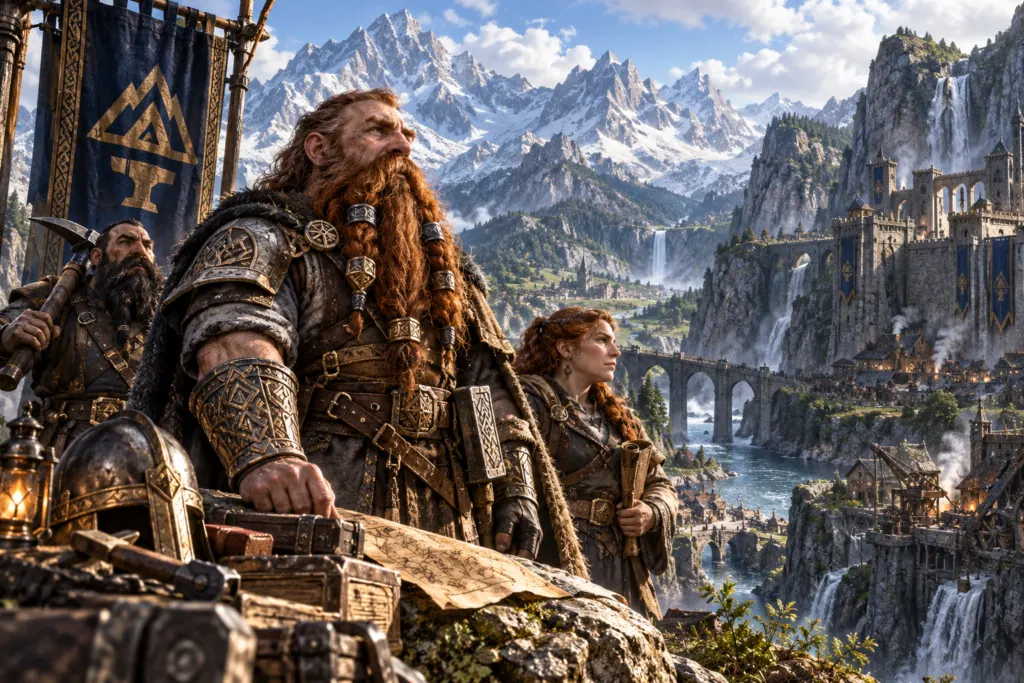
Dwarves are a people of clans, strongholds, guilds, old roads and long memory. Their ancestors built under mountains, worked giant mines, founded free holds, fought ancient wars and carried their crafts into the great cities of the surface world. In 1454, dwarves are found from isolated mountain fortresses to crowded urban workshops, from mining towns to caravan roads.
For a player character, start with four things: your clan, your homeland, your training and your obligation. Your clan tells you who claims you as kin. Your homeland tells you which laws and languages shaped you. Your training tells you what you actually know how to do. Your obligation gives you a reason to care about the world beyond yourself.
Dwarves at a Glance
| People | Dwarves |
|---|---|
| Campaign present | 1454 CE |
| Social backbone | Clans: extended kin groups built through blood, adoption, marriage, oath and recognised descent. |
| Political life | Independent holds, mining towns, guild districts, fortified villages, urban quarters, travelling families and road-warden settlements. |
| Famous traditions | Stonework, metallurgy, mining, engineering, durable craft, defensive building, runes and inherited technical knowledge. |
| Major institutions | Clans, Dwarven Craft Guilds, Stone-Chains, independent holds and Road-Warden networks. |
| Dwarven kindreds | Mountain, lowland/urban and deep-dwarf traditions remain part of the wider dwarf people. Duergar are the major sundered dwarven branch. |
| Common mounts | Mules and ponies for work and travel; war ponies for cavalry; mountain goats in high country; bears for rare elite riders. |
| Historic enemies | Many clans carry old wars against giants and orcs. These are historical conflicts, not compulsory personal hatreds. |
| Languages | A regional dialect of Dwarven, plus the local human or nonhuman language of the character’s homeland. Additional languages come from education, trade, travel and neighbours. Common is not a language in SpiralWorlds. |
| Religion | The oldest dwarven traditions revere the Primal Titans—the primordial powers of earth, fire, stone, metal and the deep world. Modern dwarves may worship gods, ancestors, local spirits or regional pantheons, but divine authority does not automatically override clan, oath or conscience. |
| Bestiary counterpart | Dwarf — Humanoid Creature |
Dwarven Clans
Clan is the heart of traditional dwarven society. A clan is larger than a household and older than a single settlement. It can include families scattered across several holds, towns or kingdoms, all linked by recognised kinship, adoption, marriage, shared ancestors and sworn obligations.
Most dwarves are born into a clan or formally accepted into one. Adoption matters. Marriage can create new ties without erasing old ones. A dwarf cut off from a clan can join another through oath, service or recognition. Clanless dwarves exist, but clanlessness is socially important precisely because clans matter so much.
What a clan gives you
A clan gives a dwarf a recognised place in a wider network: kin to call on, names to invoke, burial rights, hospitality, introductions, apprenticeship contacts, legal witnesses, old maps, family records and claims that may stretch back centuries.
What a clan expects
Clan membership brings obligations. A dwarf may be expected to answer a summons, protect a relative, repay a debt, defend a claim, preserve a secret, honour a marriage settlement or help recover property lost during war, plague or exile.
Clan is not profession
A smithing clan can produce soldiers, scholars and merchants. A famous warrior clan can contain brewers, masons and priests. Guild membership records what you do; clan membership records who stands behind your name.
Clan is not a hold
A hold is a place and a political community. Several clans can share one hold, while a single clan can have branches in many holds and cities. Old clan rivalries can therefore survive changes of ruler, border and language.
Build Your Clan
| Choose | Player question |
|---|---|
| Reputation | What is your clan famous for: craft, war, trade, law, scholarship, mining, road-keeping, wealth, stubbornness, exile or something else? |
| Home | Does the clan control a hold, live across several towns, maintain an urban quarter, travel the roads, or survive in diaspora? |
| Old claim | What mine, workshop, road, relic, debt or territory does the clan still claim? |
| Old enemy | Which clan, ruler, giant house, orc power, guild or creditor appears in the clan records for the wrong reasons? |
| Obligation | What can your clan reasonably ask you to do during the campaign? |
| Secret | What would damage the clan’s reputation if it became public? |
Dwarven Kindreds and the Duergar Schism
Dwarves belong to one widespread people, but long separation has produced distinct regional kindreds. Most of these are cultural and geographic traditions rather than separate species.
Mountain Dwarves
Clans of high holds, steep valleys and fortified passes. Mountain dwarves are famous for quarrying, defensive works, mining roads and heavily protected strongholds. The term describes a way of life and homeland, not a compulsory personality.
Hill and Lowland Dwarves
Clans of hills, river valleys, farming country, market towns and great cities. Many urban dwarf families descend from these lowland traditions and work as merchants, armourers, engineers, assayers, guild officers and householders whose clan networks link city workshops to distant mines and holds.
Deep Dwarves
Dwarf clans that remained in the deep earth without becoming duergar. They keep their own dialects, routes, mining traditions and subterranean settlements. Deep dwarf does not mean duergar.
Duergar
The Duergar are the genuinely sundered branch: descendants of deep clans cut off during the collapse of the giant slave kingdoms and transformed by generations in the deepest roads and under-realms.
The Great Betrayal
When the giant dominions began to collapse, dwarf revolts spread through mines, foundries and underground roads. In several of the deepest complexes, rebels fleeing upward sealed gates, shafts and military passages behind them so pursuing giants, orcs and other armies could not follow.
The decision saved many escaping clans. It also trapped others below.
Surface dwarves remember the sealing as a desperate act of war: if the gates had remained open, the revolt might have been crushed and every escaping family recaptured. The clans left below remember the same event as the Great Betrayal. Their kin reached freedom and closed the way behind them.
The abandoned clans survived in giant slave mines, forgotten deep roads and chambers reaching toward Svartalfaheim. Some seized the workshops of their former masters. Some made bargains with powers of the under-earth. Others endured through discipline, secrecy and relentless labour. Over generations their bodies and magic adapted to darkness, poison, isolation and subterranean war. These clans became the Duergar.
Duergar still possess recognisably dwarven institutions: clans, craft traditions, ancestral memory, oaths, mines and fortified settlements. Their feud with surface dwarves is therefore a family war as much as a racial one. A surface clan may insist, “We sealed the gates or everyone died.” A duergar clan answers, “You chose who counted as everyone.”
What About the Dwerg?
The Dwerg, Keeper of the Buried Claim is not a dwarven subrace. Despite the name and dwarflike appearance, the modern Bestiary treats the dwerg as a separate chthonic fey creature bound to buried wealth, tombs, old workmanship and under-earth claims.
Game Statistics
Choose the rules system used by your campaign. The lore on this page is shared; the mechanics are not.
Dwarf — Pathfinder 1e
Rules source: Pathfinder Roleplaying Game Core Rulebook / Pathfinder Reference Document. This panel preserves the PF1e dwarf as a legacy rules option while separating its mechanical labels from SpiralWorlds setting claims.
| Ability scores | +2 Constitution, +2 Wisdom, –2 Charisma. |
|---|---|
| Size / Type | Medium humanoid with the dwarf subtype. |
| Speed | 20 feet. Armour and encumbrance do not reduce this base speed. |
| Darkvision | 60 feet. |
| Defensive Training | +4 dodge bonus to AC against creatures of the giant subtype. |
| Hardy | +2 racial bonus on saving throws against poison, spells and spell-like abilities. |
| Stability | +4 racial bonus to CMD when resisting bull rush or trip attempts while standing on the ground. |
| Greed | +2 racial bonus on Appraise checks to determine the value of nonmagical goods containing precious metals or gemstones. |
| Stonecunning | +2 on Perception checks to notice unusual stonework. A check is allowed when passing within 10 feet even without actively searching. |
| Hatred | +1 racial bonus on attack rolls against humanoids of the orc and goblinoid subtypes. |
| Weapon Familiarity | Proficient with battleaxes, heavy picks and warhammers; weapons with “dwarven” in the name are treated as martial weapons. |
Languages
SpiralWorlds: a dwarf normally begins play speaking the regional dialect of Dwarven used by their clan, hold or household, plus the local human or nonhuman language of the place where they were raised. A dwarf from Strasbourg, for example, may speak a local Dwarven dialect and the local German speech; a dwarf raised in an orc-ruled region may speak Dwarven and the local Orcish language instead.
Characters with additional languages learn those appropriate to their neighbours, trade, education, travel or profession. Giant, Gnome, Goblin, Orc, Terran and other languages remain valid where the character has a reason to know them. Common is not used in SpiralWorlds. See Speak Language.
Pathfinder 1e Starting Age
| Adulthood | Intuitive | Self-Taught | Trained |
|---|---|---|---|
| 40 years | +3d6 years 43–58 years |
+5d6 years 45–70 years |
+7d6 years 47–82 years |
PF1e categories: Intuitive includes barbarians, oracles, rogues and sorcerers; Self-Taught includes bards, cavaliers, fighters, gunslingers, paladins, rangers, summoners and witches; Trained includes alchemists, clerics, druids, inquisitors, magi, monks and wizards.
Pathfinder 1e Random Height and Weight
| Character | Base Height | Height Modifier | Height Range | Base Weight | Weight Modifier | Weight Range |
|---|---|---|---|---|---|---|
| Male dwarf | 3 ft. 9 in. | +2d4 in. | 3 ft. 11 in.–4 ft. 5 in. | 150 lb. | +(2d4 × 7 lb.) | 164–206 lb. |
| Female dwarf | 3 ft. 7 in. | +2d4 in. | 3 ft. 9 in.–4 ft. 3 in. | 120 lb. | +(2d4 × 7 lb.) | 134–176 lb. |
These are the Pathfinder 1e character-generation tables and belong to the PF1e rules set. They are useful for generating a character’s age and build; they do not require every dwarf in the setting to look identical.
What the PF1e Trait Names Mean in SpiralWorlds
Greed and Hatred are inherited PF1e mechanical names. They do not establish that a dwarf must be greedy or personally hate orcs or goblinoids. Their bonuses can instead represent appraisal training, historical threat recognition, military drill or another character-appropriate explanation.
Dwarf — D&D 3.5e
Rules source: Revised (v.3.5) System Reference Document. Do not substitute the Pathfinder revision for these mechanics.
| Ability scores | +2 Constitution, –2 Charisma. |
|---|---|
| Size | Medium. |
| Speed | 20 feet; this remains 20 feet in medium or heavy armour and while carrying a medium or heavy load. |
| Darkvision | 60 feet. |
| Stonecunning | +2 racial bonus on Search checks involving unusual stonework; automatic opportunity to notice such work within 10 feet; may find stonework traps as a rogue; may intuit approximate depth underground. |
| Weapon Familiarity | Dwarven waraxes and dwarven urgroshes are treated as martial rather than exotic weapons. |
| Stability | +4 on checks to resist bull rush or trip attempts while standing firmly on the ground. |
| Resilience | +2 racial bonus on saving throws against poison; +2 racial bonus on saving throws against spells and spell-like effects. |
| Ancient-foe training | +1 racial bonus on attack rolls against orcs and goblinoids; +4 dodge bonus to AC against creatures of the giant type. |
| Craft knowledge | +2 racial bonus on Appraise checks related to stone or metal items and +2 racial bonus on Craft checks related to stone or metal. |
| Favored Class | Fighter. |
3.5e Languages
Rules as written: Common and Dwarven; bonus languages Giant, Gnome, Goblin, Orc, Terran and Undercommon.
Dwarf — 5.5e / 2024
Rules source: System Reference Document 5.2.1. These traits describe the current 2024 dwarf rules implementation. SpiralWorlds setting material does not add hidden mechanical bonuses.
- Creature Type: Humanoid.
- Size: Medium; typically about 4–5 feet tall.
- Speed: 30 feet.
- Darkvision: 120 feet.
- Dwarven Resilience: Resistance to Poison damage, plus Advantage on saving throws made to avoid or end the Poisoned condition.
- Dwarven Toughness: Hit Point maximum increases by 1, and increases by 1 again whenever the character gains a level.
Stonecunning
As a Bonus Action, the dwarf gains Tremorsense out to 60 feet for 10 minutes while standing on or touching a natural or worked stone surface. This can be activated a number of times equal to the character’s Proficiency Bonus; all expended uses return after a Long Rest.
Character-building principle: ability scores, background, class, skills and moral outlook come from the character-building rules and the individual character—not from a compulsory dwarven personality package.
Dwarves in 1454
Dwarves live everywhere that stone, ore, roads, trade and skilled labour create opportunity. There is no single dwarven kingdom. Instead, dwarven society forms a web of clans, holds, guilds and enclaves that crosses the borders of human and nonhuman states.
A dwarf in 1454 might come from a mountain hold, a mining town, a fortified road station, a city workshop, a caravan family or a scattered clan whose members live under several different rulers. In the Free Imperial City of Strasbourg, dwarves are established householders, armourers, assayers, engineers and traders. In other regions, clans guard old roads, operate mines, serve courts, hold fortresses or carry their tools from market to market.
Where Dwarves Live
Holds
Fortified dwarven settlements built around mines, workshops, water, storage, defensible entrances and ancestral spaces. A hold can be a fortress, town, deep market or political centre.
Cities
Urban dwarves live in craft districts, merchant households and mixed neighbourhoods. Their clan ties can stretch far beyond the city walls.
Roads and passes
Road-warden clans and travelling families maintain routes, escort caravans, survey dangerous country and keep contact between isolated communities.
Lost and displaced communities
Some clans carry keys, deeds and maps to mines or halls they no longer control. Recovering an ancestral property is a classic dwarven adventure because those claims remain politically real.
Dwarven History
The Old Faith — Titans and the Refusal to Kneel
The oldest dwarven religious traditions revere the Primal Titans, the primordial world-shaping powers associated with earth, fire, mountains, metal and the deep places of the world. Early dwarven clans honoured them as ancient powers woven into the structure of creation rather than as distant abstractions.
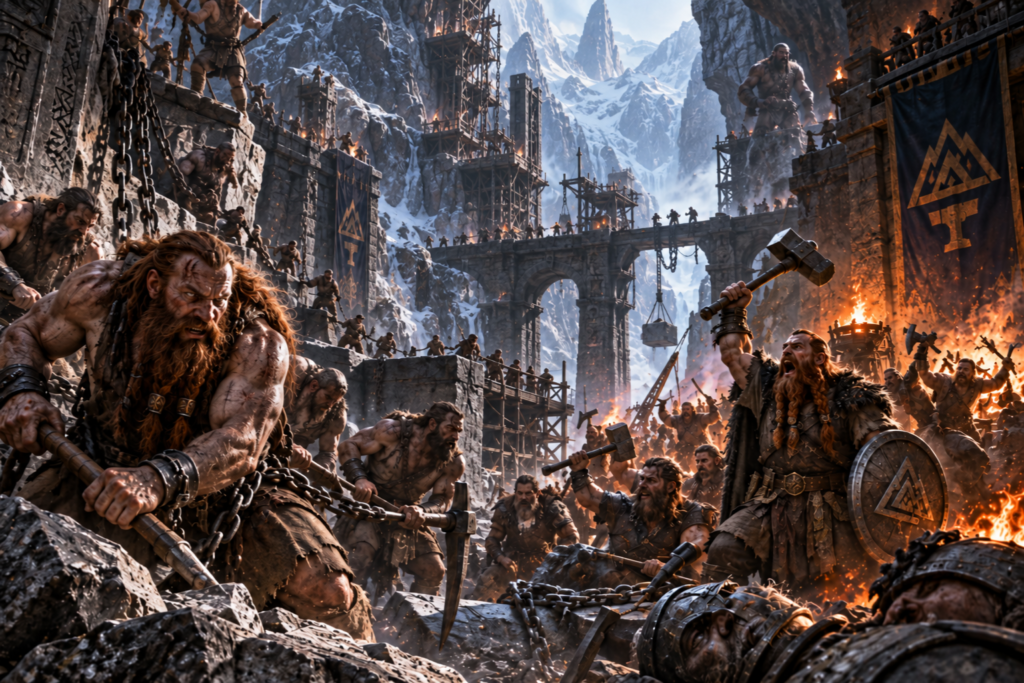
When giant successor dynasties inherited Titan roads, mines, fortresses and foundries, many giant rulers claimed authority as descendants, servants, heirs or appointed guardians of those older powers. In some regions dwarves first accepted giant lordship as part of an inherited sacred order. Tribute and service hardened into coercion, hereditary labour and outright bondage.
The revolts that broke giant rule therefore changed dwarven religion as well as dwarven politics. Dwarves did not necessarily abandon gods or the Titans, but they learned to separate reverence from submission. A powerful being, priest or ruler can be worthy of worship and still have no automatic right to command a clan.
That memory still shapes relations in 1454. God-devout peoples generally know that attempts to impose divine authority, sacred bloodline or priestly command upon dwarves can provoke fierce resistance. Dwarves have already lived beneath rulers who claimed heaven and the elder world gave them the right to rule.
Giant Bondage and the Free Holds
During The Shattered Crown, giant successor realms seize mines, quarries, foundries and underground roads. Many dwarves are forced into those systems as miners, builders, engineers and smiths. Dwarven resistance grows inside the workshops themselves: hidden tools, ruined stores, false plans, concealed routes and armed revolt.
When giant authority breaks, dwarf communities seize strongholds, flee into refuges or establish new holds around the infrastructure they know best. Some clans had remained free throughout the giant age. Others carry uncomfortable records of collaboration. That difference still matters in clan politics thousands of years later.
The First Golems
Dwarves were the first mortal people on Earth to formalise true golem-making. Elder powers, outsiders and alien civilisations had built constructs and artificial servitors long before them, but the golem tradition later mortal peoples recognise—a crafted body bound to a durable animating force and given standing commands—began in dwarven workshops.
The earliest dwarven golems were guardians, not conquest engines. Small free communities used them to hold gates, watch escape tunnels, protect children and elders, guard workshops and archives, and keep standing when too few living defenders remained. The craft grew directly from the determination that no dwarven settlement should again survive only at the mercy of a stronger ruler.
Later peoples copied, stole, purchased or independently reconstructed parts of the tradition, but dwarven clans still regard golem-craft as an ancestral achievement. Some ancient guardians remain at abandoned holds and sealed roads, obeying clan marks and commands written before recorded human history. See Golems.
The First War with the Orcs
The dwarf–orc conflict begins in the wreckage of the giant world. Dwarf refugees and orc clans fight over roads, weapons, ruined forts and mountain territory. During The Rooting Age, the War of the Broken Road turns those struggles into inherited clan history.
By 1454 the feud is ancient, but it is political and historical rather than instinctive. A dwarf character can inherit a clan grudge, reject it, exploit it or discover that the family version of events left out important facts. See Orc, Common and the modern orc successor powers.
Holds, Guilds and Stone-Chains
Holds
A hold is a settlement and political community, not a clan. Several clans can share one hold, compete for office, control different workshops or divide responsibility for defence, water, mines and trade. Older hold-towns and deep markets already used many forms of government: assemblies, craft elders, mine-right judges, hereditary keepers and elected war leaders.
Dwarven Craft Guilds
The Dwarven Craft Guilds link professionals across political borders. They certify apprentices, preserve standards, extend credit, share specialist knowledge and recognise qualifications. A guild answers the question “What do you do?” A clan answers “Who are your people?”
Stone-Chains
The Black Death creates the Stone-Chains: mutual-aid networks that preserve duplicate records, tools, deeds, family claims, apprenticeships and emergency funds when a community is destroyed or expelled. The Stone-Chains do not rule dwarves. They keep dwarven communities connected when rulers, borders and cities fail. See Plague, Labour and Broken Authority.
Craft, War and Engineering
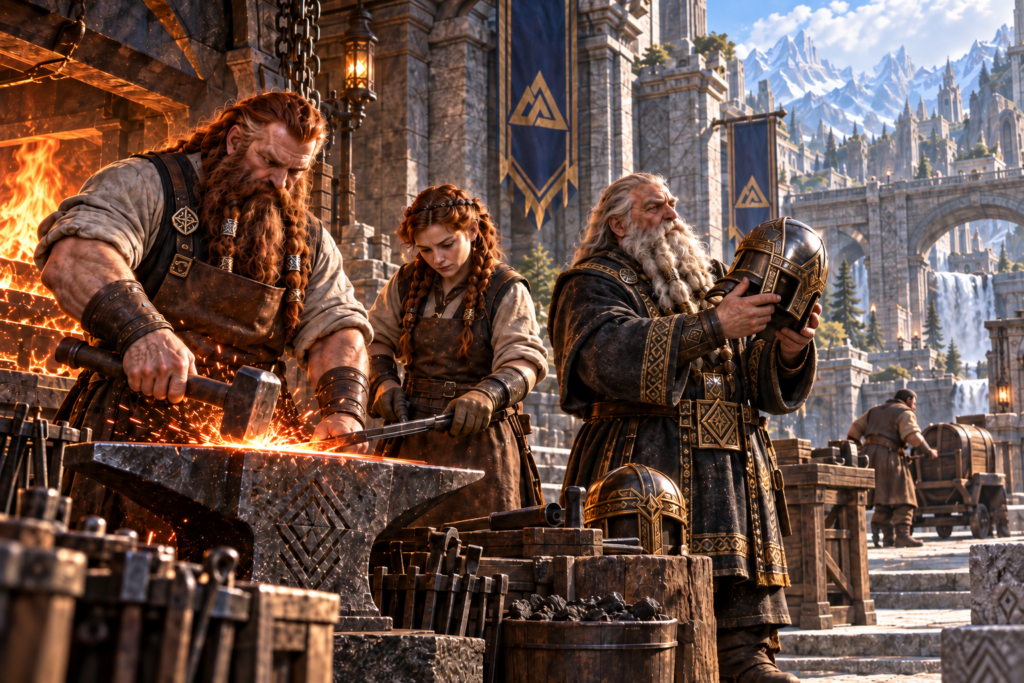
Dwarven fame for stonework and metalwork is earned. Mining, masonry, armourmaking, siege engineering, surveying, durable construction and the ancestral craft of guardian golems run through many clan histories because those skills built holds, won wars and kept communities alive underground.
That reputation does not make every dwarf a smith. Skills are taught. A character who knows stone, steel, runes or engineering should know who trained them: a parent, clan elder, guild master, military engineer, city workshop, university or travelling specialist.
The Breaking Paths establishes another important rule: dwarven technology is not uniform. A rich iron hold, an isolated mountain clan and an urban armourers’ guild can preserve completely different technical traditions.
Dwarven Mounts
Dwarves favour mounts that are strong, sure-footed and useful on broken roads. A mount is chosen for the terrain and the job, not because every dwarf rides the same animal.
| Mount | Common use | Dwarven tradition |
|---|---|---|
| Mule | Mines, caravans, engineering trains and heavy loads. | The most practical dwarven pack animal. Mules work narrow roads, carry tools and supplies, and need less ceremony than a war mount. |
| Pony | Everyday riding, messengers, travel and light cavalry. | Ponies suit dwarven stature and mountain roads. Well-bred clan ponies are valuable working animals rather than decorative pets. |
| War Pony | Scouts, hold guards and mounted warriors. | Used where roads and open ground allow organised cavalry. War ponies are far more common than bears in an actual dwarven army. |
| Mountain Goat | High passes, steep tracks and difficult uplands. | Some mountain clans breed unusually large, sure-footed goats as pack animals and riding beasts for terrain too steep for ordinary ponies. |
| Brown Bear | Elite clan champions and famous heavy riders. | Bear Riders are rare and prestigious. Training a bear is dangerous, expensive and strongly associated with particular northern and mountain clans. |
| Dire Bear | Legendary champions, heroes and exceptional war leaders. | A dire-bear rider should be memorable even among dwarves. These are not ordinary cavalry mounts. |
Bear Riders
Dwarven Bear Riders are an old and famous martial tradition preserved by a small number of clans. A bear rider is not simply a dwarf who bought an exotic animal. Rider and bear are trained together, usually through a clan lodge, military household or inherited tradition that knows how to raise, feed and control such dangerous mounts.
In battle, Bear Riders serve as shock cavalry, clan champions and guards for important passes or rulers. Most dwarven forces still rely on infantry, pack animals, ponies and engineering trains. The rarity of Bear Riders is exactly what makes them impressive.
Dire boars are not a signature dwarven mount. In SpiralWorlds they are strongly associated with orc warfare, which gives dwarf bear cavalry a distinctive visual and military identity of its own.
Dwarven Magic
Dwarven magic favours things that must endure: doors, foundations, weapons, tools, wells, tunnels, oath stones, tombs, ancestral halls and guardian golems. Runes, stone wards and construct craft often pass through clans and specialist lineages, while learned magic also travels through guilds, schools, courts, universities, temples and private masters. The oldest mortal golem tradition is dwarven.
A dwarven Fighter might be a clan champion or siege engineer. A Ranger might guard holdroads and mountain passes. A scholar might read giant masonry. A magician might inherit a clan warding tradition.
Languages and Names
Dwarves normally grow up bilingual. They speak the regional dialect of Dwarven used by their clan, hold or household, and the local human or nonhuman language of the country, city or neighbouring people among whom they live. Common is not a language in SpiralWorlds.
Dwarven is not one perfectly uniform world language. Holds, clans and long-separated communities develop regional dialects, old technical terms and local expressions. Dwarves from distant regions can usually recognise one another’s speech, but strong dialects may require patience, especially where communities have been isolated for centuries.
Additional languages come from trade, scholarship, military service, travel and neighbouring peoples. Names follow homeland and clan: a dwarf can use a local personal name, a Dwarven personal name, a clan name, a hold-name or an earned byname. Use Speak Language for the site’s language rules.
Gods, Ancestors and Clan Rites
Dwarven religion begins in deep antiquity with reverence for the Primal Titans: primordial powers of earth, fire, stone, metal, mountains and the deep world. Later clans add ancestors, local spirits, forge and protective powers, regional gods and the pantheons of neighbouring peoples.
No single god rules all dwarves. Religion follows clan history, homeland, temple allegiance and personal devotion. Urban dwarves may worship the same regional gods as their neighbours while still preserving ancestral names, burial rights, liberation oaths and old clan rites.
The central cultural lesson of giant bondage is simple: worship is not ownership. Dwarves can be devout without accepting that a priest, king, god, sacred bloodline or divine messenger automatically has the right to command them. Oaths freely sworn matter enormously; demands justified only by superior power or claimed divine favour do not.
This reputation is well known among other god-devout peoples. Attempts to force a cult, divine ruler or sacred hierarchy onto a dwarven clan are likely to be treated not as ordinary politics but as the beginning of another chain.
Appearance
Dwarves are short, broad and powerfully built by human standards. Hair and beards are often culturally important, especially in traditional clans, and may be braided, clasped or marked for family, office, mourning, craft or military service. These customs vary by clan and region.
Dwarves in the Campaign Right Now
Clan claims are becoming political
Old deeds, mine rights and plague-era records are resurfacing. A clan that can prove ownership may upset a prince, guild or city that has controlled the property for generations.
Lost holds are opening
Old tunnels, giant roads and abandoned mines are being rediscovered. Every opening raises the same question: treasure, survivors, monsters—or someone else’s legal claim?
Orc frontiers are active
Ancient clan feuds now meet modern orc states, armies and trade routes. Some clans prepare for war; others make hard bargains with neighbours their ancestors called enemies.
Giant powers still matter
Surviving giant realms keep some ancient conflicts current. A clan may treat liberation from giants as history while another still has relatives living under giant rule.
Stone-Chains guard the records
Records created during the Black Death can decide modern inheritances. Anyone trying to erase a clan, steal a mine or cancel a debt has a reason to destroy those archives.
Duergar raids create suspicion
Some duergar cells raid mines and settlements. Surface dwarf clans are often among their first targets, even when outsiders fail to make the distinction.
Build Your Dwarf
- Choose your clan. Give it a reputation, an old claim and one current problem.
- Choose your homeland. Hold, city, mine, road, court, valley, frontier or travelling community.
- Choose your rules system. Use only the 5.5e, PF1e or 3.5e mechanics from the matching tab.
- Choose your languages. Use real regional languages; do not write “Common.”
- Choose your training. If you know craft, stonework, warfare or magic, name the person or institution that taught you.
- Choose your clan obligation. A debt, summons, inheritance, feud, marriage promise, missing relative, apprenticeship or lost property.
- Choose why you adventure. Recover a hold, defend the clan, escape its expectations, make a fortune, solve an old wrong or build a reputation of your own.
Player Questions
- What is your clan called, and what is it famous for?
- Which clan member taught you the story everyone expects you to believe?
- What does your clan own—or insist it still owns?
- Which clan is your traditional rival?
- Who in your clan can ask you for help and expect you to answer?
- What craft, trade or skill do strangers wrongly assume you know?
- What do you think about your clan’s old enemies?
- What would make you choose your adventuring companions over your clan?
Adventure Hooks
- The Duplicate Deed. A Stone-Chain archive proves that a workshop district belongs to a dwarf clan expelled during the plague. The current owners have a royal grant.
- The Broken Clan Oath. Two branches of the same clan produce different versions of an ancestral oath. Both claim the other branch altered the record.
- The Road Beneath the Road. Repairs uncover an ancient giant slave road beneath a mountain pass. One branch leads toward a sealed dwarf refuge; another shows recent use.
- The Last Witness. An elderly dwarf remembers the terms of a treaty signed before any living human was born. Several rulers need that memory to be wrong.
- The Unfreed Hold. Evidence reaches the clan that dwarves are still held by a surviving giant power. A rescue could start a war.
- The Stolen Clan Book. Someone steals the genealogy and deed-book that proves several marriages, inheritances and property claims. Half the city suddenly has a motive.
- The Orc Gate. A dwarf clan and an orc-controlled road must cooperate against a third enemy. Both sides have centuries of reasons not to trust the other.
- The Apprentice Without a Master. A dead guild master leaves three apprentices, one unfinished commission and a clan dispute over who inherits the workshop.
Related SpiralWorlds Entries
Sources, Attribution and Licensing
SpiralWorlds Canon Sources
- Player Resources — people, individuality and edition separation.
- The Shattered Crown — giant slave systems, free communities and the first dwarf–orc conflicts.
- The Rooting Age — first free holds and the War of the Broken Road.
- The Blooming Cities — hold-towns, markets and government.
- The Breaking Paths — multiple dwarf histories and uneven technological development.
- Plague, Labour and Broken Authority — Stone-Chains, duergar raids and plague-era persecution.
- Guilds, Factions & Organisations — Dwarven Craft Guilds, Stone-Chains and Road-Warden networks.
- Strasbourg — urban dwarven life in 1454.
Rules Sources
- System Reference Document 5.2.1 — current 5.5e / 2024 dwarf mechanics.
- Archives of Nethys — Dwarf — Pathfinder 1e racial mechanics.
- Revised (v.3.5) SRD — Races — D&D 3.5e dwarf racial mechanics.
Legacy Page Audit
The former Race Dwarves page contained Pathfinder-derived setting prose, a Pathfinder 1e racial-traits block, three Discord-hosted images and three legacy 2014-era 5e videos. The rebuild retains the valid PF1e mechanics inside the PF1e panel but replaces the setting prose with current SpiralWorlds canon. The three dead external images are removed. The three legacy videos remain preserved in the editorial audit ledger but are not republished here because they duplicate one another, predate the current 5.5e rules and carry setting assumptions that do not govern SpiralWorlds.
SRD 5.2.1 Attribution
This work includes material from the System Reference Document 5.2.1 (“SRD 5.2.1”) by Wizards of the Coast LLC, available at https://www.dndbeyond.com/srd. The SRD 5.2.1 is licensed under the Creative Commons Attribution 4.0 International License, available at https://creativecommons.org/licenses/by/4.0/legalcode.
Legacy Open Game Content
Mechanical rules material inside the Pathfinder 1e and D&D 3.5e panels is designated Open Game Content only to the extent that it derives from material already released as Open Game Content under the Open Game License version 1.0a.
No other portion of this page is designated Open Game Content. SpiralWorlds setting material, 1454 campaign material, original explanatory prose, artwork, CSS, page design, adventure material and editorial presentation are excluded from that designation.
Open Game License v1.0a + applicable Section 15 notices
OPEN GAME LICENSE Version 1.0a
The following text is the property of Wizards of the Coast, Inc. and is Copyright 2000 Wizards of the Coast, Inc (“Wizards”). All Rights Reserved.
1. Definitions: (a) “Contributors” means the copyright and/or trademark owners who have contributed Open Game Content; (b) “Derivative Material” means copyrighted material including derivative works and translations (including into other computer languages), potation, modification, correction, addition, extension, upgrade, improvement, compilation, abridgment or other form in which an existing work may be recast, transformed or adapted; (c) “Distribute” means to reproduce, license, rent, lease, sell, broadcast, publicly display, transmit or otherwise distribute; (d) “Open Game Content” means the game mechanic and includes the methods, procedures, processes and routines to the extent such content does not embody the Product Identity and is an enhancement over the prior art and any additional content clearly identified as Open Game Content by the Contributor, and means any work covered by this License, including translations and derivative works under copyright law, but specifically excludes Product Identity; (e) “Product Identity” means product and product line names, logos and identifying marks including trade dress; artifacts; creatures characters; stories, storylines, plots, thematic elements, dialogue, incidents, language, artwork, symbols, designs, depictions, likenesses, formats, poses, concepts, themes and graphic, photographic and other visual or audio representations; names and descriptions of characters, spells, enchantments, personalities, teams, personas, likenesses and special abilities; places, locations, environments, creatures, equipment, magical or supernatural abilities or effects, logos, symbols, or graphic designs; and any other trademark or registered trademark clearly identified as Product identity by the owner of the Product Identity, and which specifically excludes the Open Game Content; (f) “Trademark” means the logos, names, mark, sign, motto, designs that are used by a Contributor to identify itself or its products or the associated products contributed to the Open Game License by the Contributor; (g) “Use”, “Used” or “Using” means to use, Distribute, copy, edit, format, modify, translate and otherwise create Derivative Material of Open Game Content; (h) “You” or “Your” means the licensee in terms of this agreement.
2. The License: This License applies to any Open Game Content that contains a notice indicating that the Open Game Content may only be Used under and in terms of this License. You must affix such a notice to any Open Game Content that you Use. No terms may be added to or subtracted from this License except as described by the License itself. No other terms or conditions may be applied to any Open Game Content distributed using this License.
3. Offer and Acceptance: By Using the Open Game Content You indicate Your acceptance of the terms of this License.
4. Grant and Consideration: In consideration for agreeing to use this License, the Contributors grant You a perpetual, worldwide, royalty-free, non-exclusive license with the exact terms of this License to Use, the Open Game Content.
5. Representation of Authority to Contribute: If You are contributing original material as Open Game Content, You represent that Your Contributions are Your original creation and/or You have sufficient rights to grant the rights conveyed by this License.
6. Notice of License Copyright: You must update the COPYRIGHT NOTICE portion of this License to include the exact text of the COPYRIGHT NOTICE of any Open Game Content You are copying, modifying or distributing, and You must add the title, the copyright date, and the copyright holder’s name to the COPYRIGHT NOTICE of any original Open Game Content you Distribute.
7. Use of Product Identity: You agree not to Use any Product Identity, including as an indication as to compatibility, except as expressly licensed in another, independent Agreement with the owner of each element of that Product Identity.
You agree not to indicate compatibility or co-adaptability with any Trademark or Registered Trademark in conjunction with a work containing Open Game Content except as expressly licensed in another, independent Agreement with the owner of such Trademark or Registered Trademark. The use of any Product Identity in Open Game Content does not constitute a challenge to the ownership of that Product Identity.
The owner of any Product Identity used in Open Game Content shall retain all rights, title and interest in and to that Product Identity.
8. Identification: If you distribute Open Game Content You must clearly indicate which portions of the work that you are distributing are Open Game Content.
9. Updating the License: Wizards or its designated Agents may publish updated versions of this License. You may use any authorized version of this License to copy, modify and distribute any Open Game Content originally distributed under any version of this License.
10. Copy of this License: You MUST include a copy of this License with every copy of the Open Game Content You Distribute.
11. Use of Contributor Credits: You may not market or advertise the Open Game Content using the name of any Contributor unless You have written permission from the Contributor to do so.
12. Inability to Comply: If it is impossible for You to comply with the terms of this License with respect to some or all of the Open Game Content due to statute, judicial order, or governmental regulation then You may not Use any Open Game Material so affected.
13. Termination: This License will terminate automatically if You fail to comply with all terms herein and fail to cure such breach within 30 days of becoming aware of the breach. All sublicenses shall survive the termination of this License.
14. Reformation: If any provision of this License is held to be unenforceable, such provision shall be reformed only to the extent necessary to make it enforceable.
15. COPYRIGHT NOTICE
Open Game License v 1.0a Copyright 2000, Wizards of the Coast, Inc.
System Reference Document. Copyright 2000, Wizards of the Coast, Inc.; Authors Jonathan Tweet, Monte Cook, Skip Williams, based on material by E. Gary Gygax and Dave Arneson.
Pathfinder Roleplaying Game Core Rulebook. © 2009, Paizo Publishing, LLC; Author: Jason Bulmahn, based on material by Jonathan Tweet, Monte Cook, and Skip Williams.
Pathfinder Roleplaying Game Reference Document. © 2011, Paizo Publishing, LLC; Author: Paizo Publishing, LLC.
END OF LICENSE