
East Central Europe
Wars are beginning, thrones are insecure, the Carpathian frontier is breaking open, and every road leads through somebody’s jurisdiction.
East Central Europe at a Glance
| Campaign Present | 1454 CE |
|---|---|
| Region | Baltic approaches, Poland, Lithuania, Bohemia, Hungary, Carpathian lands, Wallachia and Moldavia |
| Political Character | Independent kingdoms, grand duchies, principalities, noble territories, chartered towns and contested borderlands |
| Major Powers | Kingdom of Poland, Grand Duchy of Lithuania, Kingdom of Bohemia, Kingdom of Hungary, Wallachia, Principality of Moldavia |
| Principal Centres | Kraków, Vilnius, Prague, Buda, Târgoviște, Suceava |
| Great Frontiers | Teutonic States to the north; the Empire to the west; Rus lands and steppe powers to the east; Balkans and the lower Danube to the south |
| Landscape | Great forests, Baltic plains, cultivated river valleys, marshes, the Danube basin and the Carpathian Mountains |
| Languages | Polish, Lithuanian, Ruthenian, Czech, Hungarian, Romanian/Moldavian, German and numerous regional languages; learned and administrative languages vary. There is no Common. |
| Campaign Themes | War, succession, disputed borders, monster hunting, espionage, trade, wilderness travel and occult politics |
| Supernatural Powers | Vampires, undead households, forest and river beings, covens, learned magical circles and the Scholomance |
| Immediate Threats | Hell Knights, the Ninefold Dominion, predatory nobles, rival claimants, hostile monsters, mercenary armies and supernatural factions |
A Region Made for Adventurers
East Central Europe lies between the Baltic, the Empire, the Rus lands, the Danube and the Black Sea approaches. It is not one country and nobody rules it as a whole. Kings share power with nobles, diets, town councils and military commanders; princes depend upon fortress captains; merchant communities cross borders that armies cannot; and mountain valleys may recognise customs older than the state claiming them.
A traveller can leave the markets of Kraków with a royal safe-conduct, discover that it means little inside another lord’s estate, cross a forest where no human authority matters at all, and reach the Carpathians carrying documents that three governments would kill to read.
This is why adventurers come here. Armies require scouts. Merchants require escorts. Claimants require deniable agents. Towns need monster hunters. Courts need interpreters, messengers and spies. Villagers need somebody prepared to enter a marsh after sunset. Scholars seek manuscripts that sensible people have deliberately hidden. Every successful journey creates new allies, enemies and obligations.
What Is Happening Right Now?
The Teutonic War Has Begun
The old victory at Tannenberg did not make the Teutonic States harmless.
The opposite is true.
In 1454, cities and nobles inside the Teutonic state rise against its rulers and seek Casimir IV’s protection. Poland intervenes and the conflict that history remembers as the Thirteen Years’ War begins. Historically this struggle ran from 1454 to 1466; in SpiralWorlds the situation is considerably darker because the Teutonic States are also the home of the Hell Knights, an organised Lawful Evil military power with infernal connections.
The northern frontier therefore becomes one of the most dangerous places in Europe. Towns change allegiance. Mercenary companies negotiate their price. Fortresses control roads and rivers. Hell Knights attempt to identify which rebels can be frightened, bought, corrupted or publicly destroyed.
For adventurers, the war can begin with something as small as carrying a message through a checkpoint.
Casimir Rules Two Realms, Not One Country
Casimir IV is both King of Poland and Grand Duke of Lithuania, but Poland and Lithuania remain politically distinct. Their nobles, offices, laws and priorities do not simply merge because the same ruler stands above both.
War magnifies the problem. Casimir needs soldiers and money while powerful groups expect consultation and concessions. The political bargains of 1454 lead to the Nieszawa privileges, which significantly restrict unilateral royal action and strengthen regional noble assemblies.
A royal seal is therefore powerful—but never magical proof that everybody will obey.
Bohemia Is Governed through an Uneasy Balance
Ladislaus the Posthumous wears the Bohemian crown, but George of Poděbrady remains the dominant governor and political organiser. George was elected governor in 1452 and continued exercising practical authority after Ladislaus formally took the throne.
Bohemia has survived years of rebellion, divided authority and military innovation. Wagon fortifications, disciplined infantry and early firearms have changed how communities expect wars to be fought. The great reform conflicts are no longer treated as a surviving Abrahamic church dispute in SpiralWorlds; what matters in play is the political legacy—armed communities, competing noble blocs, veterans, fortified towns and arguments over who possesses legitimate authority.
Hungary Guards More Than One Southern Frontier
Ladislaus V is King of Hungary. John Hunyadi is no longer regent, but remains one of the realm’s central military figures as Captain-General.
Hungary does not face one convenient southern enemy.
The Ottoman state remains an independent power. The hobgoblin Ninefold Dominion is another. They have their own rulers, armies, interests and wars.
That distinction is fundamental to SpiralWorlds.
The Dominion seized Constantinople in 1453 and now tries to turn the city into the strategic centre of further conquest. Its Third Muster explicitly seeks to break resistance in the Carpathians.
Dracula Has Stopped the First Dominion Advance
Wallachia is no passive border principality.
In SpiralWorlds, Vlad III returned earlier than in conventional history. He is already a vampire and already building a state capable of resisting the forces pressing toward the Carpathians.
Vlad is evil, increasingly brutal and perfectly capable of atrocities. That does not make his enemies good.
Dominion infantry, artillery and fortified supply columns expected to overwhelm divided Carpathian rulers. Instead they met ambushes, destroyed forage, night attacks, undead forces and Vlad’s deliberate use of terror. The first advance has been repulsed. The Dominion is preparing to try again.
Wallachia therefore creates one of the setting’s strongest dilemmas: what happens when the monster holding the frontier may actually be the reason the frontier still exists?
Moldavia Is Fighting over Its Own Throne
Moldavia is already one of the strongest rebuilt child locations beneath this region.
Alexăndrel holds the princely seat at the page opening, while Petru Aron remains a dangerous claimant with supporters of his own. Fortress commanders, boyars, customs officials and merchant interests have to decide whose commands remain legitimate as circumstances change.
The conflict makes ordinary jobs dangerous. A caravan escort can become evidence of political allegiance. A genuine sealed order may be treason by the time it reaches its destination.
Constantinople Has Changed Every Calculation
The Ninefold Dominion now occupies Constantinople.
That alters Black Sea trade, Danubian defence, diplomacy and military planning without magically making every southern state part of the same conflict. Ottoman rulers remain separate. Balkan rulers retain their own interests. Venice, Hungary, Wallachia, Moldavia, Kemet and other powers react according to their own needs.
The Great Powers
Kingdom of Poland
Poland is a major kingdom centred on Kraków, with extensive agricultural wealth, powerful noble interests and close dynastic ties to Lithuania.
Its most urgent problem is now the northern war. Rebellion inside the Teutonic States gives Casimir an opportunity to weaken a dangerous neighbour, but war requires money, troops, agreements and commanders he cannot simply conjure into existence.
Grand Duchy of Lithuania
Lithuania is enormous, multilingual and politically distinct from Poland despite sharing Casimir IV.
Its centre is Vilnius, while its territories extend deep into lands shaped by the inheritance of the Rus principalities. Lithuanian politics therefore face west toward Poland and the Baltic while simultaneously dealing with eastern towns, nobles, trade routes and the fractured successor world beyond them.
The Grand Duchy should feel too large to summarise as Poland’s eastern partner. A campaign can remain inside Lithuania for years without needing Kraków at all.
Kingdom of Bohemia
Bohemia connects Prague, wealthy towns, mines, noble estates and veteran military communities to the eastern edge of the Empire.
Its recent wars have made political organisation inseparable from military experience. Men who learned to defend communities with wagons, handguns and disciplined infantry have not forgotten those lessons merely because the largest campaigns ended.
A Bohemian adventure should feel different from a Polish or Hungarian one: more urban, politically argumentative, heavily fortified and full of people who already know that recognised authority can collapse.
Kingdom of Hungary
Hungary controls one of the great strategic spaces of the region.
Buda looks over the Danube and the roads connecting western Europe to the plains, Balkans and Carpathian approaches. The kingdom possesses powerful nobles, mounted forces, fortified southern approaches and one of the most experienced commanders alive in John Hunyadi.
Its weakness is not lack of military ability. It is that too many dangers demand attention simultaneously.
Wallachia
Wallachia lies between the southern Carpathians and the Danube.
Its ruler, Vlad Dracula, turns the principality into a weapon.
Roads are watched. Fortresses prepare for another Dominion advance. Captured enemies disappear. Impaled bodies carry deliberate messages. Undead servants move after ordinary soldiers have stopped marching.
But villages still need crops gathered. Merchants still need roads. Families still live between armies.
That is where adventurers enter.
Principality of Moldavia
Moldavia is a fortified trade corridor between the Carpathians and Black Sea approaches. Its contested succession, powerful boyars, customs posts, river routes and local supernatural dangers all affect travel and trade.
The Road toward Zeta and the Balkans
The Principality of Zeta lies farther south, toward the Adriatic approaches. Roads from Hungary lead into the Balkans, where princely rivalries and frontier wars draw travellers beyond the Danube.
Cities Where Adventures Begin
Kraków is the political heart of Poland: royal business, noble assemblies, foreign envoys, wealthy merchants, universities, workshops and news from the Baltic war.
Vilnius is the grand-ducal centre of Lithuania and the natural starting point for campaigns moving into its eastern territories.
Prague remains one of the great political cities of the region: fortified, wealthy, argumentative and filled with factions that survived years of internal war.
Buda commands the Danube and the Hungarian court. Soldiers, diplomats, merchants and spies all move through it because decisions made there can affect the southern frontier.
Târgoviște is Vlad’s capital and therefore an exceptionally dangerous place to attract official attention.
Suceava sits at the heart of Moldavia’s succession struggle, where a sealed letter can matter as much as a sword.
People Who Matter
Casimir IV must fight the Teutonic States without allowing war to make him politically weaker at home.
Ladislaus V possesses crowns whose governments depend heavily upon other powerful men.
George of Poděbrady has turned practical political control into something approaching kingship in all but name.
John Hunyadi remains one of the most dangerous military commanders in the region.
Alexăndrel and Petru Aron compete over a Moldavian throne neither side can afford to surrender.
And Vlad Dracula no longer needs to become the monster whispered about in later stories.
He already is one.
The Carpathians also shelter older predators. Count Orlok occupies an ancient castle deep in the mountains and belongs to the wider regional supernatural landscape rather than to a random encounter table.
Factions and Hidden Powers
Political borders do not contain every organisation operating here.
The Hell Knights belong specifically to the Teutonic States. The Scholomance operates within the Carpathian sphere. The Witches of the Howling Moon, House of Dracula, Black Moon Coven, Brotherhood of the Night, Daughters of the Flame and the transregional Van Helsing Circle all have reasons to send agents through these lands. Merchant influence arrives through the Hanseatic League, while dwarven craft networks and road-warden communities can connect mines, workshops, enclaves and mountain roads without creating a dwarven nation-state.
Explore the wider network in the SpiralWorlds Factions & Organisations index.
A faction appearing in a country does not mean it controls that country.
Magic in East Central Europe
Magic belongs to ordinary society without becoming ordinary in effect.
Court scholars advise rulers. University masters teach learned natural philosophy. Civic teachers, guild specialists, private circles and master-apprentice traditions preserve difficult knowledge. Village healers know plants, inherited charms and the behaviour of local spirits. Miners learn which underground sounds mean unstable rock and which mean something is walking beneath them.
The Carpathians add a darker layer.
The Scholomance is real. Its reputation attracts ambitious students, frightened rulers, stolen manuscripts, infernal teachers and people determined to destroy knowledge they believe should never have been taught. Armaros is already established as teaching magic there.
Knowledge therefore moves through the region like any other dangerous commodity: purchased, stolen, inherited, copied, censored, smuggled and occasionally weaponised.
Creatures of the Region
East Central Europe should never become “the vampire region” and stop there.
The Carpathians are the strongest centre for vampires, vampire spawn, Vila, werewolves, Vilkacis, dangerous mountain beings and unique undead powers.
The great forests support wolves, worgs, winter predators, hostile fey, old woodland beings and monsters that can survive far from settlement.
The rivers, marshes and flooded ground are natural territories for Vodyanoi, rusalki, drowned undead and beings tied to particular pools, mills or crossings.
Battlefields, abandoned fortifications and plague landscapes produce their own dead.
The existing Slavic Bestiary already provides a substantial regional creature library including vampires, Dracula, Count Orlok, Vila, Vilkacis, Vodyanoi, winter wolves, worgs, wraiths and several forms of undead.
The important rule is ecological: a creature appears because it belongs there, has travelled there or has been brought there—not because it happens to appear on a “Slavic monsters” list.
Roads, Rivers and Mountain Passes
The region is connected by movement.
The Vistula system draws Polish trade toward the Baltic. The Danube ties Hungary to the Empire and Balkans. The Dniester and Prut connect Moldavia toward the Black Sea and eastern routes. Carpathian passes determine where armies, merchants and fugitives can realistically cross the mountains.
A road is therefore never just distance on a map.
It may pass through six different jurisdictions. A bridge may collect tolls for a lord who does not control the villages beyond it. A ferry master may know more about troop movement than the local governor. A mountain guide may recognise boundaries invisible to every royal mapmaker.
The Silk Road remains a useful wider connection, but it should no longer be used as a substitute for explaining these regional networks.
Law, Borders and Travel
There is no single East Central European law.
A traveller encounters royal officers, noble retainers, town courts, customs officials, fortress commanders, village authorities and private jurisdictions.
Weapons are ordinary on dangerous roads but alarming inside a royal audience. Foreign coin may be accepted by weight. Merchants carrying valuable goods can expect tolls and inspections. Letters of safe-conduct matter only where the issuing authority is recognised.
Magic is judged primarily by what somebody does with it. Healing a wounded traveller is not the same act as coercing a magistrate, breaking a fortress gate or raising the dead inside a town.
And during war, ordinary behaviour acquires political meaning.
A map may be espionage.
A wagonload of grain may be military supply.
A messenger may be a traitor before he knows the ruler has changed.
Rumours and Adventure Hooks
| d8 | What the Characters Hear |
|---|---|
| 1 | A Teutonic fortress commander wants to surrender, but only to people capable of extracting his family before the Hell Knights discover his intentions. |
| 2 | Two royal messengers carry genuine Polish orders concerning the same town. The orders contradict each other. |
| 3 | A Bohemian veteran has discovered that somebody is purchasing old wagon-fort equipment in enormous quantities under several false names. |
| 4 | A Hungarian commander has disappeared while inspecting a Carpathian pass. His horse returned carrying blood that is not human. |
| 5 | A Dominion engineer wants to defect from the Carpathian campaign and knows exactly how the next invasion will be supplied. Dracula wants him alive too. |
| 6 | A Moldavian fortress refuses to recognise either claimant and has closed its gates. Everyone inside stopped sending messages three nights ago. |
| 7 | Count Orlok has invited six important travellers to dinner. Five have disappeared. The sixth insists the Count saved their life. |
| 8 | A merchant caravan crosses three borders safely and vanishes on a road considered too well travelled for bandits. Its wagons are later found arranged in a perfect circle around an ancient boundary stone. |
Every one of these adventures should work the same way: the characters go somewhere, meet the people who live there, discover the local conflict, change something, and can then leave carrying consequences with them.
The Deeper History
Tannenberg remains a great Polish-Lithuanian victory, but it does not end the Teutonic problem. Internal political and economic weakness follows, local opposition grows, and in 1454 the conflict explodes again.
Bohemia’s wars prove that disciplined communities, wagon defences and firearms can resist forces that appear stronger on paper. Their political consequences survive the campaigns themselves.
Hungary still carries the consequences of earlier destruction, dynastic conflict and continual pressure along its southern approaches, but the old page’s claim that it has simply fought “the Ottoman Empire for two hundred years” is removed.
The Empire remains west of this region under Frederick III. Albert II belongs to the past and is no longer described as the reigning Emperor.
And since the capture of Constantinople, every ruler from the Baltic to the Carpathians understands that old walls, old titles and yesterday’s alliances are no guarantee of survival.
Continue Exploring
Sources, Chronology and Licensing
Campaign date: SpiralWorlds uses 1454 CE as the active campaign present. Historical rulers, wars, political institutions and territorial relationships provide the baseline, while established SpiralWorlds canon deliberately alters events where supernatural powers, nonhuman states, the Ninefold Dominion, Hell Knights, vampires and other campaign elements intervene.
Campaign chronology: Artillery, Colonies and Rival Powers, 1381–1454 provides the wider SpiralWorlds context for the Hussite wars, Constantinople, the Ninefold Dominion, Carpathian resistance and the political world immediately preceding the campaign present.
Internal setting references: Teutonic States, Kingdom of Poland, Grand Duchy of Lithuania, Wallachia, Principality of Moldavia, Factions & Organisations, and the Slavic Bestiary.
Licensing: This regional hub contains historical reference, campaign-setting adaptation, original adventure material and editorial presentation. It reproduces no edition-specific game mechanics. Linked creature, NPC, spell and rules pages retain their own individual source and licensing notices.
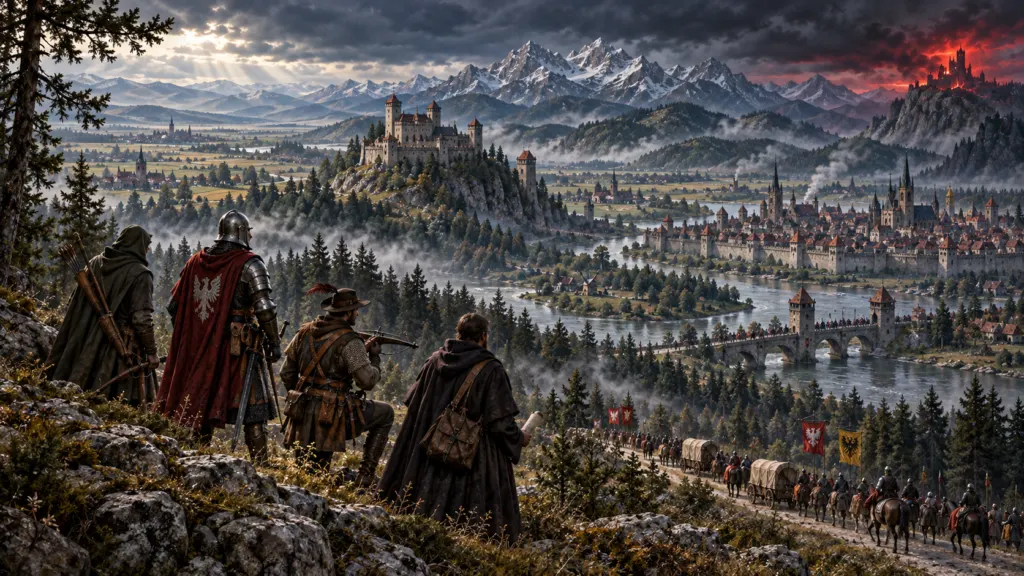
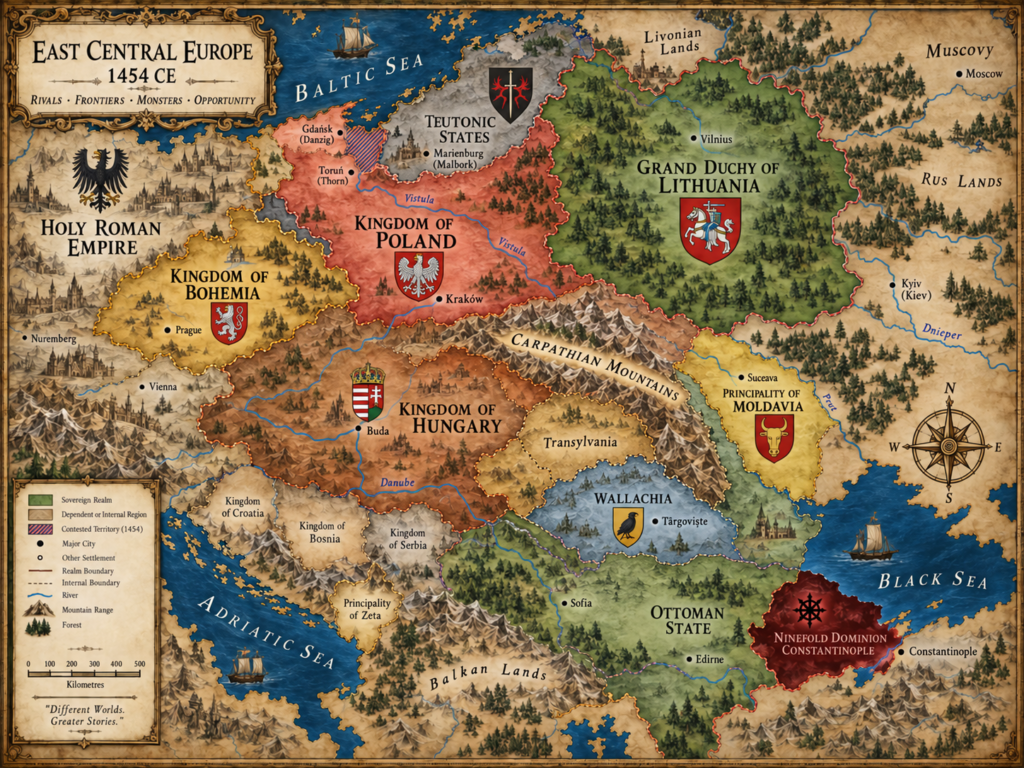
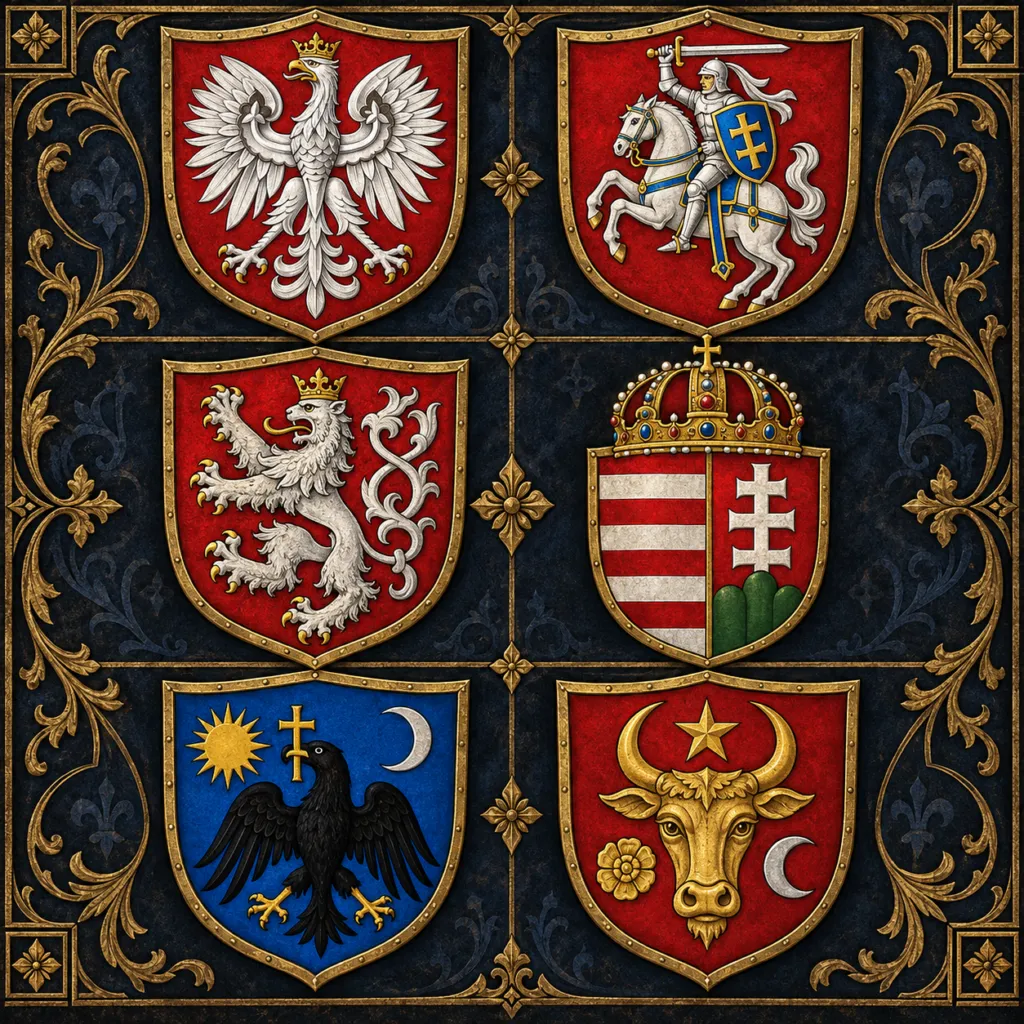
Artwork: The East Central Europe hero, Heraldic Powers panel and 1454 campaign map are SpiralWorlds campaign artwork. The map represents the campaign setting rather than a modern political map.
Keep this reference growing
If this page helped with your reading or game, you can support its upkeep or explore the curated books.
Explore the Bookshop — epics, classics and stories behind imagined worlds.