
Kingdom of Hungary
At a Glance
| Campaign present | 1454 CE |
|---|---|
| Ruler | Ladislaus V, called the Posthumous |
| Captain-general | John Hunyadi |
| Royal centre | Buda, opposite Pest on the Danube |
| Political character | A kingdom of magnates, royal counties, towns and powerful fortress commanders |
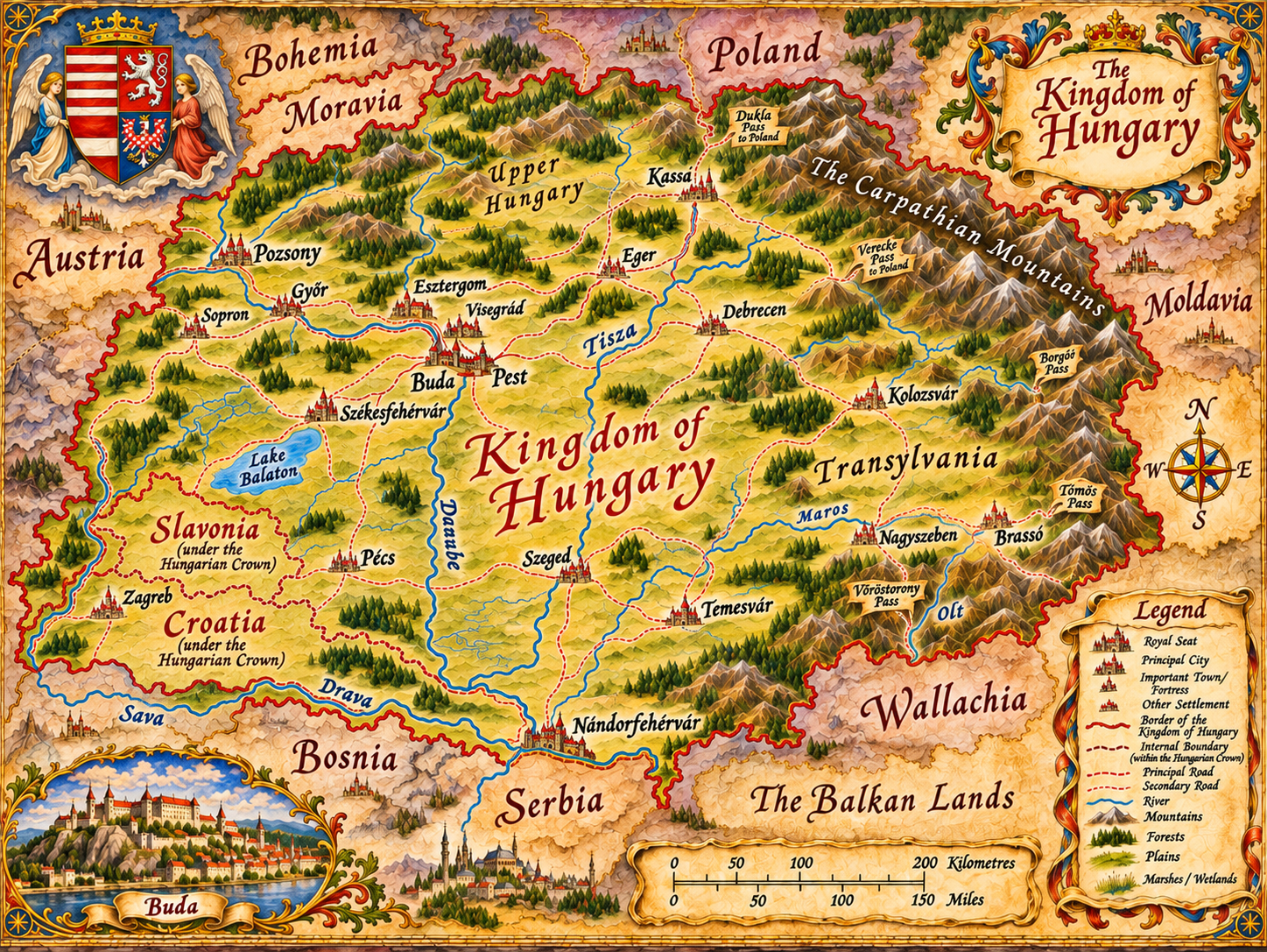
| Associated lands | Kingdom of Croatia; Transylvania and the Carpathian marches |
| Major centres | Buda, Pest, Pozsony, Sopron, Kassa, Szeged, Pécs, Temesvár, Kolozsvár and Brassó |
| Terrain | Danube and Tisza plains, northern mines, western towns, wooded mountains and southern river forts |
| Languages | Hungarian, Slovak, German, Romanian, Croatian, Ruthenian, Serbian and regional languages; Latin in many written official matters; no Common |
| Neighbours | Austria, Poland, Bohemia, Wallachia, Serbia and the Balkans |
| Pressures | Rival noble houses, uncertain loyalties, separate Ottoman and Ninefold Dominion threats, river creatures and mountain predators |
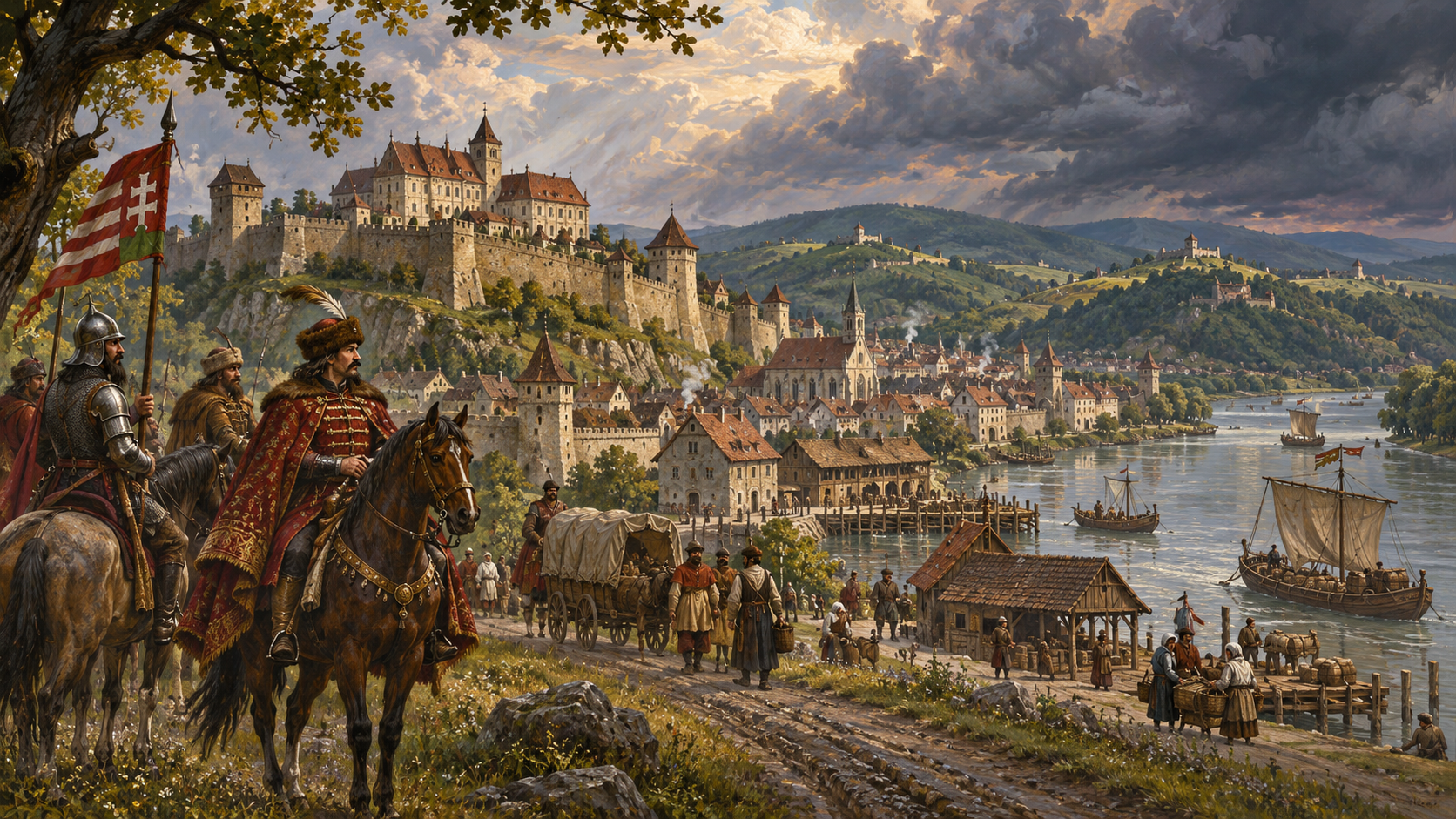
From the castle above Buda, the Danube looks like a river of opportunity: boats laden with grain, merchants seeking copper and silver, horsemen arriving with sealed messages. But the king’s command weakens with every mile it travels. A castle captain may serve John Hunyadi, a noble house may favour the king’s other advisers, and a village may fear the creatures of its own woods more than any army.
The kingdom is rich enough to defend its roads and fortresses, yet divided enough to make every expedition political. Adventurers escort supplies, hunt predators, recover stolen seals and carry intelligence to officers who may be dead or disgraced before the message arrives.
What Is Happening Right Now?
A King Surrounded by Rivals
Ladislaus V has the royal title, but his government relies on powerful noble houses, regional officials and experienced soldiers. John Hunyadi relinquished his regency in 1453, yet remains captain-general and still commands enormous respect. His household controls men and strongholds that the court cannot easily replace. Ulrich of Celje (Cillei) and the king’s other influential advisers treat that independent military power with suspicion.
Neither side needs to declare open war to damage the other. Appointments are obstructed, fortresses change hands, and captains are commanded to account for their horses, powder and grain. Royal legitimacy and the practical ability to defend a frontier do not always belong to the same man.
Two Different Southern Enemies
The hobgoblin Ninefold Dominion holds Constantinople after its conquest in 1453 and seeks fresh routes through the Balkan and Carpathian defences. The Ottoman state is a separate power, with its own rulers, army and interests; it is not a branch of the Dominion. Hungary must prepare for threats from both without assuming they work together.
Hunyadi’s captains strengthen the Sava and Danube approaches. The great stronghold of Nándorfehérvár (Belgrade) is among the most important of the southern forts. Scout companies watch crossings; hired soldiers guard wagons; riverboat crews carry stores to garrisons that may be cut off in a single bad week.
The Carpathian Balance
Transylvania belongs within the Hungarian realm, but its lords, fortified towns, Székely communities, village leaders and mountain guides have interests of their own. Beyond the heights, Wallachia is ruled by Vlad Dracula, already a vampire. His brutal defence has stopped one Dominion advance. He seeks security and seclusion, not the Hungarian throne, and punishes anyone who threatens his holdings. Border captains may sometimes exchange intelligence with his agents; few do so without fear.
Places Where Adventures Begin
Buda and Pest
Buda’s court, castle and river markets attract soldiers, diplomats, moneylenders, armourers and secret messengers. Pest across the Danube is a natural meeting place for drivers, merchants and men seeking work. An argument over a genuine royal warrant can become a deadly dispute when two houses claim authority over the same prisoners.
Pozsony, Sopron and the Western Towns
Pozsony (Bratislava) sits on the routes toward Austria; Sopron and the western markets carry news between Hungary and the neighbouring imperial lands. Foreign merchants may find willing partners here, but envoys and captains know that one sealed letter can decide which of several rival patrons gets paid.
Kassa and the Northern Mines
Kassa (Košice) is an important northern trading centre with connections toward Poland. Mines and mints around Körmöcbánya (Kremnica), Selmecbánya (Banská Štiavnica) and Besztercebánya (Banská Bystrica) support the kingdom with silver, gold and copper. Skilled miners, smiths, merchants and royal officials have their own networks. Stolen coin-metal can leave a fortress unpaid and a noble house exposed.
Szeged, Temesvár and the Southern Roads
Szeged stands on the Tisza route, while Temesvár (Timișoara) supports the routes toward the defended south-eastern approaches. Traders, refugees, frontier scouts and military suppliers mix here. The safest road on a map may be unusable after a river flood or a raid; the best guide is often someone who knows which settlements will still open their gates.
Transylvania and the Mountain Towns
Kolozsvár (Cluj), Brassó (Brașov) and Nagyszeben (Sibiu) are centres of trade and craft among hills, forests and difficult passes. They do not stand alone in a wilderness: surrounding fields, mills, villages and mines sustain them. Yet a predator occupying one crucial trail can isolate a valley long enough for a rival lord to claim the inhabitants have deserted him.
People, Factions and Allegiances
Ladislaus V needs loyalty that survives beyond court ceremonies. He rewards those who obey his orders and fears men whose armed followers seem loyal to another leader. John Hunyadi puts defence, supplies and reliable captains first; his methods can be stern, and his importance threatens the king’s advisers. Ulrich of Celje works to preserve the influence of the king’s household and allied magnates.
Town councils and merchants value trustworthy coin, roads that remain open and protection from both rebels and tax-seeking soldiers. Fortress captains seek reinforcements and the right to act before orders reach them. Mining communities, including dwarven experts alongside human guilds, guard techniques and supplies vital to the realm. Border villagers will often favour the commander who leaves their food and families intact, regardless of the official banner.
Farther east, the Scholomance attracts dangerous scholarship and unwelcome bargains. Count Orlok is a formidable presence in the wider Carpathian world, but he does not command the Hungarian crown or rule every vampire of the region.
Gods, Magic and Services
Sacred places and inherited traditions differ across the kingdom’s peoples. Old household rites, river powers and local guardians are important in many settlements. Along Slavic-speaking borders, some communities honour figures of the Slavic pantheon, including Veles and Perun. The customs of a mountain hamlet may differ sharply from those of a market city nearby.
Healers, herbalists, learned practitioners and private teachers provide services in towns and courts. Strong magic is neither cheap nor freely available. A royal officer seeking a diviner must find someone willing to work in a dangerous political dispute; a village needing a monster driven from its well can promise hospitality, provisions and lasting gratitude.
Major towns offer stableyards, armourers, healers, inns, warehouses and hired guards. In the southern forts these services narrow to whatever the garrison can spare: a working forge, a few reliable horses and a physician or healer whose supplies may already be exhausted.
Dangers and Creatures
Human violence is common on disputed roads. Soldiers of the same king can detain each other over rival warrants; a deserter may become a raider to feed his household. The vodyanoi claim deep pools and mills along the rivers, while the woods shelter wolves and werewolves. The vilkacis and other restless dead haunt particular cursed places rather than every wooded hillside. Their victims are usually travellers and villagers who lack a powerful protector.
Rumours and Adventure Hooks
| d6 | What the Characters Hear |
|---|---|
| 1 | The missing pay chest. A mining-town wagon carrying silver to Hunyadi’s troops vanishes between two guarded posts. The last guards seen with it have entered a rival magnate’s household. |
| 2 | Two sealed orders. Couriers reach Buda bearing genuine royal orders: one reinforces the southern forts, the other draws the same soldiers north. Each courier insists the other is a traitor. |
| 3 | The closed fortress. A southern captain promised refuge to fleeing villagers. Now his gate is shut, he is missing, and a wounded messenger knows who ordered the killing. |
| 4 | The price of the river. Three Tisza ferry crews disappear. A vodyanoi offers to return them if a new military dam is dismantled—but the flood would destroy the army’s winter grain. |
| 5 | The mountain guide. A village’s only reliable guide disappears where a noble timber company has cut into a protected grove. His family fears both the armed foresters and its unseen guardian. |
| 6 | The Wallachian envoy. Dracula’s messenger offers details of an approaching Dominion column in exchange for safe passage. The town on the route has sworn that no undead will cross its gates. |
Travel and Local Authority
The Danube is the kingdom’s chief artery; the Tisza serves the plains; overland roads lead toward Poland, Austria, the southern forts and the Carpathian passes. Boats and wagons are delayed by floods, winter mud, damaged bridges and soldiers. Weapons on a border road are expected, but foreigners who enter a crowded town with drawn blades will soon meet its guards.
Royal officers, county authorities, noble retainers and towns enforce their own rules. A signed safe-conduct is useful only where the issuing lord’s authority is accepted. A company that protects farmers from bandits earns friends and shelter; one that steals supplies can turn a whole district against itself.
Deeper History
After the death of Sigismund, succession disputes divided the nobility and gave military leaders extraordinary leverage. John Hunyadi emerged as governor and defender of the kingdom. Ladislaus V’s return to effective royal rule in 1453 ended the regency but not Hunyadi’s importance. In 1454, rebuilding the crown’s authority and defending the south are both unfinished struggles.
The many lands of the kingdom are connected by dynastic claims, trade, armed service and centuries of migration. Croatia has its own political identity under the shared crown; Transylvania has local privileges and fortified communities; the northern mining towns and great river ports support each other without all sharing the same loyalties. These differences are the kingdom’s strength in a crisis and the source of its rivalries.
Continue Exploring
Sources and Artwork
Historical reference: The Hunyadis and the Jagiellonian Age (HUN-REN Research Centre for the Humanities) and István Petrovics, King Matthias and the Towns of the Realm. The supernatural powers and Ninefold Dominion belong to the campaign setting.
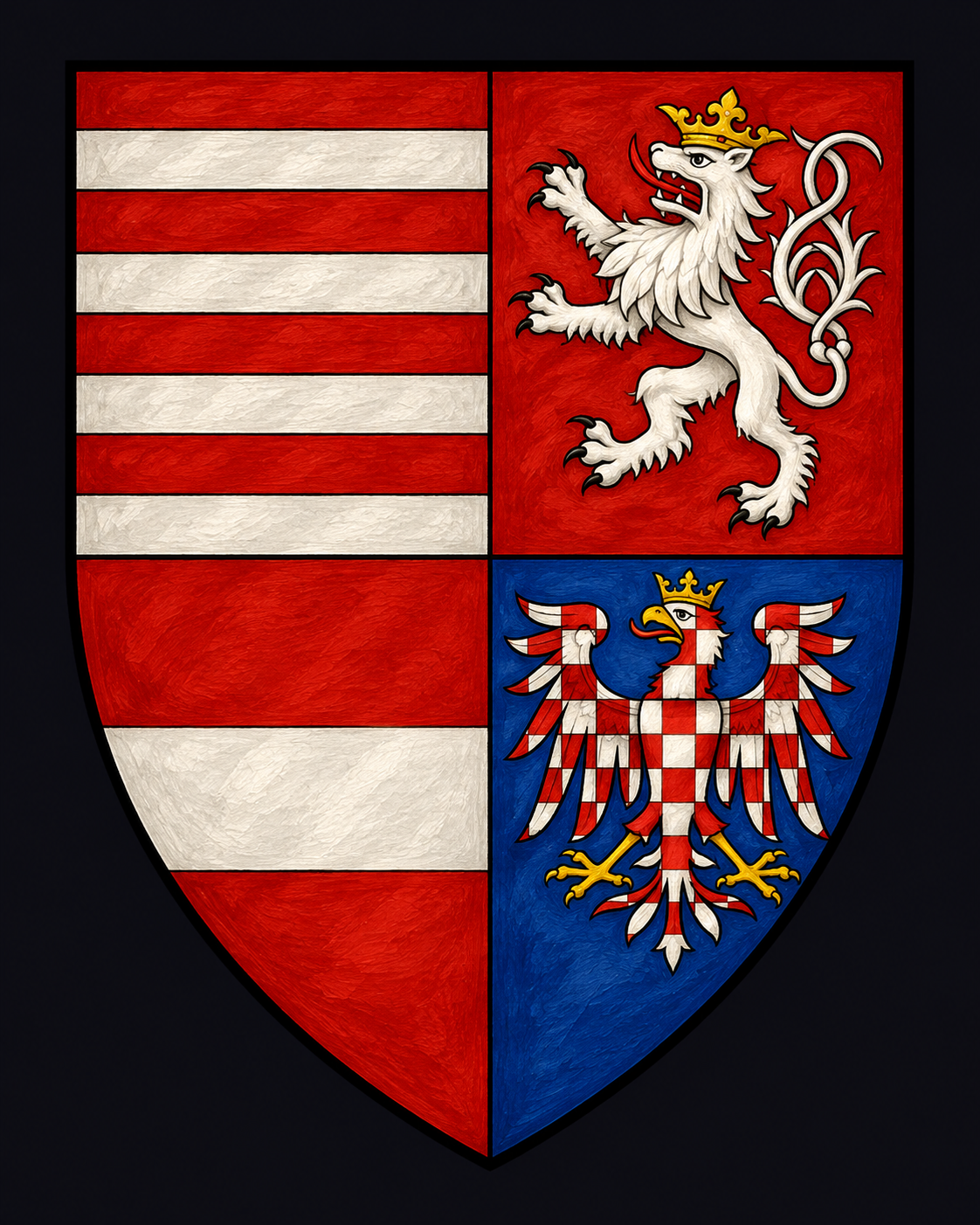
Royal heraldry: Madboy74, Ladislaus V arms, Wikimedia Commons, licensed CC BY-SA 4.0 and displayed as PNG. The Buda hero is original artwork. The map shows the approximate regional campaign setting, not the precise Hungarian county boundaries.
Keep this reference growing
If this page helped with your reading or game, you can support its upkeep or explore the curated books.
Explore the Bookshop — epics, classics and stories behind imagined worlds.