
Kingdom of Bohemia — The Crown and Its Hidden Courts
Ladislaus the Posthumous · George of Poděbrady · Prague · Moravia, Silesia and Lusatia
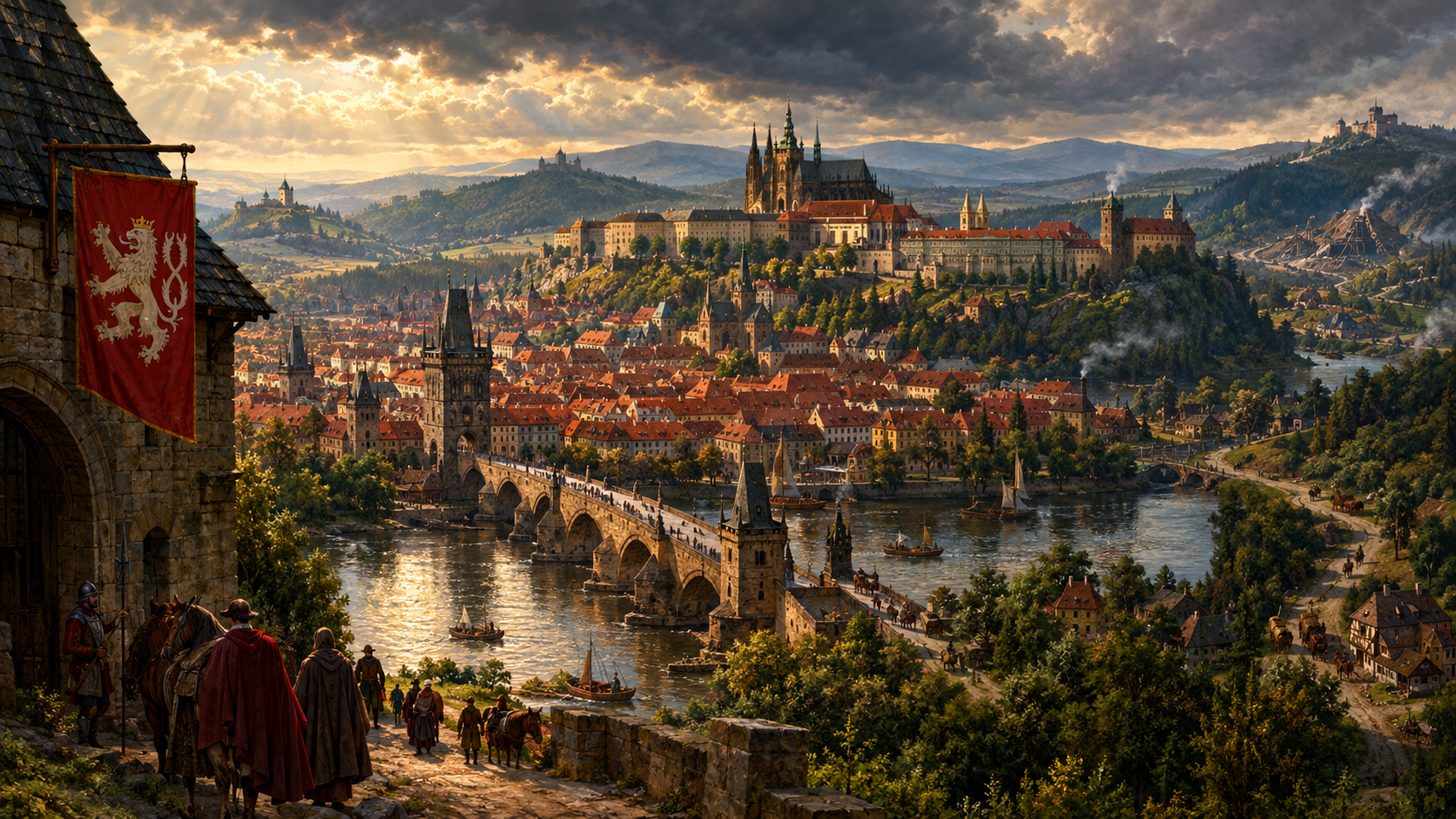
At a Glance
| Realm | The Kingdom of Bohemia, an imperial electoral kingdom whose crown claims a wider group of lands |
|---|---|
| King | Ladislaus the Posthumous, crowned in Prague in October 1453 |
| Governor | George of Poděbrady, wielding much of the kingdom’s day-to-day power |
| Capital | Prague on the Vltava |
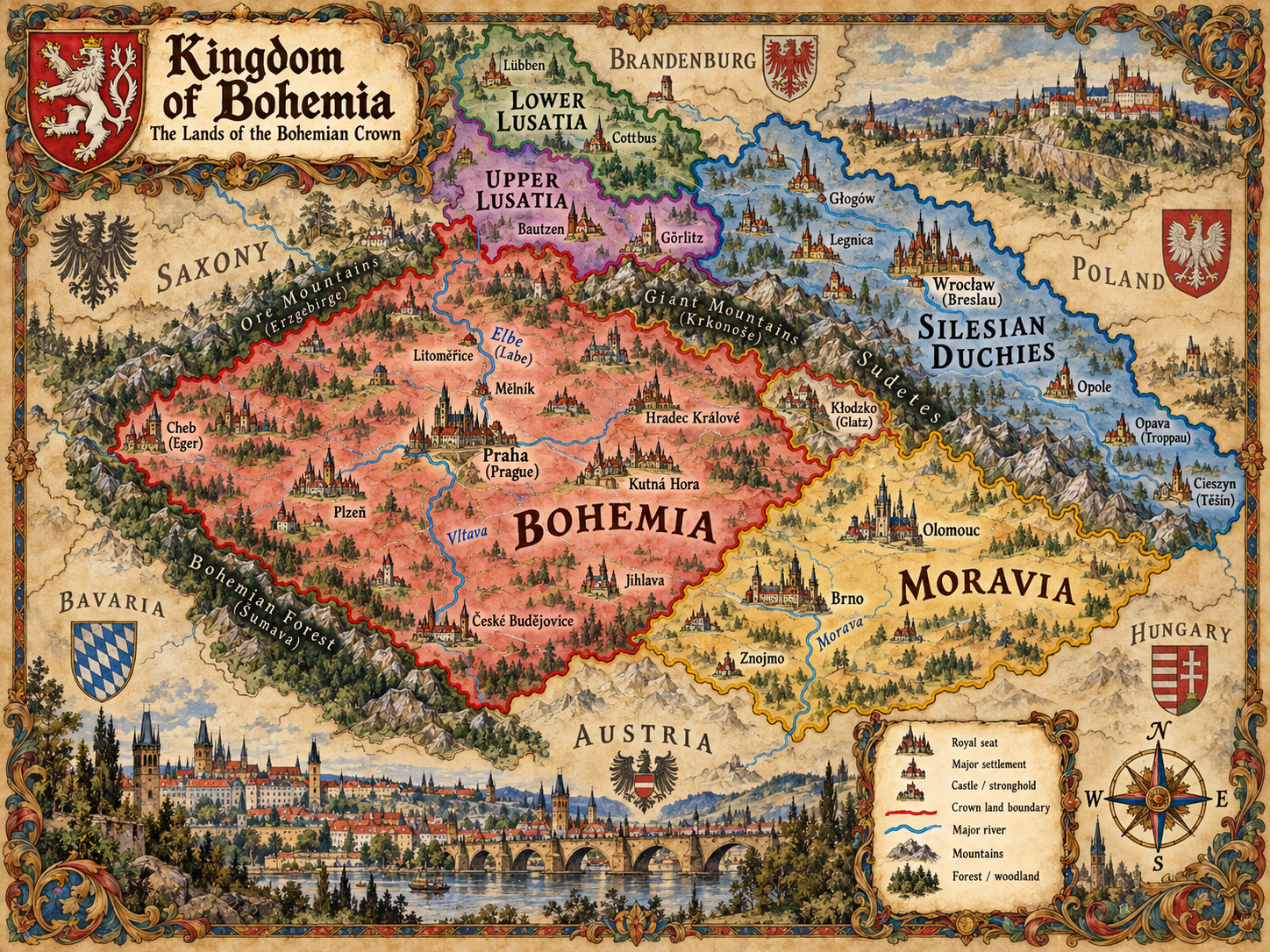
| Crown Lands | Bohemia, Moravia, the Silesian duchies, Upper Lusatia and Lower Lusatia; governance and allegiances vary |
| Imperial Standing | The Bohemian king holds an electoral vote in the Holy Roman Empire |
| Peoples | Czech and German communities, noble households, dwarven craft guilds and traders from the imperial roads |
| Beliefs | Civic gods, regional cults, ancestral rites, sacred compacts, forest shrines and temple courts with competing privileges |
| Major Conflicts | Royal authority versus governorship, estate privileges, rival divine traditions, old wars and secret societies |
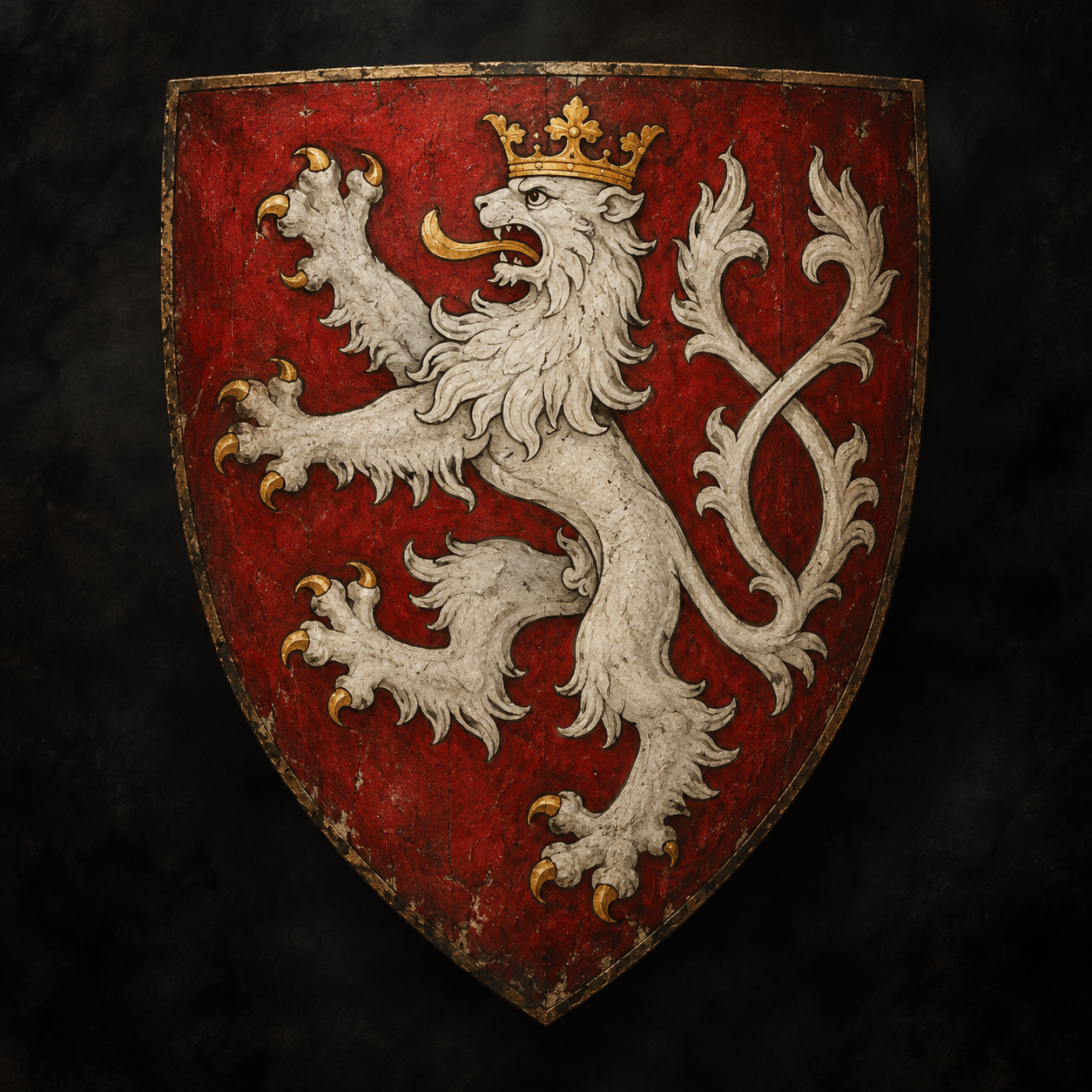
A Crown with Many Courts
The king wears the crown, but the governor carries the orders. Ladislaus the Posthumous has been crowned in Prague, yet George of Poděbrady commands the alliances and officers who keep much of the kingdom functioning. A merchant who obtains a royal promise at one desk may discover that the governor’s men demand a second seal before they honour it. The estates defend their privileges as fiercely as their castles, and adventurers carrying a royal letter may find themselves asked to choose whose authority it represents.
The word Bohemia describes both the kingdom at the heart of the crown and a wider dynastic grouping. The Silesian duchies, Moravian estates and Lusatian towns are not identical districts controlled from one desk. Their princes, civic councils and sworn privileges can complicate orders sent from Prague, particularly when ritual law or trade duties are involved.
What Is Happening Right Now?
The King’s Household and the Governor’s Men
Ladislaus hears petitioners hoping his royal seal will overturn settlements made during his minority. George’s officers insist the watch posts, court records and alliances must continue to function. Now two messengers claim the right to arrest the same treasurer. Both carry genuine seals, and arresting the wrong one could turn a loyal town against the Crown.
Unsettled Peace after the Sacred Wars
The temple leagues, town militias and great houses have laid down their banners, not their grievances. Empty farms stand beside restored shrines; boundary stones have been moved, and families still keep lists of the dead. Priests summoned to bless a repaired bridge refuse to stand beside their rivals. The governor needs safe passage and tax receipts; the king needs people willing to honour his new promises. Neither can mend the realm without deciding whose losses count.
The Bohemian Club’s Long Shadow
The Bohemian Club has concealed its occult studies behind patronage, scholarship and private suppers since 1378. Its agents survived the old wars and maintained contacts as far as Constantinople. Now an unsigned packet has arrived containing a dead courier’s instructions. Royal spies want the papers, the Club wants the courier’s surviving companion found, and a university scholar insists the enclosed ritual must never be performed.
Lands of the Bohemian Crown
Bohemia — The Royal Heartland
Prague controls major royal approaches, while Kutná Hora’s silver mines, the Elbe river roads, powerful noble estates and secluded forest districts give different groups their own leverage. A traveller with a royal introduction may still face a local toll or noble guard.
Moravia
Brno, Olomouc and Znojmo look toward different markets, noble patrons and frontier dangers. Around Jihlava, mining rights and the Bohemian–Moravian boundary keep surveyors, escorts and witnesses busy. Harvesters leave their tools at noon when a white-clad stranger crosses the furrows. Those who laugh at Lady Midday sometimes fail to return from the field.
Silesia
The Silesian duchies recognise the Crown without sharing a single purse or policy. Breslau (Wrocław) guards its mercantile charters while princes quarrel over Oder tolls, bridges and inheritance. An envoy with a Prague writ may still need the city’s counterseal. When a convoy vanishes between rival jurisdictions, both sides accuse the other of sheltering its guards.
Upper and Lower Lusatia
Bautzen and Görlitz guard the approaches to Saxony and Silesia, while the roads toward Lower Lusatia pass through woodland and wet heath. Town gates demand proof of cargo as readily as a royal passport. Beyond the causeways, the wandering lights called bludičky resemble will-o’-wisps; following one may reveal a lost traveller, a smuggler’s lantern or a pool that has swallowed a generation of boundary stones.
Places Adventurers May Reach
Prague — The Royal Capital
The castle, fortified river bridge, university and rival town councils offer a hundred ways to earn a valuable seal or a permanent enemy. At Týn Yard, known as the Ungelt, foreign merchants find guarded stores, stables and lodging beneath the watch of customs officers. A missing entry in the toll book could ruin a caravan. Down by the Vltava, boatmen hear a woman singing after dark and whisper of rusalki below the current. A water-haunted crossing might instead conceal a water weird.
Kutná Hora — Silver and the Italian Court
Miners descend into the silver workings with candles and prayer tokens while royal assayers watch the ore leave the shafts. At the Italian Court, coiners strike Prague groschen under guard and weigh bullion against a master’s scales. Dwarven metalworkers are valued for finding adulterated silver, but asking why a sealed shaft yields coins bearing an older die may provoke an arrest. A missing assay book could bankrupt a guild or expose fraud at court.
Houska Castle
A remote northern estate whose former owner was executed in 1453, leaving the widow and heirs vulnerable to confiscation and intrigue. Servants refuse to descend into its lower chambers after dark. A witness hears the same footsteps beyond two locked doors. The danger might be a thief, a restless spirit or a place marked by one of the haunts feared by ritual investigators.
The Bohemian Forest
Woodcutters and charcoal burners know paths absent from noble maps; wardens know whose hunting rights those paths cross. The cry of a hejkal can lead a traveller away from the road, while a hearth spirit resembling a domovoi knows the hidden dealings of a forest household. In the oldest groves, fey courts and the Bohemian Club both keep secluded lodges. The forester offers silver to anyone who will find two wagons that entered the fir trees and never reached the tollpost.
Rulers, Councils and Secret Factions
Ladislaus the Posthumous wants to prove that the crown can protect families who have waited years for justice. His household rewards discreet messengers and honest witnesses, though his favour may be challenged the moment it leaves Prague. George of Poděbrady needs the roads guarded, revenues collected and the estates kept at peace. His officials prize practical service but mistrust adventurers carrying contradictory seals.
Town councils and noble estates defend their charters and will commission outsiders to retrieve lost court registers. The Bohemian Club purchases rare manuscripts and private introductions through respectable patrons. Dwarven assay masters protect workshop secrets, university scholars pursue closed archives, and merchants tied to the Hanseatic League want reliable crossings toward Silesia. One stolen ledger may concern them all, though each would pay to make a different page disappear.
Magic and Adventure Hooks
Prague’s temple courts offer healing, divinations and testimony under sacred oath to petitioners who can pay or obtain a patron’s introduction. University scholars decipher seals and old sigils, while dwarven workshops make precision scales, locks and ritual fittings. A river pilot may know the pool occupied by a water weird; at a drowned mill, a patient investigator can sometimes lay a haunt to rest without burning the miller’s livelihood. Coin buys labour, but introductions buy trust, and every bargain has witnesses.
- The Two Royal Seals. An estate has been granted twice. The only witness admits both warrants are genuine. Restoring the older claim will evict families who settled during the wars; honouring the newer one may destroy a town’s trust in the Crown.
- Silver Beneath Kutná Hora. A new shaft reaches a shrine sealed before the royal mint existed. Its custodians demand the return of silver already coined and spent, while the assay master offers a fortune to conceal the find.
- A Letter from Constantinople. The Bohemian Club wants a witness recovered before royal spies discover what a stolen manuscript names. The witness will speak only if the party first frees another prisoner.
- The Houska Inheritance. The guardians of a dead lord’s children accuse one another of stealing the estate register. The missing folio may lie in a locked crypt where footsteps echo every night.
- The Unwelcome Envoy. A Silesian magistrate refuses a Prague officer’s authority as an outside force approaches. Delivering the order may avert an invasion and break the city’s charter at the same time.
- The Missing Ledger. An entry has been torn from the Ungelt customs book. Three merchants offer to recover it; each conceals a different cargo. Return it to the wrong hand and an entire caravan loses the city’s protection.
- Noon in Moravia. Harvesters vanish after a white-clad woman forbids the cutting of one field. The estate needs its grain, the governor needs his taxes, and the village wants its workers alive.
Travel, Law and Political Borders
Carry introductions to the office controlling your destination, not merely a letter sealed by the highest lord. The king’s passport can ease an approach to Prague Castle but cannot erase a guild privilege in Breslau or a noble toll in Moravia. Temple immunities, gate hours and customs duties govern the merchant roads. At the Ungelt, foreign merchants find guarded stores, stables and lodging but must submit their cargo for inspection.
The Vltava and Elbe serve freight and river traffic, although ferries, weirs and landings create places where rival officers can demand payment. Forest roads require guides and weatherwise scouts. On Lusatian marsh routes, a false lantern may be more dangerous than a robber; in Moravian grain country, villagers know what an empty road at noon can signify. Parties who seek local witnesses, not just armed escorts, often travel furthest.
Map of the Bohemian Crown Lands
Deeper History and Sources
Bohemia rose from an older duchy into a hereditary kingdom; the Crown passed through the Přemyslid and Luxembourg dynasties before Ladislaus’s troubled accession. Ladislaus was crowned on 28 October 1453, while George of Poděbrady remained governor. The wider Crown embraced Moravia, the Silesian duchies and the Lusatias, whose estates and towns retained separate rights.
For the royal chronology see the biography of Ladislaus and the study of the boy king and regent. Prague’s historic merchant yard is documented by Prague City Tourism; the royal mint is described in the Italian Court guide. For the Crown Lands’ historical geography consult the Czech Historical Atlas and the Czech Academy of Sciences reconstruction dataset (approximately 1400). Regional traditions of polednice, bludičky and forest spirits illuminate the dangers recounted along the roads. See Prague’s city guide for the capital’s streets and courts.
Explore Neighbours
Keep this reference growing
If this page helped with your reading or game, you can support its upkeep or explore the curated books.
Explore the Bookshop — epics, classics and stories behind imagined worlds.