
Grand Duchy of Lithuania
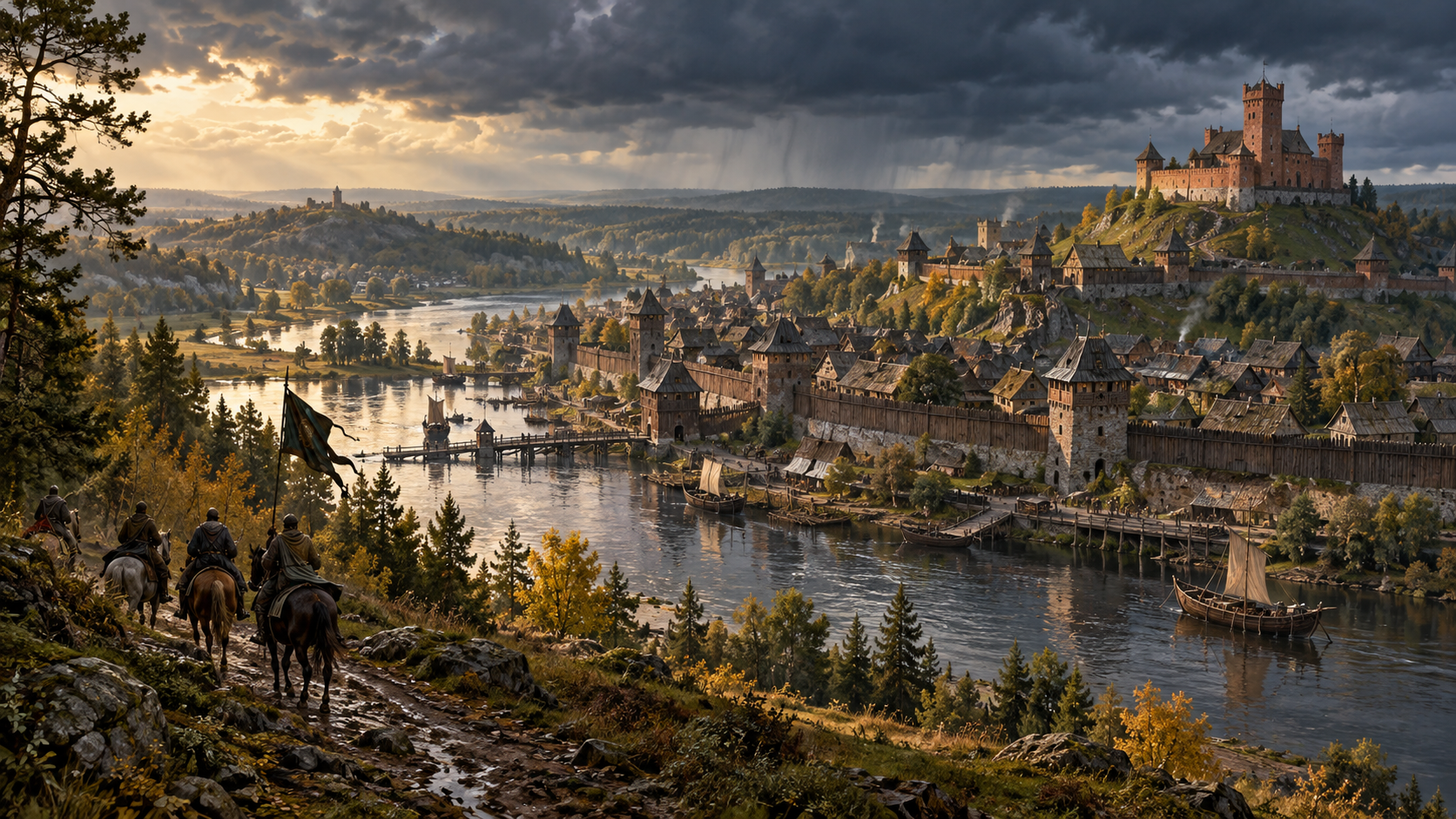
A great realm of woodland strongholds, Ruthenian cities and powerful noble houses—ruled by the same man who wears Poland’s crown, but never simply ruled from Poland.
The Grand Duchy at a Glance
| Campaign Present | 1454 CE |
|---|---|
| Capital | Vilnius; the court also uses Trakai and other grand-ducal residences. |
| Ruler | Casimir IV Jagiellon, Grand Duke of Lithuania since 1440 and King of Poland since 1447. |
| Government | Grand-ducal monarchy, advised and constrained by magnates, the Council of Lords and regional privileges. |
| Principal Lands | Lithuanian heartland, Samogitia, and extensive western and southern Ruthenian territories. |
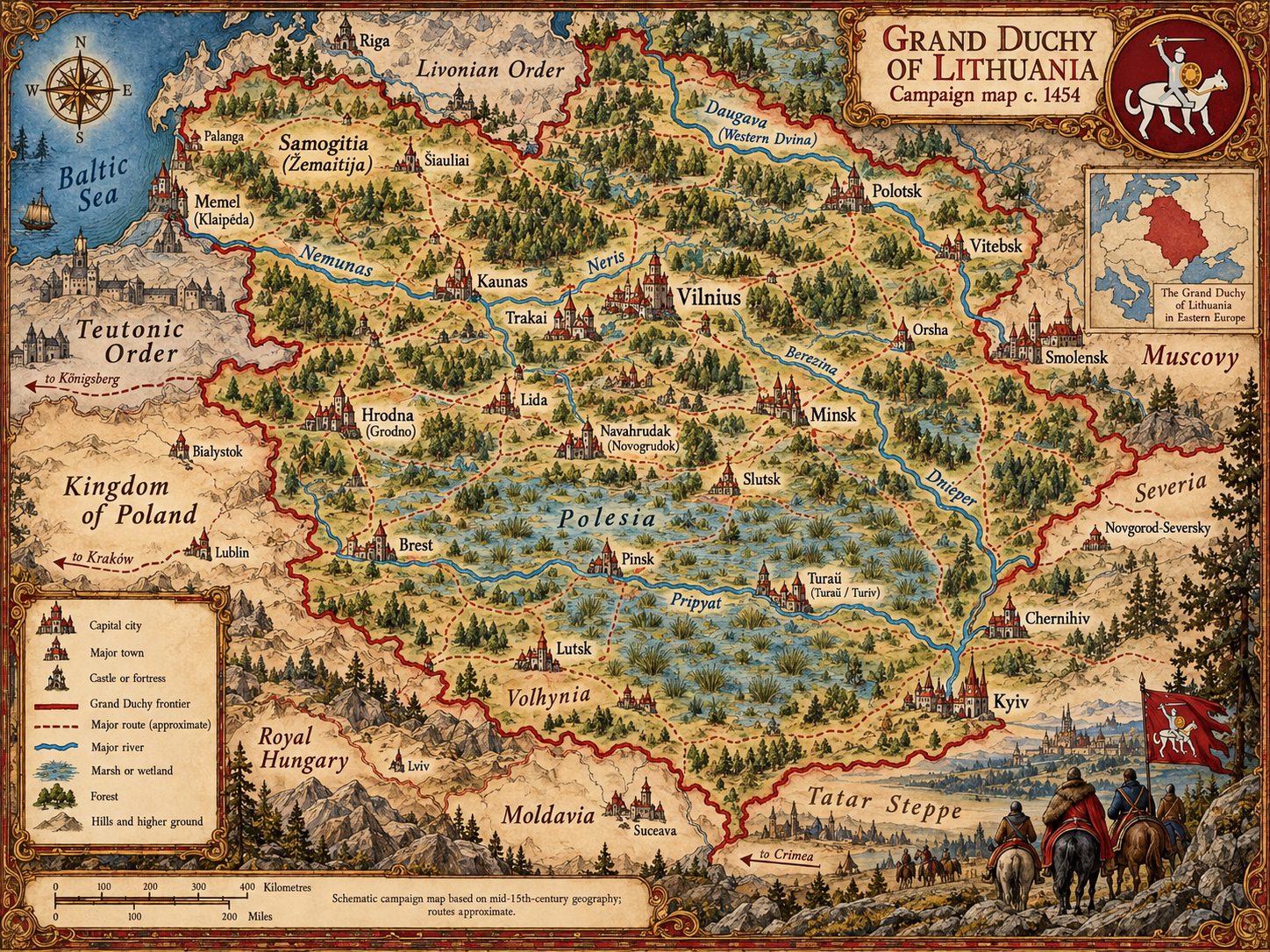
| Important Centres | Vilnius, Trakai, Kaunas, Hrodna, Navahrudak, Polotsk, Minsk, Smolensk and Kyiv. |
| Languages | Lithuanian; Ruthenian in much administration; Polish, German, Latin and other regional tongues in appropriate communities. There is no universal Common. |
| Principal Peoples | Lithuanians, Ruthenians, Poles, Tatars and other communities; language, custom and allegiance vary by locality. |
| Landscape | Ancient woods, lakes, marshes, cultivated valleys, riverside towns and the southern frontier toward the steppe. |
| Worship & Rites | Old Baltic gods, household and woodland traditions, ancestral observances and distinct Ruthenian traditions coexist within the campaign. |
| Current Crisis | Poland’s new war with the Teutonic States, Lithuanian autonomy, unstable eastern relationships and pressure on frontier roads. |
| Best Adventures | Court diplomacy, espionage, forest crossings, river trade, lost strongholds, spirit bargains and disputed inheritances. |
Where Forests and Kingdoms Meet
The Grand Duchy of Lithuania is not a small Baltic kingdom surrounded by neighbours. Its heartland lies around Vilnius, Trakai and the wooded river valleys, but its authority extends far into the Rus lands, over cities whose rulers, customs and languages differ sharply from those of the grand-ducal court. The same seal may command obedience in a castle, invite negotiation in a merchant town and mean almost nothing to a village on the edge of a forest.
Stone and brick fortresses guard important crossings. Lesser lords control wooden hillforts, ferries and toll roads. Merchants bring salt, cloth, wax, timber, grain, horses, fur and rumours between Baltic markets and inland river ports. Beyond the farms are hunting grounds, sacred places and long stretches of woodland where even a great duke’s writ travels slowly.
Adventurers find work because Lithuania’s size is its greatest strength and its greatest difficulty. An embassy needs an escort, a court needs the truth about a distant governor, a trading house needs its stolen charter recovered, and a frontier community needs help from someone with neither a lord’s allegiance nor a rival’s banner.
Explore the Surrounding Lands
What Is Happening Right Now?
One Ruler, Two Governments
Casimir governs both Lithuania and Poland, but neither realm is a province of the other. The Lithuanian lords who raised him to the grand-ducal throne in 1440 expect their offices, decisions and revenues to remain Lithuanian matters. When he is away at the Polish court, councillors and regional officers retain the practical power to govern. An envoy bearing the king’s orders may discover that a grand-ducal official has a different interpretation.
Poland’s Prussian War Has Begun
The revolt of the Prussian towns has drawn Poland into open war with the Teutonic States. Lithuania has reasons to distrust the Hell Knights, but its nobles do not wish to spend their armies and treasure merely because Casimir also wears the Polish crown. For Lithuanian travellers, the war means disrupted trade, agents on the roads and profitable bargains offered by both sides. Military assistance cannot be taken for granted.
The Eastern Frontier Is No Quiet Border
The grand duchy controls broad Ruthenian territories, while Moscow is recovering its strength under Vasily II. Border princes and town leaders watch the fortunes of both courts. Farther south, the orc successor hosts and steppe powers make tribute, cavalry raids, diplomatic hostages and caravan protection a matter of survival. A dispute over a single castle may be the opening move in a contest for a whole river valley.
The Woods Remember Older Oaths
In the old-growth country, sacred trees, burial mounds, ancestral halls and lake islands retain local authority. Many settlements pay public taxes to their lords and private dues to powers that do not recognise any grand duke. A stranger who cuts the wrong grove or removes a gift from a cairn can endanger a household far more surely than a common bandit.
Places Worth Visiting
Vilnius — The Grand-Ducal Capital
Vilnius is the seat of high politics: fortified heights, court residences, crowded markets, official messengers and noble households competing for influence. Hearings, warrants, appointments and disputes that affect distant villages can begin here. A party arriving with proof of treason must decide whose official receives it first.
Trakai — Castles Among the Lakes
Trakai’s lake strongholds provide secure lodgings, storehouses, armed garrisons and a refuge from the manoeuvres of the capital. Roads, causeways and boats determine how an attacker approaches. An isolated tower is an excellent place for an audience that neither party wants publicly recorded.
Kaunas — The Nemunas Trade Gate
At the meeting of major waterways, Kaunas sees toll collectors, river craft, warehouses and foreign merchants. Its contacts with the Hanseatic League make it a place to purchase information, arrange transport or lose a dangerous parcel in the crowd. A trade agreement is no guarantee that merchants’ rival patrons trust one another.
Samogitia — The Western Lowlands
Samogitia guards traditions and privileges that grand-ducal officers cannot simply ignore. Local elders understand forest tracks, frontier crossings and the cost of a stranger’s promise. The western approaches also feel the movement of armed men, deserters and spies from the Teutonic frontier.
Hrodna, Navahrudak and Minsk — The Inland Roads
Fortified towns and estate centres here bind the Lithuanian heartland to its Ruthenian dependencies. A dispute over a ferry, an inheritance or a forged seal can stop a caravan for days. Woodland and marsh routes make local guides worth their weight in coin.
Polotsk, Smolensk and Kyiv — Great Ruthenian Centres
These cities connect the duchy to the eastern rivers and southern lands. Powerful local traditions, princely interests and merchants make them much more than outposts of Vilnius. Their distance gives provincial magnates room to manoeuvre. A message intended to reach the capital may be copied, delayed or quietly altered before it travels west.
People Adventurers May Actually Meet
Casimir IV Jagiellon — Grand Duke and King
Casimir must protect the independence of his Lithuanian inheritance while fighting for the interests of his Polish crown. He rewards useful service, but a reckless agent can entangle both courts. The ruler is more likely to be reached through officials, councillors and letters than by a chance encounter on the road.
Jonas Goštautas — A Magnate Whose Counsel Matters
One of the great powers behind Casimir’s Lithuanian accession, Goštautas represents a nobility determined that Lithuania govern its own affairs. A petition that wins the support of his household may travel further than an expensive gift at court. Petitioners should expect a price in loyalty, evidence or future service.
The People Who Open the Gates
A castle captain, an estate steward, a Samogitian elder, a river pilot or the senior clerk of a merchant house may matter more to a travelling party than a distant prince. Their names and loyalties should emerge from the settlement or adventure where they serve, rather than from invented court offices.
Factions and Powers
Grand-ducal court and Council of Lords. Ruler and magnates agree on much in public but compete over appointments, taxation, marriages and foreign policy. A signed order may still require the consent of the official who controls the road.
Regional nobles and Ruthenian princes. Their estates, retainers and legal customs shape daily life beyond Vilnius. Many defend the grand duchy fiercely while resisting new demands from its centre.
Merchants and river carriers. Hanseatic trading interests, local guilds and independent boatmen protect different networks of warehouses, credit and ferries. Their conflicts are fought with contracts, embargoes, paid guards and stolen records.
Hell Knight agents. The Hell Knights of the Teutonic States have a history of conflict with Lithuania. Their influence belongs to their western order, not to every armed traveller in the region. Espionage and border intimidation are more useful to them here than marching a whole army into the interior.
Forest communities and old custodians. Local wardens, hunters, household cults and hidden fey interests do not form a single faction. Each has its own bonds, grievances and reasons to help or hinder travellers.
Magic, Worship and Services
Old powers. Perkūnas is invoked in storms and solemn oaths; Žemyna and other earth-and-harvest powers belong to local fields, groves and homesteads; Laima’s influence is sought where birth, fortune and fate matter. Cults and customs differ by district, and none should be treated as the uniform religion of the realm.
Courts and towns. Scribes, money-changers, healers, learned spellcasters, interpreters, shipwrights, blacksmiths and caravan masters are most readily found in established settlements. Specialists may demand a patron’s introduction. An arcane service that is commonplace in a noble household may be unknown a few villages away.
Older magic. Stories tell of laumės beside lakes and marshes, and of the aitvaras, a household spirit whose gifts may arrive through theft or unsettling bargains. These are local powers with motives of their own, not automatically hostile monsters to be slain on sight.
Dangers and Adventures
| No. | Adventure Hook | Stakes and Choices |
|---|---|---|
| 1 | The Two Seals. A royal dispatch and a grand-ducal counterorder reach the same castle. | Find which is genuine and decide which authority the garrison should obey before opposing riders arrive. |
| 2 | The Nemunas Ledger. A Kaunas merchant’s river accounts disappear after a secret meeting. | Recover them without starting a commercial feud; the books implicate traders serving both sides of the western war. |
| 3 | The Lowland Charter. Samogitian elders produce an old privilege that a visiting official wants suppressed. | Protect witnesses, test the charter and decide whether obedience to a ruler demands disobedience to his agent. |
| 4 | The Lake at Dusk. Children vanish from an island village and the fisherfolk accuse a laumė. | Distinguish an actual fey bargain from a mortal abduction; violence may destroy the only route to an agreement. |
| 5 | The Wolf Who Returns. A grave robber is found dead beyond a border hamlet, but wolves follow his burial procession. | Investigate whether a vilkacis has been roused and deal with the injustice that binds it. |
| 6 | Into the Eastern Marches. A Ruthenian governor’s messenger vanishes with a treaty and ransom promises. | Reach the meeting place before rival envoys and orc riders turn a private arrangement into frontier war. |
Travel, Law and Practical Play
Roads and rivers. The Nemunas and Neris make Kaunas and Vilnius connected in ways a winter road cannot always match. Farther east, boats and ferries are often safer than an inland trail—until floodwater, ice, tolls or an ambitious local captain intervene. Guides, horses and bridge rights should be arranged before leaving a major town.
Safe-conduct. A letter stamped in Vilnius may impress a castle official without binding the next estate’s lord. Ask who granted a warrant, where it applies, whether it permits armed retainers and whose seals are recognised. A travelling adventuring company must prove what it is carrying and why.
Justice. Town jurisdictions, noble privileges, grand-ducal courts and local customs can reach different conclusions over the same theft or killing. Suspects may flee between jurisdictions. Choosing where to present evidence can change whether a case is heard at all.
Conditions. Spring thaw floods roads and makes fords perilous. Deep summer offers travel but brings biting insects and dangerous marshes. Autumn rain delays wagons. Winter creates new routes across frozen ground and ice while making exposure a constant enemy. Give preparation, guides and negotiation as much weight as the encounter on the road.
Other Peoples of the Duchy
Humans make up its many kingdoms, communities and noble houses, but they do not possess every woodland path or mine. Dwarven craft and trading networks can carry goods and news through the Baltic interior; hidden elven communities have their own reasons to defend particular groves; travelling halflings may move between markets and the wider diaspora. None of these peoples should be given an invented national capital or compulsory loyalty to the grand duke.
The southern and eastern approaches also meet the Rus lands and the divided orc successor powers. Orc riders may serve a khan, take mercenary pay, escort merchants or raid a frontier—not because every orc belongs to one empire. Fey and household spirits belong to their own local relationships rather than the duke’s census.
The Longer History
The rise of the Lithuanian rulers. From the thirteenth century, Lithuanian dynasties forged a durable realm amid the Baltic forests. Their campaigns, marriages and agreements brought many Ruthenian lands within their influence and eventual government. The result was always larger and more diverse than Lithuania’s original heartland.
Gediminas and the expansion eastward. The grand dukes made Vilnius a principal centre and cultivated alliances among Baltic and Rus powers. Later rulers inherited a realm of distinct communities whose ties to the court were as often negotiated as imposed.
Vytautas and the western victory. Under Vytautas the Great the duchy reached an extraordinary extent. In 1410 Lithuanian and Polish forces shared in the victory over the Teutonic army at Grunwald, remembered across the region under several names. That defeat broke the order’s old invincibility without ending its ambitions.
The succession and the present. After Vytautas, competing claims strained relations with Poland. In 1440 Lithuanian magnates installed the young Casimir as their grand duke, affirming the realm’s distinct political identity. He became king of Poland in 1447. The resulting personal union creates opportunities and rivalries, not a single unified government. The western war now tests that arrangement.
Campaign Travel Map
Historical and Mythological Sources
For the historical Grand Duchy, its offices and the reign of Casimir IV: Orbis Lituaniae, early state offices; Thomas G. Chase, The Story of Lithuania, chapter VIII; and the Prussian war chronology.
For Baltic household lore: Visuotinė lietuvių enciklopedija: Aitvaras, and Laumė in Lithuanian tradition. Historical institutions and legends provide the foundation; supernatural encounters and divergent cults follow the established campaign setting.
Setting description, hooks and original illustrations are new creative material. Historical research and named folklore remain attributed to their sources. This location guide introduces no edition-specific stat blocks and claims no edition-specific rules licence.
Keep this reference growing
If this page helped with your reading or game, you can support its upkeep or explore the curated books.
Explore the Bookshop — epics, classics and stories behind imagined worlds.