
Wallachia
At a Glance
| Realm | Principality of Wallachia, between the Southern Carpathians and the Danube |
|---|---|
| Capital | Târgoviște |
| Ruler | Vlad III Dracula, the Impaler — voivode and vampire |
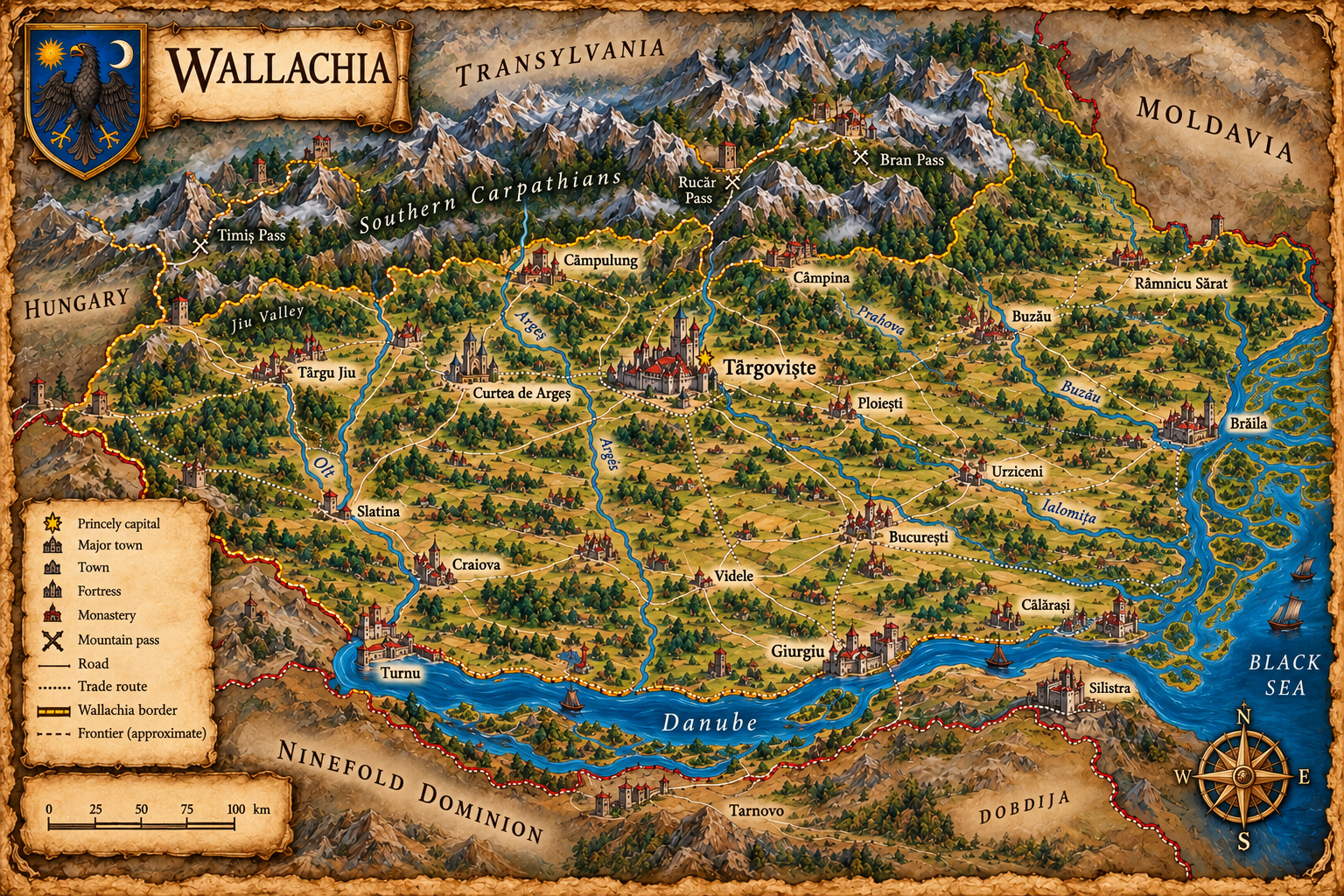
| Other notable places | Câmpulung, Curtea de Argeș, Poenari, Râmnicu Vâlcea, Giurgiu and Brăila |
| Languages | Romanian; Church Slavonic in much clerical writing; German and other languages heard on the northern trade roads |
| Faith | Predominantly Eastern Orthodox Christianity |
| Landmarks | Princely court at Târgoviște; Argeș valley; Olt gorge; Danube crossings |
| Chief dangers | Vampire retainers, frightened patrols, river raids and mountain storms |
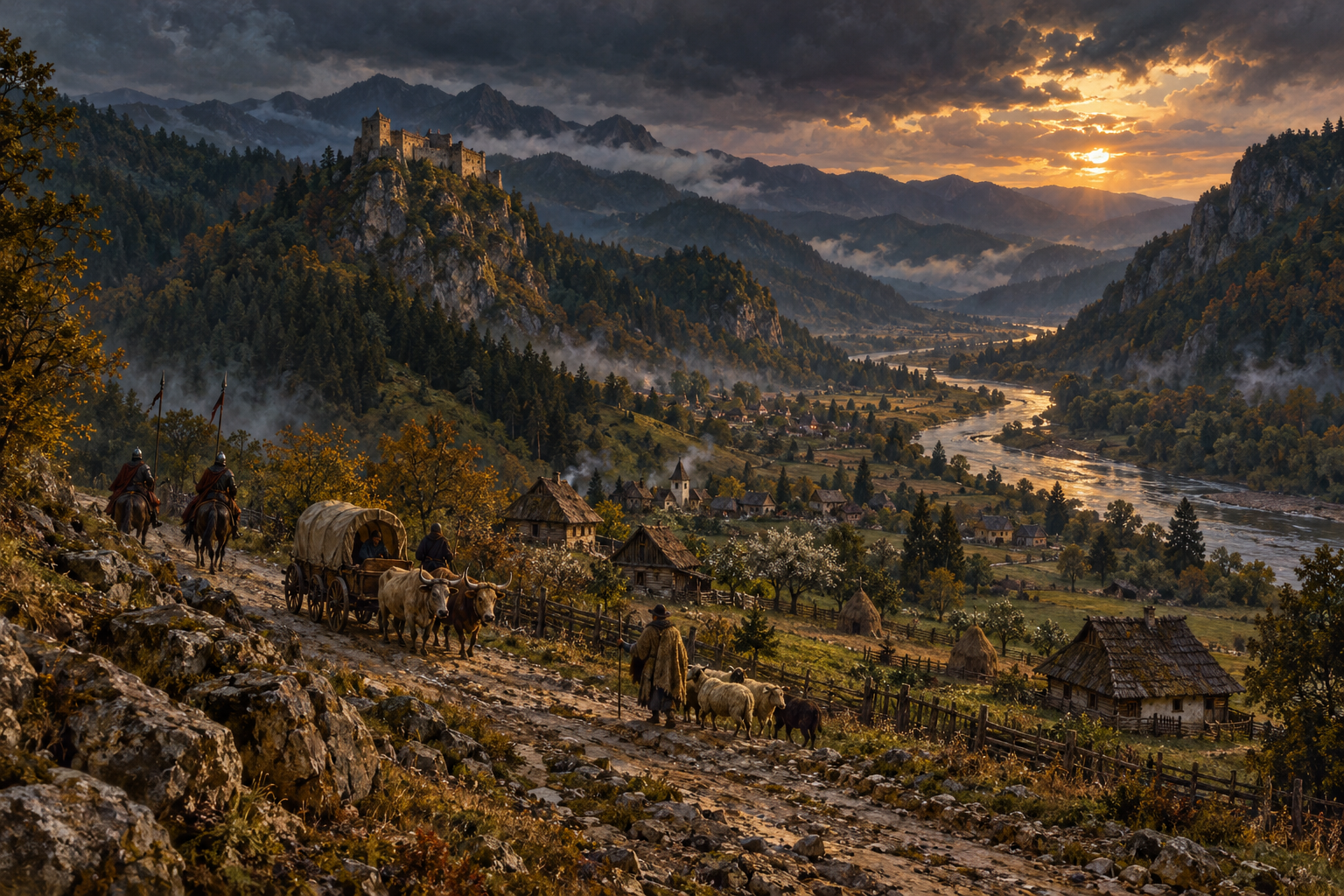
At the foot of the Carpathians, wagons creep down the stony road from the mountain passes. Beyond the last ridges lie orchards, beech woods, hay meadows and fields of grain, then a great sweep of low country running towards the Danube. Church bells carry across the villages at dawn. Shepherds bring flocks down from summer pasture. Timber rafts, salt carts and packhorses crowd the roads to the princely towns.
Wallachia has food, work, hospitable villages and old monasteries, but it is no gentle borderland. Every roadside inn knows the prince’s name. His soldiers keep some roads astonishingly safe; elsewhere a missing traveller is an accusation, and an accusation can become a death sentence. People bar their doors at dusk not only against thieves. Some of the prince’s servants are already dead.
What Is Happening Right Now?
The prince’s night patrols. A company guarding the Argeș road has stopped sending its living men home. The captain insists his soldiers have merely been transferred to Poenari, yet mothers recognise voices calling from the forest after sundown. A village priest has found an empty coffin in his churchyard. If he brings his evidence to court, the road may be cleared—or the entire village may be punished for harbouring rumours about Dracula’s men.
The missing Danube boat. At Giurgiu, the ferryman Constantin finds a skiff adrift with its oars tied inside and its cargo untouched. One crewman is alive, concealed beneath the boards: a terrified interpreter who has escaped a Ninefold Dominion reconnaissance party. The Dominion scouts want him retrieved; a Wallachian officer assumes the ferrymen are traitors. The interpreter knows where the next crossing is planned. Saving him may expose the river villages to the first retaliatory raid.
Hail in the Olt valley. A wandering student from the northern mountains has offered to end a storm that has shredded crops and stranded shepherds. His price is shelter for a sealed iron-bound book. A second storm follows wherever the book is carried. One household will hand him to the prince; another believes the mountain scholar can save the harvest. Neither knows what he brought down from the country of the Scholomance.
The Velvet Invitation
Lady Mara of Câmpulung, a wealthy widow, receives a marriage proposal written in her dead husband’s hand. The suitor is an undead captain in Vlad’s service, the same officer who protected her estates from raiders. He now demands a public betrothal at Târgoviște, claiming a forged promise gives him authority over her lands. Mara has secretly invited the adventurers to the feast. Proof of the forgery could break his political claim; open violence may bring the prince’s patrols to the door. Vlad wants loyalty and an undisturbed frontier, not a scandal over a captain who has mistaken his appetite for permission to rule. Mara offers sanctuary to anyone who helps her retain her freedom, but her guests will be watched long after the candles go out.
Across Wallachia
Târgoviște — The Princely Capital
Market stalls and workshops fill the approaches to the princely court. Tailors mend riding cloaks, smiths rivet armour, and merchants bring dyed cloth, salt, wax and imported spices through the northern passes. The court’s guards are visible at the gates, but the most alarming visitors arrive after sunset. Those summoned to a night audience do not always return to the same household.
For a stranger, the capital offers the best chance of finding a skilled physician, armourer, interpreter or wealthy buyer. It also presents the greatest danger of being mistaken for a foreign agent. The Târgoviște guide covers the court and the town in greater detail.
Curtea de Argeș — Churches and Stone
South of the mountain approaches, the older princely town has churches, workshops and travellers moving along the Argeș valley. Stonemasons, carriers and priests still use it as a place to gather news from the hills. Sister Ana tends the wounded in a modest hospice beside a churchyard. She offers clean bandages, a pallet and hot broth without demanding a story first. Her protection is real but not limitless: Dracula’s riders have begun asking for a patient whose pulse she cannot find.
Câmpulung — The Road from Brașov
Caravans descend the Rucăr–Bran route into Câmpulung with cloth, metal goods, salt and mountain gossip. Wagon wheels queue for repair after the steep roads. At the southern edge of the market stands the White Ram, a low timber lodging house kept by Petru the Latch. A bowl of barley stew, a floor mattress and stable space cost less than a private room, but Petru keeps no guest list and answers no questions before breakfast.
Ilona of Brașov, a travelling merchant with a damaged wheel and a sharp ear, pays well for a reliable escort south. She also knows which mountain villages have lost their livestock to creatures that leave the pens locked.
Poenari and the Argeș Gorge
Above the river, the steep Poenari stronghold watches a narrow approach where carts must slow and pack animals struggle. Stone and timber work continues under armed supervision. Some labourers are prisoners; others were hired and cannot now obtain permission to leave. At night the garrison changes without trumpet or torch. Families in the valley can distinguish the living guards by the sound of their boots on the stair.
The fortress is a hard target, better reached through its stores, work gangs and supply trails than by a frontal assault. Men forced to carry lime and dressed stone know the outer works. The dead sentries know the darkness.
The Olt Valley and the Danube Towns
The Olt carries mountain water and the road through its gorge links Wallachia with the Sibiu side of the Carpathians. Along its lower reaches, herds, salt traffic and boats supply the smaller markets. Farther south, Giurgiu and the river crossings face a different sort of danger. Danube boatmen can negotiate sandbanks and strong currents, but no one can guarantee who controls the opposite shore on a given night. Brăila’s river traders bring news and goods from farther east, when the routes are safe.
Food, Shelter and Useful Help
Wagon inns outside the larger towns offer haylofts and rough beds, pot meals, watered wine, horse feed and news from the preceding day’s road. The more respectable lodging houses ask a traveller’s destination; the cheaper ones ask only for coin. Village households often share food for labour, especially at harvest or when a roof needs repair. In the mountains, a shepherd’s fire and a dependable guide are worth more than silver ornaments.
For gear, seek the ironworkers and leatherworkers of Târgoviște or Câmpulung. A broken cart axle, horse shoe or ordinary blade can be repaired along the trade roads; finely worked armour takes longer and a patron’s introduction. Priests, herbalists and household healers tend ordinary sickness, childbirth and injuries. The wounds left by vampire spawn are another matter. Travellers seeking books or occult teaching seldom find them openly sold: a scholar’s recommendation, not a market stall, opens those doors.
Serious employment comes from escorting salt wagons, tracking missing stock, protecting a river boat, finding a lost shepherd or serving as a messenger between settlements. The prince pays for useful knowledge of the frontier; the danger is how his officers decide that knowledge was obtained.
The Living and the Dead
Vlad III Dracula is no distant tale. He commands the army, judges the disloyal and uses terror to make Wallachia harder to invade. Hungary’s interference angers him; pressure from the Ninefold Dominion on the Danubian frontier occupies his immediate attention. He wants Wallachia feared and left alone, not an empire conquered in his name. Some households owe their safety to his patrols. Others have lost a father, daughter or brother to the same men.
The prince’s living retainers still require rations, horses and friends. His undead followers require something more. A vampire spawn serving a night patrol hunts from ruined mills and roadside burial grounds; its orders are not always identical to the appetites driving it. The living can bargain with a captain, intercept a courier or appeal to a priest. A hungry dead soldier will recognise none of those bargains unless its master commands it.
People use the name strigoi for the restless returning dead. In villages along the lower Argeș, families keep watch over the newly buried after reports of familiar footsteps outside closed doors. Fear is justified: the corpse haunting the ruined mill above the ford is one of the prince’s escaped servants. It avoids the church steps, returns to its former home at moonrise and has begun calling for its youngest sister by name.
Other countryside terrors have their own older shapes. In meadow clearings, the unseen dancers called iele leave rings of flattened grass; a shepherd who crosses one cannot remember the path back to his flock. Along river reeds, people avoid pools whose surfaces stir against the current. These are places that alter how locals gather hay, choose a campsite and take their animals to water, not ornaments for a tavern story.
The Scholomance Beyond the Mountains
The Scholomance, the black academy associated with Vlad’s magical education, lies beyond Wallachia’s northern high country, toward the mountains south of Hermannstadt (Sibiu), in Transylvania. Its storm-working scholars do not need to cross the border to leave damage behind. A traveller arriving with rain on an empty road might be a starving student, a weather-worker carrying a forbidden book or a man whose pursuers are worse than he is. Mountain folk watch the sky before they decide whether to open a door.
Journeys Through the Principality
From Transylvania: the Brașov–Rucăr–Câmpulung road crosses steep passes with narrow weather windows; a second route follows the Olt valley from the Sibiu side towards Râmnicu Vâlcea and Slatina. Mountain snow, rockfall and washed-out bridges make a guide valuable. Hermannstadt and Brașov are across the mountains, not Wallachian towns.
Along the Argeș: roads from Curtea de Argeș and its mountain approaches lead towards the capital and the southern plain. They carry livestock, timber and stone, and they are the likeliest place to meet the prince’s armed escorts.
To the Danube: river crossings, including those by Giurgiu, depend on current, landing places and who is watching the far bank. Brăila connects the lower river with Black Sea-bound traffic. The Ninefold Dominion’s pressure belongs to this frontier; it is not another name for the Ottoman state.
East and west: roads branch east towards Moldavia and west through the Olt lands. Travellers should obtain current news of bridges and armed patrols before choosing either direction.
A Little History
Wallachia’s princely power grew from the country between mountains and river, with older seats at Curtea de Argeș and a later court at Târgoviște. Traders from across the Carpathians brought metal goods and cloth south; salt, grain, timber, animals and river traffic sustained the towns. A strong voivode could make those routes prosperous, but each invasion or contested succession fell hardest on the villages supplying horses, carts and food.
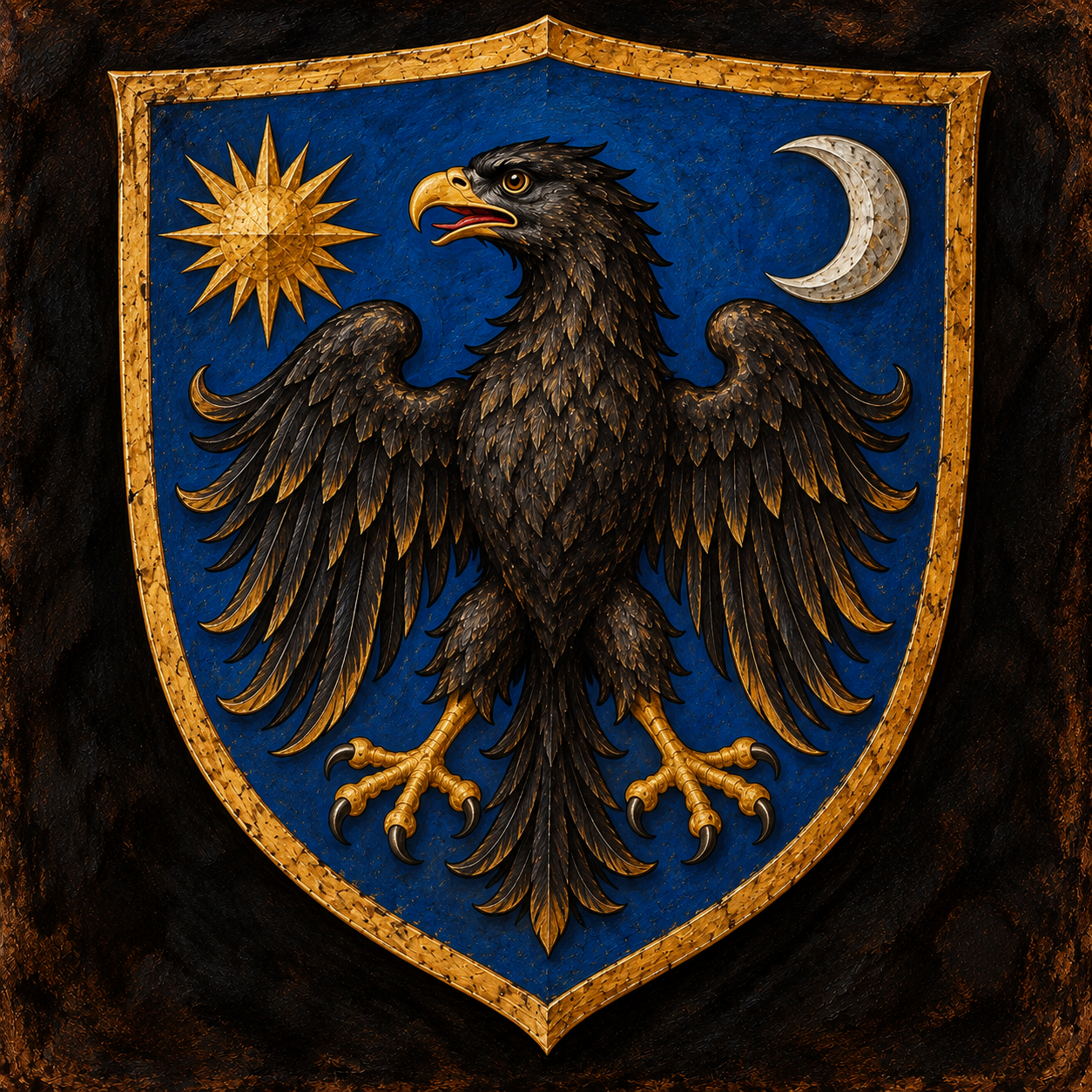
The princely eagle appears on Wallachian seals, accompanied by celestial symbols. Its form changes with the rulers and the craftsmen who cut their seals.
Further Reading and Sources
- Târgoviște: The Princely Residence of Wallachia — princely seat and town history.
- The Impact of Levantine Transit Trade on Wallachia, Transylvania and Moldova — the roads, river towns and exchange routes.
- Romanian Heraldic Symbols — medieval eagle, sun and moon.
- Folkloric Aspects of the Romanian Imaginary and Myth — Romanian strigoi, iele and other traditions.

Keep this reference growing
If this page helped with your reading or game, you can support its upkeep or explore the curated books.
Explore the Bookshop — epics, classics and stories behind imagined worlds.