
Kraków
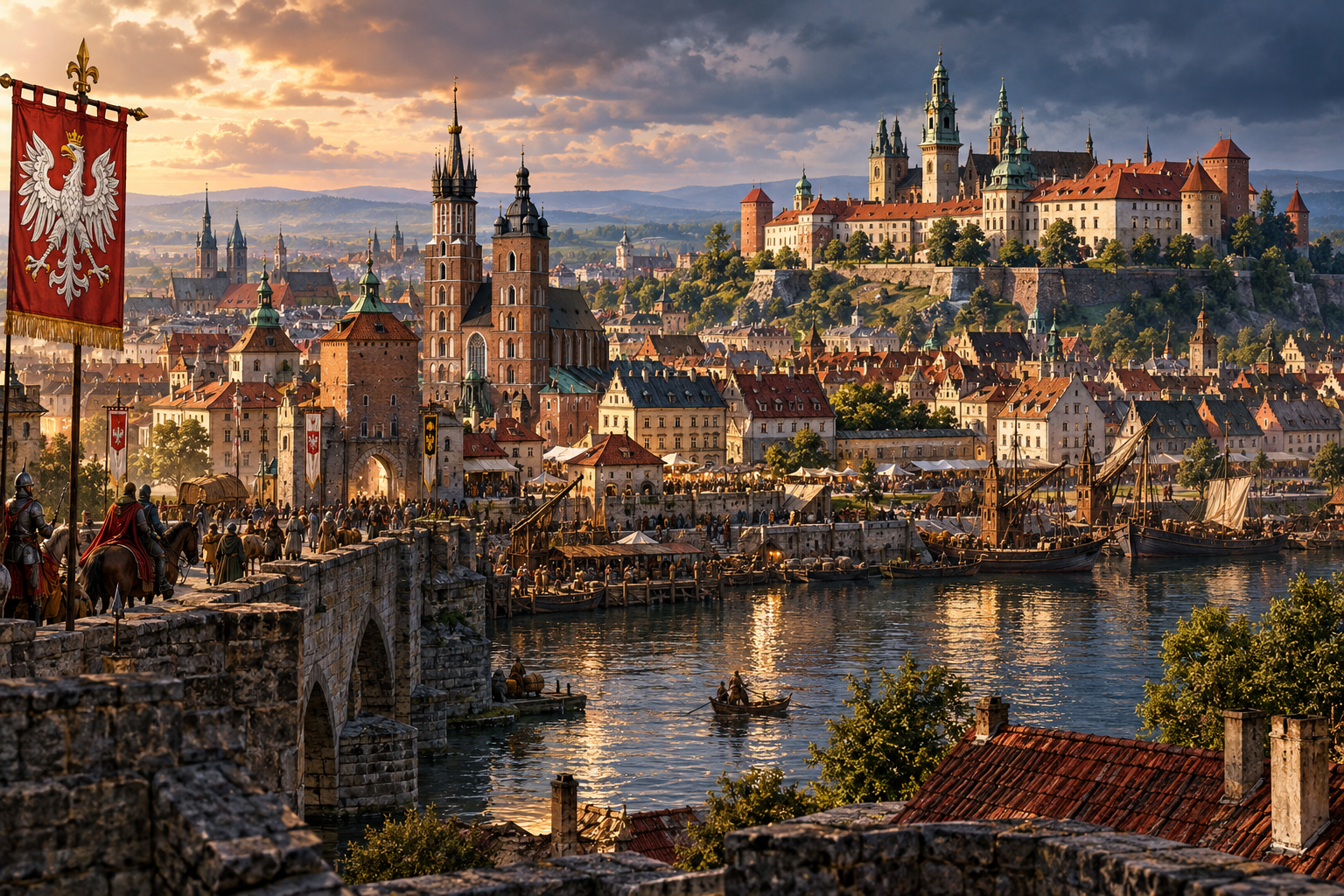
The Vistula carries salt and silver past royal towers; within the walls, scholars, merchants and envoys bargain for the future of the Crown.
Kraków at a Glance
| Campaign Present | 1454 CE |
|---|---|
| Location | On the Vistula in southern Kingdom of Poland, within East Central Europe |
| Status | Royal capital; fortified chartered city; university and commercial centre |
| Sovereign | Casimir IV Jagiellon, King of Poland and separately Grand Duke of Lithuania |
| Local Authority | Municipal council, magistrates, guild leaders and royal officers; Wawel answers directly to the court |
| Population | About 15,000 in the city (historical estimate, not a census); neighbouring settlements have their own populations |
| Languages | Polish and German in trade and civic life; Latin in scholarship and documents; other tongues carried by merchants and travellers. There is no universal Common. |
| Markets | Cloth, salt, lead, wax, timber, grain, imported luxuries, skilled metalwork and gem cutting |
| Major Sites | Wawel royal complex, Rynek Główny, the Cloth Hall, council buildings, Collegium Maius and the Vistula quays |
| Neighbouring Towns | Kazimierz and Kleparz have their own local interests and jurisdictions |
| Dangers | War procurement, forged privileges, guild disputes, smuggling, occult manuscripts and rival agents |
| Best Adventures | Court intrigue, investigations, urban pursuits, scholarship, trade escorts and hidden vaults |
A Capital Where Every Gate Has a Price
Kraków is the kingdom’s great court city: a knot of royal law, municipal privileges, scholarship and trade. The Vistula brings cargo beneath Wawel; caravans carry salt, cloth, lead and correspondence toward Bohemia, Silesia, the Baltic and the Ruthenian lands. The city’s wealth buys tall walls and fine workmanship. It also attracts every ambitious courtier, creditor, spy and thief who knows where the money is.
The crown commands armies and grants privileges, but it does not own every street. Merchants elect civic representatives, craft guilds defend their livelihoods, and royal households preserve their own officers and jurisdictions. Adventurers discover that a letter sealed in the castle may be honoured at one gate, questioned at another and quietly copied before it reaches the market.
The royal university gives Kraków a second kind of power. Astronomical calculations, law, medicine, rhetoric and disputed manuscripts pass between lecterns and private rooms. Elsewhere, dwarven workshops and old river traditions ensure that the learned city does not exhaust the mysteries hidden under its paving stones.
Explore the Surrounding Lands
What Is Happening Right Now?
A New Royal Marriage
In February, Casimir IV married Elisabeth of Austria. Her arrival brought a magnificent royal reception, distinguished guests and fresh calculations about inheritance, influence and foreign alliances. Courtiers still discuss who received an audience, who waited outside the hall and which gifts carried promises more valuable than gold. An adventuring party with the right introduction may serve a visiting household—or be mistaken for another faction’s retainers.
War in Prussia
The struggle against the Teutonic States has begun. The Crown needs loans, horses, grain, scouts, smiths and reliable roads. In the markets, royal recruiters jostle with merchants angry about requisitions and uncertain repayment. A sealed dispatch can be as dangerous as a blade; a ledger of wartime contracts can ruin powerful men.
Two Realms, One Sovereign
Casimir holds Poland’s crown and rules the Grand Duchy of Lithuania, but each realm keeps its own political demands. Lithuanian messengers and Ruthenian merchants bring concerns that cannot be settled simply by a Polish official’s order. Claims about border revenues, troops and privileges accumulate wherever the king is in residence.
The City Guards Its Privileges
The council refuses to let the emergency of war erase its chartered rights. Guild masters protest outsiders selling below customary rates; judges dispute whether royal servants can be arrested by town officers. A murderer who slips from a civic street into a protected court precinct may become the subject of a jurisdictional battle before anyone hunts him.
Places Adventurers Can Enter
Wawel — The Royal Hill
Above the Vistula stands the fortified royal complex, with guarded approaches, halls, archives, treasuries and residences. Petitioners queue for audiences while scribes copy documents and couriers wait for escorts. Access depends less on wealth alone than on sponsorship: a royal token opens certain doors, while a forged seal can lead straight to questioning.
Rynek Główny — The Great Market
The broad market square is the loudest crossroads in the city. Wagons unload near the Cloth Hall; brokers weigh goods; foreign traders hire interpreters. The council’s officers collect dues and police disputes. A prosperous stallholder may know more about a missing courier than a noble investigator, provided the party can ask without bringing guards to the shop.
The Cloth Hall and the Weighing Houses
The medieval trading hall is a place of negotiated measures, cloth grades, stored bolts and disputed payments. Lead and salt underpin wider commerce; wax, hides and imported spices change hands under watchful eyes. Here, mislabelled barrels and counterfeit weights can conceal both mundane fraud and enchanted contraband.
Collegium Maius and the Scholars’ Quarter
The university, founded in 1364 and revived in 1400, gathers masters and students of the liberal arts, law and medicine. Collegium Maius is a working complex of rooms, teaching spaces and books—not the later rebuilt courtyard seen by future visitors. Learned disputation, copied texts and questions of legitimate ownership offer as many plots as swords do.
Kazimierz — The Neighbouring Chartered Town
South of the main city, Kazimierz has its own civic identity, markets, workshops and communities. Its merchants benefit from Kraków’s traffic without sharing every privilege or tax demand. Treat it as a separate town in the present era, not merely a later suburb of Kraków.
Kleparz and the Northern Approaches
Outside the main walls, travellers from the north pass through inns, yards and trading houses before entering the city proper. An ambush in an outlying lane may leave its victims unsure which officers have authority to act. The fortified gates and existing medieval towers guard the approach; the famous later Barbican has not yet been built.
Vistula Quays and the Salt Road
Riverboats bring cargo and news, while salt from Wieliczka and Bochnia supplies one of the Crown’s great revenues. Loaders, inspectors and warehouse keepers know how much is declared and how much is carried secretly. In flood season the quays are treacherous, and a missing barge can involve three merchants, two courts and a powerful patron.
People Adventurers May Actually Meet
Casimir IV Jagiellon
The young monarch weighs war finance, noble loyalty and his responsibilities to Lithuania. He is not waiting idly in a throne room to give strangers a mission. Adventurers are more likely to first meet a marshal, councillor or clerk who can judge whether their message deserves royal attention.
Elisabeth of Austria
The new queen has brought dynastic connections and a household whose interests extend beyond Poland’s borders. Her attendants, letters and visitors offer a route into courtly politics. Helping one member of the household may offend another who expected the favour.
Sophia of Halshany
The king’s mother is an established presence within the dynasty, with longstanding ties to Lithuanian and Ruthenian networks. Envoys seeking a trusted ear sometimes approach the household around her rather than the crowded royal chancery.
Jan Długosz
The chronicler and royal-connected scholar studies events, records lineages and knows the value of documentary proof. He can help identify a historical inconsistency but will ask who supplied the document and why. Forged chronicles are not merely a scholarly nuisance when inheritances and borders are at stake.
The Unnamed Powers of the Streets
Guild elders, municipal magistrates, dwarven master metalworkers, boat captains, experienced midwives, book dealers and hired guards are the people most adventurers will actually negotiate with. Their personal names depend on the district and occasion; their motives are plain enough: protect a livelihood, settle a debt, preserve a charter or conceal a dangerous bargain.
Factions, Guilds and Competing Authorities
- The royal chancery and household: letters, appointments, guarded stores and access to the king. Royal privilege is powerful but not limitless.
- The city council and magistrates: markets, gates, ordinances, local courts and the city’s reputation as a safe place for commerce.
- The craft guilds: specialist training, quality marks, workshop disputes and control over trades.
- Merchant houses and Hanseatic connections: Baltic exchange routes, credit, distant partners and the risks of wartime shipment. These links do not make every visiting merchant a member of the same league.
- University masters and students: manuscripts, learned arguments, academic privileges and patrons competing to own rare knowledge.
- Dwarven craft households: carefully negotiated guild standing, metalworking, gem cutting and long-lived commercial obligations.
Magic, Learning and Everyday Services
Learning and consultation. Scholars can examine astronomical tables, languages, contracts, herbs or curious manuscripts. Practical expertise is not the same as a guaranteed spell. An occult specialist may require introductions and time to assess a relic rather than quote a price across a counter.
Skilled work. Dwarven workshops near commercial streets produce fine metalwork, fittings, locks and selected enchanted commissions. Most trade remains ordinary craft. A commissioned magic item requires scarce ingredients, permission or a trusted patron, and may attract the attention of guild rivals.
Lodging, healing and provisions. Inns and guesthouses serve merchants and students; healers, apothecaries, surgeons and midwives offer different degrees of expertise. The Crown’s roads support escorts, pack animals and scribes, but a party should obtain interpreters for distant journeys where Polish or German may not suffice.
Buying and selling. Salt, lead, cloth and coin are widely recognised commodities. Large or unusual transactions pass through brokers, assay, written agreements and sometimes the council’s officers. Do not treat an unfilled settlement table as a promise that rare magic or equipment is automatically available.
Dangers and Adventure Hooks
| d6 | Trouble in the Royal Capital |
|---|---|
| 1 | The Queen’s Missing Seal. A packet disappears during the royal celebrations. Its contents are harmless unless a rival adds a forged marriage pledge. Recover the true document before it is read at court. |
| 2 | The Salt Account. A war supplier has charged for more salt than arrived. The missing barrels were moved under guild seals, and the honest clerk who noticed has vanished. |
| 3 | The Student’s Cipher. An apprentice astronomer uncovers an encoded marginal note in a borrowed manuscript. Three scholars want the book; one wants its owner erased from the register. |
| 4 | The Dwarven Contract. A master smith refuses to release a commissioned ceremonial blade. Its buyer demands delivery, but the deposit was paid with coin bearing a stolen royal mark. |
| 5 | Two Courts, One Prisoner. A royal courier sought for murder claims municipal guards have no right to hold him. Prove which jurisdiction can hear the case without letting the suspect escape. |
| 6 | Fire on the River. A cargo barge burns downstream. Searchers find waterlogged war messages, an empty coffer and signs that the fire began after the crew fled. |
The most dangerous choices are often political. Helping the council may anger the castle, and fulfilling a royal order may threaten a trading family that previously sheltered the party.
Travel, Law and Practical Play
Arriving at the Gates
Gatekeepers watch carts, travellers and suspect cargo. Papers identifying an employer, letters of introduction and declared wares may reduce questioning. A suspicious visitor carrying unusual weapons should expect scrutiny, not an automatic arrest or a universal weapons ban.
Jurisdiction and Punishment
Royal officials, municipal judges, guild officers and neighbouring town authorities do not always agree. A crime in a market stall, a quarrel among students and a theft from the royal stores may each begin before different officers. Parties who bribe a minor watchman cannot assume his superior will honour the bargain.
Money and Journeys
Secure coin or reputable bills of exchange for major purchases, and expect weighing and conversion for unfamiliar currency. A hurried traveller can move faster with horses and safe-conducts but should allow time for tolls, floods and wartime inspections. The Vistula is a route for heavy freight as well as a danger in bad weather.
Roads Beyond the City
Westward merchants travel toward Silesia and Bohemia; northward agents follow roads into the Crown’s contested Prussian approaches; eastward trade passes toward Ruthenian centres and Lithuania. Southward roads wind toward mountain passes and Hungary. An apparently short journey can cross several jurisdictions.
Non-Human Peoples and Hidden Communities
Dwarves. The city’s longstanding dwarven commercial households are most visible in metalwork, gem cutting, contracts and money-changing. Their guild ties are practical, and even an outstanding smith may have to negotiate with human councillors and competing workshops.
Halflings and itinerant traders. Families moving with wagons, river craft and seasonal fairs pass through the markets. Those without established patronage are vulnerable to tolls and suspicion, making a reputable local contact valuable.
Older powers. Stories of river spirits, haunted cellars and bargains beneath the foundations circulate among boat crews and night watchmen. Some are frauds, some misremembered accidents, and a few are warnings. A monster or magical creature used in play should be drawn from the established bestiary rather than invented as a new city species.
How Kraków Became a Capital
In 1257, the city received a major charter defining its urban institutions. By the reign of Casimir III, the market and royal centre had acquired lasting prominence; the neighbouring city of Kazimierz was chartered in 1335. Kraków’s university was founded in 1364 and renewed in 1400, giving its scholars a place among the notable learned communities of Europe.
Victory over the Teutonic Order at Grunwald in 1410 helped reshape the region’s politics, but did not end every dispute along the northern frontier. In 1454, the same dynasty that links Poland and Lithuania faces a new and expensive war. The grand ceremonial welcome for Elisabeth of Austria makes this a year of marriage alliances as well as military decisions.
The later fame of Kraków’s Renaissance architects, humanists, printers and astronomers belongs to subsequent decades and centuries. The thriving court and university may lay the foundations for their achievements, but those future figures are not present as the city’s working citizens today.
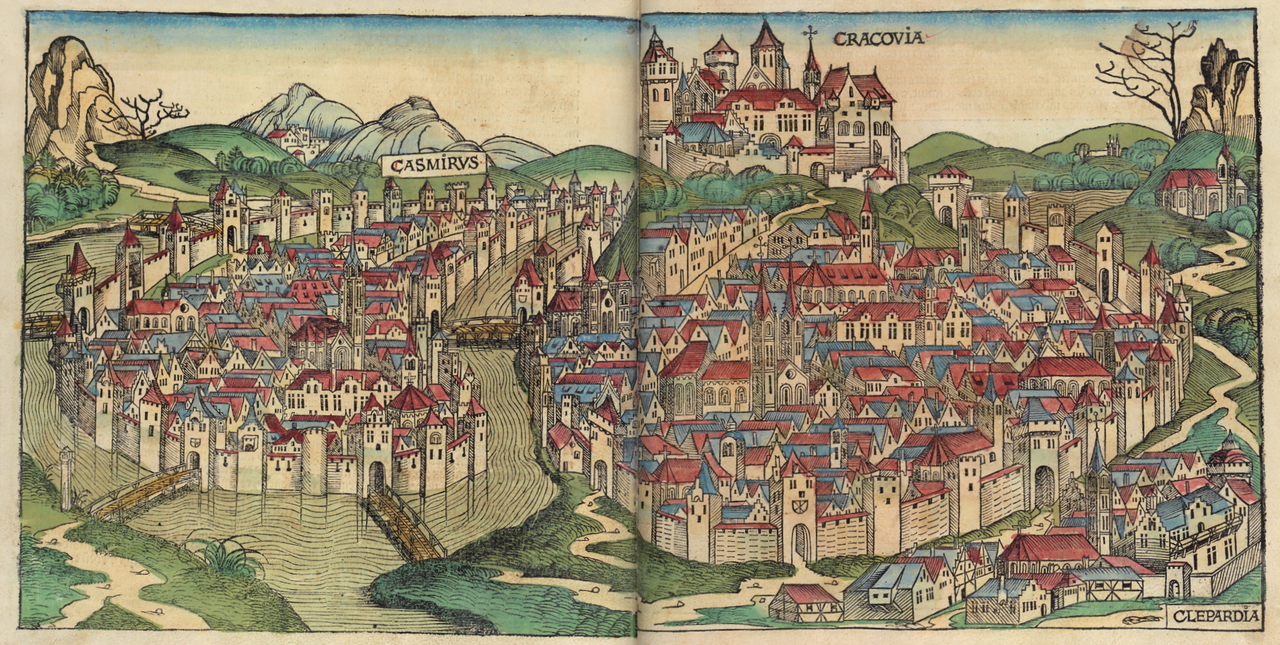
Seeing and Finding the City
Begin at Wawel, the royal hill immediately south of Kraków’s walled Old Town. Within the walls, Rynek Główny forms the commercial heart of the city, with St Mary’s Church on its northeastern side and the university quarter to the west. Kleparz stands beyond the northern approaches; Stradom lies to the south, connecting the royal hill and the neighbouring town of Kazimierz.
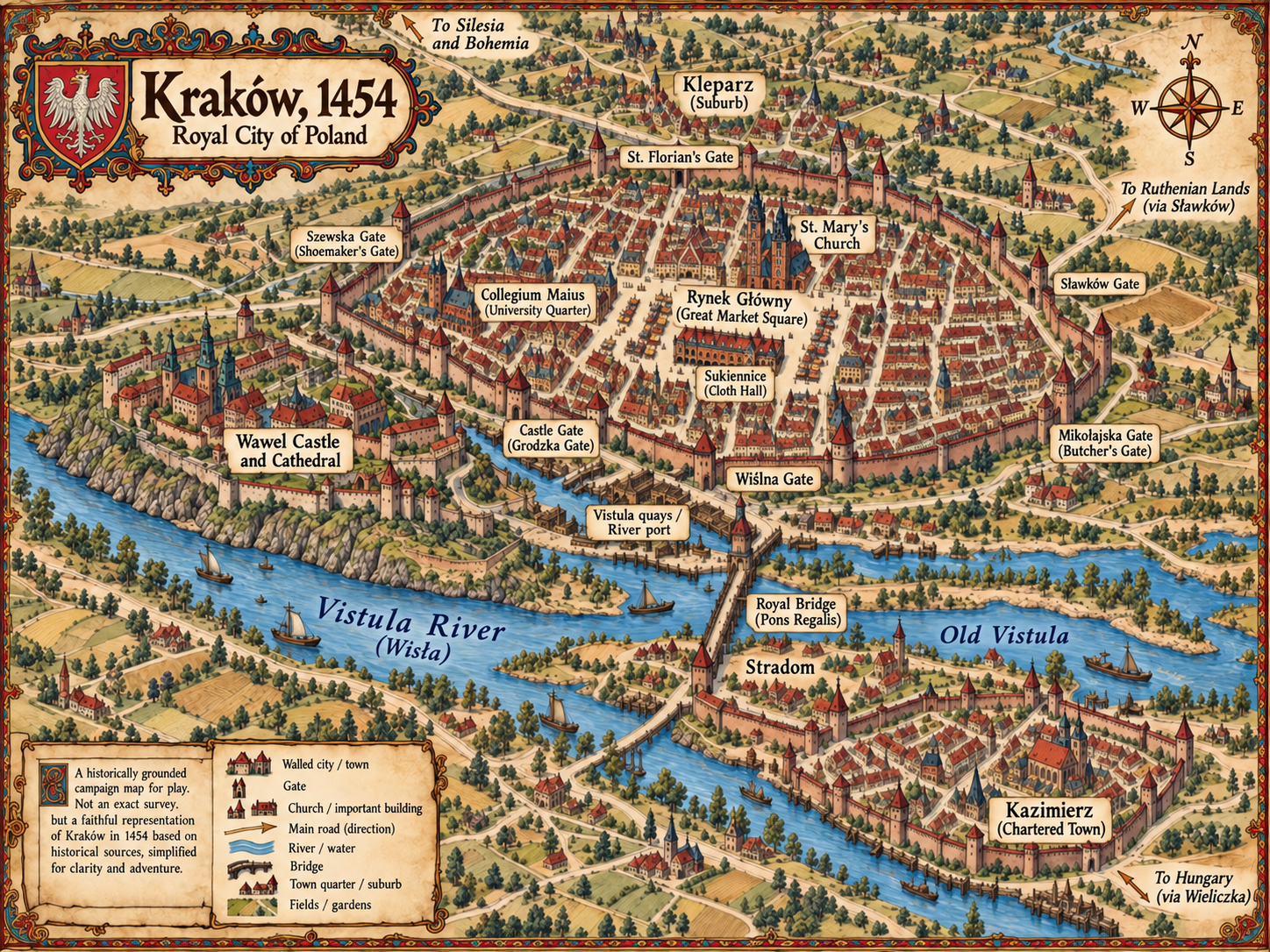
City orientation. From the northern gate, enter the merchants’ streets toward the market. From the market, travel west for university houses or south toward Wawel and the Vistula approaches. Continue through Stradom toward Kazimierz, a separate chartered town whose streets, markets and guards answer to their own authorities. Use the map for relative locations and possible journeys, not to measure precise travel distances.
Historical Sources and Image Credits
- Jagiellonian University, Corpus Academicum Cracoviense — founding, renewal and academic history.
- Medieval Heritage, Kraków Cloth Hall — market structures and medieval commercial buildings.
- Medieval Heritage, Kraków Town Hall — council buildings and market-square history.
- The Hanse, medieval trading network — long-distance commercial context.
- Historical study of royal entries in Kraków — the arrival of Elisabeth of Austria in February 1454.
- Nuremberg Chronicle (1493) — historical city woodcut, retained from the original entry; later image, not a contemporary 1454 map.
Keep this reference growing
If this page helped with your reading or game, you can support its upkeep or explore the curated books.
Explore the Bookshop — epics, classics and stories behind imagined worlds.