
The Scholomance
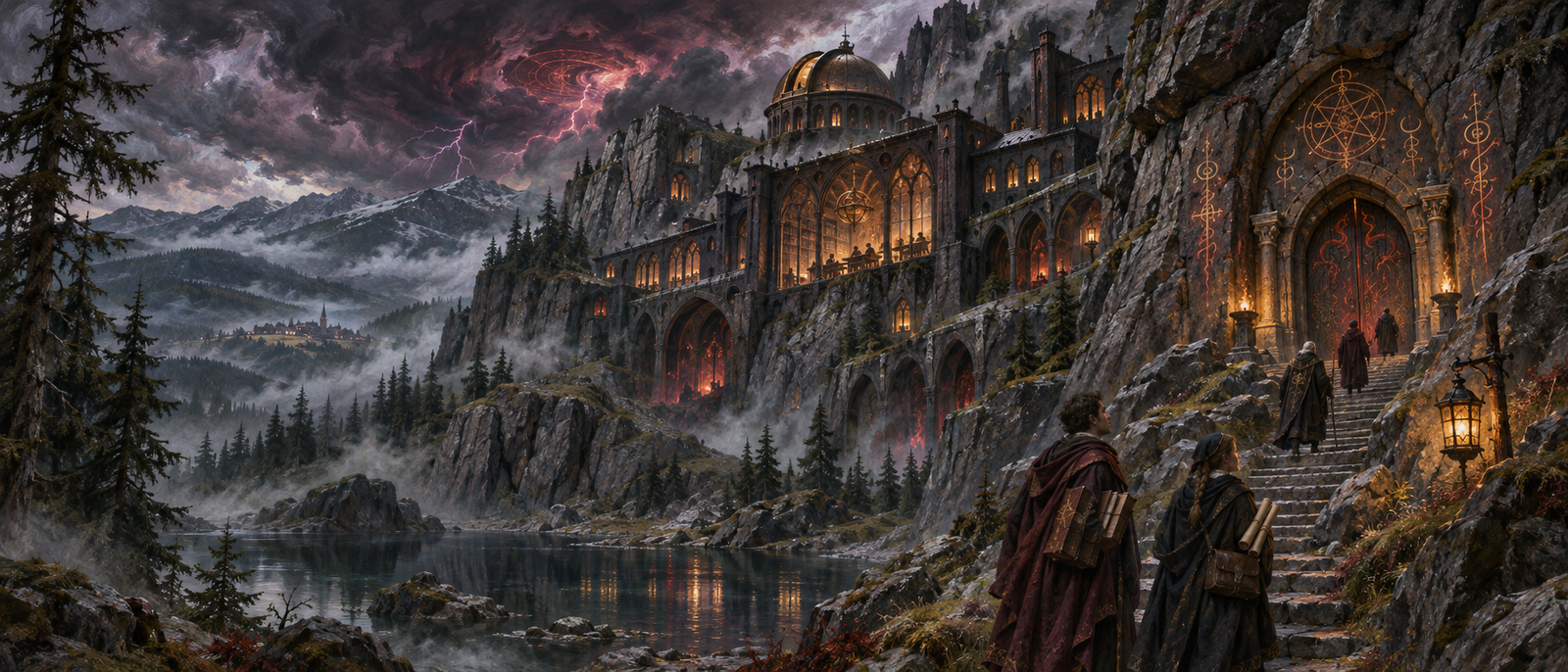
The Black School of the Carpathians · Transylvania · The Kingdom of Hungary
At dawn, twelve scholars return to Hermannstadt. Thirteen left for the mountains. They carry books written in the handwriting of people who have never learned to read, and one insists that his missing companion volunteered to stay. The other eleven will not meet his eyes. By evening, the clouds over the southern hills begin moving against the wind.
South of Hermannstadt, among the wooded heights and stone basins of the Transylvanian mountains, the Scholomance teaches knowledge that ordinary universities cannot offer. Its master is Armaros, the Infernal Archmage, a devil whose appetite for magical discovery is stronger than his interest in ruling kingdoms. He keeps his academy hidden, accepts carefully chosen students and exacts an appalling price for their education. Those who survive may become renowned sorcerers, formidable warlocks or dangerous advisers to rulers. Their loyalty to the school is far from certain.
At a Glance
| Nature | Secret infernal academy and the network of scholars it trains |
|---|---|
| Location | Hidden in the mountains south of Hermannstadt (Sibiu), Transylvania, Kingdom of Hungary |
| Master | Armaros, the Resolver of Enchantments |
| Teaching | Secrets of nature, the speech of beasts, weather-working, bindings, enchantments and dangerous ritual magic |
| Intake | Thirteen pupils per full course; twelve are ordinarily permitted to depart |
| Price | One scholar remains bound to Armaros; all others leave owing enforceable promises |
| Disposition | Lawful Evil institution; individual teachers and pupils have their own motives |
| Reach | Scattered graduates and secret intermediaries; no public territorial jurisdiction |
| Known connections | Wallachia, Vlad Dracula, and rival occult circles |
What Is Happening Right Now?
The Thirteenth Name
The last class has returned without Ilona Fekete, a gifted pupil whose name appears twice in the exit ledger: once among those released and once beneath the master’s claim. Her brother has arrived from Hermannstadt with her childhood handwriting as proof that one signature is false. Armaros is not interested in a human quarrel until he learns that somebody inside the school altered his contract. He may offer the characters passage through the gates if they recover the original ledger before his own tutors do.
The Dragon Beneath the Water
A shepherd’s family has found scorched fish beside a high mountain tarn. Rain falls from a clear sky, and pack animals refuse a pass that has served the valley for generations. The Scholomance teaches the control of storms through a dragon that sleeps beneath deep water. A young tutor has begun waking it without the master’s consent. The danger is not simply a monster loose in the hills: every attempt to force the creature back below the surface risks breaking the weather for villages downstream.
An Invitation from Wallachia
An envoy asks for a list of former pupils connected to Vlad Dracula. His interest is precise and personal, not a plan to annex the school. Armaros refuses to disclose a name unless he receives something that even Dracula cannot easily supply. A stolen letter, the release of an imprisoned scholar or the destruction of a witness might secure an answer. The envoy would rather leave with the records than accept another infernal bargain.
The Hidden Academy
The Scholomance is no great fortress visible from the valley. Its chambers occupy a broken ridge and caverns reached by paths that seem to change after sunset. At its outer approaches stand old cairns marking dangerous lightning ground. The small lake associated with the school is not called Lake Hermannstadt by its neighbours; Hermannstadt is the city below, not a mountain lake. No reliable public map marks the academy itself.
The Storm Stair
A steep track rises above the last summer grazing grounds to a door set into black stone. Those carrying a genuine summons see thirteen steps; those without one see only a wet rock face. The gatekeeper hears every spoken name but answers only requests made without threats. A party may be admitted on a tutor’s authority, by presenting an unbroken contract or by finding another route into the mountain.
The Hall of Living Tongues
Birds, hounds and stranger creatures occupy niches around a lecture chamber. Pupils learn to distinguish what an animal knows from what it has merely heard. The hall can expose an assassin, but it can also condemn a shepherd whose dog witnessed a crime the shepherd never saw. An escaped speaking raven is carrying part of the current class’s examination questions into the town.
The Observatory of Unfallen Rain
Charts of clouds hang beneath a ceiling that reveals the sky even when the chamber lies far underground. A tutor demonstrates how a hailstorm can be delayed, split or sent toward a chosen valley. The cost of each alteration is recorded on a slate: crops ruined somewhere else, a river starved of rain, or a road made impassable. Scholars who treat weather as an abstract spell fail their practical examination.
The Hall of Contracts
Here every lesson has a witness and every promise a consequence. Pupils sign for the use of books, familiar spirits and secret lectures. A debt may require a service after graduation, silence about a forbidden discovery or a return visit on a named night. Armaros prefers bargains that the signatory understands and later regrets; he regards confusion or forged consent as sloppy scholarship, not mercy.
The Thirteenth Cell
Thirteen chambers open off the students’ dormitory. Twelve have doors that lead back to the outer corridors. The last changes its position each term. It contains the records of former pupils who never went home, and sometimes their voices. The bound scholar is not automatically slain or transformed: some are made servants, some assistants, some living repositories of discoveries too dangerous to release. It is possible to free one, but not merely by breaking a lock.
The Lower Basin
A deep passage descends toward cold water beneath the rock. Chains and carved storm-marks hold the sleeping dragon’s attention, not necessarily its body. Its appearance, loyalties and willingness to serve are matters for the creature itself; the infernal tutors teach command, but command and obedience are different things.
Masters, Pupils and Servants
Armaros — Master of the academy. He values an original magical solution more than flattery, bloodshed or the praise of infernal nobles. He has no need to attend every lecture. An extraordinary research proposal may gain an audience; an attempt to cheat his ledger earns an investigation conducted with terrifying patience.
Magister Mathias of Hermannstadt — Mortal registrar. A learned local copyist who maintains contracts, invitations and the alumni correspondence. Mathias knows which promises are enforceable but cannot cancel one by himself. He will conceal a pupil’s failure if it protects the school; he will not alter an agreement without explicit authority after witnessing what happens to forgers.
Ilona Fekete — Missing thirteenth scholar. Ilona excelled at unbinding enchantments and challenged a tutor’s calculations in public. The ledger says she both departed and stayed. Finding her is the most direct way to determine whether the school’s rules protect even its own pupils.
The infernal faculty. Devils teach particular disciplines—contracts, stormcraft, enchantment, the speech of creatures—but do not share a common ambition. One seeks Armaros’s favour; another wants the right to recruit pupils for an infernal patron; a third resents any human who masters a spell before its appointed lesson. Their rivalries offer opportunities that a united faculty would never permit.
The bound scholars. Former pupils retained as payment serve as librarians, magical assistants, messengers or unwilling guardians. They are not uniformly loyal, and neither are they uniformly innocent. A long-serving scholar may protect the next class from a terrible choice while defending the very system that trapped them.
The Scholomance as a Faction
Its members are connected by education and obligation rather than by armies, uniform or territory. The academy is a place; the Scholomance circle is the difficult-to-trace web of tutors, pupils, bound servants and graduates whose debts still have force.
| Standing | What they can do | What constrains them |
|---|---|---|
| Petitioner | Seek sponsorship, deliver a discovery, negotiate admission | No access to the school’s inner chambers or teaching |
| Pupil | Study the secrets granted by a signed course agreement | Obeys the lecturers, cannot take books beyond the gate and faces the final claiming |
| Graduate | Use acquired knowledge and request limited aid from the alumni chain | Retains personal debts; has no authority to order Armaros’s faculty |
| Bound scholar | Access reserved libraries and undertake the master’s difficult work | Cannot simply leave; may negotiate duties or eventual release |
| Registrar or tutor | Issue lawful instructions within an assigned department | Accountable to Armaros; may not rewrite another tutor’s valid contracts |
| Armaros | Sets the course, claims payment, judges disputes and grants exceptions | His own exacting bargains and appetite for authentic discovery |
Goals and Methods
The academy seeks spells that have not been written, instruments that unravel enchantment, and students capable of bringing discoveries back from the mortal world. It offers astonishing tuition in exchange for secrecy, obedience and a claim upon one pupil in every course. It purchases manuscripts through intermediaries, recruits ambitious scholars through old graduates, and settles disputes by reading exactly what was promised. It does not send soldiers to occupy towns.
Lawful Evil in Practice
Armaros rewards diligence, original discovery and precise fulfilment of a contract. He punishes plagiarism, broken bargains and falsified evidence even when committed by a favourite tutor. The academy does not consider a pupil’s freedom equal to its own interests: the thirteenth may be sacrificed to secure twelve successes. A pupil who objects can remain compassionate without changing the institution’s nature. Likewise, a cruel graduate may be condemned by the academy for breach of contract rather than for cruelty.
Allies, Clients and Rivals
Infernal powers: devils may purchase training or seek talented mortals, but Armaros’s exile and independence make him a difficult subordinate. Vlad Dracula: old stories connect him with the school’s dark education; acquaintance does not mean control. Local scholars: some desire lost works, others fear the disappearance of promising pupils. Rival covens: the Witches of the Howling Moon are independent; proximity in the Carpathians neither makes them students nor allies. Villagers: families can seek the academy’s weather-working and still despise its cost.
Joining, Leaving and Betraying the Circle
An invitation requires a sponsor, proof of unusual talent and a promise accepted by the registrar. Admission is not proof of wickedness, and a pupil need not consent to another’s suffering merely to enter. Graduation ends the course, not every debt. A student who escapes with a stolen book may be hunted as a thief; a student who proves that a tutor falsified a bargain can force the master to hear a case. The most valuable betrayal is not selling the school’s location, but freeing someone whose continued captivity makes an infernal discovery possible.
Magic, Services and Dangers
Experienced pupils can learn weather-working, the languages of beasts, warding, enchantment-breaking and forbidden bargaining. The school can identify a mysterious curse, translate an animal’s testimony or teach the method for unravelling a particular spell. It will never offer such services as a normal public shop. Payment is more often research, obedience, a future favour or the right to study the supplicant than coin.
Not every spell is taught to every student. A graduate’s reputation represents hard-won experience, not an automatic bonus spellcaster level added without limit. The old claim that the Scholomance can make any practitioner more powerful is true only in the dangerous sense that its lessons may open routes no ordinary teacher would disclose. The price remains part of the reward.
The greatest dangers are broken storm bindings, infernal tutors with conflicting instructions, enchanted beasts capable of giving damaging testimony, debt traps and the powerful people who want the students’ names. A clever party may solve a threat without fighting a devil.
Adventures at the Black School
One Name, Two Signatures
Ilona’s family pays the characters to prove she was never properly claimed. The evidence is in the registrar’s book, but a tutor has taken the original page to the observatory. Returning it wins the case; destroying it frees the wrong person from a different bargain.
Rain for a Price
A village asks for relief from drought. The only graduate willing to help can bring rain by moving a storm from a neighbouring valley. The characters can negotiate an alternative, discover why the water is bound, or choose which community must bear the cost.
The Winter Masque
Magister Mathias invites the adventurers to a candlelit masquerade where graduates, masked tutors and wealthy petitioners trade favors beneath the mountain. A noblewoman named Katalin of Brașov has come to ransom her adult beloved, a former scholar still bound to the school. An infernal tutor offers to release him if she signs the same contract, while a rival tutor whispers that the original agreement was witnessed by someone who has since vanished. The adventurers can uncover the lost witness in the Hall of Living Tongues, expose the forged clause before Armaros, or spirit the captive away through the storm stair. The last choice leaves the academy’s debt collectors free to pursue him. Katalin is no helpless guest: she has already bribed one servant and concealed a dagger beneath her velvet sleeve.
The Scholar Who Came Back
One of the bound thirteen appears on the road after decades away. The contract may not have been broken: Armaros could have ordered the scholar to retrieve something. The party must decide whether to trust a fugitive who refuses to say what is hidden in his satchel.
A Dragon’s Refusal
The dragon beneath the tarn has decided not to make storms for the school’s teachers. The valley rejoices until snow and flooding arrive at the wrong seasons. Its cooperation must be earned, bargained for or replaced by a different solution; attacking it will not put the weather back as it was.
The Thirteenth Gate — Encounter Rules
When uninvited visitors force a passage into the contract hall, thirteen empty doorways appear. One turns toward the trespasser and demands a name in payment. A genuine signed invitation passes safely; the wrong name awakens a ward. The ward is a barrier and a warning, not an automatic command for every devil in the school to attack.
Thirteenth Gate — Magical Hazard
Trigger: A creature without an invitation opens the inner hall door. Detection: DC 16 Intelligence (Arcana) check identifies the moving runes. Disarm: DC 16 Intelligence (Arcana) check made beside the threshold as an action, or Dispel Magic against the ward (spellcasting ability check DC 16 if required).
Effect: The triggering creature makes a DC 16 Wisdom saving throw. On a failure it takes 13 (3d8) Psychic damage and has the Frightened condition until the end of its next turn; on a success it takes half damage and isn’t Frightened. The ward resets after 1 minute.
Alternative: A visitor may offer their true name and negotiate admission. Speaking a name does not compel a character to sign any further contract.
Thirteenth Gate — Magical Trap
Trigger: Opening the inner door without a valid invitation. Detect: DC 16 Intelligence (Arcana) reveals the ward. Disable: DC 16 Intelligence (Arcana) as an action or Dispel Magic (DC 16 spellcasting ability check for a spell of insufficient level).
Effect: DC 16 Wisdom saving throw, 13 (3d8) psychic damage and frightened until the end of the creature’s next turn on failure, half damage and no frightened condition on success. Resets after 1 minute.
Alternative: Negotiate with the unseen registrar rather than break the ward; no contract is assumed without an agreement.
Thirteenth Gate — Magic Trap
CR 4; Type magic; Perception DC 24; Disable Device DC 24; Trigger opening the inner door without a valid token; Reset automatic (1 minute).
Effect: Fear-mark ward; Will DC 18 half; 3d8 points of damage from supernatural mental assault, and shaken for 1 round on a failed save. On a successful save the creature takes half damage and isn’t shaken. Knowledge (arcana) DC 21 identifies the contractual glyph; Spellcraft DC 21 determines a safe name-token sequence. Dispel Magic can suppress the ward under the normal dispel rules.
Thirteenth Gate — Magic Trap
CR 4; Type magic; Search DC 24; Disable Device DC 24; Trigger opening the inner door without a valid token; Reset automatic (1 minute).
Effect: Mind-wracking glyph; Will DC 18 half; 3d8 damage from the glyph, and shaken for 1 round on a failed save. On a successful save the creature takes half damage and isn’t shaken. A DC 21 Knowledge (arcana) check identifies the oath-runes. Dispel Magic may suppress the ward under the normal dispel rules.
Roads, Neighbours and Older Stories
Hermannstadt stands in Transylvania under the Hungarian Crown, not in the principality of Wallachia beyond the southern mountains. Merchants, shepherds and woodcutters know the foothill tracks; few can show a stranger the school. Tales of a mountain lake, a dragon and learned weather-makers circulate far beyond the valley. Whether a particular lake is the right one should be discovered through play, not read from a public survey.
The school has outlasted several generations of rulers by remaining useful, difficult to find and unwilling to trade its independence for a noble title. Its name has many tellings. Village storytellers commonly speak of fewer pupils and of a dragon-rider claimed by a dark master; the internal register kept by Armaros records thirteen places. The contradiction itself is a clue: some stories preserve a warning, while others describe what the school wishes outsiders to believe.
Sources and Credits
The Scholomance draws upon Romanian tales of the solomonari, the weather-working scholars, and later accounts of a secret mountain school. See the Bram Stoker Estate’s discussion of the Scholomance and Hermannstadt for the literary tradition. The earlier entry credited Liber Mysterium: The Netbook of Witches and Warlocks, by Timothy S. Brannan and the Netbook team; its thirteen-student tradition and the role of Armaros remain part of the academy described here. The real geography is Transylvania; the infernal school and its inhabitants belong to the campaign world.
Keep this reference growing
If this page helped with your reading or game, you can support its upkeep or explore the curated books.
Explore the Bookshop — epics, classics and stories behind imagined worlds.