
The Teutonic States — Infernal Dominion of the Hell Knights
At a Glance
| Realm | The Teutonic States |
|---|---|
| Capital | Marienburg |
| Ruler | Ludwig von Erlichshausen, Grand Master |
| Alignment | Lawful Evil |
| Government | Militarised infernal order-state ruled through commanderies, fortified districts, military courts and the hierarchy of the Hell Knights |
| State Faith | Open devil worship centred upon the powers, laws and hierarchies of Hell |
| Relationship with Hell | Hell’s foremost recognised mortal client-state and principal lawful bridgehead on Earth, bound to the infernal government through treaties, registered contracts, diplomacy, military cooperation and commerce |
| The Burning Gate | A permanent fortified planar crossing within Marienburg connecting Earth to the regulated roads, gates and jurisdictions of Hell |
| Infernal Presence | Accredited devil diplomats, jurists, scribes, merchants, military advisers, intelligence agents and other recognised infernal residents operate openly within major Hell Knight strongholds |
| Present Crisis | The Prussian Confederation has rebelled and allied itself with the Kingdom of Poland |
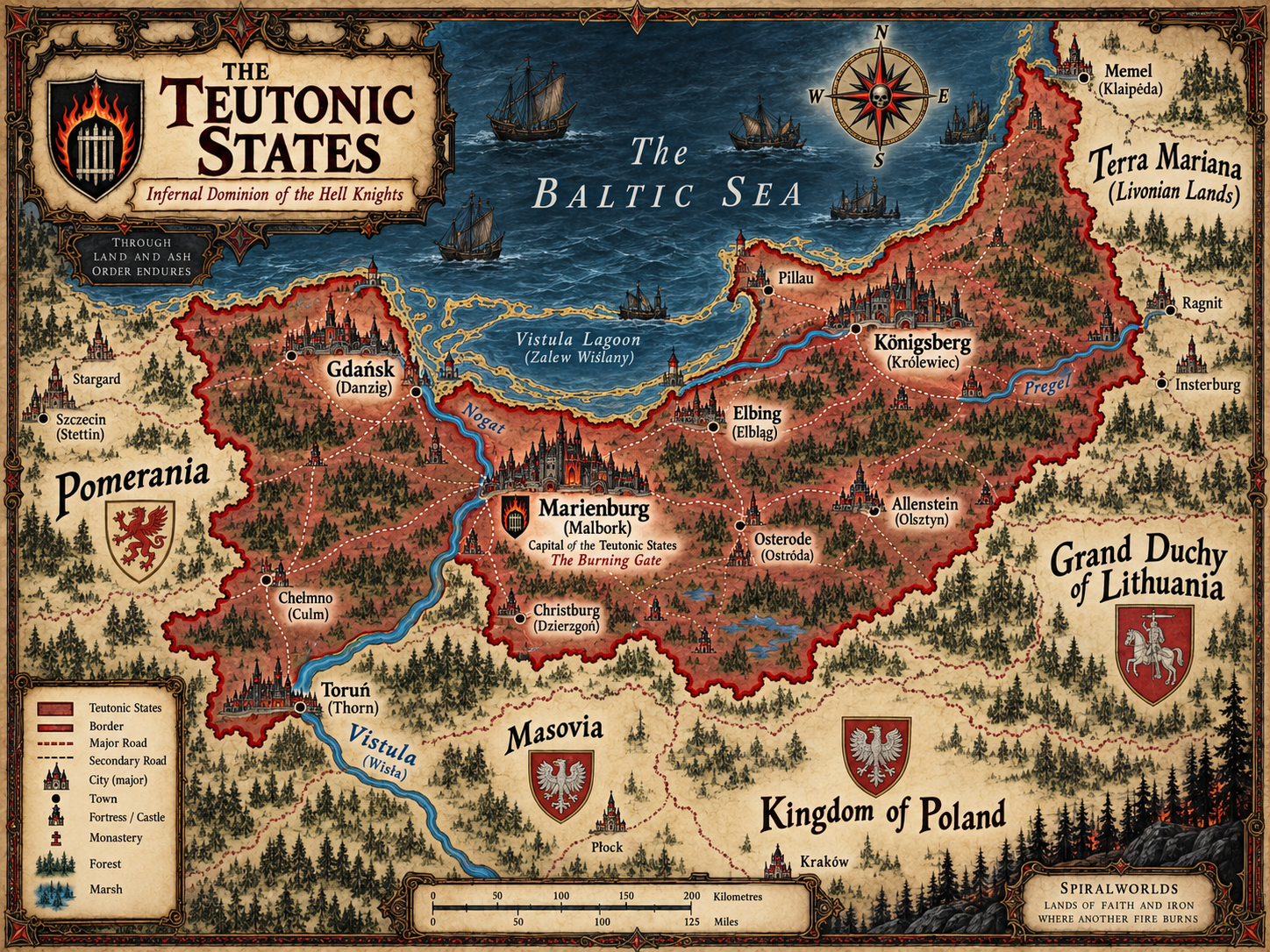
| Major Centres | Gdańsk, Elbing, Toruń, Königsberg |
| Languages | Low German, Old Prussian, Polish, Kashubian, other Baltic languages, Latin and Infernal |
| Landscape | Baltic coastline, river deltas, wooded plains, lakes, marshes, fortified roads and castle districts |
| Major Rivals | Kingdom of Poland, the Prussian Confederation and rebellious Baltic cities |
| Adventure Style | Infernal military fantasy, war, espionage, planar intrigue, siege adventures, rebellion, political intrigue, supernatural investigation and mercenary warfare |
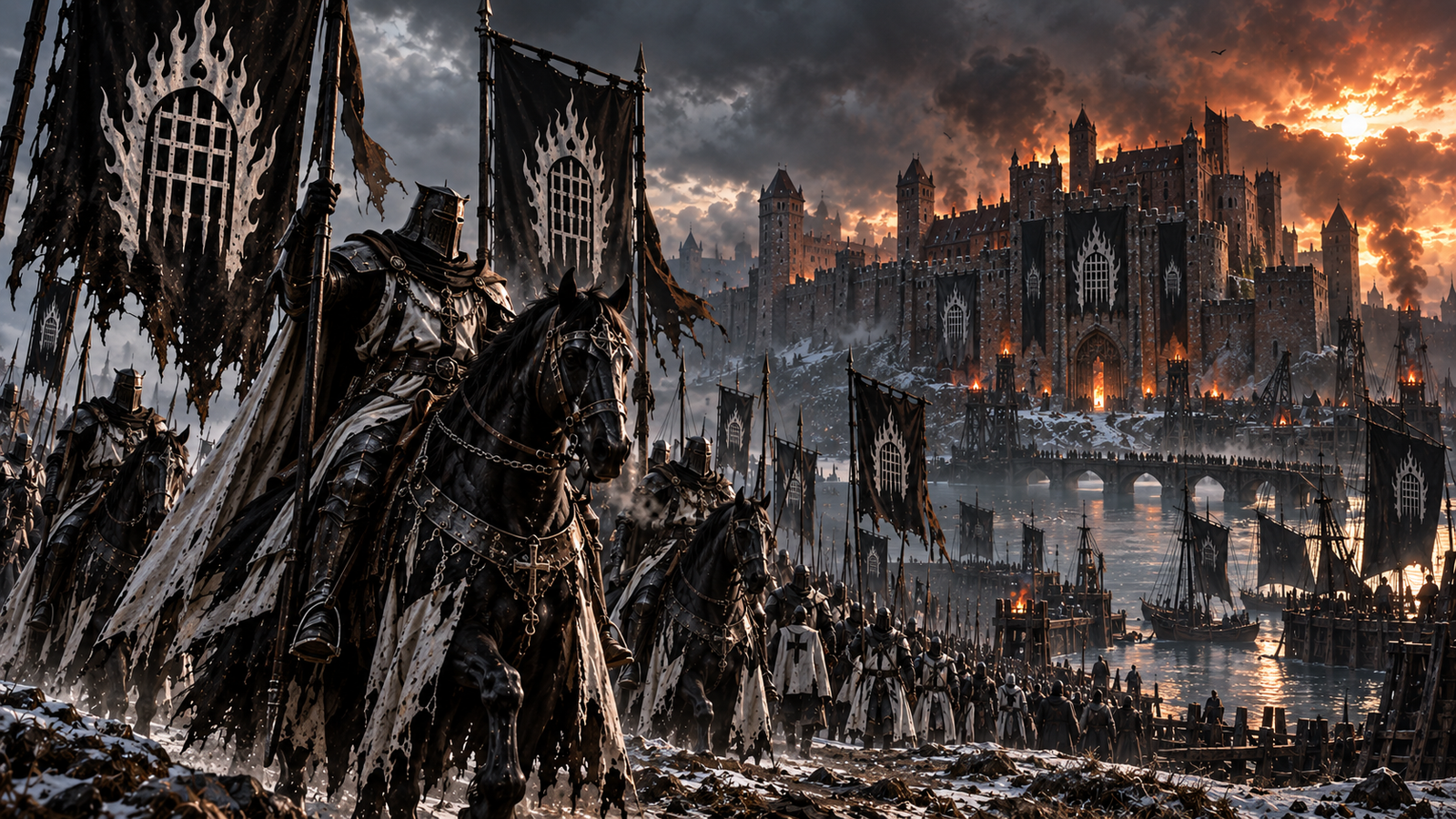
The Teutonic States are coming apart. Black banners bearing the Burning Gate still hang above formidable castles. Hell Knight patrols still demand papers on the roads. Military courts still issue sentences in the name of order. Yet merchant cities and landholders have risen against the regime, armies move along the Vistula, mercenary companies hold fortresses for masters struggling to pay them, and the authority of Marienburg is being challenged across Prussia.
This is not merely a harsh military state. The Teutonic States are openly Lawful Evil. Their rulers believe hierarchy is sacred, obedience is virtue, fear is useful and mercy is dangerous when it weakens authority. Devil worship is woven into government, military tradition and law.
The relationship goes much further than worship. The Teutonic States are Hell’s foremost recognised mortal client-state and its principal lawful bridgehead on Earth. Treaties bind Marienburg to the infernal civilisation. Hell maintains permanent diplomatic representation within the capital. Infernal contracts can be registered beyond Earth. Devils holding recognised office can legally reside within the realm. Hell Knight officers travel through the Burning Gate on official business.
The Hell Knights do not worship chaos or indiscriminate destruction. They despise both. Their ideal is a world in which everything has a place, every subordinate obeys a superior, every debt is collected, every contract is enforced and rebellion is punished so thoroughly that future generations remember the lesson.
They believe Hell demonstrates what civilisation becomes when hierarchy, law and enforceable obligation are allowed to operate without compassion.
For adventurers, this is a country of besieged castles, hostile checkpoints, contested ports, infernal tribunals, devil diplomats, secret messengers, frightened villages and dangerous loyalties. A party might arrive escorting a diplomat or hunting a fugitive and within days find itself deciding whether a fortress changes sides, whether a prisoner survives interrogation, whether an infernal ambassador can claim diplomatic immunity or whether a contract registered in another plane is allowed to seize what its signer unknowingly promised.
What Is Happening Right Now?
The revolt that the Hell Knights tried for years to contain has become open war.
The Prussian Confederation—an alliance of towns, merchants and landed interests opposed to the regime—has rejected the authority of the Grand Master and sought the protection of King Casimir IV of Poland. Important cities have changed allegiance. Castles are attacked, isolated garrisons wonder whether reinforcements will arrive, and men who were neighbours last winter now serve opposing armies.
For the Hell Knights, this is more than political rebellion.
Authority once lawfully established must be obeyed.
That principle lies at the heart of their state, and it makes compromise extraordinarily difficult.
Marienburg, seat of Ludwig von Erlichshausen and the great fortress at the centre of the Teutonic system, is therefore both a military objective and a symbol. Its walls protect armouries, treasuries, military archives, chambers of judgement, the permanent infernal legation and the fortified approaches to the Burning Gate.
The rebellion therefore threatens more than the Grand Master’s earthly government. If Marienburg falls, one of Hell’s most important recognised footholds in the mortal world may fall with it.
The Order depends increasingly upon professional mercenaries. They are skilled and expensive. Captains count unpaid wages as carefully as victories, while the Hell Knights regard contractual service as binding even when the treasury cannot fulfil its obligations.
The contradiction is dangerous.
A mercenary captain may possess a signed contract recognised by human jurists and infernal authorities while simultaneously controlling a fortress the Grand Master can no longer afford to hold.
Why Adventurers Come Here
- Carry something no official messenger can move. Letters, maps, relics, intelligence, ransom money and forbidden contracts must cross roads controlled by rival armies.
- Cross the Burning Gate. A patron needs agents capable of entering Hell, conducting business there and returning to Earth.
- Break an infernal contract. Someone signed an agreement whose true consequences have only now become apparent—and the original has been registered in an infernal archive.
- Get someone out. Merchants, defectors, captured officers, accused spies and inconvenient witnesses disappear into military prisons.
- Recover what war has exposed. Damaged commanderies and broken fortifications reveal vaults sealed during earlier infernal campaigns.
- Work for the rebellious cities. Gdańsk, Elbing and Toruń need scouts, escorts, investigators, saboteurs and specialists who can operate without formally involving the city government.
- Work for the Hell Knights. The Grand Master’s officers employ intelligence agents, monster hunters, convoy escorts and deniable specialists whose usefulness outweighs questionable loyalty.
- Work for Hell. Infernal diplomats, jurists and commercial interests occasionally need mortals capable of operating where an openly infernal agent would attract too much attention.
- Follow the money. Mercenary payrolls, confiscated merchant goods, war taxes and military treasuries move through a state desperate for coin.
- Cross the Baltic frontier. Traders, diplomats, spies and fugitives move between Prussia, Poland, Lithuania, Livonia and the wider Hanseatic world.
Places Adventurers Actually Go
Marienburg — Fortress of the Burning Gate
Marienburg is more than the capital. It is the physical expression of Hell Knight rule: walls within walls, granaries, armouries, halls of judgement, workshops, offices, treasuries, barracks, prisons and restricted infernal chambers protected by one of Europe’s greatest fortress complexes.
It is also one of the most extraordinary diplomatic centres on Earth.
Within its heavily controlled inner precincts stand the Infernal Legation and the fortified approaches to the Burning Gate, the permanent planar crossing linking the Teutonic States to Hell.
The Gate functions more like an international border than a summoning circle. Hell Knights control the mortal approaches. Infernal officials regulate passage beyond the threshold. Travellers may require recognised seals, diplomatic credentials, military orders, commercial authority or sponsorship valid under both Teutonic and infernal law.
Through the Gate pass diplomats, sealed records, intelligence, specialist goods, prisoners, military officers, infernal advisers and authorised residents of both worlds.
Its existence creates opportunities as well as defences. Servants, craftsmen, soldiers, scribes, armourers, messengers, prisoners, mercenaries, jurists, infernal officials and visiting diplomats all have reasons to pass through different parts of the fortress.
A party does not need to storm Marienburg to adventure there.
Getting one prisoner, document or unregistered traveller through the wrong door can matter more than taking a wall.
Adventure use: siege infiltration, prison escape, infernal diplomacy, planar crossing, political audience, stolen correspondence, missing payroll, infernal archive, assassination attempt, customs fraud and supernatural investigation.
Gdańsk — The Defiant Baltic Port
Gdańsk is rich enough to matter and independent enough to be dangerous. Shipping, warehouses, guilds and access to the Baltic give its government resources that inland lords cannot easily duplicate.
Its opposition to the Hell Knights turns commerce into strategy. Ships carry soldiers as easily as grain, merchants finance campaigns, and information arriving at the quays can alter decisions hundreds of miles inland.
Its merchants also understand that defeating the Hell Knights may alter access to goods and contracts previously arriving through Marienburg’s infernal connection.
Adventure use: dockside espionage, naval supply, merchant politics, smuggling, sabotage and assassins hidden among travellers.
Elbing — River, Lagoon and Rebellion
Elbing stands where river and Baltic trade meet. Control of its approaches matters to armies, merchants and anyone trying to move unnoticed through the Vistula Lagoon.
The city is a natural place for divided loyalties: civic government, merchants, military officers and neighbouring estates rarely want exactly the same thing.
Adventure use: river pursuit, stolen cargo, rival spies, secret negotiations, convoy escort and operations against nearby castles.
Toruń — The City That Chose a Side
Toruń is one of the great centres of resistance to Hell Knight rule. Here an adventurer quickly learns that rebellion is not an abstract political argument.
Gates change hands, officials issue new orders, old enemies become useful allies and anyone openly associated with the Hell Knights attracts attention.
Adventure use: urban intrigue, rebel missions, counter-intelligence, captured officials, political negotiations and dangerous crossings of the Vistula.
Königsberg — The Eastern Stronghold
Königsberg lies farther from the western centres of rebellion and remains one of the Hell Knights’ most important strongholds.
Its position makes it a gathering place for soldiers, supplies, infernal specialists and officials attempting to preserve the eastern territories while the western state fractures.
Characters who become notorious in rebel cities may discover that their names reached Königsberg before they did.
Adventure use: military headquarters, eastern expeditions, espionage, supply operations, fugitives and Hell Knight investigations.
The Commandery Roads
The Teutonic States are stitched together by castles and commanderies.
Some remain secure. Some are surrounded. Some have been abandoned. Others are controlled by soldiers whose loyalty depends upon whether anyone arrives with their pay.
Every castle can therefore represent a different political situation.
A gate may open for the Grand Master’s seal at noon and belong to someone else before dawn.
The Vistula and Nogat
Rivers are military roads. Grain, weapons, timber, soldiers and information move along them faster than heavy forces can travel overland.
Barges are searched. Ferries are watched. Bridges become strategic objectives.
Characters who control a boat can sometimes move around an army that controls every road.
The Baltic Coast and Lagoons
The coast connects the Teutonic States to the wider Baltic rather than isolating them.
Merchants, fishermen, mercenaries, diplomats and smugglers exploit the same waters.
Fog, shoals, marsh channels and shifting loyalties can make a local pilot more valuable than another sword.
People Who Matter
Ludwig von Erlichshausen — Grand Master
Ludwig rules from Marienburg while the state fractures around him.
He must preserve the Hell Knights’ territorial power, retain commanders, find money for mercenaries and demonstrate that rebellion against the infernal order can still be punished.
He is not merely the administrator of an old military order. As Grand Master he stands at the summit of an explicitly Lawful Evil mortal state whose treaties connect it directly to Hell.
He is not a Lord of Hell and is not the political equal of Asmodeus. His power rests upon his rule of the Teutonic States, the value of that state to Hell and the infernal agreements recognising his government.
For adventurers: Ludwig employs capable outsiders when their usefulness outweighs their unreliability. A successful party may receive extraordinary access to the regime. A failed or treacherous one may discover exactly how seriously the Grand Master treats an oath.
Heinrich Reuß von Plauen — Veteran Commander
Heinrich represents the professional military side of the regime: fortification, manoeuvre, intelligence, mercenary management and the practical business of keeping armies supplied while the state contracts around them.
For adventurers: he cares about useful information, working bridges, defensible roads and objectives accomplished on time.
Johannes von Baysen — Leader of the Prussian Confederation
Johannes is one of the principal political leaders opposing Hell Knight rule.
He must hold together cities, nobles and landed interests that agree about removing the regime but do not necessarily agree about what should replace it.
For adventurers: evidence, diplomacy, secret messages and the loyalty of one strategically placed official can matter as much as battlefield victories.
Ścibor von Baysen — Commander of the Rebellion
Ścibor operates in the military struggle surrounding the Confederation and Marienburg.
He is a natural patron for reconnaissance, raids, escorts, infiltration and missions whose political significance becomes clear only after the characters have accepted them.
Casimir IV — King of Poland
Poland has entered the struggle after the Prussian Confederation sought royal protection.
Casimir must turn political claims into military control while balancing the interests of Polish nobles and rebellious Prussian cities.
Most adventurers will encounter his envoys, officers, money and orders long before they encounter the king himself.
Hell Knights Encountered in the Teutonic States
- Hell Knight — a fully initiated armoured officer, judge and battlefield champion of the infernal regime.
- Hell Knight Enforcer — investigator, disciplinarian and specialist deployed when ordinary military authority proves insufficient.
- Hell Knight Armiger — an aspirant warrior serving beneath the order’s full knights while proving discipline, obedience and martial worth.
Factions and Loyalties
The Grand Master’s Government
Ludwig von Erlichshausen rules a state that remains formidable but is increasingly difficult to finance and hold together.
His administration needs money, soldiers and obedience at precisely the moment when all three are becoming harder to obtain.
The Hell Knights
The Hell Knights are the ruling military elite and ideological guardians of the Teutonic States.
They command fortresses, investigate disloyalty, enforce sentences and intervene where ordinary authority has failed.
Many of their senior jurists and commanders regard the institutions of Hell not merely as sources of magical power but as a political model worthy of study and imitation.
The Infernal Legation
Hell maintains a permanent recognised diplomatic presence in Marienburg.
The legation includes infernal diplomats, jurists, scribes, intelligence officers, commercial agents, military observers and representatives of powerful infernal courts and offices.
Those holding recognised infernal office are not treated as ordinary summoned monsters. Their seals, jurisdiction and diplomatic standing can grant them privileges acknowledged by the Hell Knight government.
A Teutonic commander may therefore possess enough soldiers to seize an infernal official while lacking the lawful authority to do so.
Infernal Interests
Hell is one infernal state, but its inhabitants do not all possess identical ambitions.
The Lords, Dukes, courtiers, Ministries and other infernal interests can compete for influence within the Teutonic relationship. One may seek military access, another commercial privilege, another legal precedent and another patronage over a particular commander.
Understanding who a devil represents can be more important than understanding what kind of devil it is.
See The Stratification of Power and The Courtiers of Perdition for the hierarchy behind these rival interests.
The Prussian Confederation
The Confederation is a coalition of cities, nobles, merchants and landed interests united by opposition to Hell Knight domination rather than by a single ideology.
Some oppose infernal rule on principle. Others resent taxation, confiscation or political interference. Others simply believe the regime is losing and intend to survive its fall.
Two patrons can therefore oppose the Hell Knights while still hiring adventurers against one another.
The Hanseatic League
The Hanseatic world connects the rebellious Baltic cities to merchants far beyond Prussia.
Trade networks become political networks, intelligence networks and escape routes.
A merchant ruined in Gdańsk may have allies in Lübeck. A stolen manifest in Elbing may matter in half a dozen ports.
Mercenary Companies
Professional soldiers are essential to the war but do not automatically share the ideology of the Hell Knights.
They signed contracts to fight.
Whether those contracts also bind their souls—or have been registered in an infernal archive—can become a considerably more important question.
The Kingdom of Poland
Polish intervention gives the Confederation the weight required to challenge the Teutonic States openly.
Polish military and political priorities do not necessarily match the ambitions of every rebellious city.
The alliance is powerful precisely because it is complicated.
The Burning Gate
The old cross no longer represents what the Order has become.
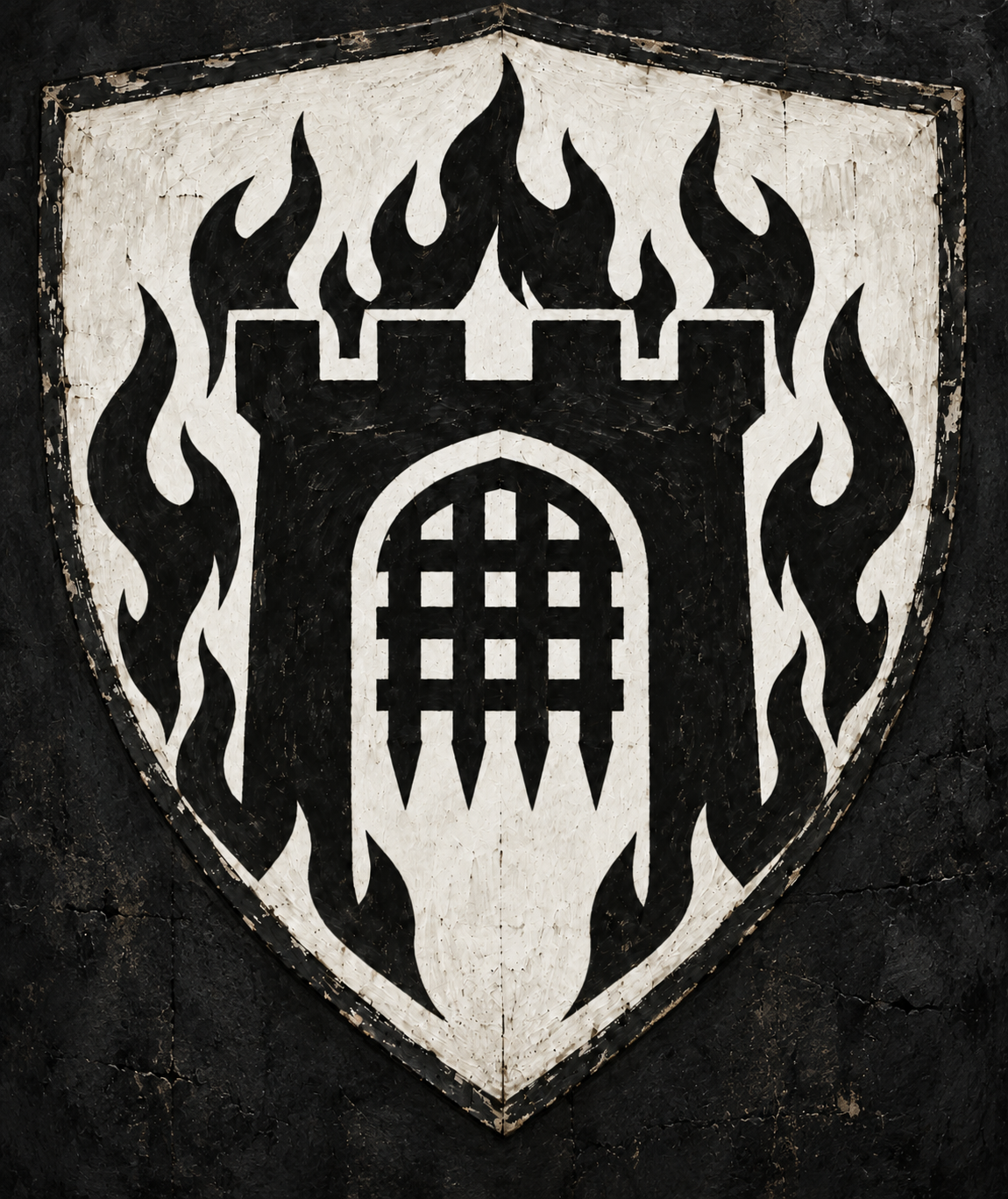
The Hell Knights instead bear the Burning Gate: a barred fortress entrance surrounded by flame.
It is both their defining emblem and the name of the permanent planar crossing at the heart of Marienburg.
To them, the emblem carries several meanings:
- Authority. The gate opens only when its keeper permits it.
- Law. Everyone passes through the proper channel.
- Confinement. Those judged dangerous can be kept inside—or outside.
- Hell. Flame surrounds the gate but does not destroy it. Fire serves structure.
- Judgement. Crossing a threshold places the traveller beneath the authority of whoever controls it.
The Burning Gate appears on armour, banners, seals, military warrants, prison doors and fortified commanderies throughout the Teutonic States.
The Gate Beneath Marienburg
The physical Burning Gate is not a temporary summoning circle.
It is a permanent regulated border between Earth and Hell.
Hell Knights guard the mortal approaches. Infernal authorities regulate the routes beyond it. Travellers require the appropriate seals, warrants, sponsorship, military orders or diplomatic status.
Crossing the Burning Gate therefore feels less like entering a magical portal and more like entering the most dangerous customs post in the world.
Weapons may be declared. Documents are examined. Cargo is recorded. Prisoners are transferred. Diplomatic bags may pass under seal. Jurisdiction changes at the threshold.
Those who cross have not entered a monster’s lair.
They have crossed into another civilisation.
Hell and the Teutonic States
The relationship between the Teutonic States and Hell is religious, diplomatic, legal, military and economic.
The Teutonic States are Hell’s foremost recognised mortal client-state and its principal lawful bridgehead on Earth.
The Hell Knights have not been conquered by an infernal army. Their rulers have voluntarily adopted infernal political principles, recognised Hell as a legitimate foreign civilisation and built agreements allowing infernal institutions to operate openly inside a mortal state.
Recognition from Malsheem
The infernal government recognises the Grand Master’s regime as a mortal authority capable of entering treaties and enforceable obligations with Hell.
The Grand Master remains ruler of the Teutonic States. He is not a Lord of Hell and does not stand as an equal to Asmodeus, Lord of Nessus and Overlord of Hell.
The value of the relationship lies precisely in the fact that the Teutonic States remain capable of governing themselves.
A conquered province must be occupied.
A client-state maintains its own roads, courts, taxes, armies and bureaucracy while progressively normalising infernal law, commerce and political influence.
The Infernal Legation
Hell maintains a permanent legation within Marienburg.
Its personnel include diplomats, jurists, scribes, intelligence officers, commercial agents, military observers and other representatives of infernal institutions.
Some possess recognised privileges and diplomatic protections under Teutonic law.
The most dangerous devil in a room may therefore not be the strongest one.
A minor-looking official carrying the correct seal may hold authority that a far more terrifying infernal warrior is legally required to obey.
For the political society behind such officials, see The Courtiers of Perdition.
Contracts Registered in Hell
Important treaties, loans, grants, military obligations and private agreements can be registered within infernal archives.
Such registration gives selected agreements a durability far beyond ordinary mortal contracts.
A document may outlive its original signatories. Rights can be transferred. Debts can be inherited. Claims can be disputed before infernal authorities. An agreement recovered generations later may remain legally alive if the jurisdiction that recognised it still exists.
This is one reason Hell Knight jurists obsess over wording, seals, witnesses, precedent and jurisdiction.
Wise adventurers read everything before signing.
Infernal Residents
Devils do not appear in the Teutonic States only when summoned for battle.
Some reside openly under recognised legal status.
They may work as diplomats, scribes, legal advisers, merchants, armourers, military specialists, intelligence agents, messengers, interrogators or representatives of powerful infernal patrons.
Creature form does not determine political rank. An adventurer who identifies what kind of devil stands before them has answered only half the question.
The other half is: whose authority does it carry?
See The Devils You Know for the wider inhabitants of Hell.
Military Exchange
The Teutonic States do not command the legions of Hell.
They can obtain authorised infernal assistance through recognised treaties, contracts and command arrangements.
Hell Knight officers pass through the Burning Gate for observation, negotiation, specialist instruction and service.
Avernus has particular importance to Hell Knight military thought. Its fortified roads, prepared positions, disciplined command structures, immense logistics networks and perpetual war against the Abyss provide the Order with a model of organised warfare far beyond anything available on Earth.
Infernal advisers may assist with fortification, logistics, intelligence, interrogation, siegecraft and military law. Specialist outsiders may accompany selected Hell Knight formations under tightly defined authority.
A devil that cannot be controlled is still considered a liability rather than an ally.
Trade Through the Gate
Hell’s economy is not based solely upon souls, and neither is its relationship with the Teutonic States.
Weapons, metals, crafted goods, magical materials, information, specialised labour, services, prisoners, commercial privileges and access all cross the relationship.
Some goods arriving through the Burning Gate are legal within the Teutonic States while prohibited almost everywhere else in Europe.
Others require licences so restrictive that possession without the correct paperwork is itself evidence of a serious crime.
What Hell Wants
Hell does not maintain this relationship out of affection for the Hell Knights.
The Teutonic States offer something potentially more valuable than conquest: a mortal government voluntarily recognising infernal authority as legitimate.
Every treaty creates precedent. Every infernal document accepted by a mortal court extends the practical reach of infernal law. Every devil granted diplomatic standing makes the next infernal envoy less extraordinary. Every commercial privilege creates dependency. Every military agreement makes another agreement easier.
The Hell Knights believe they are studying the greatest civilisation of ordered evil in existence so that they can perfect their own state.
Hell sees a mortal government teaching itself how to become useful.
Magic in the Teutonic States
Magic is practical, institutional and heavily militarised.
At the Gates
Important fortresses employ specialists capable of examining seals, identifying enchantments and recognising magically altered documents.
A forged pass that fools an ordinary sentry may not survive inspection in the second guardroom.
On Campaign
Commanders value divination, battlefield healing, alchemy, engineering magic, weather knowledge and reconnaissance.
A wizard capable of locating a missing supply convoy may be more valuable to an army than another dozen swords.
In the Cities
Merchants purchase wards for warehouses and strongrooms. Apothecaries prepare magical remedies beside conventional medicines. Scholars copy practical texts. Wealthy captains purchase protection from poison, curses and supernatural surveillance.
Infernal Magic
The Hell Knights openly employ summoning, binding, warding and contract magic associated with Hell.
Such practices are regulated rather than hidden.
Unauthorised dealings with devils remain crimes—not because the state objects to devils, but because it objects to uncontrolled power.
Temporary summoning is also legally distinct from entering the realm through the Burning Gate. A devil called by a private spellcaster does not automatically possess the diplomatic or legal status of an accredited infernal official arriving under treaty.
Restricted Vaults
Hell Knight commanderies maintain confiscated grimoires, infernal weapons, sealed contracts and dangerous objects acquired during previous campaigns.
Some were locked away because destroying them was impossible.
Others were locked away because destroying them would have been wasteful.
What Characters Can Buy or Arrange
| Service | Where It Is Easiest to Find | Complication |
|---|---|---|
| Arms, armour and repairs | Major cities, castles and military markets | Large purchases attract attention during wartime |
| River or coastal passage | Gdańsk, Elbing and river settlements | Boats may be searched or requisitioned |
| Guides and local pilots | Ports, ferries and forest settlements | The guide may know only territory controlled by one side |
| Healing and alchemical treatment | Cities, military camps and wealthy commanderies | Priority often goes to soldiers |
| Scribes, translators and document specialists | Major towns and administrative centres | Competent scribes recognise suspicious papers |
| Mercenary soldiers | Almost anywhere armies gather | They work for contracts rather than friendship |
| Smuggled goods or forged papers | Ports and contested towns | The seller may also sell the buyer’s name |
| Infernal translation | Hell Knight commanderies and major administrative centres | The translator may be legally required to report the document |
| Infernal legal advice | Hell Knight courts and administrative centres | The advice may be correct in ways the client regrets |
| Licensed infernal goods | Marienburg and authorised military markets | Possession without the correct seal can itself be a serious offence |
| Passage through the Burning Gate | Marienburg | Requires recognised authority, sponsorship, diplomatic status or other valid documentation |
Dangers Beyond the Battlefield
Wrong Banner, Wrong Road
A party can leave a friendly settlement and encounter a hostile checkpoint before sunset.
Yesterday’s safe conduct may be worthless after a nearby castle changes hands.
Mercenaries Without Pay
Professional soldiers become unpredictable when their employers cannot meet their obligations.
A village may discover that the men assigned to defend it have begun collecting their wages directly from the inhabitants.
Siege Country
Burned farms, abandoned hamlets, broken bridges and stripped granaries can make apparently short journeys difficult.
Armies consume enormous quantities of food, fodder and timber.
Spies and Informers
Everyone wants to know which fortress is weak, who intends to defect, when supplies will arrive and whether a city council can still be trusted.
Adventurers ask questions for a living.
That makes them look exactly like spies.
Infernal Clauses
A bargain does not need to look supernatural to be dangerous.
A merchant, soldier or adventurer may discover that a contract signed months earlier contains obligations enforceable by powers far beyond the local court.
Infernal Jurisdiction
The strongest person in the room may not possess the greatest authority.
Characters who threaten, arrest or rob an infernal resident may discover that the being they treated as an ordinary monster possesses recognised diplomatic or legal protection.
A street fight can therefore become an international—and interplanar—incident.
What the Castles Were Built Over
Older sacred sites, burial grounds, abandoned settlements and forgotten ruins lie beneath a state created through centuries of conquest.
War breaks seals. Artillery exposes foundations. Retreating soldiers enter chambers nobody has disturbed for generations.
Not everything awakened by the conflict understands—or cares—which side is fighting.
The Dead Do Not Always Leave the Field
Large battles, executions and massacres can leave supernatural consequences.
A road that was safe before an engagement may remain dangerous long after both armies have moved away.
Rumours Heard in Inns, Camps and Guardrooms
| Rumour | What May Be Behind It |
|---|---|
| A mercenary captain intends to sell his fortress. | He may be negotiating with several buyers at once. |
| A Hell Knight prison beneath Marienburg contains someone officially declared dead. | The prisoner knows why several commanderies changed commanders in the same month. |
| A rebel city has acquired a weapon capable of breaking castle wards. | The device works, but its maker has disappeared. |
| A convoy carrying the Grand Master’s payroll vanished without a battle. | Someone knew its exact route and timetable. |
| A village refuses entry to soldiers of either side after sunset. | The inhabitants are more frightened of what now walks the nearby battlefield. |
| A sealed Teutonic archive contains proof that an important rebel secretly worked for the Hell Knights. | The documents exist; whether they are genuine is another question. |
| A senior commander signed a private infernal contract without the Grand Master’s permission. | The agreement may give an infernal patron influence over an entire fortress district. |
| An accredited infernal jurist has discovered a flaw in the Order’s claim to a strategically vital castle. | Several factions now want the document containing its judgement. |
| The Infernal Legation has sealed part of Marienburg and refuses to explain why. | Something—or someone—crossed the Burning Gate under diplomatic protection and has not reported to its expected destination. |
| The Burning Gate was closed for thirteen minutes last night. | Nobody in Marienburg admits to giving the order. |
Adventures — and What Happens When the Party Returns
| Adventure | Immediate Choice | When the Characters Return |
|---|---|---|
| The Unpaid Castle. A mercenary garrison has not been paid and asks the party to carry its demands to Marienburg. | Deliver the demand, steal the contract, find the money or introduce another buyer. | The castle may still fly the same banner—or belong to whoever benefited from the party’s decision. |
| The Prisoner Beneath the Commandery. A city wants a captive removed before a Hell Knight interrogator arrives. | Rescue the prisoner, question them first or discover why both sides want them. | The commandery increases inspections and remembers the party’s descriptions. |
| The Infernal Clause. A merchant discovers that a wartime loan gives an infernal creditor rights over his household if he defaults. | Pay the debt, invalidate the contract, bargain with its holder or steal the original document. | The creditor may have rewritten its agreements throughout the district. |
| Across the Burning Gate. A document registered in Hell must be challenged before the infernal authority that recognised it. | Obtain lawful passage, cross illegally, bargain for representation or find another way to invalidate the claim. | The characters may return with an infernal judgement that Teutonic courts are required to recognise. |
| The Diplomat Nobody Can Arrest. Evidence links an accredited infernal official to killings in Marienburg. | Expose the evidence, violate diplomatic protection, force Hell to withdraw the official or discover who is framing it. | The incident changes how infernal residents are treated throughout the capital. |
| The River Ledger. A merchant book records payments linking respectable traders to both armies. | Give it to a city council, the Order, its owner or nobody. | Businesses close, fortunes change and former friends may become powerful enemies. |
| The Broken Ward. Artillery exposes a sealed chamber beneath an old fortress. | Explore it before either army understands what has been uncovered. | If anything escapes, the military situation may become the least important problem in the district. |
| The False Envoy. Two men arrive with apparently genuine authority from the same ruler. | Determine which one is real before a fortress commander commits his garrison. | The political map may have changed because the party chose correctly—or because they did not. |
| The Road Through Konitz. A patron needs people or supplies moved through a corridor contested by armies. | Fight through, negotiate passage, disguise the convoy or find another route. | A former battlefield becomes a checkpoint, refugee camp, fortified village or haunt depending upon what followed. |
Travel Through the Teutonic States
Roads
Military and commercial roads connect castles, towns and river crossings, but wartime travel slows wherever bridges have been destroyed or checkpoints established.
Travellers carrying weapons should expect questions.
Rivers
The Vistula system is one of the great movement corridors of the region.
Barges carry quantities of food, timber and equipment impossible to move efficiently by wagon.
Controlling a landing stage can therefore matter more than controlling miles of empty road.
The Baltic
Sea travel connects the major ports to the wider Hanseatic world.
Ships can bypass armies but not blockades, storms, piracy, hostile harbours or officials inspecting cargo.
The Burning Gate
Marienburg also connects the Teutonic States to another world entirely.
The Burning Gate provides regulated passage into Hell and from there to its roads, gates, cities and jurisdictions.
This is not ordinary civilian travel. Passage is controlled, documented and politically sensitive. Travellers without legitimate authority may discover that crossing illegally is easier than returning legally.
Forests, Marshes and Back Roads
Leaving the main routes avoids soldiers but introduces different problems: poor tracks, difficult navigation, bandits, deserters, dangerous wildlife and older supernatural powers largely indifferent to the current war.
Law in the Teutonic States
Hell Knight law is harsh, hierarchical and deliberately predictable.
The state would rather create a cruel rule and enforce it consistently than permit a compassionate official to make exceptions.
Common Principles
- Orders issued by legitimate superiors are presumed lawful until formally overturned.
- Oaths and written contracts are treated with extreme seriousness.
- Rebellion against established authority is among the gravest offences.
- Desertion, espionage and sabotage may receive military punishment even when committed by civilians.
- Property can be requisitioned for military necessity.
- Officials are expected to record decisions, confiscations and sentences.
- Authorised infernal agreements can carry legal force.
- Recognised infernal offices, diplomatic protections and treaty rights can possess standing within Teutonic courts.
- Selected contracts registered under infernal jurisdiction may remain enforceable beyond the death of their original signatories.
This bureaucracy is one reason adventurers can sometimes survive dealings with the regime.
A sufficiently good document can defeat an ordinary officer even when kindness cannot.
Law in Contested Territory
| Where | Authority Characters Encounter |
|---|---|
| Hell Knight castle district | Order officials, military commanders and infernal military law |
| Marienburg’s infernal precinct | Teutonic authority complicated by treaty, diplomatic privilege and recognised infernal jurisdiction |
| Rebel city | Municipal government, Confederation officials and allied commanders |
| Polish-held position | Royal officers and military authority |
| Mercenary-held fortress | Whatever the captain’s contract and armed garrison allow him to enforce |
| Contested countryside | Local custom until an army arrives |
Safe-conducts, seals, letters of introduction and recognised patrons are enormously valuable.
Characters who become known to one faction may discover that reputation follows them across the region—and occasionally through the Burning Gate.
Trade, Money and the War
The Teutonic States sit across major Baltic and river trading routes.
Grain, timber, fish, wax, amber, cloth, metal goods and military supplies move through ports and market towns while merchants maintain connections far beyond the realm.
Marienburg also possesses something no ordinary Baltic market can offer: regulated access to the economy of Hell.
Weapons, metals, magical materials, specialist craftsmanship, intelligence, services and unusual commodities can cross the Burning Gate under licence.
War distorts everything.
Armies need food. Castles need powder, timber, stone and craftsmen. Horses need fodder. Mercenaries need money. Cities need ships. Refugees need transport. Smugglers need buyers.
A wagon of ordinary flour can therefore become strategically important.
The regime’s financial weakness is especially dangerous because its military system increasingly depends upon soldiers whose loyalty is contractual.
When payment fails, control of a castle can become a financial negotiation.
When infernal guarantees are involved, failure to pay can become something much worse.
Languages
There is no universal “Common” language.
Low German is widespread within many towns, merchant communities and the administrative world of the Order.
Old Prussian and other Baltic languages survive among local populations.
Polish becomes increasingly important toward the south and west and wherever Polish troops and officials operate.
Kashubian is heard in Pomerelian communities, while additional Baltic languages become increasingly relevant toward Lithuania and Livonia.
Latin remains important among learned administrators, diplomats, scholars and practitioners educated through the wider network of European schools and scholarly traditions.
Infernal
Infernal is an important institutional language of the Teutonic States.
It is used in infernal contracts, diplomatic correspondence, formal devil summoning, binding formulae, Hell Knight rites, high military oaths and communication with inhabitants and authorities of Hell.
Senior Hell Knights, infernal jurists, summoners, diplomats and specialist scribes are expected to understand it. Many commanders know enough Infernal to recognise the precise wording of an oath or contract even when they are not fluent conversational speakers.
Within the Infernal Legation and the controlled precincts surrounding the Burning Gate, Infernal may be heard as a working administrative language rather than merely as the language of ritual.
Infernal is not the everyday language of ordinary inhabitants.
A farmer outside Marienburg may never hear an entire sentence of Infernal, while a Hell Knight legal archive may contain shelves of contracts, treaties and judgements written in it.
An adventuring party unable to communicate with local people should experience that as a genuine limitation rather than automatically falling back upon Common.
Terra Mariana and the Livonian Lands
Terra Mariana should not be understood as simply another province governed directly from Marienburg.
The Livonian lands contain the Livonian branch of the Order alongside other territorial authorities, vassals and powerful towns.
Their relationships are negotiated, competitive and frequently tense.
The agreement reached at Walk brought the major Livonian powers into a confederative arrangement, but it did not turn them into a single centralised state.
The result is an excellent neighbouring campaign region: related to the Teutonic world and touched by its infernal politics, but capable of making decisions according to its own interests.
Marienburg’s especially close relationship with Hell does not automatically grant the Grand Master control over every Livonian institution or make every eastern branch of the Order equally infernalised.
The principal SpiralWorlds gateway is Terra Mariana, with Riga as one of its most important cities.
The Deeper Political Background
The Teutonic territorial state was built over centuries through conquest, settlement, castle-building, administration and control of strategically valuable Baltic lands.
Its power was never based upon knights alone.
Cities, merchants, local landholders, subject communities, settlers, administrators and military estates all formed parts of the system.
Over time, however, the ruling order became increasingly dominated by the ideology now embodied by the Hell Knights.
Infernal hierarchy offered them a model of government they considered stronger and more reliable than compromise: explicit ranks, binding duties, enforceable contracts and punishment without sentiment.
Admiration became contact. Contact became agreement. Agreements became treaties, recognised jurisdictions, military exchanges and finally the permanent Burning Gate and Infernal Legation at Marienburg.
The state changed accordingly.
The great defeat at Grunwald weakened its prestige and finances but did not destroy it.
The deeper problem became the struggle between the ruling order and increasingly organised Prussian estates and towns.
The Prussian Confederation emerged from that struggle. Its members demanded greater political influence and resisted arbitrary government, economic interference and the growing dominance of the Hell Knights.
The conflict finally broke beyond negotiation.
The Confederation turned against the regime and sought Casimir IV’s support.
Poland accepted the opportunity.
The result is not a finished historical outcome in the campaign present.
It is a war whose future has not yet been decided.
The Opening Year of the War
This chronology is kept here for the GM rather than repeatedly forcing dates into the main location text.
| Event | Campaign Significance |
|---|---|
| The Prussian Confederation rises. | Hell Knight authority collapses across numerous towns and castles; political disputes become military ones. |
| Marienburg is besieged. | The capital becomes both battlefield and symbol of whether the infernal state—and Hell’s principal lawful bridgehead on Earth—can survive. |
| Casimir IV accepts the Confederation’s allegiance. | The revolt becomes an international war rather than an internal dispute. |
| The struggle around Konitz intensifies. | The western approaches and routes between Poland and the Baltic become strategically crucial. |
| The Order achieves an important battlefield recovery at Konitz. | The rebels discover that the Hell Knights are wounded, not helpless. |
| The mercenary crisis worsens. | Military success does not solve the Grand Master’s inability to pay the professionals defending his state. |
A GM can place a campaign at any point within this opening phase without rewriting the location.
Before a battle, rumours concern what might happen.
Afterward, the same NPCs react to what did happen.
Using the Teutonic States in a Campaign
This location works best when the war changes around the characters.
If they save a merchant, he should remember them when they return.
If they help a commander hold a bridge, that bridge should affect later military movements.
If they expose a spy, the opposing intelligence network should change its methods.
If they steal a mercenary payroll, an apparently unrelated fortress may later change sides because its soldiers were never paid.
If they invalidate an infernal contract, the devil or institution that expected to benefit from it may seek another route to the same result.
If they cross the Burning Gate, their actions in Hell can create consequences waiting for them when they return to Earth.
If they embarrass an infernal diplomat in Marienburg, that official—or its successor—may still remember them years later and on another plane.
The party does not need to determine the outcome of the entire war.
They should be able to determine the outcome of their part of it.
That is what makes returning worthwhile.
Videos — Historical Background
Historical Basis and SpiralWorlds Adaptation
The political geography, principal settlements, Grand Master Ludwig von Erlichshausen, Prussian Confederation and opening conflict of the Thirteen Years’ War retain their historical foundations.
SpiralWorlds changes the nature of the ruling order.
Here, the Teutonic States have evolved into an openly Lawful Evil infernal military power. The Hell Knights dominate the state’s military and ideological hierarchy, the Burning Gate has replaced the cross as their defining emblem, and formal relationships with Hell shape law, warfare, diplomacy, commerce and politics.
The relationship is no longer limited to summoning or worship. Marienburg contains a permanent regulated planar crossing and Infernal Legation. Hell recognises the Grand Master’s government as a mortal authority capable of entering treaties and enforceable obligations. Infernal residents can hold recognised status within the state, while Hell Knight officers can enter Hell on official business.
The Teutonic States remain a mortal state rather than a province of Hell. That distinction is central to the relationship. Hell gains more from a functioning earthly government that voluntarily normalises infernal institutions than it would from territory requiring permanent occupation.
The historical rebellion remains grounded in genuine political and economic tensions, but opposition to the regime carries an additional dimension. Rebellious cities are not merely challenging taxes or territorial authority. They are challenging a government that has made Earth part of Hell’s diplomatic, legal and commercial sphere.
That does not make every rebel heroic.
Nor does it make every inhabitant of the Teutonic States evil.
Merchants, farmers, sailors, craftsmen, mercenaries, soldiers, scholars and local nobles retain their own motives, loyalties and fears.
The Hell Knights are the regime.
The people living beneath that regime are a much more complicated story.
Research References
- Historical scholarship on the Teutonic territorial state and Prussia.
- Historical scholarship on the Prussian Confederation and the Thirteen Years’ War.
- Historical records concerning Ludwig von Erlichshausen and Marienburg.
- Historical material concerning Gdańsk, Elbing, Toruń and Königsberg.
- Historical research concerning the Livonian confederative agreement and the political structure of Terra Mariana.
Licensing
Historical names, places and events are factual material. SpiralWorlds campaign text, adventure material, infernal government, the Burning Gate, Hell Knight interpretation, the Teutonic relationship with Hell and other original supernatural setting elements are presented as original SpiralWorlds content.
Embedded videos remain the property of their respective creators and platforms.
Keep this reference growing
If this page helped with your reading or game, you can support its upkeep or explore the curated books.
Explore the Bookshop — epics, classics and stories behind imagined worlds.