
Principality of Moldavia — Carpathian Frontier of Rival Princes
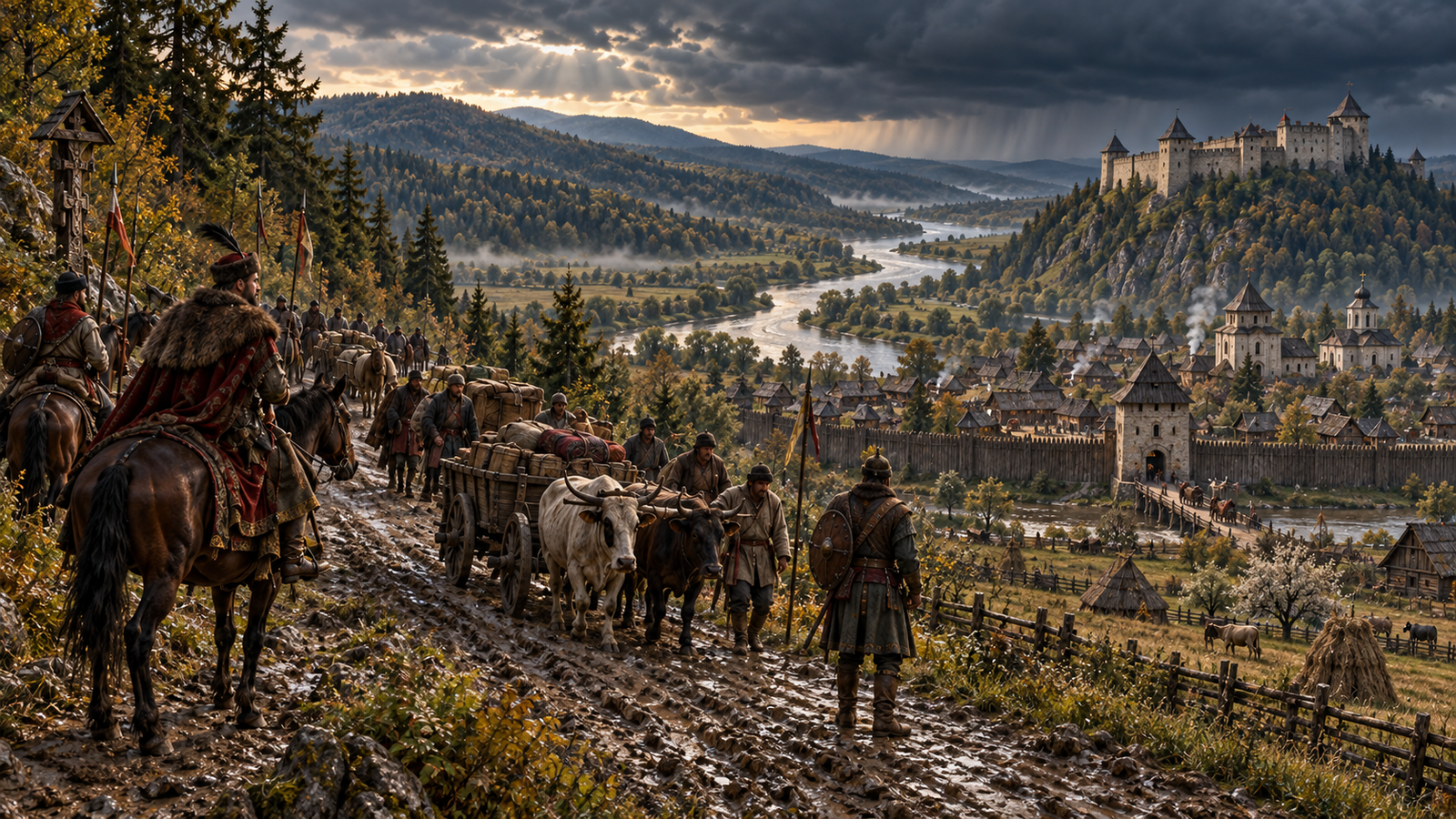
Moldavia is a country of wooded Carpathian roads, broad river valleys, cattle trains, fortified crossings and nervous gates. A traveller can begin the morning among mountain forests, spend the afternoon arguing over customs seals and reach nightfall beneath walls whose captain may have changed allegiance since the last messenger passed through.
The principality is rich enough to attract merchants and strategically placed enough to attract armies. Trade runs between the Black Sea, Suceava, the Dniester crossings and the roads toward Poland and Central Europe. That wealth pays princes, boyars, garrisons and customs officers—but it also means that whoever controls the roads can finance a claim to the throne.
Adventurers come here because Moldavia rarely needs heroes in the abstract. It needs escorts who can keep a caravan moving, scouts who can cross a watched frontier, negotiators trusted by mutually hostile fortresses, hunters willing to follow singing into a river marsh, investigators who can distinguish forged orders from legitimate ones, and blades prepared to survive when a routine delivery becomes part of a civil war.
At a glance
Moldavia in Play
- Campaign present
- 1454 CE
- Government
- Principality ruled by a voivode, with powerful boyars, court officers and fortress commanders
- Princely seat
- Suceava
- Ruler at page opening
- Alexăndrel of Moldavia
- Principal claimant
- Petru Aron
- Languages
- Romanian/Moldavian vernaculars; Slavonic in many charters and offices; additional merchant languages on the great roads. There is no Common.
- Character
- Fortified frontier, caravan realm, dynastic battleground and Black Sea trade corridor
- Primary dangers
- Succession violence, corrupt or divided officials, raiding, unsafe roads, river undead, forest powers and foreign intelligence
- Major exports
- Cattle, dried fish, honey and other agricultural or pastoral goods
- Major imports
- Fine cloth, iron goods, spices and luxury merchandise travelling through long-distance trade networks
Immediate campaign pressure
What Is Happening Right Now?
The Throne Is Not Secure
Alexăndrel holds the princely seat at the default opening of this page, but possession is not permanence. Petru Aron has already killed Bogdan II, already ruled once and already been driven out once. He has supporters, contacts and every reason to try again.
Every Fortress Captain Matters
Suceava can issue an order. That does not guarantee Hotin, Neamț, a river crossing or an armed boyar will obey it quickly. Messengers, seals, hostages and personal loyalties can matter as much as proclamations.
The Black Sea Road Is Under Pressure
Cetatea Albă remains one of Moldavia’s richest strategic gateways. An Ottoman naval attempt against the fortress demonstrates that southern powers understand exactly what the port is worth. Its walls have held; the danger has not gone away.
Constantinople Has Changed the Balance
The hobgoblin Ninefold Dominion now occupies Constantinople. The Ottoman state remains a separate power with its own armies and ambitions. Moldavian merchants, diplomats and commanders must therefore reckon with two different southern pressures rather than treating them as one enemy.
Use the Succession Crisis Immediately
Do not begin with a lecture on dynastic genealogy. Give the characters two legitimate-looking orders that contradict one another. A customs master accepts one seal; a fortress captain recognises the other. The party then learns the politics by deciding which order to obey.
Player-facing reasons
Why Adventurers Come to Moldavia
- Escort a caravan. Cloth, ironware and luxury goods travel inward while cattle, fish, honey and other Moldavian products move toward foreign markets.
- Carry sealed orders. A document may determine whether a fortress opens its gate or joins a claimant.
- Find a missing traveller. Forest roads, river crossings and disputed frontiers make disappearance easy to explain and difficult to investigate.
- Work for a prince without joining his cause. Courts need scouts, interpreters, guards, troubleshooters and deniable outsiders.
- Free, recover or protect captives. Slavery and war create fugitives, ransom disputes, escaped labourers and families separated by law or violence.
- Hunt something that the road wardens cannot. Rusalki, predatory fey, undead and older forest powers do not respect customs posts.
- Reach the Black Sea. Cetatea Albă connects Moldavia to maritime commerce, spies, smugglers and events far beyond the principality.
- Disappear. A traveller who can change horses, language, patron and road quickly may escape an enemy here—provided the enemy has not already purchased the next gate.
Where characters can go
Places to Visit
Suceava
The political centre of the principality: court, treasury, charters, petitioners, guards, merchants and men waiting outside doors for someone more powerful to decide their future.
Come here for: royal employment, succession intrigue, forged seals, noble feuds, legal petitions, high-value purchases and information from every major road.
Cetatea Albă
A heavily fortified commercial city near the mouth of the Dniester, known beyond Moldavia as Akkerman or by older forms of Maurocastro. Its walls protect both Moldavian authority and a commercial world much larger than the principality.
Come here for: ships, foreign merchants, maritime intelligence, smuggling, military engineering, customs disputes and rumours from the Black Sea.
Hotin
A fortress on the Dniester corridor where travellers, armies and traders approach Moldavia from the north and northeast. Control of the crossing means control of information as well as movement.
Come here for: border negotiations, intercepted letters, prisoner exchanges, military reconnaissance and caravans arriving from the Polish and Ruthenian roads.
Neamț and Târgu Neamț
A fortified mountain approach where steep country narrows the choices available to an army. The market below the stronghold serves soldiers, herders, timber workers, travellers and people who know how to move through the forests.
Come here for: mountain guides, hidden roads, wilderness expeditions, garrison work, fugitives and supernatural threats from the high country.
Iași
A growing eastern market and customs point whose importance comes from movement rather than monumental power. Traders, agents and messengers meet here before continuing toward the Dniester, Suceava or routes beyond Moldavia.
Come here for: rumours, translators, livestock sales, merchant disputes, quiet meetings and cargo that should not attract attention at the capital.
Siret
An older political centre now valuable as a road town linking Moldavia toward Chernivtsi, Lviv and the wider commercial world to the northwest.
Come here for: foreign caravans, old loyalties, provincial contacts, horses, guides and news that reaches Suceava only after merchants have already acted on it.
Chilia
The Danube port is too strategically valuable to describe as an ordinary Moldavian town. Its possession and influence are contested, and the people who want it include rulers interested in trade, naval access and control of the lower river.
Come here for: spies, competing jurisdictions, covert diplomacy, river traffic and missions where admitting who hired you is the fastest route to prison.
The Forest Roads and River Fords
Much of Moldavia is experienced not as a city or castle but as the distance between them: wet tracks, woodland, pasture, ferries, mills, villages, rivers and temporary camps.
Come here for: ambushes, trackers, escaped captives, broken wagons, strange songs, old boundary stones and adventures nobody at court will ever hear about unless the party survives.
Who matters
People You Will Meet
Alexăndrel of Moldavia
Young, legitimate enough to command loyalty and vulnerable enough that every ambitious boyar must calculate whether that loyalty will still be useful next season. At the opening of this guide he holds the princely seat, but his rival has not vanished.
What he needs: reliable fortress commanders, money, functioning roads and proof that Petru Aron’s supporters can be isolated before they coordinate.
Petru Aron
The killer of Bogdan II and a former ruler in his own right. Petru does not need everyone to love him. He needs enough armed men, enough defecting nobles and one decisive opening.
What he needs: recognition, money, intelligence and commanders willing to change sides at exactly the right moment.
Stephen, Son of Bogdan II
The murdered prince left a surviving son. Stephen is not the immediate ruler of Moldavia, but every faction that remembers Bogdan II must account for the possibility that his heir will return with friends and soldiers.
What others fear: that today’s apparently settled dispute is only the prelude to another claimant entering the field.
Toader Cernat, Keeper of the Western Seals
A senior customs officer in Suceava who maintains several generations of tariff rolls and can recognise dozens of noble seals at a glance. He claims to serve the lawful prince, carefully avoiding the question of which claimant that phrase will describe next month.
Use him for: identifying forged papers, arranging legal passage or quietly selling the party’s travel plans to someone richer.
Nastasia of Iași
A healer, interpreter and dream-reader whose house is visited by merchants who would rather ask her what a journey means than explain their fears to a court official.
Use her for: herbal treatment, local supernatural knowledge, introductions to caravan masters and warnings delivered through symbols rather than certainty.
Mira Three-Reeds
A free halfling ferrymaster whose relatives are not all free. She knows which estates search escaped labourers aggressively, which officials can be bribed, and which river islands disappear completely when the spring waters rise.
Use her for: clandestine crossings, rescue missions, rumours among bonded halfling communities and travel without official attention.
Power and loyalty
Factions and Competing Interests
Alexăndrel’s Court
Goal: make possession of the throne durable.
Method: secure Suceava, maintain revenue, confirm loyal commanders and prevent local disputes becoming openings for Petru Aron.
Petru Aron’s Claimants
Goal: return Petru to the princely seat.
Method: court disaffected boyars, acquire money, promise offices, undermine confidence and turn a military confrontation into a rapid political collapse.
The Boyar Houses
Goal: preserve estates, privileges, households and regional leverage no matter who wins.
Method: delay commitments, negotiate separately, marry strategically, hold armed retainers and make every prince pay for support.
Fortress Captains and Customs Officers
Goal: survive the succession crisis while keeping garrisons paid.
Method: demand seals, collect tolls, watch roads, hoard supplies and refuse to be the first official to discover that yesterday’s lawful order has become treason.
Merchant Houses and Caravan Masters
Goal: keep the Moldavian trade corridor open.
Method: cultivate both courts, finance escorts, maintain translators and favour any local authority capable of making tolls predictable.
Bonded Halfling Households and Free Kin
Goal: survive an institution that treats many of their families as transferable property, while free relatives seek security, ransom, escape or legal release.
Method: kinship networks, hidden savings, forged permissions, sympathetic ferrymen and the chaos created whenever estates change hands.
Steppe Envoys and Warbands
Orc successor powers to the east are not one unified empire. Individual riders may appear as raiders, mercenaries, messengers, captives, traders or representatives of competing khans.
See The Empire of the Orcs for the fractured inheritance of Mhurak’s Great Muster.
Foreign and Supernatural Networks
Wallachian agents, Black Sea merchants, Dominion intelligence, occult travellers and monster hunters may all operate in Moldavia without controlling it.
The distinction matters: a visitor from a powerful organisation is an influence, not proof that the organisation owns the region.
Money, supplies and employment
Trade, Markets and What Adventurers Can Obtain
Moldavia’s roads form part of an international commercial corridor linking the Black Sea with Suceava, Siret, Chernivtsi, Lviv and routes farther west. Important towns profit from customs duties, which makes tax posts political assets rather than simple roadside inconveniences.
| Need | Where to Look | What Can Complicate It |
|---|---|---|
| Horses, oxen and wagons | Suceava, Iași, Siret and major caravan markets | Army purchasing, confiscation, bad roads and inflated prices during mobilisation |
| Armed escorts | Market towns, noble households and fortress settlements | Retainers may have political loyalties the characters do not share |
| Guides and interpreters | Customs towns, ferries, caravan yards and border markets | A guide who knows three languages may also work for three patrons |
| Fine cloth, iron goods and imports | Suceava and major trade markets | Customs duties, restricted cargo and suspicion of foreign merchants |
| Cattle, dried fish and honey | Regional markets and merchant caravans | Livestock theft, river conditions and disputed tolls |
| Messengers and local hirelings | Large settlements and princely or boyar courts | A messenger may refuse a road controlled by a rival claimant |
| Rare magical assistance | Court specialists, respected healers, private teachers and occult contacts | Magic is unevenly available and reputation matters more than a universal price list |
For general campaign costs, hirelings, messengers, tolls and transport, see Hirelings, Servants & Services.
The supernatural in ordinary life
Everyday Magic in Moldavia
Magic is visible without being uniform. Villagers know which pools should not be disturbed after sunset. Herders knot protective cords into harness. Ferrymen remember which islands belong to the river only during flood season. Healers combine plants, inherited charms and practical medicine. Court officials may employ learned specialists, while merchants quietly pay for omens before committing a fortune to one road.
None of this creates a universal magical law or a single recognised magical profession. One settlement may welcome a weather-reader and distrust a necromancer; another may care only whether the stranger’s magic damages property, insults a local power or threatens the prince.
River Spirits and the Unquiet Dead
The Dniester, Prut, Siret and smaller waters are natural places for stories of drowned dead and dangerous voices. A rusalka can turn an otherwise mundane ferry crossing into a local tragedy that no garrison patrol is equipped to solve.
Forest Powers
Remote woodland may shelter fey, old boundary powers and beings that remember the valley before the newest road was cut through it. The wider Slavic Bestiary provides suitable regional threats; creatures such as the samodiva should remain exceptional rather than becoming random roadside wildlife.
Carpathian Occult Knowledge
The notorious Scholomance lies outside Moldavia in the wider Carpathian sphere. Its students, enemies, rumours and forbidden books can cross Moldavian roads without making the school a Moldavian institution.
What goes wrong
Dangers on the Roads
| d8 | Road Encounter |
|---|---|
| 1 | A customs post possesses new orders that contradict the documents issued to the party two days earlier. |
| 2 | A wounded mounted retainer refuses treatment until someone promises to deliver the sealed packet tied beneath his armour. |
| 3 | A wealthy caravan has a broken axle. Its missing outriders were last seen following tracks into the forest. |
| 4 | A halfling family hiding beneath sacks in an ox cart begs the characters not to reveal which estate they fled. |
| 5 | Orc riders approach beneath a recognised truce marker. They want to exchange prisoners, not fight—but the local Moldavian patrol does not yet know that. |
| 6 | Dense river fog closes around a ferry after sunset. Singing begins downstream, although every known passenger is aboard. |
| 7 | An old woodland offering-place has been freshly repaired. The villagers insist they did not do it. |
| 8 | A claimant’s patrol searches every traveller for a letter matching a description uncomfortably close to something the party is carrying. |
Things people say
Rumours
- “Hotin keeps two sets of princely orders locked in the same chest.” The captain intends to display whichever set belongs to the man who wins.
- “The walls at Cetatea Albă frightened an entire fleet away.” Mostly true. The greater question is who now knows exactly where those defences are strongest.
- “Bogdan’s son is dead.” False—and someone is paying travellers to repeat it.
- “A customs officer in Iași can make a wanted person legally disappear.” He can alter records. Whether that survives a change of prince is another matter.
- “The state’s halfling workers found an older road beneath a collapsed mine.” True, but their overseer sealed the entrance after two workers failed to return.
- “Do not answer a woman singing from the opposite bank.” Good advice, even when the singer is human.
- “Dominion officers are buying Moldavian cattle through intermediaries.” Possible. The buyer may instead be trying to discover who controls the trade network.
- “Alexăndrel is about to arrest every boyar who ever spoke to Petru Aron.” Almost certainly exaggerated—which does not prevent frightened nobles from acting as if it were true.
Adventures that begin here
Adventure Hooks
- The Second Seal. The characters carry a genuine order from Suceava. At Neamț they discover another genuine order, issued under the same authority, commanding the exact opposite.
- The Missing Caravan. Twelve wagons of imported cloth disappear between Siret and Suceava without leaving signs of a battle. Their guards have not returned, but the oxen are found grazing peacefully beside the road.
- The Fortress Engineer. A specialist who inspected Cetatea Albă after the naval attack vanishes while travelling inland. Three powers want the notes in his possession.
- The Prince’s Witness. A minor boyar claims he can prove that one of Petru Aron’s most important supporters secretly negotiated with Alexăndrel. He will testify only if the party extracts his family first.
- Three-Reeds Crossing. Mira’s relatives are to be transferred to a distant estate. She asks the characters to intervene legally if possible, by ransom if necessary, and by escape if every lawful option fails.
- The Song Below the Ferry. Travellers are drowning at the same crossing. The ferryman insists the river is haunted; the local official insists a rival toll keeper is sabotaging him. Both explanations may be true.
- Under Truce. An orc envoy requests safe passage to Suceava for negotiations. Someone wants the envoy dead specifically because successful talks would stabilise the eastern road.
- The Empty Watchtower. A border tower stops signalling. No bodies are found. Every weapon remains in place. In the mud outside, the tracks of the missing garrison all lead into the same forest.
Simple campaign procedure
Running the Succession Crisis
Two Standing Scores
Track Alexăndrel Standing and Aron Standing separately from 0 to 3. Characters begin at 0 with both unless their background says otherwise.
- 0 — Unknown: treated as ordinary travellers, mercenaries or merchants.
- 1 — Useful: minor officials recognise their work and may grant introductions or modest assistance.
- 2 — Associated: supporters of the rival claimant begin to obstruct, watch or test them.
- 3 — Agents: the faction trusts them with sensitive work; enemies may detain them, seize correspondence or attempt to turn them.
A character can have Standing with both sides. In Moldavia that does not mean neutrality; it means both sides believe the character may still be useful.
Consequences
Law, Tolls and What Happens If You Cause Trouble
Moldavian law is experienced locally. The prince claims authority, but a traveller usually encounters that authority through boyars, judges, customs officers, village leaders, fortress captains and armed retainers.
At Gates and Customs Posts
Expect questions about origin, destination, cargo, employer and weapons. Merchants are expected to declare valuable goods. Important letters may be inspected, sealed or copied. A noble escort can shorten the process; a suspicious seal can make it much longer.
Weapons
Carrying weapons on dangerous roads is ordinary. Carrying concealed weapons into a princely audience, approaching a fortress in formation or refusing a lawful demand to peace-bind arms is another matter.
Magic
There is no single law declaring magic legal or illegal throughout the principality. Harm, fraud, coercion, grave disturbance, attack on a ruler or interference with a fortress are offences regardless of whether the means used were mundane or magical.
Typical Escalation
A failed encounter with authority should not immediately become a death sentence. Escalate through questioning, delay, extra tolls, confiscation, demands for surety, armed escort, detention, formal accusation and only then severe punishment where the offence justifies it.
Treason
The succession struggle makes political offences exceptionally dangerous. Carrying letters, money, soldiers or intelligence for a rival claimant can turn an otherwise ordinary crime into treason.
Coercion and status
Slavery in SpiralWorlds Moldavia
Slavery is a visible part of Moldavian society and should have consequences in play rather than appearing as decorative background. The state, noble households and large sacred estates may own enslaved workers. They labour in households, agriculture, workshops, gold washing and other specialised occupations.
In SpiralWorlds, many enslaved Moldavians are halflings. Some enslaved orc captives also remain from warfare and frontier raiding. Free members of both peoples exist elsewhere, and legal status is not a biological condition.
For adventurers this creates concrete problems: an escaped person may be legally pursued as property; purchasing someone’s freedom may require dealing with an owner who refuses money; a change of ruler can invalidate an agreement; and rescuing a family can turn a local dispute into conflict with a powerful estate.
Moving through the principality
Travel
The Northwest Road
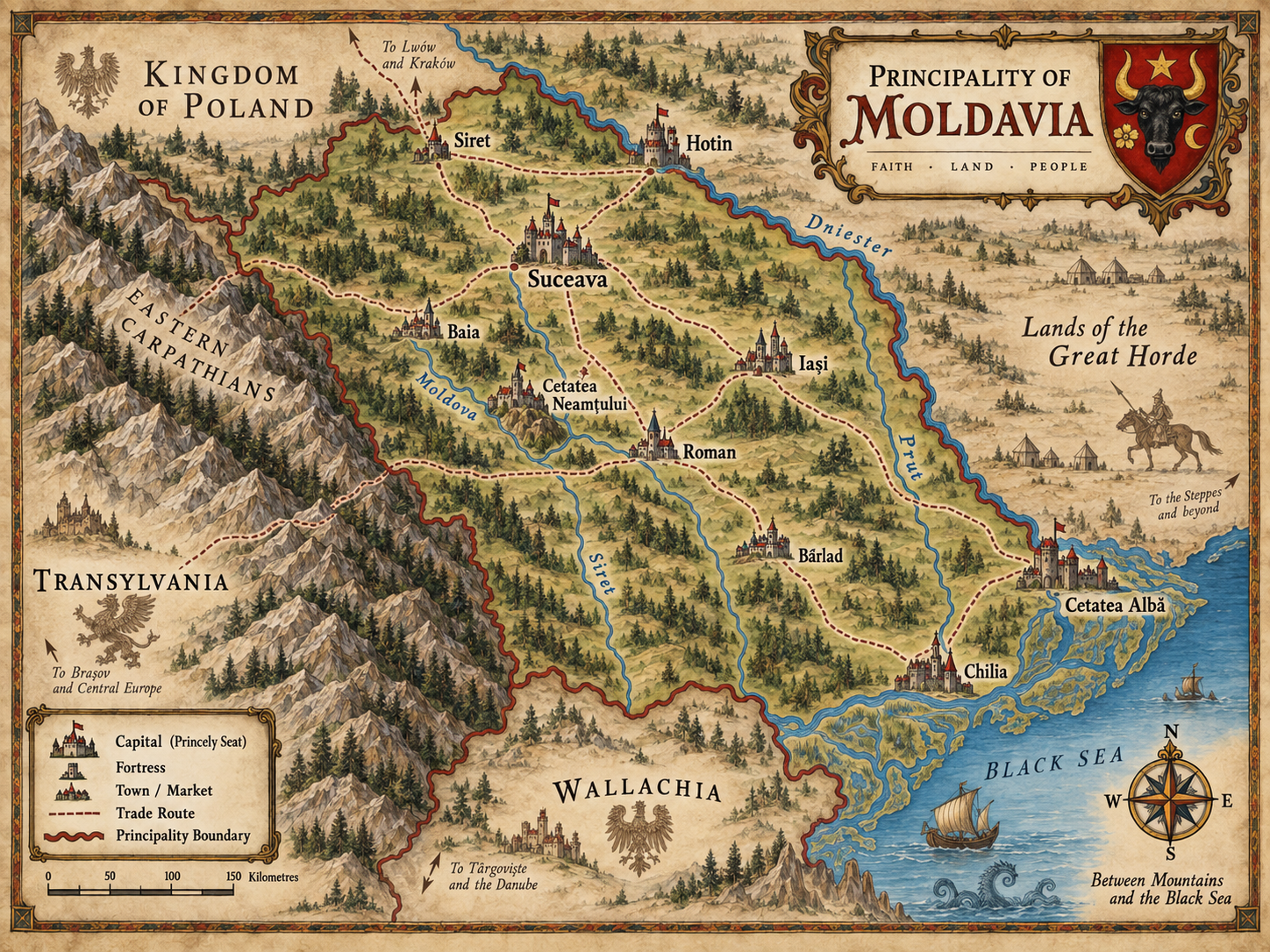
Suceava and Siret connect toward Chernivtsi, Lviv and the wider Central European commercial network. This is the road for imported cloth, metal goods, foreign messengers and political news from Poland.
The Dniester Corridor
Hotin and Cetatea Albă make the river a chain of military, commercial and diplomatic importance. A journey along it can move from fortified crossings to open country and finally to the Black Sea world.
The Carpathian Roads
Western routes are constrained by mountains, forest, weather and passes. Local guides matter. Armies cannot always move where individuals can.
The Southern Approaches
Roads toward Wallachia and the lower Danube bring merchants, claimants, mercenaries, refugees and political intelligence. See Wallachia for the neighbouring Carpathian theatre.
Moldavia also sits near the western edge of much larger Eurasian trade systems. See the Silk Road for the wider overland commercial network.
Deeper context
Politics, Succession and Historical Background
Moldavia occupies the lands between the Eastern Carpathians and the Dniester, with access toward the Black Sea. Its geography makes it both defensible and exposed: mountains protect the west, while river corridors and open eastern approaches connect it to trade, raiding and competing states.
The principality’s recent history is dominated by the consequences of dynastic conflict. Bogdan II gains the throne, only to be murdered by Petru Aron while attending a gathering at Reuseni. Petru then faces Alexăndrel, who removes him and again occupies the throne.
The struggle is not finished. Surviving evidence places Petru Aron back in power by late summer. A traditional reconstruction places the change on 22 August, but the documentary record is firmer about the broader transition than that single day. Alexăndrel later returns briefly before Petru finally restores himself again.
The importance of these repeated changes is not merely genealogical. Each reversal requires fortress commanders, boyars, customs officers, towns and foreign neighbours to decide whether yesterday’s oath still binds them. That is the political environment characters actually encounter.
Stephen Waits Beyond the Immediate Contest
Bogdan II’s son Stephen survives. He is not yet Stephen the Great, but his existence prevents Petru Aron’s victory from ever being the final answer to Moldavia’s dynastic problem.
Cetatea Albă and the Black Sea
The fortified port is one of the principality’s most valuable commercial assets. Trade connects it with Lviv, Caffa and other Black Sea markets. An Ottoman fleet attempts to take the city but abandons the effort when faced with its fortifications.
That event should be felt in play: engineers examine walls, merchants discuss naval risk, officials search for spies, and every neighbouring power understands that a strong fortress is valuable precisely because someone intends to test it again.
Campaign canon
Historical Moldavia and SpiralWorlds
| Historical Foundation | SpiralWorlds Treatment |
|---|---|
| Moldavia is a real medieval principality centred on Suceava. | The geography, trade corridors, succession politics and major fortresses remain the foundation of play. |
| Alexăndrel and Petru Aron repeatedly contest the throne. | The succession crisis becomes the principal immediate political pressure for adventurers. |
| Cetatea Albă is a major Black Sea commercial and military centre. | Its merchants, walls, naval danger and intelligence networks become a major campaign gateway. |
| The historical conquest of Constantinople is Ottoman. | The Ninefold Dominion instead occupies Constantinople. The Ottoman state remains a separate regional power. |
| Historical Moldavia is shaped by Christian institutions. | Abrahamic religions are absent from SpiralWorlds canon. Sacred estates, local cults, divine traditions and supernatural institutions fill relevant campaign roles without reproducing Christian theology. |
| Roma and Tatar slavery is historically documented. | Many enslaved communities are instead halflings, with some orc captives. This is setting fiction, not a historical claim. |
| Folklore describes dangerous river and forest beings. | Rusalki, fey and other supernatural beings are physically real and can become direct adventure threats. |
Historical Sources & Campaign Adaptation
The historical framework of this entry draws on research concerning the Moldavian princely succession, the Moldavian commercial road, the fortified Black Sea city of Cetatea Albă and scholarship on slavery in medieval Moldavia.
Particularly useful references include the Encyclopedia of the History of Ukraine entry on the Moldavian Trade Route; Treccani’s historical entry on Cetatea Albă; Romanian studies of Alexăndrel and Petru Aron’s chronology; and Viorel Achim’s research on Roma and Tatar slavery in Moldavia.
SpiralWorlds preserves the real geography and much of the political and economic framework while introducing its established fantasy peoples, supernatural beings, altered religions and the Ninefold Dominion divergence.
Rules & Licensing
This location page uses original, system-neutral campaign material rather than reproducing Open Game Content rules text. Creature, class, spell and rules pages linked from this entry may use different game systems or licences; consult the licence stated on the individual linked page before importing its mechanics.
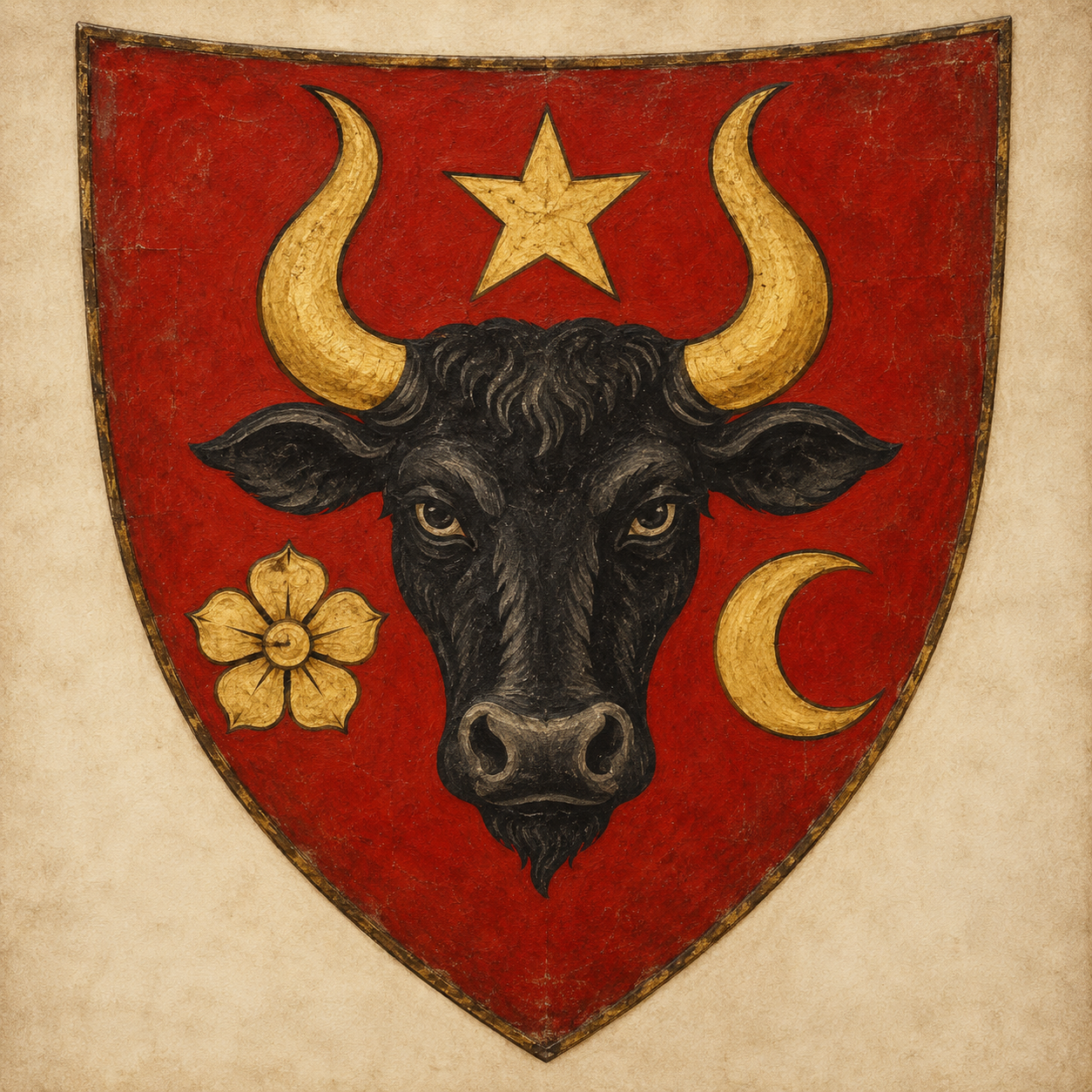
The Moldavia frontier hero, reconstructed coat-of-arms artwork and principality map were produced for the SpiralWorlds version of this entry.
Keep this reference growing
If this page helped with your reading or game, you can support its upkeep or explore the curated books.
Explore the Bookshop — epics, classics and stories behind imagined worlds.