
Hanseatic League
Merchant league · Baltic and North Sea
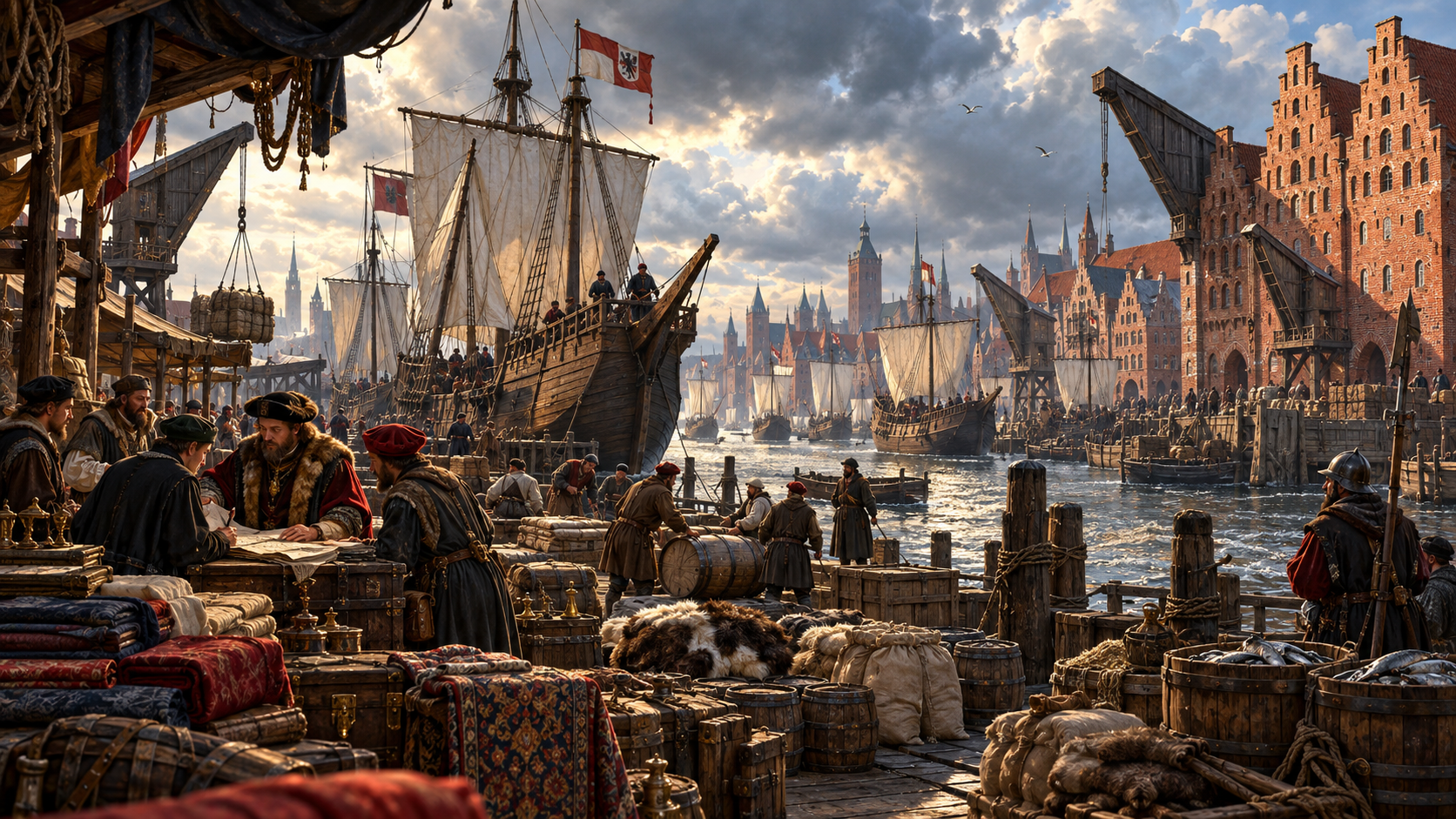
The Hanseatic League is the most powerful commercial network of the northern seas: a web of merchant guilds, city councils, warehouses, privileges, convoys and negotiated rights stretching from the eastern Baltic to England and Flanders. It is wealthy enough to influence kings, stubborn enough to resist them and loose enough that no single ruler can simply seize its treasury or command its cities.
The League is not a kingdom and has no permanent central government. Its strength comes from cooperation. When enough Hanseatic cities agree that a toll, pirate fleet, confiscation or hostile ruler threatens their trade, they can combine money, ships, embargoes, legal pressure and armed force with remarkable effect. When their interests diverge, the same network can become slow, divided and intensely political.
At a Glance
| Type | Merchant league, city network and defensive commercial alliance |
|---|---|
| Principal Centre | Lübeck |
| Core Reach | Baltic Sea, North Sea, lower Rhine routes and major northern river corridors |
| Major Foreign Kontore | Novgorod, Bergen, Bruges and London |
| Important Hanseatic Cities | Lübeck, Hamburg, Wismar, Rostock, Stralsund, Visby, Riga, Reval, Danzig, Thorn, Cologne and many others |
| Commercial Language | Middle Low German is dominant across much of the network, alongside local languages |
| Power Base | Credit, shipping, warehouses, privileges, civic law, merchant information, convoys and coordinated boycotts |
| Immediate Concerns | War in Prussia, Sound tolls, piracy, rival merchants, disputed privileges and keeping the great trade roads open |
| Campaign Use | Patron, employer, creditor, rival, information network, smuggling target or political pressure group |
What Is Happening Right Now?
The League is rich, but 1454 is not a quiet year. Several of its most valuable eastern routes run through territories where commercial grievances, civic autonomy and war have become inseparable.
The Prussian Cities Are in Revolt
Danzig and Thorn stand among the great commercial centres caught in the rebellion against the Teutonic States. The Prussian estates have turned to the Polish crown for support, and the struggle is becoming the long war that merchants already fear will close roads, seize cargoes and redraw the political map of the southern Baltic.
For Hanseatic merchants, this is not a simple question of choosing a side. A convoy may carry goods owned by men from several cities, financed by lenders in another, insured through private arrangements elsewhere and bound for a port whose ruler could change before the ship arrives.
The Sound Tolls Still Hurt
The Danish crown controls the narrow sea-road between the Baltic and the North Sea. Tolls imposed on ships passing the Sound remain a permanent source of friction. The League wants predictable passage and low costs; rulers want revenue and leverage. Every diplomatic quarrel over the straits can become a shipping crisis within days.
England Is Profitable and Difficult
London remains one of the four great foreign Kontore, but English merchants increasingly resent Hanseatic privileges. Cloth, metal, wax, timber, grain and Baltic goods make the relationship too valuable to abandon, yet both sides watch every tariff, seizure and legal dispute for signs that commercial rivalry is becoming something worse.
Bruges Is Still a Great Market
Bruges remains one of the richest exchange points in northern Europe, drawing merchants from many regions into the same commercial world. Hanseatic traders use it to connect Baltic goods with western cloth, credit and luxury markets. Antwerp is rising, but the League has not simply abandoned Bruges for it.
How the Hanseatic League Works
There is no Hanseatic king, parliament or standing bureaucracy. The League works through layered agreements between merchants and cities.
Hanseatic Days
Delegates meet when serious common business requires it. Lübeck is the usual centre of these gatherings. Decisions depend on negotiation between cities whose interests overlap without being identical. Smaller towns often follow the lead of stronger neighbours; major cities can refuse policies that threaten their own trade.
City Councils and Merchant Guilds
Many leading merchants sit close to civic government. That gives the League influence over harbour law, weights and measures, convoy organisation, warehouse access and the treatment of foreign merchants. It also means factional disputes inside one city can affect the entire network.
Kontore and Trading Yards
Outside the Hanseatic heartlands, merchants cluster in privileged trading communities. These Kontore provide storage, arbitration, local representation, shared rules and a secure base in foreign cities. Their elders negotiate with local rulers and defend the rights of merchants who may be hundreds of miles from home.
Pressure Before War
The League prefers profitable trade to battle. Its first weapons are usually negotiation, withdrawal of merchants, collective refusal to trade, credit pressure and rerouting cargo. If those fail, member cities can finance armed ships, escorts and military action—but only when enough interests align.
The Trade Network
Hanseatic wealth comes from moving ordinary goods in extraordinary quantities. The network is strongest when it controls not only a product, but the warehouses, ships, contracts and information needed to move that product safely.
| Route or Market | Typical Goods | Why It Matters |
|---|---|---|
| Baltic grain ports | Grain, flour, timber, ash, pitch | Feeds western towns and supplies shipyards |
| Scandinavia | Dried fish, timber, metals, hides | Links northern resources to continental markets |
| Novgorod and the eastern road | Furs, wax, honey, timber | Connects the League to the wealth of the Rus lands |
| England | Cloth, woollen goods, metals | One of the League’s richest western commercial relationships |
| Flanders | Cloth, dyes, luxury goods, credit | Connects Baltic trade to the great western markets |
| Salt routes | Salt | Essential for food preservation, especially the fish trade |
Hanseatic Cities and Ports
The League is not a closed club with a single permanent roll of members. Its network includes dominant maritime cities, inland market towns, regional partners and foreign trading communities. Some cities send delegates regularly; others are represented by stronger neighbours or participate only when their own trade is affected.
Wendish and Pomeranian Network
| City | Role in the Network |
|---|---|
| Lübeck | The leading meeting place of the League and the great hinge between Baltic and North Sea trade. |
| Hamburg | Major Elbe port linking inland commerce with the North Sea and western markets. |
| Lüneburg | Great inland salt centre whose output is essential to the Baltic fish trade. |
| Wismar | Important Mecklenburg port and one of the old centres of Wendish cooperation. |
| Rostock | Large Baltic port, ship-owning city and powerful partner of Lübeck and Wismar. |
| Stralsund | Strategic Pomeranian port controlling routes around Rügen and the southern Baltic. |
| Demmin | River and overland market linking Pomeranian produce to the larger ports. |
| Greifswald | Smaller but active Pomeranian port closely tied to Stralsund and the Baltic routes. |
| Anklam | Peene River town carrying grain, timber and regional goods toward the Baltic. |
| Stettin (Szczecin) | Major Oder estuary port and increasingly important centre for the eastern Pomeranian towns. |
| Pasewalk | Inland Pomeranian market town tied into the commercial network of the coastal cities. |
| Kolberg (Kołobrzeg) | Baltic port whose salt and maritime trade give it influence beyond its size. |
| Rügenwalde (Darłowo) | Smaller Pomeranian port carrying grain, timber, fish and coastal traffic. |
| Stolp (Słupsk) | Regional market town connected to Baltic ports and the eastward road. |
Prussian and Eastern Baltic Network
| City | Role in the Network |
|---|---|
| Visby | The old Gotland trading centre and a vital staging point in the central Baltic. |
| Stockholm | Swedish royal port tied to the trade in metals, fish, timber and imported grain. |
| Danzig (Gdańsk) | The great Vistula-mouth port. Grain exports and the Prussian revolt make it one of the most important cities in the current crisis. |
| Elbing (Elbląg) | Prussian port and river-market competing and cooperating with Danzig for eastern Baltic commerce. |
| Thorn (Toruń) | Major Vistula river city and one of the centres of the Prussian uprising. |
| Königsberg | Major Prussian port and administrative centre with access to amber, grain and eastern routes. |
| Riga | Powerful Daugava port linking Baltic shipping to inland trade routes. |
| Reval (Tallinn) | Fortified northern Baltic port and western gateway to trade with the Rus lands. |
| Dorpat (Tartu) | Inland Livonian market linking western merchants with river and overland routes eastward. |
| Kraków | A loosely connected inland market rather than a core maritime city, valuable for routes into Poland and Hungary. |
| Breslau (Wrocław) | Loosely associated inland commercial centre connecting northern trade with Bohemia and Central Europe. |
Saxon and Brandenburg Network
| City | Role in the Network |
|---|---|
| Brunswick | One of the strongest inland Hanseatic centres, coordinating much Saxon trade. |
| Bremen | Major Weser port connecting inland Germany with the North Sea. |
| Magdeburg | Important Elbe trading centre and inland link between eastern and western markets. |
| Goslar | Mining and metal centre whose silver and ore feed long-distance trade. |
| Erfurt | Large inland market connecting Thuringia to wider Hanseatic commercial routes. |
| Stade | Lower Elbe port handling river and North Sea traffic. |
| Berlin | Formerly more closely tied to the League, but under growing princely control and outside the active Brandenburg Hanseatic bloc after 1442. |
| Frankfurt an der Oder | Oder market whose Hanseatic position has also weakened under Brandenburg pressure. |
Rhine, Westphalia and the Low Countries
| City | Role in the Network |
|---|---|
| Cologne | Great Rhine city and one of the oldest western centres of the German merchant community trading with England. |
| Dortmund | Powerful Westphalian commercial city with deep links to Baltic trade and long-distance merchant families. |
| Deventer | IJssel market and river port connecting the Low Countries to inland Hanseatic routes. |
| Kampen | Important Zuiderzee port and maritime link between German and Low Countries trade. |
| Groningen | Northern market city with links to Frisian, North Sea and Baltic commerce. |
| Münster | Major Westphalian inland market and regional centre for merchant networks. |
| Osnabrück | Inland trading city connecting Westphalian production with the northern routes. |
| Soest | Old Westphalian merchant city whose commercial ties remain important despite its recent political conflicts. |
| Wesel | Lower Rhine market and river port connecting inland Germany with the Low Countries. |
Foreign Markets, Branches and Trading Stations
Not every important Hanseatic destination is a member city. Outside the League’s heartlands, merchants maintain privileged yards, warehouses, seasonal markets and trading communities. The four great Kontore dominate this system, but many smaller stations matter to captains and adventurers.
| Market | Status and Importance |
|---|---|
| Novgorod | One of the four great Kontore and the principal eastern market for furs, wax and other Rus goods. |
| Bergen | One of the four great Kontore and the great northern market for stockfish. |
| Bruges | One of the four great Kontore and the principal western exchange for cloth, credit and luxury goods. |
| London | One of the four great Kontore; the Steelyard anchors Hanseatic trade in England. |
| Antwerp | A rapidly growing western market. Important to Hanseatic merchants, but not one of the four principal Kontore. |
| Bishop’s Lynn | English east-coast market used by German merchants; valuable for grain, fish and imported Baltic goods. |
| Ipswich | English east-coast trading station with links to North Sea shipping. |
| Malmö | Major Scanian market and port on the Sound routes. |
| Falsterbo | Seasonal centre of the great Scanian herring markets, drawing merchants and fleets from across the Baltic. |
| Kaunas | Lithuanian inland trading centre with an established German merchant community and strong Hanseatic connections. |
| Pleskau (Pskov) | Important Rus market connected to the Novgorod trade system and eastern overland routes. |
| Polotsk | Dvina-route market linking Baltic merchants with the interior of Lithuania and the Rus lands. |
The Four Great Kontore
Novgorod — The Eastern Gate
The Novgorod Kontor is the great eastern terminus of Hanseatic trade. Merchants deal in furs, wax, honey, timber and other goods from deep within the Rus lands. The route is long, dangerous and politically sensitive, making reliable guides, escorts and interpreters exceptionally valuable.
Bergen — The Northern Storehouse
Bergen ties the League to Norway’s immense fisheries. Dried cod moves south while grain and manufactured goods move north. The German merchant quarter is commercially powerful enough to influence local politics, but its privileges also create resentment.
Bruges — The Western Exchange
Bruges is where merchants from the Baltic meet the great cloth, luxury and credit markets of the west. Information travels almost as quickly as money here. A rumour about war, harvests or piracy can change prices before the relevant ship reaches port.
London — The English Gate
The London Steelyard gives Hanseatic merchants a permanent foothold in the English capital. It is profitable, politically sensitive and constantly exposed to disputes over privilege, customs and competition with local merchants.
What the League Can Offer Adventurers
The Hanseatic League is rarely a single patron. More often, characters deal with one city council, one merchant house, one convoy master or one Kontor acting in the wider League’s name.
| Access | What It Can Mean in Play |
|---|---|
| Passage | Berths on merchant ships, convoy space and introductions to reliable captains. |
| Credit | Letters of credit, advances against cargo, loans and access to trusted moneychangers. |
| Information | Prices, ship movements, port rumours, political news and names of reputable merchants. |
| Warehousing | Secure storage in foreign ports and access to guarded merchant compounds. |
| Legal Help | Arbitration, witnesses, civic advocates and pressure on local officials. |
| Rare Goods | Fast access to imported materials, specialist tools and products that may not be available locally. |
What the League Demands in Return
Hanseatic favours are commercial obligations, not gifts. A party that repeatedly uses League ships, warehouses or credit will eventually be asked to protect the system that made those advantages possible.
- Escort a convoy through waters where pirates have started taking ships alive rather than sinking them.
- Recover cargo before a rival city can legally declare it abandoned.
- Carry sealed commercial letters through a war zone without allowing either army to read them.
- Find out who is counterfeiting Hanseatic marks on low-quality goods.
- Negotiate with a ruler, guild, dwarf hold or supernatural territorial power whose demands are blocking a trade road.
- Protect a witness in a dispute where several wealthy merchant houses have reason to make that witness disappear.
Adventure Hooks
- The Missing Cog. A heavily insured ship disappears between Visby and Lübeck. No wreckage is found, but its cargo appears for sale in three different ports.
- War on the Vistula. A merchant syndicate needs neutral agents to reach Danzig while the Prussian revolt turns roads, toll stations and river ports into military objectives.
- The False Seal. Perfect copies of a Lübeck merchant seal are being used to move contraband through the League’s own warehouses.
- The Bergen Debt. A Norwegian supplier claims the Kontor has withheld payment; the merchants insist the original cargo was cursed and destroyed. Both sides can prove part of their story.
- Steelyard Night. Someone inside the London merchant community is selling shipping schedules to raiders. The culprit may be acting for money, revenge or a foreign crown.
- The Price of the Sound. A toll dispute threatens to strand dozens of ships. The League wants a settlement before rival merchants take over the route.
Friends, Rivals and Pressure Points
The League does not divide the world neatly into allies and enemies. The same crown can protect Hanseatic merchants in one port and tax them heavily in another. The same city can support a common embargo one year and break it the next.
Midgard matters because Danish control of the Sound, Norwegian fish, Swedish metals and Baltic shipping all sit inside the League’s commercial world. Norway depends heavily on the Bergen trade while also resenting how much power foreign merchants can acquire. England wants Hanseatic commerce but contains powerful merchants who would rather possess the same privileges themselves. The Prussian and eastern Baltic cities need access to western markets even while war threatens the political structures around them.
History of the League
The League grew gradually from associations of long-distance merchants rather than from a single founding charter. Lübeck’s rise linked the Baltic to the North Sea world, while merchants established protected communities in major foreign markets. During the fourteenth century, cities began coordinating more deliberately through Hanseatic Days, common policies and collective action.
At its strongest, the League can boycott markets, pressure rulers and assemble fleets. Yet its greatest strength and greatest weakness are the same thing: every important decision must persuade cities whose fortunes are connected but never identical.
Map of the Hanseatic Network

Explore Connected Regions
Keep this reference growing
If this page helped with your reading or game, you can support its upkeep or explore the curated books.
Explore the Bookshop — epics, classics and stories behind imagined worlds.