
Russia — The Rus Lands
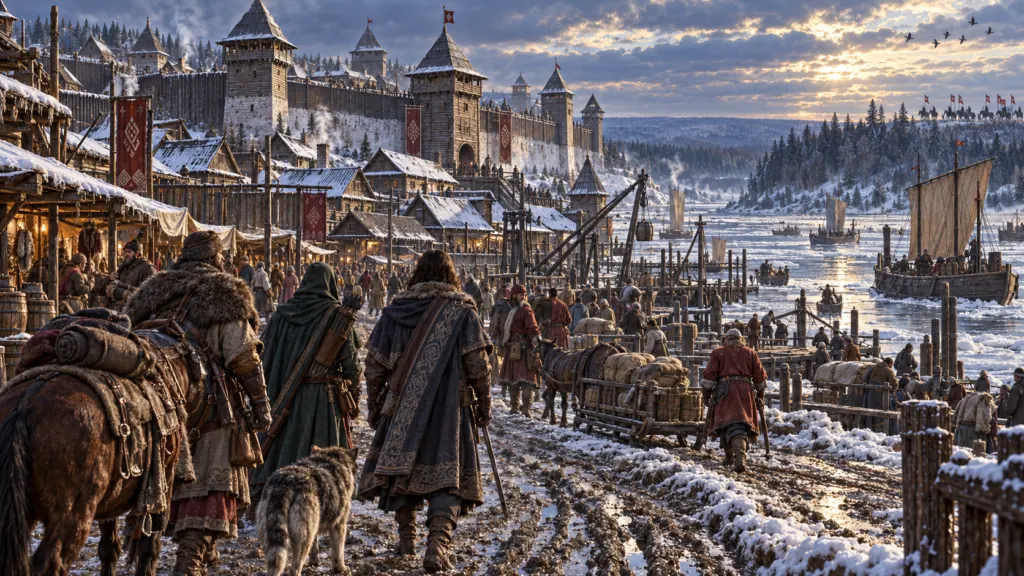
At a Glance
| Campaign Present | 1454 CE |
|---|---|
| Region | The Rus lands of northeastern and northwestern Europe |
| Political Condition | Divided among rival principalities, republics and frontier powers |
| Strongest Rus Power | Muscovy — the Grand Duchy of Moscow |
| Major Independent Powers | Novgorod, Pskov, Tver, Ryazan and Yaroslavl |
| Western Power | The Grand Duchy of Lithuania, ruling extensive western and southern Rus territories |
| Eastern Powers | The Great Horde and the Khanate of Kazan |
| Principal Routes | The Volga, Oka, Moskva and Volkhov rivers, Lake Ilmen, Lake Ladoga and the great overland roads |
| Languages | Regional Rus dialects, Old Novgorodian, Orc, Baltic and Uralic tongues, German among some western merchants, and learned languages |
| Campaign Themes | Rival princes, republican politics, tribute, frontier war, trade, winter travel, ancient claims and supernatural wilderness |
| Best For | Political intrigue, dangerous journeys, investigation, horror, diplomacy, war and long-running regional campaigns |
Russia and the Rus Lands
No king rules Russia. No border stays quiet.
Russia is not one kingdom. Across the forests, rivers and fortified towns of the Rus lands, princes compete for cities, republics guard their liberties, orc khans demand tribute and Moscow intends to make every rival answer to it.
A traveller leaving Novgorod crosses several jurisdictions before reaching Moscow. A merchant charter accepted in one city is questioned in the next. A noble seal opens one gate and attracts spies at another. A safe-conduct granted beneath an orc standard is worth more than silver on the Volga and enough to make its bearer deeply suspect farther west.
Outside the major settlements, authority weakens quickly. Roads vanish into forest. Rivers become highways, borders and battlefields. Ferrymen know stretches of water where no sensible traveller sings after sunset. Villages maintain old understandings with household spirits. Things in the forest ignore princely claims entirely.
Adventurers come here because every journey leads somewhere that matters. They meet rulers, merchants, fugitives, monsters, soldiers and spirits. They choose whom to trust. They solve one problem and create another.
When they return, people remember.
What Is Happening Right Now?
Ivan Holds Moscow After the Civil War
The long Muscovite civil war is over. Vasily II the Blind endured its worst years and Dmitry Shemyaka is dead, but Ivan IV, called the Terrible, now holds Moscow’s throne. His court intends that no rival claimant will again divide the realm.
Muscovy is powerful, but it does not rule the Rus lands. Novgorod remains free. Tver and Ryazan have their own rulers. Yaroslavl still possesses its princes. The eastern frontier remains dangerous. Lithuania dominates much of the wider Rus inheritance.
Ivan has secured his command of Moscow and is already looking outward.
Novgorod Knows Moscow Is Coming
The Republic of Novgorod remains wealthy, independent and difficult to intimidate. Its merchants look towards the Baltic and northern forests. Its political factions argue over Moscow, Lithuania, trade and the price of preserving republican liberty.
Dmitry Shemyaka found support and refuge here during the civil war. Ivan’s agents have not forgotten which households aided Moscow’s enemies.
The road between Moscow and Novgorod is filling with envoys, merchants, informants and men who claim to be none of those things.
Tver Is an Ally That Intends to Remain Independent
Boris Alexandrovich rules one of Moscow’s strongest Rus neighbours. His daughter Maria’s marriage into the Muscovite ruling house binds the two courts without making Tver a dependency.
The alliance helped Moscow survive its civil war.
Tver has no intention of disappearing inside Moscow.
Every gift, marriage, military agreement and disputed estate strengthens one side more than the other.
Ryazan Watches the Oka
Ryazan remains an independent southern principality where diplomacy and frontier war are the same business conducted by different men. The Oka carries merchants, envoys, soldiers, fugitives and rumours between the Rus heartlands and the dangerous country beyond.
A ford lost for a week matters more than a treaty signed in a distant hall.
Pskov Guards Its Own Freedom
Pskov is not simply a smaller Novgorod. Its republican institutions, fortified position and western connections make it a political power in its own right.
Agents from larger states seek influence. Merchants seek access. Soldiers come because somebody is always nervous about the frontier.
The people of Pskov survive by ensuring that visitors rarely obtain everything they came for.
Yaroslavl Still Has a Choice
On the Volga, Yaroslavl remains a princely and commercial centre whose independence still stands against Muscovite expansion.
Its merchants profit from river traffic. Its princes watch Moscow grow stronger. Its neighbours measure every decision against Moscow’s next move.
For the moment, Yaroslavl still says no.
The Great Horde Still Expects Tribute
Krusk Ash-Standard claims the central western inheritance of the old Great Muster. His Great Horde controls or contests the lower Volga, the Caspian steppe, Sarai and the old tribute routes leading towards the Rus lands.
Krusk regards those routes as proof of conquest.
A Rus prince who stops paying has publicly tested whether the khan is still strong enough to take what is owed.
Kazan Blocks Moscow’s Eastern Road
Myev Stone-Eye rules Kazan through clan strength, political hostages, fortified crossings and control of the middle Volga.
Her warriors know forest-steppe, river warfare, boats, forts and wooded approaches. Worg scouts move where horses struggle. Infantry guard crossings. Rival chiefs measure Myev’s strength while she watches Moscow test the edge of her realm.
Myev signs treaties when they strengthen Kazan and breaks them when they cease to do so.
Choose Where You Go
| Destination | What You Find | Why Adventurers Go |
|---|---|---|
| Muscovy | A victorious but still consolidating princely state centred on Moscow. | Court intrigue, fugitives, succession politics, frontier war and missions too sensitive for recognised officials. |
| Novgorod Republic | A wealthy merchant republic determined to preserve its freedom. | Trade disputes, faction struggles, wilderness expeditions, espionage and the approaching confrontation with Moscow. |
| Pskov Republic | A fortified western republic balancing larger neighbours. | Diplomacy, spying, border warfare, smuggling and political asylum. |
| Grand Principality of Tver | A prosperous independent rival tied to Moscow by marriage and alliance. | Court intrigue, dynastic secrets, merchant wealth and resistance to Muscovite dominance. |
| Grand Principality of Ryazan | The southern Oka frontier where princely politics meets the steppe. | Raids, escorts, disputed crossings, missing scouts and dangerous diplomacy. |
| Yaroslavl | An old Volga principality watching Moscow grow. | River trade, local rivalries, noble disputes and the price of remaining independent. |
| The Northern Forests | Thinly governed wilderness stretching beyond easy princely control. | Furs, lost settlements, ancient ruins, spirits, monsters and people who do not want to be found. |
| The Volga Frontier | The meeting ground of Rus principalities, Kazan and the Great Horde. | Forts, prisoners, trade, tribute, raids, spies and river warfare. |
| The Qasimov March | An orc war-host living beneath Moscow’s protection on the Oka. | Blood-feuds, uneasy alliances, Kazan agents, captives, border war and chiefs who obey only while obedience remains useful. |
| Lithuanian Rus Borderlands | Rus lands facing west towards a different great power. | Defectors, rival claims, spies, merchants and families divided by political frontiers. |
Qasimov — The Orc March
On the Oka frontier, Moscow has made an alliance that many Rus lords consider almost as dangerous as the enemy it stops.
Qasim commands an orc war-host driven west by defeat, feud and the knowledge of what awaits a broken clan that falls back into the hands of its enemies.
They did not come to Muscovy because they wished to become Rus.
They came because Moscow offered something their enemies would not.
Survival.
Qasim fought for Vasily II when the Grand Prince needed dangerous allies. In return, Qasim received land, protection and room to maintain his own warriors along the Oka.
The bargain endures because both sides need it.
Moscow gains fighters who know the eastern orc clans, their standards, grudges, battle habits and weak chiefs. Qasim gains fortified country behind Muscovite lines and enough armed strength to make Myev Stone-Eye think carefully before settling old accounts.
No one mistakes this for friendship.
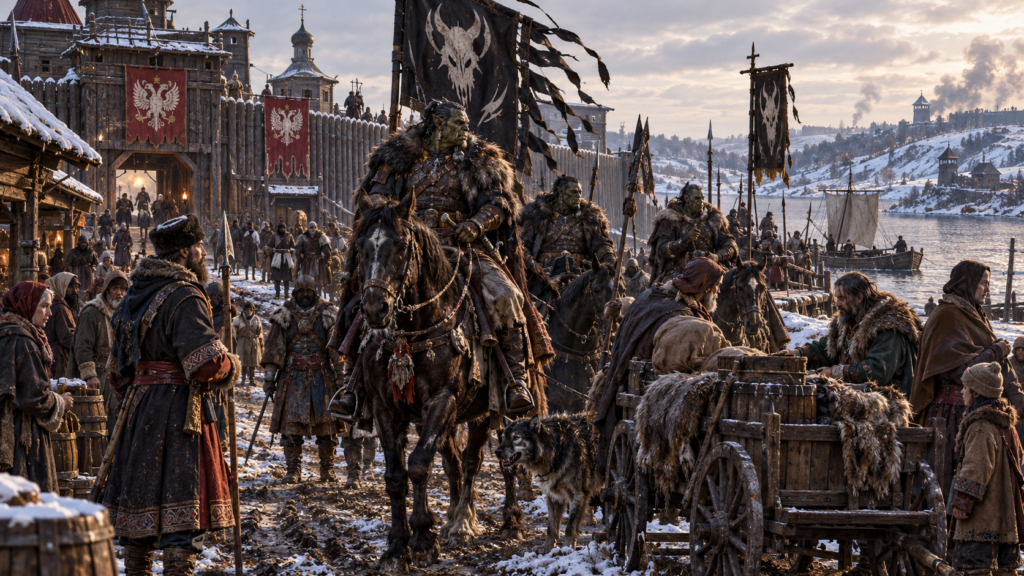
Orcs See the March Differently
A Rus official looks at Qasimov and sees land, villages, taxes and military obligations.
An orc sees standards, dependants, claims, prey, rivals, witnesses and the reach of retaliation.
Most of Qasim’s warriors are Chaotic Evil. They plan, trade, negotiate and wait when patience serves them. They reject the idea that order deserves obedience merely because it is order.
A chief is obeyed because that chief rewards followers, protects dependants, punishes defiance and wins.
When he stops doing those things, yesterday’s authority means nothing.
Qasim survives because he remains useful, feared and successful.
Every ambitious Fanglord beneath him watches for weakness.
Scar-Law
Qasim’s people are not lawless.
Their law is not human law.
Scar-Law lives through witnessed speech, scars, tokens, standards and remembered precedent. It distinguishes between chiefs, envoys, oath-bound warriors, hostages, surrendered enemies, protected traders and clan dependants.
Those distinctions matter enormously to an orc.
They do not imply mercy.
A protected merchant crosses an orc camp untouched because the mark he carries places the authority of a powerful chief behind him. A captive without such protection becomes property. A surrendered village keeps its homes because somebody has accepted its submission. A village that breaks surrender terms answers collectively for the breach.
An orc does not ask whether this is fair.
He asks who claimed the village, who witnessed the surrender, whose standard guaranteed it, what was promised and who will retaliate if that promise is broken.
It Is Them or Us
Qasim’s warriors understand the alternatives with a clarity many Muscovite officials lack.
If Kazan destroys their refuge, rival chiefs die. Strong warriors submit or are killed. Dependants are divided. Captives change owners. Herds, weapons and stores are taken. Old feuds are settled while nobody remains strong enough to object.
Qasim’s warriors need no affection for Moscow to fight ferociously for the alliance.
Moscow is useful.
Kazan is dangerous.
That is enough.
Protection Is Not Kindness
Human villages stand within Qasim’s reach.
His orcs do not regard their inhabitants as equals.
The villages provide grain, animals, labour, information and revenue. They stand beneath Qasim’s protection. A raider who burns one has taken something from him. A bandit who repeatedly robs its merchants announces that Qasim cannot protect what he claims.
Either insult provokes brutal retaliation.
“You need not like the tusks at the gate. You need only remember why Stone-Eye’s riders have not crossed it.”
The arrangement is ugly, dangerous and effective.
That is why Ivan maintains the bargain.
What Goes Wrong
Everything that ambition, appetite and rivalry allow.
A war-chief raids somewhere Qasim intended to leave untouched because the horses are worth taking. Another kills over a witnessed insult and leaves the political consequences to somebody else. A victorious captain returns with enough followers, treasure and captives to wonder why Qasim is still chief.
Every order passes through fear, reward, rivalry, appetite and opportunity before it becomes obedience.
If Qasim appears weak, the March fractures.
If Ivan’s court appears weak, the alliance changes.
If Myev Stone-Eye offers an ambitious chief something better, yesterday’s loyalty disappears.
Cities, Fortresses and Starting Points
Moscow
Moscow is the centre of Ivan IV’s power: a court crowded with victorious allies, former enemies, ambitious relatives, petitioners and men who survived the civil war by changing sides at exactly the right moment.
Adventurers come here for patronage, information and money. They leave with enemies they did not know they had.
Novgorod
Novgorod is wealthy because roads, rivers and distant markets meet here. Merchants handle furs, wax, timber, cloth, metals and other goods moving between the northern interior and western trade.
The same connections bring rumours, foreign agents, unusual magical texts and people fleeing authorities elsewhere.
Pskov
Pskov’s walls and republican institutions make it a natural home for border adventures. Diplomats bargain here because armies are expensive. Spies come because diplomacy often fails.
Tver
Tver sits on the vital approaches between Moscow and Novgorod. Its princes remain independent; its merchants profit from movement between rivals; its court knows that friendship with Moscow is both necessary and dangerous.
Ryazan
Ryazan looks south and east towards country where political frontiers are measured in patrols, forts and control of the next crossing. A missing messenger here matters more than a missing noble in a safer land.
Yaroslavl
Yaroslavl’s Volga position makes it a natural port for merchants, envoys and anyone moving towards the eastern frontier. Old princely confidence survives beside growing anxiety about Moscow.
Nizhny Novgorod
Nizhny Novgorod is one of the great doors towards Kazan. Soldiers pass through it. Traders negotiate passage. Scouts arrive with stories that become less reassuring every week.
Torzhok
Torzhok matters because roads matter. Whoever controls movement between Novgorod and the interior delays armies, enriches merchants, intercepts messengers and charges travellers who cannot afford to turn around.
People You May Meet
Ivan Grozny — Ivan the Terrible
The Grand Prince of Moscow is acquiring a reputation for ruthless vigilance, disciplined fear and little patience with rival centres of power.
Ivan Grozny is intelligent, ambitious, suspicious and convinced that divided authority is the great weakness of the Rus lands.
He despises Novgorod’s independence, distrusts Tver even when Tver calls itself an ally, dislikes boyars who treat privilege as a limit upon princely power and regards orc tribute claims as humiliations that Moscow should answer with steel.
He commands Muscovy, but he does not rule the independent Rus republics and principalities around it.
He commands retainers, money and informants, as well as the Blackhound Brotherhood, whose officers answer to him alone.
Ivan hires capable outsiders for work his own retainers cannot perform openly.
Those who disappoint him discover that he remembers failure as clearly as insult.
Grigori Rasputin — The Man Who Refuses to Die
Rasputin is a wandering healer from the countryside whose age nobody can establish.
Stories place him in villages decades apart without visible change. Poison fails. Wounds close. He knows things spoken far from him behind locked doors.
His greatest power is access.
Heal one sick child in a ruling household and guards who would kill an ordinary stranger begin opening doors.
Moscow watches him. Tver investigates him. Ivan Grozny wants to know whether Rasputin can be controlled.
Ivan Barkov — The Man Nobody Should Quote
Barkov writes obscene verse, political satire and translations good enough that respectable people read him secretly while publicly condemning him.
His work spreads particularly well through Novgorod’s literate merchant world.
One poem mocks a Muscovite prince.
Another describes a prominent boyar’s private behaviour with suspicious accuracy.
A third insults somebody who is not human and does not understand satire as harmless entertainment.
Barkov considers all three successes.
Igor Voss — Anatomist of Forbidden Things
Igor follows rumours of unusual corpses east.
He knows plague pits, charnel grounds, battlefield remains and the marks left when death does not proceed correctly. In the northern country he has heard of bodies preserved beneath frozen earth for decades.
One of them is still warm.
Igor is useful enough that sensible people overlook how eager he is to find it.
Krusk Ash-Standard — Khan of the Great Horde
Krusk measures rulers by what they can hold.
The old tribute routes towards Rus prove that stronger orcs once forced these princes to kneel. Moscow’s refusal to honour old obligations is a challenge to his strength.
Myev Stone-Eye — Khan of Kazan
Myev rules because enough powerful clans believe removing her costs more than following her.
She uses hostages, fortresses, river control, clan rivalries and fear with equal practicality. She understands Muscovite politics well enough to defeat humans without fighting every one of them.
Offer the right prince a better enemy.
Offer the right boyar a profitable secret.
Offer the right orc a reason to betray Qasim.
Armies come later.
Olga of Kiev — The Ruthless Queen Returned
Olga remembers a Rus world older than Moscow’s ambitions, older than the Great Horde and older than most claims now treated as ancient.
She has returned from death.
Scholars argue over whether she is revenant, deathless queen or something for which their classifications have no name.
Olga remembers.
Receiving her strengthens a ruler’s claim to the old Rus inheritance.
Rejecting her awakens old oaths, old graves and powers that still recognise her authority.
When These People Collide
Ivan IV and the Civil-War Boyars
Ivan remembers who served Moscow during the civil war, who betrayed it and who waited to see which side would win. Every old allegiance is a possible weapon in his hands.
Ivan Grozny and Barkov
Barkov considers Ivan irresistible material. Ivan considers ridicule an attack upon authority.
Rasputin and Ivan Grozny
Ivan wants Rasputin’s gifts. He cannot tolerate power he cannot command.
Igor and Rasputin
Igor has spent years studying the dead. A living man who repeatedly refuses to become one is the most interesting specimen he has ever encountered.
Olga and Moscow
Moscow claims leadership of Rus. Olga asks one devastating question: who gave it to you?
Olga and Krusk
Krusk’s authority rests partly upon inherited conquest. Olga remembers the lands before that conquest and rejects the idea that conquest creates eternal rights.
Myev and Qasim
A human enemy is an enemy. An orc who carries his knowledge, warriors and grudges into human service is a traitor.
Factions and Powers
The Muscovite Princely Household
It wants Ivan’s rule made unchallengeable, rival claimants neutralised and Moscow recognised as the strongest Rus power.
Muscovite Boyars and Service Princes
Some are loyal. Some are ambitious. All remember how quickly fortunes changed during the civil war.
The Oprichniki — The Blackhound Brotherhood
The Oprichniki are Ivan Grozny’s most feared instrument.
They ride in black beneath the sign of the hound and broom. Their arrival means arrests, confiscation, interrogation and the sudden disappearance of people who believed their rank protected them.
The Brotherhood hunts treason, disobedience and supernatural threats that ordinary officials cannot contain. Its riders cross Muscovy, the Novgorod roads and neighbouring Rus lands carrying authority that few local officials challenge openly.
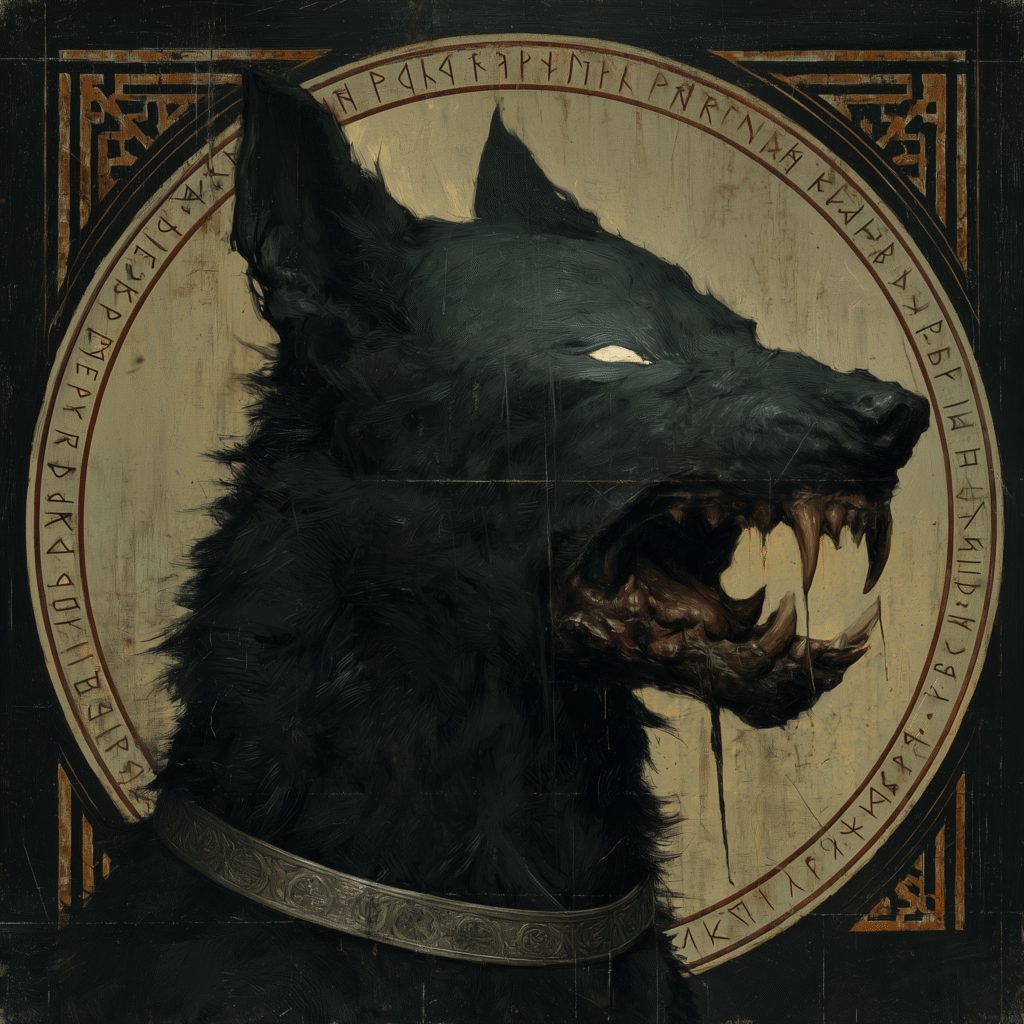
Svyatoy Voron, the Holy Raven, commands the Brotherhood through enforcers, seers, covert killers and militant captains.
Kormchii patrol roads, settlements and estates. They make arrests, enforce confiscations and carry the Brotherhood’s authority into places where Ivan’s ordinary officials lack the nerve to go.
Vedyuny interrogate through divination, trance and coercive magic. Secrets that survive ordinary questioning rarely survive them.
Chornyye Teni remove enemies whose deaths must remain deniable. Their work begins where public accusation becomes politically inconvenient.
Volkodlak commanders lead the Brotherhood’s most violent operations and impose discipline upon men already feared by everybody else.
Boyars hate the Oprichniki because birth and privilege do not stop a black rider at the gate. Merchants fear confiscation. Novgorod watches every rumour of their movement. Ivan values them because terror begins working before the Brotherhood arrives.
The Oprichniki also hunt the supernatural. Restless dead, hostile spirits, dangerous fey and creatures that prey upon Muscovite settlements are destroyed, captured or bound when the Brotherhood decides they threaten Ivan’s power.
The distinction between protecting the people and strengthening Ivan is rarely important to them.
The Novgorod Veche and Great Families
They agree that Novgorod remains free. They disagree fiercely about what must be sacrificed to keep it that way.
Novgorod’s Merchants
Trade dislikes war and profits from preparing for it. Merchants want roads open, cargo protected and princely quarrels kept away from profitable routes.
The Pskov Republic
Pskov preserves its autonomy by balancing foreign relationships and trusting no larger neighbour completely.
The Court of Tver
Tver needs Moscow strong enough to be useful and not strong enough to swallow it.
The Court of Ryazan
Ryazan survives by noticing threats before those threats become armies.
Krusk’s Standards
The Great Horde is held together by powerful clans, military households, inherited routes and the belief that weakness forfeits command.
Myev’s Kazan Court
Kazan’s fortress court sits among competing clan interests. Hostages, wealth, fear and victory matter more than abstract obedience.
Qasim’s War-Host
Qasim remains strong enough to satisfy Moscow without appearing subordinate enough to lose the respect of his own chiefs.
The Supernatural Rus Lands
The forests and rivers are not empty spaces between political centres. They contain powers with their own territories, memories and desires.
Domovoi — The Other Members of the Household
Prosperous houses contain more residents than their owners admit. Domovoi guard hearths, workshops, stables and family spaces. Some are helpful. Some are temperamental. All care more about the continuity of the household than the ambitions of whoever currently possesses its deed.
Domovoi witness murders, overhear bargains, guard secrets and remember every stranger who crosses the threshold.
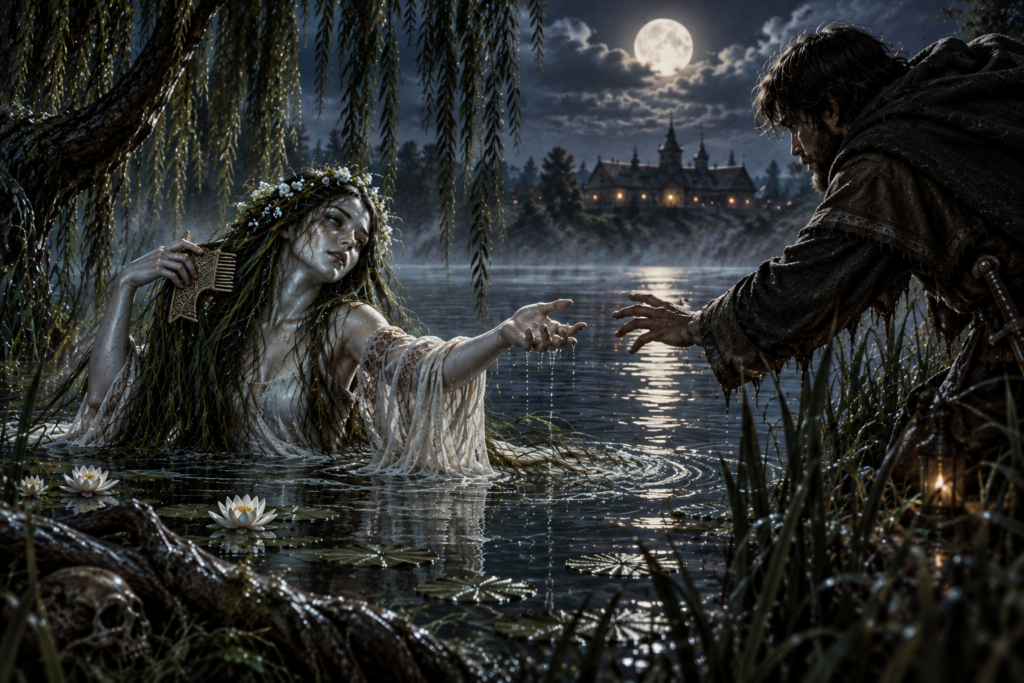
Rusalka — The Dead Beside the Water
Rivers remember violent deaths.
Rusalki linger beside lakes, rivers and drowned places. Some kill. Some seek vengeance. Others pursue desires that made sense only when they were alive.
Every ferry master knows at least one story about a passenger who answered singing from the bank.
Vodyanoi — Masters of Dangerous Water
Deep pools, mills, ferries and difficult river reaches belong to beings who do not recognise human ownership.
A prince claims both banks.
The Vodyanoi beneath the bridge laughs at him.
Forest Powers
Ancient forest beings measure time differently from humans. A human lifetime is barely enough for some of them to notice a new road.
Hunters learn which groves admit travellers, which trees must not be cut and which paths lead somewhere no map records.
Baba Yaga
Baba Yaga belongs to no prince.
Those who find her receive answers, curses, impossible bargains or tasks whose purpose becomes clear years later.
Finding her hut is difficult.
Convincing it to remain where you found it is harder.
Gorynych
When a Gorynych claims a region, roads close, settlements empty, tribute changes hands and neighbouring rulers raise armies.
Its arrival changes the political map.
More creatures of the region can be found in the Slavic Bestiary.
Magic, Knowledge and Services
Magic is known, studied and useful, but it is not distributed evenly.
Moscow’s ruling households employ healers, diviners, alchemists, astrologers and learned spellcasters. Wealth buys books, rare components and discreet expertise.
Novgorod’s trading connections bring foreign texts, imported magical materials and scholars carrying ideas from distant cities.
Artisans preserve practical magic through master-and-apprentice teaching. Rural practitioners learn charms, remedies and local rites through families and individual teachers.
Some knowledge belongs to no school.
Rasputin knows things scholars cannot explain. Baba Yaga has no need of their approval. Olga remembers arts modern practitioners know only from fragments. Igor learned enough respectable natural philosophy to discover how much more exists beyond respectability.
Rivers Are Roads
To understand travel in the Rus lands, follow the water.
The Volga links princely cities to Yaroslavl, Nizhny Novgorod, Kazan and the lands farther south. The Oka carries traffic through the southern Muscovite and Ryazan frontier. The Volkhov and Lake Ilmen belong to Novgorod’s great commercial world, while Lake Ladoga opens routes towards the Baltic.
Overland routes matter where they connect these systems, especially the roads through Torzhok and Tver between Novgorod and Moscow.
Season changes everything.
In winter, frozen rivers become the fastest roads in the region. Spring thaw turns those roads into barriers.
| Route | Why It Matters | Typical Trouble |
|---|---|---|
| Novgorod → Torzhok → Tver → Moscow | Trade, politics and the growing Moscow-Novgorod confrontation | Spies, tolls, intercepted letters, rival escorts and sudden border closures |
| Novgorod → Volkhov → Ladoga → Baltic | Western commerce and foreign contact | Storms, piracy, dangerous water, supernatural encounters and disputed cargo |
| Moscow → Oka → Ryazan | Southern frontier movement | Raiders, military patrols, missing envoys and contested crossings |
| Moscow → Vladimir → Nizhny Novgorod | Main approach towards Kazan | Scouts, frontier forts, refugees and changing military orders |
| Volga north and south | Trade, tribute and war | Orc patrols, river monsters, toll collectors, hostage exchanges and rival claims |
| Novgorod → Pskov | Republican and western politics | Smugglers, diplomats, fugitives and foreign agents |
| Northern forest routes | Furs, isolated settlements and wilderness expeditions | Lost trails, winter, spirits, monsters and settlements that have stopped answering |
Law Changes at the Border
There is no single law of Russia. Every border changes who rules, what is owed and which promises still matter.
Moscow, Novgorod, Pskov, Tver, Ryazan, Yaroslavl, Kazan, the Great Horde and Qasim’s March recognise different authorities, privileges and obligations.
Adventurers care about seals, witnesses, safe-conducts, toll receipts and patronage.
A weapon carried openly in one city must be surrendered at the next gate. A merchant protected by a Novgorodian agreement reaches Tver and discovers that the official at the gate recognises none of it. A man wanted in Moscow becomes valuable to somebody in Novgorod precisely because Moscow wants him.
Orc territory follows a different logic.
Scar-Law protects a traveller more effectively than pleading innocence. A recognised standard places a person beneath the authority of the chief behind it. Attacking that person challenges the chief directly. Without such status, assumptions that seem obvious in a human court mean nothing.
Dangers and Rumours
- A dead messenger lies on the Moscow road carrying three sealed letters, each naming a different traitor.
- One of Krusk Ash-Standard’s tribute envoys has disappeared inside Rus territory.
- A Qasimov Fanglord is quietly offering silver for the names of warriors willing to change standards.
- People near a northern river hear singing beneath the ice.
- A Domovoi has driven an entire noble family out of its own house and refuses to explain why.
- Myev Stone-Eye has released several valuable prisoners without ransom.
- Ivan Barkov has written a poem nobody has seen, and three powerful men are already trying to destroy it.
- Rasputin has predicted the death of a prince but refuses to say which one.
- Igor Voss has purchased enough lamp oil, rope and digging equipment for a very large grave.
- A woman carrying Olga of Kiev’s authority has appeared at a western crossing with an escort of dead warriors.
- A Great Horde standard has been seen near Torzhok where no Great Horde army should be.
- A forest road used for generations now returns travellers to the same tree no matter which direction they walk.
Adventures in the Rus Lands
Olga’s Letter
A messenger arrives carrying a document written by Olga of Kiev. Moscow wants it examined, Novgorod wants it copied, Lithuania wants the messenger and Krusk wants to know exactly what Olga claims he has no right to possess.
The Man Who Will Not Die
Rasputin is murdered. By morning he is alive again and insists one of the adventurers was present at a second murder that has not yet happened.
Barkov’s Last Poem
Barkov disappears after circulating a devastating satire of Ivan Grozny. Moscow wants the copies burned. Novgorod wants proof Moscow ordered the disappearance. Barkov’s publisher swears the final stanza was added by somebody else.
The Frozen Grave
Igor Voss hires the party to escort him north. The corpse he seeks has lain beneath frozen earth for decades. When they reach it, its heart is still beating.
The Last Tribute
A payment promised to Krusk Ash-Standard disappears on the road east. Moscow denies sending tribute. Krusk’s envoy possesses witnesses who say otherwise. Somebody profits if both rulers believe the other has lied.
Stone-Eye’s Hostage
An important captive escapes Kazan carrying evidence that somebody in Moscow has been secretly negotiating with Myev Stone-Eye.
The Orcs of the Oka
Qasim is accused of betraying Moscow after one of his chiefs raids protected territory. Evidence points towards Kazan, a Muscovite boyar and the guilty chief at the same time.
The River Bride
A Rusalka begins telling travellers the exact day they will die. Every prediction has come true. The next name she gives belongs to the person paying the party.
The Empty Hearth
An entire wealthy household disappears overnight. Its terrified Domovoi remains, has barricaded the cellar and attacks anyone who tries to open it.
The Black Standard at Torzhok
A Great Horde banner appears above an abandoned toll station deep inside Rus territory. Krusk denies sending warriors. The scars recorded on the banner belong to orcs dead for generations.
Orlok’s Cargo
A merchant shipment reaches Novgorod from the west carrying valuable cloth, wine, metalwork and one sealed crate whose owner travelled no farther than the Carpathians.
The Terrible Grand Prince
Ivan Grozny hires the party to expose a conspiracy against Moscow. The evidence is real. Several alleged conspirators are guilty only of believing Ivan should never be allowed more power.
When Adventurers Return
Nothing here resets because an adventure ended.
Save a Novgorodian convoy and merchants remember the party’s names. Destroy the warband demanding payment from that convoy and somebody on the Volga remembers those names too.
Protect Qasim’s people and Moscow’s frontier grows safer while Myev Stone-Eye adds the adventurers to a list of useful enemies.
Humiliate Ivan Grozny and the insult still matters five years later.
Help Rasputin and powerful families assume the party can reach him again.
Accept Olga’s authority and ancient spirits begin treating the party as servants of promises they do not understand.
Kill a Rusalka and grateful ferrymen discover that she had been keeping something worse away.
Return visits change guards, prices, rumours, hospitality, enemies and opportunities.
The Rus lands remember what the adventurers do.
Powers Beyond the Border
Russia is connected to a much larger world.
Vlad III Dracula
The vampire prince of Wallachia has his own wars and ambitions. His merchants, envoys, spies and undead servants travel farther than his armies.
Count Orlok
Orlok remains a Carpathian predator. He does not need to abandon his castle to threaten Novgorod. Coffins travel. Servants travel. Cargo travels. Plague travels.
Elizabeth Báthory
The Blood Countess belongs to the dangerous aristocratic world farther west. Vampires possess property, servants, grudges and politics as well as appetites.
Muma Pădurii
The Forest Mother belongs to the ancient Romanian woodlands, but old forests are joined by paths humans do not see. Travellers entering the wrong grove in Rus emerge much farther from home than geography permits.
Ileana Cosânzeana
Ileana guards enchanted places rather than human borders. Hidden paths through fey country open in forests claimed by Rus princes who have no idea another realm overlaps their own.
More figures from the wider region can be found among the Eastern European NPCs.
How the Rus Lands Became This Way
The old Rus political world was shattered by the western expansion of Mhurak Stone-Blood’s Great Muster.
Cities fell. Princes submitted. Tribute flowed east. Populations moved, fortifications changed hands and generations grew up beneath the consequences of conquest.
The empire did not remain united.
After Mhurak’s successors failed to hold everything gathered beneath the first great standard, the western dominions fractured. The Great Horde, Kazan, Crimea and other orc powers inherited different territories, roads, armies and claims.
They also inherited reasons to hate one another.
Lithuania expanded across extensive western and southern Rus lands. Novgorod and Pskov preserved republican traditions. Tver, Ryazan, Yaroslavl and other principalities pursued their own interests. Moscow grew richer, survived repeated struggles and acquired the ability to make its ambitions everybody else’s problem.
The civil war that has only just ended nearly proved that Moscow’s rise could be reversed.
Vasily II survived.
That matters because several different futures remain possible.
Moscow may dominate the Rus lands.
Novgorod may preserve its freedom.
Tver may remain a rival.
Kazan may break Muscovite expansion.
Krusk may restore enough of the old tribute system to prove that the Great Horde is not finished.
Olga may return old claims to the political world that thought them safely buried.
Russia is not the story of a unified country.
It is the moment when several different Russias are still possible.
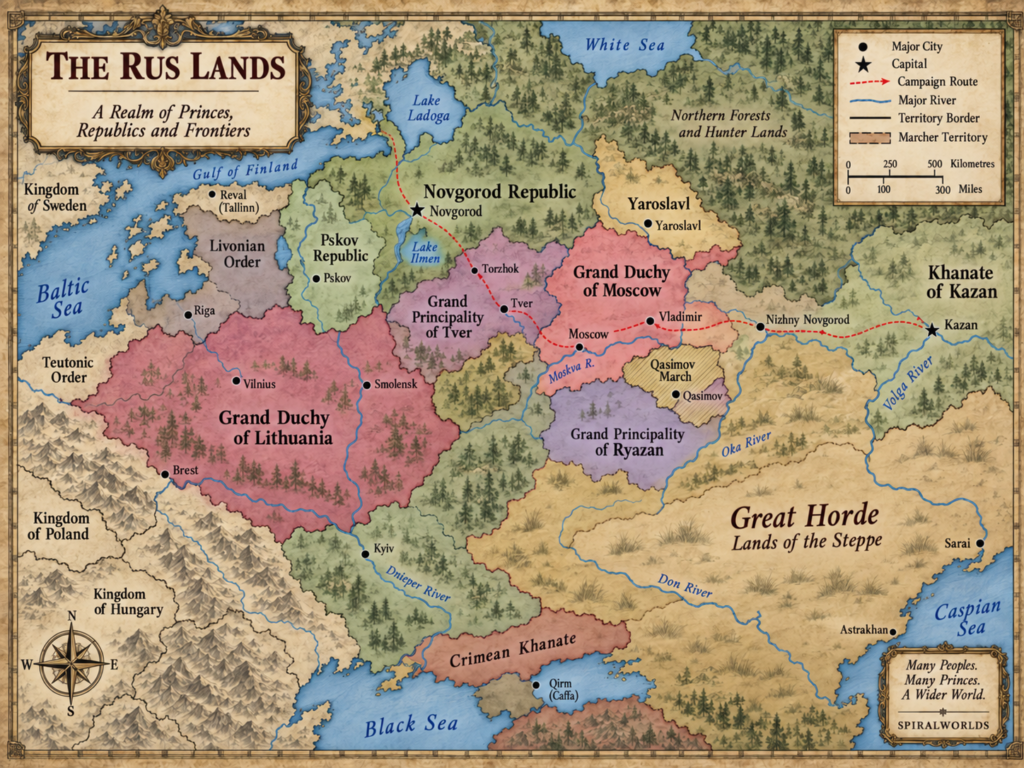
Campaign Map
The campaign map of Russia and the Rus lands shows a political world divided by republics, principalities, Lithuanian territories and the orc frontier. Rivers matter as much as borders. The Volga, Oka, Volkhov, Lake Ilmen and Lake Ladoga determine how armies, merchants and adventurers move.
Russia RPG Campaign FAQ
Is Russia a unified kingdom in 1454?
No. The Rus lands are divided among Muscovy, Novgorod, Pskov, Tver, Ryazan, Yaroslavl and other territories, while Lithuania controls extensive western Rus lands and orc successor states dominate important eastern and southern frontiers.
Who is the strongest Rus ruler?
Ivan IV, the Terrible, is the reigning Grand Prince of Muscovy and its strongest central authority, but he does not rule the independent Rus lands.
Why do adventurers go to Russia?
For political employment, trade, missing-person investigations, wilderness expeditions, monster hunting, diplomacy, hostage recovery, war, forbidden knowledge and the endless problems created when rival states share roads, rivers and enemies.
Are the orcs simply enemies?
No. Most orc societies of the western successor states are brutal and typically Chaotic Evil, but politics crosses species boundaries. Moscow employs Qasim’s orcs against other orcs. Rus merchants trade with orc territories. Orc chiefs feud with one another. A traveller fights Kazan warriors one month and travels beneath an orc safe-conduct the next.
What is Russia like in this fantasy RPG setting?
Russia is a fractured campaign region of rival Rus principalities, republics, orc successor states, dangerous rivers, ancient forests and supernatural powers.
Continue Exploring
Sources and Further Reading
- Janet Martin, Medieval Russia, 980–1584, Cambridge University Press.
- UNESCO World Heritage Centre — Historic Centre of the City of Yaroslavl
- Historical chronology and biographical material for Vasily II, Ivan Vasilievich, Maria Borisovna, Tver and the late Muscovite civil war.
- Historical studies of Novgorod, Pskov, Muscovite expansion, Volga politics and the fragmentation of the western steppe successor states.
- Slavic folklore traditions concerning household spirits, water spirits, forest beings and legendary figures.
Keep this reference growing
If this page helped with your reading or game, you can support its upkeep or explore the curated books.
Explore the Bookshop — epics, classics and stories behind imagined worlds.