
Prague — Capital of Bohemia
At a Glance
- Realm
- Kingdom of Bohemia, within the Holy Roman Empire.
- King
- Ladislaus the Posthumous, crowned in 1453.
- Governor
- George of Poděbrady, directing much of the kingdom’s government.
- Government
- Royal monarchy, Bohemian estates and the separate councils of Prague’s towns.
- Population
- Approximately 30,000, a campaign estimate rather than an exact historical census.
- Languages and peoples
- Czech- and German-speaking residents, dwarven craft communities, merchants, scholars and retainers.
- Settlement character
- Lawful Neutral metropolis for Pathfinder 1e; its inhabitants vary in alignment.
- Key landmarks
- Prague Castle, Stone Bridge, Old Town Square, astronomical clock, university, New Town, Lesser Town, river wharves and dwarven workshops.
- Best for
- Royal intrigue, university mysteries, guild disputes, river pursuits and construct investigations.
- Immediate danger
- Royal and gubernatorial agents contend for authority while the city’s wards guard their privileges.

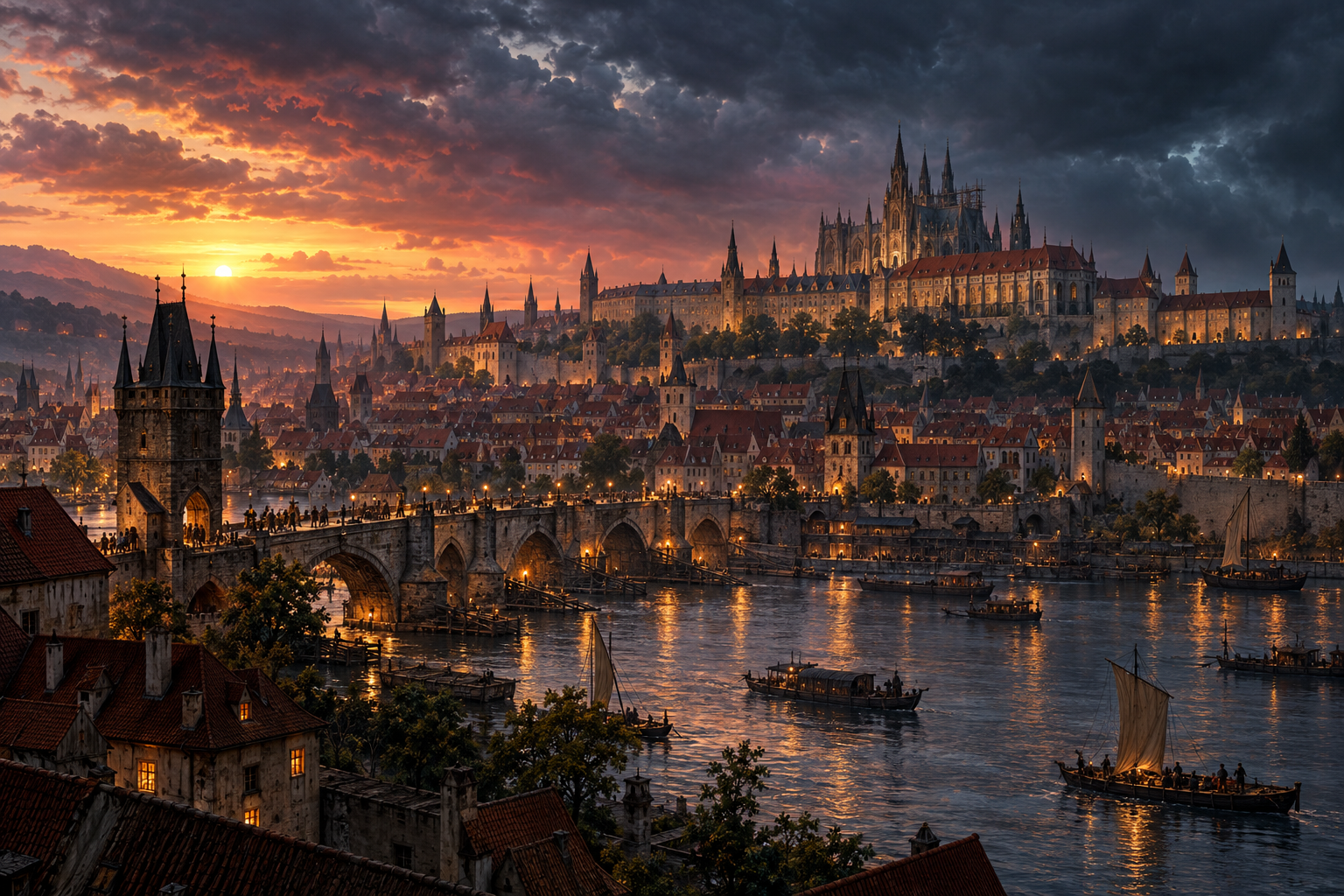
Prague is a city of two powers: Ladislaus the Posthumous wears Bohemia’s crown, but George of Poděbrady directs much of the kingdom’s government. Between the royal castle and the Vltava wharves, councillors, guilds and scholars are watching which of them will prevail.
Prague stands on the Vltava River, where the royal castle watches a guarded stone bridge, competing towns and busy wharves. Charles IV’s great building programme gave the city its New Town, university and magnificent Gothic skyline, but his age of imperial residence is already past. In 1454 the royal court of Ladislaus the Posthumous shares the city with the administrative power of George of Poděbrady.
The river carries timber, grain, metalwork, merchants and news. Summer can be warm, but mist, cold rain and winter ice make a crossing dangerous. For adventurers, control of a gate, bridge tower or sealed dispatch can be as important as any army beyond the walls.
What Is Happening Right Now?
The Young King and the Governor
Ladislaus the Posthumous is crowned King of Bohemia, but George of Poděbrady still directs the kingdom’s day-to-day government. The king’s extended residence at Prague has brought two households of officials and servants into close contact. Their relations are outwardly cooperative; the arguments begin among those who hope to gain appointment, guard duty or control of a royal dispatch.
The Peace Has Living Enemies
The fighting and political divisions of earlier decades have not been forgotten. Town councillors distrust heavily armed noble retinues, rival captains remember old debts, and a rumour at the gate can summon watchmen before either side has agreed which court has jurisdiction. The city has avoided another open struggle by bargaining as much as by force.
The Owl-Sealed Letter
A manuscript courier from Constantinople arrives with a wax seal showing a crowned owl. The sign belongs to a branch of the Bohemian Club, an established society founded in 1378. Its role in the fall of that city in 1453 has left witnesses and unpaid obligations, and its patrons in Prague are now quietly searching for a missing copy of the report. No royal court openly admits using the Club; anyone offering proof may become useful or dangerous to both Ladislaus and George.
The Astronomical Clock Has Lost Time
A university observer finds a discrepancy in the astronomical dial of the Old Town Hall. Its original mechanism dates to 1410, and the guildsmen responsible for it will not welcome unsupervised visitors. A missing apprentice and a bronze gear discovered at the river wharves suggest someone is interfering with more than civic timekeeping.
The Dwarven Workshops Have Shut Their Doors
A commission involving unusually fine locks has divided the smiths of the Dwarven Quarter. Merchants cannot collect their orders; a noble household threatens to invoke the governor’s officers; and an apprentice insists that an unopened vault has begun to ring from the inside. No witness agrees who last held the key.
Who Holds Power in Prague?
Ladislaus the Posthumous — the King
Crowned in Prague in October 1453, Ladislaus possesses the crown and its prestige. Royal courtiers seek access to his seal, while visiting envoys try to discover which documents really express the young king’s wishes. Through much of 1454 he remains in the city, but he does not govern without powerful intermediaries.
George of Poděbrady — the Governor
George controls the practical administration and commands deep networks of noble and military supporters. He has not yet become king. Rival households want to prise the crown from his influence; merchants prefer his ability to keep trade routes and streets open. A spy who learns which side controls a courier can make a fortune.
University Scholars, Guilds and Councillors
Knowledge, money and local jurisdiction give the town councils and Charles University’s masters power of their own. A charter witnessed by trusted scholars may defeat a noble’s bluff. A guild can close its workshops until a dispute is settled; a civic watch can close a town gate while royal officers protest their authority.
John of Rokycany remains an influential voice among Bohemia’s reform-minded learned circles. His connections can open doors but do not excuse visitors from local feuds. For wider political links, follow the Kingdom of Bohemia and the factions directory.
People, Guilds and Factions
| Power | What it wants | What it can offer adventurers |
|---|---|---|
| Ladislaus and the royal household | Recognition of royal authority without being seen as the instrument of another man’s government. | Royal safe-conducts, court hearings, guarded access to the castle. |
| George of Poděbrady and his officers | Quiet streets, reliable intelligence and political rivals kept from reviving the fighting. | Warrants, armed escort, reliable information from administrative servants. |
| Old Town councillors and watch | Protection of urban privileges, shops, revenues and jurisdiction. | Bridge access, town records, permission to search guild premises. |
| University masters | Patronage, access to manuscripts and credit for discoveries. | Translation, research, astronomical knowledge and introductions to spellcasters. |
| Dwarven craft guilds | Control of their contracts, stoneworks and intricate metalworking secrets. | Expert repair, crafted equipment, knowledge of hidden cellars. |
| The Bohemian Club | Protect its long-standing occult contacts and recover the lost Constantinople report without becoming visible to the Crown. | Old manuscripts, discreet patrons, ritual expertise and concealed routes through established lodges. |
| River traders and distant merchants | Safe tolls, unhindered cargoes and profitable dealings with Bohemia and Silesia. | Transport, rumours and discreet passage out of the city. |
The city receives traders who know the Hanseatic League, but that wider merchant network does not govern Prague. More distant legal and diplomatic disputes reach the city through the Bohemian Crown and the Empire.
People Adventurers May Actually Meet
George of Poděbrady can grant an audience through trusted officers when a problem threatens the city’s peace. Ladislaus the Posthumous may receive an important petitioner through the royal household, although gaining admission is difficult. John of Rokycany can bring scholars and civic representatives together when a dispute cannot be settled through armed authority. Ordinary watch officers, couriers, guildmasters and bargemen can provide witnesses without introducing unestablished named NPCs.
Places Adventurers Will Visit
Prague Castle and the Royal Heights
The royal precinct commands the west bank. Armed retainers guard the gates, officials screen petitions and courtiers decide who may approach the king. Servants’ passages offer less formal routes, but a stranger found near protected documents will be treated as a spy. The great cathedral works stand among the castle’s most imposing landmarks.
The Stone Bridge
The fortified stone crossing carries travellers, wagons and messages between the Lesser Town and Old Town. In this period it is known as the Stone or Prague Bridge; the familiar name Charles Bridge belongs to later usage. Its towers serve as checkpoints, and a blocked bridge can divide the city in a moment. The famous long procession of later Baroque statues does not yet line its parapets.
Old Town Square and the Astronomical Clock
Guildsmen, dealers, witnesses and city officers assemble beneath the Town Hall. The clock’s earliest astronomical machinery dates to 1410. Later decorative additions are not yet present. An altered gear, stolen manuscript or missing clockmaker can therefore point to a real and valuable piece of contemporary craftsmanship.
New Town, Lesser Town and the University
The New Town’s broad plan offers workshops, trading space and routes around the crowded older quarter. The Lesser Town climbs towards the castle, with inns well placed for spies watching the bridge. Charles University attracts mathematicians, scribes, natural philosophers and ambitious patrons; access to difficult magical research still depends on introductions and trust.
The Dwarven Quarter and River Cellars
Dwarven masons, smiths and lockmakers guard their guild secrets in workshops known for elaborate mechanisms and sound stonework. Their elders answer to guild custom and insist that outsiders respect the quarter’s sealed workshops. Along the Vltava, barges and warehouses provide cover for contraband, hidden entrances and nocturnal exchanges. A sealed cellar may conceal ordinary stolen iron—or a rare clay golem whose maker has vanished.
The university courts, the Old Town’s guild streets and the river landings are close enough for a single messenger to move news among them, but the bridge towers make the west bank a different problem. A pursuit through Prague should always ask which gates remain open, who recognises the messenger’s authority and how quickly a rumour reaches the castle.
Markets, Learning and Magical Services
What Visitors Can Buy
The river markets trade in grain, timber, hides and metalwork. The Old Town has prosperous traders, scribes and craftspeople; the New Town offers larger workshops and storage. A specialist lock, finely engraved seal or copied chart may require guild sponsorship and several days rather than a single trip to a shop.
The University and Arcane Learning
Charles University offers scholarship, astronomical reckoning, mathematics and the scrutiny of troublesome documents. The right scholar may identify a forged charter or explain the augury used to warn a household. Powerful spellcasting, exceptional research and commissioned enchantments depend on the individual practitioner; the settlement’s Pathfinder 1e spellcasting ceiling is not a guarantee that every magic exists for sale.
Dwarven Workmanship
Guild metalworkers produce superior locks, mechanisms and stone fittings. An artificer can investigate a damaged mechanism but may find that its arcane design is older than the guild contract. Dwarven craftsmen do not freely divulge apprentices’ marks or methods to visitors without a sponsor.
Dangers Beneath the City’s Peace
- Armed household politics: rivalry between attendants and retainers can trap outsiders between jurisdictions; bribery may solve one problem and worsen another.
- The bridge chokepoint: locked gates, crowds and Vltava floods can isolate the castle side of the city at a crucial moment.
- Rival town privileges: warrants, debts and guild rights are not automatically respected across every district.
- Forbidden workshops: an escaped clockwork golem or clay golem is an extraordinary incident requiring a dedicated encounter, not a random street patrol.
- Rumours from the interior: a messenger bringing news from Houska Castle may be carrying a true warning, a false accusation or bait for someone at court.
Pathfinder 1e — Settlement Mechanics
Prague — LN metropolis (council); qualities: Academic, Prosperous, Strategic Location. These are optional Pathfinder 1e settlement rules and do not replace the city narrative for other editions.
| Settlement Trait | Value |
|---|---|
| Population | 30,000 (campaign estimate) |
| Corruption / Crime | +4 / +4 |
| Economy / Law | +6 / +3 |
| Lore / Society | +4 / +8 |
| Danger | +10 |
| Base Value / Purchase Limit | 22,400 gp / 150,000 gp |
| Available spellcasting | Up to 9th level, subject to patrons and individual availability |
| Magic items | Almost all minor; 4d4 medium; 3d4 major, subject to settlement availability rules |
These Pathfinder statistics represent the capital’s markets and civic institutions, not guaranteed access to forbidden magic. For 5.5e/2024, 5e/2014 and 3.5e, use the city description, individual NPC statistics and appropriate edition rules. See Settlements for the full rules framework.
Run Prague Tonight: The Missing Clockmaker
The Old Town astronomical clock, whose original mechanism dates to 1410, has begun losing time. A young assistant who identified the fault has disappeared. One councillor believes a rival has tampered with the clock; the university fears someone is using its mechanism to conceal a meeting beneath the Town Hall. The characters must choose which claimant to trust before the evening watch seals the square.
First Encounter: The Courier at the Bridge
Visible clue. A royal courier collapses beside the Stone Bridge parapet with a broken seal and a packet that ticks faintly.
Competing claims. A castle officer demands the packet for Ladislaus; an Old Town watch captain claims it as evidence; a governor’s messenger insists it belongs to George.
Escalation. The bridge gates close at dusk and each claimant brings armed witnesses. A gear-shaped mark in the broken wax matches a tool used in the clock tower.
Counterplay. The characters can question witnesses, take the packet to a neutral university master or trace the courier’s movements to a river cellar. None of these choices requires combat.
Further Leads
- The Lost Register. Names vanish from a university enrolment book on the same nights that warehouse guards report footsteps in an empty street.
- The Dwarven Vault. A metal-bound door begins to ring from the inside. The locksmiths will grant an audience to anyone who can account for a missing apprentice.
- The Houska Letter. A traveller from Houska Castle carries a warning written in a dead courtier’s hand. The governor needs to know whether it is a forgery before the king sees it.
Law, Watch and Safe-Conduct
Prague has overlapping jurisdictions rather than a single citywide watch. A royal messenger relies on castle officials, a guild member turns first to a civic court, and a quarrel between armed noble retainers may draw officers loyal to George of Poděbrady. A letter of introduction helps a traveller through one gate without necessarily settling a dispute in the next town.
- At the gates: officers question armed companies, suspect merchants and travellers unable to explain sealed cargo. A recognised seal or respectable patron speeds admission.
- Arrests: prisoners are held under the authority of the arresting household or town. Knowing which court will hear a complaint can be the difference between justice and disappearance.
- Guild contracts: an unpaid artisan may appeal to guild authorities; attempting to break an oath or seize a commissioned mechanism invites fines and confiscation.
- Use of magic: public enchantment of a guard, forged magical credentials, and unauthorized constructs are treated as threats to the peace. Ordinary healing and sanctioned craft are not equivalent offences.
Travel and the City’s Approaches
| Approach | Why travellers use it | Possible complication |
|---|---|---|
| Vltava river landing | Grain, timber, finished goods and discreet messengers. | River flooding, a missing barge or merchants disputing their toll receipts. |
| Western road | Couriers and merchants travelling toward the German lands. | Noble patrols, demands for sealed documents and changes of jurisdiction. |
| East toward Kutná Hora | Silver, contracts, court messengers and inland trade. | A guarded shipment whose contents do not match its manifest. |
| North-east toward Silesia | Trade and diplomacy via Breslau. | Toll disputes, a missing courier or rival trade agents. |
| Stone Bridge between banks | The principal fortified crossing between the castle approaches and Old Town. | Closed tower gates, crowd congestion and opposing warrants. |
The castle rises over the west bank; the Lesser Town lies below it. The Stone Bridge connects to the Old Town on the east bank, while the New Town stretches largely south and east. This is a guide for movement in play, not a claim that every medieval street followed today’s routes.
Deeper Routes and Related Entries
- Kingdom of Bohemia — the crown, royal estates and regional obligations shaping Prague.
- The Empire — Prague’s place among the territories and courts of Central Europe.
- Houska Castle — a threatening destination for investigators leaving the city.
- Breslau — Silesian trade, couriers and political contacts.
- Hanseatic League — broader merchant networks beyond the local river tolls.
- Clay Golem and Clockwork Golem — exceptional construct encounters rather than commonplace guards.
- Settlements — Pathfinder 1e modifiers and rules for running this city in other editions.
How Prague Became the Crown’s Great City
Long before the present political settlement, Prague grew on both sides of the Vltava around its fortified castle and the trade routes converging on the river. Later kings claimed its heights, craftsmen crowded its towns, and merchants moved silver and foreign goods beneath towers that have outlasted several dynasties.
Four Turning Points
- 1348 — The Great Enlargement
- Charles IV establishes the New Town and the university, expanding Prague’s commercial and scholarly power well beyond the older wards.
- 1357 — A Stronger Crossing
- Work begins on the great stone bridge that carries the road from the castle side to the Old Town. Bridge towers become points of political and practical control.
- 1410 — The Astronomical Dial
- The Old Town receives a remarkable astronomical clock; its earliest mechanism and dial belong to this period, while many familiar later decorations have not yet been fitted.
- 1453–1454 — Crown and Governorship
- Ladislaus is crowned in Prague in October 1453; George of Poděbrady continues to govern. Through most of the following year the royal presence intensifies rather than resolves competition for offices and influence.
Old conflicts still shape the loyalties of guild leaders and great households. The deeds of Jan Hus, Jerome of Prague and Jan Žižka are remembered as part of the city’s earlier troubled generation, not encounters with living residents of the present court.
Prague in the Old Chronicles
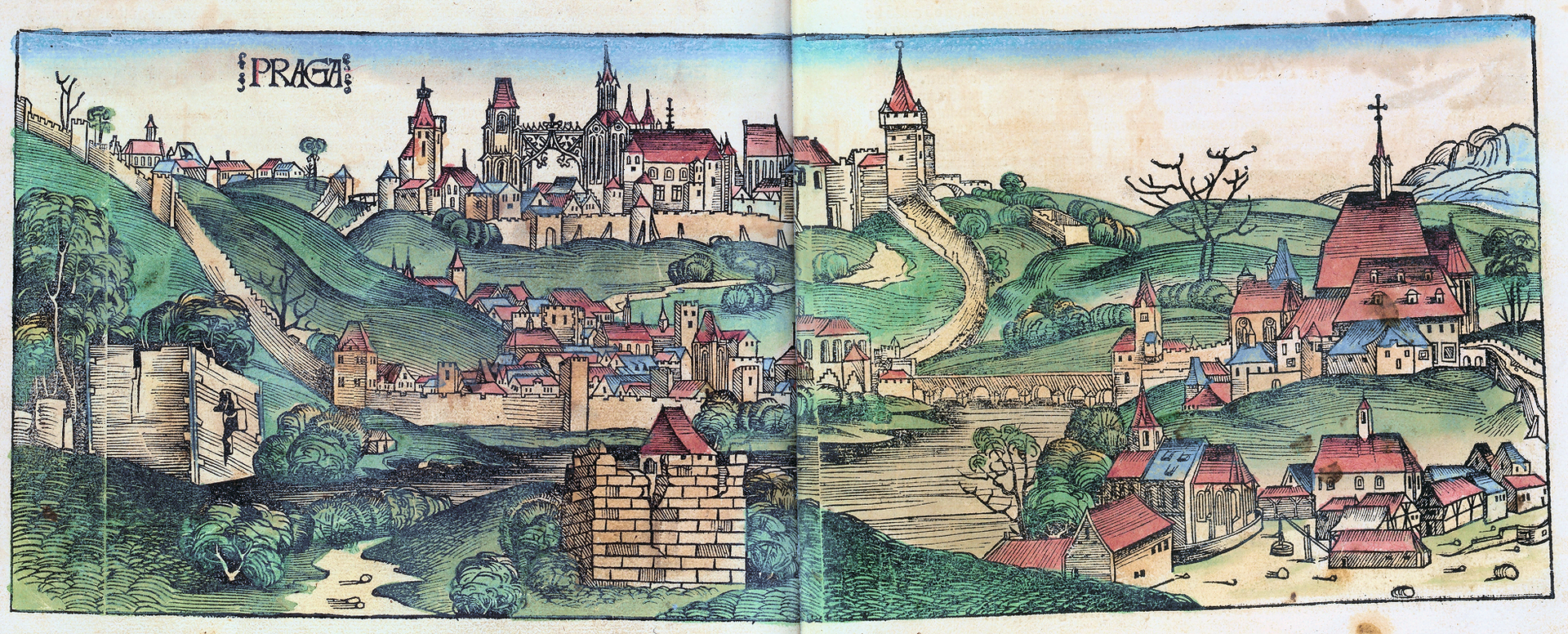
City Map and District Orientation
History and Rules Sources
The city preserves the great urban works of Charles IV and a royal government shared between Ladislaus and his governor George of Poděbrady. The original clock mechanism predates the campaign, while later decorative and mechanical additions do not. The dwarven quarter, hidden constructs and clockmaker mystery are part of the living realm rather than records of ordinary political history.
- UNESCO — Historic Centre of Prague: the castle, Old Town, Lesser Town, New Town, river and medieval architecture.
- Prague City Tourism — Astronomical Clock: its early mechanism and later alterations.
- Archives of Nethys — Pathfinder 1e settlements: the baseline metropolis and chosen settlement modifiers.
- Ladislaus the Posthumous and George of Poděbrady: the royal succession and governorship.
Keep this reference growing
If this page helped with your reading or game, you can support its upkeep or explore the curated books.
Explore the Bookshop — epics, classics and stories behind imagined worlds.