
Professor James Moriarty — The Napoleon of Crime
At a Glance
- Name: Professor James Moriarty
- Species: Human
- Age: Mid-forties
- Base: London, with agents in England and continental ports
- Role: Mathematician, teacher and criminal strategist
- Alignment: Lawful Evil
- Faction: Moriarty’s Criminal Web — founder and leader
- Known for: Compartmentalised criminal cells and plans with several contingencies
- At the table: Hidden patron, calculating rival or architect of a major crime
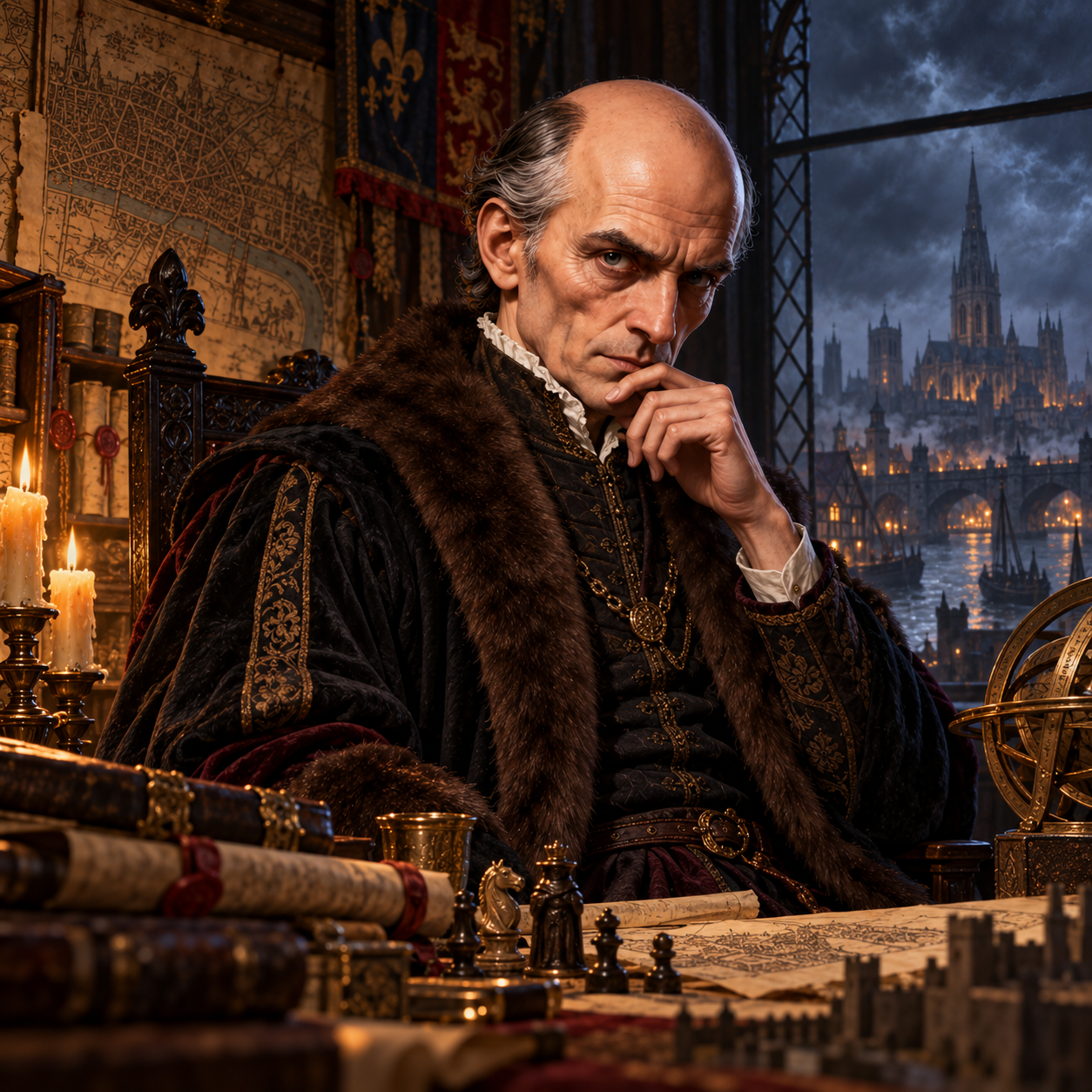
James Moriarty does not think like an ordinary criminal. To him, theft, extortion, murder and bribery are operations in a larger system: each has a cost, a probability of failure and a useful distance from the person who benefits.
He is a celebrated mathematician and teacher whose studies cover numbers, geometry and celestial motion. Beneath his respectable career is a criminal network in which each participant knows only the next instruction. He greets callers in a quiet study, corrects their smallest factual errors and rarely allows anyone to see a complete plan.
Game Statistics
Professor James Moriarty — 5.5e / 2024
Medium Humanoid (Human), Lawful Evil
Armor Class 18 (+2 breastplate)
Hit Points 190 (20d8 + 100)
Speed 30 ft.
Initiative +8 (18)
| STR | DEX | CON | INT | WIS | CHA |
|---|---|---|---|---|---|
| 10 (+0) | 18 (+4) | 20 (+5) | 22 (+6) | 18 (+4) | 20 (+5) |
Saving Throws Dex +8, Int +10, Wis +8, Cha +9
Skills Deception +13, Insight +12, Investigation +14, Perception +8, Persuasion +13
Senses Passive Perception 18
Languages English, French, Latin, criminal ciphers
Challenge 12 (8,400 XP; PB +4)
Traits
Perfect Calculation. Moriarty’s Precise Strike applies its additional damage to every hit, even when he is alone, outnumbered or unable to give orders. Moriarty adds his Proficiency Bonus to Initiative rolls. If he is conscious when combat begins, he does not have Disadvantage on Initiative from being surprised.
Reliable Genius. When Moriarty makes an Intelligence (Investigation), Wisdom (Insight), or Charisma (Deception) ability check, a d20 roll of 9 or lower counts as 10, even in combat.
Contingency Planner (1/Day). When Moriarty fails an Intelligence, Wisdom or Charisma saving throw, he can reroll it and must use the new result.
Compartmentalised Cells. Each ordinary agent knows only an immediate contact. Captured underlings cannot simply recite the whole criminal network.
Actions
Multiattack. Moriarty makes three Precise Strikes. He may alternate between his rapier and throwing knives.
Precise Strike (Rapier). Melee Attack Roll: +8, reach 5 ft., one target. Hit: 26 (1d8 + 4 plus 5d6) Piercing damage. Moriarty aims for an opening others fail to perceive; the additional dice are part of the attack, not Sneak Attack and do not require an ally.
Precise Strike (Throwing Knife). Ranged Attack Roll: +8, range 20/60 ft., one target. Hit: 24 (1d4 + 4 plus 5d6) Piercing damage. Moriarty carries twelve balanced knives and can draw one as part of each attack.
Disarming Prediction (Recharge 5–6). Moriarty makes one Precise Strike against a creature within the weapon’s normal range. On a hit, the creature must succeed on a DC 18 Dexterity saving throw or drop one held item of Moriarty’s choice at its feet and become unable to take Reactions until the start of Moriarty’s next turn. The attack still deals damage if the creature is holding nothing.
Bonus Action
Read the Next Move. Moriarty studies one creature he can see within 60 feet. The next attack roll he makes against it before the end of this turn has Advantage. Until the start of Moriarty’s next turn, the creature has Disadvantage on its first attack roll against Moriarty.
Reaction
Prepared Reversal (3/Day). When Moriarty takes damage from an attack, he reduces the damage by 18 (4d8) and moves up to 15 feet without provoking Opportunity Attacks. He must have a clear route and cannot move if his Speed is 0.
Equipment and Tactics
Moriarty wears a +2 breastplate beneath his coat; he carries a rapier, twelve balanced throwing knives, coded papers and a concealed escape kit. Spellcasting none. He can fight effectively without allies: he marks one opponent with Read the Next Move, attacks three times, and uses Prepared Reversal to survive retaliation. Armed agents, traps and prepared surroundings are separate threats that make him more dangerous without being necessary for his own attacks.
Professor James Moriarty — 5e / 2014
Medium humanoid (human), lawful evil
Armor Class 18 (+2 breastplate); Hit Points 190 (20d8 + 100); Speed 30 ft.; Challenge 12 (8,400 XP; proficiency bonus +4).
STR 10 (+0), DEX 18 (+4), CON 20 (+5), INT 22 (+6), WIS 18 (+4), CHA 20 (+5).
Saving Throws Dex +8, Int +10, Wis +8, Cha +9; Skills Deception +13 (expertise), Insight +12 (expertise), Investigation +14 (expertise), Perception +8, Persuasion +13 (expertise); Senses passive Perception 18; Languages English, French, Latin and criminal ciphers.
Traits
Perfect Calculation. Moriarty cannot be surprised while he is conscious. His Precise Strike damage applies to every hit; it does not require advantage, a nearby ally or a target denied its Dexterity bonus.
Reliable Genius. Moriarty treats any d20 roll of 9 or lower as a 10 on Intelligence (Investigation), Wisdom (Insight) and Charisma (Deception) checks, even in combat.
Contingency Planner (1/Day). Moriarty can reroll a failed Intelligence, Wisdom or Charisma saving throw, but must use the new result.
Compartmentalised Cells. Captured agents usually know only their immediate contact. The remainder of Moriarty’s organisation is uncovered through testimony, records and investigation.
Actions
Multiattack. Moriarty makes three Precise Strike attacks, in any combination of rapier and throwing knives.
Precise Strike (Rapier). Melee Weapon Attack: +8 to hit, reach 5 ft., one target. Hit: 26 (1d8 + 4 plus 5d6) piercing damage. The extra damage represents Moriarty’s extraordinary timing and accuracy, and works without allies.
Precise Strike (Throwing Knife). Ranged Weapon Attack: +8 to hit, range 20/60 ft., one target. Hit: 24 (1d4 + 4 plus 5d6) piercing damage. Moriarty carries twelve balanced knives and can draw one as part of each attack.
Disarming Prediction (Recharge 5–6). Moriarty makes one Precise Strike against a creature within the weapon’s normal range. If it hits, the target must succeed on a DC 18 Dexterity saving throw or drop one held object of Moriarty’s choice at its feet; until the start of Moriarty’s next turn it also cannot take reactions. Creatures holding no objects are unaffected by the disarm but still suffer the attack’s damage.
Bonus Action
Read the Next Move. Moriarty chooses one creature he can see within 60 feet. He has advantage on his next attack against that creature before the end of this turn, and the creature has disadvantage on its first attack against Moriarty before the start of his next turn.
Reaction
Prepared Reversal (3/Day). When an attack deals damage to Moriarty, he reduces the damage by 18 (4d8) and moves up to 15 feet without provoking opportunity attacks, provided he has an unobstructed route and his speed is not 0.
Equipment and Tactics
Moriarty wears a +2 breastplate; he carries a rapier, twelve balanced throwing knives, coded papers and an escape kit. Spellcasting none. He is a formidable solitary combatant, using Read the Next Move, three Precise Strikes and Prepared Reversal to seize the advantage. His criminal network supplies additional foes and hazards rather than the source of his personal power.
Professor James Moriarty — Pathfinder 1e
CR 12 (XP 19,200)
Human rogue 9/expert 6; LE Medium humanoid (human)
Init +6; Senses Perception +22
Defense
AC 22, touch 15, flat-footed 22 (+3 chain shirt +7, Dex +2, deflection +2, dodge +1; uncanny dodge)
hp 131 (15d8 + 60; maximum first rogue Hit Die)
Fort +11, Ref +12, Will +16
Defensive Abilities evasion, uncanny dodge, improved uncanny dodge, trap sense +3, prepared reversal
Offense
Speed 30 ft.
Melee +2 dagger +15 (1d4 + 2 plus 6d6/19–20); full attack +2 dagger +15/+10 (1d4 + 2 plus 6d6 precision/19–20 each)
Ranged +2 dagger +15 (1d4 + 2 plus 6d6 precision/19–20; range increment 10 ft.)
Special Attacks sneak attack +5d6 (applies additionally when normal sneak attack conditions are met), perfect calculation, blinding powder
Base Atk +10; CMB +10; CMD 25
Statistics
Str 10, Dex 14, Con 18, Int 22, Wis 18, Cha 18
Feats Deceitful, Dodge, Improved Initiative, Iron Will, Leadership, Persuasive, Skill Focus (Bluff), Skill Focus (Knowledge [engineering]), Skill Focus (Sense Motive).
Rogue Talents Finesse Rogue (Weapon Finesse), Trap Spotter, Fast Stealth, Weapon Training (Weapon Focus [dagger]).
Skills Bluff +32, Diplomacy +26, Disable Device +17, Disguise +21, Knowledge (engineering) +30, Knowledge (local) +24, Perception +22, Sense Motive +28, Sleight of Hand +17, Stealth +17; Languages Common, French, Latin and criminal ciphers.
Campaign Abilities
Perfect Calculation (Ex). Every weapon hit Moriarty makes against a creature he can see deals an additional 6d6 damage of the weapon’s type. This extraordinary damage is not sneak attack or precision damage and needs neither flanking nor an ally. Creatures immune to critical hits still take these dice; ordinary damage reduction applies. His normal sneak attack +5d6 stacks only when its usual conditions are met.
Read the Next Move (Ex). As a swift action, Moriarty chooses one creature he can see within 60 feet. Until the start of his next turn, Moriarty gains a +2 insight bonus on weapon attack rolls against that target, and the target takes a –2 penalty on its attack rolls against Moriarty.
Reliable Genius (Ex). Moriarty can take 10 on Bluff, Knowledge (engineering), Perception and Sense Motive checks even when threatened or distracted.
Blinding Powder (Ex; 3/day). As a standard action, Moriarty releases an alchemical powder in a 15-foot cone. Creatures in the cone must make a DC 23 Reflex save or be blinded for 1 round; on a success they are dazzled for 1 round. This is a nonmagical alchemical effect.
Prepared Reversal (Ex; 3/day). When Moriarty is hit by an attack, he can use an immediate action to reduce damage from that attack by 15 and move 10 feet without provoking attacks of opportunity. He cannot move through occupied spaces or blocked terrain and must be able to move.
Contingency Planner (Ex; 1/day). As an immediate action after failing a saving throw, Moriarty rerolls it and must use the new result.
Equipment and Tactics
Gear +3 chain shirt, +2 dagger and spare balanced daggers, ring of protection +2, cloak of resistance +2, three doses of blinding powder, cipher notebook, instruments and concealed money. Spellcasting none.
Even without accomplices, Moriarty uses his swift-action prediction, precise full attacks and powder to defeat opponents while Prepared Reversal blunts counterattacks. His command of London’s criminal cells creates separate encounter threats; it is not a prerequisite for these abilities.
Professor James Moriarty — D&D 3.5e
CR 12
Human rogue 9/expert 6; LE Medium humanoid (human)
Init +6; Senses Listen +22, Spot +22
Defense
AC 22, touch 15, flat-footed 22 (+3 chain shirt +7, Dex +2, deflection +2, dodge +1; uncanny dodge)
hp 113 (15d6 + 60; average Hit Dice)
Fort +11, Ref +12, Will +16
Defensive Abilities evasion, uncanny dodge, improved uncanny dodge, trap sense +3, prepared reversal
Offense
Speed 30 ft.
Melee +2 dagger +14 (1d4 + 2 plus 6d6/19–20); full attack +2 dagger +14/+9 (1d4 + 2 plus 6d6/19–20 each)
Ranged +2 dagger +14 (1d4 + 2 plus 6d6/19–20; range increment 10 ft.)
Special Attacks sneak attack +5d6 under normal rules; perfect calculation, blinding powder
Base Atk +10; Grp +10
Statistics
Str 10, Dex 14, Con 18, Int 22, Wis 18, Cha 18
Feats Dodge, Improved Initiative, Iron Will, Leadership, Negotiator, Skill Focus (Knowledge [architecture and engineering]), Weapon Finesse (seven feats including human bonus).
Skills Bluff +22, Diplomacy +26, Disable Device +22, Gather Information +24, Hide +18, Knowledge (architecture and engineering) +27, Knowledge (local) +24, Listen +22, Move Silently +18, Search +24, Sense Motive +24, Spot +22; Languages Common, French, Latin and criminal ciphers.
Campaign Abilities
Perfect Calculation (Ex). Every weapon hit Moriarty makes against a creature he can see deals an additional 6d6 damage of the weapon’s type. This extraordinary damage is not sneak attack and does not require flanking or an ally. Creatures immune to critical hits still take these extra dice; ordinary damage reduction applies. Moriarty also deals his standard +5d6 sneak attack when its usual conditions are satisfied.
Read the Next Move (Ex). As a swift action Moriarty chooses one creature he can see within 60 feet. Until the start of his next turn, he gains a +2 insight bonus on weapon attack rolls against that target; the target takes a –2 penalty on attack rolls against Moriarty.
Reliable Genius (Ex). Moriarty can take 10 on Bluff, Knowledge (architecture and engineering), Search and Sense Motive checks even when threatened or distracted.
Blinding Powder (Ex; 3/day). As a standard action Moriarty releases an alchemical powder in a 15-foot cone. A creature in the cone must succeed on a DC 23 Reflex save or be blinded for 1 round; on a success it is dazzled for 1 round. This is an extraordinary, nonmagical alchemical effect.
Prepared Reversal (Ex; 3/day). When an attack hits Moriarty, he can take an immediate action to reduce that attack’s damage by 15 and move 10 feet without provoking attacks of opportunity. The movement requires an open path and a speed greater than 0.
Contingency Planner (Ex; 1/day). Moriarty can use an immediate action when he fails a saving throw to reroll it, and must accept the second result.
Equipment and Tactics
Possessions +3 chain shirt, +2 dagger and spare balanced daggers, ring of protection +2, cloak of resistance +2, three doses of blinding powder, coded ledgers, mathematical instruments and portable valuables. Spellcasting none.
Moriarty is dangerous even in an empty room. He exploits a studied target with Read the Next Move, attacks at full speed and uses Prepared Reversal to break an enemy’s rhythm. His criminal organisation can add independent threats but does not provide his personal combat abilities.
What Is James Moriarty Doing Right Now?
Three Thames barges have vanished within sight of London Bridge. Their crews were paid to leave them at exact hours; the cargoes—iron chain, pitch and spare mooring rope—were moved through different warehouses. Moriarty is preparing to trap a silver-laden merchant vessel beneath the bridge at the next favourable tide, while armed men disguised as rescuers strip its hold.
The forged orders and stolen seal impressions troubling Sherlock Holmes are Moriarty’s distraction. They will send the river watch to the wrong landing just as the chains are drawn tight. An apprentice chandler saw one of the payments made and has disappeared; his mother holds a scrap of the professor’s calculations. The adventurers can find the boy, trace the ironwork or reach the bridge before the trap closes.
Encounters
- The party captures a criminal lieutenant who genuinely knows nothing beyond one coded instruction.
- Moriarty hires the adventurers through an intermediary to destroy a gang he intended to sacrifice anyway.
- A sequence of small thefts forms a geometric pattern across London when plotted on a map.
- Holmes and Moriarty each offer explanations for the same evidence, and both are partly correct.
Appearance and Manner
Moriarty is spare, controlled and scholarly, with the habit of arranging objects into precise positions while speaking. His clothing is sober and expensive without display. He gives instructions softly, rarely repeats himself and becomes most animated when someone presents an unexpected variable.
Personality
Cold, patient and intellectually vain, Moriarty prefers arrangements in which other people believe they acted freely. He dislikes unnecessary violence because it introduces variables he cannot price.
Relationships
Sherlock Holmes: the opponent most likely to see the network as a whole.
Jonathan Wild: useful intermediary whose greed makes him predictable until it does not.
Charles Hitchen: a corrupt deputy useful for sending investigators and watchmen in the wrong direction.
Sebastian Moran: his most trusted marksman and a dangerous independent hunter, called upon when a delicate scheme cannot be entrusted to ordinary thieves.
Equipment and Resources
- A finely fitted breastplate concealed beneath sober clothing, a rapier and throwing knives
- Blinding powders, escape tools and carefully prepared disguises
- Coded ledgers and mathematical tables
- False identities, funded safe houses and private correspondence
- Bribed clerks, messengers and criminals who fear disappointing him
- Copies of seals, trade routes and response times
Facing Moriarty
Moriarty notices how a visitor stands, which hand reaches for a weapon and which door their eyes return to. He draws conclusions before anyone speaks. Once threatened, the professor is no helpless scholar: he moves before an opponent commits to a strike, cuts at exposed joints and uses his surroundings without hesitation. His throwing knives are as deliberate as his equations.
His associates make him dangerous across London, but they do not make him dangerous in the room. Even when his messengers have fled and his safe houses are gone, a confrontation with Moriarty remains a fight against a formidable opponent.
Adventure Hooks
- The Bridge Trap: a barge diver vanishes after discovering a chain fastened beneath London Bridge. The party must identify the rigging crew and stop the robbery before the tide turns.
- The Expendable Gang: Moriarty pays the adventurers to destroy a violent riverside gang, then uses the empty streets to move his own men into its territory.
- The Professor’s Proof: Moriarty gives the party a calculation naming the hour and place an ally will betray them. The figures are accurate because he has already paid someone to arrange the event.
- Holmes’s Blind Spot: Moriarty plants a perfect mathematical pattern to draw Holmes away from the one warehouse holding a living witness.
Connected Places and People
Literary Sources
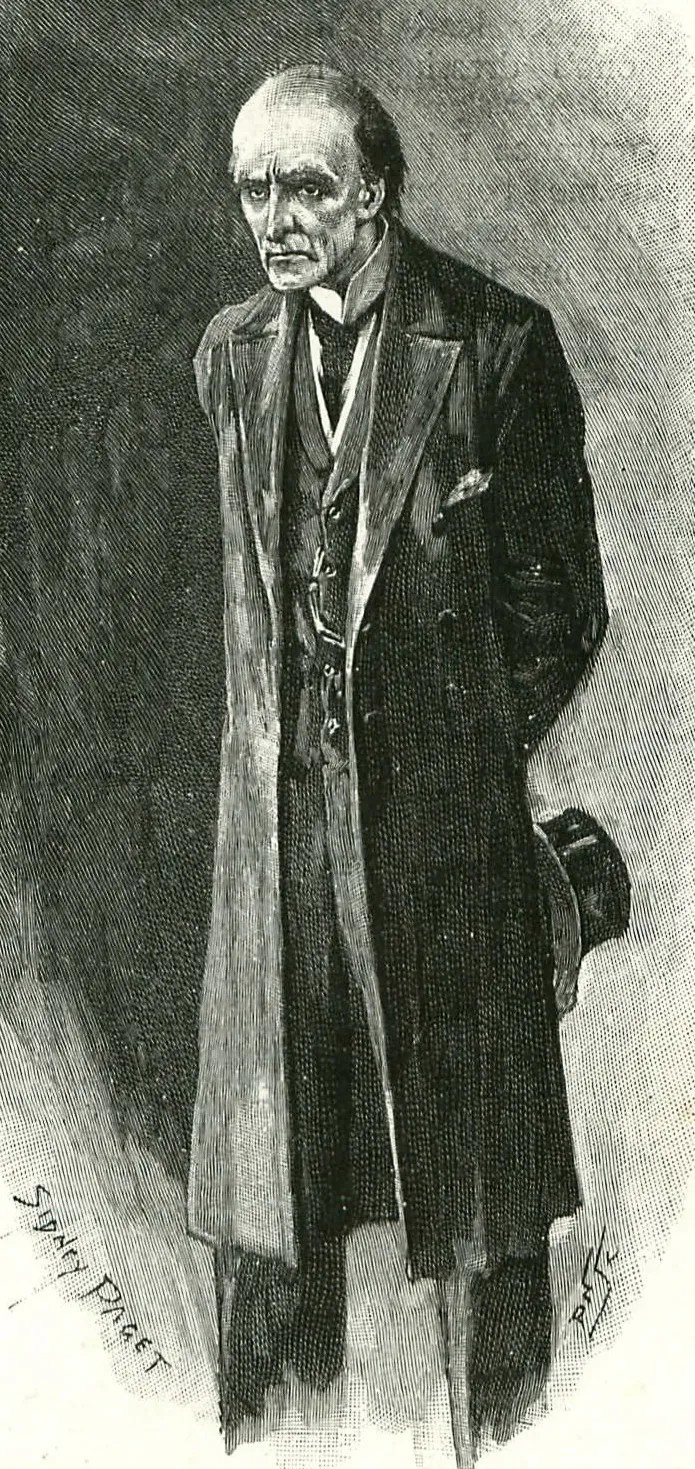
Professor Moriarty first appears in Arthur Conan Doyle’s The Final Problem (1893). His mathematical genius, hidden criminal network and rivalry with Holmes come from Doyle’s stories. Read The Memoirs of Sherlock Holmes, which includes The Final Problem. The original Sidney Paget illustration of Moriarty (1893; public domain) is also retained as a literary reference.
Keep this reference growing
If this page helped with your reading or game, you can support its upkeep or explore the curated books.
Explore the Bookshop — epics, classics and stories behind imagined worlds.