
Paris — Bridges, Markets and Hidden Courts
Paris
Capital of France · Seine bridges, markets and royal courts
At a Glance
| Realm | Kingdom of France |
|---|---|
| Ruler | Charles VII and his royal officials |
| City | Seine bridges, island courts, Left Bank schools, Right Bank markets |
| Commerce | River trade, cloth, grain, craft guilds and learning |
| Arriving from England | London via Dover and the Channel |

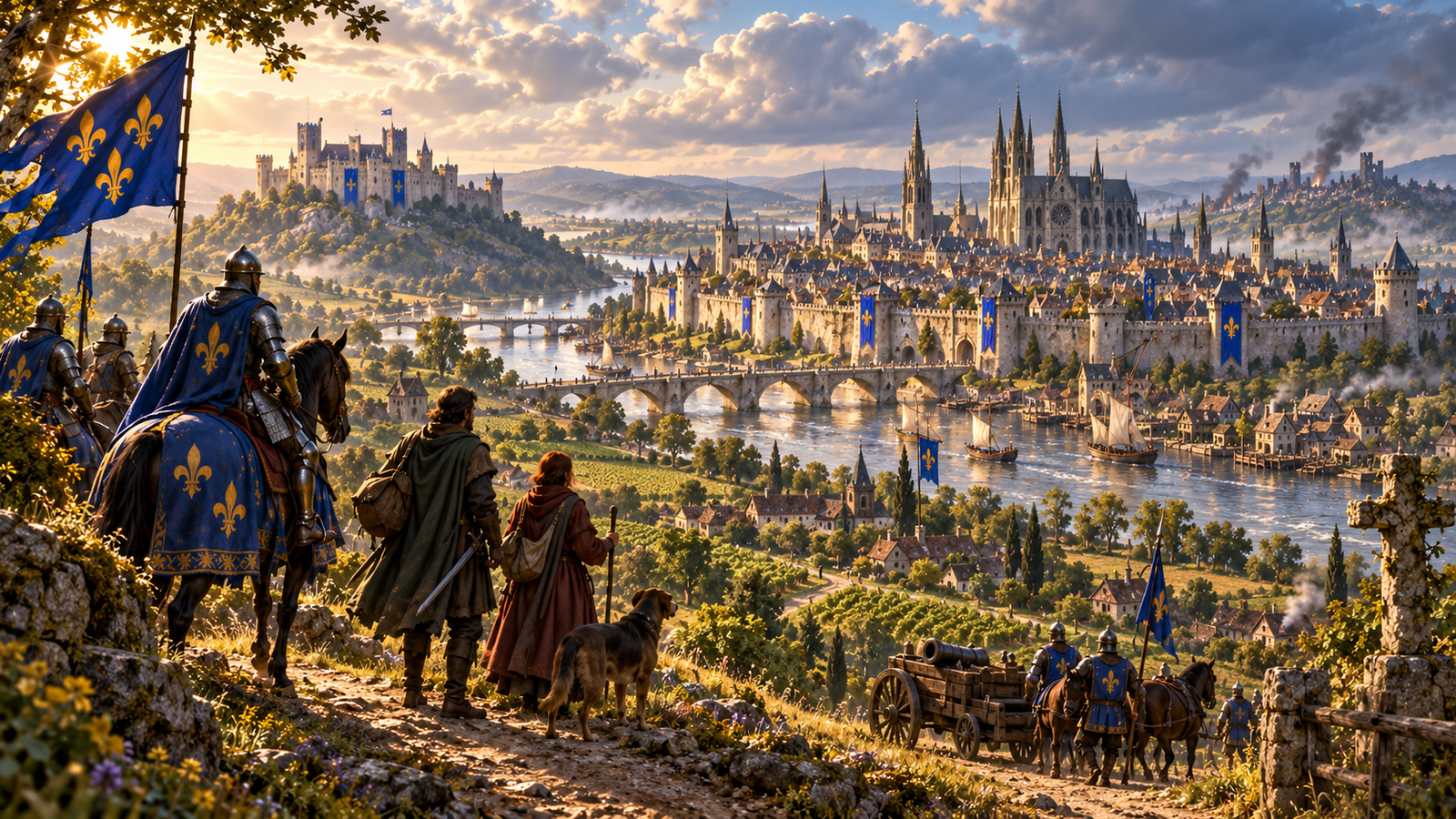
The first thing a traveller hears is water: poles knocking against boats on the Seine, the creak of a timber crane and the calls of sellers passing baskets over the heads of a crowd. Above the river stand crooked roofs, towers and narrow bridges busy with people. Paris belongs to the king, but most of what makes the city live happens in its kitchens, workshops, markets, sacred precincts and streets.
What Is Happening Right Now?
Two messengers have vanished between the crowded streets around Les Halles and the hidden Court of Miracles. The one who has come back knows the recognition sign but cannot remember the name of the woman who taught it to him. Clopin Trouillefou has stopped using his usual runners. He wants people from outside the Court to learn who is wearing his people’s faces.
At the same time, a boat carrying grain has come loose at the upstream landing, and the market bakers are already arguing over which stalls will go hungry. Esmeralda performed near the river yesterday; today somebody is paying strangers to report where she and her white goat Djali appear. The missing grain is a public problem. The missing runners are not. A useful visitor can take either job, but moving around the city may entangle the two.
Five Places Worth Crossing Paris For
Les Halles — the market before sunrise
Wagons arrive in the dark with grain, cheeses, fish, cloth and barrels. Porters carry a hundred competing smells along the tight lanes: cut onions, hot bread, blood from the butcher’s blocks and damp straw. This is the place to buy supplies and hear news from other regions before the crowd swallows the speaker. A baker who cannot obtain grain may be willing to hire guards for his next delivery.
The Seine bridges and Île de la Cité
The river is a working road. Bargemen, fishers, boat repairs and river stairs matter as much as the stone bridges. The island holds courts and a great polytheistic sacred precinct. Crowds emerge from its doors, traders wait at the approaches and couriers cross between the banks; an armed rider can take longer than a porter on foot when the traffic jams.
The great sacred precinct and its bells
Stone towers and bells rise over the island. In the city’s living fantasy, the precinct serves the gods rather than an Abrahamic hierarchy. Quasimodo knows the upper stairs and the view over the roofs better than most guards know their own streets. A frightened child who has vanished into the towers is safer with someone who understands him than with a crowd bent on shouting him down. The precinct’s own location entry needs its legacy religious language brought into line with this setting.
The Left Bank schools and Rue de la Huchette
Students in ink-stained sleeves haggle over borrowed books, argue under the eaves and keep landlords awake. The narrow streets behind the river contain inexpensive rooms and noisy eating houses. A hired translator, a scrivener or a tutor can be found here, but a travelling scholar who has sold the same translation twice may be hiding from both patrons.
The Louvre and the western approaches
The Louvre is a royal fortress and residence, not a public gallery. Its walls, storehouses and servants draw craftsmen, visitors and soldiers into a different Paris from the market. A traveller seeking the court needs an introduction; a traveller seeking a carpenter, harness repair or food should not wait at the palace gate.
Where to Eat, Sleep and Find Help
The Eel and Lantern — near the Right Bank river stairs
Moderate, busy, respectable. Host Mathilde Sorrel keeps three small chambers, a common sleeping loft and hot eel stew with rye bread. She has a lockable corner for merchant samples, though her yard is too tight for more than two horses. Boatmen and travelling factors exchange river news over supper. Mathilde’s nephew has not returned from the grain barge, and she knows the last landing where he was seen.
The Crooked Ladle — Rue de la Huchette
Cheap, lively, little privacy. Keeper Perron Vinet serves onion broth, coarse bread, wine by the cup and straw sleeping spaces behind a curtain. He has no safe stabling: the nearest yard belongs to another house. Performers, students and apprentices share benches here. Somebody has been rehearsing Court of Miracles signs in his back room, and Perron is frightened of what will happen if he identifies the visitor.
Other practical help
At Les Halles buy fresh provisions while the stalls are open. Along the quays hire a boatman for short river work, but agree on the landing and price first. A smith can repair harness, a barber-surgeon can treat an injury and college scribes will copy ordinary letters. A genuine spellcaster requires introductions and payment; there is no shop promising every magic item in a window.
People Who Can Change Your Visit
Esmeralda and Djali: a young dancer and her clever white goat, watched more closely than either deserves. She can recognise the regular street performers and may see who is following her. Help her escape a threatening watcher and she will show a stranger a safer route through the market. Her trained goat’s clever tricks are not spells.
Clopin Trouillefou: the Court’s formidable leader knows where a person can disappear and what a dangerous favour costs. His authority is real inside the connected hidden courtyards, but his missing runners suggest someone has found a way around it. He wants discreet outsiders and will remember whether they endanger the people he protects.
Quasimodo: the bell keeper knows the towers and small sounds above the city. He has little reason to trust a crowd that mocks him. Quiet, practical kindness opens doors that official orders cannot.
Mathilde Sorrel: the Eel and Lantern’s host wants her nephew found alive. She has contacts among rivermen, not at the palace. A boatman’s word to her carries more weight than a royal seal.
These are the people immediately useful to this district of the living setting. The wider French NPC collection contains additional figures whose histories and appearances need to be reconciled with each adventure.
Under the City’s Ordinary Faces
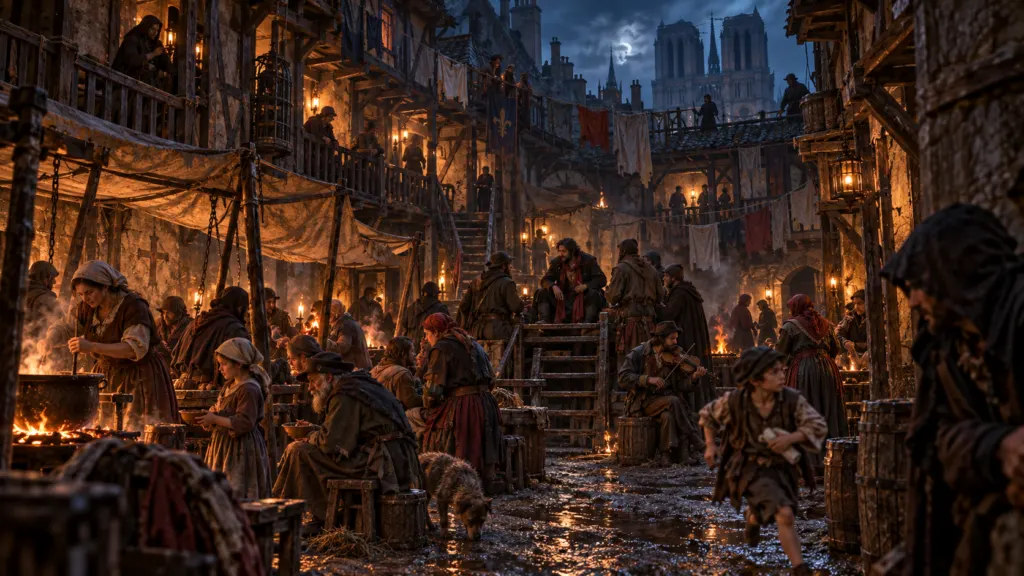
Not every danger in Paris carries a knife or wears a soldier’s badge. The Court of Miracles is a lived-in settlement of performers, workers, beggars, fugitives and criminals; it is not one enormous gang of interchangeable enemies. Families eat and sleep there. Someone has learned its signs, and a real doppelganger can borrow a human appearance well enough to make a familiar face untrustworthy.
The creature has been seen leaving an alley near Les Halles wearing the likeness of a missing runner. Clopin’s informants have heard two contradictory accounts of the same person crossing the river at different times. That is evidence to investigate, not a new rule that mirrors or bells magically expose shapechangers. The visitor may question witnesses, follow the market deliveries and discover what the impostor is collecting before it steals another identity.
Divine power is real at the city’s sacred precincts, and city wards have limits. Neither a blessing nor a wealthy patron makes the people of the lower streets vanish. The dangerous question is not just how to defeat an impostor, but who will shelter the real person once they are found.
Three Adventures That Begin on Arrival
- The Wrong Runner: Clopin offers safe lodging in exchange for finding a missing messenger. The party discovers a duplicate face at the market. Killing the apparent culprit in public may kill an innocent before anyone can prove which witness saw the true runner; patient investigation might save both the missing person and the Court’s secrecy.
- The Grain on the Water: A damaged grain vessel is drifting towards a bridge while the bakers’ apprentices are scrambling along its bank. The party can hire a boat, persuade a rival crew to help, or rescue trapped people from the river. A merchant wants his sacks saved before the sailors; Mathilde’s nephew may be aboard.
- The Bell Keeper’s Warning: Quasimodo has watched the same traveller visit the towers by two different routes, each time claiming a different name. He asks the party to escort a frightened apprentice down the stairs unnoticed. On the ground, guards hunting Esmeralda are questioning everyone who emerged from the sacred precinct.
These troubles overlap in the streets. A stolen face near Les Halles may lead towards Clopin’s missing runners, while the stranded grain boat draws witnesses out of their homes.
More people in the Paris and French NPC archives
These entries belong to the wider convergent fantasy setting; not every figure must be in this market on the same day.
Angelica, René d’Aramis de Vannes “Aramis”, Astolfo, Athos, Bradamante, Louis Dominique Bourguignon “Cartouche”, Charles de Batz-Castelmore d’Artagnan, Comte de Rochefort, Cosette (“the Lark”), Esmeralda, Claude Frollo, Joannes Frollo “jolly”, Pierre Gringoire, Andre-Louis Moreau, Nostradamus, Leonora Dori, Milady de Winter, Captain Phoebus de Chateaupers, Porthos, Quasimodo, Roland/Orlando, Ruggiero, Clopin Trouillefou, King of the Court of Miracles, Monsieur Thénardier and Madame Thénardier (the Jondrettes)
The Road from London to Paris
Visit every stop: London → Rochester → Canterbury → Dover → Calais → Boulogne → Montreuil → Abbeville → Amiens → Beauvais → Paris.
Travellers from London normally come through Rochester, Canterbury and Dover before making the Channel crossing. Calais is still an English garrison and commercial harbour, not a French royal town. From there, road stages through Boulogne, Montreuil, Abbeville, Amiens and Beauvais can bring a caravan or mounted traveller towards Paris. Wissant offers an older alternative landing when the master and weather favour it.
Crossing into France is not the end of border checks. The Somme towns lie under Burgundian rule in this political settlement; beyond them the roads lead into the French king’s lands. Merchants should obtain safe-conduct and declare their goods, while messengers learn whose seals will be honoured at the next gate.
The road runs in both directions: return to London or enter the Kingdom of France from Paris. For a traveller, the immediate questions are which vessel is sailing, what the road is like after rain and whom the next official serves.
Deeper History: A City Built on a River
Paris has grown around the Seine for centuries. Trade along its banks feeds the Right Bank markets; the river island remains a centre of ceremony and royal justice, while the Left Bank has colleges, teachers and students. The great medieval market at Les Halles developed from an earlier market transferred towards the Champeaux in the twelfth century. Its crowds make it a good place to buy almost anything a traveller can carry, but not to leave horses unattended.
Charles VII rules the French kingdom, yet the streets do not resemble a modern capital. The fortified Louvre stands at the western edge of the older city; the Bastille guards its eastern approaches. The later Versailles palace, Palais-Cardinal, Moulin Rouge and Grand Guignol have no buildings in the current medieval city. The great sacred precinct on the river island is polytheistic in this world. Its dependent character pages may still contain older terminology awaiting repair.
Paris on the Map
This map marks modern Paris and its river. It helps locate the Seine, the island and major approaches; it does not reconstruct medieval walls, the Court of Miracles or the boundaries of the sacred precinct.
Sources and More of Paris
The historical setting uses Archives de Paris: the medieval origins of Les Halles, the Historical Atlas of Paris: the Halles district and material about the medieval Paris markets. The inns and immediate adventure situations on this page are campaign material, not claims about historically documented businesses.
Explore the Court of Miracles, the sacred island precinct, the Bastille and the French NPC directory. Travellers leaving Paris by the northern road can return through Beauvais to Amiens.
Keep this reference growing
If this page helped with your reading or game, you can support its upkeep or explore the curated books.
Explore the Bookshop — epics, classics and stories behind imagined worlds.