
Charles Hitchen — Corrupt Marshal’s Deputy
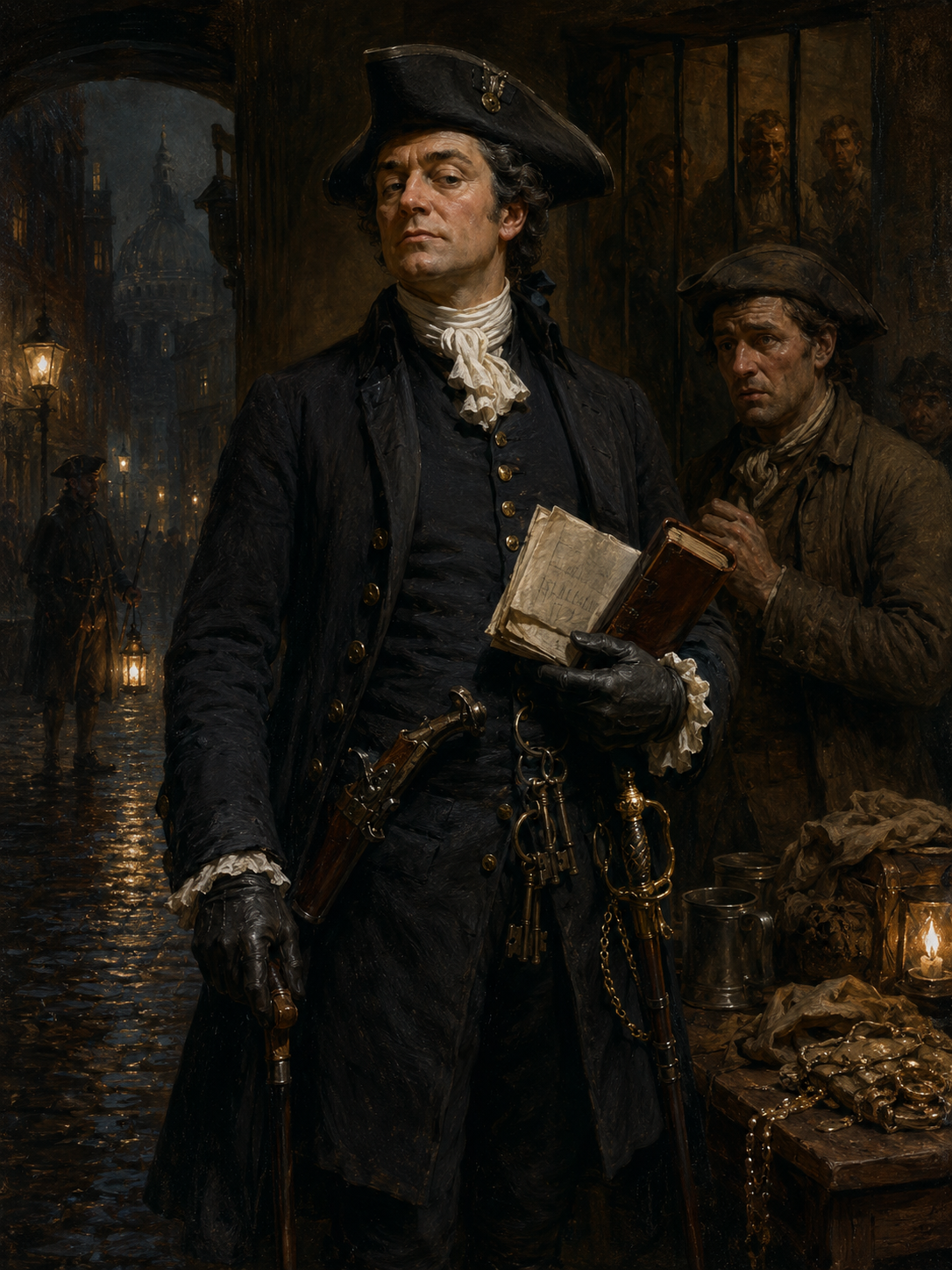
Charles Hitchen wears authority like armour. He can order a door opened, summon a constable, inspect a prisoner or ask awkward questions without immediately looking like a criminal. That appearance of legitimacy is the foundation of his real business: selling protection to thieves, charging victims for the return of their own property and turning information gathered through office into private profit.
Hitchen is not the most powerful man in London’s underworld, but he is one of the most dangerous to cross because he can make private enemies look like public suspects. Adventurers may meet him as an investigator, an official obstacle, an intermediary offering a “practical solution” or the man quietly ensuring that the wrong door is searched at exactly the right time.
At a Glance
- Name: Charles Hitchen
- Species: Human
- Age: Mid-forties
- Base: London
- Role: Marshal’s deputy, finder of stolen goods, corrupt investigator and underworld broker
- Alignment: Lawful Evil
- Campaign status: Alive and active
- Campaign use: Corrupt official, false ally, investigation target, blackmailer or rival information broker
Game Statistics
5.5e / 2024
Charles Hitchen
Medium Humanoid (Human), Lawful Evil
Armor Class 16 (brigandine)
Hit Points 71 (11d8 + 22)
Speed 30 ft.
| STR | DEX | CON | INT | WIS | CHA |
|---|---|---|---|---|---|
| 13 (+1) | 15 (+2) | 15 (+2) | 16 (+3) | 14 (+2) | 18 (+4) |
Saving Throws Wis +5, Cha +7
Skills Deception +10, Insight +8, Investigation +9, Intimidation +7, Persuasion +7
Senses passive Perception 12
Languages English, French, thieves’ cant
Challenge 5 (1,800 XP; PB +3)
Traits
Official Leverage. Hitchen has Advantage on Charisma (Intimidation) and Charisma (Persuasion) checks against ordinary criminals, prisoners, fences and city residents who reasonably believe he can arrange an arrest, search or official enquiry.
Stolen-Goods Network. Hitchen has Advantage on Intelligence (Investigation) checks made in London to locate stolen property, identify a fence or determine who usually handles a particular kind of contraband.
Plausible Procedure. The first time each day a creature succeeds on an Insight check against Hitchen’s Deception, Hitchen can force it to reroll. The second result stands. This represents his ability to bury a lie inside genuine procedure, paperwork and half-truths.
Actions
Multiattack. Hitchen makes two attacks with his Sword-Cane Blade or Dagger.
Sword-Cane Blade. Melee Attack Roll: +5, reach 5 ft. Hit: 6 (1d8 + 2) Piercing damage.
Dagger. Melee or Ranged Attack Roll: +5, reach 5 ft. or range 20/60 ft. Hit: 4 (1d4 + 2) Piercing damage.
Produce a Warrant (Recharge 5–6). Hitchen presents, cites or invents an official basis for detention. One creature within 30 feet that can hear and understand him must succeed on a DC 15 Wisdom saving throw or hesitate until the end of its next turn. While hesitating, its Speed is halved and it cannot take Reactions. A creature that knows the warrant is false has Advantage on the save.
Order the Seizure (1/Day). Up to three allied guards, constables or hired toughs within 60 feet can each move up to half their Speed and attempt to Grapple one creature they can reach.
Reactions
Shift the Blame. When Hitchen is targeted by an ability check or accusation based on evidence another creature could plausibly have created, he gains +3 to the relevant Deception check.
Charles Hitchen — 5e / 2014
Medium humanoid (human), lawful evil
Armor Class 16 (brigandine); Hit Points 71 (11d8 + 22); Speed 30 ft.; Challenge 3 (700 XP; proficiency bonus +2, personal combat only).
STR 13 (+1), DEX 15 (+2), CON 15 (+2), INT 16 (+3), WIS 14 (+2), CHA 18 (+4).
Saving Throws Wis +4, Cha +6; Skills Deception +8 (expertise), Insight +6 (expertise), Investigation +7 (expertise), Intimidation +6, Persuasion +6; Senses passive Perception 12; Languages English, French, thieves’ cant.
Traits
Official Leverage. Hitchen has advantage on Charisma checks to demand information from residents who reasonably believe that his official commission permits him to arrest or search them.
Stolen-Goods Network. Hitchen has advantage on Intelligence (Investigation) checks to track fences and stolen goods in districts where he has established informants.
Plausible Procedure (1/Day). When a creature succeeds on Wisdom (Insight) against his Charisma (Deception), Hitchen can force a reroll. The second result stands. This trait doesn’t forge evidence or remove witnesses.
Actions
Multiattack. Hitchen makes two rapier or dagger attacks.
Rapier. Melee Weapon Attack: +4 to hit, reach 5 ft., one target. Hit: 6 (1d8 + 2) piercing damage.
Dagger. Melee or Ranged Weapon Attack: +4 to hit, reach 5 ft. or range 20/60 ft., one target. Hit: 4 (1d4 + 2) piercing damage.
Produce a Warrant (Recharge 5–6). One creature within 30 feet that can understand and hear Hitchen makes a DC 14 Wisdom saving throw or has its speed halved and cannot take reactions until the end of its next turn. A creature holding proof the warrant is invalid has advantage on the save.
Order the Seizure (1/Day). Up to three willing allied officers within 60 feet may each use a reaction to move up to half their speeds and attempt to grapple an adjacent creature, resolving all checks normally.
Original 2014 encounter conversion. Official status and accomplices are separate resources, not counted as intrinsic combat challenge.
Pathfinder 1e
Charles Hitchen CR 5; human rogue 4/expert 3; LE Medium humanoid.
AC 19, touch 13, flat-footed 16; hp 52; Fort +4, Ref +8, Will +7.
Melee mwk rapier +8 (1d6+1/18–20) or dagger +8 (1d4+1/19–20); Special Attacks sneak attack +2d6.
Str 13, Dex 16, Con 14, Int 16, Wis 14, Cha 18. Feats Deceitful, Persuasive, Skill Focus (Bluff), Skill Focus (Knowledge [local]). Skills Bluff +17, Diplomacy +15, Intimidate +13, Knowledge (local) +16, Perception +12, Sense Motive +14, Sleight of Hand +10.
Colour of Office (Ex). Hitchen gains a +2 circumstance bonus on Bluff, Diplomacy and Intimidate checks when he can plausibly claim to be acting under civic or marshal authority.
D&D 3.5e
Charles Hitchen CR 5; human rogue 4/expert 3; LE Medium humanoid.
AC 18; hp 47; Fort +4, Ref +8, Will +7; Melee masterwork rapier +8 (1d6+1/18–20); sneak attack +2d6.
Abilities Str 13, Dex 16, Con 14, Int 16, Wis 14, Cha 18. Feats Deceitful, Negotiator, Persuasive, Skill Focus (Gather Information). Skills Bluff +17, Diplomacy +15, Gather Information +17, Intimidate +13, Knowledge (local) +16, Listen +11, Sense Motive +14, Spot +11.
What Is Charles Hitchen Doing Right Now?
Hitchen has begun seizing low-level thieves connected to a market in stolen seals, signets and official scraps. Publicly, he claims to be dismantling a forgery ring. Privately, he is searching for the buyer before Jonathan Wild finds them first.
Several of the prisoners know almost nothing. Hitchen does not care. Their arrests allow him to raid rooms, pressure families and demand payment for leniency. One prisoner, however, really did carry a wax impression taken from a noble household. If that prisoner vanishes, the entire investigation changes.
Encounters
Hitchen speaks in the language of inconvenience. He rarely threatens someone directly when he can instead explain how unfortunate it would be if a search, detention, tax question or property dispute became official. He likes rooms with witnesses because witnesses make extortion look like administration.
He is careful around adventurers who carry recognised warrants, noble patronage or obvious military authority. Against people with no institutional protection, he becomes much bolder.
Personality
Greedy, disciplined and smugly practical, Hitchen believes corruption is simply the fee charged by men who understand how the city actually works. He is offended by accusations of dishonesty, not because they are false but because he considers himself more useful than honest men.
He fears public humiliation more than prison. If forced to choose between money and reputation, he will sacrifice money first and arrange revenge later.
Relationships
Jonathan Wild: rival and occasional partner. Each believes the other is a useful criminal pretending to be something more respectable.
Jenny Diver: Hitchen has tried to recruit her as an informant. She treats every such offer as evidence he is frightened of her.
Fagin: a source of street intelligence Hitchen would happily destroy if doing so were profitable.
City officers: some despise him, some use him and some owe him favours they regret.
Equipment and Resources
- Brigandine worn beneath respectable outer clothing
- Rapier or narrow thrusting sword and dagger
- Official seals, copied orders and blank forms
- Reward notices and lists of wanted criminals
- Informant notes concealed inside legitimate case records
- Cash for bribes and payments to constables
- Access to holding rooms, search parties and city officers when his authority is accepted
Adventure Hooks
- The Paid Search: Hitchen offers to “discover” stolen property for a fee. The party knows he has already found it.
- The Prisoner Who Matters: among six petty thieves Hitchen has arrested, one unknowingly carries evidence of a forged warrant network.
- Competing Authority: Hitchen attempts to search the party’s lodging using an order whose wording is technically valid but whose purpose is not.
- The Honest Officer: a city constable asks the party to prove Hitchen is taking payments without exposing every informant in the district.
- Wild’s Offer: Jonathan Wild will provide evidence against Hitchen—but only if the party leaves one of Wild’s own operations untouched.
Connected Places and People
Mythical and Historical Context
Campaign chronology: The historical Charles Hitchen (circa 1675–1727) became a London under-marshal and controversial thief-taker in the early eighteenth century. The corrupt city officer here is a fictional fifteenth-century counterpart, not the documented official. His public office, dealings with stolen goods and rivalry with Jonathan Wild inform the story, but his warrants, street organisation and encounters are original 1454 fiction. See the historical overview of Hitchen and the history of thief-taking.
Charles Hitchen was a London under-marshal and thief-taker whose historical reputation became closely associated with corruption, stolen goods and the blurred line between law enforcement and organised crime. This version translates that role into the civic and household structures of fifteenth-century London.
Rules Notes
The game statistics and campaign relationships on this page are original adaptations designed for play in the stated rules editions.
Keep this reference growing
If this page helped with your reading or game, you can support its upkeep or explore the curated books.
Explore the Bookshop — epics, classics and stories behind imagined worlds.