
Tower of London — Fortress of the Crown

London · Royal fortress · Palace · Prison · Mint · Armoury · Menagerie
At a Glance
| Realm | Kingdom of England |
|---|---|
| Location | North bank of the Thames at the eastern edge of London |
| Functions | Royal fortress, palace, prison, treasury, armoury, Mint and menagerie |
| Key structures | White Tower, inner and outer wards, Wakefield Tower, river gate, Mint workshops and the Lion Tower |
| Best for | State intrigue, secure prisoners, counterfeit coin, royal treasure, secret passages, dangerous custody and supernatural investigations |
| Supernatural | Gruffudd’s ghost, location-bound haunts, the crownless omen, the phantom bear and black dogs |
| Current pressure | Political uncertainty makes control of coin, arms, records, prisoners and gates exceptionally important |
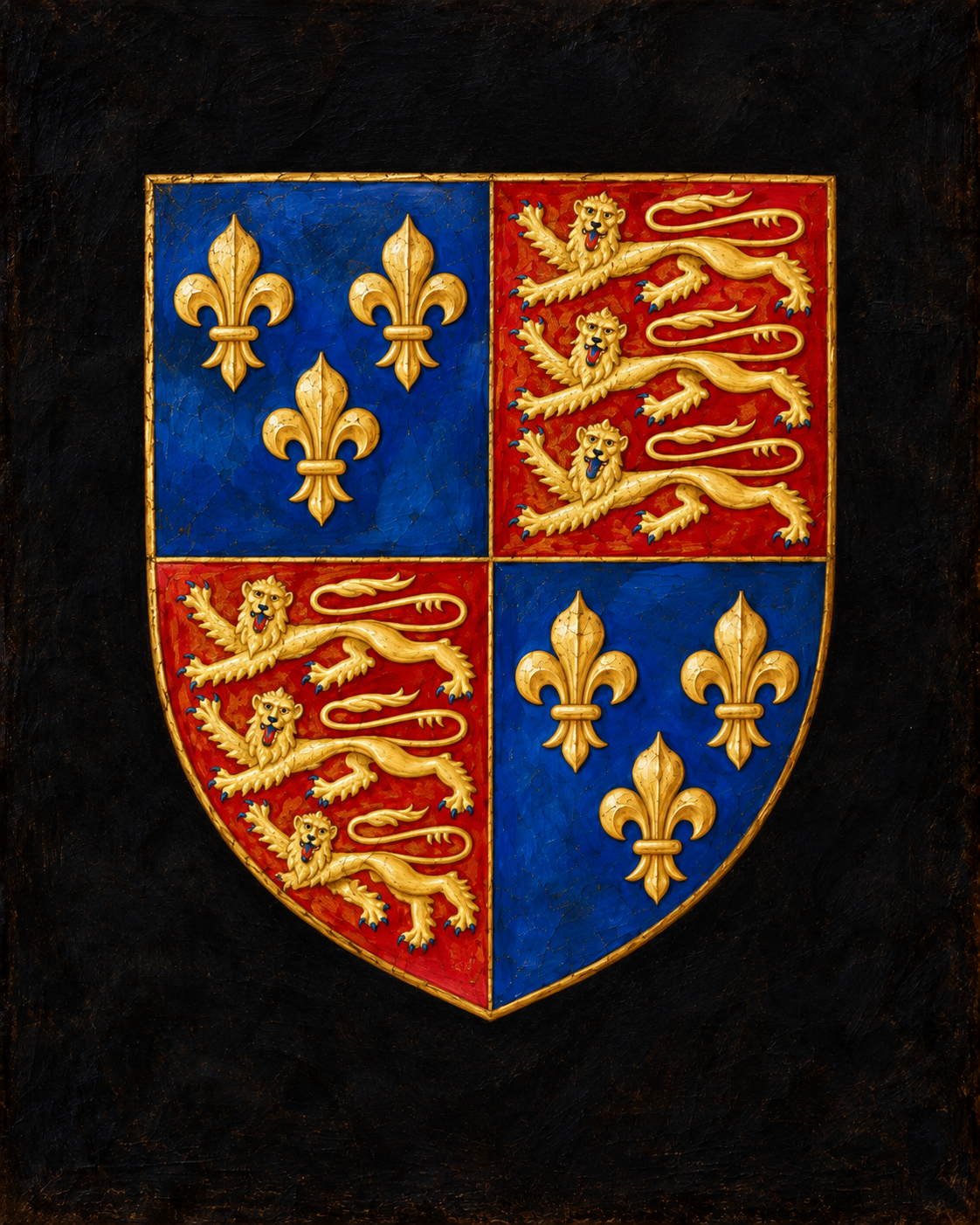
The Tower of London is the hardest concentration of royal authority in the capital. Its walls contain far more than prisoners. Coin is struck here, weapons are stored here, royal treasure can be secured here, dangerous captives are held here and exotic beasts are kept within the same defensive complex. A crisis elsewhere in England becomes immediate at the Tower because so many instruments of government are already behind its gates.
What Is Happening Right Now?
Henry VI remains king while Richard, Duke of York, serves as Protector. The Tower has not become a battlefield, but uncertainty makes its everyday functions more dangerous. Whoever controls access to armour, coin, secure chambers and prisoners possesses leverage that reaches far beyond London.
Royal officers are therefore suspicious of irregular orders. A sealed instruction that would be routine in a peaceful year may now be checked twice. A noble arriving with an armed retinue can trigger a gate closure simply because nobody wishes to be the officer who admitted the wrong men.
The Mint continues striking the realm’s coin inside the walls. The menagerie still draws attention from visitors and courtiers. Prisoners range from common offenders to people whose captivity has diplomatic or political value. The Tower is busy precisely because it is feared.
Run the Tower Tonight
The Counterfeit Die
A coin die disappears from a locked Mint workshop. The guards seal the ward before anyone can leave, but newly struck false coins are already being spent across London. Someone has either found another exit or another Mint.
The Empty Cage
A royal beast vanishes from a secured enclosure without breaking the gate. Its keeper swears the animal was asleep at dusk. Claw marks lead toward a wall and stop at solid stone.
The Prisoner Who Was Never Booked
A guarded chamber contains a man whom no officer admits receiving. He knows the names of three royal councillors, carries no weapon and insists he was brought into the Tower through a Roman gate beneath the outer ward.
The Rope at Midnight
A sentry beneath the White Tower hears cloth scraping stone and watches a knotted rope descend from an empty window. The rope vanishes at dawn, but anyone who climbs it reaches a chamber that should not connect to the stair they used. The guards blame Gruffudd’s haunt; the prisoner found waiting inside says the rope was meant for him.
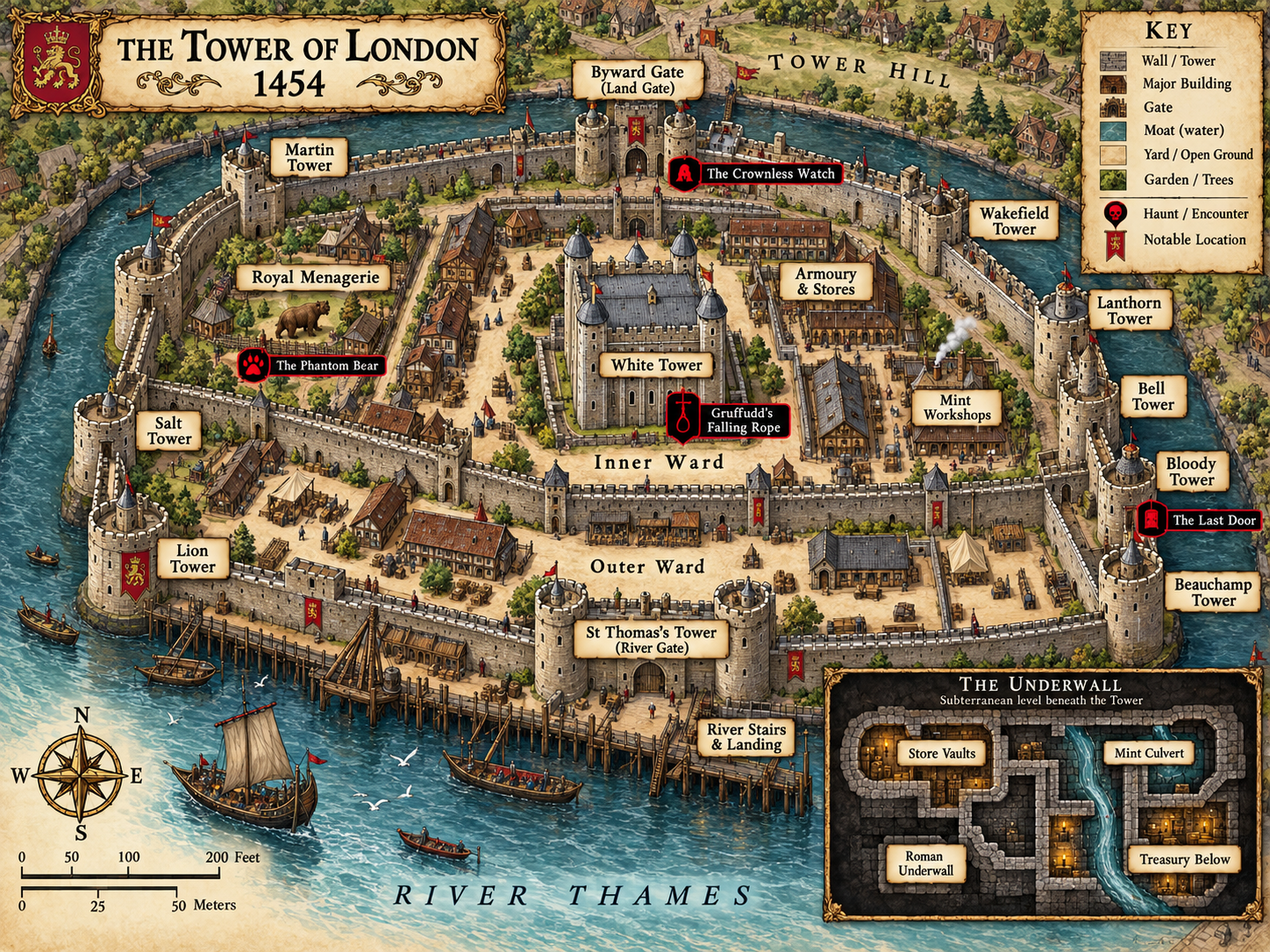
Map of the Tower
Fortress, Palace and Prison
The White Tower remains the visual heart of the fortress, but the medieval complex around it is just as important. Concentric walls, towers, gates and the moat create successive layers of control. The inner ward protects the most sensitive buildings; the outer defences separate the fortress from the city and river approaches.
The Tower was not built primarily as a prison, yet it is ideal for high-value captives. Wealth and rank do not necessarily mean a bare cell: important prisoners can be lodged according to status while still remaining completely under guard. Release may come through ransom, political settlement or royal decision rather than escape.
That makes custody a political weapon. Keeping a noble alive but inaccessible can be more useful than killing him. A prisoner who receives the wrong visitor can alter alliances outside the walls without ever leaving the fortress.
The Mint
Most English coin is produced inside the Tower’s protection. Furnaces, dies, precious metal, scales and skilled workers occupy a tightly controlled world where theft and counterfeiting threaten the authority of the Crown itself.
Mint workers are watched because tiny losses become fortunes when repeated. Metal enters by weight and finished coin leaves by count. A clerk who alters a ledger can steal without touching silver; a die cutter can create treason with a piece of hardened steel.
Magic makes the problem worse. Illusion, transmutation and shapechanging are treated as threats to monetary security even when no crime has yet occurred. Mint officers therefore value reliable detection, trusted witnesses and secure assay rooms.
The Royal Menagerie
Wild beasts have been kept at the Tower since the reign of Henry III. Lions are the most famous occupants, but earlier kings also received a great white bear and an elephant as royal gifts. By the present day the menagerie is an old institution rather than a novelty.
The animals create practical dangers inside a fortress already full of guards and prisoners. Feed must enter, cages must be repaired and keepers need access at awkward hours. A frightened beast can turn a security alarm into chaos; a shapechanger hiding among animals could move surprisingly close to a royal gate.
Dungeon: The Underwall
The Tower is itself a dungeon above ground, but its most dangerous unexplored route lies beneath the working fortress. No adventurer can descend without entering a place controlled by royal officers, guards and locked schedules.
The Store Vaults
Below the outer ward are secure stores for arms, supplies and confiscated property. One chamber has a floor that rings hollow beneath heavy barrels. Removing them exposes a stone trapdoor that does not appear on current inventories.
The Mint Culvert
The trapdoor opens beside a narrow drainage channel running under the workshops. Silver filings glitter in the silt. Someone has widened the culvert recently, creating a crawlspace large enough to move small packets beneath the guard posts.
The Roman Underwall
Farther east, the passage meets massive masonry older than the Norman fortress. The buried wall belongs to Roman Londinium and contains a blocked opening filled with reused stone. Scratched into the mortar are names from several centuries, none written by the same hand.
The Treasury Below
Behind the Roman opening lies a chamber whose bronze-bound chests bear royal seals from reigns that never existed. Each contains coins stamped with a different king’s face. Taking one coin causes a second version of the Tower to appear in reflections, with different banners flying over the walls.
Anything found below has consequences above. A smuggling route threatens the Mint. A hidden gate compromises the fortress. Impossible royal coin can become evidence in a succession conspiracy. The Tower’s dungeon is dangerous because every secret beneath it is a weapon against the living state above.
Creatures Within the Walls
Mimics
Mimics occasionally infest long-sealed stores, adopting the forms of chests, doors and discarded furniture. The Tower treats them as a security problem rather than a curiosity: a false strongbox beside real treasure is dangerous even before it attacks.
Black Dogs
Black dogs are sometimes reported on the roads around Tower Hill after executions or political deaths. Guards distinguish ordinary strays from supernatural hounds by one simple sign: the latter leave no reflection in standing water.
Hauntings & Restless Dead
The Tower is old enough for memory to have become dangerous. Guards know that not every footstep belongs to a living prisoner and not every shape moving between the towers is flesh. These manifestations are treated as security hazards: a frightened sentry can open the wrong door just as surely as a bribed one.
Gruffudd ap Llywelyn — The Fallen Prince
The strongest named haunting clings to the White Tower. Gruffudd ap Llywelyn, Welsh prince and prisoner of Henry III, died here in 1244 while attempting to escape. He twisted sheets and clothing into an improvised rope, lowered himself from his window and fell when the rope failed. On certain nights guards hear fabric strain against stone above them, followed by a sudden snap and the impact of a body where nobody is found.
Gruffudd can manifest as an actual ghost, but the place of his death has also produced a recurring haunt: a supernatural event bound to the location rather than a spirit that can simply be fought.
Haunt: The Falling Rope
| Haunt type | Chained haunt — the Falling Rope is bound directly to Gruffudd ap Llywelyn’s ghost. Suppressing the manifestation does not permanently destroy it while Gruffudd remains restless. |
|---|---|
| Secondary traits | Persistent · proximity-triggered · compulsion |
| Rules model | Use Suicide Compulsion (CR 4) for the forced reenactment, modified by the Chained haunt element. |
| Behaviour | Compulsion · repetition of a death · fall hazard |
| Notice | A faint scrape of cloth against stone above, followed by the creak of weight on an unseen rope. |
| Trigger | A prisoner, fugitive or would-be rescuer passes beneath Gruffudd’s old escape route after dark. |
| Manifestation | A rope of knotted cloth appears overhead. One creature hears urgent breathing and sees the wall as Gruffudd saw it on the night of his escape. For a few heartbeats every open door looks barred except the route upward. Anyone who follows the vision risks reliving the fatal fall; anyone who resists hears the impact below and finds fresh blood on otherwise clean stone. |
| Reset | The following night. |
| Permanent Rest | The haunt can be quieted by completing the escape it endlessly attempts: lower a sound rope from the chamber, carry a living prisoner safely to the ground and speak Gruffudd’s name before cutting the rope free. |
Gruffudd’s ghost, when it appears separately from the haunt, does not usually attack anyone who leaves him alone. He becomes dangerous when prevented from reaching a door, stair or window. He repeats the logic of an escape attempt: testing locks, studying patrols and trying routes that no longer exist. Adventurers who follow him may discover forgotten ways through the fortress—or be led over the same fatal drop that killed him.
The Crownless Prince at the Gate
Llywelyn ap Gruffudd, the last native Prince of Wales, was killed in 1282. His severed head was carried to London and displayed at the Tower. The dead prince’s body lies far away, but something of him remains where his enemies exhibited their victory. In rain or river mist a pale head is sometimes seen high above the approach, crowned with ivy and watching those who pass beneath.
The apparition is an omen rather than a wandering corpse. It appears most often when Welsh prisoners enter the fortress, when someone betrays a sworn lord, or when a captive is about to be moved under a false order. Guards dislike speaking of it because the sight has preceded enough political trouble to make even practical men superstitious.
Haunt: The Crownless Watch
| Haunt type | Vaporous haunt — the Crownless Watch forms out of rain and Thames mist as an incorporeal manifestation over the gate. |
|---|---|
| Secondary traits | Proximity-triggered · apparition · omen |
| Rules model | Use Baleful Apparition (CR 6) as the base manifestation, modified by the Vaporous haunt element. At the Tower it reveals betrayal and false authority rather than merely inflicting fear. |
| Behaviour | Apparition · omen · betrayal warning · false-authority revelation |
| Notice | Rain or river mist tastes suddenly of iron; ivy trembles on still stone and a watcher feels observed from above. |
| Trigger | A prisoner is brought through the gate under false authority, a forged order or a deliberate betrayal of sworn protection. |
| Manifestation | The severed head of a crowned man appears above the gate. For a moment seals seem broken, names on warrants blur and every lie spoken about the prisoner’s custody echoes a second time in a different voice. Those willing to look up can often tell which order, escort or witness is false. |
| Reset | At the next turn of the Thames tide. |
| Permanent Rest | The haunt cannot be permanently destroyed while the Tower continues to receive prisoners through treachery. It can be suppressed for a year and a day if a falsely detained captive is publicly released beneath the gate and the false order is burned there. |
The Phantom Bear
The royal menagerie has kept great beasts at the Tower for generations, including the white bear given to Henry III in the thirteenth century. The living animal is long dead, but keepers tell of a huge pale bear seen where no cage stands. It moves without the clatter of chain or claw and can vanish into masonry when cornered.
Haunt type: Free-roaming haunt. Unlike the Tower’s room-bound manifestations, the Phantom Bear can move through the menagerie, wards and passages instead of occupying one fixed location. Its route changes from night to night, although it repeatedly returns to places associated with the royal beasts.
A person who meets the bear alone must decide whether it is merely an animal spirit, a warning attached to the menagerie, or something older wearing the memory of the king’s beast. Dogs refuse to follow its trail. Horses shy from places it has crossed. A witness who approaches rather than fleeing sometimes sees wet paw prints leading toward sealed stone.
Prison Echoes
Not every haunting has a name. Locked chambers can carry whispers from prisoners no clerk remembers. Chains sometimes shift after a cell has been emptied. A guard may hear questioning through a wall and discover that the room beyond has been sealed for decades. These lesser echoes are best treated as specific haunts rather than complete ghosts. A former cell may hold a persistent Cold Spot; a dead prisoner’s shackles can become an Item-bound haunt; a Rapping Spirit may communicate through the masonry; and a Slamming Portal can seal the living inside. Particularly cruel jailers sometimes leave Possessing haunts that attach themselves to a new prisoner rather than remaining in a single chamber.
Haunt: The Last Door
| Haunt type | Spiteful haunt — the prison memory actively resists intruders, strengthening its supernatural interrogation and making its effects harder to resist. |
|---|---|
| Secondary traits | Proximity-triggered · confinement · multi-stage manifestation |
| Rules model | Begin with Slamming Portal (CR 1), followed by Ghastly Whispers (CR 8), with the Spiteful haunt element applied to the supernatural interrogation. |
| Behaviour | Confinement · whispers · phantasm · interrogation · truth test |
| Notice | A key turns in a lock that has no keyhole on the occupied side. Footsteps stop outside, but no shadow crosses beneath the door. |
| Trigger | A lone creature remains inside a former cell after the door is closed. |
| Manifestation | The chamber briefly becomes the remembered prison of someone who never left it. The door cannot be found, the walls seem to draw closer and unseen officials recite charges from different centuries. A victim who answers the voices with lies hears chains tighten; one who gives a true name and a true reason for being in the Tower sees the real door again. |
| Reset | One hour after the chamber is emptied. |
| Permanent Rest | Find the forgotten prisoner’s name in the Tower’s records, mark it openly on the chamber door and carry news of the prisoner’s fate beyond the walls. If the records were deliberately erased, exposing who ordered the erasure also ends the haunt. |
Running the Haunts: not every supernatural event needs an undead creature behind it. Use a haunt when the Tower itself seems to remember what happened there: give it a warning sign, a trigger, a manifestation, a reset and a way to lay it permanently to rest. Gruffudd can reveal an escape route, the crownless prince can foreshadow betrayal, the phantom bear can draw characters toward a sealed passage, and prison echoes can expose a room that the living authorities insist does not exist.
The Thames Gate
The river is the Tower’s fastest road. Barges can move prisoners, treasure, supplies and royal officers without crossing crowded city streets. The same access makes waterside security essential. A forged river pass can bypass half of London’s witnesses.
At night, the Thames also carries stranger traffic. Fog settles against the walls, tides expose foundations and boats can appear silently beneath the river gate. The fortress watches the water as carefully as the road.
Historical and Mythological Context
William the Conqueror began the great stone fortress after the Norman Conquest, and successive kings expanded it into the concentric castle familiar by the later Middle Ages. Historic Royal Palaces records its long use as fortress, royal residence, prison, armoury, treasury, Mint and menagerie.
Edward I moved the Mint inside the Tower around 1279, placing coin production behind royal walls. The menagerie began earlier in the thirteenth century, when Henry III received exotic animals as diplomatic gifts. Neither function is a later embellishment: both are active parts of the medieval fortress.
Historic Royal Palaces — Story of the Tower · Historic Royal Palaces — The Tower Mint · Historic Royal Palaces — Royal Menagerie · Historic Royal Palaces — The Tower as Prison · Historic Royal Palaces — Tower Ghost Stories
Keep this reference growing
If this page helped with your reading or game, you can support its upkeep or explore the curated books.
Explore the Bookshop — epics, classics and stories behind imagined worlds.