
Ebenezer Scrooge — Master of the Counting House
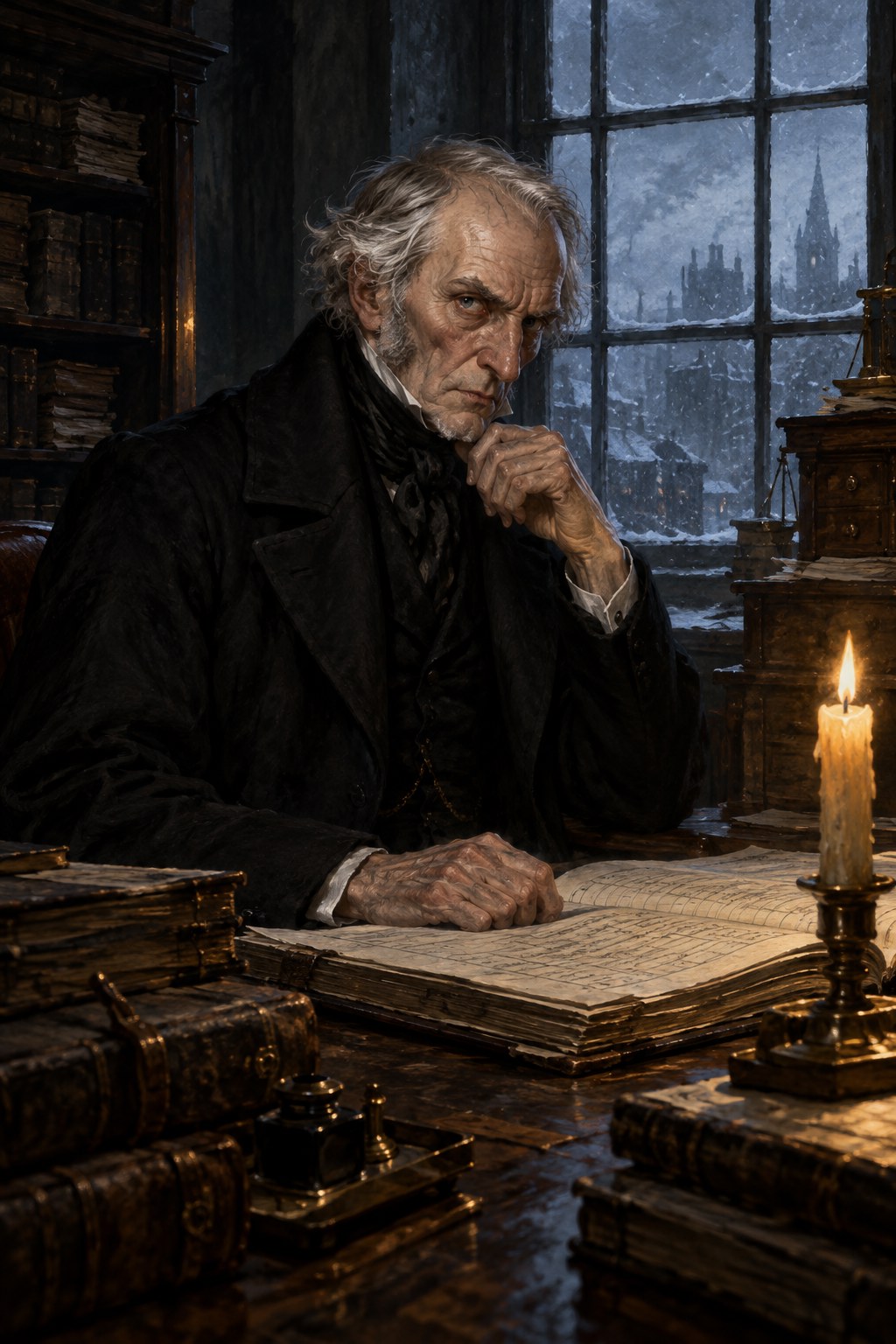
A London wool-and-credit merchant who measures obligation in coin is about to discover that some debts are carried by the living and the dead alike.
Ebenezer Scrooge runs a prosperous counting house that finances cloth shipments, urban property and merchant ventures. He is feared for exact contracts, cold rooms and colder decisions. Yet the supernatural world has taken an interest in him. The ghost of Jacob Marley has begun appearing around Scrooge’s accounts, dragging the symbols of unpaid obligation behind him and warning that the merchant’s ledgers have become a moral trap as real as any curse.
At a Glance
- Role: Merchant-financier, creditor and haunted miser
- Primary region: London
- Status: Alive and active
- Campaign use: Difficult patron, supernatural moral target, merchant-network NPC
- Power: Modest personal threat; considerable economic influence
Game Statistics
5.5e / 2024
Ebenezer Scrooge — CR 3 Medium Humanoid; AC 12; HP 40; Int 17, Wis 15, Cha 12. Skills History +6, Insight +5, Investigation +7, Persuasion +4. Ledger Mind. Advantage on checks involving contracts, debts, prices and account irregularities. Hard Bargain. Once per scene, after a creature makes a Persuasion check against Scrooge, he may force it to reroll unless it offers a concrete concession. Haunted Conscience. Scrooge has disadvantage on saves against supernatural effects created by Marley or spirits specifically confronting his own choices.
Ebenezer Scrooge — 5e / 2014
Medium humanoid (human), lawful neutral
Armor Class 12; Hit Points 40; Speed 30 ft.; Challenge 0 (10 XP; proficiency bonus +2), reflecting his limited personal combat ability.
STR 8 (−1), DEX 12 (+1), CON 12 (+1), INT 17 (+3), WIS 15 (+2), CHA 12 (+1).
Skills History +5, Insight +4, Investigation +7 (expertise), Persuasion +3; Senses passive Perception 12; Languages English, French.
Traits
Ledger Mind. Scrooge has advantage on Intelligence checks relating to contracts, prices, debts, written promises and accounting irregularities.
Hard Bargain (1/Scene). After a creature attempts a Charisma (Persuasion) check to obtain a financial concession from Scrooge, he may make the creature reroll the check and use the second result unless it offers an objectively meaningful concession.
Haunted Conscience. Scrooge has disadvantage on saving throws against the unique supernatural visitations bound to his own broken promises. This does not affect ordinary fear or charm saves.
Actions
Walking Stick. Melee Weapon Attack: +1 to hit, reach 5 ft., one target. Hit: 2 (1d6 − 1) bludgeoning damage.
Demand Payment. Scrooge demands settlement of a legitimate obligation. Resolve the outcome through ordinary conversation and ability checks; this action grants no magical control.
Original 2014 social NPC conversion. Scrooge’s financial influence and haunt encounters must be adjudicated separately from his personal challenge rating.
Pathfinder 1e
Ebenezer Scrooge — CR 4 human expert 6; hp 36; AC 14; Appraise +15, Knowledge (local) +13, Profession (merchant) +16, Sense Motive +12; Skill Focus (Profession [merchant]), Iron Will.
D&D 3.5e
Ebenezer Scrooge — CR 4 human expert 6; hp 31; AC 13; Appraise +14, Knowledge (local) +12, Profession (merchant) +15, Sense Motive +11; Skill Focus (Profession [merchant]), Negotiator.
What Is Ebenezer Scrooge Doing Right Now?
Scrooge has begun hearing chains in rooms where no one stands and finding account pages turned to names he did not open. He believes a rival merchant is trying to frighten him until Marley appears where no mundane intruder could have entered.
At the same time, a winter grain-and-fuel shortage is forcing him to decide whether to enforce contracts that will ruin several debtor households. His decision affects the Cratchit family directly and gives the haunting immediate stakes.
Encounters
- Scrooge hires the party to prove the haunting is fraud and becomes angry when they cannot.
- A ledger vanishes from a locked strongroom and reappears open at one family’s debt.
- Marley speaks to an adventurer because Scrooge refuses to listen to the dead man directly.
- A merchant rival offers to buy Scrooge’s debt contracts cheaply during the panic.
Personality, Appearance and Manner
Sharp, suspicious and emotionally armoured. Scrooge notices waste immediately and sentiment slowly. His humour is dry, his hospitality minimal and his fear of dependency stronger than his greed.
He wears good but severe wool, carries keys and account tablets, and keeps his office warmer only when ink begins to freeze. If transformed by play, he should remain recognisably exacting rather than becoming foolishly generous overnight.
Relationships and Influence
- Jacob Marley: dead former partner whose haunting is both warning and unfinished business.
- Tiny Tim and the Cratchits: a family whose welfare turns abstract wages into visible consequences.
- London merchants: respect his solvency and dislike his inflexibility.
- Debtors: know Scrooge primarily as signatures, deadlines and collectors.
Equipment and Possessions
- Counting-house keys and seals
- Ledgers, tally sticks and contracts
- Strongbox and reserve coin
- Heavy winter cloak and walking stick
- Merchant correspondence and warehouse claims
Using This NPC at the Table
Scrooge should be a social and supernatural pivot, not a combatant. The party can influence him through evidence, relationships, visions and consequences, but simple Persuasion should not erase a lifetime of habits.
Adventure Hooks
- Marley’s Chain: one link bears the seal of a contract Scrooge does not remember signing.
- The Cratchit Debt: a minor account becomes central to the haunting.
- Three Visitors: different spirits demand the party escort Scrooge through three dangerous visions.
- The Bought Ledger: Moriarty or another network wants Scrooge’s records for reasons unrelated to morality.
- A Changed Man: if Scrooge reforms, rivals immediately test whether mercy has made him financially vulnerable.
Related Places and People
Mythical and Historical Context
Ebenezer Scrooge is a fictional merchant from Charles Dickens’s A Christmas Carol (1843), not a documented 1454 moneylender. His counting house has been recast as a medieval debt-and-contract business. Jacob Marley and the supernatural visitors represent bargains, regrets and haunting within this setting, without requiring the nineteenth-century machinery, social institutions or religious observances of the original tale. The original A Christmas Carol establishes his literary origin; debts, adventure hooks and encounter rules here are original.
Sources and Adaptation
Adapted from Charles Dickens’s public-domain character into the fifteenth-century London merchant economy. Victorian offices, technology and Christmas-specific religious framing are removed; the core story remains one of debt, isolation, consequence and supernatural intervention.
Keep this reference growing
If this page helped with your reading or game, you can support its upkeep or explore the curated books.
Explore the Bookshop — epics, classics and stories behind imagined worlds.