
Boulogne-sur-Mer
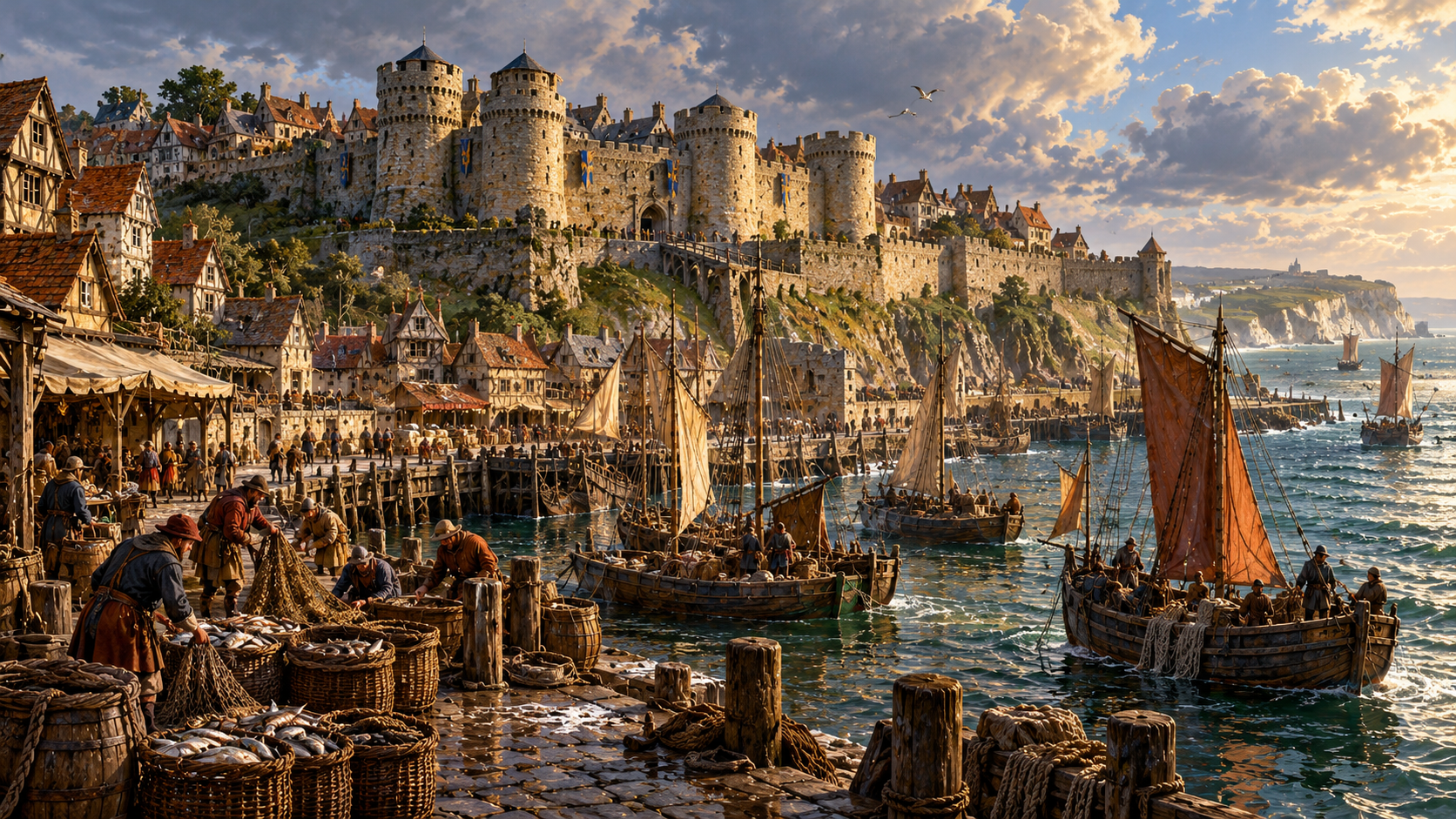
Fishing boats below the walls; a sacred boat stirs before the gale
At a Glance
| Location | Boulogne-sur-Mer, above the Channel harbour |
|---|---|
| Known for | Hilltop count’s castle, fish market, pilgrim shrine and harbour |
| For travellers | Inns, pilots, stabling, shipwrights and coastal provisions |
| Adventure | A strange sacred boat and fishing craft missing at sea |
| Onward road | Calais, Boulogne and Montreuil |
| Authority | County of Boulogne, outside the English Pale |

Boulogne is two towns at once. Below the hill, sailors haul wet nets beside the harbour. Above, the count’s castle and high walls watch a road full of people who have just left English Calais. A safe-conduct that mattered in the Pale may carry little weight at the count’s gates; the Channel wind cares about neither.
What Is Happening Right Now?
A fishing boat has been hauled onto the shingle with its mast splintered, and three sailors swear that a second boat moved against the tide without a crew. No such vessel has entered the harbour. In the upper town the old sacred boat kept beside the goddess’s image is wet with seawater although its storehouse has been locked all night.
The sea blessing is due at dusk. Keeper Alix Montfort wants to inspect the ancient hull before it is carried before the people, but the market fishers are demanding that the blessing go ahead: a gale is coming and their boats cannot remain ashore all week. Harbour captain Aveline Rose has found a boy clinging to driftwood beneath the quay. He carries a copper pilgrim badge impressed with a boat like the one in the sacred precinct.
The port smells of salt fish, tar and drying nets. Above it, the count’s castle is already preparing its watch fires. The party can take the boy to shelter, help the keepers inspect the boat or join a crew trying to secure the fishing fleet before dark.
Places to Explore
Castle of the Counts
Philippe Hurepel set his fortress on the exposed side of the high town in the thirteenth century. Its many-sided curtain wall joins round towers above a moat. It has no central keep: the corner towers and connecting walls defend one another, while two gateways lead towards the town and open country. Beneath the medieval stonework are remains of much older Roman walls. A visitor may find soldiers on the gate, masons working on the weathered parapets, and a guide who knows the hidden older foundations.
The walled upper town
Strong gates control the approaches; shops, dwellings and sacred houses fill the lanes behind them. A heavy wagon cannot necessarily take the same route as a mounted messenger.
The lower harbour
Fish auctions, boat repairs and wet rope dominate the working waterfront. Weatherbound crews spend money faster than their ships can earn it.
Road to Montreuil
The southward road follows coast and upland tracks towards the Canche valley. Rain can make a steep cart path slower than a longer ridge road.
Inns and Practical Services
The Count’s Lantern — beside the upper gate
Comfortable and expensive. Ysabeau Caron rents private bedchambers, serves roast fish, herb pottage and wine and keeps an enclosed yard for horses. Merchants and visiting retainers stay here. She has given the shipwrecked boy a dry cloak and refuses to let an angry stranger question him alone.
The Salt Net — fishermen’s quarter
Cheap, crowded and noisy. Jory Maret serves broth, bread, mussels and ale, with straw sleeping space above the nets. His open yard can hold a couple of horses but has no night watch. Jory knows which pilots can read the tide and has lost a brother aboard the boat damaged this morning.
Help around the harbour
Shipwrights repair spars and boat fittings when suitable timber is available; rope makers, chandlers and fish merchants sell line, hooks, canvas, oil, food and water for a crossing. Pilots know the shoals, tides and the safest place to put ashore in poor weather. A harbour healer can clean wounds and treat fever, while the sacred precinct offers sanctuary to distressed sailors; neither can promise a miracle on demand. Ysabeau knows merchants who will hire armed escorts for goods leaving inland, and Jory can introduce a trustworthy boatman. Unusual weapons, rare spellbooks and specialist armour are not ordinary purchases on the quay.
Temple keepers accept offerings for the sailors’ blessing, but refuse to sell the sacred boat or promise fair weather.
People to Meet
Aveline Rose commands the harbour boats. She cares less about merchant stamps than about getting her crews home before the gale and will lend a skiff to people who can handle it.
Alix Montfort guards the boat and goddess’s image in the old shrine. She knows which timbers were repaired and which should still carry salt from the sea. The seawater on the hull has frightened her.
Ysabeau Caron hosts well-to-do guests at the Count’s Lantern but has taken the rescued boy into her kitchen. She wants him to reach his family safely even if he has witnessed something a noble patron would rather conceal.
Jory Maret owns the Salt Net and understands the fishing grounds. His brother sailed on the damaged boat; he will join a search himself if the harbour captain lets him.
The Boat Without a Crew
The Goddess Who Came Ashore
Generations ago a small vessel with neither crew, oars nor sail came into Boulogne against the tide. Seated inside was the image of a mother goddess holding a child. The boat grounded at the foot of the high town, and the image would not be moved farther until a sacred house was prepared for her. The shrine has welcomed Channel sailors and pilgrims ever since.
The original hull rests above the harbour beside the goddess’s shrine. When storms approach, its wood sometimes beads with salt water although no one has carried it down to the beach. Keeper Alix has seen the old timbers tighten and creak as if a swell were lifting them. The sea goddess can protect those who seek her with respect; she does not turn a dangerous crossing into a safe one for a careless captain.
What has changed? The hull is wet, a child has been pulled from the harbour with a pilgrim badge showing that same boat, and fishing craft are not returning. A blessing held too late may do little for sailors still at sea. The party must learn who has been out on the water, carry word to the keepers and help the people who cannot wait for a miracle.
Three Adventures Between Harbour and Castle
- The boat that returned: Investigate the ancient sacred hull, wet beneath the locked roof, and the pilgrim badge recovered from the sea. A child who saw a boat travelling against the tide may know more than the frightened sailors. The goddess’s power is real, but her keepers must discover what she is trying to warn them about.
- Bring the crews in: A fishing boat has torn its rigging on a shoal. Work with Aveline and Jory to bring the sailors and their catch ashore before the gale. Save people first; the fish will spoil unless a second party can carry it to the market.
- The sea blessing: Help Alix prepare the procession from the upper shrine to the quay without endangering the crowds or abandoning the fishermen. A wealthy traveller wants a private ceremony, but the goddess’s warning concerns boats still at sea.
The blessing is not a routine guarantee of calm weather. Sailors may receive real protection when the old rite is undertaken with its proper keeper, yet the storm still requires seamanship and good judgment.
The Next Stage of the Road
Previous stop: English-held Calais lies north-east beyond a change of jurisdiction. Harbour pilots and coast traders know which road is passable after heavy rain.
Next stop: Montreuil-sur-Mer lies inland along the coastward road. Ask after the Canche crossings before committing a loaded wagon.
Travel the complete route: London → Rochester → Canterbury → Dover → Calais → Boulogne → Montreuil → Abbeville → Amiens → Beauvais → Paris.
Plan food, beds, weather delays, coin and written safe-conduct for the political frontiers. Historical road distances vary with the path you take.
Deeper History
The ancient upper town was enclosed by renewed defensive walls around 1231. Philippe Hurepel began the comital castle in 1226, placing its polygonal walls and towers against the most exposed approach. Roman masonry survives beneath sections of the medieval fortress. Below the walls, sailors, fishers and merchants keep the harbour alive.
New gunpowder weapons have begun changing what rulers expect from defences, but the heavy later artillery bastions have not appeared. The enormous domed basilica seen in modern Boulogne belongs to a much later rebuilding; in the present town the boat-borne goddess is honoured in an older medieval sacred house. Travellers arriving by sea can recognise the walled upper town without looking for a Renaissance fortress or nineteenth-century dome.
Campaign Map
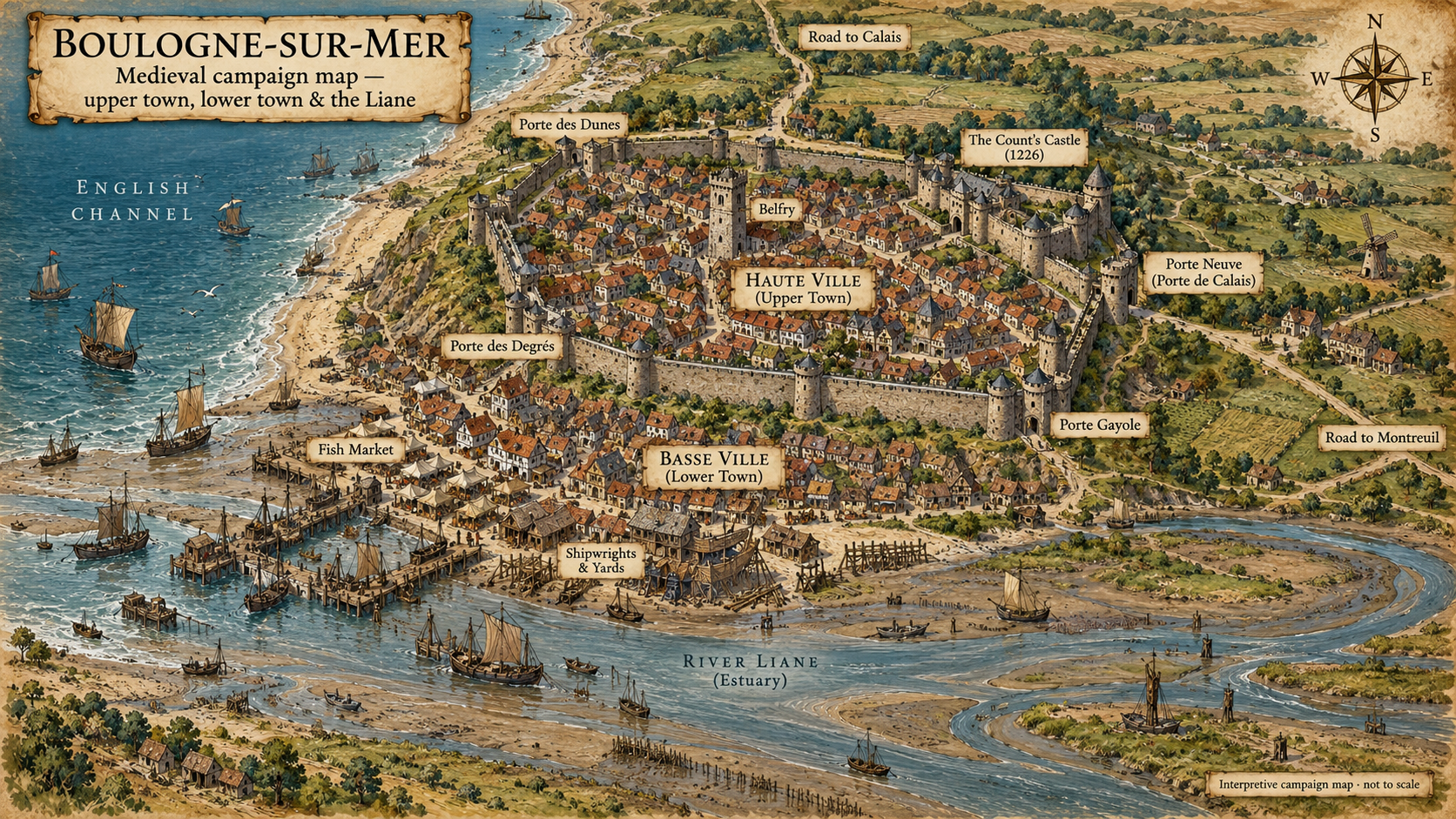
Modern geographic locator
Use this modern locator for the town’s position on the Channel coast.
Research and Related Places
Tourisme Boulogne — castle and ramparts · Hauts-de-France heritage inventory — the boat-borne image · London Museum: medieval badge depicting the sacred boat
Keep this reference growing
If this page helped with your reading or game, you can support its upkeep or explore the curated books.
Explore the Bookshop — epics, classics and stories behind imagined worlds.