
Amiens
The Somme’s blue-dye yards, river mills and great sacred sanctuary
At a Glance
| Location | Amiens, beside the River Somme |
|---|---|
| Known for | Woad-dyers, river mills, cloth markets and the great sacred sanctuary |
| For travellers | Inns, boatmen, repairs, healing and routes towards Abbeville or Beauvais |
| Beyond the walls | Ulphe’s silent marsh near Boves |

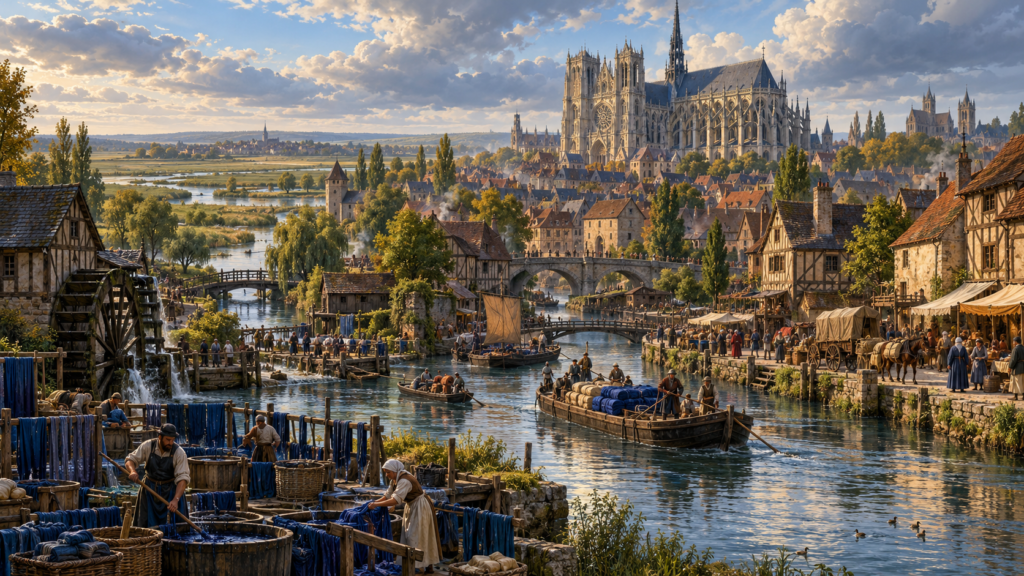
Amiens smells of dye vats and river water. Traders compete over the blue woad that helped build the city’s great vaulted sanctuary, while the Somme passes beneath bridges and mill wheels. The Burgundian commissioner has influence here; so do the magistrates who have to keep the markets open.
What Is Happening Right Now?
Blue dye has stained the Somme’s lower millrace, and a wheel has stopped while workers argue over a sluice opened in the night. The dyers need clean water to finish a merchant’s order. A grain barge cannot reach the flour mill, and apprentices have been sent into cold water to recover bundles washed downstream.
At the same time, fishers arriving from the Boves marsh report that the frogs have begun calling inside Ulphe’s silent pools. The sound is faint but unmistakable. Someone has cut a new channel through the reeds, letting river water run across the old wetland. The city’s temple keepers want to see the pool for themselves, while master dyer Hugo Morin fears his workers will be blamed for everything that has happened along the river.
Places to Explore
The monumental sanctuary
A vast thirteenth-century vaulted complex, here dedicated to the gods of the living fantasy world. Generations of masons, rich merchants and ritual keepers have shaped the building.
Woad and dyers’ streets
The blue-dye trade needs water, drying yards and healthy workers. A change in river use can harm a hundred households without anyone drawing a sword.
The Somme mills
Mills serve grain and cloth production; bargemen, millers and fishers dispute water levels after every heavy rain.
Market and civic chambers
Town magistrates guard their communal liberties while Burgundian officers hold overlordship. Neither can feed a city without its working trades.
Inns and Practical Services
The Blue Reed
Merchant quarter; expensive curtained rooms, guarded horses, mutton pottage and good wine. Clémence Vail has taken in two soaked apprentices from the millrace; they know who was working the sluice after dark.
The Mill Wheel
Lower Somme; inexpensive stew, ale and shared pallets. Etienne Fré knows which sluice was opened after midnight.
The Mill Steps — repairs, remedies and passage
Near the riverside mills, ironworker Perrin Bellot mends buckles, blades, hinges and cart fittings. A straightforward repair usually takes a day; a ruined suit of armour cannot be replaced at an hour’s notice. Perrin has stopped work on the damaged mill wheel because his apprentice’s tools lie beneath the flooded landing. Herbalist Aveline Sorel, whose stall stands beside the cloth market, treats cuts and river chills and sells common remedies. Serious wounds go to the sanctuary’s healers, who cannot promise miraculous cures on demand.
Etienne can introduce travellers to boatmen who know the Somme and the tracks towards Boves. Clémence knows merchants willing to buy ordinary recovered goods and can arrange a paid copyist for letters or maps. The great sanctuary keeps records that scholars may ask to consult, but admission depends on its keepers; it is not a public shop for spells. Performers can seek an evening’s work at the Blue Reed when its guests are in the mood to listen.
People Who Can Change the Day
Clémence Vail keeps the Blue Reed inn. She shelters merchants and exhausted travellers alike, and has offered dry rooms to two dye apprentices whose clothes are still blue to the elbow. Their story may reveal who opened the sluice.
Hugo Morin is a master dyer with thirty households depending on his orders. He can hire anyone who knows how to handle a boat or a water gate. He is not kind when frightened, but he will pay a fair wage when the danger is past.
Etienne Fré keeps the Mill Wheel and grew up near Boves. He knows which channel once carried water into Ulphe’s pools and where the riverbanks are firm enough to cross at night.
Keeper Lucie tends Ulphe’s shrine. She will not demand a donation before helping an injured child. She wants the marsh left wet and the old silence restored, not a punishment for the first dyer accused of causing it.
Ulphe and the Silent Frogs
The Quiet Marsh at Boves
Beyond Amiens, near Boves, live frogs that move, feed and breed but make no sound. Long ago Ulphe, a devotee of the marsh gods, commanded the calling to stop when the noise prevented her hearing her companion Domice at dawn. The frogs fell silent, and generations of fishers have worked the water without hearing a chorus from those pools.
The difference is easy to discover: frogs elsewhere along the Somme still croak. In Ulphe’s wetland the reeds rustle, the water ripples and the insects buzz, but a frog opening its mouth gives no voice. The enchantment is real and local to that water. It has shaped the way fishers listen for boats and the way shrine keepers lead travellers through the marsh.
What is different now? A newly cut watercourse crosses into the silent pools. Etienne has heard frog calls there for the first time, and Lucie finds that some of the newcomers came from the noisy outer channel. Perhaps the ancient working is unchanged and strangers have brought ordinary frogs into its reach; perhaps the diverted water is changing what belongs to the sacred pools. Investigating requires careful observation, not smashing a magical stone or proclaiming the frogs imaginary. If the watercourse is restored, the party will learn whether the silence follows the frogs or the wetland.
Adventures on the Somme
- The blue river: Follow dye-stained water below the mill. A worker has been caught under a broken gate, and freeing him will release a rush of water towards the cargo landing. A rope, a boat and a plan for the sluice can save a life and the grain.
- Where the frogs sing: Walk with Etienne and Lucie to Ulphe’s pools. Find the cut channel and see which frogs are making sound. Restoring the water will help the marsh but leave a dye yard without enough flow unless the miller agrees to a different opening time. The result matters to both livelihoods.
- The finished blue cloth: Hugo’s apprentices must dry a valuable shipment by morning. Assist with a dry workroom, find a boatman willing to carry the finished cloth towards Beauvais, or accept that the workers will lose the sale. A stranger who protects their wages gains friends in Amiens.
These problems can be solved without killing anyone. A saboteur may have opened the sluice deliberately. The people who saw the late-night workers, the damaged gate and the dye-stained water are the first clues.
The Next Stage of the Road
Previous stop: Abbeville and the western Somme country. Traders can arrive by road or river, depending on their cargo and the water.
Next stop: Beauvais. You are leaving the Somme towns and approaching French royal authority; riders should arrange lodging before the gates close.
Travel the complete route: London → Rochester → Canterbury → Dover → Calais → Boulogne → Montreuil → Abbeville → Amiens → Beauvais → Paris.
Plan food, beds, weather delays, coin and written safe-conduct for the political frontiers. Historical road distances vary with the path you take.
Deeper History
The great sanctuary began in 1220 and its principal fabric belongs to the thirteenth century. Amiens was a major northern cloth and woad centre. Under the political settlement of 1435 the Somme towns passed under the duke of Burgundy, subject to their own civic privileges and a larger struggle for power.
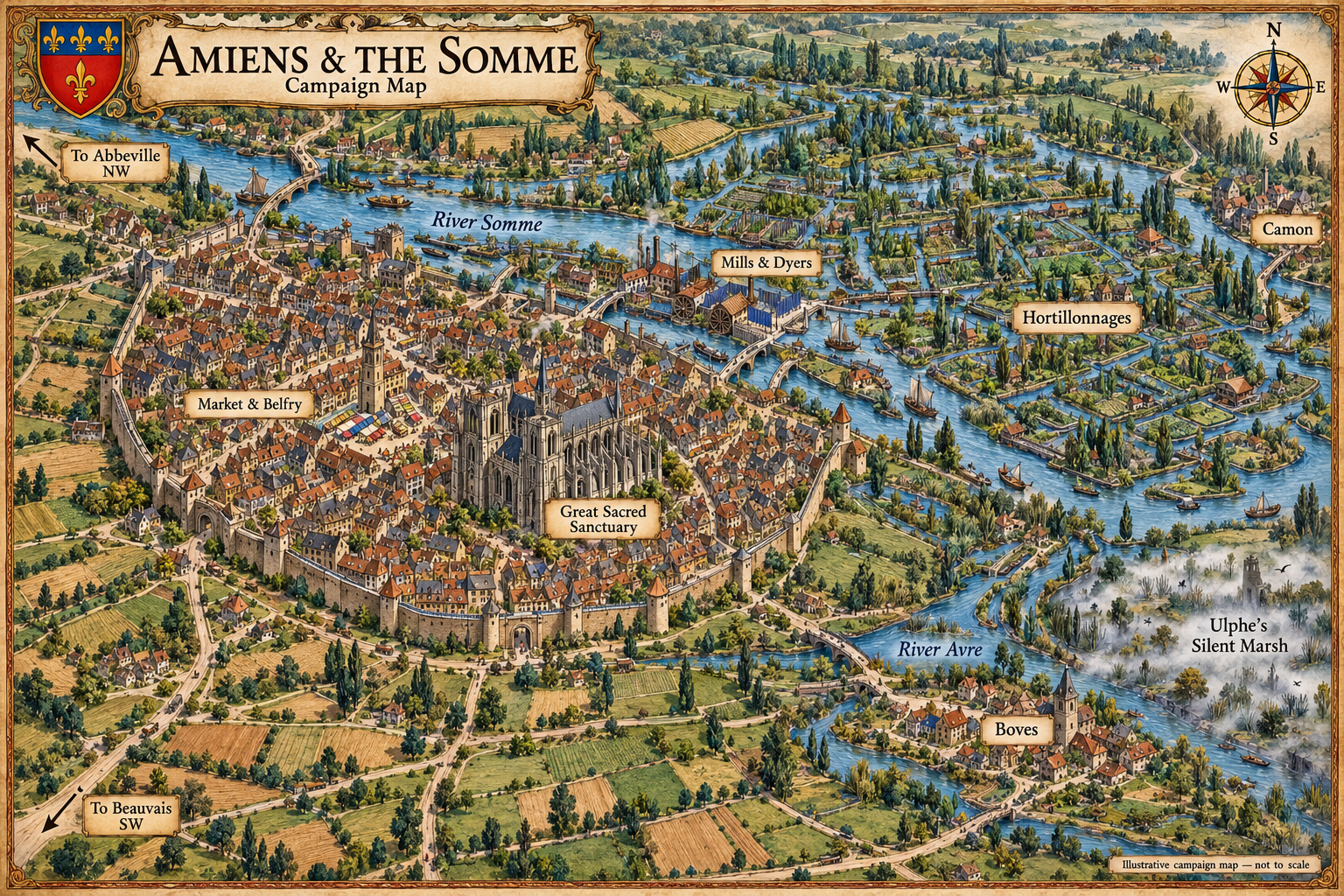
Amiens and the Somme — Campaign Map
Show modern geographic locator
The map below shows today’s Amiens, not medieval streets or campaign sites.
Research and Related Places
Civic arms: the red shield and blue chief with gold fleurs-de-lys follow the arms granted to Amiens in 1185, rather than the later ivy design or the duke of Burgundy’s personal arms. Amiens Municipal Archives. The painted shield above follows this historical design.
UNESCO — Amiens Cathedral · Amiens monument history · Columbia University — Ulphe and the silent frogs
Keep this reference growing
If this page helped with your reading or game, you can support its upkeep or explore the curated books.
Explore the Bookshop — epics, classics and stories behind imagined worlds.