
Boggart – Fey Creature for Fantasy RPGs
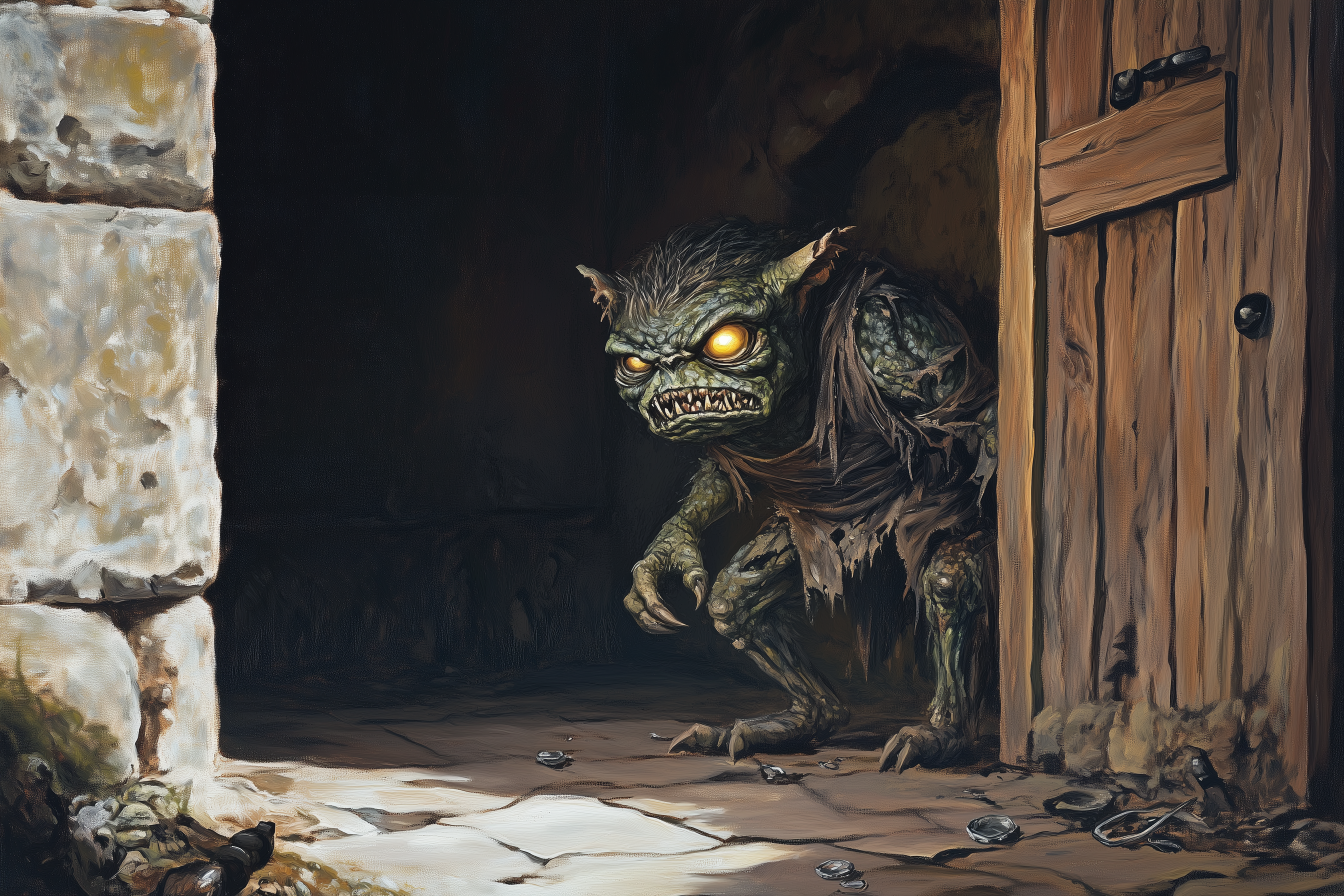
At a Glance
A boggart is a solitary, usually hostile fey spirit that makes a place or household miserable before it ever risks a fair fight. Some are almost invisible presences that slam doors, spoil food and steal tools; others take a small, gangly body with long arms and attack from marshes, streams, ruins or dark rooms. The dangerous ones turn fear, confusion and bad terrain into weapons.
Game Statistics
Choose the ruleset used at the table. Each version below is self-contained and represents the same predatory boggart in that edition’s mechanics.
Boggart — 5.5e / 2024
Small Fey, Chaotic Evil
AC 15
Initiative +4 (14)
HP 91 (14d6 + 42)
Speed 30 ft., Swim 30 ft.
| STR | DEX | CON | INT | WIS | CHA |
|---|---|---|---|---|---|
| 15 (+2) | 18 (+4) | 16 (+3) | 14 (+2) | 12 (+1) | 18 (+4) |
Saving Throws Dex +6, Wis +3, Cha +6
Skills Deception +6, Perception +5, Stealth +8, Survival +3
Senses Darkvision 60 ft.; Passive Perception 15
Languages Common, Sylvan
CR 4 (1,100 XP; PB +2)
Traits
Cold-Iron Aversion. After the boggart takes damage from a cold-iron weapon, it can’t use Fade from Sight until the end of its next turn.
Marsh and House Lurker. The boggart can take the Hide action as a Bonus Action. It has Advantage on Dexterity (Stealth) checks made in dim light, cluttered interiors, heavy vegetation, mud or shallow water.
Actions
Multiattack. The boggart makes two Long Claw attacks. If both attacks hit the same Large or smaller creature, the boggart can use Abduct immediately after the second hit.
Long Claw. Melee Attack Roll: +6, reach 10 ft. Hit: 8 (1d8 + 4) Slashing damage plus 5 (1d10) Psychic damage.
Abduct. The creature hit twice by the boggart’s Multiattack must succeed on a DC 14 Strength or Dexterity saving throw (its choice) or have the Grappled condition (escape DC 14). The boggart can immediately move up to 15 feet without provoking Opportunity Attacks, dragging the target with it. A creature grappled this way can repeat the save at the end of each of its turns, ending the condition on itself on a success.
Boggart Terror (Recharge 5–6). Each enemy of the boggart’s choice within 30 feet that can hear it makes a DC 14 Wisdom saving throw. On a failed save, a creature has the Frightened condition until the end of its next turn, and its Speed is 0 while Frightened this way. On a successful save, the creature is immune to this boggart’s Boggart Terror for 24 hours.
Bonus Action
Fade from Sight. While in dim light, darkness, clutter, vegetation or mist, the boggart becomes Invisible until the start of its next turn. The effect ends early immediately after it makes an attack roll or forces a creature to make a saving throw.
Reaction
Scuttle Away. When a creature misses the boggart with a melee attack, the boggart moves up to 10 feet without provoking Opportunity Attacks.
Running the 5.5e Boggart
Open from hiding with Boggart Terror, then isolate the easiest target. Use Long Claw from 10 feet away and Abduct to pull that target behind furniture, into a side room, down a bank or into shallow water. Fade from Sight is primarily an escape and repositioning tool rather than a source of permanent invisibility.
Boggart — 5e / 2014
Small Fey, Chaotic Evil
Armor Class 15 (natural armor)
Hit Points 71 (11d6 + 33)
Speed 30 ft., swim 30 ft.
| STR | DEX | CON | INT | WIS | CHA |
|---|---|---|---|---|---|
| 10 (+0) | 18 (+4) | 16 (+3) | 12 (+1) | 14 (+2) | 16 (+3) |
Saving Throws Dex +6, Wis +4
Skills Deception +5, Perception +4, Stealth +8
Senses darkvision 60 ft., passive Perception 14
Languages Common, Sylvan
Challenge 3 (700 XP)
Traits
Fey Ancestry. The boggart has advantage on saving throws against being charmed, and magic can’t put it to sleep.
Sneaky. The boggart can take the Hide action as a bonus action on each of its turns.
Actions
Multiattack. The boggart makes two Claw attacks.
Claw. Melee Weapon Attack: +6 to hit, reach 10 ft., one target. Hit: 8 (1d8 + 4) slashing damage plus 3 (1d6) psychic damage.
Abduct. If both Claw attacks hit the same Large or smaller creature in one turn, the target must succeed on a DC 14 Strength saving throw or be grappled (escape DC 14). The boggart can move up to half its speed immediately, dragging the target with it.
Cackle of the Wicked (Recharge 5–6). Each creature of the boggart’s choice within 30 feet that can hear it must succeed on a DC 13 Wisdom saving throw or be frightened for 1 minute. A frightened creature repeats the save at the end of each of its turns, ending the effect on itself on a success.
Bonus Actions
Shadow Step. While in dim light or darkness, the boggart teleports up to 30 feet to an unoccupied space it can see that is also in dim light or darkness.
Reaction
Counter Trick. When a creature the boggart can see within 30 feet makes an attack roll, the boggart imposes disadvantage on that roll by producing a sudden false sound, movement or flicker at the edge of the attacker’s vision.
What Changed in 5.5e?
- The newer version is CR 4 and uses a stronger battlefield-control role.
- Abduct is integrated directly into Multiattack and gives the target a choice of Strength or Dexterity to resist.
- Fade from Sight replaces teleportation with short, terrain-dependent invisibility.
- Cold iron gains explicit mechanical counterplay.
- Boggart Terror is shorter and more predictable at the table than the 2014 fear effect.
Boggart — Pathfinder 1e
Boggart CR 4
XP 1,200
CE Small fey
Init +5; Senses low-light vision; Perception +12
Defense
AC 16, touch 16, flat-footed 11 (+5 Dex, +1 size)
hp 31 (7d6+7)
Fort +3, Ref +10, Will +5
DR 5/cold iron
Offense
Speed 30 ft., swim 30 ft.
Melee 2 claws +9 (1d3+2)
Space 5 ft.; Reach 10 ft.
Special Attacks abduct, sneak attack +1d6
Psychic Magic (CL 8th; concentration +12) 10 PE—aversion (2 PE, DC 16), hallucinatory terrain (4 PE, DC 18), hold person (2 PE, DC 16), invisibility (2 PE, DC 16), telekinetic maneuver (0 PE)
Statistics
Str 15, Dex 20, Con 13, Int 14, Wis 10, Cha 19
Base Atk +3; CMB +7 (+9 drag); CMD 19 (21 vs. drag)
Feats Agile Maneuvers, Combat Expertise, Improved Drag, Weapon Finesse
Skills Acrobatics +13, Bluff +10, Climb +12, Craft (traps) +10, Handle Animal +8, Intimidate +11, Knowledge (geography) +8, Knowledge (nature) +9, Perception +12, Sense Motive +4, Stealth +23, Swim +16; Racial Modifiers +2 Perception, +4 Stealth
Languages Common, Sylvan
Special Ability
Abduct (Ex). When a boggart hits a single target with both claw attacks as part of a full attack, it can attempt a drag combat maneuver as a free action. It can move more than 5 feet as part of this combat maneuver even if it has no movement remaining for the round.
Ecology
Environment temperate forests or swamps
Organization solitary, gang (2–5), or band (6–12)
Treasure standard
Running the Pathfinder Boggart
Use invisibility, aversion and terrain to separate one creature from the group. A boggart that can drag a victim into deep mud, a stream, a pit or a prepared trap is far more dangerous than one forced to trade claw attacks in open ground.
Boggart — D&D 3.5e
| Size/Type | Small Fey |
|---|---|
| Hit Dice | 7d6+7 (31 hp) |
| Initiative | +5 |
| Speed | 30 ft. (6 squares), swim 30 ft. |
| Armor Class | 16, touch 16, flat-footed 11 (+5 Dex, +1 size) |
| Base Attack/Grapple | +3/+1 |
| Attack | Claw +9 melee (1d3+2) |
| Full Attack | 2 claws +9 melee (1d3+2) |
| Space/Reach | 5 ft./10 ft. |
| Special Attacks | Abduct, sneak attack +1d6, spell-like abilities |
| Special Qualities | Damage reduction 5/cold iron, low-light vision |
| Saves | Fort +3, Ref +10, Will +5 |
| Abilities | Str 15, Dex 20, Con 13, Int 14, Wis 10, Cha 19 |
| Skills | Bluff +12, Climb +10, Craft (trapmaking) +10, Hide +23, Listen +12, Move Silently +15, Spot +12, Swim +18, Tumble +13 |
| Feats | Combat Expertise, Improved Initiative, Weapon Finesse |
| Environment | Temperate forests, marshes, riverbanks and isolated dwellings |
| Organization | Solitary, gang (2–5), or band (6–12) |
| Challenge Rating | 4 |
| Treasure | Standard |
| Alignment | Usually chaotic evil |
| Advancement | 8–12 HD (Small) |
| Level Adjustment | — |
Abduct (Ex)
If a boggart hits one creature with both claw attacks in the same round, it can immediately attempt a special grapple check without provoking an attack of opportunity. The boggart gains a +6 racial bonus on this check, for a typical check modifier of +7. If it succeeds, it may move up to half its speed and bring the grappled creature with it. This movement can pull a victim into water, difficult terrain or a trap.
Sneak Attack (Ex)
The boggart deals an extra 1d6 points of damage whenever its target would be denied a Dexterity bonus to AC or when the boggart flanks the target.
Spell-Like Abilities
Caster level 8th. Save DCs are Charisma-based.
At will—mage hand; 3/day—invisibility; 1/day—hallucinatory terrain (DC 18), hold person (DC 17).
Aversion (Su)
Once per day, a boggart can mark one creature or one fixed 20-foot-radius area it can see within 60 feet. A creature targeted directly, or a creature that enters the marked area, must succeed on a DC 17 Will save or become unwilling to approach the chosen creature or area for 1 hour. An affected creature can defend itself normally if attacked. This is a mind-affecting fear effect.
Skills
A boggart has a +4 racial bonus on Hide checks and a +2 racial bonus on Listen and Spot checks. It has a +8 racial bonus on Swim checks and can always choose to take 10 on a Swim check, even if distracted or endangered.
3.5e Conversion Note
This is a standalone D&D 3.5e conversion. Pathfinder CMB/CMD, drag feats, psychic-energy points and consolidated skills have been replaced with 3.5e grapple, skill and spell-like-ability mechanics rather than copied across unchanged.
Behaviour
A boggart wants control before it wants blood. It learns the shape of a house, track, farmyard, clough or marsh and then turns that familiarity against everyone else. A household boggart starts with missing tools, spilled milk, unexplained footsteps, doors that refuse to stay shut and noises just beyond a wall. A wild boggart uses the same instinct outdoors: false voices from the reeds, stones thrown from cover, livestock panicked at the wrong moment and tracks that lead toward mud, deep water or a drop.
The boggart rarely reveals itself because someone asks it to. It appears when the sight of it will worsen fear, lure a victim into pursuit or convince the household that the haunting has become physically dangerous.
Its cruelty is personal. Once a boggart chooses a household, traveller or local family, it can maintain the feud for months or years. Moving house does not necessarily end the trouble. In northern English tradition, the joke in several boggart tales is precisely that the spirit comes too.
If Violence Starts
Start before initiative. The characters are asked to stay one night in a farmhouse where something has been escalating for a week. Give them three signs before the first attack: a missing key turns up inside a locked churn, wet footprints appear on an upper floor, and a horse refuses to enter the stable.
The boggart does not attack the whole group. It isolates whoever investigates alone. When combat begins, place a stream, well, stairwell, cellar hatch, animal pen or deep mud within one move of the creature. The boggart tries to frighten the group, grab one target and pull that target toward the hazard.
If the characters flood the room with light, keep together, block the hazard and produce cold iron, the encounter should become noticeably easier. If they chase noises separately through darkness, they are playing the boggart’s game.
Encounters and Tactics
The Haunted Farm
Use the boggart as an escalating investigation. Begin with theft and sabotage, then attack livestock, then a sleeper, and finally anyone who tries to expose its hiding place. The goal is to make the players decide whether to trap, bargain with, drive out or kill something they cannot reliably see.
The Riverbank Ambush
Place the boggart on the far side of difficult ground. It hides, frightens the rear rank and pulls a lightly armoured target toward the water. The creature should retreat through reeds, roots or a culvert rather than stand still after a successful drag.
The Boggart Hole
A ravine, hollow, cave or steep-sided clough gives the monster vertical cover and dangerous edges. Use thrown noises, false glimpses and disappearing tracks to draw the group off the safe path. The monster attacks only after a character is below the others or cut off by terrain.
A Gang of Boggarts
Multiple boggarts become dangerous quickly because they can attack from several concealment points. Do not have all of them rush the same doorway. One distracts, one frightens, and one drags. Their retreat routes should already be known to them.
Weaknesses and Counterplay
Take away concealment. Lamps, daylight, cleared furniture, opened shutters and controlled sightlines matter. A boggart is much less dangerous once it cannot vanish behind darkness and clutter.
Do not pursue every sound. A boggart wins when the party splits. Characters who hold a defensible position and make the creature come to them deny it its favourite tactic.
Block the hazard. Close the cellar door, rope characters together at the riverbank, fill the pit, shut livestock outside the fight or move the encounter away from deep water. Its long arms are frightening because of where they can put a victim.
Use cold iron. In Pathfinder and 3.5e, cold iron directly defeats its damage reduction. The 5.5e version also reacts badly to cold iron, giving characters a practical reason to bring the traditional anti-fey material. See the Cold Iron.
Control fear. Protection against fear, strong Wisdom saves, removing frightened allies from immediate danger and preventing the monster from repeatedly choosing isolated targets all reduce its control of the battlefield.
House Boggarts and Wild Boggarts
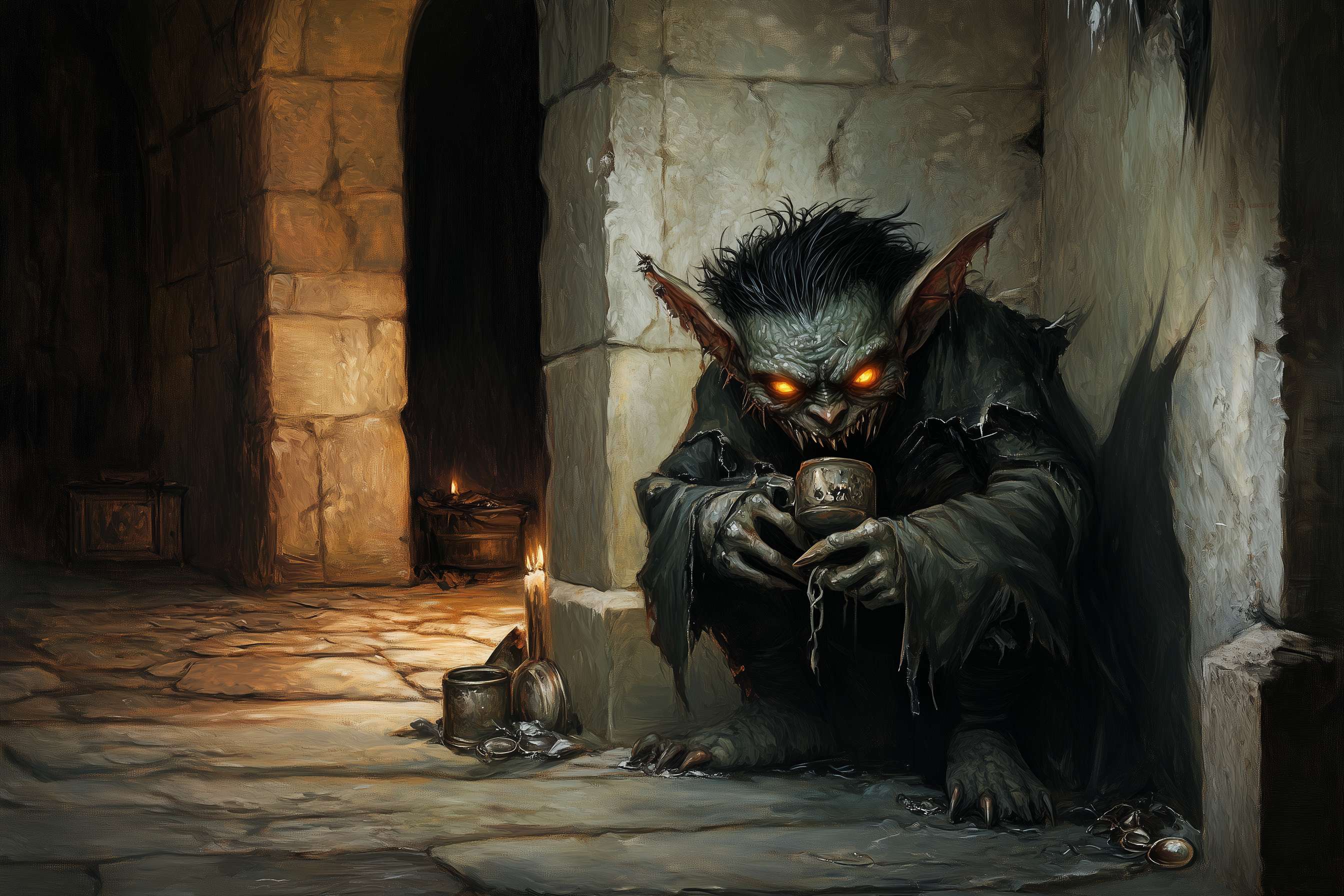
“Boggart” is broader in English folklore than a single goblin species. The name has been used for household spirits, place-haunting beings, ghosts, shapechangers and other solitary supernatural presences. For play, two patterns are especially useful.
House Boggarts
A house boggart attaches itself to a dwelling, farm or family. It knows every stair, cupboard, chimney, roof space and loose board. At first its attacks look like bad luck: milk spoils, tools disappear, bedding is pulled away and animals panic. As the hostility grows, the spirit becomes more physical.
A house boggart is not the same as a helpful Brownie, but folklore often links the ideas. One explanation says that an offended household helper can “turn boggart.” In the campaign world this is one origin, not a rule for every boggart.
Wild Boggarts
Wild boggarts claim lonely lanes, marshes, caves, burial places, riverbanks, woods and steep cloughs. They may be visible creatures or little more than a hostile presence until they choose to attack. These boggarts are especially likely to lure travellers off the road, mimic sounds and use water, mud or steep ground as part of the kill.
Never Name the Boggart
Local warning: do not give the thing a personal name.
Northern English boggart lore includes a warning that naming the boggart can make it harder to reason with and more destructive. That makes an excellent table rule even when no spell is involved: villagers refuse to name the spirit, children use circumlocutions, and an outsider who loudly invents a name may trigger the next escalation.
A Games Master can treat this as folklore only, or make it supernatural. If it is supernatural, naming the boggart might give it Advantage on its next attack, restore an expended fear ability, or allow it to follow the speaker across a threshold it could not otherwise cross. Pick one consequence and establish it through local warnings before it matters.
Boggarts in Northern England
Boggart traditions are strongest across the north of England, particularly Lancashire and Yorkshire, with related traditions across Cheshire, Derbyshire, Lincolnshire and neighbouring districts. In the campaign present, the densest boggart country lies in farmsteads, wet valleys, old lanes and wooded ravines where households and landscape overlap.
The British Isles contain many local names for solitary spirits, and not every boggart should look alike. One appears as a long-armed fey, another as a black animal, another as a light on the moor, and another remains unseen for an entire adventure. The shared feature is not anatomy but hostile, intimate haunting.
The best-known real-world boggart place-name is Boggart Hole Clough at Blackley in Manchester. Modern scholarship also shows that “boggart holes” and related place-names were spread across a wider northern landscape rather than belonging to one single story.
Signs of a Boggart
| d8 | Sign |
|---|---|
| 1 | A household object disappears and returns somewhere physically impossible. |
| 2 | Milk sours overnight while every other stored food remains fresh. |
| 3 | Wet footprints cross a dry room and stop at a wall. |
| 4 | A horse refuses a familiar stable, bridge or lane. |
| 5 | Someone hears their own name whispered from a cupboard, chimney or reed bed. |
| 6 | Bedding is pulled away moments after the fire dies down. |
| 7 | Small hand marks appear above normal reach or on the underside of a beam. |
| 8 | A trail of lost coins or trinkets leads toward water, mud or a drop. |
Useful Boggart Variants
The Poltergeist Boggart
Keep the normal statistics but describe the creature as almost never visible. Replace claw imagery with flying household objects, slammed shutters and invisible hands. Its Abduct ability becomes a sudden wrenching pull.
The Black-Dog Boggart
Use the same Challenge Rating and core abilities, but give it the appearance and movement of a large black dog. Long Claw becomes a spectral bite or shoulder-check, while Fade from Sight represents the animal vanishing behind hedges, walls or mist.
The Water Boggart
Make the swim speed central. Put the lair beside a ford, millrace, pond or flooded quarry. The creature does not need extra damage; deep water and the threat of drowning already make Abduct dangerous.
The Ruin Boggart
This boggart occupies an abandoned tower, chapel, mine building or manor. It rigs loose masonry, rotten stairs and dropped beams rather than relying only on supernatural tricks.
Adventure Hooks
The Churn on the Cart
A family abandons its farm after weeks of torment. Half a mile down the road, a voice laughs from inside the packed churn: “Aye, moving are we?”
The Child Who Named It
A child gives the household boggart a pet name. That night the harmless thefts become violence, and every attempt to erase the name makes the spirit angrier.
Three Blue Lights
Three blue flames appear beneath an ash tree beside a bend in the road. The next morning a wagon lies overturned and cloven tracks surround it.
The Dry Footprints
Wet prints lead from a stream to an upstairs bedchamber but never cross the floor between. Someone in the house is being selected.
The Boggart Hole
Travellers disappear from a wooded ravine. The local guide refuses to speak the place-name after sunset and will not cross the brook twice in one night.
The Brownie’s Grudge
A once-helpful household spirit has become cruel after a new owner broke an old custom. Restoring the relationship may be possible—but another fey is encouraging the transformation.
Treasure and Rewards
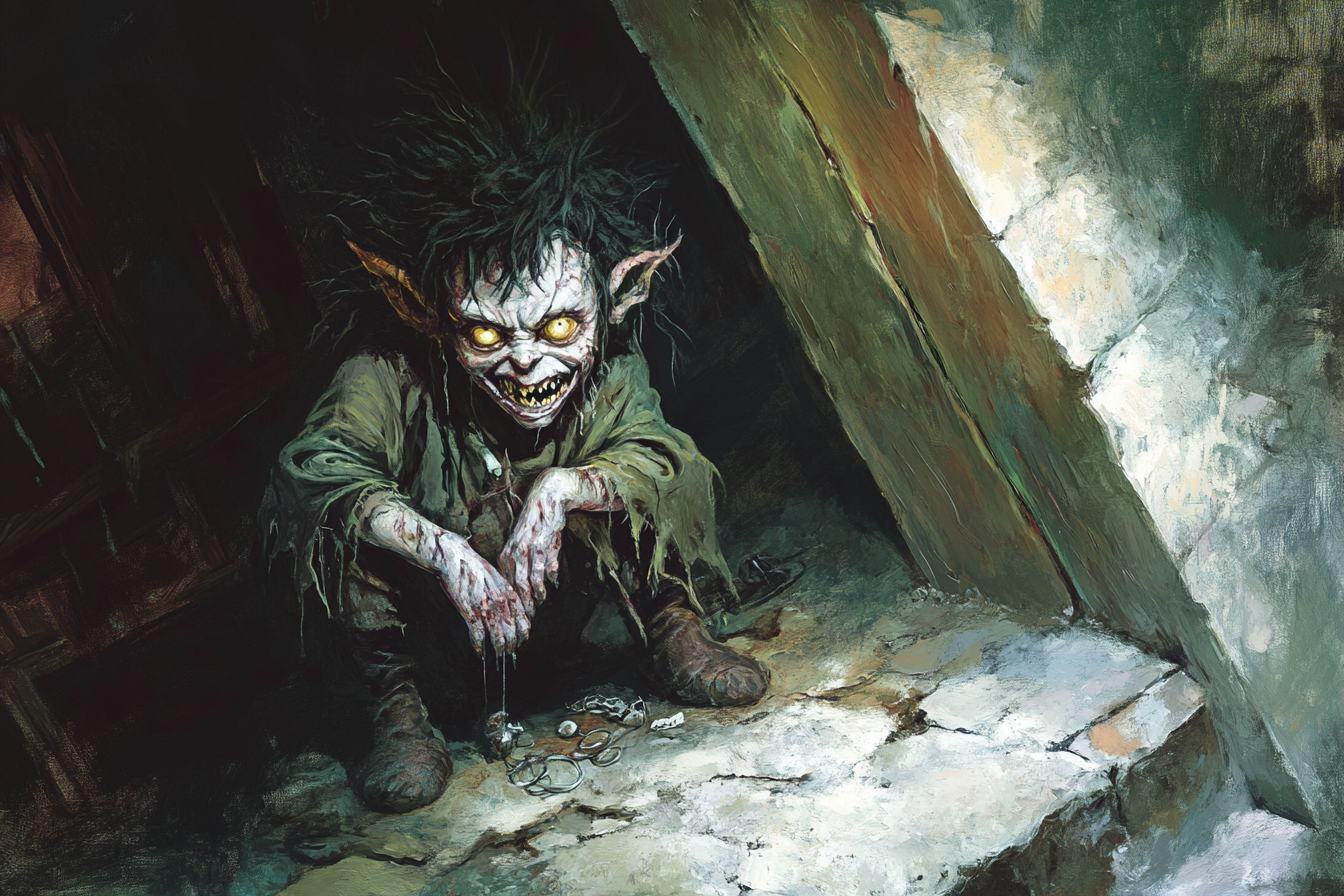
A boggart’s “hoard” is usually intimate rather than rich: keys, buckles, buttons, spoons, toys, letters, locks of hair, broken jewellery, coins taken one at a time, livestock bells and tools stolen because someone needed them. A larger wild boggart may also accumulate valuables from travellers who vanished in its territory.
The best reward for defeating one may be what comes back. A missing signet proves an inheritance claim. A stolen key opens a room sealed for twenty years. A child’s lost toy shows that a supposedly recent haunting began a generation earlier.
Related Creatures and Places
Watch and Listen
Hobs & Boggarts in Derbyshire Folklore visits real Derbyshire sites associated with hobs and boggarts and is directly relevant to the landscape traditions used on this page.
Folklore and Sources
The historical boggart is not simply a standard goblin. Northern English usage could cover a wide range of solitary supernatural beings, including household spirits, place-haunting entities, apparitions and shapechangers. That breadth is important: the fixed long-armed creature in the rules panels is the form most useful for combat, while the surrounding lore deliberately keeps the older ambiguity.
House and wild boggarts are both well attested in later northern English folklore. Stories also include boggarts following families who attempt to move away, troubling sleepers, moving or breaking household objects and attaching themselves to named landscape features.
Further reading: Simon Young, The Boggart: Folklore, History, Place-names and Dialect; The Folklore Society, The Suburban Boggart; Simon Young, “Boggart Holes” place-name study; and northern English local folklore collections.
Rules and Licensing
D&D 5.5e / 2024
This work includes material from the System Reference Document 5.2.1 (“SRD 5.2.1”) by Wizards of the Coast LLC, available at https://www.dndbeyond.com/srd. The SRD 5.2.1 is licensed under the Creative Commons Attribution 4.0 International License, available at https://creativecommons.org/licenses/by/4.0/legalcode.
D&D 5e / 2014
This work includes material from the System Reference Document 5.1 (“SRD 5.1”) by Wizards of the Coast LLC, licensed under the Creative Commons Attribution 4.0 International License.
Pathfinder 1e and D&D 3.5e
The Pathfinder 1e boggart statistics and the D&D 3.5e backward conversion use and adapt Open Game Content under the Open Game License Version 1.0a. The rules text in those two edition panels is designated Open Game Content to the extent permitted by that license; original setting prose and artwork are not.
Open Game License Version 1.0a
OPEN GAME LICENSE Version 1.0a
The following text is the property of Wizards of the Coast, Inc. and is Copyright 2000 Wizards of the Coast, Inc (“Wizards”). All Rights Reserved.
1. Definitions: (a) “Contributors” means the copyright and/or trademark owners who have contributed Open Game Content; (b) “Derivative Material” means copyrighted material including derivative works and translations (including into other computer languages), potation, modification, correction, addition, extension, upgrade, improvement, compilation, abridgment or other form in which an existing work may be recast, transformed or adapted; (c) “Distribute” means to reproduce, license, rent, lease, sell, broadcast, publicly display, transmit or otherwise distribute; (d) “Open Game Content” means the game mechanic and includes the methods, procedures, processes and routines to the extent such content does not embody the Product Identity and is an enhancement over the prior art and any additional content clearly identified as Open Game Content by the Contributor, and means any work covered by this License, including translations and derivative works under copyright law, but specifically excludes Product Identity. (e) “Product Identity” means product and product line names, logos and identifying marks including trade dress; artifacts; creatures characters; stories, storylines, plots, thematic elements, dialogue, incidents, language, artwork, symbols, designs, depictions, likenesses, formats, poses, concepts, themes and graphic, photographic and other visual or audio representations; names and descriptions of characters, spells, enchantments, personalities, teams, personas, likenesses and special abilities; places, locations, environments, creatures, equipment, magical or supernatural abilities or effects, logos, symbols, or graphic designs; and any other trademark or registered trademark clearly identified as Product identity by the owner of the Product Identity, and which specifically excludes Open Game Content; (f) “Trademark” means the logos, names, mark, sign, motto, designs that are used by a Contributor to identify itself or its products or the associated products contributed to the Open Game License by the Contributor; (g) “Use”, “Used” or “Using” means to use, Distribute, copy, edit, format, modify, translate and otherwise create Derivative Material of Open Game Content; (h) “You” or “Your” means the licensee in terms of this agreement.
2. The License: This License applies to any Open Game Content that contains a notice indicating that the Open Game Content may only be Used under and in terms of this License. You must affix such a notice to any Open Game Content that you Use. No terms may be added to or subtracted from this License except as described by the License itself. No other terms or conditions may be applied to any Open Game Content distributed using this License.
3. Offer and Acceptance: By Using the Open Game Content You indicate Your acceptance of the terms of this License.
4. Grant and Consideration: In consideration for agreeing to use this License, the Contributors grant You a perpetual, worldwide, royalty-free, non-exclusive license with the exact terms of this License to Use, the Open Game Content.
5. Representation of Authority to Contribute: If You are contributing original material as Open Game Content, You represent that Your Contributions are Your original creation and/or You have sufficient rights to grant the rights conveyed by this License.
6. Notice of License Copyright: You must update the COPYRIGHT NOTICE portion of this License to include the exact text of the COPYRIGHT NOTICE of any Open Game Content You are copying, modifying or distributing, and You must add the title, the copyright date, and the copyright holder’s name to the COPYRIGHT NOTICE of any original Open Game Content you Distribute.
7. Use of Product Identity: You agree not to Use any Product Identity, including as an indication as to compatibility, except as expressly licensed in another, independent Agreement with the owner of each element of that Product Identity. You agree not to indicate compatibility or co-adaptability with any Trademark or Registered Trademark in conjunction with a work containing Open Game Content except as expressly licensed in another, independent Agreement with the owner of such Trademark or Registered Trademark. The use of any Product Identity in Open Game Content does not constitute a challenge to the ownership of that Product Identity. The owner of any Product Identity used in Open Game Content shall retain all rights, title and interest to the Product Identity.
8. Identification: If you distribute Open Game Content You must clearly indicate which portions of the work that you are distributing are Open Game Content.
9. Updating the License: Wizards or its designated Agents may publish updated versions of this License. You may use any authorized version of this License to copy, modify and distribute any Open Game Content originally distributed under any version of this License.
10. Copy of this License: You MUST include a copy of this License with every copy of the Open Game Content You Distribute.
11. Use of Contributor Credits: You may not market or advertise the Open Game Content using the name of any Contributor unless You have written permission from the Contributor to do so.
12. Inability to Comply: If it is impossible for You to comply with any of the terms of this License with respect to some or all of the Open Game Content due to statute, judicial order, or governmental regulation then You may not Use any Open Game Material so affected.
13. Termination: This License will terminate automatically if You fail to comply with all terms herein and fail to cure such breach within 30 days of becoming aware of the breach. All sublicenses shall survive the termination of this License.
14. Reformation: If any provision of this License is held to be unenforceable, such provision shall be reformed only to the extent necessary to make it enforceable.
15. COPYRIGHT NOTICE
Open Game License v 1.0a Copyright 2000, Wizards of the Coast, Inc.
System Reference Document Copyright 2000–2003, Wizards of the Coast, Inc.; Authors Jonathan Tweet, Monte Cook, Skip Williams, Rich Baker, Andy Collins, David Noonan, Rich Redman, Bruce R. Cordell, John D. Rateliff, Thomas Reid, James Wyatt, based on original material by E. Gary Gygax and Dave Arneson.
Pathfinder Roleplaying Game Core Rulebook Copyright 2009, Paizo Publishing, LLC; Author Jason Bulmahn, based on material by Jonathan Tweet, Monte Cook, and Skip Williams.
Pathfinder Roleplaying Game Bestiary 6 © 2017, Paizo Inc.; Authors Robert Brookes, Benjamin Bruck, John Compton, Paris Crenshaw, Adam Daigle, Crystal Frasier, James Jacobs, Thurston Hillman, Tim Hitchcock, Brandon Hodge, Jason Keeley, Isabelle Lee, Jason Nelson, Tim Nightengale, F. Wesley Schneider, David Schwartz, Mark Seifter, Todd Stewart, Josh Vogt, and Linda Zayas-Palmer.
Boggart D&D 3.5e rules adaptation Copyright 2026 SpiralWorlds.
Keep this reference growing
If this page helped with your reading or game, you can support its upkeep or explore the curated books.
Explore the Bookshop — epics, classics and stories behind imagined worlds.