
Montreuil-sur-Mer
High ramparts, Canche mills and Gargantua’s river
At a Glance
| Location | Montreuil-sur-Mer, above the Canche |
|---|---|
| Known for | Medieval castle, high ramparts, cloth market and river mills |
| For travellers | Inns, wagon repairs, river guides and overland routes |
| Happening now | A stranded cloth boat, exposed giant’s mark and missing child |
| Onward road | Boulogne to the north; Abbeville and Amiens south-east |
| Authority | French Crown, town commune and royal castle wardens |
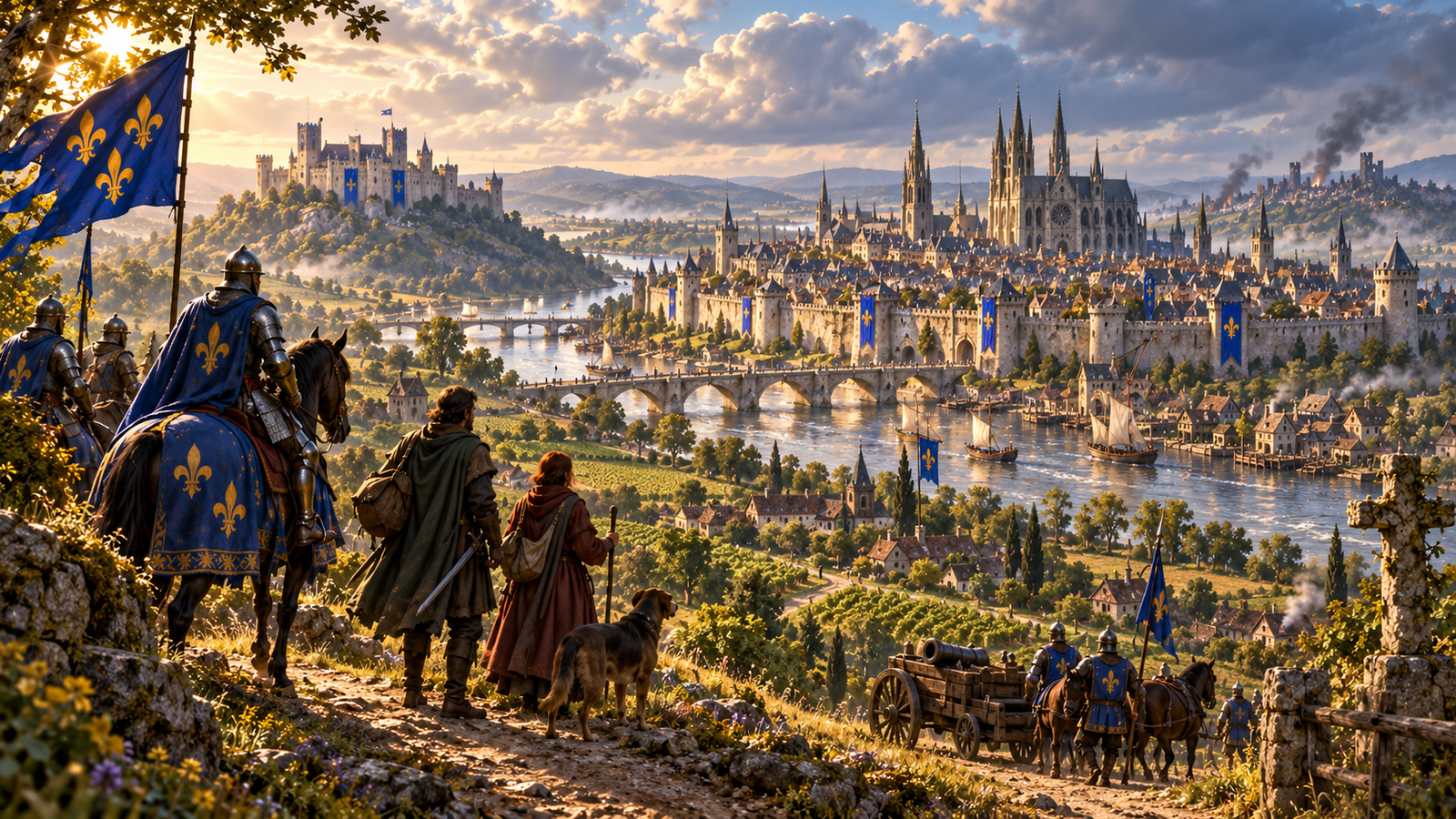
From the road, Montreuil appears above the valley like a ship of stone. It was once the French king’s great Channel port, but the Canche is shifting and silting. Traders argue over whether their goods belong on a boat or a wagon, while the garrison asks how much longer the old walls can protect the town.
What Is Happening Right Now?
At the Bascon mills below Montreuil, the Canche has begun to fall at the wrong hour. A mill wheel turns in empty air, stranded eels writhe in its channel, and a boat carrying dyed cloth cannot reach the landing. The town’s carters offer to haul the cargo up to the high gate, but they cannot get their wagons onto the soft bank before sunset.
Miller Éloi Basquin found a slab of stone newly exposed in the riverbed, scored with a print wider than his grinding wheel. He has covered it with boards because curious children have started crossing dangerous mud to touch it. Fisherwoman Marcelle names Gargantua, the living giant whose enormous footsteps and thrown stones have reshaped the countryside. She knows that he still walks France, and fears what a return to the Canche would mean for the river. The tale says that when he relieved himself here, the torrent became the Canche. Marcelle thinks the newly exposed stone may be one of the marks he left on its banks.
The river still carries living fish and boats, and the stranded crew needs help now. Recovering the cloth, keeping the children off the mud and finding out why water is draining into a newly opened channel may be three parts of the same task.
Landmarks, Streets and Places to Explore
The high ramparts
Rounded towers and arrow slits defend the headland. Walkways command the Canche valley, but weather and fatigue wear down guards tasked with seeing every passing cart.
The early royal castle
A polygonal castle from the age of Philip Augustus holds the high ground. The later great bastioned citadel has not been built; the castle still keeps its earlier medieval form.
Market and cloth hall
The town’s famous cloth trade is still recognised, though war and declining river access have weakened profits. A trustworthy merchant may buy a fine cloak for less than its maker expects.
The Canche valley and Bascon mills
Below the high town, the changing river meanders past working mills and shallow fishing places. Eels and salmon pass the wheels as they travel between salt and fresh water. A local pilot knows where a punt can still float and which banks will swallow a loaded cart. The mills are not decorative ruins: their workers can repair a torn net, mill grain or help haul stranded cargo.
Where to Eat, Drink and Sleep
The High Gate — castle approach
Moderate to high cost. Madame Renée Varon offers neat beds, bean-and-mutton pottage, wine and a locked stable. Carters and castle messengers stop here. She has dry blankets ready for anyone pulled from the mud, and her stable boy saw children climb down towards the newly exposed giant’s footprint.
The Half-Tide — old quay
Cheap, damp. Keeper Thibault Ruis rents hayloft space and serves freshwater fish, coarse bread and ale. Boatmen know the silted channel. A carter who stayed last night has vanished with a sack of borrowed coins.
Repairs, provisions and river help
The cloth workers can rescue a wet bolt of fabric, and a cartwright can repair a wheel before the difficult southern road. A smith by the upper market resets horseshoes and mends ordinary iron fittings; merchants sell rope, lantern oil, feed and dry food for the next stage. Renée can find guarded stabling and a trustworthy driver. Thibault knows which fishers can guide travellers through the exposed Canche mud, but the riverbank remains treacherous even at low water. A local herbalist tends cuts and chills; serious injuries need the sanctuary’s healers, whose help is not guaranteed on demand.
Éloi Basquin offers food and a fair wage to anyone who can brace the mill’s damaged water channel or help free the stranded barge. Travellers who recover the missing child will find the town more welcoming than strangers who simply ask about its treasures.
People and Powers
Cloth merchant Céline du Val wants the stranded barge unloaded before its colours are ruined. Miller Éloi Basquin keeps the Bascon wheel turning and has found the giant’s footprint in the riverbed. Fisherwoman Marcelle knows where the Canche is deepest at low water and fears a child has gone missing among the shallows. Castellan Arnaud Desson can lend ropes and carts, but only after someone tells him where they are needed.
Gargantua’s Canche and the Low Mills
Gargantua’s passage really shaped the Canche valley. The colossal traveller relieved himself as he went, and that astonishing torrent made a river. Montreuil’s people have far more immediate reasons to remember him than to debate the dignity of the story: the current still turns their mills, carries their catches, and cuts off roads after heavy rain.
Below the walls: The Bascon mills stand where fresh water and tidal salt meet. Eels slip through the sluices; salmon struggle upstream. This is the place to hire a river guide, buy fresh fish or watch a loaded barge fight the shallows. The immense footprint has become exposed here during a strange fall of water, and a new channel is taking water away from the mill.
- Get the crew ashore: Reach a cloth boat abandoned on mud, recover its cargo and rescue a sailor trapped beneath an overturned punt before the incoming tide covers him.
- Follow the stolen river: Track the unexpectedly dry channel to a collapsed earth bank. Repairing it restores the mill but floods an eel fisher’s winter store; the workers must choose whose property to save first.
- Find the giant’s mark: Children have crossed the mud to the enormous stone and one is missing. Follow fresh small footprints among the giant’s old impressions and bring the child home without stepping into the soft bed.
When Gargantua Returns
Gargantua is alive. If he turns his steps back towards the Canche, Montreuil cannot simply close its gates and wait: a giant ninety feet tall can stride across fields, lift a stranded barge, dislodge a riverbank or crush a mill without noticing. The castle watch would send riders ahead to warn the outlying farms. Boatmen would haul their craft away from the shallows, and the market would be asked to assemble food for a guest whose appetite could exhaust its stores.
The sensible townsfolk hope to welcome rather than fight him. Marcelle believes the giant may know why the river has changed its course; Éloi needs his strength to shift the stone blocking the old channel. But the giant must be persuaded to work from firm ground: a single helpful step through the mud might destroy the mills he came to save. Travellers who meet him on the road could negotiate that visit, guide him to a safe resting place, or discover that the latest sighting was a merchant’s invention.
The Road and the Next Stop
Visit every stop: London → Rochester → Canterbury → Dover → Calais → Boulogne → Montreuil → Abbeville → Amiens → Beauvais → Paris.
North leads to Boulogne and the count’s lands; south-east leads to Abbeville and the Burgundian-held Somme towns. Montreuil itself remains under the French Crown, so the next frontier matters to messengers and merchants. The Canche’s shallows make it wiser to arrange overland transport than to assume a boat can reach the high town.
Deeper History
Montreuil stood on a hill above the Canche and was once the Capetian kings’ sole royal seaport, before 1204. The town held communal privileges and a cloth trade, with thirteenth-century walls and castle. At the Treaty of Arras in 1435, much of neighbouring Ponthieu passed into Burgundian hands, but Montreuil was specifically excepted and returned to the French Crown. This makes its road towards Abbeville a real change of political authority, rather than another Burgundian town. By the late Middle Ages, war and silting had weakened the port. The celebrated later bastioned citadel does not exist in the present campaign scene.
Real-World Locator
The map marks modern Montreuil-sur-Mer; its roads and buildings are not a historical reconstruction.
Research and Onward Locations
Montreuil town heritage: Lower Town, Bascon mills and Gargantua’s Canche · City of Montreuil: town history · Pas-de-Calais Departmental Archives: Montreuil excepted in 1435 · Montreuil museum: medieval royal castle
London · Rochester · Canterbury · Dover · Calais · Boulogne · Montreuil · Abbeville · Amiens · Beauvais · Paris
Keep this reference growing
If this page helped with your reading or game, you can support its upkeep or explore the curated books.
Explore the Bookshop — epics, classics and stories behind imagined worlds.