
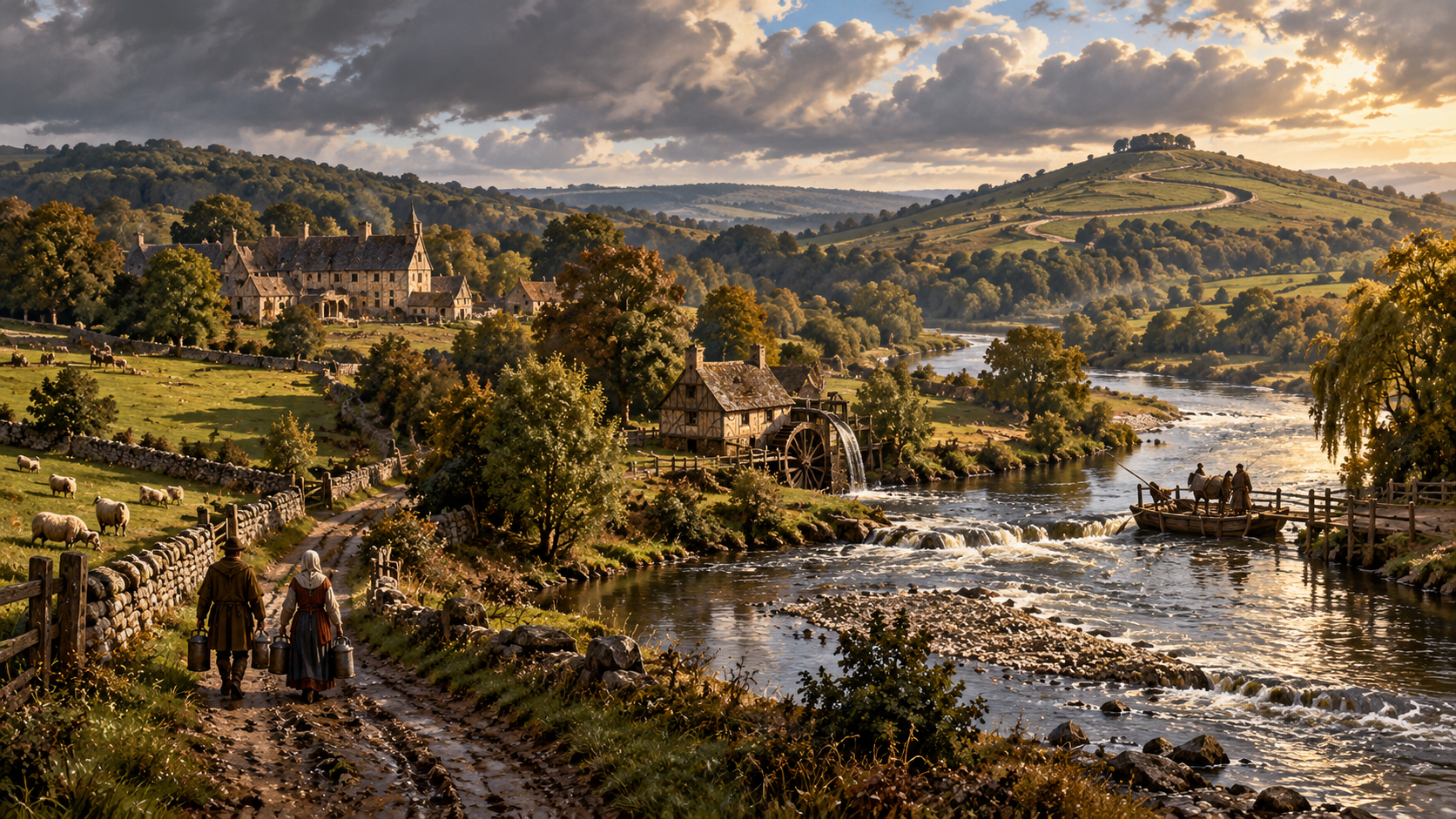
Lower Wear at a Glance
| Region | River Wear below Chester-le-Street towards Fatfield and Penshaw, in north-east England |
|---|---|
| Landscape | Bends of the Wear, cattle pasture, riverside woodland, gravel shallows, wet tracks and working mills |
| Settlements | Farm clusters and ferry-side hamlets; Worm Hill at Fatfield is the clearest local landmark |
| People to meet | John Lambton, the Lambton household, drovers, ferrymen, millworkers and a smith |
| Present danger | The Lambton Worm; milk tribute buys time, but does not make the roads safe |
| What travellers need | Safe river passage, shelter, food, a guide, replacement animals and reliable news of the Worm |
| Best approach | Help a milk cart, ask the ferryman about the current, then decide whether to distract or confront the Worm |

Along the lower River Wear, farmers measure their safety in pails of milk. The Lambton Worm has made the river crossing dangerous, the grazing land poor and the night watch essential. A party arriving here will find frightened people who still have to work, trade and get their animals to water.
What Is Happening Now?
The daily milk delivery is a dangerous feeding routine, not an agreement. The steward learned that a full trough draws the Worm away from the hall; nobody has heard it ask for milk. A missing pail can leave it hungry enough to raid cattle sheds and houses. Landowners are worried about lost income; drovers care more about the people who walk beside the wagons. Neither can stop feeding families while an enormous serpent controls the river.
John Lambton‘s old choice has become everyone else’s burden. His household holds land and resources that might pay for the defence, but villagers want more than a promise that another armoured champion will arrive.
Every dawn the estate’s milk wagons must be counted. A pail tipped in the ruts can be the difference between a quiet morning and a farm lost before noon. That makes the drovers important people: they know which animals are ill, which field gates open and whose family is sheltering on the road. If adventurers carry a tribute themselves, local people will watch what they do rather than listen to claims of bravery.
Places Along the Wear
Worm Hill, near Fatfield
A low rise associated with the creature’s great coils. Deep tracks across the slope look like wagon ruts until someone follows them around the hill. Its open approaches leave visitors exposed, but the summit gives a view of the river route and any herds moving below.
The Worm Well
According to the tale, a young John cast a strange little catch into a well, and the creature grew beyond its confines. Some villagers avoid the water even now. The site is useful for learning how the disaster began; it need not contain another copy of the Worm.
The Lambton Household and Estate
The Lambton household has barns, stables, stores and a trough large enough to take the day’s tribute. Its main hall is a working manor rather than a later-period Gothic castle. Its steward can arrange payment and a guarded route. The owner can supply armour or metal, but the local witch has warned John that victory comes with a terrible condition: if he fails to kill the first living thing he sees afterwards, she will curse his family for nine generations.
The River Rock
Local accounts describe the creature coiling round a rock in the Wear. The surrounding current can carry severed flesh downstream, which matters because blows alone do not always keep the Worm in pieces. The safe bank changes with flood and season; ask ferry workers rather than assuming the shortest crossing is the best.
The Mill and Ferry
The miller keeps grain moving and knows the upstream water level. The ferryman knows where a cart might ford in low water, where the gravel shifts and which side channels are strong enough to carry floating wreckage. They can help a party prepare a trap, provided their families have a way out of danger.
The Wooded Reach towards Cox Green
Downriver bends pass dense growth and low banks. The paths near Cox Green can hide a single watcher but not a wagon convoy. Fishing nets and eel baskets sometimes return torn; that may mean the Worm has passed, but floodwater or hungry otters can also do the damage. Ferrymen identify fresh tracks by what they have dragged through the mud.
Penshaw’s Rival Hill
Penshaw Hill also appears in versions of the legend, particularly where rings of earthwork invite the story of a serpent’s coils. It is not Worm Hill at Fatfield, and its later famous monument does not belong in the opening-era view. People from either hillside may tell the same story differently.
People, Trade and Work
A smith repairs ploughshares, rivets mail and may build outward-facing bladed armour given suitable iron and several hours’ safe labour. A drover knows which farms have spare milk. Mill workers can direct wagons away from flooded tracks. Those who work on the river exchange news while mending gear or waiting for the next boat. A visitor who helps them is more likely to hear where the Worm was seen that morning.
Travellers can eat or shelter in the ferryside houses, or pay a household to share a loft. More permanent lodgings are described below. Milk is scarce and wages rise whenever the Worm takes another animal.
The household’s best-known figure is John Lambton. He wants to kill the beast, but the warning about his bloodline has made him guard his plans. He can fund a harness and hire drovers; the party still needs local knowledge to choose a suitable river channel. An elder estate servant knows the daily milk tally. The ferryman knows the bank where a shattered body is most likely to wash away.
Life here is not all about the Worm. There are reeds to cut for roofs, grain to grind, cattle to drive to common pasture and nets to mend. A millworker can put visitors in touch with a ferryman; a smith can turn worn metal into outward-facing blades, but only if someone keeps the workshop open at night.
Where to Eat, Drink and Sleep
These are campaign establishments created for play, not claimed medieval buildings or historically recorded inn names.
The Ferry Bell — the sheltered landing
Guesthouse and eating room; moderate cost. Host Alys keeps a clean loft, hot barley stew, fresh water and a guarded lean-to for pack animals. Her ferryman brother checks the crossing before taking payment. Drovers bringing livestock pay less for the floor beside the hearth; armed strangers are asked to leave their weapons by the door. The household has rope, lantern oil and names of reliable river pilots. If the ferry stops, the Bell fills quickly and Alys gives beds first to stranded families.
The Clay Bank — above the mill road
Rough alehouse and lodging; cheap. A narrow cottage serves dark ale, coarse bread and smoked river fish when there is a catch. Beds are shared and the door does not bolt well. Millhands and carters bring news, but visitors who flaunt silver will pay more. Keeper Hob can show a traveller which gravel bank stays dry in ordinary weather; he will not guarantee safety during a flood or offer to face the Worm.
Without an inn: farm lofts take paying travellers who can help at milking time. A traveller can bargain for a meal by guarding the milk carts, fixing tackle or helping load the ferry. The cheapest night may be the one most likely to put them on the Worm’s route at first light.
Dangers and Choices
| Situation | What visitors see | What they can do |
|---|---|---|
| Tribute is short | A nearly empty pail and worried drovers | Find milk to distract the creature, evacuate the farm or guard the escape route |
| Ferry halted | Boats hauled ashore and fresh gouges in the landing | Take the slower upstream road or find a safe escorted crossing |
| Blacksmith threatened | The forge has shut before evening | Protect the workshop while a barbed harness is made |
| Household silence | Servants will discuss the milk but not the family curse | Question them gently or seek the witch to learn the precise terms of her curse |
At the table: make the immediate cost visible. If the party saves a cart, a family gets milk home. If it abandons a ferry crossing, a guide must choose between his boat and his neighbours. If it insists on killing the Worm in a dry field, explain what residents have learned about the body rejoining. Players may choose a different strategy once they know the consequence.
Travel and Local Knowledge
Arriving from the south: The north road reaches Durham through York, Northallerton and Darlington. From Durham, follow the Wear’s northern country through Chester-le-Street towards Fatfield and Worm Hill. Visitors coming from Nottingham can follow the York leg first. Durham is an inland city farther upriver; the Lower Wear is a separate area, not another name for Durham’s streets.
On foot, the rough tracks become slippery in heavy rain; mounted parties must slow around livestock and boggy verges. In spring floods, the current may help wash fragments of the Worm apart but makes every crossing more dangerous. In dry weather the river rock is easier to reach, but broken pieces can lodge on exposed gravel. Decide which conditions prevail before the fight and make them clear to the players.
The hill called Worm Hill is recorded near Fatfield. Penshaw Hill also claims a place in the legend. The two are separate places; local storytellers can argue about the creature’s coils without the GM having to move either hill.
What the Valley Remembers
The Wear runs past Durham and Chester-le-Street towards Sunderland, winding through pasture and woodland before its tidal lower reaches. The Lambton estate and river crossings are part of the countryside’s working geography; they are not stages built solely for the monster. In the folklore, John Lambton caught a little serpent while fishing, threw it into a well and left it to grow. After he went away, the creature took livestock and damaged fields. Milk delivered from the estate kept it fed until his return.
Iseult of the Ford, a local witch, has told John how to fight the Worm in the river while wearing armour fitted with blades, so that the current carries its severed pieces away. She threatens a nine-generation family curse if he fails to kill the first living thing he meets after victory—one grim variation on Bestow Greater Curse, rather than a magical power unique to the Worm. The familiar ending of the old tale has John’s father run out before the intended hound, leaving John unwilling to kill him and therefore subject to the witch’s curse. Adventurers may help John choose differently, learn other ways Iseult uses curse magic, or challenge her condition.
For the place’s present, remember the ordinary families: the Worm has made their ferries uncertain and their food dear. Defeating it is a victory only if the valley can trade, eat and travel afterwards.
Orientation for the GM
This is a relative route sketch, not a measured map. The river runs on towards Sunderland; use a real regional map for exact directions and distances. Do not turn the story’s Worm Hill, the well and the battle rock into precisely surveyed locations without a separate campaign map.
| Site | Best approach | What may change the route |
|---|---|---|
| Lambton estate and trough | Wagon track across grazing land | How much milk survives the journey |
| Smith and mill road | Track beside the mill run | Flooded wheel race or a shuttered forge |
| Worm Hill (Fatfield) | Open pasture, exposed slope | Whether the Worm has already left for the river |
| River battle rock | Bank and ferry landing | Current strength and whether fragments can wash clear |
| Cox Green / Penshaw reach | Wooded riverside path | Mist, high water and competing hill traditions |
Related Places and Characters
For the creature’s four-edition statistics, see the Lambton Worm. For the surrounding kingdom, see England. The mill, Worm Well, tribute route and river rock are different stops within the valley, each with its own approach and dangers.
Sources and Campaign Use
The Lambton Worm is a genuine County Durham tradition; the working ferries, local services, immediate threats and playable situation above are SpiralWorlds campaign material, not claims about a particular medieval day. Worm Hill’s Fatfield location and the competing Penshaw tradition are recorded in the regional Historic Environment Record and the National Trust’s account.
Geography and folklore references: Newcastle University Co-Curate: River Wear, Historic Environment Record 7852: Worm Hill at Fatfield, and National Trust: Lambton Worm walk. The named guesthouses and current Worm troubles are campaign additions. The historical sources are used for the river geography and the different tellings of the legend.
Keep this reference growing
If this page helped with your reading or game, you can support its upkeep or explore the curated books.
Explore the Bookshop — epics, classics and stories behind imagined worlds.