
Kingdom of France
At a Glance
| Campaign Baseline | 1454 CE |
|---|---|
| Political Status | A powerful but politically uneven kingdom whose Crown has emerged much stronger from the Hundred Years’ War. |
| Ruler | King Charles VII of France. |
| Heir | Louis, Dauphin of Viennois, the king’s estranged and increasingly independent son. |
| Capital | Paris. |
| Population | Approximately 14 million as a campaign estimate; medieval demographic totals vary according to reconstruction and territorial definition. |
| Government | Hereditary monarchy working through royal officers, great nobles, appanages, towns, local privileges and overlapping jurisdictions. |
| Languages | Middle French and regional langues d’oïl; Occitan varieties across much of the south; Breton in Brittany; Basque in the southwest; Franco-Provençal varieties in parts of the southeast; Latin among many learned and administrative circles. |
| Military Character | Royal men-at-arms, permanent military companies, archers, fortified towns, handguns and an increasingly formidable artillery establishment. |
| Immediate Pressures | Post-war reconstruction, Gascon loyalties, English Calais, Burgundian power, Breton autonomy, conflict between Charles and Louis, displaced soldiers and supernatural violence. |
| Campaign Tone | Royal intrigue, recovering war zones, monster hunts, disputed inheritance, urban crime, dangerous roads, artillery, court politics and legends that are simply part of the world. |
Royal Arms

The war is over. France is not at peace.
The Kingdom of France has driven England from almost all of its continental possessions. Bordeaux has returned to French authority, Normandy is again in royal hands, and Charles VII possesses an army, treasury and administrative reach his predecessors could only have envied. On paper, France has won.
On the road, victory feels less complete. A century of intermittent warfare has left ruined strongholds, disputed estates, abandoned villages, veterans who know no trade except violence, noble families whose loyalties changed with the armies around them, and communities that survived under more than one master. Royal officials arrive to collect taxes and confirm titles just as local lords insist that ancient privileges still protect them.
France is therefore ideal adventuring territory. A company can escort a royal messenger in the morning, investigate a haunted battlefield in the afternoon and discover by nightfall that the person paying them is also financing a Burgundian faction. Cannon can break a castle wall, but no bombard can decide who owns the land behind it.
Magic is part of the learned and practical world. It is studied through universities, Latin schools, courts, guild workshops, private circles, alchemy, medicine, astronomy and natural philosophy. Rural communities preserve equally serious knowledge about forests, waters, stones, spirits, curses and the things that return after death.
There is no universal fantasy language called Common. Travellers succeed or fail according to the languages they actually know, the interpreters they can hire and the communities willing to speak with them.
Humans form the majority population, but France is not exclusively human. Dwarven craftsmen, miners, wardens and merchant families live in dispersed holds, towns and guild networks. Halflings live both settled and itinerant lives. Gnomes appear among specialist craftsmen and gunsmiths, although some of the most ambitious have crossed the Atlantic. Elves are uncommon in mainland France but are known through travel and contact with Britain and Scandinavia.
What Is Happening Right Now?
An adventuring company does not need to wait in a tavern for a quest. France already has more problems than its rulers can solve openly.
Gascony Has Changed Masters Again
Bordeaux has only recently returned to French control. Some Gascon families prospered under England, some resisted it, and many simply changed allegiance whenever survival required it.
Royal officers are confirming property, hunting dangerous collaborators and securing fortifications. Forged deeds are suddenly worth fortunes. A missing witness can decide who owns a castle.
The Fortune of Jacques Cœur
Jacques Cœur, once one of the richest financiers and merchants in France, has fallen spectacularly from royal favour. His property, accounts, correspondents and hidden obligations touch merchants, officials and nobles across the kingdom.
His escape from imprisonment at Poitiers becomes a ready-made campaign event: before it, somebody is preparing the escape; afterwards, royal agents are hunting everyone who helped him vanish.
The King and His Heir Barely Trust One Another
Louis, Dauphin of Viennois, governs Dauphiné with an independence that increasingly resembles a prince preparing his own state. He develops allies and policies that do not always serve his father.
A single letter carried between Paris, Burgundy, Savoy and Grenoble can be worth more than a chest of silver.
Burgundy Is Too Powerful to Ignore
Philip the Good commands a Burgundian state extending through Burgundy, Franche-Comté, Artois, Flanders and the Low Countries.
His court possesses wealth, prestige, diplomats and the Order of the Golden Fleece. France may have defeated England, but no sensible councillor believes the Burgundian question has disappeared.
Richelieu, Prime Minister of France
Cardinal Richelieu is Prime Minister of France and one of the most powerful men in the kingdom. He directs a growing network of royal officials, informants, spies and political agents whose reach extends from Paris into provincial courts, fortified towns and foreign capitals.
Richelieu is determined to make France stronger, more obedient and more difficult for rival nobles and foreign powers to manipulate. Letters are intercepted, officials are compromised, hostile alliances are broken and enemies disappear behind perfectly lawful warrants.
His power extends beyond ordinary politics. Richelieu maintains close dealings with infernal powers, and some of the intelligence reaching his offices comes from sources no ordinary minister could command. Service to the Prime Minister can elevate an adventuring company rapidly—and bind it to struggles far larger than the mission it was originally given.
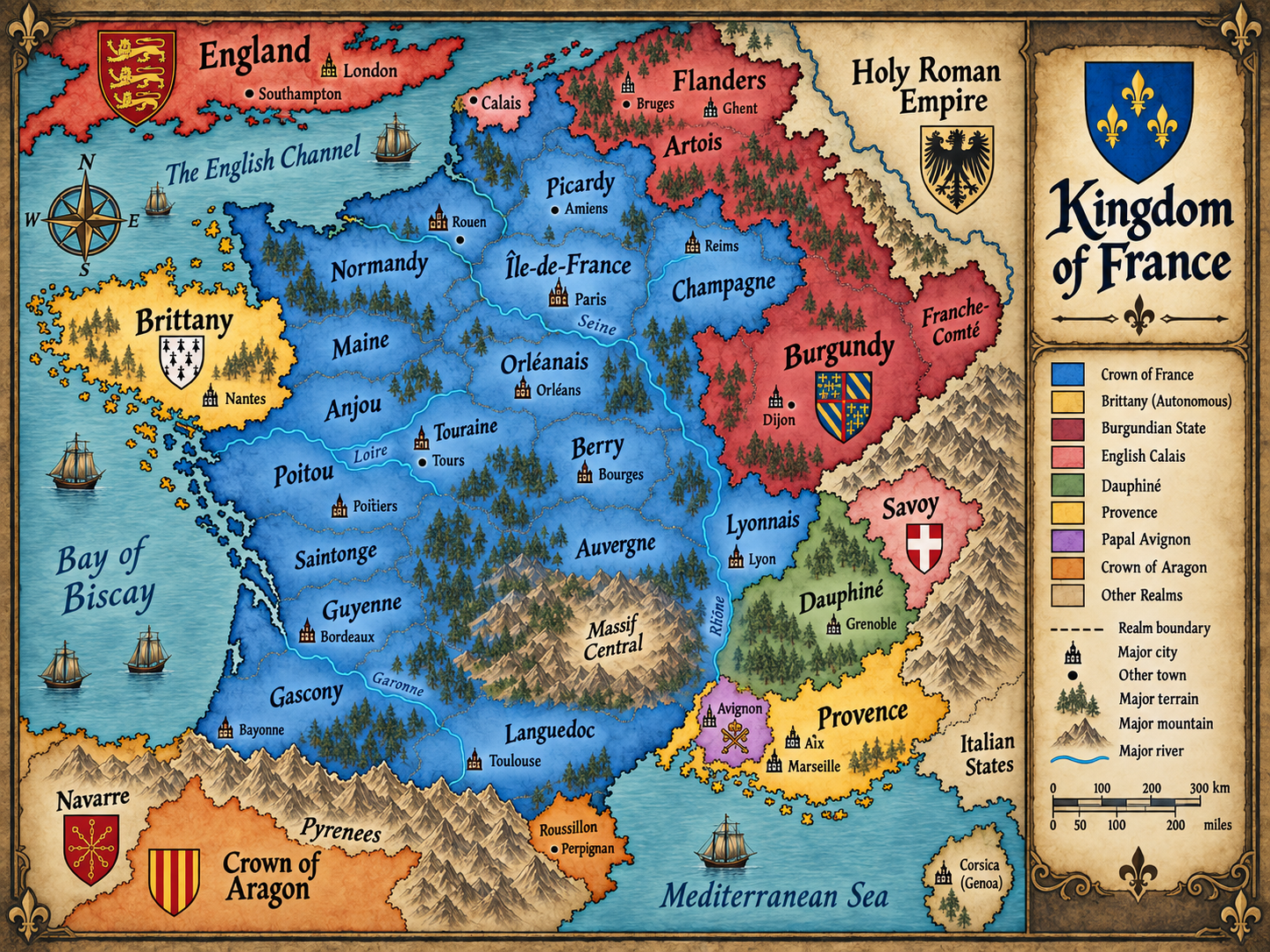
Campaign Map
Running France at the Table
France is too large and politically varied for one settlement stat block. Use the kingdom as a regional campaign layer, then apply the relevant town, wilderness, NPC or creature mechanics when the party reaches a particular destination.
France — Regional Campaign Profile
Use ordinary ability checks when uncertainty matters. Do not roll simply to buy food, follow a public road or enter an open market.
| Difficulty | Typical Regional Use |
|---|---|
| Routine | Find ordinary lodging, purchase normal supplies, identify a major road, hire a common carrier or discover who publicly governs a town. |
| DC 10 | Learn road conditions, locate a particular tradesperson, identify local tolls or distinguish royal soldiers from a noble household’s retainers. |
| DC 15 | Secure an introduction to an official, scholar, specialist craftsman or wealthy merchant; trace a disputed deed; recognise politically sensitive heraldry. |
| DC 20 | Enter restricted archives, cross a military cordon without delay, locate a clandestine buyer, expose a sophisticated forged seal or uncover a concealed allegiance. |
| DC 25 | Reach a tightly protected court secret, identify a senior opposing agent, expose a carefully concealed supernatural conspiracy or gain access to material protected as a matter of state. |
Failure should alter the situation rather than stop play. A failed attempt might produce delay, a higher toll, questioning, an unwanted escort, loss of secrecy, a hostile witness or an obligation to somebody who offers help.
France — Pathfinder 1e Regional Play
Use individual settlement pages for marketplace limits and local services. At kingdom scale, France is primarily a network of jurisdictions, roads, reputations and political attitudes.
| Situation | Useful Skills | Typical Pressure |
|---|---|---|
| Crossing a guarded frontier or city gate | Diplomacy, Bluff, Knowledge (local) | Documents, declared business, weapons and reputation matter. |
| Following a difficult rural route | Survival, Knowledge (geography) | Weather, damaged bridges, patrols and local warnings alter the route. |
| Working noble politics | Diplomacy, Sense Motive, Knowledge (nobility) | A successful audience can create obligations as well as access. |
| Investigating deeds, warrants or correspondence | Linguistics, Knowledge (local), relevant Profession | Forgery and genuine authority may exist in the same chain of documents. |
| Finding hidden magical or criminal networks | Diplomacy, Intimidate, Sense Motive, Stealth | Success reveals contacts; failure may reveal the investigators instead. |
France — D&D 3.5e Regional Play
Treat each city or town as its own community for local wealth and authority. The kingdom layer determines who claims jurisdiction and what happens when the party moves between communities.
| Situation | Useful Skills | Result of Failure |
|---|---|---|
| Find political or street information | Gather Information, Knowledge (local) | The party gains incomplete information or becomes known to interested people. |
| Deal with officials or nobles | Diplomacy, Bluff, Sense Motive, Knowledge (nobility and royalty) | Access is delayed, restricted or made conditional on service. |
| Cross dangerous countryside | Survival, Knowledge (geography) | Time, supplies or discretion are lost instead of the journey simply ending. |
| Detect false papers or identity | Forgery, Sense Motive, appropriate Knowledge | The false trail survives long enough for its creator to react. |
| Move unseen through controlled territory | Hide, Move Silently, Disguise | Patrols, witnesses or toll officials create a new complication. |
Where Adventurers Go
France is not one uniform blue kingdom. Language, economy, law, local identity, noble power and supernatural practice change as the party crosses the country.
Île-de-France and Paris
The Crown’s political centre offers royal administration, wealthy households, merchants, scholars, courts, archives, guilds, great markets and a population large enough for almost anybody to disappear inside it.
Paris is where royal politics, urban crime, scholarship and supernatural intrigue collide. It is also home to an unusually dense concentration of characters from the French NPC collection.
Claude Frollo is a learned judicial authority and occult power whose desire for control reaches into the courts, archives and ancient sacred precincts of the city.
Quasimodo knows the bells, towers, roofs and hidden heights of Paris better than almost anybody alive. Esmeralda moves through a different Paris of performers, outsiders, travellers and street intelligence.
Captain Phoebus de Châteaupers connects street adventures to royal armed authority, while Pierre Gringoire moves among poets, performers and the people who survive around the edges of respectable society.
Beneath respectable Paris lies the Court of Miracles, where Clopin Trouillefou presides over beggars, thieves, informants and people who know how to vanish.
The occult underworld has its own brokers. La Voisin deals in prophecy, poison, forbidden magical services and the weaknesses of wealthy clients.
Above and around all of them, Richelieu maintains a network of agents, compromised officials and supernatural influence.
Go there for: royal intrigue, Frollo, Quasimodo, Esmeralda, the Court of Miracles, occult services, political agents, archives, scholars and urban adventures.
Normandy
Normandy is French again, but generations of Anglo-Norman history cannot be erased by decree. Fortified towns, ports, estates and families still remember English rule, French reconquest and the changing value of loyalty.
Rouen is one of the kingdom’s great commercial and administrative cities and an obvious base for adventures in northern France.
Robert the Devil also belongs to Normandy. Knight, outlaw and feared warrior, he is exactly the sort of figure travellers may know first through contradictory stories told at roadside inns and only later encounter in person.
Go there for: ports, disputed loyalties, wealthy merchants, old fortresses, military remnants, Robert the Devil and dangerous roads toward the Channel.
Brittany
Brittany lies within the wider French political world without functioning as an ordinary royal province. Duke Peter II rules a powerful and distinctive duchy whose nobles, ports and institutions expect their privileges to be respected.
The supernatural landscape is equally distinctive. The Ankou travels Breton roads and grave country.
Bluebeard brings danger into noble households. His wealth, fortified estate and outward respectability turn hospitality itself into an adventure hazard.
Go there for: ducal politics, Atlantic ports, old roads, noble horror, standing stones, disappearances and encounters with death.
The Loire, Anjou, Touraine and Poitou
River roads, fertile estates, fortified towns and noble households make the western heartlands excellent territory for intrigue that can become violence without becoming open war.
Loudun controls important approaches between Poitou, Anjou and Touraine. Its citadel, markets, old foundations and competing political networks make it one of the most immediately playable French towns already developed on SpiralWorlds.
Urbain Grandier is one of Loudun’s most dangerous local powers: charismatic, politically connected and entangled with infernal forces. His influence reaches into households, rival factions and the hidden struggles surrounding the town.
Poitiers also matters because Jacques Cœur’s imprisonment and escape make the region a corridor for secret messages, bribed officials, missing records and competing searches.
Go there for: castles, royal officers, couriers, merchant intrigues, old cellars, noble estates, Grandier and Richelieu’s interference.
Guyenne, Bordeaux and Gascony
This is the kingdom’s freshest political wound. Bordeaux and the surrounding country spent generations tied to the English Crown and have only recently been reconquered.
Bordeaux is therefore much more than a wine port. It is a city of merchants, confiscations, returning officials, divided loyalties and people attempting to prove that they supported the correct side at exactly the correct moment.
Gascony also produces some of France’s most dangerous individualists. Charles de Batz-Castelmore d’Artagnan is a Gascon royal swordsman whose loyalty to the Crown repeatedly places him inside political plots larger than himself.
Cyrano de Bergerac is another Gascon blade: soldier, poet, playwright and duellist, equally capable of settling an encounter with words or steel.
English contacts have not disappeared merely because an army lost. Ships, letters, family connections and money still cross the Bay of Biscay and the Channel.
Go there for: post-war espionage, d’Artagnan, Cyrano, merchant wealth, disputed estates, English agents, smuggling, duels and recently abandoned fortifications.
Languedoc and the Southern Roads
Southern France is not simply Paris with warmer weather. Occitan speech, Mediterranean connections, different local customs, mountain approaches and long-distance commerce give it its own rhythm.
Toulouse anchors an important southern administrative and commercial world. Roads east approach the Rhône, Provence and the Italian states; roads south reach the Pyrenees and the lands beyond.
Nostradamus and other travelling physicians, astrologers and seers from the French NPC collection can naturally enter adventures along these southern routes without changing the political era surrounding them.
Go there for: long-distance merchants, mountain travel, Mediterranean intelligence, astrologers, magical scholarship and journeys toward Iberia or Italy.
Gévaudan and the Massif Central
France becomes thinner here. Roads are harder, settlements smaller and central authority more dependent upon people who actually know the valleys, grazing grounds, woods and uplands.
In Gévaudan, livestock and isolated travellers can disappear without anybody immediately knowing whether the killer was a wolf, a person, a monster or something clever enough to imitate all three.
Go there for: monster hunts, isolated communities, difficult terrain, shepherd routes, missing travellers and things that avoid royal roads.
Dauphiné
Dauphiné is politically connected to the French Crown but governed personally by Louis, Dauphin of Viennois. Grenoble and the surrounding territory have become his laboratory for government, alliances and power.
The region faces Savoy, Alpine roads and the complicated eastern political world. A visitor carrying a Parisian warrant may discover that the Dauphin’s officers have their own interpretation of royal authority.
Go there for: Charles-versus-Louis intrigue, Alpine roads, Savoyard diplomacy, administrative reform, spies and dangerous correspondence.
The Burgundian Frontier
The Burgundian State is not simply another French province. It is a wealthy political power whose possessions extend through territories associated with both France and the Empire.
Poligny is retained as an important SpiralWorlds destination, but geographically it lies in Burgundian Franche-Comté rather than the direct royal kingdom.
The Werewolves of Poligny make the Jura approaches an obvious destination for trackers, occult investigators and hunters.
Gilles Garnier, the Werewolf of Dôle, stalks the eastern country. His killings draw hunters across forests, villages and competing jurisdictions where every delay gives him another night to feed.
Go there for: Burgundy, the Golden Fleece, border intrigue, mountain roads, werewolves, divided jurisdictions and cross-border pursuit.
People of France
France is crowded with rulers, soldiers, scholars, criminals, wanderers, enchanters, courtiers and legendary champions. Some command armies or ministries; others control a street, a château, a guild, a criminal network or a single dangerous secret.
The French NPC collection gathers the people adventurers are most likely to meet, oppose, serve or hear about while travelling through the kingdom.
The Crown and Its Agents
Charles VII — King of France
Charles has survived civil war, foreign occupation and years when his claim appeared fragile. He now possesses the prestige of victory and stronger royal institutions.
Adventurers matter because they can solve a problem without requiring the Crown to mobilise soldiers or publicly acknowledge what is happening.
Louis — Dauphin of Viennois
The future Louis XI is already a formidable political actor, but he is not yet king.
His independent government in Dauphiné and hostility toward his father produce intercepted letters, unofficial envoys and competing loyalties.
d’Artagnan
A Gascon swordsman and royal officer with the nerve to act before slower officials have finished deciding whose responsibility a crisis is.
He works naturally as ally, rival, patron or fellow adventurer.
Athos, Porthos and Aramis
Athos, Porthos and Aramis are experienced royal swordsmen with very different temperaments, loyalties and private obligations. Together with d’Artagnan they form one of the Crown’s most capable—and least predictable—small fighting companies.
Captain Tréville
A senior royal martial patron and natural source of discreet missions involving couriers, guards, duels, political security and suspected treachery.
Comte de Rochefort and Milady de Winter
Rochefort is a spy and swordsman; Milady is a far more dangerous infiltrator. Either can turn a seemingly private adventure into part of a wider intelligence struggle.
Paris
Claude Frollo
Scholar, judicial authority and occult manipulator. Frollo possesses knowledge, position and an obsessive need to control people and events around him.
Quasimodo
Keeper of the great bells and high towers of Paris. Quasimodo knows routes through the upper city that guards, thieves and assassins rarely consider.
Esmeralda
Performer, traveller and natural connection between respectable Paris, outsiders and the Court of Miracles.
Captain Phoebus de Châteaupers
An officer able to connect a street-level problem directly to the Crown’s armed authority.
Pierre Gringoire
Poet and playwright whose ambitions repeatedly place him among people far more dangerous than the audiences he hoped to entertain.
Clopin Trouillefou
Leader within the Court of Miracles and one of the best sources of unofficial information in Paris.
La Voisin
Fortune-teller, poisoner and occult broker. She sells dangerous answers to people wealthy enough to believe consequences are something that happens to other people.
Cardinal Richelieu
Prime Minister of France, master of intelligence and one of the Crown’s most formidable political operators. Richelieu commands officials, informants, swordsmen and secret agents throughout the kingdom.
His infernal alliances give him access to knowledge and influence beyond the reach of ordinary statecraft.
Swordsmen, Knights and Wanderers
Cyrano de Bergerac
Soldier, poet, playwright and duellist. Cyrano is brilliant, brave, difficult and almost constitutionally incapable of ignoring an insult.
Roland / Orlando
Roland is one of France’s greatest paladins, a warrior whose name carries enormous weight among knights, soldiers and rulers. Where Roland goes, questions of honour, war, loyalty and heroic obligation rarely remain small.
Bradamante
Knight and questing champion whose travels connect France with Italy and wider European affairs.
Angelica
Angelica is a princess, traveller and adventurer whose journeys carry her between French courts, distant kingdoms and conflicts that reach far beyond the kingdom’s borders.
Astolfo and Ruggiero
Astolfo and Ruggiero are wandering champions whose quests cross kingdoms, seas and planes. Their arrival in France usually signals that a local struggle is part of something much larger.
Atlantes
Atlantes is an enchanter and keeper of ancient lore whose knowledge reaches into prophecy, magical imprisonment and secrets beyond the libraries of ordinary scholars.
Brunello
Brunello is a thief, spy and agent renowned for entering guarded places, stealing objects thought secure and learning secrets their owners intended to keep hidden.
Sir Jean de Carrouges
Sir Jean de Carrouges is a formidable knight whose reputation rests upon martial honour, personal courage and a willingness to settle grave disputes by force of arms.
Nobles, Criminals and Dangerous People
Bluebeard
A wealthy noble whose château offers luxury, hospitality and locked doors that guests are instructed never to open.
Gilles de Rais
Warrior, nobleman, alchemist and one of the darkest names associated with France. His estates, followers, experiments and supernatural consequences can remain dangerous regardless of whether an adventure concerns the man himself or what he left behind.
Gilles Garnier
Gilles Garnier, the Werewolf of Dôle, stalks the eastern country. His killings draw hunters across forests, villages and competing jurisdictions where every delay gives him another night to feed.
The Werewolves of Poligny
Pierre Burgot, Michel Verdun and Philibert Montot give the Burgundian frontier a recurring network of human and lycanthropic danger.
Urbain Grandier
A charismatic and dangerous power in Loudun whose local influence is entangled with infernal forces and wider political manipulation.
Cartouche
Cartouche is a master thief and outlaw whose network reaches through taverns, markets, roads and criminal circles. He trades information as readily as stolen goods and rarely commits a robbery without a second purpose.
The Thénardiers
The Thénardiers are innkeepers, thieves and confidence tricksters who prey upon travellers once the victims believe they have finally reached safety.
Jean Valjean and Inspector Javert
A pursued man and the relentless law officer hunting him create an immediate question for adventurers: who deserves help when legal authority and justice are no longer the same thing?
Enchanted Courts and Strange Households
Beauty and the Beast
Belle and the ruler of a cursed château make the French countryside a place where a noble estate can conceal an enchantment powerful enough to alter everyone living within it.
Cinderella
An enchanted noble household built around hidden identity, cruelty, magical intervention and sudden changes of fortune.
Other characters in the French NPC collection include Casanova, Julie d’Aubigny, Eustace the Monk, Madame de Montespan, Madame de Pompadour, Tarrare, André-Louis Moreau, Jean Prouvaire, Combeferre, Courfeyrac, Feuilly and many others.
Across France these figures move through courts, roads, taverns, theatres, battlefields and criminal circles as thieves, swordswomen, courtiers, seers, fugitives, investigators, outlaws and political organisers.
Browse the complete collection: French NPCs – In a Realm of Legends, Shadows, and Steel.
Factions and Political Powers
| Power | What It Controls | What It Wants | Why Adventurers Matter |
|---|---|---|---|
| The French Crown | Royal administration, taxation, army, justice, appointments and expanding central authority. | Order, revenue, obedience and recognition of royal rights. | Armed outsiders can solve problems without mobilising an army or publicly implicating the king. |
| The Dauphin’s Household | Dauphiné, personal clients, officers, messengers and political relationships. | Freedom of action and leverage against Charles VII. | Travellers can carry messages and negotiate where obvious royal envoys cannot. |
| Duchy of Brittany | Breton government, ports, nobles and local military resources. | Protection of ducal authority and Breton privileges. | Neutral companies can handle problems involving both Breton and French interests. |
| Burgundian State | Burgundy, Franche-Comté, Artois, Flanders and wider Low Countries possessions. | Prestige, political independence, trade and advantage over rival courts. | Burgundian money can buy excellent agents—and French officials know it. |
| Order of the Golden Fleece | Elite Burgundian chivalric prestige and court relationships. | Service, reputation, dynastic power and Burgundian interests. | A knight’s badge can turn a routine encounter into an international matter. |
| Court of Miracles | Begging networks, hiding places, thieves, informants and criminal Paris. | Survival, profit and autonomy from respectable authority. | It can find people whom royal officials cannot—and hide people royal officials desperately want. |
| Richelieu’s Network | Informants, compromised officials, secret correspondence and occult leverage. | A France increasingly dependent upon systems Richelieu can influence. | Characters may be hired, framed, watched or gradually converted into assets. |
| Guild and Merchant Networks | Credit, transport, workshops, warehouses and commercial information. | Open routes, predictable law and profitable privilege. | Merchants know who travelled, what moved and where unusual goods came from. |
| Dwarven Craft and Warden Networks | Mines, craft halls, specialist workshops, guarded routes and family connections. | Security, fair access to trade and protection of dwarven communities. | They know tunnels, metals, fortifications and places where ordinary authorities possess little reach. |
| Halfling Networks | Inns, markets, family connections, seasonal travel and local information. | Safe travel, reliable trade and protection of their communities. | A trusted introduction can cross barriers that money alone cannot. |
See the wider SpiralWorlds factions and organisations index for organisations operating beyond France.
Creatures, Curses and the Restless Dead
Monsters, spirits, cursed people, revenants and stranger beings inhabit the same roads, forests, cities and estates as royal soldiers, merchants and farmers. Some are well known locally; others survive precisely because witnesses rarely live long enough to establish a pattern.
Ankou — Brittany
The death-cart belongs on Breton roads, around grave grounds, lonely villages, crossroads and places where somebody died without receiving what the dead believe they are owed.
Gargoyles — Cities and Fortresses
Worked stone gives gargoyles perfect cover. Towers, bridges, noble halls, abandoned fortifications and great urban buildings allow them to remain visible all day without being recognised.
Werewolves of Poligny — Eastern Frontier
The Jura country provides forest, isolation and conflicting jurisdictions. A creature can kill in one lord’s territory and retreat into another before officials have agreed who possesses authority to pursue it.
Gilles Garnier — Dôle and the Jura
Garnier hunts across the countryside around Dôle. The villages know the deaths are not ordinary wolf attacks, but fear, distance and divided jurisdictions make organised pursuit difficult.
The War Dead — Former Battlefields
Ghosts, revenants and other restless dead matter most where betrayal, improper burial, magical violence or unfinished duty gives the dead a reason not to leave.
Urban Predators — Paris, Rouen and Bordeaux
Shapechangers, undead, hidden cultists and magical criminals can survive for years in great towns because crowds provide victims and anonymity. Their best defence may be respectable paperwork rather than armour.
The World Bestiary contains further creatures encountered across French cities, forests, rivers, ruins and wilderness.
Magic, Scholars and Services
Magic in France is learned, practised, regulated and argued about rather than confined to isolated towers.
| Where | What Can Be Found | What Adventurers Actually Gain |
|---|---|---|
| Universities and advanced schools | Languages, medicine, law, astronomy, natural philosophy, magical theory and manuscript traditions. | Research, translation, specialist consultation, identification of unusual phenomena and introductions to scholars. |
| Royal and noble households | Astrologers, physicians, alchemists, learned secretaries, magical advisers and private collections. | High-level expertise with political obligations attached. |
| Guild workshops | Alchemy, metalwork, glass, inks, fine mechanisms, weapon craft and practical enchantment. | Repairs, commissions, specialist materials and technically informed rumours. |
| Private circles | Experimental magic, forbidden manuscripts, divination, spirit lore and politically sensitive practices. | Rare knowledge at the cost of secrecy, patronage or risk. |
| Village specialists | Herbs, charms, weather knowledge, childbirth, animal lore, local spirits, curses and remedies. | Answers that a university scholar may not possess because the problem belongs to one valley rather than a textbook. |
| Occult brokers | Divination, poisons, curses, secret introductions, infernal contacts and forbidden services. | Fast solutions carrying hidden prices. |
Paris offers the greatest concentration of learned specialists. Bordeaux, Toulouse, wealthy commercial centres and major noble households provide alternatives. Smaller settlements may have fewer practitioners but much deeper local knowledge.
Return to Magic for the wider SpiralWorlds magical reference.
War, Firearms and the King’s Army
France is one of the places in Europe where gunpowder should be visible rather than treated as exotic scenery.
Charles VII’s reforms have created permanent royal military companies capable of being maintained beyond a single feudal campaign. The Crown can place trained men-at-arms under captains who answer to royal authority instead of relying entirely upon temporary noble service and uncontrolled mercenary companies.
French artillery is equally important. Cannon and field guns helped transform the final campaigns against England and demonstrated that walls once assumed to be secure could be broken.
Adventurers travelling through France may therefore encounter royal men-at-arms, archers, handgunners, garrison soldiers, artillery crews, powder wagons, founders, armourers, engineers, requisitioned horses and officials carrying authority to secure supplies.
What This Means in Play
A castle remains a serious defence, but its owner can no longer assume masonry makes him untouchable. Gunpowder magazines become strategic targets. Founders and engineers become valuable specialists. Powder theft can matter more than stealing finished weapons.
A party carrying ordinary personal firearms does not automatically astonish every soldier it meets. A wagon carrying an unexplained bombard, barrels of powder or weapons intended for a private army is another matter.
Dangers, Rumours and Adventure Hooks
The Bordeaux Deed
Two families produce apparently genuine deeds to the same Gascon estate. One was issued under English authority, another under French authority and a third document hidden in the house predates both. Somebody is killing the witnesses before the royal hearing.
The Merchant Prince’s Ledger
A page from Jacques Cœur’s accounts names a royal official, a Burgundian factor and an unknown fourth partner. The missing half of the ledger is being moved toward Poitiers disguised as a manuscript on alchemy.
The Calais Letter
A French courier dies at an inn carrying a letter apparently written in English-held Calais. Three factions want it returned unopened. The seal is genuine. The handwriting belongs to somebody who died during the war.
The Dauphin’s Road
Louis needs a sealed packet taken to Grenoble without using his own household. Charles VII’s officials independently hire the same party to discover what the Dauphin is sending south.
The Gunfounder
A master founder disappears with drawings for a lighter field gun. Royal officials blame Burgundy. Burgundian agents insist he intended to sell the design to neither side. A gnome workshop claims he stole the crucial idea from them.
The Ankou’s Empty Cart
The Ankou appears repeatedly on one Breton road, but its cart is empty. The villagers are terrified not because somebody has died, but because they believe it has arrived early.
Stone Above Paris
A gargoyle that has watched the same building for generations suddenly leaves its perch and kills a royal clerk. The clerk had just opened an archive sealed during the English occupation.
The Poligny Hunt
A wounded courier crosses from Burgundian territory claiming that the Werewolves of Poligny are hunting one particular traveller. French officials want the traveller protected. Burgundian officials want to know why.
The Blue Warrant
A sealed order carrying apparently legitimate royal authority instructs a town to surrender three prisoners to agents of Richelieu. The prisoners insist the warrant was created before the crimes listed upon it occurred.
The Atlantic Crate
A ship from New France unloads a locked gnome-built firearm mechanism that French armourers cannot reproduce. Before it reaches Paris, the crate is replaced with an identical box containing a corpse.
The Bell-Ringer Saw Everything
A royal officer falls from a Paris rooftop carrying a sealed packet. Quasimodo saw who pursued him, but Frollo has ordered that nobody be allowed to reach the bell-ringer first.
The Gascon Challenge
Cyrano has publicly challenged a Burgundian envoy after discovering that the man’s insult concealed a coded message. Preventing the duel may save the envoy. Allowing it may expose the conspiracy.
Four Swords for the King
d’Artagnan, Athos, Porthos and Aramis disappear while carrying evidence of a plot against the Crown. The party must retrace their route while Rochefort and Milady attempt to reach the evidence first.
The Locked Room at the Château
Bluebeard invites the party to his estate and offers an extraordinary reward for a simple service. There is only one condition: nobody must open the iron-bound door at the end of the west gallery.
Roland’s Enemy
A terrified noble claims that Roland has challenged him to single combat. The noble insists he has never met the knight. Roland confirms the challenge—and produces a letter bearing the noble’s seal that explains exactly why.
The Enchanted Château
Every servant in a noble estate has been transformed by the same enchantment, yet the lord of the house insists there is no curse. Belle asks the party to discover why everybody within the estate remembers a different version of the night the transformation began.
Roads, Rivers, Borders and Law
Travel through France is shaped by roads, river valleys, bridges, ferries, gates and jurisdiction. The safest route is not always the shortest.
| Route | Typical Campaign Use | Main Risks |
|---|---|---|
| Paris → Rouen | Royal business, Seine commerce, Normandy and Channel traffic. | Tolls, river crime, political surveillance and post-war disputes. |
| Paris → Orléans → Tours | Royal heartlands, Loire estates, messengers and noble households. | Competing warrants, noble privilege and valuable traffic. |
| Paris → Poitiers → Bordeaux | Southwestern administration and recently reconquered Gascony. | Long travel, disputed property, former English loyalties and military patrols. |
| Paris → Champagne → Burgundy | Diplomacy, merchants and the eastern political frontier. | Burgundian agents, heraldic misunderstandings and jurisdictional disputes. |
| Paris → Lyon → Dauphiné | Trade toward the Rhône, Savoy and the Dauphin’s government. | Mountain weather, political scrutiny and Charles-versus-Louis intrigue. |
| Atlantic and Channel Ports | England, Brittany, Iberia, the Low Countries and New France. | Weather, piracy, privateering, customs, smuggling and supernatural sea encounters. |
Authority Changes from Place to Place
A traveller may pass from royal land into a great lord’s jurisdiction, a chartered town, a ducal territory or a politically sensitive frontier without crossing anything resembling a modern border post.
Who possesses the legal right to arrest somebody, collect a toll, inspect cargo or judge a killing may be as important as whether the accused actually committed the offence.
Weapons
Swords, bows and military equipment are familiar sights after decades of war. An organised body of armed strangers is still conspicuous. Gates and patrols care less about whether a sword exists than who carries it, how many armed companions travel together and whether anybody reputable will answer for them.
Magic
There is no single kingdom-wide rule treating every magical act identically. Local authority, the apparent purpose of the magic, harm caused, political sensitivity and the identity of the practitioner matter.
Healing a wounded traveller and secretly enchanting a royal seal are both magical acts. Authorities do not regard them as the same problem.
Tolls and Privilege
Bridge tolls, market dues, road charges and customs are common enough that an adventuring company may encounter several during one journey.
The more interesting question is whether the person collecting the money actually possesses the right to do so.
An unlawful toll backed by twenty armed men is still unlawful—and still very real.
France and the Atlantic
The French Crown already possesses settlements and political interests across the Atlantic through the Viceroyalty of New France. French ships carry people, messages, maps, wealth and military intelligence between Europe and North America.
Mainland France remains a gunpowder kingdom of cannon, bombards, handguns, armour, archers, cavalry and increasingly professional royal forces.
North America has developed its own technological frontier. Exiled gnome gunsmiths and competing workshops have accelerated firearms development far beyond ordinary European practice, producing revolvers and other weapons unavailable from normal French arsenals.
That difference is becoming strategically important. French merchants want exclusive contracts. Royal officers want examples. Gunsmiths want the secrets. Rival powers want to prevent the Crown from obtaining them first.
A vessel arriving from New France can therefore carry furs, maps, unfamiliar plants, diplomatic messages, magical discoveries and a firearm worth starting a small war over.
Deeper Political Context
The Hundred Years’ War Has Ended, but the Claim Has Not Vanished
The French victory at Castillon and the recovery of Bordeaux have effectively ended the great phase of Anglo-French warfare. England retains Calais, however, and English claims concerning France have not simply ceased to matter.
The important campaign consequence is not merely that France won. Thousands of people built identities, fortunes, alliances and enemies during a conflict that has suddenly stopped providing the rules by which they lived.
Charles VII Has Changed What the Crown Can Do
Permanent taxation, military reform and a standing royal military establishment give Charles greater practical power than many earlier French kings possessed.
This is not the uniform absolutist state of later centuries. Local rights, great nobles, regional institutions, appanages and privileged towns remain real limits upon royal authority.
The Crown is stronger precisely because it now possesses better tools for negotiating, pressuring or overcoming those limits.
Burgundy Is a State, Not Just a Province
Philip the Good’s possessions connect Burgundy with Franche-Comté, Artois, Flanders and major territories in the Low Countries.
His wealth and prestige make the Burgundian court one of the great political centres of western Europe.
Adventurers crossing the eastern frontier should therefore feel that they are entering another political system, not merely travelling into a differently coloured French county.
Brittany Is Not Ordinary Royal France
The Duchy of Brittany maintains strong institutions, political identity and ducal authority. French influence matters, but a royal order does not automatically erase Breton privilege.
Dauphiné Is the Heir’s Power Base
Louis is not merely waiting in Paris to inherit his father’s throne. His government in Dauphiné gives him officials, experience, political relationships and a territorial base from which to pursue his own interests.
France Is Becoming Stronger Before Anyone Knows What That Means
This is the central political theme of the kingdom. Charles VII has created institutions capable of winning a long war. Those institutions do not disappear when peace comes.
Tax collectors still collect. Soldiers still require wages. Artillery still exists. Officials continue expanding their records. Nobles still remember when royal power was weaker.
Every one of those facts can become an adventure.
Continue Through SpiralWorlds
| Destination | Use It For |
|---|---|
| Paris | Royal politics, scholars, commerce, crime and major urban adventures. |
| Rouen | Normandy, merchants, northern France and the legacy of English rule. |
| Bordeaux | Recently reconquered Gascony, Atlantic commerce and divided loyalties. |
| Loudun | Royal authority, occult politics, fortified-town play, Grandier and Richelieu. |
| Gévaudan | Upland wilderness, isolated settlements and monster hunting. |
| Poligny | The Burgundian Franche-Comté frontier and werewolf country. |
| French NPCs | d’Artagnan, Cyrano, Frollo, Quasimodo, Roland, Bluebeard, Bradamante, La Voisin and the wider France character library. |
| New France | The French Atlantic presence and alternate technological frontier. |
| British Isles | England across the Channel and the other side of the recently ended war. |
| Heroes and Villains | The complete SpiralWorlds character directory. |
| Factions | Political, mercantile, secret and supernatural organisations. |
| World Bestiary | Established creatures for French cities, roads, forests, ruins and wilderness. |
| Settlements | The wider town and city library. |
| Europe | Continue into neighbouring European campaign regions. |
Videos
These overviews provide historical background to France, its rulers, wars, regions and development.
History of France
The Animated History of France
Sources, Artwork and Compatibility
Historical and Geographical Basis
- Historical material concerning Charles VII, French military reform and the development of the permanent royal army.
- Historical studies of the Battle of Castillon and the Gascon campaigns used for the French recovery of Bordeaux and the end of English territorial rule outside Calais.
- Historical material concerning Louis, Dauphin of Viennois, his administration of Dauphiné and his developing conflict with Charles VII.
- Historical material concerning Jacques Cœur, his commercial network, fall from royal favour, imprisonment and escape.
- Historical studies of Philip the Good and the Burgundian State used for Burgundy, Franche-Comté, Artois, Flanders and the Low Countries.
- Historical maps of France around the conclusion of the Hundred Years’ War used as political-geography cross-checks.
- NASA and modern physical-geography references used to cross-check the broad placement of the Atlantic and Mediterranean coasts, Pyrenees, Alps, Massif Central and principal river systems represented on the campaign map.
- Medieval demographic totals remain estimates. The approximately 14-million population used here is a campaign-scale figure rather than a claimed census total.
SpiralWorlds Canon and Internal Sources
- French NPCs — regional character collection used to integrate French rulers, swordsmen, heroes, criminals, occult figures, wanderers and supernatural antagonists directly into adventures.
- Loudun — current settlement structure and the established Richelieu and Grandier campaign threads.
- Guilds, Factions and Organisations — current faction reference, including European political and chivalric organisations.
- Ankou — established Breton supernatural presence.
- Gargoyle — established urban and worked-stone creature.
- Werewolves of Poligny — established eastern frontier threat.
- Viceroyalty of New France — established alternate-history French Atlantic presence.
Artwork
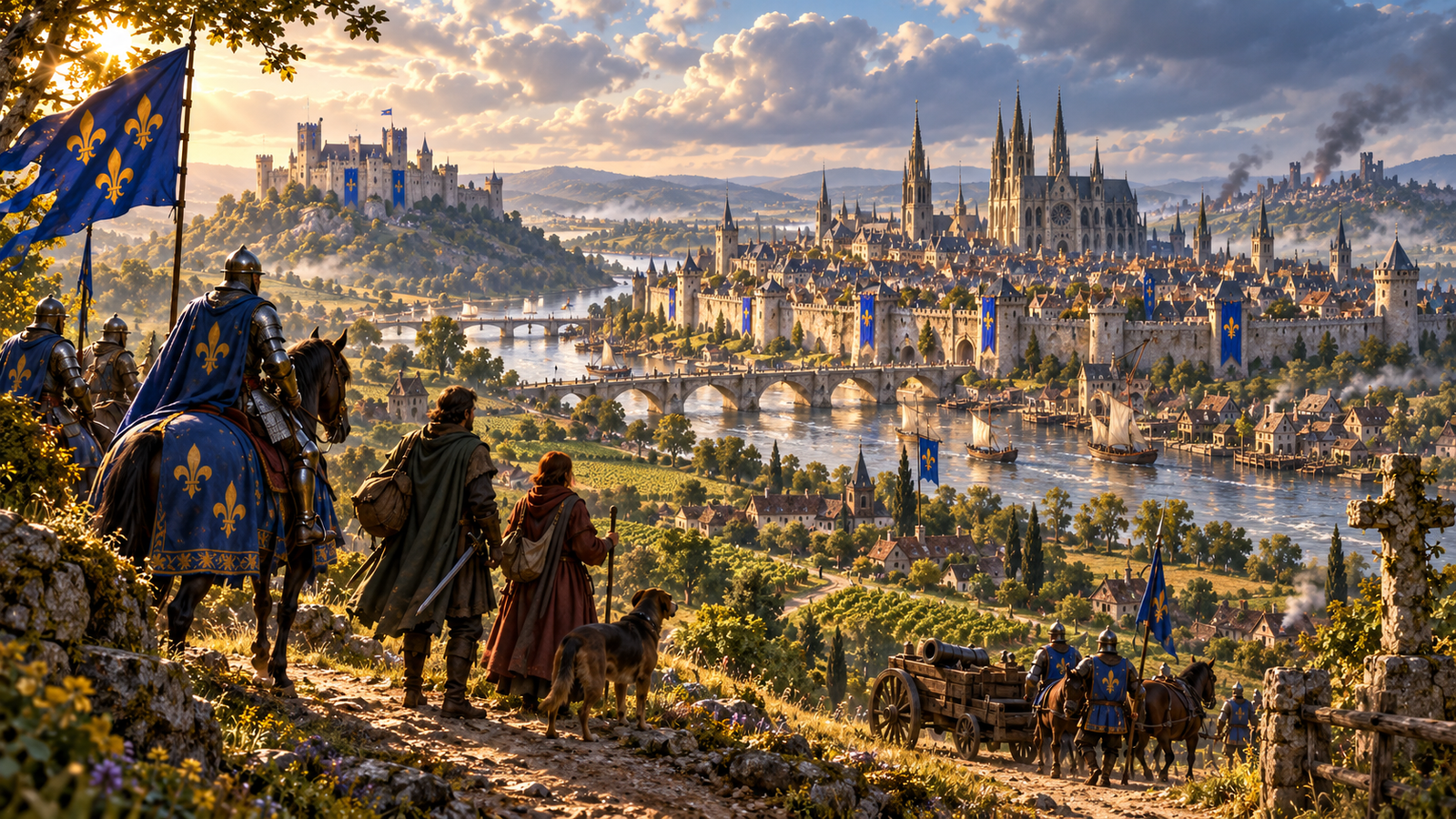
Kingdom of France hero illustration. SpiralWorlds, 2026. Original campaign artwork depicting the recovering late-medieval kingdom, royal troops, artillery, agriculture, river traffic and fortified urban France.
Kingdom of France coat of arms. SpiralWorlds, 2026. Painted interpretation of the royal arms: Azure, three fleurs-de-lis Or.
Kingdom of France campaign map. SpiralWorlds, 2026. Original campaign cartography using historical political mapping and modern physical-geography references as broad cross-checks. It is intended for game orientation rather than as a cadastral reconstruction of every feudal holding.
Rules and Licensing
The three edition panels on this regional hub are original SpiralWorlds campaign guidance. They explain how to apply familiar ability checks, skills, travel, reputation and local consequences when running adventures in France.
No portion of this France hub is designated as Open Game Content. Linked monster, NPC, settlement, spell and rules pages retain their own applicable licensing and attribution.
D&D and related rules terminology is referenced for compatibility and identification of the relevant game system. Pathfinder is referenced for compatibility with Pathfinder First Edition play.
Original SpiralWorlds setting material, campaign material, adventure hooks, page design, CSS, editorial prose, artwork and cartography Copyright © 2026 SpiralWorlds.
Keep this reference growing
If this page helped with your reading or game, you can support its upkeep or explore the curated books.
Explore the Bookshop — epics, classics and stories behind imagined worlds.