
Clopin Trouillefou — King of the Court of Miracles

Clopin Trouillefou already knows someone has betrayed the
Court of Miracles.
What he does not know is whether the information was sold to a royal officer, passed to one of
Claude Frollo’s
agents, or bought by something that has learned to imitate the city’s beggars too well.
Two of Clopin’s runners have disappeared. A stranger has begun using Court signs without permission.
Someone is paying for descriptions of
Esmeralda’s
movements through Paris. Clopin cannot investigate openly without admitting that the King of Thunes may no longer know everything happening inside his own realm.
So he needs outsiders: capable people with no established place in the Court’s rivalries, no obvious reason to protect him, and just enough self-interest to accept a dangerous bargain.
At a Glance
| Name | Clopin Trouillefou |
|---|---|
| Titles | King of Thunes; successor to the Grand Coësre; supreme suzerain of the Realm of Argot; Prince of Argot; Bishop of Fools |
| People | Human |
| Occupation | Counterfeit beggar; former thief; cutthroat and killer; underworld sovereign, judge and war leader of the Court of Miracles |
| Base | The Court of Miracles, Paris, Kingdom of France |
| Languages | French; Parisian underworld argot and cant |
| Alignment | Chaotic Neutral |
| Source Tradition | Literary and adapted — Victor Hugo‘s Notre-Dame de Paris |
| Campaign Present | 1454 CE |
What Is Clopin Doing Right Now?
Clopin is trying to discover who has learned the Court’s routes.
The first sign was a missing runner. The second was a beggar working a market pitch that belonged to somebody else while using a Court recognition sign almost correctly. The third was money: newly struck coins appearing among people who could not explain where they came from.
Now someone is asking questions about Esmeralda — where she performs, which streets she favours, where she disappears after dark and who comes looking for her.
Clopin has not sounded an alarm. Instead he has changed passwords, moved several sleepers, sent contradictory rumours through different parts of Paris and waited to see which story returns to him.
One has.
Clopin believes at least one person inside the Court is selling information. He also suspects that the buyer may not be an ordinary criminal or official. He wants the player characters to follow the false trail he has deliberately released and identify whoever comes to collect it.
Playing Clopin
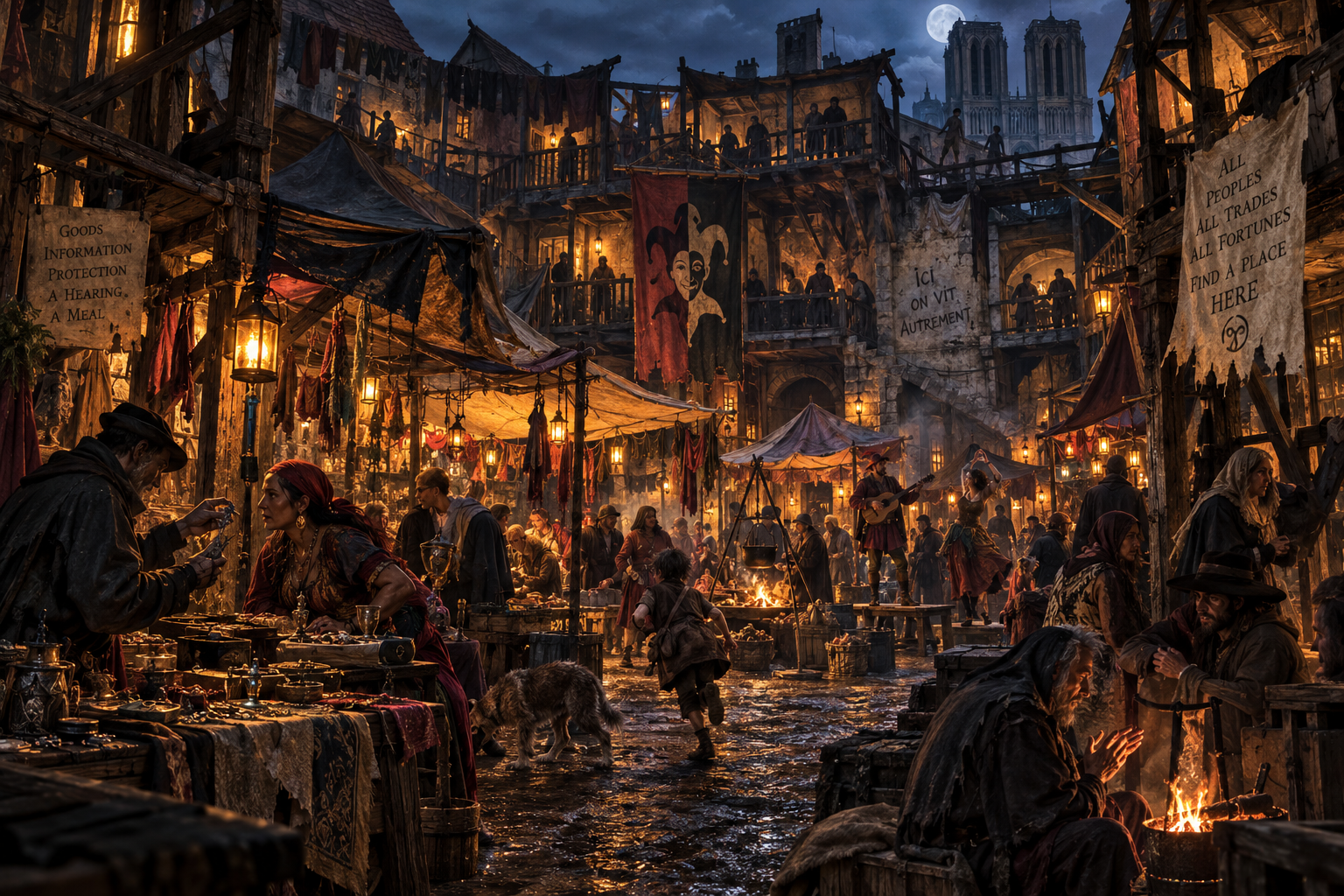
Clopin should never feel like a conventional crime lord sitting behind a desk. He is part street performer, part judge, part quartermaster, part gang captain and part mocking sovereign of a kingdom whose borders exist only because thousands of people agree that they do.
He can be funny without becoming harmless. He can threaten somebody while making the entire room laugh. He can turn a joke into a verdict, a favour into an obligation and an apparent insult into a test of nerve.
Voice and Manner
- Speaks quickly when amused and slowly when genuinely angry.
- Uses titles extravagantly, especially when mocking respectable authority.
- Rarely gives a complete explanation when half a truth will reveal what somebody really wants.
- Enjoys making visitors uncertain whether they are guests, prisoners or applicants for membership.
- Lets the Court laugh for him. If nobody laughs, the room has become dangerous.
What Earns His Respect
- Keeping a bargain after the advantage has disappeared.
- Refusing to be intimidated without becoming foolishly insulting.
- Protecting somebody weaker when no reward is obvious.
- Spotting a deception he expected to succeed.
- Bringing useful information rather than promises.
What Makes Him Dangerous
- He knows people rather than merely places.
- He can turn a crowd from spectators into participants.
- His authority is portable: a market, tavern, alley or bridge can become Court territory when enough of his people are present.
- He remembers debts and favours for years.
- He prefers several small advantages to one dramatic gamble.
What He Will Not Forgive Easily
- Selling a Court resident to an outside enemy.
- Using the Court as cover for violence that brings retaliation upon everyone.
- Stealing from the desperate and calling it cleverness.
- Giving authorities routes into places that depend on secrecy.
- Breaking sanctuary after accepting the Court’s protection.
The King of Thunes
Clopin’s kingship is deliberately absurd and completely serious.
He does not rule because of hereditary law, a royal charter or a palace guard. His crown is mock regalia. His throne may be a barrel, stone, table or whatever raises him above the crowd. His authority survives because he can settle arguments, organise people quickly, punish betrayal, distribute resources, remember who owes whom and make the Court act together when acting separately would destroy it.
That distinction matters in play. A character who laughs at the title may find Clopin laughing too. A character who assumes the title has no power because it looks ridiculous has misunderstood the entire Court of Miracles.
The Three Sovereigns of the Court
Clopin is the dominant personality of the Court, but he should not erase everybody else’s authority.
In Hugo’s original Court, three sovereign figures preside over Gringoire:
Clopin Trouillefou, Mathias Hunyadi Spicali and Guillaume Rousseau.
SpiralWorlds retains that structure because it gives the Court internal politics rather than turning it into a single gang with a single chief.
| Sovereign | Claim | Campaign Role |
|---|---|---|
| Clopin Trouillefou | King of Thunes; successor to the Grand Coësre; suzerain of the Realm of Argot | The strongest organiser, public voice and crisis leader in the Court. |
| Mathias Hunyadi Spicali | Duke of Egypt and Bohemia | Commands his own following and cannot simply be treated as one of Clopin’s subordinates. |
| Guillaume Rousseau | Emperor of Galilee | A third centre of recognised authority whose support, indifference or opposition can alter Court decisions. |
The titles are theatrical, inherited, invented, contested and politically useful all at once. Nobody outside the Court needs to recognise them. Inside it, that is irrelevant.
Clopin and the People Around Him
Esmeralda
Clopin treats Esmeralda as part of the Court’s protected world rather than as property. Her ability to move between street performers, outsiders and respectable crowds makes her useful, but that usefulness also exposes her to people who cannot reach the Court directly.
He is more suspicious than she is. When somebody begins asking questions about her, Clopin assumes purpose before coincidence.
Pierre Gringoire
Gringoire is exactly the sort of man Clopin finds both irritating and entertaining: educated enough to produce explanations for everything, impractical enough to require rescue from situations he has explained perfectly, and adaptable enough to survive among people who initially have no reason to keep him alive.
Clopin can use him as messenger, witness, intermediary or bait — often without telling Gringoire which one he is.
Quasimodo
Clopin does not underestimate Quasimodo merely because much of Paris does. The bell-ringer’s command of heights, roofs, towers and hidden approaches makes him a dangerous obstacle and a potentially invaluable ally when an adventure moves above street level.
Claude Frollo
Frollo represents the kind of enemy Clopin dislikes most: educated, patient, connected to formal authority and capable of pursuing private aims through institutions larger than himself.
Clopin may not know every part of Frollo’s purpose, but he knows enough to watch anyone who asks too many questions about Esmeralda, old Paris, forbidden knowledge or people who have disappeared.
Captain Phoebus de Châteaupers
Phoebus belongs to another Paris: armed authority, noble confidence and people who can make a street suddenly belong to the Crown. Clopin therefore treats him as both a person and a moving piece of state power.
If Phoebus enters Court business, Clopin immediately asks whether he is acting for himself, for somebody above him or simply because he has not yet understood what he has stepped into.
Jehan Frollo
Jehan is easier to admit than to control. He understands revelry, students, disorder and the joy of doing something merely because somebody respectable said not to do it. Clopin can use that energy, but he does not mistake recklessness for loyalty.
What Clopin Knows
Clopin is one of the best unofficial information sources in
France’s capital, but he does not know everything. His advantage comes from receiving hundreds of small observations that individually seem worthless.
| Clopin Can Usually Discover | What He May Demand in Return |
|---|---|
| Which markets have suddenly gained unfamiliar watchers. | A day’s discreet work for the Court. |
| Who is buying stolen goods that were previously too dangerous to move. | Recovery of an item before asking who wanted it. |
| Which guards alter their patrols for money, fear or private reasons. | Proof that the question will not bring retaliation upon Court residents. |
| Which strangers have asked for Esmeralda, Gringoire, Quasimodo or Frollo. | A name, route, message or favour of equal value. |
| Which disappearances look like ordinary Parisian violence and which do not. | Help investigating the ones that do not. |
| Who inside the Court is suddenly spending beyond their means. | Silence until Clopin decides what to do with the answer. |
Using Clopin in a Campaign
| Role | How It Works |
|---|---|
| Patron | Clopin hires people precisely because they are not known members of the Court. |
| Information Broker | He knows where to begin, who to ask and which answer is suspiciously easy. |
| Temporary Ally | A threat to Paris may also threaten the Court, forcing cooperation without trust. |
| Antagonist | The characters have endangered one of his people, crossed Court territory or brought official attention somewhere it cannot survive. |
| Judge | Characters accused of an offence inside the Court may discover that its justice is theatrical, swift and very real. |
| Wild Card | Clopin may sabotage both sides of a conflict if he believes either victory would make the Court less free. |
Game Statistics
Clopin is built as a human leader, rogue and organiser rather than a magical boss monster. Clopin alone is a CR 8 opponent. His danger comes from deception, movement, dirty fighting, experience and command. Inside the Court of Miracles, his lookouts, hidden routes, rooftop shooters, crowds, decoys and reinforcements make the overall encounter substantially more dangerous. In 5.5e, those advantages are represented by the nonmagical Court of Miracles lair actions below; they belong to the organisation and terrain, not to supernatural powers possessed by Clopin himself.
Clopin Trouillefou — 5.5e
Medium Humanoid (Human), Chaotic Neutral
Armor Class 17 (studded leather)
Hit Points 153 (18d8 + 72)
Speed 30 ft.
| STR | DEX | CON | INT | WIS | CHA |
|---|---|---|---|---|---|
| 12 (+1) | 20 (+5) | 18 (+4) | 14 (+2) | 14 (+2) | 18 (+4) |
Saving Throws Dex +8, Wis +5, Cha +7
Skills Deception +10, Insight +5, Perception +5, Performance +10, Persuasion +7, Sleight of Hand +11, Stealth +11
Senses passive Perception 15
Languages French, Parisian underworld argot and thieves’ cant
Challenge 8 (3,900 XP; PB +3)
Traits
Counterfeit Beggar. Clopin has Advantage on Charisma (Deception) checks made to pass himself off as injured, destitute, harmless or beneath notice. A creature examining a disguise or false infirmity contests Clopin’s Deception with its Wisdom (Insight).
Evasion. If Clopin is subjected to an effect that allows him to make a Dexterity saving throw to take only half damage, he instead takes no damage on a successful save and only half damage on a failed save. He can’t use this trait while Incapacitated.
Sneak Attack (1/Turn). Clopin deals an extra 21 (6d6) damage when he hits a creature with a weapon attack while he has Advantage on the attack roll, or while one of his allies is within 5 feet of the target and Clopin doesn’t have Disadvantage on the attack roll.
King of Thunes. Clopin has Advantage on Charisma checks made to command, rally, bargain with or read the mood of people who recognise the authority of the Court of Miracles. This is social authority, not supernatural compulsion.
Actions
Multiattack. Clopin makes three attacks, using his Shortsword, Dagger or Sling in any combination.
Shortsword. Melee Attack Roll: +8, reach 5 ft. Hit: 8 (1d6 + 5) Piercing damage.
Dagger. Melee or Ranged Attack Roll: +8, reach 5 ft. or range 20/60 ft. Hit: 7 (1d4 + 5) Piercing damage.
Sling. Ranged Attack Roll: +8, range 30/120 ft. Hit: 7 (1d4 + 5) Bludgeoning damage.
Dirty Fighting (1/Turn). When Clopin hits a creature within 5 feet with a weapon attack, he can deal an extra 7 (2d6) damage. If he does, the target must succeed on a DC 16 Constitution saving throw or be unable to take Reactions until the start of Clopin’s next turn. The extra damage and hindrance are nonmagical and represent a concealed weapon, thrown grit, a vicious feint or a similarly underhanded tactic.
Bonus Actions
Cunning Action. Clopin takes the Dash, Disengage or Hide action.
Court Command. Clopin chooses one ally he can see within 30 feet who can hear him. That ally can use its Reaction to move up to half its Speed without provoking Opportunity Attacks or make one weapon attack.
Reaction
Uncanny Dodge. When an attacker Clopin can see hits him with an attack, Clopin halves the attack’s damage against him.
Equipment
Studded leather concealed beneath patched clothing, shortsword, several daggers, sling, purse containing mixed coin, disguised begging props, improvised mock regalia and small tokens used to identify trusted Court messengers.
Court of Miracles Lair Actions
When Clopin fights inside the Court of Miracles and its people have had time to recognise the threat, the Court acts almost like another combatant. On initiative count 20 (losing initiative ties), Clopin can cause one of the following nonmagical effects. He can’t use the same effect two rounds in a row. These actions cease if the Court has been evacuated, its defenders are scattered, or Clopin has been cut off from his signals and routes.
Rooftop Signal. Clopin signals hidden allies. Up to two willing Court allies within 60 feet who can see or hear the signal can each use their Reaction to move up to half their Speed without provoking Opportunity Attacks. One of those allies can instead make one ranged weapon attack.
The Street Closes. Barrels overturn, shutters slam, ropes tighten and bodies flood a passage. Clopin chooses a 20-foot-square area he can see within 60 feet. Until initiative count 20 on the next round, that area is Difficult Terrain for his enemies, and the first enemy that enters the area on a turn must succeed on a DC 16 Dexterity saving throw or fall Prone.
Crossfire from Above. Sling stones, bolts and thrown debris rain from roofs and galleries. One creature Clopin can see within 60 feet must make a DC 16 Dexterity saving throw, taking 10 (3d6) Piercing or Bludgeoning damage on a failed save, or half as much damage on a successful one.
Hidden Passage. A concealed door, ladder or trapdoor opens at exactly the right moment. Clopin moves up to half his Speed without provoking Opportunity Attacks and can immediately take the Hide action. This movement must follow a physically plausible route through the Court; it is not teleportation.
Encounter note: Clopin remains CR 8 by himself. Clopin plus active Court lair actions and several capable defenders should be treated as a harder encounter appropriate to the actual creatures and environmental advantages present.
Clopin Trouillefou — Pathfinder 1e
Male human rogue 9, Chaotic Neutral
CR 8; XP 4,800
Init +5; Senses Perception +13
Defense
AC 19, touch 16, flat-footed 13 (+3 armor, +5 Dex, +1 dodge)
hp 77 (9d8 + 27 plus Toughness)
Fort +6, Ref +11, Will +4
Defensive Abilities evasion, improved uncanny dodge, trap sense +3, uncanny dodge
Offense
Speed 30 ft.
Melee masterwork shortsword +12/+7 (1d6+1/19–20) or masterwork dagger +12/+7 (1d4+1/19–20)
Ranged sling +11/+6 (1d4+1)
Special Attacks sneak attack +5d6
Statistics
Str 12, Dex 20, Con 16, Int 14, Wis 12, Cha 18
Base Atk +6; CMB +7; CMD 23
Feats Combat Reflexes, Dodge, Improved Feint, Mobility, Skill Focus (Bluff), Toughness, Weapon Finesse
Skills Acrobatics +17, Bluff +19, Climb +13, Diplomacy +16, Disguise +16, Intimidate +16, Perception +13, Perform (oratory) +16, Sense Motive +13, Sleight of Hand +17, Stealth +17
Languages French; Parisian underworld argot and cant
Rogue Talents
Bleeding Attack, Combat Trick, Fast Stealth, Surprise Attack.
King of Thunes (Ex)
Allies from the Court of Miracles within 30 feet who can see or hear Clopin gain a +2 morale bonus on saving throws against fear and a +1 morale bonus on attack rolls made as part of an ambush, coordinated withdrawal or defence of a Court resident. An ally can benefit from this ability only while it willingly recognises Clopin’s authority.
Counterfeit Beggar (Ex)
Clopin gains a +4 circumstance bonus on Bluff and Disguise checks made to present himself as injured, destitute, harmless or beneath notice.
Dirty Fighting (Ex)
Once per round when Clopin deals sneak attack damage in melee, he can forgo 2d6 points of that sneak attack damage to impose one of the following conditions on the target until the beginning of Clopin’s next turn: dazzled, deafened, or unable to make attacks of opportunity. This ability represents feints, thrown grit and concealed tricks rather than magic.
Tactics
Clopin avoids fair stand-up combat. He feints, tumbles, uses cover and allies to create sneak-attack opportunities, withdraws if isolated and turns the Court itself into an intelligence and reinforcement network rather than fighting to the death.
Gear
Masterwork studded leather, masterwork shortsword, masterwork dagger, sling with 20 bullets, disguise kit, masterwork thieves’ tools, begging props, mock regalia and assorted coin.
Clopin Trouillefou — D&D 3.5e
Male human rogue 8, Chaotic Neutral
CR 8
Init +4; Senses Listen +12, Spot +12
Defense
AC 18, touch 15, flat-footed 14 (+3 studded leather, +4 Dex, +1 dodge)
hp 44 (8d6 + 16)
Fort +4, Ref +10, Will +3
Defensive Abilities evasion, improved uncanny dodge, trap sense +2, uncanny dodge
Offense
Speed 30 ft.
Base Attack +6/+1; Grapple +7
Melee masterwork shortsword +11/+6 (1d6+1/19–20) or masterwork dagger +11/+6 (1d4+1/19–20)
Ranged sling +10/+5 (1d4+1)
Special Attacks sneak attack +4d6
Statistics
Str 12, Dex 18, Con 14, Int 14, Wis 12, Cha 18
Feats Dodge, Mobility, Skill Focus (Bluff), Weapon Finesse
Skills Bluff +18, Disguise +15, Gather Information +15, Hide +15, Listen +12, Move Silently +15, Perform (oratory) +15, Sense Motive +12, Sleight of Hand +15, Spot +12, Tumble +15
Languages French; Parisian underworld argot and cant
King of Thunes (Ex)
Court allies within 30 feet who can hear Clopin gain a +2 morale bonus on Will saves against fear and a +1 morale bonus on attack rolls during the first round of a coordinated ambush, withdrawal or defence. This is extraordinary leadership rather than a magical effect.
Counterfeit Beggar (Ex)
Clopin gains a +4 circumstance bonus on Bluff and Disguise checks made to imitate injury, destitution or harmlessness.
Dirty Fighting (Ex)
Once per round when Clopin deals sneak attack damage in melee, he may sacrifice 1d6 points of sneak attack damage to prevent the target from making attacks of opportunity until the start of Clopin’s next turn. This represents a feint, thrown grit, a concealed blade or another mundane underhanded tactic.
Tactics
Clopin relies on concealment, flanking, feints, Tumble and allies. He attacks distracted targets, refuses prolonged toe-to-toe fighting and treats a successful withdrawal as victory whenever remaining would expose the Court’s leadership unnecessarily.
Possessions
Masterwork studded leather, masterwork shortsword, masterwork dagger, sling with 20 bullets, masterwork thieves’ tools, disguise materials, begging props, mock regalia and mixed coin.
Clopin in 1454 Paris
The SpiralWorlds Clopin is not waiting for the events of 1482 to begin. He is already established in Paris in 1454, when the Kingdom of France has emerged from the Hundred Years’ War stronger but still politically uneven, crowded with armed men, displaced people, rival jurisdictions, old loyalties and new opportunities for anyone able to move between official and unofficial worlds.
That environment suits Clopin. The Court is valuable because it can absorb people the formal city cannot easily classify: itinerant labourers, performers, beggars, petty thieves, fugitives, discharged fighters, abandoned children, failed students, smugglers, migrants and people who simply need to disappear for a few nights.
Clopin’s power therefore rests on something more durable than theft. He manages information and refuge.
A stolen purse matters. Knowing which gate is watched, which innkeeper asks no questions, which official accepts money, which alley has suddenly become unsafe and which frightened stranger is lying about being followed matters much more.
Literary Origin and SpiralWorlds Adaptation
Clopin Trouillefou originates in Victor Hugo‘s Notre-Dame de Paris, first published in 1831 and set in Paris in 1482. SpiralWorlds presents Clopin in the campaign year 1454.
In the novel, Clopin first appears as a counterfeit beggar disrupting Pierre Gringoire’s performance. Gringoire later encounters him again in the Court of Miracles, where Clopin is revealed as the King of Thunes and one of three powerful sovereigns presiding over the underworld community.
Hugo gives Clopin a mixture of menace, theatrical humour, criminal violence and practical leadership. He is prepared to have Gringoire executed, explicitly describes himself as a cutthroat who kills rather than a cutpurse who steals, and later distributes weapons, forms the Court into organised ranks and commands the assault on Notre-Dame.
SpiralWorlds keeps that essential character while changing the chronology. Clopin’s authority, counterfeit begging, Court politics, rough humour, capacity for violence, loyalty to people he recognises as his own and talent for directing a crowd remain central. The campaign does not assume that Hugo’s later tragic sequence must occur exactly as written.
Later film, animation and stage adaptations may be useful inspiration, but they are not used here as primary canon. The foundation for this page is Hugo’s public-domain novel together with SpiralWorlds’ 1454 campaign adaptation.
Hugo’s Clopin: Beggar, Cutthroat and King
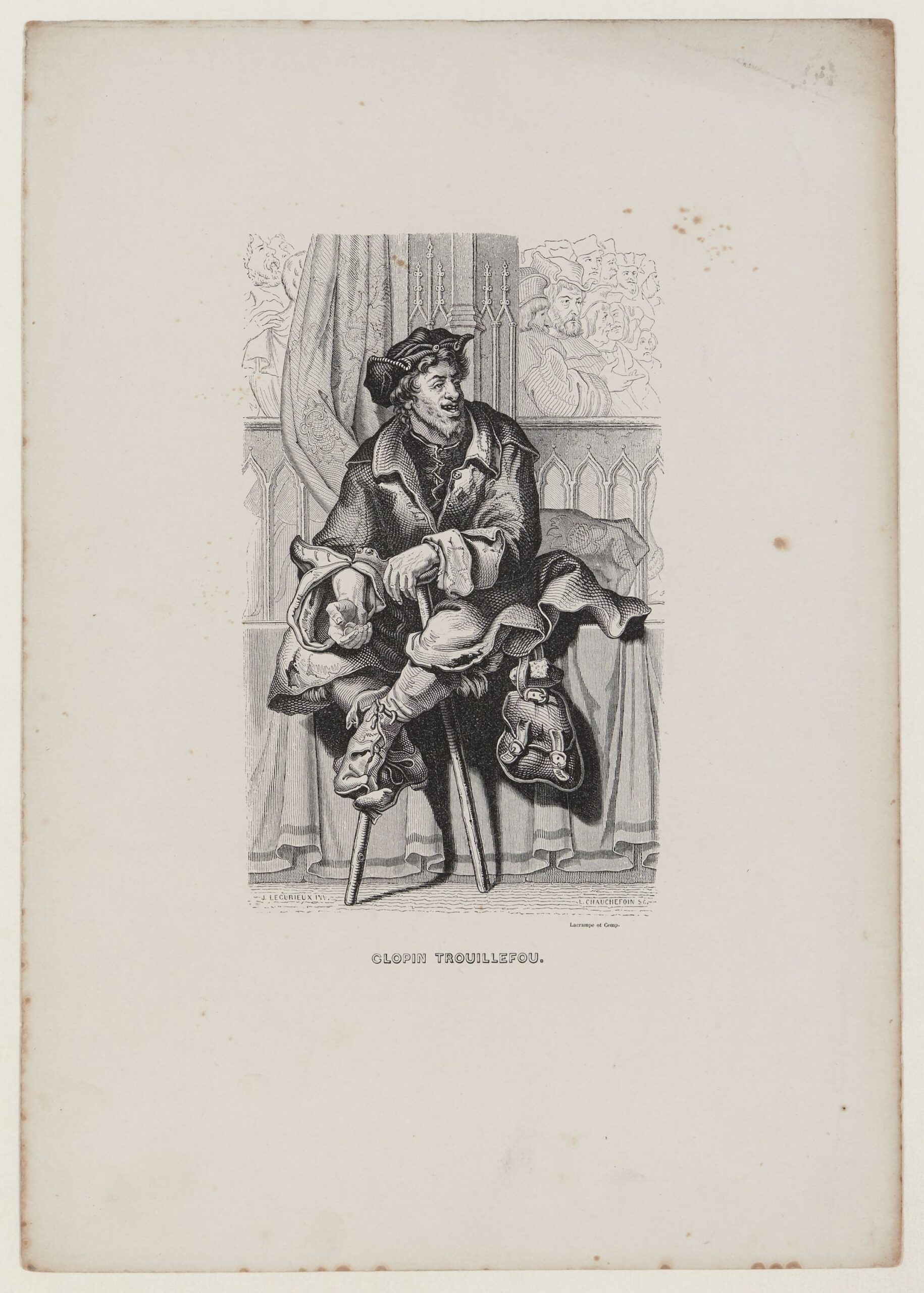
Clopin is not simply a thief with a crown. Hugo gives him several distinct identities, and they all matter.
He is a counterfeit beggar. At the Feast of Fools, Clopin openly asks for charity while displaying a supposed injury. A student recognises him and mocks the fact that the sore previously associated with his leg has somehow moved to his arm. Clopin does not break character; he keeps begging. False infirmity is therefore not an invention added by SpiralWorlds — it is one of his first acts in the novel.
He is no longer primarily a thief. This point is unusually explicit. When Gringoire lumps together vagabonds, thieves and men of the knife, Clopin angrily distinguishes himself from a common pickpocket. He says that he no longer steals, that he is above it, and identifies himself instead as a killer: “Cut-throat, yes; cutpurse, no.” The strongest source-grounded description is therefore former thief, current cutthroat and killer, not merely “master thief.”
He is a criminal sovereign and judge. In the Court of Miracles he presides over Gringoire’s case, explains the Court’s law, orders that Gringoire be hanged, supervises his test for admission to the thieves’ fraternity and stops the execution only when Esmeralda invokes the Court’s own custom. His power is judicial and organisational as much as criminal.
He is a leader of armed men. Later in the novel Clopin personally regulates the distribution of a large stock of weapons, forms the Truands into a disciplined column, gives the password for the march through Paris and commands the attack on Notre-Dame. Hugo specifically emphasises how silently and precisely his orders are obeyed. Clopin is therefore also a capable gang captain and war leader, not merely a street rogue.
Best campaign shorthand: counterfeit beggar, former thief, cutthroat/killer, King of Thunes, criminal judge, gang chief and battlefield leader.
Related People, Places and Resources
Adventure Hooks
The False Miracle
A crippled beggar throws away his crutch and runs when followed into an alley. That would be unremarkable in the Court — except Clopin has never seen him before, nobody taught him the signs he uses, and the scars beneath his bandages are not theatrical.
The Price of Esmeralda
Three different people begin paying for the same information about Esmeralda. Clopin wants to know whether they are competing buyers or three parts of the same organisation.
The Traitor’s Coin
Fresh silver appears in the Court after a runner vanishes. Clopin gives the characters three names and deliberately tells each suspect a different false secret. Their task is not to interrogate anybody. It is to watch which lie leaves the Court.
The Empty House
A family protected by the Court disappears overnight. Their door was barred from inside, their belongings remain, and neighbours heard no struggle. Clopin refuses to accept the city watch’s explanation that they simply fled.
The King’s Map
Somebody has produced a remarkably accurate map of passages, yards, roof routes and concealed entrances around the Court. Clopin wants every copy destroyed — after he learns who commissioned it.
A Crown for a Night
Clopin publicly names one player character “king” or “queen” of an absurdly specific part of the Court during a celebration. The title appears meaningless until three rival groups arrive the next morning demanding judgment in a dispute Clopin has deliberately refused to settle himself.
Sources and Further Reading
- Victor Hugo, Notre-Dame de Paris / The Hunchback of Notre Dame, Project Gutenberg: full public-domain text.
- Paris Musées, Maison de Victor Hugo — Clopin Trouillefou, c. 1844, wood engraving, CC0: collection record.
- Paris Musées, Maison de Victor Hugo — Gustave Doré, La Cour des Miracles, c. 1859, CC0: collection record.
- D&D System Reference Document 5.2.1: current open 5.5e rules reference.
- Archives of Nethys — Pathfinder First Edition rules and NPC-building references.
- d20SRD — D&D 3.5e Rogue and open rules reference.
Rules Sources and Licensing
D&D 5.5e / 2024
The 5.5e NPC is an original SpiralWorlds stat block constructed using the current SRD 5.2.1 rules framework.
This work includes material from the System Reference Document 5.2.1 (“SRD 5.2.1”) by Wizards of the Coast LLC, available at https://www.dndbeyond.com/srd. The SRD 5.2.1 is licensed under the Creative Commons Attribution 4.0 International License, available at https://creativecommons.org/licenses/by/4.0/legalcode.
Pathfinder 1e and D&D 3.5e
The Pathfinder 1e and D&D 3.5e statistics are independently written compatibility stat blocks using open rogue, combat, skill and NPC-building mechanics. Mechanical material in those two edition panels is designated Open Game Content only to the extent that it derives from material already released as Open Game Content under the Open Game License version 1.0a.
SpiralWorlds-original setting prose, 1454 campaign material, character interpretation, adventure hooks, page architecture, CSS, artwork and editorial presentation are not designated Open Game Content by this notice.
Open Game License v1.0a — applicable notice
OPEN GAME LICENSE Version 1.0a
The following text is the property of Wizards of the Coast, Inc. and is Copyright 2000 Wizards of the Coast, Inc (“Wizards”). All Rights Reserved.
1. Definitions: (a) “Contributors” means the copyright and/or trademark owners who have contributed Open Game Content; (b) “Derivative Material” means copyrighted material including derivative works and translations; (c) “Distribute” means to reproduce, license, rent, lease, sell, broadcast, publicly display, transmit or otherwise distribute; (d) “Open Game Content” means the game mechanic and includes the methods, procedures, processes and routines to the extent such content does not embody Product Identity and is an enhancement over the prior art and any additional content clearly identified as Open Game Content; (e) “Product Identity” means product and product line names, logos and identifying marks including trade dress; artifacts; creatures characters; stories, storylines, plots, thematic elements, dialogue, incidents, language, artwork, symbols, designs, depictions, likenesses, formats, poses, concepts, themes and graphic, photographic and other visual or audio representations; names and descriptions of characters, spells, enchantments, personalities, teams, personas, likenesses and special abilities; places, locations, environments, creatures, equipment, magical or supernatural abilities or effects, logos, symbols or graphic designs; and any other trademark or registered trademark clearly identified as Product identity by the owner of the Product Identity, and which specifically excludes the Open Game Content; (f) “Trademark” means the logos, names, mark, sign, motto, designs that are used by a Contributor to identify itself or its products or the associated products contributed to the Open Game License by the Contributor; (g) “Use”, “Used” or “Using” means to use, Distribute, copy, edit, format, modify, translate and otherwise create Derivative Material of Open Game Content; (h) “You” or “Your” means the licensee in terms of this agreement.
2. The License: This License applies to any Open Game Content that contains a notice indicating that the Open Game Content may only be Used under and in terms of this License. You must affix such a notice to any Open Game Content that you Use. No terms may be added to or subtracted from this License except as described by the License itself. No other terms or conditions may be applied to any Open Game Content distributed using this License.
3. Offer and Acceptance: By Using the Open Game Content You indicate Your acceptance of the terms of this License.
4. Grant and Consideration: In consideration for agreeing to use this License, the Contributors grant You a perpetual, worldwide, royalty-free, non-exclusive license with the exact terms of this License to Use the Open Game Content.
5. Representation of Authority to Contribute: If You are contributing original material as Open Game Content, You represent that Your Contributions are Your original creation and/or You have sufficient rights to grant the rights conveyed by this License.
6. Notice of License Copyright: You must update the COPYRIGHT NOTICE portion of this License to include the exact text of the COPYRIGHT NOTICE of any Open Game Content You are copying, modifying or distributing, and You must add the title, the copyright date, and the copyright holder’s name to the COPYRIGHT NOTICE of any original Open Game Content You Distribute.
7. Use of Product Identity: You agree not to Use any Product Identity, including as an indication as to compatibility, except as expressly licensed in another, independent Agreement with the owner of each element of that Product Identity. You agree not to indicate compatibility or co-adaptability with any Trademark or Registered Trademark in conjunction with a work containing Open Game Content except as expressly licensed in another, independent Agreement with the owner of such Trademark or Registered Trademark. The use of any Product Identity in Open Game Content does not constitute a challenge to the ownership of that Product Identity. The owner of any Product Identity used in Open Game Content shall retain all rights, title and interest in and to that Product Identity.
8. Identification: If you distribute Open Game Content You must clearly indicate which portions of the work that you are distributing are Open Game Content.
9. Updating the License: Wizards or its designated Agents may publish updated versions of this License. You may use any authorized version of this License to copy, modify and distribute any Open Game Content originally distributed under any version of this License.
10. Copy of this License: You MUST include a copy of this License with every copy of the Open Game Content You Distribute.
11. Use of Contributor Credits: You may not market or advertise the Open Game Content using the name of any Contributor unless You have written permission from the Contributor to do so.
12. Inability to Comply: If it is impossible for You to comply with any of the terms of this License with respect to some or all of the Open Game Content due to statute, judicial order or governmental regulation then You may not Use any Open Game Material so affected.
13. Termination: This License will terminate automatically if You fail to comply with all terms herein and fail to cure such breach within 30 days of becoming aware of the breach. All sublicenses shall survive the termination of this License.
14. Reformation: If any provision of this License is held to be unenforceable, such provision shall be reformed only to the extent necessary to make it enforceable.
15. COPYRIGHT NOTICE
Open Game License v 1.0a Copyright 2000, Wizards of the Coast, Inc.
System Reference Document. Copyright 2000, Wizards of the Coast, Inc.; Authors Jonathan Tweet, Monte Cook, Skip Williams, based on material by E. Gary Gygax and Dave Arneson.
Pathfinder Roleplaying Game Reference Document. © 2011, Paizo Publishing, LLC; Author: Paizo Publishing, LLC.
Pathfinder Roleplaying Game Core Rulebook. © 2009, Paizo Publishing, LLC; Author: Jason Bulmahn, based on material by Jonathan Tweet, Monte Cook, and Skip Williams.
Frequently Asked Questions
Who is Clopin Trouillefou?
Clopin Trouillefou is Victor Hugo’s King of Thunes, a counterfeit beggar and powerful leader within the Court of Miracles. SpiralWorlds adapts him as a major 1454 Paris NPC, information broker and underworld sovereign.
Is Clopin the only ruler of the Court of Miracles?
No. Clopin is the dominant figure, but Hugo presents him alongside Mathias Hunyadi Spicali, Duke of Egypt and Bohemia, and Guillaume Rousseau, Emperor of Galilee. SpiralWorlds retains this three-sovereign political structure.
Why is Clopin active in 1454 when Notre-Dame de Paris is set in 1482?
SpiralWorlds deliberately advances Clopin’s career by nearly three decades so that the literary Paris cast can participate in the campaign present. The page clearly separates this adaptation from Hugo’s original chronology.
How should a Games Master use Clopin?
Use him as a patron, intelligence broker, temporary ally, underworld judge or antagonist. He is most effective when his real power comes from people, information, routes, favours and crowd leadership rather than unexplained supernatural abilities.
Keep this reference growing
If this page helped with your reading or game, you can support its upkeep or explore the curated books.
Explore the Bookshop — epics, classics and stories behind imagined worlds.