
Space
Geography · The Material Plane
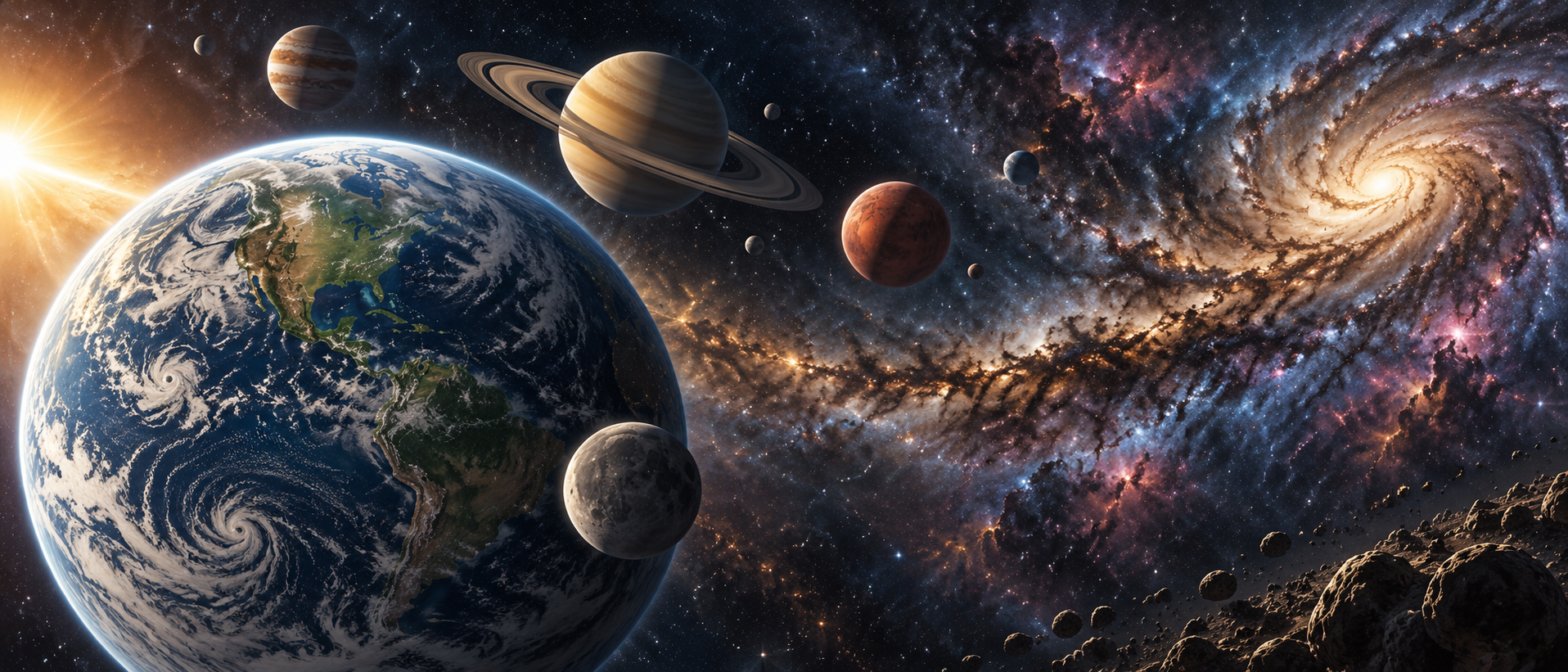
Earth is one inhabited world in an older, wider universe. Beyond its atmosphere lie the Moon, the other planets, distant stars and civilisations whose histories began before Earth formed.
The night sky is familiar to sailors, astrologers and temple astronomers. Its true distances are not. A portal in a forgotten observatory may reach a neighbouring world more quickly than a vessel crossing the dark; an ancient star chart may mark a route that vanished long before any earthly kingdom was founded.

Choose where to explore
The celestial atlas
Follow the Sun outward through the known planets, then into worlds charted only through observations, rumours or disputed records. Planet Nine is an unconfirmed astronomical hypothesis; Nibiru is an ancient name later attached to a fictional wandering-planet story. Neither is an established ninth or twelfth planet in real astronomy.
The inner Solar System
The central star, the rocky worlds and Earth’s nearest neighbour.
The giant planets
Vast atmospheres, ring systems and remote moons.
The far reaches
Dwarf worlds and disputed objects on the limits of known astronomy.
Beyond the Solar System
The wider physical cosmos, from local stars to the universe itself.
Crossing the void
Space is a physical journey, not a passage into an Outer Plane. It is not another ocean with invisible winds. Conventional sails and earthly magnetic compasses alone cannot drive or navigate a ship through a vacuum; its maker must provide actual motive power, protect the hull and keep the crew alive. The Moon is the nearest testing ground, Mars calls for an ambitious expedition, and the outer worlds demand exceptional passages or extraordinary vessels. The stars beyond the Sun lie at distances that ordinary early voyages cannot bridge.
No two kingdoms need approach the journey alike. Ming shipwrights adapt protected compartments, logistical records and long-distance navigation. Prague astronomers depend on measurement, geared instruments and experimental engines. Kemet keeps fixed gateways; the Ninefold Dominion studies captured machinery; Majapahit merchants seek repeatable trade and trustworthy pilots; Richelieu’s French office seeks secrets more often than territory. Dwarven workshops, gnome inventors, independent communities and much older extraterrestrial peoples follow their own aims.
Every expedition has to answer four questions: what brings it to this destination, what keeps its crew alive, how will it communicate with the people already there, and what brings it home? A profitable mine, a foreign ally, a recovered chart or a surviving pilot may be reason enough to go. Spacefaring Powers of 1454 follows the methods, destinations and ambitions of the different earthly programmes.
Outer Space Terrain provides older rules and background for journeys between worlds; check any edition-specific mechanics before play.
Spacefaring Powers in 1454
Explore the full Spacefaring Powers of 1454 atlas, with its six national programmes, older celestial histories, rival expeditions and routes between worlds. On the Moon, Three-Marks Refuge is a precarious Ming naval outpost, not a common port for every spacefaring people.
Earth’s great kingdoms no longer regard the heavens as an empty wilderness. Ming China’s guarded celestial fleet sends a few costly aetherships beyond Earth. Prague’s scholars test their navigational calculations and experimental vessels while Bohemian royal factions compete for the results. The catfolk temples of Kemet preserve older planetary gates and the knowledge needed to close them safely.
In Constantinople, the hobgoblin Ninefold Dominion examines devices seized after its conquest in 1453. Cardinal Richelieu’s covert French office buys and steals charts while keeping its own experiments secret. Majapahit’s court and merchant houses finance separate ventures joining island navigation to the star routes. These are rival institutions, not a single earthly fleet: each can offer something the others lack, and none can guarantee safe passage or a return voyage.
- Ming China: imperial aetherships and protected records — Imperial Celestial Fleet.
- Bohemia: Kepler, Copernicus and Tycho Brahe’s celestial calculations — Prague Celestial Project.
- Kemet: ancient planetary portals and temple custodians — Kemet’s Ancient Roads to the Stars.
- Ninefold Dominion: recovered celestial apparatus and war command — Celestial War Command.
- France: Richelieu’s secret celestial office — Richelieu’s Secret Celestial Office.
- Majapahit: merchant-funded star-sea navigation — Star-Sea Navigators.
Inhabited worlds beyond Earth have their own histories and governments. Their skies are not the property of any earthly crown, and an aethership’s successful arrival is not a claim of conquest.
The People Who Make Voyages Possible
The celestial projects depend on specialists no single crown can command. Zheng He brings generations of maritime practice to the Ming fleet, insisting that a successful departure means nothing without provisions, reliable records and a return course. Kepler, Copernicus and Tycho Brahe dispute the paths of planets in Prague. Paracelsus studies sickness, breathable air and the perils of keeping living crews inside sealed hulls.
Dwarven guilds supply pressure-tight joins and precision mechanisms, while gnomish artificers devise new instruments and dangerous experiments. English intelligence officers acquire observations without claiming a fleet equal to Ming China’s. Atlantean custodians keep older records and devices whose workings still escape modern scholars. These people retain their own loyalties and prices; a hired craftsman is not the property of the ruler funding the ship.
What the Stars Remember
Older worlds and visitors left their instruments long before the kingdoms of 1454. Kemet’s temples preserve part of that inheritance, while other crossings lie buried or guarded by powers beyond Earth. The Ming dynasty’s founding in 1368 and its great ocean voyages of 1405–1433 supplied a tradition of far-reaching navigation and logistical record-keeping. The Ninefold Dominion’s conquest of Constantinople in 1453 brought new celestial relics into hobgoblin hands. The struggles of 1454 now decide whether ancient crossings will be reopened, who may use them and whether those who depart can return.
Beyond Earth, a traveller is an arrival, not a conqueror. Inhabited worlds have their own rulers, customs and histories, and even a royal commission recognised throughout a kingdom carries no authority on a planet that has never heard of its king.
The Older Peoples of the Void
Fraal refugees, stranded on Earth for about a century, seek the damaged charts of a disputed homeworld or waypoint known to some as Planet Nine. Yithian archivists can exchange minds across eras and worlds without undertaking ordinary ship voyages. Mi-Go scientists maintain mining and biological stations and pursue their own aims. Elder Things preserve remnants of an ancient interplanetary civilisation whose settlements on Earth date back to the Archean.
These are independent peoples, not a secret alliance directing the courts of Earth. Their dealings with earthly navigators range from guarded diplomacy and trade to theft, containment and open violence. Even their surviving maps can disagree about what lies at a particular destination.
Beyond physical space
Planets and stars belong to the Material Plane. The Planes of Existence are different realities, entered through magical crossings and exceptional paths. The Multiverse concerns those realities, not a distant object in the Solar System.
Many inhabited worlds are older than Earth. Their earliest histories connect to Toward Earth and Beyond, The Dawn of Earth and the wider Timeline.
Knowledge of the heavens
Mariners steer by stars, temple astronomers record omens and mages preserve celestial routes. Their knowledge is valuable without every ancient story being literally true. The observatory, the sacred text and the traveller’s testimony may describe the same light in the sky for entirely different reasons.
Astronomical reference: NASA Solar System · Planet Nine hypothesis
Keep this reference growing
If this page helped with your reading or game, you can support its upkeep or explore the curated books.
Explore the Bookshop — epics, classics and stories behind imagined worlds.