
The Court of Miracles — Hidden Settlement of Paris
Beneath respectable Paris survives another city: a refuge, market, intelligence network and criminal counter-society ruled more by reputation than by written law.

At a Glance
| Campaign Present | 1454 CE |
|---|---|
| Location | Paris, Kingdom of France |
| Type | Hidden urban settlement, refuge and criminal counter-society |
| Dominant Sovereign | Clopin Trouillefou, King of Thunes |
| Other Recognised Sovereigns | Mathias Hunyadi Spicali, Duke of Egypt and Bohemia; Guillaume Rousseau, Emperor of Galilee |
| Population | Variable. Several hundred people may sleep, shelter, work or trade through the connected yards during a busy night, but the population constantly changes. |
| Languages | Middle French predominates. Travelling halfling households use local speech alongside family argots, trade signs and route-cants rather than a single racial language. Educated residents may know Latin. Parisian argot and thieves’ cant serve as coded forms of communication. |
| Authority Outside the Court | Royal and civic officers centred upon the Grand Châtelet and the authority of the Prévôt of Paris. |
| Known For | Begging networks, fugitives, performers, thieves, fences, information brokers, hidden lodging, coded speech and people who know how to disappear inside Paris. |
| Campaign Tone | Urban intrigue, pursuit, hiding places, divided loyalties, survival, black markets, social disguise and secrets that move faster than official messengers. |

By daylight the lane appears to end in collapsed sheds, stacked barrels, laundry and a cart whose broken wheel has apparently not moved in months. After sunset the cart shifts. A door opens behind it. Two children vanish through a gap between buildings, somebody whistles from an upper gallery, and the dead end becomes an entrance.
Beyond it lies another Paris.
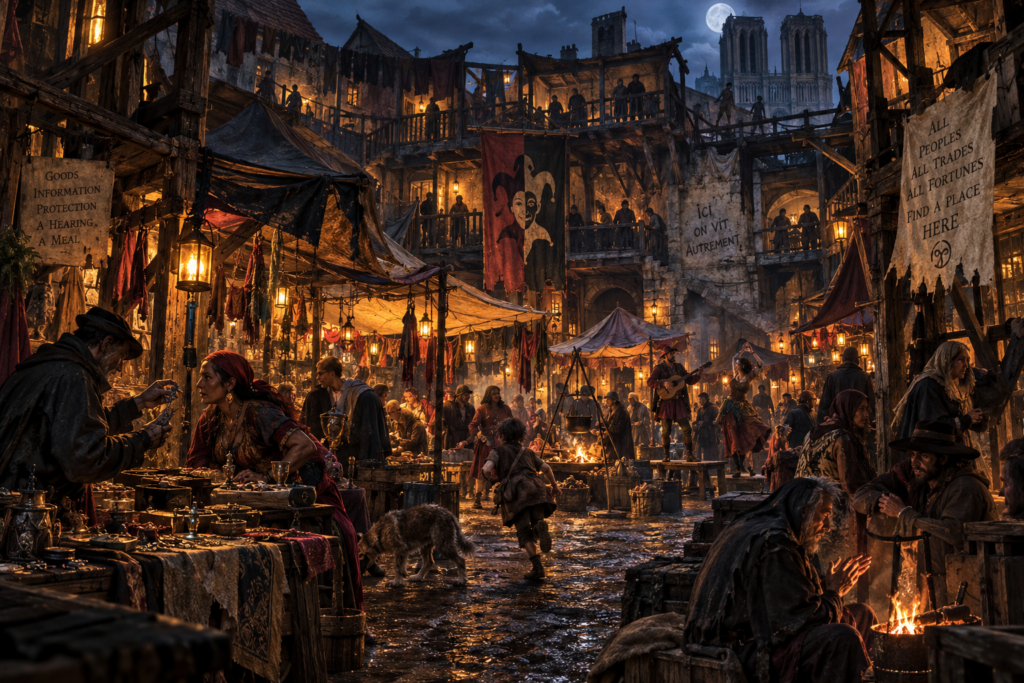
Cookfires burn beneath leaning timber galleries. Stolen cloth dries beside honestly mended shirts. A fiddler competes with three arguments and a crying baby. Labourers returning from casual work share space with travelling performers, hawkers, fugitives, thieves, widows, wounded veterans, displaced families, beggars, former students, fences and people who would rather not explain their names.
Somewhere in the crowd a man who limped through Paris all day now walks normally. Twenty paces away, somebody who really cannot walk is repairing a purse while laughing at him.
This is the Court of Miracles.
It is not simply a thieves’ den and it is not a romantic kingdom of the poor. It is a settlement created by people whom respectable Paris finds useful, dangerous, embarrassing or disposable. Some residents commit crimes. Some survive because criminals protect them. Some want nothing to do with crime at all.
All understand that official Paris can enter their streets far more easily than they can enter official Paris on equal terms.
At the centre of the Court’s public life stands Clopin Trouillefou. He calls himself a king because Paris already has enough respectable titles. The joke stops being funny when he gives an order and an entire courtyard falls silent.
Yet Clopin is not the Court’s only sovereign. Mathias Hunyadi Spicali and Guillaume Rousseau possess recognised authority of their own. Court politics therefore depend on alliance, reputation and practical power rather than simple obedience to one chief.
What Is Happening Right Now?
The Court is not waiting for adventurers to arrive. Several problems are already moving through it.
Someone Is Mapping Esmeralda’s Life
Esmeralda still performs openly in Paris with Djali.
Somebody has begun asking the wrong questions: where she sleeps, which streets she prefers, who warns her about patrols, when she returns to the Court and which hidden entrances she uses.
Esmeralda thinks this may be another admirer, enemy or frightened gossip. Clopin does not.
The information is too systematic. Someone is not merely following a girl. Someone is learning how the Court itself connects to the rest of Paris.
Clopin Needs People He Does Not Own
Clopin needs a task completed outside the Court without sending any of his recognised people. A familiar face would reveal that the Court is involved. A royal officer would bring questions. A professional criminal might simply sell the information twice.
Adventurers are useful precisely because they are outsiders.
Esmeralda can make the introduction. Clopin will make the offer. Neither intends to explain everything at the first meeting.
A Raid Is Being Prepared Too Carefully
Ordinary patrols are inconvenient. This is different.
A clerk connected to the city’s judicial machinery has been asking about property boundaries, rear doors, adjoining workshops and cellar ownership. A sergeant has quietly paid for information concerning night traffic. Somebody has obtained a sketch showing one of the Court’s escape routes.
Clopin can survive a raid.
What concerns him is that somebody appears to be planning one using information that should only be available from inside.
Running the Court at the Table
The Court works best when access, trust and consequences matter more than random combat. Characters can enter it quickly with a recognised guide. Arriving armed, uninvited and demanding information produces a very different experience.
The Court of Miracles — 5.5e Urban Play
Do not require a check for ordinary interaction once the characters have been accepted. Checks matter when access, secrecy, pursuit or somebody’s trust is genuinely uncertain.
| Situation | Typical Check | DC |
|---|---|---|
| Locate a hidden Court entrance without a guide | Wisdom (Perception), Intelligence (Investigation) or an appropriate social approach | 15 |
| Recognise Court signs, lookout behaviour or coded warnings | Wisdom (Insight) or Intelligence (Investigation) | 13 |
| Gain an introduction to a fence, guide or information broker | Charisma (Persuasion) or Charisma (Deception) | 15 |
| Conceal somebody from an active search | Dexterity (Stealth), Intelligence (Investigation) or Charisma (Deception) | 15–20 |
| Detect an informer or contradictory story | Wisdom (Insight) | 15 |
| Escape through the Court during a raid | Dexterity (Acrobatics), Strength (Athletics), Wisdom (Perception) or Dexterity (Stealth) | 15 |
| Reach Clopin without an introduction after causing trouble | Usually not a single check; requires leverage, service or a trusted intermediary | 20+ |
Court Heat
Use Court Heat when the characters repeatedly attract attention. Begin at 0.
- 0 — Unknown: nobody important cares who they are.
- 1 — Noticed: lookouts begin remembering faces.
- 2 — Watched: strangers shadow the party and contacts become cautious.
- 3 — Closed Doors: ordinary Court services become unavailable without an intermediary.
- 4 — Clopin Decides: the characters are summoned, expelled, used, tested or deliberately handed a problem.
Helpful service can reduce Heat. Betrayal, leading officers into the Court or harming protected residents can raise it immediately.
The Court of Miracles — Pathfinder 1e Urban Play
| Situation | Useful Skills | Typical DC |
|---|---|---|
| Find an entrance without a guide | Knowledge (local), Perception, Diplomacy | 15 |
| Read a lookout or suspected informer | Sense Motive | 15 |
| Gather information without exposing the real question | Diplomacy, Bluff | 15–20 |
| Arrange false identity, concealed lodging or covert passage | Bluff, Disguise, Knowledge (local) | 18 |
| Move through the Court unseen | Stealth | Opposed by Perception or DC 15 |
| Escape during a raid or blocked alley | Acrobatics, Escape Artist, Climb, Stealth | 15–20 |
| Secure a personal audience with Clopin | Diplomacy, Bluff, Intimidate or recognised service | 20+ |
Failure should usually create exposure, delay, debt or suspicion rather than simply making the Court inaccessible.
The Court of Miracles — D&D 3.5e Urban Play
| Situation | Useful Skills | Typical DC |
|---|---|---|
| Locate the Court through street contacts | Gather Information, Knowledge (local) | 15 |
| Identify coded behaviour or a false story | Sense Motive, Knowledge (local) | 15 |
| Convince a resident to introduce the party | Diplomacy or Bluff | 15–20 |
| Travel through the Court unnoticed | Hide, Move Silently, Disguise | Opposed or DC 15 |
| Create or detect false papers | Forgery, Sense Motive, appropriate Knowledge | 15–20 |
| Escape through a blocked route | Escape Artist, Climb, Jump, Balance | 15–20 |
| Reach Clopin after angering the Court | Gather Information plus Diplomacy, Bluff or leverage | 20+ |
A failed check should change the situation: somebody learns what the characters want, a contact demands payment, an informer becomes interested or a safe route becomes temporarily unusable.
The Court Is Not One Courtyard
Outsiders imagine a single hidden square packed with criminals. The reality is more difficult to destroy.
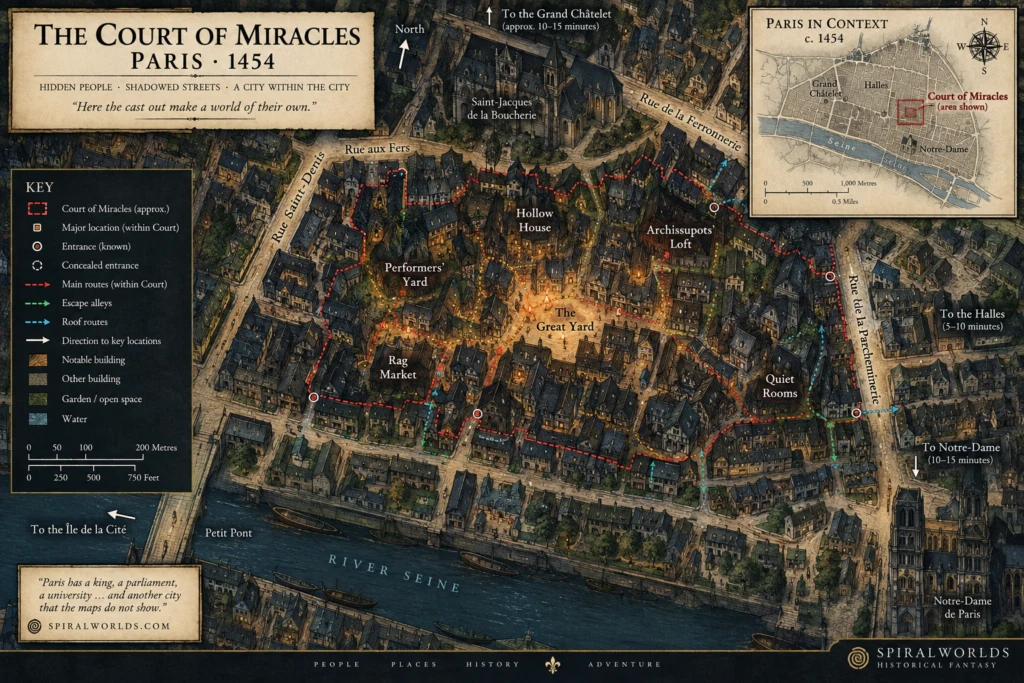
The Court is a connected cluster of cramped yards, workshops, rented rooms, lean-to shelters, cellars, passages and concealed entrances within the crowded fabric of Paris. Its exact boundaries depend upon whom one asks.
Clopin’s authority is strongest around the central gathering places and weakens into streets where ordinary tradespeople, landlords and residents share space with people attached to the Court.
This uncertainty is deliberate.
A raid against one yard does not eliminate the network. A searched house does not reveal every cellar. A landlord may genuinely know nothing about the passage behind his wall. A child carrying bread may also know three ways to reach Clopin without using a public street.
The Court is physically part of Paris. It is not a supernatural pocket realm. Its greatest defence is social geography: knowing which doors open, which roofs connect, which staircases terminate in somebody else’s kitchen and which apparent dead ends are only dead ends for strangers.
Entering the Court
With an Invitation
The easiest way in is to arrive with somebody already known. Esmeralda, a recognised runner, a performer, a trusted fence or one of Clopin’s people can turn a suspicious arrival into an ordinary visit.
Weapons are not automatically confiscated. Paris is full of armed men. What matters is whether the newcomers behave like guests or like the first five soldiers of a force waiting around the corner.
Without an Invitation
A stranger searching too obviously discovers something important about the Court before ever finding it:
Paris watches back.
Street sellers notice repeated questions. Children remember descriptions. A beggar moves to another corner. Somebody follows the searcher for half a street and then disappears.
By the time an adventurer finds a genuine entrance, the Court may already know who is coming.
During a Pursuit
The Court is at its most dangerous when somebody tries to force entry while chasing another person.
Doors close. Furniture moves. A washing line falls across an alley. A rooftop runner signals ahead. The fugitive is passed from household to household while pursuers are channelled toward a yard with one visible exit and four invisible witnesses.
A character who believes the Court has merely “lost” the fugitive has probably misunderstood what happened.
Who Lives Here?
The Court is poor, but poverty is not a profession.
Its residents include people with real disabilities, beggars who exaggerate or invent injuries, casual labourers, widows, orphaned children, displaced families, performers, petty traders, craftsmen without guild protection, former soldiers, migrants, servants between households, debtors, thieves, fences, confidence tricksters, prostitutes, runaways, failed students, messengers and people hiding from private enemies.
These categories overlap. They do not make everybody interchangeable.
A woman who sells stolen cloth may also feed three unrelated children. A genuine beggar may hate counterfeit beggars for damaging public sympathy. A thief may refuse to rob within the Court because the people there know his mother. A former student may be capable of forging a Latin document while being unable to afford supper.
Clopin’s genius is not that he makes these people obedient. It is that he persuades enough of them that the Court survives only if they do not destroy one another faster than Paris can.
Power Inside the Court
The Three Sovereigns
The Court recognises three theatrical but politically meaningful sovereigns. Their titles have no standing in royal law. Inside the Court, that hardly matters.
| Sovereign | Claim | Role Inside the Court |
|---|---|---|
| Clopin Trouillefou | King of Thunes; successor to the Grand Coësre; suzerain of the Realm of Argot | The strongest organiser, public voice, intelligence broker and crisis leader. |
| Mathias Hunyadi Spicali | Duke of Egypt and Bohemia | Commands his own following and represents a centre of authority that Clopin cannot simply order about. |
| Guillaume Rousseau | Emperor of Galilee | A third recognised sovereign whose support, neutrality or opposition can change the outcome of Court disputes. |
Clopin Trouillefou
Clopin is King of Thunes, Prince of Argot, Bishop of Fools and the dominant personality of the Court.
Some titles are jokes. Some are insults reclaimed as honours. All reinforce the same point: when the Court requires a single voice in a crisis, Clopin intends that voice to be his.
He is not a feudal monarch. He owns no legal jurisdiction and commands no formal city office. His authority depends on information, favours, reputation, personal courage, long memory and the willingness of other people to accept his settlements.
Clopin can hide a fugitive, ruin a thief’s access to fences, call witnesses, close doors, move information through Paris and make somebody discover that every useful street contact has suddenly become unhelpful.
That is often more useful than a crown.
Mathias Hunyadi Spicali
Mathias Hunyadi Spicali, Duke of Egypt and Bohemia, represents an authority older and more independent than the idea that every Court resident belongs to Clopin.
He commands his own following, carries particular weight among travelling families and possesses an established protective relationship around Esmeralda.
Clopin may be the Court’s dominant public figure. Mathias is not his lieutenant.
Guillaume Rousseau
Guillaume Rousseau, Emperor of Galilee, forms the third point of the Court’s sovereign triangle.
His importance is political rather than administrative. When the Court is divided, his support can give one faction legitimacy, prevent a decision from becoming universal or force Clopin to negotiate rather than command.
The Court becomes more interesting when its sovereignty is untidy.
The Archissupots
The Court preserves the title archissupot for educated rogues, failed scholars and former students who know how respectable Paris speaks, writes and thinks.
They teach argot, decode official language, recognise seals, read notices, compose letters, expose crude forgeries and explain the behaviour expected in places where a badly chosen word can reveal that somebody does not belong.
They are useful precisely because the boundary between the University, the street and the criminal world is more porous than polite Parisians like to admit.
Households, Lookouts and Runners
Most Court authority is much smaller than a title.
A woman who controls six sleeping spaces matters. A boy who knows which sergeant is approaching matters. A fence with three merchant contacts matters. A cook who can feed twenty people on credit matters.
A grandmother whom half the yard trusts may matter more during a dispute than somebody calling himself a prince.
The Court works because authority is distributed until a crisis forces it to concentrate.
Places Inside the Court
The Great Yard
The nearest thing the Court possesses to a public square. Fires, benches, barrels and temporary stalls can be removed quickly when needed. Clopin addresses large gatherings here, disputes are heard here and strangers requiring public judgement are often brought here.
The Rag Market
Clothing, boots, belts, blankets, pots, tools, buckles, scraps of armour and objects whose previous owners may still be looking for them change hands here. Honest second-hand goods and stolen property are deliberately difficult to distinguish.
The Archissupots’ Loft
A cramped upper room filled with discarded documents, damaged books, practice signatures, scraps of seals, old notices and phrases copied from legal or commercial writing. It is part classroom, part forgery workshop and part archive of how Paris speaks to itself.
The Common Pot
Not an inn. A large cooking area where food is pooled, traded, purchased collectively or stretched further than respectable cooks would consider possible. News circulates here because almost everybody eventually needs to eat.
The Performers’ Yard
Musicians, tumblers, storytellers, dancers and animal trainers practise away from hostile crowds. Esmeralda and Djali are familiar sights here, although Esmeralda does not maintain one predictable sleeping place.
The Hollow House
A building whose interior has been altered so many times that the visible staircase is not the most useful way through it. Partition walls conceal crawlspaces, one upper room opens into the neighbouring structure and the cellar provides an emergency route during searches.
The Quiet Rooms
A changing set of sleeping places reserved for people who must disappear for a night or two. Access is controlled through personal trust. A character cannot simply pay at the door and rent anonymity.
The Back Ways
The Court’s most valuable possession is not treasure but routes: cellars, yards, roof connections, rear doors and passages through properties whose owners may or may not know exactly how often they are used.
People of the Court and Its Boundaries
Not every famous Parisian associated with the Court lives inside it. That distinction matters.
| Person | Relationship to the Court | Use in Play |
|---|---|---|
| Clopin Trouillefou | Dominant sovereign and permanent centre of Court authority. | Patron, judge, information broker, dangerous ally or political obstacle. |
| Mathias Hunyadi Spicali | Duke of Egypt and Bohemia; recognised sovereign with his own following. | Independent authority, travelling networks, protection and internal Court politics. |
| Guillaume Rousseau | Emperor of Galilee and the third recognised Court sovereign. | Broker, counterweight to Clopin, swing voice in disputes or unexpected patron. |
| Esmeralda and Djali | At home among the Court’s people but independent of any single faction. Moves regularly between the Court and public Paris. | Guide, intermediary, performer, witness, ally or person in immediate danger. |
| Pierre Gringoire | Court resident and tolerated educated outsider whose fortunes repeatedly draw him into Court life. | Writer, intermediary, witness and source of complications. |
| Jehan / Joannes Frollo | A Court-associated resident and student-world connection. Easy to admit, much harder to control. | Unreliable companion, troublemaker, student contact or source of information that arrives attached to another problem. |
| Quasimodo | Not a Court resident. His connection comes principally through Esmeralda and his unmatched knowledge of the upper city. | Rooftop witness, rescuer, messenger and master of routes the Court itself does not control. |
| Captain Phoebus de Châteaupers | Outsider connected to armed authority and to Esmeralda. His arrival inside the Court would immediately attract attention. | Personal complication, official pressure, military contact or reason for Clopin to become suspicious. |
| Claude Frollo | External threat. His interest in Esmeralda and knowledge of Paris make him dangerous without making him part of the Court. | Investigator, occult manipulator, patron of intermediaries and persistent source of pressure. |
What Can Adventurers Find Here?
| Service | What the Court Can Provide | The Catch |
|---|---|---|
| Information | Street movements, patrol habits, rumours, missing people, servants’ gossip, who bought unusual goods and who suddenly stopped appearing. | The Court knows street Paris better than court politics. Information may also create an obligation. |
| Hidden Lodging | A room, cellar, loft or borrowed sleeping space where somebody can disappear temporarily. | Trust matters more than money. |
| Disguise | Clothes, dirt, props, false occupational identities, altered posture and coaching. | Looking poor is easier than behaving convincingly like somebody who has lived a particular life. |
| Fencing | Buyers for ordinary stolen goods and introductions for more dangerous property. | Famous, magical or politically sensitive items attract specialists and questions. |
| Messages | Small messages can cross Paris through runners who appear unrelated. | Secrecy increases cost and time. |
| False Papers | Basic letters, introductions, copied handwriting and crude documentary disguises. | A serious royal seal or high-level warrant requires expertise beyond ordinary street forgery. |
| Guides | Alleys, markets, river approaches, night routes, roofs and neighbourhood boundaries. | Guides refuse destinations likely to bring officers back to their households. |
| Healing | Practical wound care, herbs, midwifery, splinting and knowledge acquired through necessity. | Serious injuries still require skilled treatment; poverty does not create miraculous medicine. |
Magic in the Court
The name Court of Miracles does not mean that every apparent miracle is supernatural.
Some are deliberate performances. A false cripple stands upright after a day’s begging. A supposedly blind man counts his coins. A woman covered in convincing sores washes away the mixture that produced them.
Others are simple misunderstandings. A trained animal appears unnaturally intelligent. A skilled herbalist heals something a frightened stranger thought incurable. A disguise succeeds because the observer wanted to believe it.
Real magic also exists.
Minor charms, practical illusion, concealed messages, warding signs, divination and learned magical techniques circulate through Paris like any other specialised knowledge. The Court occasionally shelters practitioners who cannot or will not work openly.
That does not make the Court a magical marketplace.
A stranger arriving and asking to buy forbidden magic from “the criminals” is more likely to meet a liar than a wizard.
Law, Raids and the Grand Châtelet
The Court exists inside a city with functioning law.
The Prévôt of Paris and the judicial machinery centred upon the Grand Châtelet possess officers, investigators, clerks, sergeants, prisons, records and the authority of the Crown.
Their reach is imperfect rather than imaginary.
That makes a serious investigation dangerous.
A drunken patrol can be avoided. A clerk who identifies who legally owns three connected buildings is harder to misdirect. A sergeant carrying a description is inconvenient. An investigator carrying names, witness statements and an authorised search becomes a threat to everyone who provided shelter.
Why the Authorities Do Not Simply Destroy the Court
Because the Court is not a fortress with a flag over the gate.
Destroying it would require identifying every household, distinguishing residents from neighbours, proving offences, keeping suspects from moving, preventing information from leaking and convincing landlords and local interests to cooperate.
It would also destroy a source of intelligence.
Officers sometimes use informants from the same world they publicly condemn. Merchants sometimes recover stolen goods through people they would never invite into their houses. Wealthy households sometimes employ servants who know exactly where to find the Court when discretion matters.
Paris dislikes the Court.
Paris also uses it.
Rules the Court Actually Enforces
The Court possesses no clean written constitution. Its rules survive through reputation, precedent and the sovereigns’ ability to make consequences believable.
- Do not lead a raid home. Anybody knowingly guiding hostile officers into protected spaces faces severe consequences.
- Do not create unnecessary bodies. Murder attracts more attention than theft and gives officials reasons to search harder.
- Respect declared protection. If a recognised Court authority publicly places somebody under protection, harming that person becomes a challenge to the authority itself.
- Pay witnessed debts. The Court cannot function if every transaction becomes a knife fight.
- Settle internal theft before it becomes feud. Stealing from outsiders is one thing. Repeatedly robbing the people who share your escape routes is bad business.
- Information belongs to somebody. Selling the same dangerous secret to opposing sides may be profitable once.
Punishments range from repayment and public humiliation to exclusion from services, loss of protection, beating, expulsion or—in extreme cases—death.
Clopin prefers punishments that preserve the Court. A corpse cannot repay anything.
Dangers Inside the Court
The Court is safer for some people than the streets outside it. That does not make it safe.
Predatory Criminals
Not everybody respects the sovereigns, and some obey only while watched. Newcomers carrying visible wealth attract exactly the sort of people who make the Court’s reputation believable.
Informers
City officers, private enemies and political networks all pay for information. The most dangerous informer is not a stranger but a resident who already knows which detail matters.
Fire
Timber, cloth, crowded rooms, cookfires and narrow access routes make fire one of the Court’s worst possible disasters. A deliberate blaze could kill more people than a raid.
Disease
Crowding and poverty create real medical danger. The existence of counterfeit illnesses does not make genuine sickness disappear.
Urban Monsters
A predator that understands crowds can hunt people nobody expects the authorities to search for. A missing beggar produces less official pressure than a missing councillor.
The Wrong Secret
The Court hears things. Knowing which royal officer visits which house, which merchant is bankrupt or which official bought forbidden services can be more dangerous than carrying stolen silver.
Rumours and Adventure Hooks
The Map of Esmeralda
A boy steals a scrap of parchment from a stranger and brings it to Clopin. It contains no treasure map. It marks Esmeralda’s known performance places, three routes toward the Court and the hours when she normally disappears from public streets.
The Informer Who Does Not Exist
Clopin receives three warnings apparently sent by a trusted lookout. The lookout denies sending any of them. All three warnings were correct.
The False Royal Warrant
Officers arrive with a convincing order authorising the seizure of one particular resident. The document is forged—but the seal impressed upon it appears genuine.
The Empty Room
A fugitive vanishes from a protected room without using the door. Clopin first suspects betrayal. The wall behind the bed is colder than it should be.
The Archissupot’s Book
An old notebook contains examples of signatures, phrases and official formulae copied over thirty years. Someone is murdering former students to find one particular page.
The Bell-Ringer’s Warning
Quasimodo sends a warning through Esmeralda: somebody has been watching the Court’s roof routes from above.
The Child With the Signet
A frightened child offers to sell the adventurers a noble signet ring. Clopin wants to know where it came from before anybody buys it.
The Fire at the Wrong Time
A blaze begins in an abandoned shed just as city officers approach from the opposite direction. Accident, diversion and assassination are all possible.
The Man Who Really Was Healed
A beggar famous for pretending to be lame wakes one morning to discover that an old injury which genuinely hurt him for years has vanished overnight. He is terrified rather than grateful.
Clopin’s Missing Runner
One of Clopin’s best runners disappears between two streets only minutes apart. No officer arrested him. No body appears. His last message contained only four words: Do not use the door.
Using the Court in a Paris Campaign
The Court works best as a recurring location rather than a dungeon cleared once.
Characters who help it should gradually acquire faces they recognise: the same cook, the same suspicious lookout, the same child carrying messages, the same elderly resident who always knows when somebody is lying.
Characters who exploit it should discover the opposite.
Doors stop opening.
Nobody knows anything.
The useful fence has moved.
A guide who once charged silver now claims never to have met them.
The Court’s real power is not combat strength. It is the ability to decide whether Paris feels like a maze full of allies or a maze full of witnesses.
The Court, Paris and the Wider World
The Court exists because Paris is large enough to hide contradictions.
The capital contains royal officials, scholars, merchants, craftsmen, soldiers, wealthy households, servants, markets, travellers and people arriving from across the kingdom.
Every layer produces information and every layer produces people who fall out of it.
The Court collects both.
That makes it relevant to more than street crime.
A Burgundian agent can disappear here. A royal clerk can sell a document. A noble servant can reveal which guest arrived after midnight. A scholar can quietly purchase a manuscript. A thief can unknowingly steal an object that belongs to something much older than France.
The Court is a local settlement with national consequences whenever the wrong secret crosses its threshold.
Historical and Literary Context
The Historical Courts of Miracles
Paris genuinely developed places later remembered as cours des Miracles, associated particularly with poverty, begging, marginal communities and criminal folklore.
The famous organised Court described by later writers belongs to evidence substantially later than the SpiralWorlds campaign year.
Ollivier Chereau’s Le Jargon ou Langage de l’Argot réformé, known from surviving editions around 1630, helped establish the colourful literary picture of an organised beggar society with ranks, jargon and an underworld Court. Henri Sauval later repeated and developed such material in his history of Paris.
The page therefore does not claim that historians possess documentary evidence for Clopin’s Court operating in its literary form in 1454.
Victor Hugo’s Medieval Court
Victor Hugo made the Court of Miracles one of the great locations of Notre-Dame de Paris.
His story is set in 1482 and gives the Court its famous literary inhabitants and sovereigns, including Clopin Trouillefou, Mathias Hunyadi Spicali and Guillaume Rousseau.
Hugo was writing in the nineteenth century and was not producing a neutral archaeological reconstruction of fifteenth-century Paris. His Court is a literary creation drawing on medieval Paris, later traditions, social history and Romantic imagination.
The SpiralWorlds Adaptation
SpiralWorlds deliberately moves the central Court of Miracles characters and conflicts into the campaign present of 1454.
Within campaign canon, an organised hidden Parisian underworld already exists under its three recognised sovereigns, with Clopin as its dominant organiser and public personality.
Later writers preserve, distort and popularise traditions surrounding such communities.
This lets the campaign use Clopin, Esmeralda, Gringoire, Jehan and their Parisian world now without pretending that every element of Hugo’s literary Court is documented history for 1454.
Gustave Doré and the Literary Court
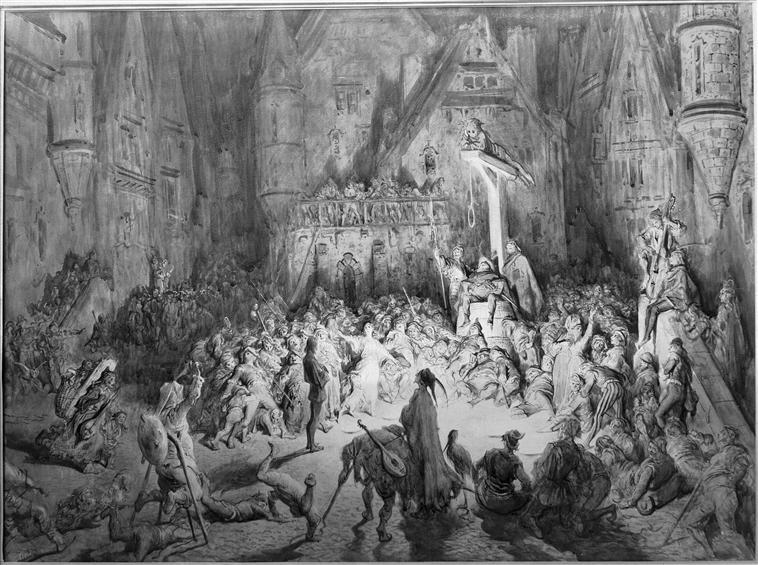
Gustave Doré’s famous nineteenth-century interpretation of the Court remains worth preserving, but it belongs here in the literary history rather than serving as documentary evidence for the appearance of Paris in 1454.
Video and Table Atmosphere
The existing medieval-slum ambience recording remains useful as optional table atmosphere rather than historical evidence.
Continue Through SpiralWorlds
| Destination | Use It For |
|---|---|
| Paris | The capital surrounding the Court: royal authority, markets, scholars, streets and major urban locations. |
| Kingdom of France | The wider 1454 political and campaign setting. |
| Notre-Dame de Paris | The cathedral, its towers, Quasimodo and another major centre of the Paris campaign. |
| Clopin Trouillefou | The Court’s dominant sovereign, organiser and principal information broker. |
| Esmeralda | Performer, intermediary and one of the Court’s strongest connections to public Paris. |
| Pierre Gringoire | Poet, playwright and Court resident. |
| Jehan / Joannes Frollo | Student, troublemaker and connection between the Court and the unruly student world. |
| Quasimodo | The upper city, rooftops, bells and a different network of hidden Parisian routes. |
| Captain Phoebus de Châteaupers | Armed authority and one of Esmeralda’s most dangerous personal entanglements. |
| Claude Frollo | Occult and judicial pressure surrounding Esmeralda and Paris. |
| French NPCs | The wider character collection for Paris and France. |
| Guilds, Factions and Organisations | The Court’s place among the political, criminal, mercantile and supernatural organisations of 1454. |
| Rogue | Edition-specific rogue mechanics, infiltration, thieves’ tools and thieves’ cant. |
Sources, Artwork and Compatibility
Primary Literary Source
Victor Hugo’s Notre-Dame de Paris is the principal literary source for Clopin, Esmeralda, Pierre Gringoire, the three Court sovereigns and the famous medieval literary Court.
Read the public-domain text at Project Gutenberg .
Historical Context
The organised “Realm of Argot” described in later sources belongs to a later documentary tradition. Ollivier Chereau’s Le Jargon ou Langage de l’Argot réformé survives in seventeenth-century editions and is an important source for the later literary conception of the Court.
FranceArchives — Ollivier Chereau, Le Jargon ou Langage de l’Argot réformé .
Gustave Doré
Paris Musées identifies Gustave Doré’s La Cour des Miracles as a drawing produced around 1859 for Victor Hugo’s Notre-Dame de Paris. The museum record makes the reproduction available as CC0.
Paris Musées — Gustave Doré, La Cour des Miracles, c.1859 .
SpiralWorlds Canon
The current Clopin Trouillefou page establishes the three-sovereign Court structure, Clopin’s current 1454 investigation, his relationship with Esmeralda and the Court’s role as refuge and intelligence network.
The Kingdom of France page identifies the Court of Miracles as an active Parisian underworld power in the campaign present.
The Guilds, Factions and Organisations index classifies the Court of Miracles as a current criminal counter-society · Paris.
New SpiralWorlds Artwork
The hero, Paris civic arms, campaign map and Court night-market illustration are original SpiralWorlds campaign assets created for this page.
The campaign map is an adventure aid rather than documentary historical cartography. The Paris shield identifies the surrounding city and should never be described as the Court’s own heraldry.
Rules and Compatibility
The three edition panels on this page are original SpiralWorlds campaign guidance for investigation, reputation, concealment, social access and pursuit inside the Court of Miracles.
The 5.5e panel uses terminology compatible with the current fifth-edition rules framework. Pathfinder First Edition and D&D 3.5e are identified for compatibility with those systems.
No portion of the original Court of Miracles setting prose, campaign interpretation, adventure hooks, page architecture, CSS, original artwork or cartography is designated Open Game Content by this page.
Original SpiralWorlds setting material, campaign material, adventure hooks, page design, CSS, editorial prose, original artwork and cartography Copyright © 2026 SpiralWorlds.
Keep this reference growing
If this page helped with your reading or game, you can support its upkeep or explore the curated books.
Explore the Bookshop — epics, classics and stories behind imagined worlds.