
The Low Countries — Burgundian Courts and Free Cities
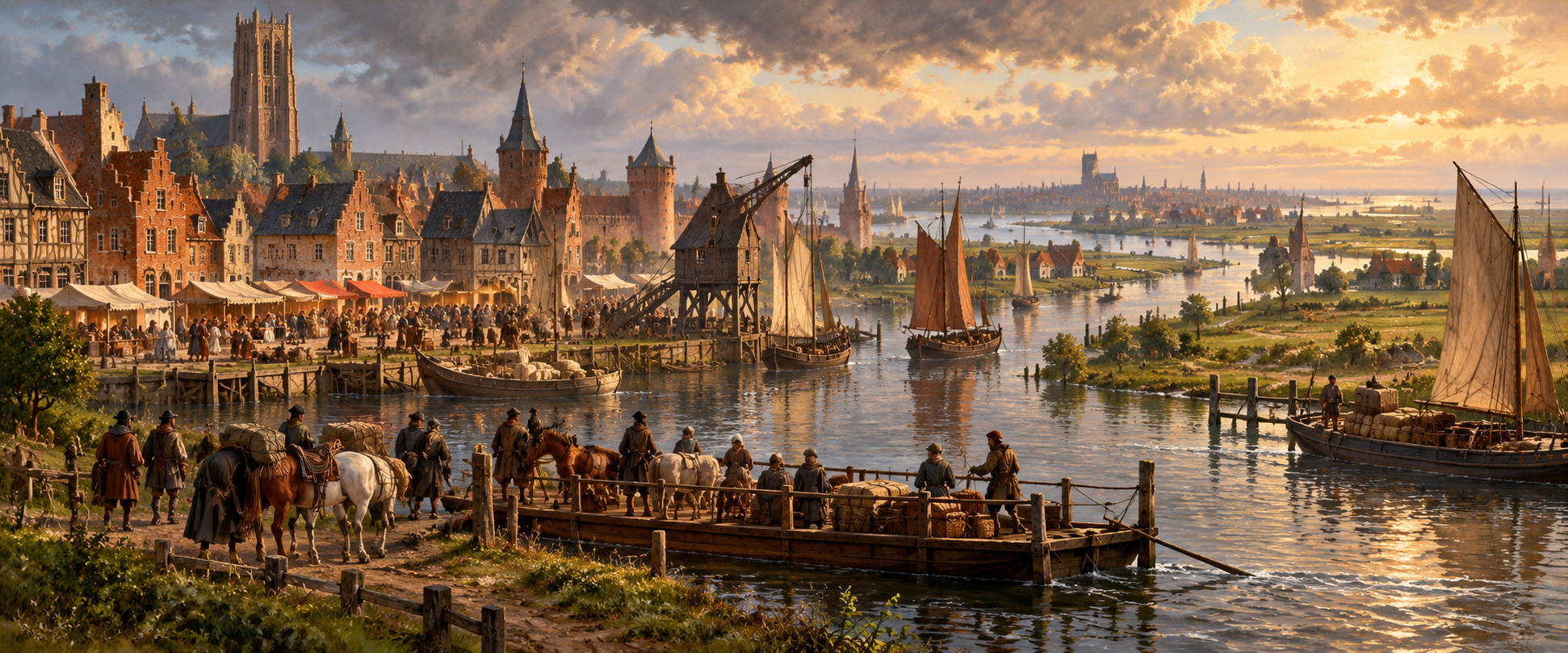
The Low Countries · Between the North Sea and the Rhine
At a Glance
| Great Power | Philip the Good, Duke of Burgundy, controls a composite group of territories including Flanders, Artois, Brabant, Hainaut, Holland, Zeeland, Namur and Luxembourg. |
|---|---|
| Independent and Contested Powers | The prince-bishop of Utrecht, the Duke of Guelders, Frisian communities and some northern cities retain their own institutions and allegiance. |
| Imperial and Royal Claims | Most principalities are imperial fiefs; Flanders and Artois have important feudal relationships with the French crown. Philip’s possessions are held together by his person, not by one uniform kingdom. |
| Political Pattern | Composite duchies, counties, lordships and prince-bishoprics with town councils, estates and merchant privileges. |
| Trade | Flemish cloth, Dutch and Zeeland shipping, fish, grain, salt, cattle, river tolls and northern European maritime commerce. |
| Sacred Traditions | Household and ancestor cults, river and sea gods, civic temples, regional polytheistic orders and old protective spirits. |
| Adventuring | Secret toll agreements, guild feuds, disputed succession, smuggling, dangerous waterways, court diplomacy and ancient coastal shrines. |
Follow the smell of hot dye from a Flemish cloth shop towards the waterside, where skippers shout over crates of fish and wool. To the north, ferries slip between low islands and wet meadows; further inland, market carts cross the rivers towards stone-walled towns. You can find work on a boat, shelter in a merchant house or trouble beyond the next flooded road. The lands are crowded with people, old sacred places and rival powers, but no two harbours feel quite the same.
Arriving in the Low Countries
You rarely travel far without meeting water. In Flanders, narrow streets lead from crowded cloth markets to the quays. Near Bruges, ships use the Zwin and its smaller ports to reach the sea; local pilots know which channels are deep enough for a loaded boat. Further north, Zeeland’s ferries carry people and livestock between low islands and wet banks. A journey that takes a day in calm weather may be delayed for several days by wind, floodwater or a missing ferryman.
Bring dry clothes, enough coin for crossings and a clear idea of where your goods will be stored. A boatman can recommend a sheltered berth; a cartwright can replace a broken wheel; guild contacts may help at the larger markets. Local temples and household shrines offer another way to ask for protection before a dangerous crossing. A city pass will not guarantee help in a distant marsh village.
Choose Your First Stop
- Trade and workshops: start in Flanders for cloth markets, canals, crowded inns and rich patrons.
- Boats and flood country: head into Zeeland, where pilots, ferries and tidal weather decide how far a party can go.
- The freer north: begin in Groningen or cross the heath of Drenthe to meet traders, spirits and travellers beyond Burgundy’s direct reach.
What Is Happening Right Now?
A Grounded Cargo at the Zwin
A grain boat bound for Bruges has run aground near the Zwin’s smaller harbours. The crew claims the channel changed overnight. Merchants want their sacks carried overland, but a local pilot says the cargo was moved before the tide fell. Find out who took it, hire carts or wait for the water to return. The missing grain is already driving up the price of bread nearby.
The Shut Dye House at Ghent
Dyeworkers in Ghent have locked their doors after a Burgundian officer demands a new payment on their supplies. Cloth merchants need finished fabric before the next river convoy leaves. A forewoman named Lieve will open the workshop if the workers receive what they are owed. Her rivals offer the party a different job: guard the next shipment and find who has been stealing dye on the road.
Danger on the Frisian Water
Along the Zuiderzee, traders hear that Grutte Pier’s Black Hope of Arum has struck another ship. A small ferry turns back rather than face armed vessels, leaving travellers stranded on the shore. A coastal family offers shelter to Pier’s wounded men, while a Burgundian agent offers coin for their names. The decision may decide which harbour welcomes the party next.
Territories Under the Burgundian Duke
The following lands are linked through the rule of Philip the Good, but keep their own laws and political institutions.
- Flanders and Artois — cloth wealth and complicated French feudal obligations. Ghent’s guilds are still recovering from their defeat at Gavere in 1453, while Arras and its neighbours guard separate Burgundian privileges.
- Brabant, Limburg and Mechelen — inland courts and strategic towns.
- Hainaut, Holland and Zeeland — territories whose claims came into Burgundian hands by 1433.
- Namur and Luxembourg — strategically important inland holdings.
The Burgundian Netherlands page follows this composite court and its ministers more closely.
Other Rulers and Freedoms
- Utrecht Prince-Bishopric — Rudolf van Diepholt and its chapter, estates and towns form a distinct imperial religious principality.
- Guelders and Zutphen — Duke Arnold of Egmont’s possessions, still separate from Burgundy.
- Frisian Freedom, East Frisia and Groningen — coastal liberties, conflicting chieftain claims, Ulrich Cirksena’s consolidation and the disputed royal style of Johann II rather than one united Frisian state.
- Overijssel and Drenthe — northern communities shaped by local law and the wider interests of Utrecht’s prince-bishop, not ducal Burgundy.
Places, Routes and Powers
The Flemish cloth towns attract dye makers, merchants and professional advocates. The ports and estuaries of Holland and Zeeland bring sailors and cargoes from the North Sea. The inland courts of Brabant carry influence across the wider Burgundian possessions. Utrecht and Guelders provide alternative patrons for travellers fleeing ducal officers. Along coastal marshes, a local guide’s knowledge of tides may matter more than any lord’s title.
Humans form many city guilds and households; dwarven craftsmen, halfling river traders, gnome scholars and older fey powers also move through the markets, marshland and hidden water routes. Local beliefs and non-human presence differ from city to city rather than falling under one invented regional ruler.
Two Further Adventures
- Lost in the Scheldt. A pilot ferrying an envoy to a tidal shrine has not returned. The boat lies empty on a patch of sand that vanishes at high water. Find the pilot’s trail before the estuary covers it; the envoy’s attendants know more than they are saying.
- Utrecht’s Secret Guest. A scholar fleeing Burgundian riders reaches a riverside inn with a sealed case of letters. She needs passage out of the duchy’s reach. The ferryman will help, but he has already been questioned, and the next crossing will be watched.
Travel and Weather
Ask about the tide before hiring a ferry across the Scheldt or the Zeeland channels. Cargo boats take longer than travelling on horseback, but carry more food and equipment. Rain can turn a marsh track into a stream; a coastal gale may keep a vessel in harbour for days. Carry enough coin for local services, find a pilot who knows the landing stages and arrange a dry place for supplies before dusk.
Earlier and Later History
Philip gained Brabant and Limburg in 1430, secured Holland and Zeeland by 1433, and obtained control of Luxembourg in the 1440s. Burgundy does not yet mean every province of the Low Countries. The Seventeen Provinces as a formal later grouping, Charles V and Philip II of Spain, the Dutch Revolt, the Union of Utrecht in 1579 and the Dutch Republic all belong to future history. They are not present political institutions.
The Duchy of Burgundy lies beyond the Low Countries. In the neighbouring Free County, Countess Adeline rules Dole despite Philip’s rival claim. Besançon retains separate imperial privileges. None is a Low Countries province.
Low Countries — Regional Campaign Locator
Find a place to begin. Select a settlement to open its region’s gazetteer entry. The locations are shown in roughly north-up order; the locator omits borders and travel distances.
All 13 map places — accessible text links
For historical territorial reconstruction, see the Royal Netherlands Academy’s Historical Atlas of the Low Countries; it is more reliable for disputed boundaries than an adventure locator.
Historical Sources
The Burgundian history of Holland describes Philip’s acquisitions and the competing maritime interests. The Valois-Burgundy territorial chronology explains the composite dominion. Britannica’s Union of Utrecht reference places the later revolt-era institutions in the sixteenth century. For the canals and merchant streets of Bruges, see UNESCO’s Historic Centre of Brugge; for the medieval tidal route to the sea, see The Lost Harbours of the Zwin. For a scholarly comparison of trade and waterways in Flanders, Holland and Zeeland, see Counts, Cities and Commerce.
Keep this reference growing
If this page helped with your reading or game, you can support its upkeep or explore the curated books.
Explore the Bookshop — epics, classics and stories behind imagined worlds.