
Beauty and the Beast NPC: The Winter Rose Tale
In the vanished lordship of Valombre, a stolen rose, a cursed lord, and a brave merchant’s daughter reveal the terrible difference between love, debt, mercy, and possession.
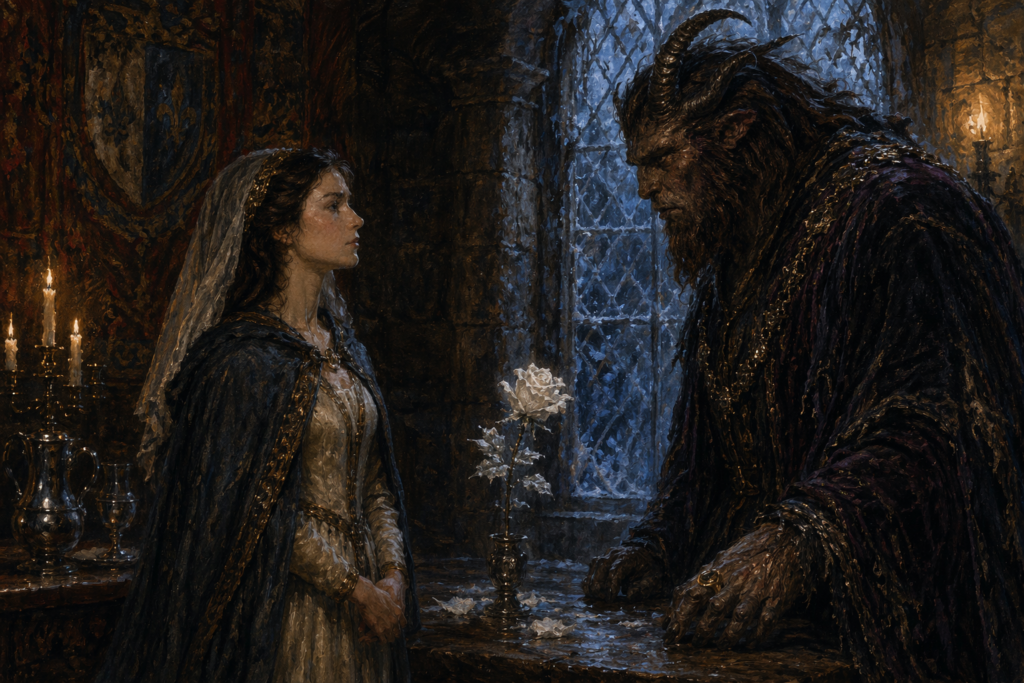
In the eastern marches of the Kingdom of France, near the old Champagne–Burgundy borderlands, there are roads that no honest map keeps for long. Travellers speak of pale orchards under frost, of a castle glimpsed at dusk beyond black trees, and of white roses blooming in winter where no rose should live. This is Valombre, a vanished seigneurie whose last lord was Sire Aurelian de Valombre, now remembered as the Beast of the Winter Rose.
The tale begins with two failures of hospitality. The first belonged to Aurelian himself. Proud, beautiful, and praised too early in life, he mistook rank for virtue and refinement for mercy. When a stranger came to his gates during a winter storm and asked for shelter, he refused her. By dawn, the lord of Valombre had been transformed into the visible shape of his hidden nature: horned, furred, powerful, and terrible.
The second failure came years later, when a ruined merchant lost his way in the same winter wood. The Castle of the Winter Rose received him with warmth, food, firelight, and silence. No host appeared. No servant demanded payment. Yet at dawn, thinking of his youngest daughter, Isabeau de Valfleur, the merchant plucked one pale rose from the castle garden.
The Beast appeared then, not as a mindless monster, but as an injured lord whose house had been violated after giving shelter. He accused the merchant of theft and ingratitude. The rose was no ordinary flower. It was bound to the curse itself, a living measure of judgment, mercy, and release. To take it was to touch the deepest wound of Valombre.
In fear, the merchant promised what no father should promise: that his daughter would come in his place. Yet that promise has no true power unless Isabeau chooses to answer it. She is not ransom, property, payment, or cure. She enters the castle by her own will, whether to save her father, answer the bargain, uncover the truth, or confront the injustice hidden beneath both theft and punishment.
Within the castle, Isabeau finds no simple villain and no harmless victim. The Beast is courteous, dangerous, ashamed, lonely, and capable of sudden rage. He can offer protection, learning, wealth, and wonder, but he must also learn that love cannot be demanded as compensation for suffering. Isabeau sees him clearly enough to pity him, challenge him, resist him, and perhaps love him — but never blindly.
The curse of the Winter Rose is not broken by beauty alone, nor by a kiss given at the correct hour. Love may reveal the road out of the curse, but it cannot walk that road for the Beast. The decisive act is release: the moment when he chooses mercy over possession, truth over pride, and another’s freedom over his own salvation.
At the table, the Winter Rose tale should not be treated as a simple romance or a simple monster hunt. It is a story of hospitality broken twice: first by the lord who refused shelter, then by the guest who stole from the house that saved him. It is also a story of moral sight. The player characters may find themselves protecting Isabeau, bargaining with the Beast, uncovering Valombre’s vanished history, judging the fairness of the curse, or deciding whether redemption remains possible after real harm has been done.
Used well, Beauty and the Beast becomes more than a tale of love conquering ugliness. It becomes a campaign pressure point: what is owed after mercy, what cannot be bought with pity, and whether a monster can become human again without first being allowed to own the person who sees him.
Beauty and the Beast NPCs: Editions
Isabeau de Valfleur 5.5e 2024
The Beast of the Winter Rose
Isabeau de Valfleur Pathfinder /3.5
The Beast of the Winter Rose Pathfinder /3.5
Isabeau de Valfleur

Common Epithet: Beauty
Other Names: The Beauty of Valombre, the Rose-Guest, the Merchant’s Youngest Daughter
Gender: Female
Race: Human
Occupation: Merchant’s daughter, reader, negotiator, reluctant guest of an enchanted castle
Religion: Local French folk piety and household devotions, shaped by the old powers of forest, hearth, threshold, and winter wood
Allies: The Beast of the Winter Rose, if he proves worthy of trust; the Hearth-Mother; the truth-bearing mirror of the East Gallery; sympathetic members of the enchanted household
Enemies: False rescuers, possessive suitors, cruel villagers, opportunistic nobles, and any who treat her as ransom, property, or prize
Abode/Base of Operations: Her father’s merchant household; later, by choice or circumstance, the Castle of the Winter Rose
Nationality: French
Languages: French, local trade dialects, and courtly Latin
Alignment: Neutral Good
Affiliations: The Valfleur household; the Winter Rose tale; the enchanted household, if she chooses to aid them
Significant Relationship: Sire Aurelian de Valombre, the Beast of the Winter Rose, if their bond develops through freedom rather than possession
Overview
Isabeau de Valfleur is the youngest daughter of a ruined French merchant, remembered in the Winter Rose tale by the old epithet Beauty. Her name survives not only because she was lovely, though she was, but because she could look upon terror without surrendering judgment.
Her father’s misfortune brings the tale to her door. Lost in the winter woods of Valombre, he receives shelter from the unseen household of the Castle of the Winter Rose and then plucks a pale rose from its garden. When the Beast demands restitution, the frightened merchant promises what no father should promise: that his youngest daughter will come in his place. Yet Isabeau is not owned by that bargain. The tale becomes meaningful only when she chooses to answer it.
She enters the castle with fear, anger, compassion, and resolve all present at once. She understands that the Beast is dangerous, that her father’s promise was unjust, and that the castle’s wonders may conceal as much as they reveal. Her courage lies in remaining clear when others would flee, flatter, or submit.
Within the Castle of the Winter Rose, Isabeau becomes a living challenge to the curse. She sees the wounded lord inside the Beast, but she also sees the pride, rage, and possessiveness that helped make him monstrous. She may pity him, speak with him, challenge him, forgive him, or come to love him, but none of these things can be demanded from her as payment.
Appearance
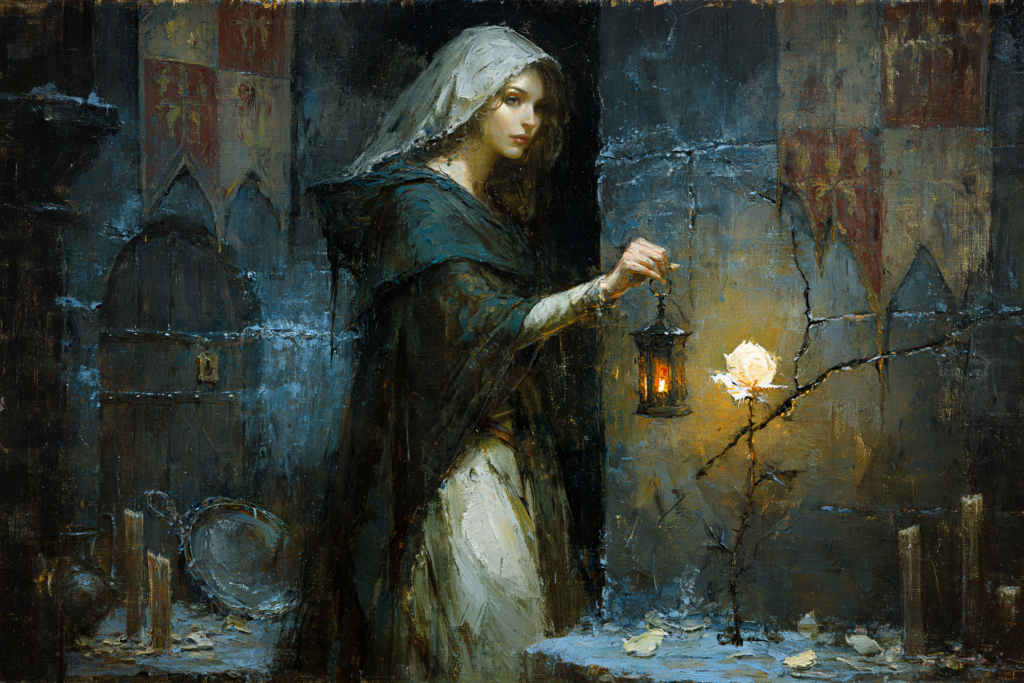
Isabeau is very beautiful, but not in the manner of an idle court ornament. She has the composed bearing of someone accustomed to household work, family difficulty, trade accounts, and careful speech. Her beauty is sharpened by intelligence rather than softened by innocence.
She dresses as the daughter of a respectable merchant family: plainly beside noblewomen, but well-kept and chosen with care. Her gown may be of good wool or faded silk, mended skilfully at the hem and sleeve. Her veil, ribbon, or girdle is modest but clean. Her hands may show ink, thread, travel, or household labour.
Her eyes are often the first thing others remember: steady, attentive, and difficult to deceive. Inside the Castle of the Winter Rose, her warmth and mortality stand out against tarnished silver, cracked mirrors, candlelit stone, and rooms too long preserved from ordinary life.
Personality and Voice
Isabeau’s greatest strength is clear compassion. She can feel pity without letting pity command her. She can recognise pain without excusing cruelty. She can see the Beast’s loneliness and still name his rage.
She is courageous, but not fearless. She may tremble before the Beast’s roar, but she will still ask the next question. She may grieve for her father, but she will not pretend his bargain was just. She may enter the castle willingly, but she does not mistake sacrifice for surrender.
Isabeau speaks plainly, though not crudely. She is courteous when courtesy is deserved, careful when danger requires it, and unexpectedly sharp when someone mistakes her kindness for weakness. With the Beast, she is neither fawning nor cruel. She challenges him most effectively when she refuses to speak to the monster alone and addresses the man still hidden inside it.
Dialogue Cues
- “My father’s fear made the promise. I came because I chose to answer it.”
- “You may be wronged, my lord, and still be wrong.”
- “I am not the rose he stole.”
- “If you want truth from me, do not punish me for giving it.”
- “I can pity you without belonging to you.”
- “Let me leave freely, and I will know whether I wish to return.”
Role in the Curse
Isabeau can affect the curse because she sees clearly and acts freely. She is not a magic key, sacred object, ransom, or reward for the Beast’s suffering. Her love cannot be demanded, purchased, inherited, bargained for, or used as payment for a stolen rose.
Her power lies in moral sight. She can name what the Beast hides from himself. She can recognise when his courtesy is genuine and when it is another form of control. She can leave, and her leaving may teach him more than her staying.
The curse weakens when the Beast responds to Isabeau’s freedom with mercy rather than possession. If he allows her to depart without threat, the Winter Rose may brighten. If he apologises without demanding forgiveness, a locked room may open. If he protects her without claiming her, the castle may remember warmth. If he accepts her refusal, one of the household spirits may regain a name.
Using Isabeau at the Table
Isabeau gives the party a human centre inside the enchanted tale. She can explain what brought her to the castle, what she has seen, and what she fears may happen if the Beast fails.
As an ally, she is strongest in social scenes, investigation, negotiation, and moral decisions. She can read servants, interpret the Beast’s mood, recognise false courtesy, and push the party toward questions violence cannot answer.
As a hostage who is not helpless, she may be physically endangered but should never be passive. She can hide messages, mislead enemies, bargain for time, comfort frightened servants, and refuse to cooperate with anyone who treats her as property.
If the party tries to “return” her, “claim” her, “trade” her, or use her as leverage, they repeat the logic of the curse. Isabeau works best when her choices are allowed to matter.
Isabeau de Valfleur
Medium Humanoid, Neutral Good
Armor Class 15
Hit Points 66
Speed 30 ft.
| STR | DEX | CON | INT | WIS | CHA |
|---|---|---|---|---|---|
| 10 (+0) | 16 (+3) | 14 (+2) | 16 (+3) | 18 (+4) | 17 (+3) |
Saving Throws Dex +5, Wis +7, Cha +6
Skills History +6, Insight +10, Investigation +6, Perception +7, Persuasion +9, Religion +6
Senses passive Perception 17
Languages French, local trade dialects, courtly Latin
Challenge 4 (1,100 XP)
Traits
Unbought Heart. Isabeau has advantage on saving throws against being Charmed or Frightened, and against curses or enchantments that would force affection, forgiveness, marriage, loyalty, or willing captivity.
Clear-Sighted Compassion. Isabeau has advantage on Wisdom (Insight) checks made to discern grief, shame, fear, remorse, possessiveness, concealed cruelty, or false courtesy.
Reader of Old Tales. Isabeau has advantage on Intelligence (History, Investigation, or Religion) checks related to curses, fairy bargains, enchanted castles, hospitality taboos, old noble houses, and folklore trials.
Moral Witness. When a creature Isabeau can see within 30 feet makes a Charisma check to confess, apologise, bargain honestly, plead truthfully, or reveal an emotionally difficult truth, Isabeau can grant that creature a +1d4 bonus to the roll. She cannot use this trait to aid Deception.
The Courage to Leave. Isabeau has advantage on ability checks and saving throws made to escape restraints, resist imprisonment, leave an enchanted location, or overcome magical hospitality that attempts to keep her in a place against her will.
Clear Before the Curse, 1/Day. When Isabeau fails a Wisdom or Charisma saving throw against a curse, Enchantment, Illusion, fear effect, or magical coercion, she can choose to succeed instead. When she does, one creature of her choice within 30 feet that can see or hear her gains advantage on its next saving throw against the same effect before the end of its next turn.
Actions
Dagger. Melee or Ranged Weapon Attack: +5 to hit, reach 5 ft. or range 20/60 ft., one target. Hit: 5 (1d4 + 3) Piercing damage.
Raise the Lantern. Isabeau raises a lantern, candle, or other clear light and chooses one creature, object, or magical effect she can see within 30 feet. Until the start of her next turn, Isabeau and one ally of her choice have advantage on ability checks made to recognise an illusion, concealed emotional truth, disguised creature, hidden writing, secret door, or curse mark connected to the target.
Speak the Truth. Isabeau chooses one creature within 30 feet that can hear and understand her. The creature must make a DC 15 Wisdom saving throw. On a failed save, it cannot willingly speak a deliberate lie to Isabeau until the end of her next turn. The creature may remain silent, refuse to answer, or evade the question.
Name the Wound. Isabeau chooses one creature within 30 feet that can hear her and is hiding shame, grief, fear, remorse, or possessive desire. The creature must succeed on a DC 15 Charisma saving throw or have disadvantage on the next attack roll it makes before the end of its next turn. If the target is the Beast of the Winter Rose, he instead has disadvantage on the next attack roll he makes against a creature that has not harmed him this round. A creature immune to being Charmed is immune to this effect.
Call for Mercy, Recharge 5–6. Isabeau chooses up to three creatures within 30 feet that can hear and understand her. Each target gains advantage on the next saving throw it makes against being Charmed, Frightened, or affected by an Enchantment effect before the start of Isabeau’s next turn. A target that is currently Charmed or Frightened may immediately repeat its saving throw against one such effect.
Bonus Actions
Steady Another. Isabeau chooses one creature within 30 feet that can hear her. The target gains advantage on the next saving throw it makes against being Frightened before the start of Isabeau’s next turn.
Read the Room. Isabeau chooses one creature she can see within 30 feet. Until the start of her next turn, she has advantage on Wisdom (Insight) checks made against that creature, and the creature cannot gain advantage on Charisma (Deception) checks against her.
Reactions
Stand Between. When a creature within 5 feet of Isabeau is targeted by an attack from a creature that can hear her, Isabeau may speak a sharp warning, plea, or rebuke. The attacker must succeed on a DC 15 Wisdom saving throw or have disadvantage on the attack roll. This reaction has no effect on creatures that cannot hear her, cannot understand her, or lack any capacity for hesitation or emotion.
Do Not Make Me Your Excuse. When the Beast of the Winter Rose uses an action, legendary action, or lair action to restrain, frighten, imprison, or harm a creature that has not attacked him this round, and Isabeau can see him within 60 feet, she may force him to make a DC 15 Charisma saving throw. On a failure, the Beast does not lose the action, but affected creatures have advantage on saving throws against that action, and the Beast has disadvantage on any attack roll made as part of it. Once Isabeau uses this reaction, she cannot use it again until she finishes a Long Rest.
Role in the Curse
Isabeau’s presence can weaken the Winter Rose curse, but she does not break it by being possessed, won, kept, or loved at the proper hour. Her power lies in agency, truth, refusal, compassion, and clear sight.
At the DM’s discretion, one of the following effects may occur when Isabeau acts freely and the Beast responds with mercy rather than possession:
- If Isabeau freely enters the Castle of the Winter Rose, one sealed room may open.
- If Isabeau forgives a true wrong after the Beast admits it without excuse, one petal of the Winter Rose brightens.
- If Isabeau leaves and the Beast allows her to go without threat or punishment, the curse weakens for one year and one day.
- If Isabeau refuses the Beast and he accepts her refusal, one member of the enchanted household regains a name, voice, memory, or body.
- If Isabeau risks herself to protect the household, the castle ceases to treat her as a prisoner.
- If the Beast tries to force Isabeau’s love, loyalty, or return, the Winter Rose blackens and one of the castle’s lair effects becomes harsher.
Equipment
Isabeau carries practical possessions rather than adventuring arms:
- a small dagger
- a hooded travelling cloak
- a lantern
- flint and tinder
- a small book of tales, accounts, or household records
- a ribbon, ring, or keepsake from her family
- a purse containing 2d10 gp and trade tokens
- a modest charm against fear or ill fortune, worth 50 gp
If she has earned the trust of the castle, she may also carry a freely given castle key. This key opens one ordinary locked door within the Castle of the Winter Rose and cannot be used by anyone who takes it from her by force.
Using Isabeau in Encounters
Isabeau should not be used as a front-line combatant. Her role is to steady the scene, reveal emotional truth, resist coercion, and force both the Beast and the player characters to confront the moral shape of their choices.
In a tense negotiation, she can make violent characters pause, help honest speakers find courage, or expose a false rescuer’s selfish motive. In an exploration scene, she can recognise the significance of mirrors, roses, sealed chambers, old household records, and servant behaviour. In a fight, she should usually seek cover, protect the vulnerable, steady allies, or speak to the part of the enemy that still hesitates.
If the party treats Isabeau as a thing to rescue, trade, deliver, hide, or command, her presence should make that mistake visible. She is not a treasure parcel or quest object. She is a person whose choices shape the curse.
The Beast of the Winter Rose
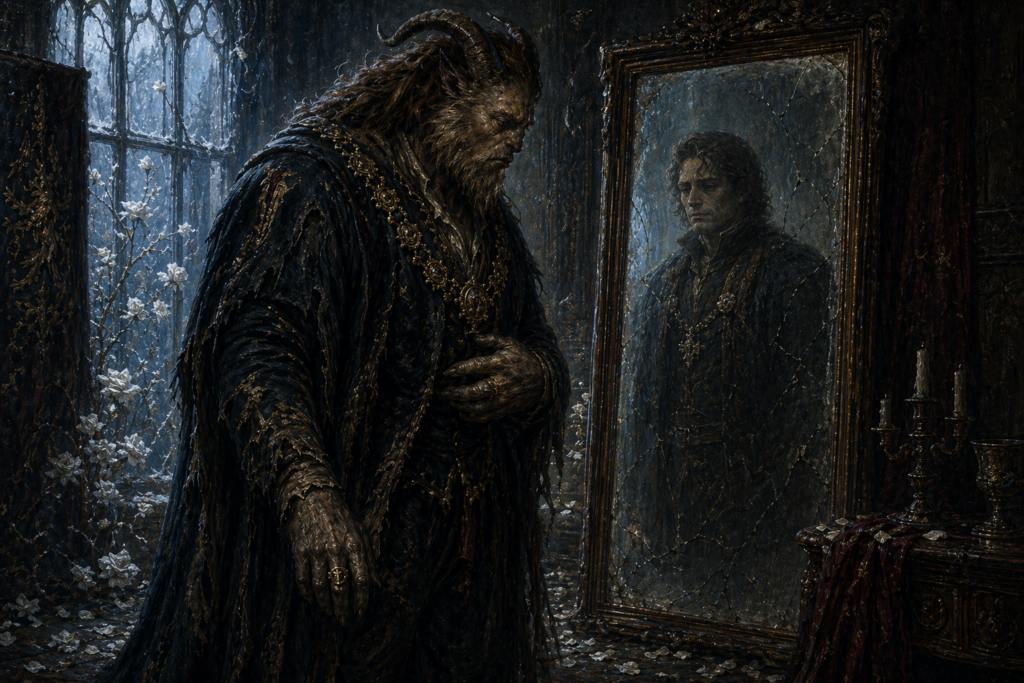
A cursed seigneur whose terrible shape reveals the pride that ruined him, the shame that haunts him, and the mercy he must learn before he can become human again.
Name: The Beast of the Winter Rose
Former Name: Sire Aurelian de Valombre
Aliases: The Beast, the Winter Rose Beast, the Horned Master, the Lord Behind the Frosted Glass, the Master of the Castle of the Winter Rose
Gender: Male
Race: Human, cursed into monstrous form
Creature Type: Unique cursed humanoid / monstrosity
Occupation: Former seigneur, imprisoned lord, dangerous host, guardian of the cursed castle
Religion: Local French household rites and old forest-threshold observances, now overshadowed by the fairy judgment bound to the Winter Rose
Allies: The enchanted household, though their loyalty is strained; the Hearth-Mother; the Iron Steward; the truth-bearing mirror of the East Gallery; Isabeau de Valfleur, if he earns her trust
Enemies: Cruel hunters, false rescuers, opportunistic nobles, rival claimants to Valombre, and any who exploit Isabeau or the castle’s enchantment
Inner Enemy: His pride, possessiveness, shame, and the hardening curse
Abode/Base of Operations: The Castle of the Winter Rose
Homeland: The vanished seigneurie of Valombre, a forested lordship in the Kingdom of France near the Champagne–Burgundy borderlands
Nationality: French
Languages: French, courtly Latin, Sylvan, and the old tongue of the forest
Alignment: Lawful Neutral, tending toward Neutral Good if redeemed or Neutral Evil if the curse hardens fully
Affiliations: The lost house of Valombre; the Castle of the Winter Rose; the enchanted household; the fairy judgment bound to the Winter Rose
Significant Relationship: Isabeau de Valfleur, if their bond develops through freedom rather than possession
Overview
The Beast of the Winter Rose was once Sire Aurelian de Valombre, last lord of a small forested seigneurie in the eastern marches of France. Admired for beauty, rank, and courtly grace, he learned early to mistake obedience for love and refinement for mercy.
His curse did not create a monster from nothing. It revealed one. When Aurelian violated the ancient duties of hospitality, the old powers of the winter wood gave his inward failure a body. He woke horned, furred, clawed, and terrible, yet not freed from memory. The man remained inside the beast-form, conscious of every flinch, whisper, and altered reflection.
That memory makes him dangerous. The Beast is strong enough to tear apart armed men, but he is not mindless. He is educated, perceptive, ashamed, proud, and capable of sudden courtly gentleness. He can host guests with formal grace one hour and shake the castle with rage the next.
He is pitiable, but not innocent. His loneliness is real, and so is the harm that made the curse necessary. He wants mercy, but often approaches it as a debt owed to him. He wants love, but must learn that love cannot be demanded, frightened, purchased, or locked inside a castle.
In a campaign, the Beast should never be only a combat encounter. He is a host, prisoner, patron, threat, moral test, and possible tragedy. The party may defeat him, redeem him, expose him, bargain with him, or watch him fail. The best version of the tale leaves room for more than one just answer.
Appearance
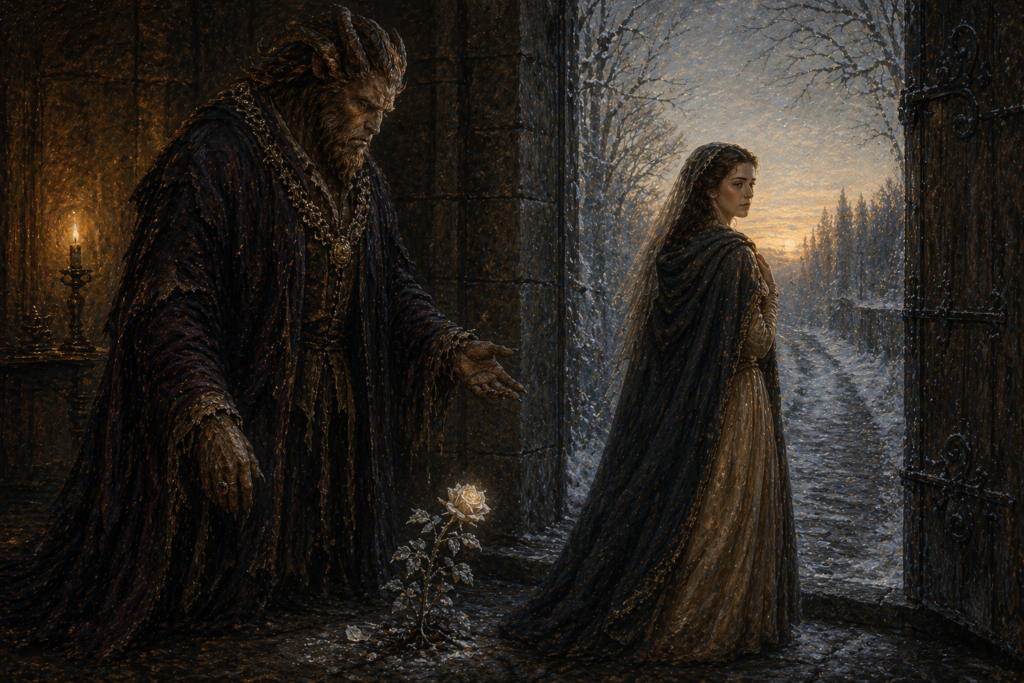
The Beast stands larger than any ordinary man, broad through the shoulders and heavy with the strength of a forest predator. Dark fur covers his arms, back, chest, and neck, thickening beneath the jaw. His hands remain almost human in shape, but end in black claws capable of scoring oak and stone.
Curved horns sweep back from his brow. His mouth is fanged, his jaw powerful, and his breath carries the cold scent of winter leaves and old smoke. Yet his eyes remain human: intelligent, wounded, watchful, and more disturbing than his monstrous features because they understand exactly what others see.
He still wears the remains of noble dress: torn velvet, stained linen, a ruined doublet, a tarnished chain of office, and a cracked signet ring forced onto one clawed finger. These details do not make him less monstrous. They make the curse harder to dismiss. He is not a beast pretending to be a lord; he is a lord made unable to hide the beast within him.
His movements are controlled until shame, insult, or fear brings the animal strength forward in a single violent motion.
First Impression at the Table
The Beast should be heard before he is seen.
A slow tread crosses an upper gallery. Claws touch stone. Somewhere in the hall, a lock turns without a hand upon it. Candles gutter. The enchanted household falls silent. A smell of frost, roses, and banked hearth-smoke enters the room before he does.
When he appears, he does not rush. He descends or emerges with deliberate restraint, allowing the party to understand his size, strength, and command of the place. The castle seems to notice him. Doors lean inward. Curtains stir. Mirrors cloud at their edges.
He speaks before he attacks, unless the party has already broken hospitality. His voice is low, rough, and formal, carrying the remains of education through the throat of the curse. The first encounter should leave players uncertain whether they have met a monster, a lord, a prisoner, or all three.
Personality and Temperament
The Beast is courteous, but easily insulted; lonely, but suspicious of kindness; generous to guests, but terrifying when mocked. Shame rules much of his temper. Pity wounds him almost as much as contempt, because fear leaves him in control and gentleness asks him to admit need.
He is protective, especially toward the household, Isabeau, and guests who genuinely come under his care. Yet that protectiveness can become possession if unchecked. He must constantly learn the difference between guarding and owning.
At his best, the Beast is brave, intelligent, perceptive, and capable of profound loyalty. At his worst, he is proud, volatile, possessive, and quick to use fear when words fail. His redemption should not feel like sudden softness, but like difficult choices made against his worst instincts.
Voice and Manner
The Beast speaks as a nobleman whose body has made every word harder to shape. His voice is deep and rough, but his phrasing remains formal. He chooses words carefully, especially when ashamed. He is most dangerous when he becomes quiet.
With guests, he observes hospitality almost obsessively. Food, fire, shelter, and courtesy are offered with grave precision. Guests who steal, insult the household, threaten Isabeau, or treat the castle as plunder may discover how quickly courtesy becomes judgment.
With servants, he is complicated. He depends on them, resents their pity, and fears their hatred. His progress can often be measured by how he speaks to those bound to serve him.
With Isabeau, he is careful, uncertain, and most vulnerable to failure. He may try to be gentle and still speak as if gentleness deserves reward. His most important scenes with her are not when he speaks beautifully, but when he accepts an answer he does not want.
Dialogue Cues
- “You stand beneath my roof. Remember what that means before you test my patience.”
- “Do not call me unfortunate unless you are prepared to name what I did.”
- “The rose was not a flower. It was the one thing in this house still keeping count.”
- “I can protect you. I am learning that this does not mean I may keep you.”
- “I was not made a beast because I was unloved. I was made a beast because I was unmerciful.”
The Curse in Him
The curse lives in the Beast as more than shape. His body is the visible part, but the deeper enchantment responds to choice. When he acts from pride, possession, cruelty, or self-pity, the castle grows colder and the Winter Rose darkens. When he shows mercy without reward, tells the truth without excuse, or releases what he has the power to keep, the curse loosens.
His monstrous form is a continuing revelation. The horns, claws, fangs, and fur show what he once hid behind beauty and rank. Every reflective surface in the castle refuses to flatter him.
The curse especially resists possession disguised as love. If the Beast tries to keep Isabeau through fear, debt, guilt, or enchantment, the Winter Rose withers. If he lets her leave freely, even when losing her may doom him, the rose brightens. This is the heart of his trial: he must become capable of love without ownership.
Relationship with Isabeau
Isabeau de Valfleur is not the Beast’s cure, prize, ransom, or reward. She is the person whose presence makes the truth impossible to avoid.
The Beast may love her, but love is not enough if he uses it as another form of claim. He may fear losing her, but that fear cannot justify keeping her. He may be kinder with her than with anyone else, but kindness that demands payment is still part of the curse.
Their relationship may become love, friendship, forgiveness, rejection, grief, or tragedy. The decisive test is not whether Isabeau can see the man inside the Beast. It is whether the Beast can honour the freedom of the woman who sees him.
How to Use the Beast at the Table
As a social encounter, the Beast should be formal, intimidating, watchful, and emotionally volatile.
As a patron, he can offer sanctuary, treasure, fairy knowledge, hidden roads, protection from the winter wood, or access to the secrets of Valombre.
As an antagonist, he may enforce a cruel bargain, imprison a guest, threaten a village, conceal the household’s suffering, or mistake protection for possession.
As a boss monster, he should fight as lord of a cursed house, using doors, mirrors, servants, shadows, frost, rose-briars, and sudden physical power.
As a mystery figure, he can be understood through contradictions: a monster who keeps hospitality, a captor who protects, a guilty man who suffers, and a cursed lord who may be guarding something worse than himself.
As a redemption arc, his most important action should be release. He must choose mercy when command would be easier.
As a failed-redemption horror figure, he becomes the final form of noble appetite: a lord who has mistaken his suffering for virtue and turned the castle from a place of judgment into a place of consumption.
The Beast of the Winter Rose
Large Monstrosity, Lawful Neutral
Armor Class 17
Hit Points 184
Speed 40 ft., climb 20 ft.
| STR | DEX | CON | INT | WIS | CHA |
|---|---|---|---|---|---|
| 22 (+6) | 13 (+1) | 20 (+5) | 15 (+2) | 16 (+3) | 16 (+3) |
Saving Throws Str +10, Con +9, Wis +7, Cha +7
Skills Athletics +10, Insight +7, Intimidation +7, Perception +7, Persuasion +7
Damage Resistances Bludgeoning, Piercing, and Slashing from nonmagical attacks
Condition Immunities Charmed, Frightened
Senses Darkvision 60 ft., passive Perception 17
Languages French, courtly Latin, Sylvan
Challenge 10 (5,900 XP)
Traits
Cursed Noble. The Beast counts as both a Humanoid and a Monstrosity for spells and magical effects. Effects that reveal a creature’s true form show a human lord overlaid with a horned beast.
Keen Smell. The Beast has advantage on Wisdom (Perception) checks that rely on smell.
Master of the Castle. While inside the Castle of the Winter Rose, the Beast has advantage on initiative rolls and Wisdom (Perception) checks. He also has advantage on saving throws against effects that would banish him, teleport him, turn him, or magically move him out of the castle. He cannot become lost inside his own castle, even when its rooms shift or its corridors rearrange.
Wounded Majesty. The first time the Beast is reduced to half his hit points or fewer, each hostile creature within 30 feet that can see him must succeed on a DC 16 Wisdom saving throw or have disadvantage on its next attack roll against him. A creature that cannot be Frightened is immune to this effect.
Mercy Can Break the Curse. If the Beast willingly releases a creature he wishes to keep, confesses a true wrong without excuse, protects someone without claiming them, or accepts Isabeau de Valfleur’s refusal without punishment, the curse weakens. At the DM’s discretion, this may suppress one lair action for 24 hours, remove the Beast’s damage resistance until the next dawn, open a sealed room, restore part of the enchanted household, or brighten one petal of the Winter Rose.
Actions
Multiattack. The Beast makes two attacks, choosing from Claw and Bite.
Claw. Melee Weapon Attack: +10 to hit, reach 5 ft., one target. Hit: 17 (2d10 + 6) Slashing damage.
Bite. Melee Weapon Attack: +10 to hit, reach 5 ft., one target. Hit: 19 (3d8 + 6) Piercing damage.
Roar of the Winter Hall, Recharge 5–6. The Beast releases a roar that shakes doors, candles, glass, and bone. Each creature of his choice within 60 feet that can hear him must make a DC 16 Wisdom saving throw. On a failed save, a creature is Frightened for 1 minute. A Frightened creature repeats the save at the end of each of its turns, ending the effect on itself on a success. On a successful save, a creature is immune to this Roar for 24 hours.
Bonus Actions
Furious Bound, Recharge 4–6. The Beast moves up to 20 feet without provoking Opportunity Attacks. If he ends this movement within 5 feet of a creature, he can make one Claw attack.
Scent of the Intruder. The Beast marks one creature he can smell or see within 60 feet. Until the end of his next turn, he knows the direction of that creature while it remains within the castle, unless magic prevents scent or divination from finding it.
Reactions
Interpose the Curse. When a creature the Beast can see within 10 feet of him is hit by an attack, the Beast can move up to 10 feet without provoking Opportunity Attacks and become the target of the attack instead, provided he is able to move and ends this movement adjacent to the protected creature. He usually uses this reaction to protect Isabeau, a guest under his hospitality, or a member of the enchanted household.
Legendary Actions
The Beast can take 3 Legendary Actions, choosing from the options below. Only one Legendary Action may be used at a time and only at the end of another creature’s turn. He regains spent Legendary Actions at the start of his turn.
Claw. The Beast makes one Claw attack.
Move. The Beast moves up to half his speed without provoking Opportunity Attacks.
Command the Household. An enchanted object, door, curtain, suit of armor, chair, chain, or candelabrum within 60 feet interferes with one creature the Beast can see. The target must succeed on a DC 16 Dexterity saving throw or have its speed reduced to 0 until the end of its next turn.
Roaring Rebuke, Costs 2 Actions. One creature within 30 feet that damaged the Beast since the end of his last turn must succeed on a DC 16 Wisdom saving throw or be pushed up to 15 feet away and knocked Prone.
Lair Actions
When fighting inside the Castle of the Winter Rose, the Beast can invoke the castle’s curse. On initiative count 20, losing initiative ties, he may use one of the following lair actions. He cannot use the same lair action two rounds in a row.
Doors Remember Their Master. Doors slam, locks turn, or corridors shift. Up to three creatures the Beast can see within 60 feet must succeed on a DC 16 Strength saving throw or be pushed 10 feet and Restrained by furniture, doors, curtains, or ironwork until initiative count 20 on the next round.
The Mirrors Accuse. A mirror, polished shield, window, or darkened pane reveals a creature’s shame. One creature within 60 feet that can see its reflection must make a DC 16 Wisdom saving throw. On a failure, it is Frightened of the Beast until the end of its next turn. On a success, it glimpses the sorrow beneath the curse and has advantage on its next Charisma check made to influence the Beast.
Thorns Beneath the Stone. White rose-briars burst through cracks in the floor. A 20-foot-radius area within 90 feet becomes difficult terrain until initiative count 20 on the next round. A creature that enters the area for the first time on a turn or starts its turn there takes 7 (2d6) Piercing damage.
The Household Intervenes. Enchanted servants distract, shield, or obstruct. Until initiative count 20 on the next round, the Beast gains half cover. Alternatively, one creature of his choice gains half cover if the Beast is protecting rather than attacking.
Treasure and Possessions
The Beast carries no weapon. His treasure is bound to the castle, the lost house of Valombre, and the fairy judgment that holds him.
Appropriate treasure includes:
- a cracked Valombre signet ring worth 250 gp
- a tarnished chain of office worth 500 gp
- ruined noble garments with salvageable gold thread worth 150 gp if carefully repaired
- a silver-framed truth mirror worth 2,500 gp, though removing it may anger the castle
- old noble plate, coin, and jewels worth 4,000–8,000 gp total
- a fairy key capable of opening one magically sealed door, chest, or gate once per month
- the Winter Rose, a unique story object that should not be treated as ordinary treasure
The greatest treasure is access. The Castle of the Winter Rose can serve as sanctuary, prison, court, dungeon, or gateway into the older powers of the forest.
Running the Beast in Combat
The Beast should speak before fighting unless the party has already broken hospitality, harmed Isabeau, attacked the household, or treated the castle as plunder. He fights first as a lord defending his house, not as an animal looking for prey.
If protecting Isabeau, a guest, or a servant, he uses Interpose the Curse, Command the Household, and movement to control the battlefield. If enraged or betrayed, he uses Furious Bound, Roar of the Winter Hall, and direct attacks to break morale quickly.
Inside the castle, he should use doors, mirrors, furniture, servants, and briars to divide the party and force choices. He should not simply charge and trade attacks until he falls.
Mercy can matter during the fight. If the Beast chooses to release a captive, protect someone without claiming them, accept Isabeau’s refusal, or stop himself from killing an already-defeated foe, the DM may suppress a lair action, brighten the Winter Rose, or otherwise show the curse weakening.
Isabeau’s presence should alter his decisions. She may not control him, but she can make his worst instincts visible. A battle with the Beast is most powerful when it is also a test of what he becomes under pressure.
Balance and Role Note
The Beast is a CR 10 unique monster outside the Castle of the Winter Rose. Inside the castle, treat the encounter as one difficulty step higher, because his lair actions, legendary actions, battlefield control, and command of the household make him function more like a true lair boss.
His raw damage is dangerous but not overwhelming for his CR. His true strength comes from battlefield control, fear, protection, environmental pressure, and the castle’s moral logic. He should not be used as a random encounter. He is a story-bearing creature whose combat should reflect hospitality, shame, possession, mercy, and release.
Isabeau de Valfleur — Pathfinder 1e Stat Block
Isabeau de Valfleur
CR 4
XP 1,200
Female human heroic NPC
NG Medium humanoid
Init +2; Senses Perception +12
Defense
AC 16, touch 12, flat-footed 14
(+2 Dex, +3 armor, +1 deflection)
hp 42 (6d8+18)
Fort +4, Ref +5, Will +9
Defensive Abilities clear before the curse, the courage to leave, unbought heart
Offense
Speed 30 ft.
Melee masterwork dagger +7 (1d4/19–20)
Ranged dagger +6 (1d4/19–20)
Special Attacks moral witness, name the wound
Statistics
Str 10, Dex 14, Con 14, Int 16, Wis 18, Cha 17
Base Atk +4; CMB +4; CMD 16
Feats Alertness, Iron Will, Persuasive, Skill Focus (Sense Motive)
Skills Diplomacy +14, Knowledge (history) +12, Knowledge (local) +12, Knowledge (nobility) +12, Knowledge (religion) +10, Linguistics +8, Perception +12, Sense Motive +18, Survival +9
Languages French, courtly Latin, local trade dialects, Sylvan
SQ reader of old tales
Gear masterwork dagger, masterwork studded leather worn beneath travelling clothes, fine but practical travelling clothes, hooded cloak, lantern, flint and steel, book of tales or household accounts, family keepsake, purse with 2d10 gp and trade tokens, minor charm of resistance +1
Special Abilities
Unbought Heart (Ex): Isabeau gains a +4 bonus on saving throws against charm and fear effects, and against curses or enchantments that would force affection, forgiveness, marriage, loyalty, willing captivity, or obedience to a possessive bargain.
Clear-Sighted Compassion (Ex): Isabeau gains a +4 bonus on Sense Motive checks made to discern grief, shame, fear, remorse, possessiveness, concealed cruelty, or false courtesy. This bonus is included in her statistics when such matters are relevant.
Reader of Old Tales (Ex): Isabeau gains a +4 bonus on Knowledge checks related to curses, fairy bargains, enchanted castles, hospitality taboos, old noble houses, and folklore trials.
Moral Witness (Ex): As an immediate action, Isabeau may aid a creature within 30 feet that she can see and hear when that creature attempts a Diplomacy check to confess, apologise, bargain honestly, plead truthfully, or reveal an emotionally difficult truth. The creature gains a +2 bonus on the check. Isabeau cannot use this ability to aid Bluff checks.
Name the Wound (Su): As a standard action, Isabeau may speak a hard truth to one creature within 30 feet that can hear and understand her. If the creature is hiding shame, grief, fear, remorse, or possessive desire, it must succeed at a DC 16 Will save or take a –2 penalty on attack rolls until the end of its next turn. If the target is the Beast of the Winter Rose, he instead takes this penalty only on attacks against creatures that have not harmed him since the start of his last turn. This is a mind-affecting emotion effect. The save DC is Charisma-based.
Clear Before the Curse (Su) 1/day: When Isabeau fails a saving throw against a curse, enchantment, illusion, fear effect, or magical coercion, she may choose to succeed instead. When she does, one ally within 30 feet who can see or hear her gains a +4 morale bonus on its next saving throw against the same effect before the end of its next turn.
The Courage to Leave (Ex): Isabeau gains a +4 bonus on Escape Artist checks, opposed checks, and saving throws made to escape restraint, resist imprisonment, leave an enchanted location, or overcome magical hospitality that attempts to keep her in a place against her will.
Role Note
Isabeau is a CR 4 legendary mortal heroine, not a front-line combatant. Her challenge rating reflects social force, resilience, curse-resistance, and her ability to alter scenes of fear, enchantment, shame, and moral pressure. She is most useful in negotiation, investigation, castle exploration, and confrontations where the Beast or the party must decide whether mercy, possession, duty, or fear is driving their choices.
The Beast of the Winter Rose — Pathfinder 1e Stat Block
The Beast of the Winter Rose
CR 10
XP 9,600
Male unique cursed human monstrosity
LN Large monstrous humanoid
Init +5; Senses darkvision 60 ft., scent; Perception +18
Defense
AC 25, touch 10, flat-footed 24
(+1 Dex, +15 natural, –1 size)
hp 147 (14d10+70)
Fort +9, Ref +10, Will +13
Defensive Abilities cursed noble, wounded majesty; DR 10/cold iron; Immune fear; Resist cold 10
Offense
Speed 40 ft., climb 20 ft.
Melee bite +22 (2d8+9), 2 claws +22 (2d6+9)
Melee with Power Attack bite +18 (2d8+21), 2 claws +18 (2d6+21)
Space 10 ft.; Reach 10 ft.
Special Attacks furious bound, interpose the curse, roar of the winter hall
Statistics
Str 28, Dex 13, Con 20, Int 15, Wis 16, Cha 16
Base Atk +14; CMB +24; CMD 35
Feats Alertness, Combat Reflexes, Improved Initiative, Iron Will, Power Attack, Skill Focus (Intimidate), Vital Strike
Skills Climb +25, Diplomacy +12, Intimidate +23, Knowledge (nobility) +13, Perception +18, Sense Motive +18, Stealth +10
Languages French, courtly Latin, Sylvan
SQ master of the castle, mercy can break the curse
Special Abilities
Cursed Noble (Su): The Beast counts as both a humanoid and a monstrous humanoid for effects that depend on creature type, whichever is less beneficial to him. Divination effects that reveal true forms show a human lord overlaid with his horned beast-shape.
Master of the Castle (Su): While inside the Castle of the Winter Rose, the Beast gains a +2 bonus on initiative checks, Perception checks, and saving throws against effects that would teleport, banish, turn, or magically move him out of the castle. He cannot become lost inside the castle, even when its halls shift. Inside the castle, the GM may also allow doors, mirrors, furniture, rose-briars, and enchanted household spirits to act as hazards or environmental effects appropriate to the scene.
Roar of the Winter Hall (Su): Once every 1d4 rounds, the Beast may release a terrible roar as a standard action. Creatures of his choice within 60 feet that can hear him must succeed at a DC 20 Will save or become shaken for 1 minute. A creature that fails by 5 or more is frightened for 1 round, then shaken for the remaining duration. This is a sonic, mind-affecting fear effect. The save DC is Charisma-based.
Furious Bound (Ex): As a swift action once every 1d4 rounds, the Beast may move up to 20 feet without provoking attacks of opportunity. If he ends this movement adjacent to a creature, he may make one claw attack against that creature.
Interpose the Curse (Ex): Once per round as an immediate action, when Isabeau de Valfleur, a guest under the Beast’s hospitality, or a member of the enchanted household within 10 feet would be hit by an attack, the Beast may move up to 10 feet without provoking attacks of opportunity and become the target of the attack instead, provided he ends this movement adjacent to the protected creature and is able to move.
Wounded Majesty (Su): The first time the Beast is reduced to half his hit points or fewer, each hostile creature within 30 feet that can see him must succeed at a DC 20 Will save or take a –2 penalty on attack rolls against him for 1 round. Creatures immune to fear are immune to this effect. The save DC is Charisma-based.
Mercy Can Break the Curse (Su): If the Beast willingly releases a creature he wishes to keep, confesses a true wrong without excuse, protects someone without claiming them, or accepts Isabeau’s refusal without punishment, the curse weakens. At the GM’s discretion, this may suppress one castle hazard or lair-like effect for 24 hours, remove the Beast’s damage reduction until the next dawn, open a sealed room, restore part of the enchanted household, or brighten one petal of the Winter Rose.
Ecology
Environment any forested castle or enchanted noble estate
Organization unique
Treasure see possessions
Possessions
The Beast carries no weapon. His treasure is bound to the Castle of the Winter Rose and the lost house of Valombre: a cracked signet ring worth 250 gp, a tarnished chain of office worth 500 gp, ruined noble garments with recoverable gold thread worth 150 gp, old plate and coin worth 4,000–8,000 gp, a silver-framed truth mirror worth 2,500 gp, and a fairy key able to open one magically sealed door, chest, or gate once per month. The Winter Rose itself is a unique story object and should not be treated as ordinary treasure.
Role Note
The Beast is a CR 10 unique monster outside the Castle of the Winter Rose. Inside the castle, he should function as one difficulty step higher because of shifting halls, enchanted household aid, mirror judgments, rose-briar hazards, and the moral pressure of the curse. He should speak before fighting unless hospitality has already been broken. In combat, he is most effective when protecting Isabeau or the household, controlling movement, frightening enemies, and using the castle rather than trading attacks mindlessly.
Shared Adventure Hooks and Consequences

These hooks are designed for Beauty and the Beast: The Winter Rose Tale, with Isabeau de Valfleur and the Beast of the Winter Rose both active in the story. Use them to create pressure around justice, mercy, freedom, and the cost of redemption.
Adventure Hooks
The Merchant’s Promise
Isabeau’s father returns from the winter wood pale, shaken, and carrying a white rose that never wilts. He claims the Beast spared his life only after he promised that Isabeau would come to the Castle of the Winter Rose in his place.
The party may be asked to escort Isabeau, protect her from the bargain, confront the Beast, or prove whether the merchant’s theft truly justifies the demand. The complication is that Isabeau insists on choosing her own course.
The Rose That Calls Her Name
The Winter Rose begins appearing in Isabeau’s dreams: pale petals on black stone, a locked door, a horned shadow, and a voice asking whether mercy can be owed. Each morning, frost gathers on her window. Then one petal appears on her pillow, untouched by any hand.
Isabeau asks the party to help her find Valombre. The Beast may not know she is coming, and the castle may be calling her for reasons of its own.
The Hunter at the Gate
A celebrated noble hunter arrives with retainers, hounds, and a public vow to slay the Beast and “free” Isabeau. He is handsome, brave, admired, and utterly certain of his own virtue.
The party must decide whether to aid him, restrain him, expose his vanity, or prevent the Beast from confirming every terrible rumour by killing him in rage.
The Household Begs for Help
One of the enchanted household spirits reaches the party beyond the castle walls. The servants believe the Winter Rose is nearing its final turn. Some want Isabeau brought safely to the castle; others want her kept away.
The party must enter Valombre, learn which servants can be trusted, and decide whether the household is trying to save the Beast, Isabeau, itself, or something buried beneath the castle.
The False Beauty
A rival noble house sends a false “Beauty” to Valombre, hoping to manipulate the Beast, claim the vanished lordship, or seize the castle’s treasure. The impostor may be trained in courtly deception and supported by lawyers, mercenaries, priests, or fairy-bargain specialists.
The party must uncover the fraud before the Beast’s hope is turned into another weapon against him.
The Mirror Shows the Party
The Mirror in the East Gallery begins showing the party’s own failures: moments when they used power without mercy, called possession protection, or accepted obedience as loyalty.
The castle is no longer testing only the Beast. The party must decide whether to dismiss the visions, learn from them, or risk being judged by the same magic that condemned Aurelian.
The Final Petal Falls Tonight
Only one pale petal remains on the Winter Rose. If it falls before dawn, Aurelian de Valombre is lost, the household remains bound, and Valombre’s roads vanish from the world.
The party has one night to bring about the final act the curse requires: confession, release, refusal, forgiveness, sacrifice, or death.
The Beast Releases Her
The Beast has done the one thing no one expected: he has opened the gate and allowed Isabeau to leave freely. The curse weakens, but the castle is now vulnerable.
Rival nobles, hunters, treasure-seekers, and forest powers move toward Valombre. Isabeau asks the party to help decide whether she should return, and what must happen if she does.
Consequences
If the Party Protects Isabeau’s Agency
Isabeau trusts the party with more of what she has seen: the Beast’s restraint, the household’s divisions, and the truth of the Winter Rose. Her choices become clearer, though not easier.
The curse responds to freedom. Doors open. Mirrors clear. A servant may regain a name, voice, memory, or hand. The Beast is forced to confront Isabeau’s will as something he cannot command.
If the Party Treats Isabeau as Property
If the party tries to return, trade, hide, deliver, or bargain with Isabeau as an object, they repeat the logic of the curse. The castle may answer with locked doors, clouded mirrors, sudden frost, and reflections of their own failures.
Isabeau’s trust suffers. The Beast may become more possessive, because the party has confirmed his worst belief: that everyone claims what they fear to lose.
If the Beast Lets Isabeau Leave
This is the central turning point. If the Beast releases Isabeau freely, without threat, guilt, bargain, or hidden condition, the Winter Rose brightens.
A sealed room may open. One member of the household may recover a name, voice, or human hand. The curse does not necessarily end, but the Beast has proven he can choose mercy over possession.
If Isabeau Returns Freely
If Isabeau returns after being allowed to leave, the castle recognises the difference between captivity and choice. The Winter Rose may bloom more fully, the mirrors may show gentler truths, and the Beast may lose one of his harsher lair effects.
Her return should create possibility, not ownership. Love, friendship, forgiveness, or unfinished duty may follow, but none of them should be assumed.
If Isabeau Refuses Him
If Isabeau refuses the Beast and he accepts her refusal, the curse weakens more deeply than if he merely receives affection. One household spirit may be restored, the gates may open, or the Winter Rose may cease withering for a year and a day.
If he rejects her refusal, the rose blackens at the stem, the castle grows colder, and the Beast moves closer to becoming the monster the old tales warned of.
If the Party Kills the Beast
Killing the Beast may end the immediate danger, but it does not necessarily heal Valombre. If he dies without repentance, the castle may remain cursed, the household may stay bound, and the Winter Rose may turn to black glass.
If he dies protecting Isabeau, releasing a captive, or confessing without excuse, part of the curse may break. The victory should feel solemn rather than triumphant.
If the Beast Is Redeemed
A redeemed Beast does not simply become handsome and innocent. He becomes accountable. If his human form returns, it should bear a mark of the curse: a scar where horns once grew, roughness in the voice, winter-white hair, or a rose-shaped mark above the heart.
The household is freed only if Aurelian accepts responsibility for what happened to them. Valombre may return to maps, but former servants, villagers, rivals, and Isabeau must still decide what place he deserves in the world.
If the Beast Fails
If the final petal falls while the Beast clings to possession, pride, or self-pity, Aurelian de Valombre is lost. The Beast remains, but no longer as a man trapped in monstrous shape.
The castle no longer tests guests; it consumes them. The household darkens. Isabeau may become the witness who escaped, the one person he still seeks, or the one name he can no longer understand.
If the Party Walks Away
If the party leaves Valombre unresolved, the tale continues. Roads disappear. Villagers vanish near the winter wood. Hunters enter the castle and do not return. Isabeau may be forced to act alone.
The Winter Rose does not punish the party for leaving, but unresolved curses keep growing.
External Links / Sources and Inspiration
These sources are useful for background on the Beauty and the Beast tale, animal bridegroom folklore, and older folktale structures behind the Winter Rose version.
- Beauty and the Beast — tale history and variants
A general background source for the French literary tale, older variants, and the wider Beauty and the Beast tradition. - D. L. Ashliman — Beauty and the Beast: Folktales of Type 425C
A useful comparison source for the merchant, rose, daughter, bargain, and enchanted spouse structure. - Animal as Bridegroom — ATU 425 Tradition
Background on the wider animal bridegroom and enchanted spouse folklore family that informs the Beast archetype.
Keep this reference growing
If this page helped with your reading or game, you can support its upkeep or explore the curated books.
Explore the Bookshop — epics, classics and stories behind imagined worlds.